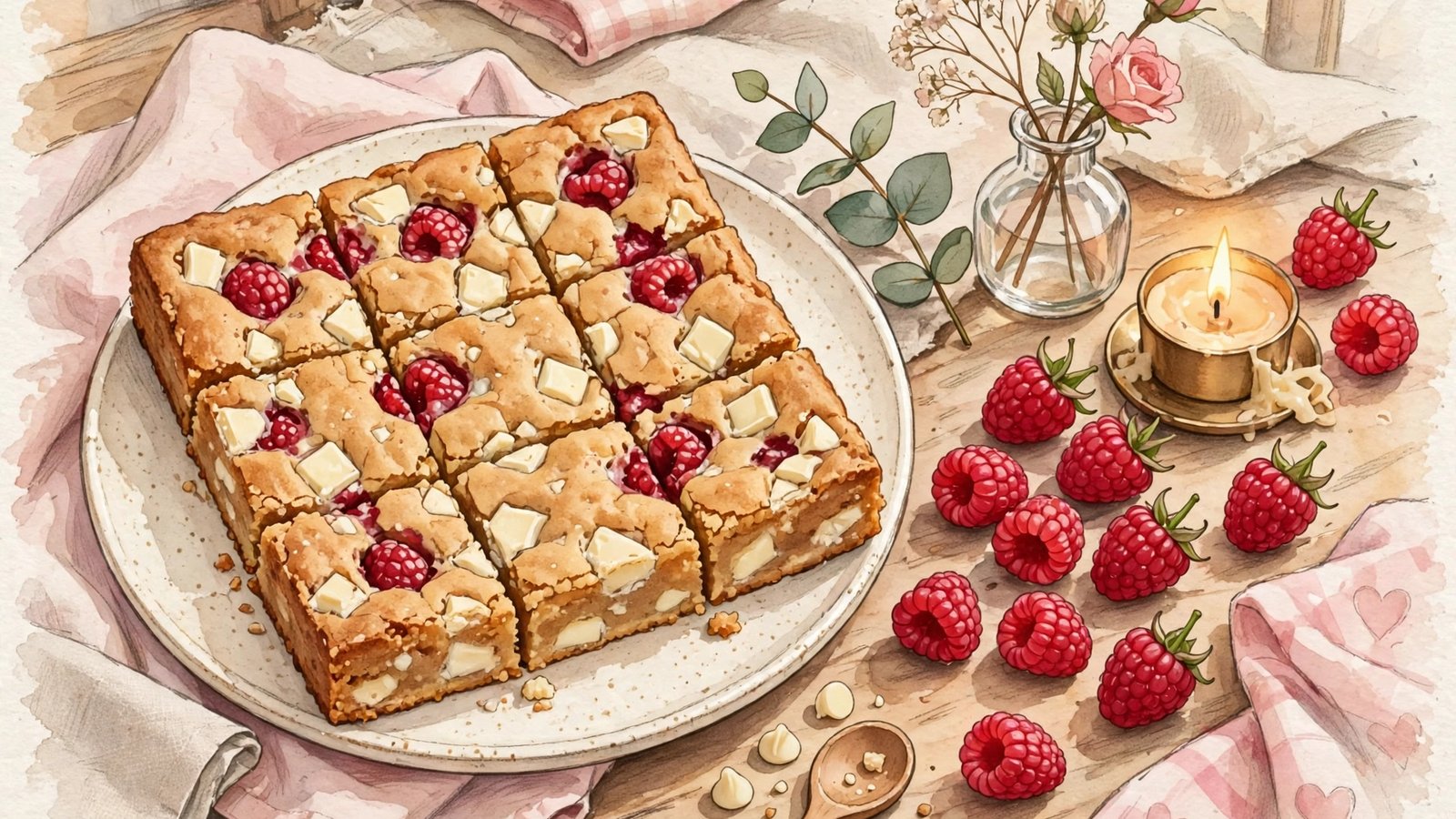
Short answer
- Melt 1/2 cup butter and whisk it with 1 cup packed light brown sugar and 1/4 cup granulated sugar. Whisk in 2 eggs and 2 teaspoons vanilla, fold in 1 1/2 cups flour, 1/2 teaspoon baking powder, and 1/2 teaspoon salt, then fold in 3/4 cup white chocolate chips and 1 1/4 cups raspberries. Spread the batter in a parchment-lined 8-inch square pan, scatter the remaining 1/4 cup white chocolate over the top, and bake at 350 degrees F for 28 to 34 minutes, until the edges are golden and set and the center is just set with moist crumbs on a toothpick, not wet batter and not a clean toothpick. Cool completely, at least 1 hour in the pan and then fully out of it, before cutting into 12 or 16 squares. Store airtight at room temperature for up to 3 days, refrigerate for longer keeping within the week, or freeze wrapped bars and thaw before serving.
Introduction
Blondies are the quieter cousin of brownies: no cocoa in the base, a buttery brown sugar batter, and a chewy, golden crumb that lets mix-ins shine. For Valentine’s Day, raspberries and white chocolate are a natural pairing. The berries bring tartness and a rosy color, the white chocolate brings sweetness and creaminess, and together they make a bar that looks festive without food coloring or elaborate decoration. Baked in a square pan, cut into neat squares, and shared from a plate or a small box, they are a Valentine’s gift that feels handmade in the best sense, because it is.
This recipe is written for a home baker, not a pastry kitchen. It uses one bowl for the batter, a standard 8-inch square pan, and ingredients from a regular grocery store. Fresh or frozen raspberries both work, with a small technique difference explained below. The bars serve 12 to 16 people, depending on how generously you cut them, which makes them suitable for a classroom treat box, a work share, or a quiet dessert for two with plenty left over.
Why Raspberries and White Chocolate Work Together
White chocolate is sweet and rich, and on its own it can taste one-note in a baked bar. Raspberries correct that. Their acidity cuts the sweetness, their juice creates rosy swirls, and their tartness keeps each bite from feeling heavy. A blondie that is only sweet gets tiring after one square, while a blondie with tart berries invites a second.
The numbers help explain the balance. According to USDA FoodData Central data for raw raspberries, 1 cup (123 grams) contains about 64 calories, about 14.7 grams of carbohydrate, about 5.4 grams of sugar, and about 8 grams of fiber, along with about 32.2 milligrams of vitamin C. In plain terms, raspberries bring far more tartness, water, and fiber than sugar, which is why a full cup and a quarter can stand up to a sweet batter without making the bar taste like jam. They are the acid and the structure break in every bite.
Texture matters too. White chocolate melts into creamy pockets as the bars bake, while raspberries soften and collapse slightly, leaving jammy spots. The base itself should be chewy rather than cakey, which comes from melted butter, a higher proportion of brown sugar to white sugar, and not overbaking. A blondie pulled out when the center still looks slightly soft will set into a chewy bar as it cools; one baked until firm throughout will be dry by the time it reaches the plate.
There is also a labeling point worth knowing before you shop. In the United States, white chocolate has to meet the FDA standard of identity in 21 CFR 163.124. The FDA compliance guide restates it as at least 20 percent cocoa butter, at least 14 percent total milk solids, at least 3.5 percent milkfat, and no more than 55 percent nutritive carbohydrate sweeteners. White chocolate gets its flavor and melt from cocoa butter, milk solids, and sweetener, with no cocoa solids. Reading the package name tells a cocoa butter product from a white confectionery coating made mainly with other fats. Both bake, but cocoa butter melts more smoothly and tastes creamier, which is what this recipe assumes.
What Each Ingredient Does
A blondie has few ingredients, so each one has a visible job.
| Ingredient | Amount | What it does in this recipe |
|---|---|---|
| Unsalted butter, melted | 1/2 cup (1 stick) | Fat and richness; melted rather than creamed, it helps produce a dense, chewy crumb instead of a cake-like one |
| Light brown sugar | 1 cup, packed | Main sweetener and source of blondie flavor; its molasses adds a caramel note and moisture that support chew |
| Granulated sugar | 1/4 cup | Sweetness, and helps the top set with a light sheen |
| Eggs | 2 large | Bind the batter and help the bars set; they are also why the center must bake through fully |
| Vanilla extract | 2 teaspoons | Rounds out the brown sugar and butter flavor |
| All-purpose flour | 1 1/2 cups | Structure; too much mixing after it is added can make the crumb tough |
| Baking powder | 1/2 teaspoon | A small amount of lift so the bars are tender rather than leaden |
| Kosher salt | 1/2 teaspoon | Balances sweetness and sharpens the berry and vanilla flavors |
| White chocolate chips or chopped white chocolate | 1 cup, divided | Melts into creamy, sweet pockets inside and a visible topping |
| Raspberries, fresh or frozen | 1 1/4 cups | Tartness, color, moisture, and jammy pockets against the sweet base |
| Lemon zest (optional) | 1 teaspoon | Adds brightness that makes the raspberry flavor read more clearly |
| Toppings (optional) | To taste | Melted white chocolate drizzle, freeze-dried raspberry powder, or powdered sugar, added just before serving |
King Arthur Baking describes the same base logic in its own blondies recipe: brown sugar adds a deeply caramelized flavor to chewy, rich bars, and melting the butter with the sugar gives the sugar a head start on dissolving. During baking, that dissolved sugar migrates to the surface and recrystallizes into a shiny top. That is why this recipe asks you to whisk the melted butter and sugars until smooth and slightly glossy rather than grainy: you are setting up the crust. Brown sugar also matters because its molasses holds moisture, and moisture in the crumb is a large part of what reads as chew after cooling. If you only have dark brown sugar, you can use it in place of light brown sugar; expect a deeper molasses flavor and a slightly darker crumb.
Ingredients
- 1/2 cup (1 stick) unsalted butter, melted and slightly cooled
- 1 cup packed light brown sugar
- 1/4 cup granulated sugar
- 2 large eggs, at room temperature
- 2 teaspoons vanilla extract
- 1 1/2 cups all-purpose flour
- 1/2 teaspoon baking powder
- 1/2 teaspoon kosher salt
- 1 cup white chocolate chips or chopped white chocolate, divided
- 1 1/4 cups fresh raspberries, rinsed gently and patted dry, or frozen raspberries used straight from the freezer
- Optional: 1 teaspoon lemon zest, for brightness
- Optional, for topping: extra white chocolate for drizzling, freeze-dried raspberry powder, or a dusting of powdered sugar
A note on allergens: this recipe contains wheat, milk, and egg as core ingredients. White chocolate contains milk and may contain soy lecithin, so check the label. The bars are not safe for guests with wheat, milk, or egg allergies, or with a soy allergy where the chocolate label declares soy, unless specifically adapted. The FDA lists nine major food allergens that must be declared on packaged food labels in the United States: milk, egg, fish, crustacean shellfish, tree nuts, peanuts, wheat, soybeans, and sesame, with sesame added as the ninth effective January 1, 2023. If you are baking for someone with allergies, read every label, including the chocolate and the flour.
Fresh Raspberries Versus Frozen Raspberries
Both work in this recipe, but they behave differently, and the handling starts before the berries reach the bowl.
Fresh raspberries are fragile and hold surface moisture, and that moisture is the enemy twice over: it encourages mold in storage, and it can waterlog a batter. Utah State University Extension advises not washing berries until close to the time you eat them because they tend to rot if held moist, and for raspberries it advises refrigerating them unwashed in a single layer between paper towels and using them within 3 days. When you are ready to bake, wash them gently under running water, do not soak them, and blot them dry with a paper towel. Pick out any moldy or damaged berries first, rinse just before baking, pat dry, and fold in last with a light hand. Dry berries distribute instead of sinking and bleeding, and they keep some shape in the finished squares.
Frozen raspberries solve the short fresh season and shelf life, but they must go into the batter still frozen. Do not thaw them first. A thawed raspberry has started to collapse and release juice, and that free juice thins the batter, streaks the pan, and can leave the center underbaked. Fold frozen berries in straight from the freezer, work quickly, and expect the baking time to run a few minutes longer because the batter starts colder. The result usually shows more swirl and softer, jammier pockets than the fresh version.
If you are freezing fresh raspberries yourself, Penn State Extension describes tray freezing: after the fruit has been washed and drained, place it one layer deep on a tray and freeze uncovered just until solid, about four to six hours, then package and seal quickly. Tray-frozen berries stay loose, so you can measure out 1 1/4 cups without thawing the rest. The same source notes that freezing does not kill most microorganisms but prevents their growth at 0 degrees F or lower, and that frozen fruit is best used within 8 to 12 months for quality.
One caution applies to both forms: do not add extra liquid, such as raspberry puree or juice, to the batter without adjusting the flour. Extra liquid can leave the center underbaked. Whole or lightly crushed berries give the flavor without upsetting that balance.
How to Make Raspberry White Chocolate Blondies
1. Prepare the pan and oven
Preheat the oven to 350 degrees F. Line an 8-inch square baking pan with parchment paper, leaving an overhang on two sides to lift the bars out later. Lightly grease any exposed sides. The parchment sling is worth the minute it takes: it lets you lift the whole slab out for clean cutting and is the simplest insurance against sticking.
2. Mix the batter
In a large bowl, whisk together the melted butter, brown sugar, and granulated sugar until smooth and slightly glossy. Add the eggs one at a time, whisking well after each, then stir in the vanilla and lemon zest if using. The mixture should look thick and smooth, not grainy. If the butter was very hot, let it cool slightly first so the eggs whisk in smoothly.
3. Add the dry ingredients
Sprinkle the flour, baking powder, and salt over the wet mixture and fold gently with a spatula until just combined, with no visible streaks of flour. Do not overmix. Overmixing develops gluten and turns a chewy blondie into a tough, cakey bar. A few small lumps are fine; they will disappear in baking.
4. Fold in the chocolate and berries
Fold in 3/4 cup of the white chocolate chips. Then add the raspberries and fold very gently, just enough to distribute them. Fresh raspberries break if stirred vigorously, which is not a disaster, because broken berries make pretty swirls, but a light hand keeps some whole. If using frozen raspberries, fold them in frozen and expect the baking time to run a few minutes longer.
5. Pan, top, and bake
Spread the batter evenly into the prepared pan. It will be thick; use a spatula to push it into the corners so the center and edges finish at the same time. Sprinkle the remaining 1/4 cup of white chocolate chips over the top, pressing them lightly in. Bake for 28 to 34 minutes, until the edges are golden and set and the center is just set with a slight wobble. Use the doneness tests in the next section rather than the clock alone, because ovens, pans, and frozen berries all shift the timing.
6. Cool completely before cutting
This step is the hardest to wait for and the most important for neat bars. Let the pan cool on a wire rack for at least 1 hour, then lift the slab out with the parchment and cool completely before cutting. Warm blondies cut into ragged pieces; fully cooled blondies cut cleanly. Use a sharp knife, wipe it clean between cuts, and cut into 12 or 16 squares. If you like, drizzle with melted white chocolate and sprinkle with freeze-dried raspberry powder or powdered sugar just before serving.
How to Tell When Blondies Are Done
Underbaked and overbaked are both easy mistakes, because the ideal finish sits in a narrow window between them. Use three checks together.
First, look at the edges and surface. The edges should be golden and set, and the top should look set rather than wet with raw batter. King Arthur Baking describes its blondies as done when the top crust is shiny but the middle is still gooey, though not liquid. That distinction, gooey but not liquid, is the heart of the test.
Second, gently shake the pan. The center should move only slightly, not slosh. If it still ripples like liquid, the bars need more time regardless of the clock.
Third, use the toothpick test. A toothpick in the center should come out with moist crumbs attached, not wet batter and not completely clean. King Arthur gives the same test: a few wet crumbs, but no raw batter showing. A completely clean toothpick means the bars are likely past the chewy point. Wet batter means return the pan to the oven and check again in 5-minute increments.
There is a food safety reason not to pull the pan too early. This batter contains eggs, and FoodSafety.gov lists egg dishes, such as frittata and quiche, at a safe minimum internal temperature of 160 degrees F (71 degrees C). A blondie is not a frittata, but the principle carries over: the center must be fully set, with no wet or liquid batter remaining. A set center with moist crumbs is the practical sign that the egg has cooked through while the crumb stayed moist. If you use a thermometer, probe the center and look for at least 160 degrees F, knowing that melted chocolate pockets can affect the reading.
Carryover matters too. The hot pan keeps cooking the edges, and the center finishes setting as the slab cools, which is why a slightly soft middle becomes a chewy bar rather than a raw one. Judge the final texture only after the full cooling time.
Storage, Freezing, and Thawing
Cool the bars completely before packing them. Warm bars sealed in a container trap steam and soften the crust.
For short keeping, store the cut bars in an airtight container at room temperature for up to 3 days, or refrigerate them for up to a week. Those windows are practical quality guidance for this specific bar, not a precise USDA figure for this recipe, and the berry pockets make these bars more perishable than a plain blondie. King Arthur Baking advises storing its plain blondies well wrapped at room temperature for up to a week and freezing for longer storage; the raspberries here are the reason for the shorter window.
For the general safety rules behind any storage decision, USDA Food Safety and Inspection Service guidance on leftovers is the reference point. It says bacteria grow rapidly between 40 degrees F and 140 degrees F, perishable food should be refrigerated within 2 hours (1 hour if over 90 degrees F), leftovers keep 3 to 4 days refrigerated or 3 to 4 months frozen, and frozen food stays safe indefinitely at 0 degrees F or below while quality declines. Bars topped with anything perishable, such as cream cheese frosting, stop being a counter food: refrigerate those within 2 hours.
For longer storage, wrap individual bars tightly and freeze them at 0 degrees F or below. Individual wrapping limits moisture loss and freezer burn and lets you thaw one serving at a time. For best quality, eat frozen bars within 2 to 3 months. Thaw a wrapped bar in the refrigerator or at room temperature, and eat it within a day of thawing.
Texture changes in storage are normal. Refrigerated bars firm up because butter firms when cold, so let one sit at room temperature briefly before serving. Thawed bars may show softer berry pockets, because freezing and thawing break down the delicate fruit. When in doubt about a stored bar, in particular one left out too long, one with an off smell, or one showing mold, throw it out rather than tasting to check.
Variations That Still Work
For a lemon-raspberry version, keep the lemon zest and add 1 teaspoon of lemon juice to the batter, reducing no other liquid. The small amount brightens the berries without thinning the batter.
For a darker, less sweet version, swap half the white chocolate for dark chocolate chips. The bars will taste deeper and less sweet, though the Valentine’s pink effect will be less pronounced.
For a nutty crunch, fold in 1/2 cup of chopped toasted pistachios or almonds, but only if nut allergies are not a concern at your table, since tree nuts are a major allergen and the specific nut must be named when you share the bars.
For a double batch, bake the doubled recipe in a 9-by-13-inch pan, increase the baking time to about 35 to 42 minutes, and rely on the toothpick and set tests rather than the clock. Do not bake a double batch in the same 8-inch pan; the center will stay wet long after the edges overbake.
For a gift-box version, cut the bars smaller, wrap pairs in parchment or wax paper, and place them in a small box or tin with a note. Blondies travel better than frosted cakes because they have no delicate topping to smudge. For a classroom or office share, label the box with the ingredients, especially wheat, milk, egg, and any soy declared on the chocolate label, and add the bake date, so recipients know the room-temperature window is already running.
A gluten-free swap needs caution. As written, these bars are not gluten-free. A gluten-free flour blend may work, but results vary by blend and this recipe has not been tested with one. If you bake that version, also check every other label, including the chocolate.
Troubleshooting
| Problem | Likely cause | Fix for next time |
|---|---|---|
| Bars are dry and crumbly | Overbaked, often by trusting the clock instead of the crumb test | Check 5 minutes earlier and take the pan out when the toothpick shows moist crumbs, not a clean toothpick |
| Center sinks after baking | Oven opened too early, batter overmixed, or center was still liquid | Keep the door closed until the edges set, fold the flour in gently, and give a sinking center the extra 5-minute increments it needs |
| Center is wet while edges are done | Extra liquid from thawed berries or puree, or a pan that is too small | Use frozen berries unthawed, skip added puree, and bake in the stated 8-inch pan or a 9-by-13-inch pan for a double batch |
| Raspberries all sank to the bottom | Berries were wet, or the batter was too thin | Pat fresh berries dry, fold them in last and gently, and avoid extra liquid in the batter |
| Bars stick to the pan | Parchment sling skipped, or ungreased pan sides | Line the pan with an overhang and grease exposed sides, then cool fully before lifting |
| White chocolate on top browned too dark | Topping chips exposed to direct heat for the full bake | Tent the pan loosely with foil for the last 10 minutes of baking |
| Crumb is tough or cakey | Flour was overmixed after being added | Fold only until no flour streaks remain; a few small lumps are fine |
One pattern runs through most of these fixes: blondies forgive small mixing errors, but not timing errors. Almost every disappointing batch traces back to a pan that stayed in too long, came out with a liquid center, or was cut before it had cooled.
Serving and Sharing
Serve at room temperature, where the butter and white chocolate taste creamy. Add any powder dusting at the last moment, because it absorbs moisture and fades if it sits. If you are sharing beyond your household, write the ingredient list, the allergens, and the bake date on the box or a card inside it.
Frequently Asked Questions
Fresh or frozen raspberries: which should I use?
Both work. Fresh berries, rinsed gently just before baking and patted dry, give cleaner pieces and more intact fruit. Frozen berries, used unthawed, give more swirl and a slightly longer bake. Do not thaw frozen berries first, or they will release too much juice and can leave the center wet. Utah State University Extension gives the fresh rule: do not wash raspberries until close to use, wash gently under running water without soaking, and blot dry.
How do I know when blondies are done?
Use three checks together. The edges should be golden and set, the center should be just set with only a slight wobble when the pan is gently shaken, and a toothpick in the center should come out with moist crumbs, not wet batter and not completely clean. King Arthur Baking uses the same standard for its blondies: a shiny top, a middle that is gooey but not liquid, and a few wet crumbs with no raw batter. Start checking a few minutes before the 28 to 34 minute window ends.
How long do the bars keep, and can I freeze them?
Up to 3 days at room temperature in an airtight container, or up to a week refrigerated, as practical quality guidance for this berry version rather than a precise USDA figure for this recipe. For longer storage, wrap bars individually and freeze at 0 degrees F or below; for best quality, eat them within 2 to 3 months. USDA leftover guidance gives the general background: refrigerate perishable food within 2 hours, and frozen food remains safe indefinitely at 0 degrees F while quality declines.
Can I double the recipe?
Yes, in a 9-by-13-inch pan. Increase the baking time to about 35 to 42 minutes and check with the toothpick and set tests, because a larger pan bakes differently. Do not double the batter in the original 8-inch pan, or the center will stay wet after the edges are overdone.
Are these blondies gluten-free, and what allergens do they contain?
No. As written they use all-purpose wheat flour, and a gluten-free blend has not been tested with this recipe. The core allergens are wheat, milk, and egg. White chocolate contains milk and may contain soy lecithin, so check its label. The FDA list of nine major food allergens is milk, egg, fish, crustacean shellfish, tree nuts, peanuts, wheat, soybeans, and sesame. If you add pistachios or almonds, name the specific nut when you share the bars.
Why did my raspberries sink or my center stay wet?
Wet berries and extra liquid are the usual causes. Patting fresh berries dry, using frozen berries unthawed, folding the fruit in last and gently, and adding no puree or extra juice all help. If the center is still liquid at the end of the stated time, bake in further 5-minute increments until it is just set, because the egg batter must cook through fully.
Can I use white baking chips that are not real white chocolate?
You can, but check the package name and ingredient list. Under the FDA standard restated in its compliance guide, white chocolate contains at least 20 percent cocoa butter, at least 14 percent total milk solids, at least 3.5 percent milkfat, and no more than 55 percent sweeteners. A product that does not meet that standard is sold under a different name, such as a white confectionery coating, and may taste sweeter and melt less smoothly, so the pockets in the bars may be firmer and less creamy.
Sources & references
- US FDA, Small Entity Compliance Guide: Standard of Identity for White Chocolate. Used for the standard of identity in 21 CFR 163.124 restated in plain language: white chocolate contains a minimum of 20 percent cocoa butter, a minimum of 14 percent total milk solids, a minimum of 3.5 percent milkfat, and a maximum of 55 percent nutritive carbohydrate sweeteners, and for the label bearing the name white chocolate or white chocolate coating.
- US FDA, Food Allergies: What You Need to Know. Used for the nine major food allergens (milk, egg, fish, crustacean shellfish, tree nuts, peanuts, wheat, soybeans, and sesame), sesame becoming the ninth major allergen with the change effective January 1, 2023, and the two ways a major allergen food source name is declared on a label, in parentheses after the ingredient or in a Contains statement.
- FoodSafety.gov, Cook to a Safe Minimum Internal Temperature. Used for egg dishes (such as frittata and quiche) at a safe minimum internal temperature of 160 degrees F (71 degrees C), raw eggs cooked until the yolk and white are firm, and leftovers at 165 degrees F (74 degrees C).
- USDA Food Safety and Inspection Service, Leftovers and Food Safety. Used for bacteria growing rapidly between 40 degrees F and 140 degrees F, refrigerating leftovers within 2 hours (1 hour if the temperature is over 90 degrees F), leftovers kept in the refrigerator for 3 to 4 days or frozen for 3 to 4 months, and frozen food remaining safe indefinitely while quality declines.
- USDA FoodData Central, Raspberries, raw (SR Legacy data). Used for the nutrient values for 1 cup (123 grams) of raw raspberries: about 64 calories, about 14.7 grams carbohydrate, about 5.4 grams sugar, about 8 grams fiber, and about 32.2 milligrams vitamin C. Values were read on 30 October 2026 from USDA-sourced copies of that entry, because the FoodData Central detail view did not render its nutrient table in this pass; the figures are stated with "about" for that reason.
- King Arthur Baking, Blondies recipe. Used for brown sugar adding a deeply caramelized flavor to chewy, rich bars, melting butter with sugar giving the sugar a head start on dissolving and producing a shiny top as the sugar migrates and recrystallizes during baking, the doneness description of a shiny top crust with a middle that is still gooey but not liquid and a toothpick coming out with a few wet crumbs and no raw batter, cooling completely before slicing, and storage of plain blondies well wrapped at room temperature for up to a week with freezing for longer storage.
- Utah State University Extension, How to Preserve Berries. Used for not washing berries until close to the time of eating because they tend to rot if held moist, raspberries selected red, firm, and plump, refrigerating raspberries unwashed in a single layer between paper towels and using them within 3 days, and washing raspberries gently under running water without soaking and blotting dry with a paper towel.
- Penn State Extension, Let's Preserve: Freezing Fruits. Used for tray freezing raspberries and similar fruit one layer deep on a cookie sheet or shallow tray, frozen uncovered just until solid (four to six hours) and then quickly packaged and sealed so pieces stay loose, freezing not killing most microorganisms but preventing their growth at 0 degrees F or lower, and using frozen fruit within 8 to 12 months for best quality.


