Short answer
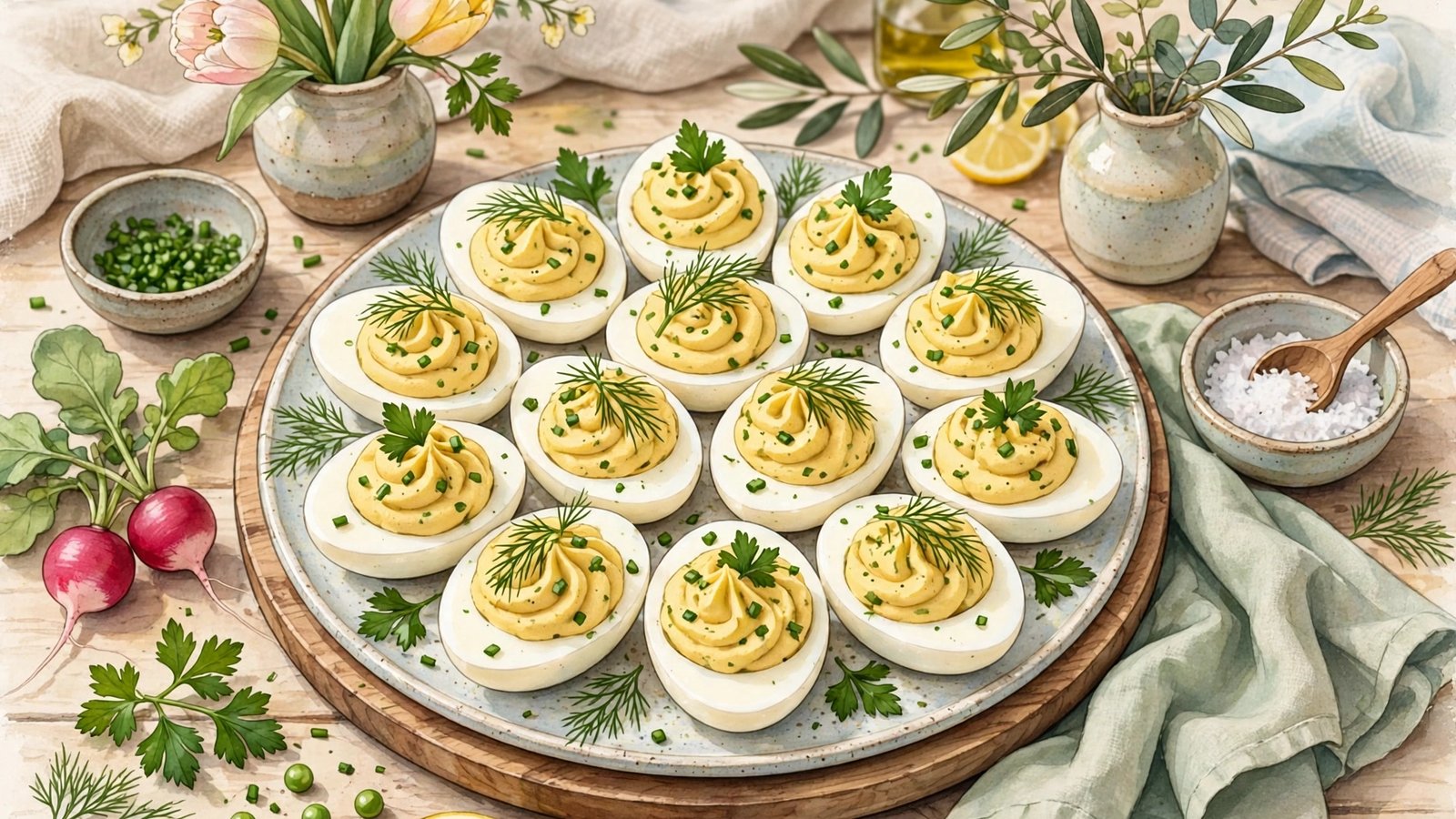
- Hard-cook 12 large eggs by covering them with cold water, bringing it to a full boil, removing the pan from the heat, covering it, and letting the eggs stand for 12 minutes. Move them into an ice bath for at least 15 minutes, then peel starting at the large end under cold running water. Halve the eggs, mash the yolks until fine, and stir in 1/2 cup mayonnaise, 2 teaspoons Dijon mustard, 1 teaspoon white wine vinegar or lemon juice, 1/2 teaspoon kosher salt, 1/4 teaspoon black pepper, and garlic powder if you like it. Fold in finely chopped fresh dill, chives, and parsley, pipe the filling into the whites, and garnish with extra herbs and paprika. Refrigerate until serving, serve cold, and discard any eggs out for more than 2 hours, or more than 1 hour above 90 degrees Fahrenheit. Filled deviled eggs are best eaten within 2 days.
Introduction
Deviled eggs have been on spring tables for a very long time, and for good reason. They are inexpensive, they can be made ahead in stages, they feed a crowd from a single carton of eggs, and they disappear reliably at every kind of gathering, from Easter brunch to a church picnic. The classic version, hard-cooked eggs with mashed yolks, mayonnaise, mustard, and a pinch of seasoning, is already good. Fresh herbs lift it without complicating it. Dill, chives, and parsley add color, fragrance, and a clean, green flavor that suits the season and keeps the eggs from tasting heavy.
This version stays close to the classic on purpose. It uses a smooth, well seasoned yolk filling, a generous amount of fresh herbs, and a few practical techniques: an ice bath for easy peeling, a piping bag or zip-top bag for neat filling, and a make-ahead plan that keeps the whites and filling separate until serving. It makes 24 deviled egg halves from 12 eggs, enough for a holiday table, and it can be halved for a smaller group. Because deviled eggs are a perishable, cold served food, this guide also gives the food safety rules that govern them, checked against United States Department of Agriculture, Food and Drug Administration, FoodSafety.gov, Egg Safety Center, American Egg Board, and university extension guidance on 30 October 2026.
Why Deviled Eggs Belong at Easter
For a holiday host, deviled eggs solve a specific problem: they can be fully prepared before guests arrive, served cold, and eaten without cutlery or heating, from ingredients most kitchens already have. Fresh herbs suit Easter because they are among the first green things to feel abundant in spring. Dill, chives, and parsley are inexpensive, need no cooking, keep their color in a cold filling, and cut the richness of yolk and mayonnaise, so each half tastes light even though the filling is rich. That balance is why the herbs go into the filling in quantity, not only on top.
One Easter caution belongs here. Eggs that are decorated, hidden, and hunted are not the eggs you eat. The Food and Drug Administration advises that Easter eggs should be hard-boiled before coloring and not eaten after hiding or playing with them, because bacteria and viruses picked up on the shells can transfer to the edible part. The Department of Agriculture adds that any decorated egg intended for eating should use only food-grade dye, suggests two sets, one for decorating and hiding and another for eating, and recommends non-food decorative eggs for hunts. This recipe is for the eating batch.
Ingredients
- 12 large eggs
- 1/2 cup mayonnaise
- 2 teaspoons Dijon mustard
- 1 teaspoon white wine vinegar or lemon juice
- 1/2 teaspoon kosher salt, plus more to taste
- 1/4 teaspoon black pepper
- 1/4 teaspoon garlic powder, optional
- 3 tablespoons finely chopped fresh dill, plus small fronds for garnish
- 3 tablespoons finely snipped fresh chives, plus extra for garnish
- 2 tablespoons finely chopped fresh flat-leaf parsley
- Paprika or smoked paprika, for garnish, optional
- Flaky salt, for garnish, optional
Egg is one of the nine major food allergens that must be declared on packaged food labels in the United States. The Food and Drug Administration lists those nine as milk, eggs, fish, Crustacean shellfish, tree nuts, peanuts, wheat, soybeans, and sesame, with sesame becoming the ninth under the Food Allergy Safety, Treatment, Education, and Research Act, effective January 1, 2023. Tell any guest with an egg allergy that this dish is egg from start to finish, mayonnaise included, and check mayonnaise and mustard labels for other allergies, because formulations differ by brand.
Buy eggs only if sold from a refrigerator or refrigerated case, and open the carton to check that the eggs are clean and the shells are not cracked. Store the carton promptly in a clean refrigerator at 40 degrees Fahrenheit or below, checked with a refrigerator thermometer. Clemson University Extension adds two details: store eggs in the grocery carton in the coldest part of the refrigerator, not in the door, and do not wash eggs, because washing can remove the protective mineral oil coating applied at the packing plant.
Choosing Eggs for Easy Peeling
The most useful step happens a week before you cook. Very fresh eggs can be difficult to peel after hard-cooking. The American Egg Board advises buying and refrigerating eggs a week to 10 days in advance, explaining that this rest lets the eggs take in air, which helps separate the membranes from the shell. Buy the weekend before Easter, keep the eggs in their carton in the coldest part of the refrigerator, and cook them a day or two before serving.
This is a quality rule, not a safety rule, and it sits inside the safety windows: the Food and Drug Administration advises using eggs in their original carton within 3 weeks for best quality, while the FoodSafety.gov chart gives raw eggs in the shell 3 to 5 weeks at 40 degrees Fahrenheit or below. Never age eggs on the counter, because any bacteria present can grow quickly at room temperature. With very fresh eggs, peel slowly under cold running water and put the neatest halves at the front of the platter.
How to Hard-Cook the Eggs, Step by Step
Step 1: Start in cold water, finish off the heat
Place the eggs in a single layer in a large saucepan and cover with cold water by about an inch. A single layer matters, because stacked eggs cook unevenly and knock against each other. Bring the water to a full, rolling boil over medium-high heat. As soon as it boils, remove the pan from the heat, cover it, and let the eggs stand for 12 minutes for large eggs. Set a timer: guessing here is how eggs end up overcooked.
This is the American Egg Board method: the pan comes off the heat so the eggs cook gently in hot water rather than boiling water, producing tender eggs rather than rubbery ones and minimizing cracking. Do not pierce the shells first, because an unsterile piercer can introduce bacteria and piercing creates hairline cracks bacteria can enter after cooking, and never microwave eggs in their shells, because steam builds up too quickly and they are likely to explode.
Step 2: Cool quickly in an ice bath
While the eggs stand, prepare a large bowl of ice water. Transfer the eggs with a slotted spoon and cool for at least 15 minutes, until completely cool. Quick cooling stops the cooking where you chose, helps prevent the greenish ring described below, and brings the eggs through the warm range quickly. University of Nebraska-Lincoln Extension advises eliminating the ring by avoiding overcooking and cooling eggs quickly in cold or ice water until completely cooled, then refrigerating them in their shells.
Do not leave hard-cooked eggs sitting in hot cooking water or cooling on the counter for hours. They should be refrigerated within 2 hours of cooking, a limit given by the Egg Safety Center, Clemson Extension, and the Food Safety and Inspection Service leftovers rule, which allows only 1 hour above 90 degrees Fahrenheit.
Step 3: Peel, starting at the large end
The American Egg Board notes that eggs are easiest to peel right after cooling, because cooling causes the egg to contract slightly in the shell. Its method: tap the egg on the countertop until the shell is finely crackled all over, roll it between your hands to loosen the shell, then start peeling at the large end, where the air cell sits, holding the egg under cold running water to help ease the shell off. Rinse away fragments and pat the eggs dry, because surface water thins the filling and makes it slide. If a white tears, fill it a little less and place it at the back of the platter.
Step 4: Halve the eggs and keep the whites cold
Slice each egg in half lengthwise with a sharp knife, wiping the blade clean between cuts. Pop the yolks into a medium bowl and arrange the whites cut side up on a platter or in a deviled egg tray. If a white will not sit flat, trim a very thin slice from the rounded bottom, sparingly, because trimming too much weakens the cup. While you make the filling, keep the whites refrigerated: that is a direct Department of Agriculture tip for deviled eggs, along with keeping finished eggs chilled until serving. The clock that matters is total time out of refrigeration, not serving time alone.
The Filling: Smooth, Seasoned, and Herb Forward
Mash the yolks with a fork until fine and crumbly, before any wet ingredient goes in. Yolks mashed dry break down completely, while yolks mashed after mayonnaise is added tend to stay lumpy, because the fat coats the crumbs. Then add the mayonnaise, mustard, vinegar or lemon juice, salt, pepper, and garlic powder if using, and stir until smooth. For an extra smooth filling, press it through a fine sieve or pulse it briefly in a food processor.
Season so the filling tastes slightly bold on its own, because the plain white dilutes seasoning in every bite. Adjust salt first, then acid, then mustard. The filling should hold its shape when piped but eat softly: if stiff, add mayonnaise a teaspoon at a time; if loose, chill it for 20 minutes to firm it.
Fold in the herbs last, reserving some for garnish. Wash them before chopping and dry them thoroughly: wet herbs are the most common hidden cause of a loose filling. Chop finely enough to pipe through a wide tip, but not to a paste. Pipe from a piping bag with a large star or round tip, or a zip-top bag with one corner snipped off, mounding the filling slightly above the rim. A small spoon also works. Garnish, cover loosely, and refrigerate at least 30 minutes before serving.
A Guide to the Fresh Herbs
The three herbs are not interchangeable, and knowing what each one does lets you adjust the mix with confidence.
| Herb | Flavor | Preparation | Amount |
|---|---|---|---|
| Dill | Fresh, grassy, slightly tangy, the most distinctive | Chop fronds finely, save small whole fronds for garnish | 3 tablespoons |
| Chives | Mild onion flavor without bite | Snip with scissors or slice thinly | 3 tablespoons |
| Flat-leaf parsley | Clean, peppery background | Chop leaves and tender stems finely, dry very well | 2 tablespoons |
Dill is tasted first, and it makes the eggs read as spring food rather than picnic food. Chives give the gentle onion note classic recipes get from grated onion, without harshness or extra liquid. Parsley adds lasting color and a mild peppery background. Other soft herbs can replace these in the same total quantity: tarragon is strong, so use a third of the mix at most, and basil bruises dark, so fold it in last and serve the same day. Woody herbs such as rosemary and thyme stay gritty in a smooth filling.
Fresh herbs are strongly preferred, as a flavor judgment, not a rule. If you must use dried, use about one third of the fresh amount, because dried herbs are concentrated, and expect darker color and duller flavor.
Variations That Still Work
Change one thing at a time, taste, and stop while the eggs still taste like deviled eggs. For a lemon-herb version, add a teaspoon of finely grated lemon zest and slightly more juice: zest gives lemon flavor without much extra liquid. For mild heat, add a pinch of cayenne or a dash of hot sauce, and taste again after the filling rests, because heat blooms as it sits. For a richer version, replace 2 tablespoons of mayonnaise with sour cream, which adds tang, or softened cream cheese, which pipes more firmly. For a bacon version, top each egg with a small piece of crisp bacon just before serving, and tell guests it is there, because it changes the dish for anyone who does not eat pork.
One caution applies to every variation: do not mix watery ingredients such as diced tomato or cucumber into the filling. They release liquid as they sit and make it runny and pale, so serve those flavors alongside as a topping instead. Finely chopped pickles, drained and patted dry, can work in small amounts, while wet relish will thin the filling.
Food Safety: The Rules That Govern This Dish
Deviled eggs are perishable, and every authority checked here treats them that way. The Food and Drug Administration states that fresh eggs, even with clean, uncracked shells, may contain Salmonella bacteria that can cause foodborne illness. Proper refrigeration, cooking, and handling prevent most egg safety problems, and hard-cooking protects this dish provided the eggs are cooked until yolk and white are firm.
The range to avoid is the Danger Zone: bacteria multiply rapidly between 40 degrees Fahrenheit and 140 degrees Fahrenheit, and food should not be left in that range for more than 2 hours. Department of Agriculture spring holiday guidance names deviled eggs directly among perishable foods to discard if left out longer than 2 hours in the Danger Zone. The Food and Drug Administration adds the hot weather exception: more than 1 hour above 90 degrees Fahrenheit is too long. When in doubt, throw it out.
The Department of Agriculture advises that all egg dishes should reach 160 degrees Fahrenheit, as measured by a food thermometer, and the Food and Drug Administration gives the same figure for casseroles and other egg dishes. For eggs themselves, the standard used here is to cook until both white and yolk are firm. This filling contains no raw egg.
Storage times depend on the form of the egg, and the sources draw the lines in slightly different places, so this recipe follows the strictest line for each form. In the shell, hard-cooked eggs keep longest: the Food and Drug Administration, the FoodSafety.gov chart, and the American Egg Board all give 1 week refrigerated, with the chart adding do not freeze. Once an egg cracks or is peeled, the Egg Safety Center shortens the window to 1 to 2 days refrigerated, because hard-cooking washes away the shell protective coating and leaves the pores open for bacteria to enter. The American Egg Board is stricter still and advises eating peeled eggs that day. For the finished dish, the Egg Safety Center advises enjoying dishes containing hard-boiled eggs within 2 days of making them, and this recipe uses that window, even though general leftover guidance allows 3 to 4 days, because the specialist guidance is written for exactly this food.
Clean handling ties the rules together: wash hands with warm water and soap for at least 20 seconds before preparing food, and wash hands, utensils, equipment, and surfaces with hot, soapy water before and after contact with raw eggs. This article gives no individual health advice, but the Food and Drug Administration notes that children, older adults, pregnant women, and people with weakened immune systems are at greater risk for severe Salmonella illness, a reason to be strict for everyone.
Make-Ahead Plan, Day by Day
Deviled eggs are best when whites and filling are stored separately and assembled close to serving, which keeps both inside their own storage windows. Because the American Egg Board advises eating peeled eggs the same day while the Egg Safety Center allows 1 to 2 days refrigerated, the calmest plan peels the eggs the day before serving at the earliest.
Two days before serving: hard-cook the eggs, cool them in the ice bath, and refrigerate them unpeeled in their shells, in the carton or a covered container, inside the 1 week window. Do the cooking early, not the peeling.
The day before serving: peel and halve the eggs and make the filling. Refrigerate the whites in a single layer in a covered container, and the filling separately, covered or in its piping bag. The filling tastes better made ahead, as the herbs and mustard settle into the yolks. Taste it again before piping, because cold dulls seasoning.
On serving day: pipe the filling a few hours before serving at most, garnish, cover loosely, and refrigerate until the platter goes out. If you must assemble fully a day ahead, cover tightly and refrigerate, and accept softer filling and darker herbs. Count the 2 days for the finished dish from when it was made and the 1 week for shell eggs from cooking day, and write the cook date on the container.
Serving, Transporting, and the Outdoor Table
Keep deviled eggs chilled until serving. Set the platter out shortly before guests eat, not when the first guest arrives, and return it to the refrigerator after the first round instead of leaving it out for grazing. For a long gathering, follow the Food and Drug Administration approach: serve a small platter at a time, replenish with a fresh chilled platter rather than topping up a warm one, and keep cold egg dishes on ice if they will stay out.
For transport, pack the eggs in an insulated cooler with enough ice or frozen gel packs to keep them cold. The Department of Agriculture advises a cooler with ice for deviled eggs, and the Food and Drug Administration adds that it should travel in the passenger compartment rather than the warmer trunk, sit in the shade on arrival, and stay closed as much as possible. For a longer trip, transport whites and filled piping bag separately and assemble on arrival. Outdoors, remember the 1 hour limit above 90 degrees Fahrenheit, put out small batches, and treat any egg that has used its full time out as finished, even if it looks fine.
Troubleshooting
| Problem | Likely cause | Fix |
|---|---|---|
| Green or gray ring on the yolk | Overcooking, or slow cooling | Timed off-heat method, quick ice bath |
| Rubbery whites | Boiled the whole time | Boil, remove from heat, cover, stand |
| Shells stick, whites tear | Very fresh eggs, or peeled late | Buy a week to 10 days ahead, peel right after cooling from the large end |
| Lumpy filling | Yolks not mashed fine first | Mash dry yolks first, or press through a sieve |
| Runny filling | Too much liquid, or wet herbs | Dry herbs well, add acid sparingly, chill to firm |
| Bland filling | Seasoned only for the spoon | Season slightly bold, taste again after chilling |
The green ring is unattractive but not harmful. University of Nebraska-Lincoln Extension explains that it is caused by sulfur from the white and iron from the yolk reacting to form ferrous sulfide at the surface of the yolk, usually through overcooking, and sometimes encouraged by a high amount of iron in the cooking water. The American Egg Board gives the same triggers. A ring is a quality signal, not a safety verdict: an egg with a ring that was handled correctly is safe, and an egg with a perfect yellow yolk that sat out all afternoon is not. Judge safety by time and temperature, never by color alone. If the platter looks uneven, one garnish repeated across every half and a wiped rim make even varied eggs look deliberate.
Frequently Asked Questions
How far ahead can I make deviled eggs?
In stages. Hard-cook up to a week ahead and keep the eggs refrigerated in their shells, peel the day before serving at the earliest, make the filling up to a day ahead, and assemble a few hours before serving. Eat filled eggs within 2 days. The shell buys the time: sources agree on 1 week in the shell, while peeled eggs get 1 to 2 days from the Egg Safety Center and a same day recommendation from the American Egg Board.
How long can deviled eggs sit out?
No more than 2 hours in total, counting preparation, unrefrigerated transport, and serving, and no more than 1 hour above 90 degrees Fahrenheit. The Department of Agriculture states that perishable foods such as deviled eggs should be discarded if left out longer than 2 hours in the Danger Zone between 40 degrees Fahrenheit and 140 degrees Fahrenheit, and the Food and Drug Administration gives the same limits.
Can I use dried herbs instead of fresh?
Yes, but fresh is strongly preferred, because dried herbs give neither the same color nor the same fresh flavor. If you must use dried, use about one third of the fresh amount, crumble them finely, and let the filling rest at least 30 minutes so they soften. Expect a darker, duller result.
Can I freeze deviled eggs?
No. The FoodSafety.gov chart lists hard-cooked eggs as do not freeze, and deviled eggs freeze worse than plain eggs, because the whites turn rubbery and watery and a mayonnaise based filling separates on thawing. Make only what will be eaten inside the 2 day window, or keep extra eggs in their shells and fill them fresh.
Why did my yolks turn green, and are those eggs safe to eat?
The ring is ferrous sulfide, formed when sulfur from the white reacts with iron from the yolk, usually from cooking too long or at too high a temperature, or cooling too slowly. University of Nebraska-Lincoln Extension and the American Egg Board both describe it as not harmful. Prevent it with the off-heat method and quick ice bath cooling, and judge any egg by handling and storage, not by the ring.
Are deviled eggs safe for pregnant guests or young children?
This article gives no individual health advice. The Food and Drug Administration notes that children, older adults, pregnant women, and people with weakened immune systems are at greater risk for severe Salmonella illness, which is a reason to be strict about full cooking and refrigeration. Serve only eggs cooked until white and yolk were firm, kept at 40 degrees Fahrenheit or below and inside the 2 hour limit, and let guests with specific concerns follow their own clinician advice.
What should I do with eggs left over from decorating and hunting?
Do not eat them. The Food and Drug Administration advises against eating Easter eggs after hiding or playing with them, and the Department of Agriculture recommends two sets, one for decorating and hiding and another for eating, with only food-grade dye on any egg that might be eaten and non-food decorative eggs for hunts.
Sources & references
- US Department of Agriculture, Simple Food Safety Steps for Spring Holiday Meals. Used for bacteria multiplying rapidly between 40 degrees Fahrenheit and 140 degrees Fahrenheit in the Danger Zone, food not being left in the Danger Zone for more than 2 hours, perishable foods such as ham slices, brisket, and deviled eggs being discarded if left out for longer than 2 hours in the Danger Zone, all egg dishes reaching a safe minimum internal temperature of 160 degrees Fahrenheit as measured by a food thermometer, eggs intended for eating not sitting out at room temperature for more than 2 hours, hard-cooked eggs being kept in the refrigerator until ready to serve, using only food-grade dye on decorated eggs intended for eating, making two sets of eggs with one for decorating and hiding and another for eating, and using non-food decorative eggs for egg hunts.
- US Food and Drug Administration, What You Need to Know About Egg Safety. Used for fresh eggs, even with clean, uncracked shells, possibly containing Salmonella, for buying eggs only if sold from a refrigerator or refrigerated case and checking that eggs are clean and shells are not cracked, for storing eggs promptly in a clean refrigerator at 40 degrees Fahrenheit or below with a refrigerator thermometer, for storing eggs in their original carton and using them within 3 weeks for best quality, for using or eating hard-cooked eggs, in the shell or peeled, within 1 week after cooking, for refrigerating leftover cooked egg dishes and using them within 3 to 4 days, for washing hands, utensils, equipment, and work surfaces with hot, soapy water before and after contact with raw eggs, for cooking eggs until both the yolk and the white are firm, for casseroles and other dishes containing eggs being cooked to 160 degrees Fahrenheit, for Easter eggs being hard-boiled before coloring and not eaten after hiding or playing with them, for never leaving cooked eggs or egg dishes out for more than 2 hours or more than 1 hour above 90 degrees Fahrenheit, for keeping cold egg dishes on ice and serving small platters at a time, for transporting cooked eggs in an insulated cooler in the passenger compartment rather than the trunk, and for children, older adults, pregnant women, and people with weakened immune systems being at greater risk for severe Salmonella illness.
- FoodSafety.gov, Cold Food Storage Chart. Used for raw eggs in shell keeping 3 to 5 weeks in a refrigerator at 40 degrees Fahrenheit or below, for hard-cooked eggs keeping 1 week refrigerated, and for hard-cooked eggs being listed as do not freeze.
- Egg Safety Center, How Long Are Hard-Boiled Eggs Safe to Eat. Used for hard-cooked eggs with intact shells being refrigerated within 2 hours of cooking and used within 1 week, for the protective coating on the shell being washed away by hard-boiling and leaving the pores open for bacteria to enter, for eggs that crack during cooking or are peeled being kept refrigerated and eaten within 1 to 2 days, and for dishes containing hard-boiled eggs, when properly refrigerated, being enjoyed within 2 days of when they were made.
- American Egg Board, How to Make Hard-Boiled Eggs. Used for the off-heat method producing tender rather than rubbery eggs and minimizing cracking, for the greenish ring resulting from a reaction between sulfur in the egg white and iron in the yolk when eggs are cooked too long or at too high a temperature and being minimized by cooking in hot rather than boiling water and cooling immediately, for very fresh eggs being difficult to peel and for buying and refrigerating eggs a week to 10 days in advance so air helps separate the membranes from the shell, for eggs being easiest to peel right after cooling because cooling causes the egg to contract slightly in the shell, for peeling by tapping the shell until finely crackled, rolling the egg, and starting at the large end under cold running water, for hard-boiled eggs in the shell being refrigerated safely up to 1 week in their original carton, for peeled eggs being eaten that day, for piercing shells before cooking not being recommended, and for never microwaving eggs in shells.
- University of Nebraska-Lincoln Extension, How to Avoid a Green Ring on Hard-Boiled Egg Yolks. Used for the greenish-gray ring being unattractive but not harmful, for the ring being caused by sulfur from the egg white and iron from the egg yolk reacting to form ferrous sulfide at the surface of the yolk, for the reaction usually being caused by overcooking and also by a high amount of iron in the cooking water, for eliminating the ring by avoiding overcooking and cooling eggs quickly after cooking in cold or ice water until completely cooled, and for hard-cooked eggs in the shell being refrigerated up to 1 week.
- Clemson University Extension, Safe Handling of Eggs. Used for eggs being perishable like raw meat, poultry, and fish, for storing eggs immediately in the refrigerator at 40 degrees Fahrenheit or slightly below in the grocery carton in the coldest part of the refrigerator rather than the door, for not washing eggs because washing can remove the protective mineral oil coating, for using raw shell eggs within 3 to 5 weeks, and for hard-cooked eggs being refrigerated within 2 hours of cooking and used within a week because the protective coating is washed away.
- USDA Food Safety and Inspection Service, Leftovers and Food Safety. Used for bacteria growing rapidly between 40 degrees Fahrenheit and 140 degrees Fahrenheit, for leftovers being refrigerated within 2 hours of cooking or within 1 hour when the temperature is over 90 degrees Fahrenheit, for cold perishable food being kept at 40 degrees Fahrenheit or below, and for the general leftover window of 3 to 4 days in the refrigerator, which this recipe does not use for filled deviled eggs because the Egg Safety Center gives the stricter 2 day window for dishes containing hard-boiled eggs.
- USDA, Spring for Food Safety. Used for washing hands with warm water and soap for at least 20 seconds, for perishable food not being left out for more than 2 hours at room temperature, for keeping the whites refrigerated while preparing the filling, for keeping deviled eggs chilled until ready to serve, and for using a cooler with ice when transporting deviled eggs to another location.
- US Food and Drug Administration, Food Allergies: What You Need to Know. Used for the nine major food allergens being milk, eggs, fish, Crustacean shellfish, tree nuts, peanuts, wheat, and soybeans under the Food Allergen Labeling and Consumer Protection Act of 2004, with sesame declared the ninth major food allergen by the Food Allergy Safety, Treatment, Education, and Research Act signed on April 23, 2021, effective January 1, 2023.


