Short answer
- Cut about 1 pound of day old French bread, challah, or brioche into 1 inch cubes, about 10 cups. Whisk 4 large eggs with 2 cups whole milk, 1 cup heavy cream, 3/4 cup granulated sugar, 1/4 cup orange juice, 2 tablespoons orange zest, 2 teaspoons vanilla extract, 1 teaspoon ground cinnamon, 1/4 teaspoon ground nutmeg, and 1/4 teaspoon kosher salt. Pour the custard over the bread with 2 cups fresh or frozen cranberries and 2 tablespoons melted unsalted butter, press the bread down into the custard, and soak for at least 30 minutes, or cover and refrigerate for up to 8 hours. Bake in a buttered 9 by 13 inch dish at 350 degrees F for 45 to 55 minutes, until the top is golden and a food thermometer in the center reads at least 165 degrees F, the FoodSafety.gov safe minimum for meatless casseroles. Rest 15 minutes before serving. Refrigerate leftovers within 2 hours and use them within 3 to 4 days, reheating portions to 165 degrees F.
Introduction
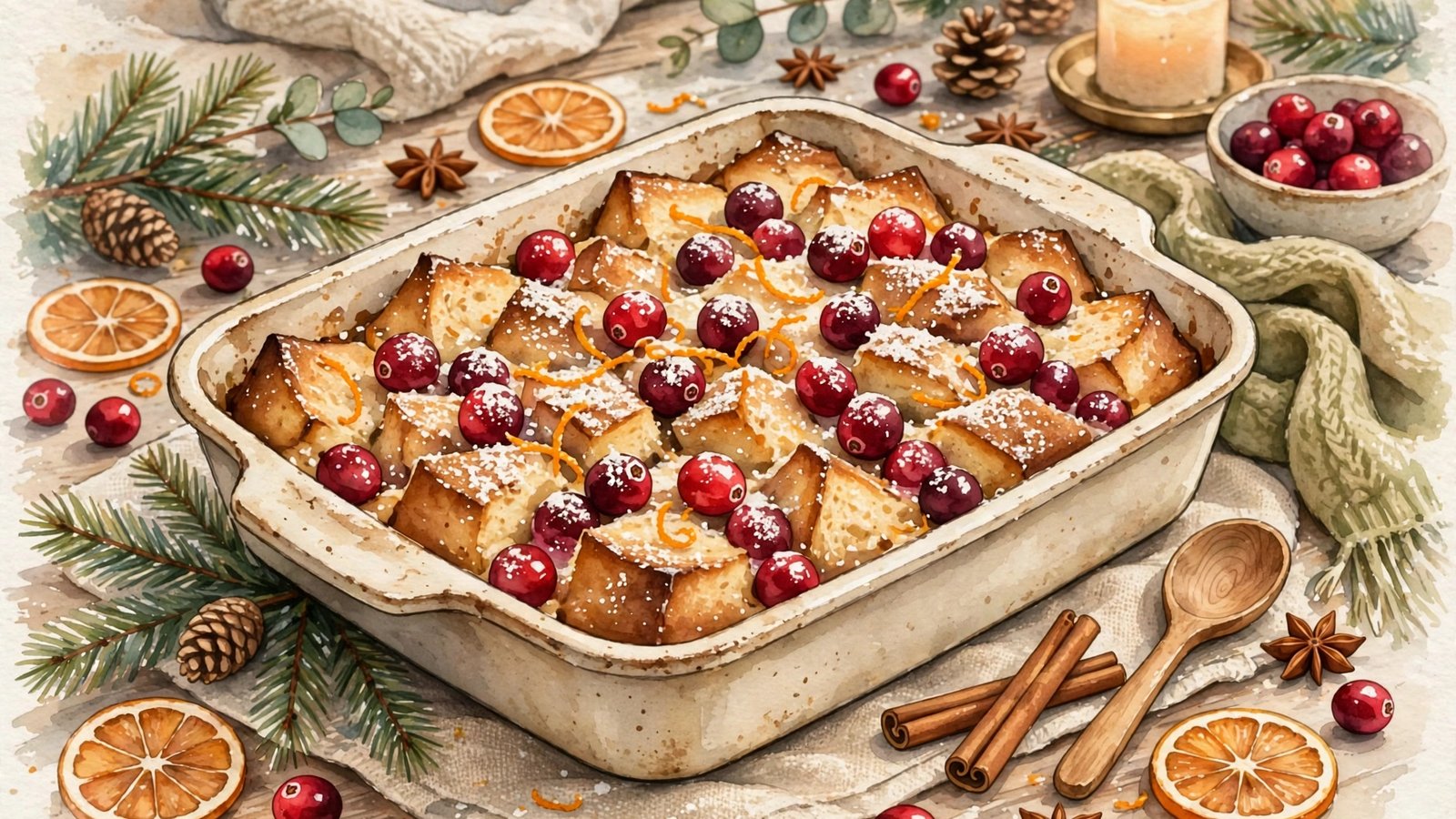
Bread pudding is one of the most forgiving desserts a home cook can make, and this Christmas cranberry orange bread pudding is its festive version. Day old bread soaks up a spiced egg custard, fresh or frozen cranberries burst into tart ruby pockets, and orange zest and juice lift a rich dish so it tastes bright rather than heavy. Baked until the top is crisp and the center is soft and set, it can be assembled ahead, served warm or at room temperature, and offered with whipped cream, ice cream, warm custard sauce, or nothing at all.
The Christmas character comes from flavor and season, not decoration. Cranberries are a fall and early winter fruit, at their peak when holiday cooking happens, and their tartness is a natural counterpoint to custard. Cinnamon and a little nutmeg add warmth without turning the pudding into a spice cake. No food coloring, special mold, or elaborate presentation is needed. Food safety, storage, and allergen statements were checked against the United States Department of Agriculture Food Safety and Inspection Service (USDA FSIS), FoodSafety.gov, and the United States Food and Drug Administration (FDA) on 30 October 2026. Cranberry selection and storage statements were checked against Penn State Extension and Utah State University Extension on the same date.
Why Bread Pudding Suits Christmas
Holiday cooking is often a scheduling puzzle, and bread pudding helps solve it. It can be assembled hours ahead and refrigerated before baking, which moves the work out of the busiest part of the day. It uses bread that might otherwise go stale, which is practical in a season of large grocery trips. It serves a crowd from one dish, eight to ten people from the quantities here, and it reheats well, so a second serving the next day is a genuine pleasure rather than a compromise.
The method is also forgiving. Bread pudding depends mainly on soaking and on baking until the custard is set. Drier bread absorbs more custard, fresher bread less, and a longer soak helps. That margin is a kindness in a busy week, provided two points stay fixed: the assembled dish, with raw egg and milk, stays refrigerated, and the baked center reaches the temperature in the Short Answer.
The flavor balance is the other reason it earns oven time. Cranberry cuts through cream and sugar, orange adds fragrance and acidity rather than more sweetness, and warm spice sits underneath both.
Choosing and Handling the Cranberries
Fresh cranberries are the first choice when they are available. Utah State University Extension notes that the peak harvest season for cranberries is October through December, which is why they are used most often during the holidays. Penn State Extension adds that fresh cranberries are readily available in stores from October through December, so buying an extra bag for the freezer during that window is a practical plan.
Select berries that are brightly colored, smooth, glossy, and firm. Utah State University Extension gives a similar test: full, plump, firm, and dark red or yellowish red, avoiding bruised or shriveled berries. Penn State Extension notes that a fresh berry will bounce when dropped, because small air filled chambers inside cause it to bounce and float. Discard shriveled, soft, wrinkled, or blemished berries. Before cooking, sort out soft berries and stems, rinse, and drain well.
Storage figures for raw berries vary by source and packing, so read them as a range. Penn State Extension says fresh cranberries are usually good in the refrigerator for two weeks, with gradual loss of quality after that, and can be stored in the original packaging in the crisper for up to four weeks. Utah State University Extension also gives up to four weeks in the crisper. Buy berries close to the baking day when you can.
Frozen cranberries need no thawing before they go into the pudding, and Penn State Extension confirms that it is not necessary to thaw frozen berries before use in cooking generally. They may release a little more juice as they bake, which is normal. If you freeze fresh berries yourself, Penn State Extension gives up to twelve months in the freezer, with frozen berries best used within one year, either directly in their bags or sorted, washed, and dried first. Those figures are for raw berries, not the finished pudding.
One measurement saves confusion. Penn State Extension notes that the commonly sold 12 ounce bag contains about 3 cups of cranberries. This recipe uses 2 cups, so one bag is enough. This recipe uses whole berries, so measure them whole.
Choosing the Bread, and Drying Fresh Bread
Sturdy bread works best. Day old French bread, challah, and brioche hold their shape in custard and give a crisp top over a soft center. Very soft sandwich bread can dissolve into mush once saturated. A crusty loaf is not a problem: the crust softens in the soak and crisps again at the edges.
Day old matters for a practical reason. Drier bread absorbs custard more evenly and holds distinct pieces after baking. Fresher bread is already holding more moisture, so it takes up less custard and can bake up dense or soggy in patches. If your bread is fresh, dry the cubes yourself. Spread them on a baking sheet and dry them in a 300 degree F oven for 10 to 15 minutes, stirring once, until they feel dry to the touch but are not browned. Let them cool before the custard goes over them.
Cut 1 inch cubes: smaller pieces drift toward a uniform, cake like texture, and larger pieces can stay dry in the middle. Do not strip all the crust away. It carries flavor and structure.
What the Orange Is Doing
Orange appears twice in this recipe, as zest and as juice, and the two forms do different jobs. The zest carries the fragrant oils from the outer peel, so it gives aroma that survives baking. The juice adds acidity and a softer orange flavor, and it also becomes the soaking liquid in the dried cranberry variation. Use both when you can. A pudding made with juice alone tastes flatter, and one made with zest alone can taste perfumed without tasting bright.
Zest only the colored outer layer: the white pith underneath is bitter. Two tablespoons of zest come from about two oranges, which also supply the 1/4 cup of juice. Zest before you juice, because a squeezed orange is awkward to zest.
Ingredients
- 1 loaf, about 1 pound, day old French bread, challah, or brioche, cut into 1 inch cubes, about 10 cups
- 2 cups fresh or frozen cranberries, rinsed and picked over
- 4 large eggs
- 2 cups whole milk
- 1 cup heavy cream
- 3/4 cup granulated sugar
- 1/4 cup orange juice, freshly squeezed if possible
- 2 tablespoons orange zest, from about 2 oranges
- 2 teaspoons vanilla extract
- 1 teaspoon ground cinnamon
- 1/4 teaspoon ground nutmeg
- 1/4 teaspoon kosher salt
- 2 tablespoons unsalted butter, melted, plus more for greasing the dish
- 2 tablespoons coarse sugar or granulated sugar, for sprinkling on top, optional
- For serving, optional: softly whipped cream, vanilla ice cream, or warm custard sauce
Bread, milk, cream, butter, and eggs are central here. Wheat, milk, and egg are major allergens, so tell guests what is in the dish and check packaged labels, as the allergen section explains.
How to Make It, Step by Step
1. Prepare the dish and the bread
Butter a 9 by 13 inch baking dish generously, including the corners. Place the bread cubes in a large bowl. If the bread is fresh, dry the cubes first using the oven method above and let them cool. If the cranberries are frozen, leave them frozen. Sort fresh berries, discard any that are soft or shriveled, rinse, and drain well.
2. Make the custard
In a separate large bowl or jug, whisk together the eggs, milk, cream, sugar, orange juice, orange zest, vanilla, cinnamon, nutmeg, and salt until the sugar is dissolved and the mixture is smooth. Whisking thoroughly matters. Undissolved sugar can settle at the bottom, and unmixed egg can bake into pale streaks in the finished pudding. Taste a spoonful now: this is the easiest moment to judge sweetness, tartness, and spice.
3. Combine and soak
Toss the cranberries with the bread cubes first, so the berries are distributed rather than sinking later. Pour the custard over, add the melted butter, and stir gently so every cube is moistened. Press lightly with a spatula so the bread sits in the custard. Cover and soak for at least 30 minutes at room temperature, or refrigerate for up to 8 hours for a make ahead version. A longer soak gives a more uniform texture, a shorter soak more distinct bread pieces. Do not stretch the room temperature soak: the safety section explains the 2 hour limit for a dish containing raw egg and milk.
4. Bake until set, and check the center
Preheat the oven to 350 degrees F. If the dish was refrigerated, let it sit at room temperature only while the oven heats, not for an extended counter rest. Uncover the dish, sprinkle it with coarse sugar if you are using it, and bake for 45 to 55 minutes, until the top is golden and crisp and the center is set. The center should not jiggle like liquid when the dish is gently shaken. A slight wobble is fine, but visible liquid sloshing means it needs more time.
Use a thermometer, not only the wobble test. FoodSafety.gov, in its safe minimum internal temperature chart, lists meat and meatless casseroles at 165 degrees F, which governs this dish as a meatless casserole and also exceeds the chart line for egg dishes such as frittata and quiche at 160 degrees F. The chart advises always using a food thermometer to check whether food has reached a temperature hot enough to kill harmful germs. Insert the thermometer into the center of the pudding, where the custard is thickest and cooks last, and look for at least 165 degrees F. If the top is browning faster than the center is setting, cover the dish loosely with foil and continue baking in 10 minute increments, checking the center again each time.
5. Rest and serve
Let the pudding rest for 15 minutes before serving. The rest lets the custard finish setting and makes slicing cleaner. Serve warm, at room temperature shortly after baking, or lightly reheated on another day, with whipped cream, ice cream, or custard sauce if you like. Add any powdered sugar at the last moment, because it dissolves into the warm top within minutes.
Scaling the Recipe Down or Up
The base recipe fills a 9 by 13 inch dish and serves eight to ten. Halving and doubling are worth doing on paper first, because custard ratios keep the texture right.
For a half batch, use 5 cups of bread cubes, 1 cup of cranberries, 2 large eggs, 1 cup of whole milk, 1/2 cup of heavy cream, 6 tablespoons of granulated sugar, 2 tablespoons of orange juice, 1 tablespoon of orange zest, 1 teaspoon of vanilla extract, 1/2 teaspoon of cinnamon, 1/8 teaspoon of nutmeg, 1/8 teaspoon of salt, and 1 tablespoon of melted butter. The sugar figure checks out directly: half of 3/4 cup is 3/8 cup, and 3/8 cup equals 6 tablespoons. Bake the half batch in an 8 or 9 inch square dish and start checking early. The 165 degree F center reading, not the clock, decides when it is done.
For a double batch, double every ingredient and bake it in two separate 9 by 13 inch dishes rather than one very deep dish. Two standard dishes keep the depth, baking time, and center setting close to the base version. One deep dish is the most common route to a browned top over a liquid center.
Variations That Still Work
Dried cranberries can replace fresh or frozen ones. Use about 1 1/2 cups, soak them in the orange juice for 15 minutes, and reduce the custard sugar by 2 to 3 tablespoons, because dried cranberries are usually sweetened. They stay chewy and sweet, while fresh berries burst and stay tart.
A handful of chopped toasted pecans or walnuts stirred in with the bread adds crunch. Check for nut allergies at the table before adding them, and say clearly that the pudding contains nuts if you do. Tree nuts are a major allergen, and nuts are an addition a guest cannot see reliably in a baked serving. A splash of orange liqueur in place of part of the orange juice adds depth for an adult table, but do not assume the alcohol fully bakes out, and label the dish clearly if children or guests avoiding alcohol will be served.
For a lighter version, use all milk instead of milk plus cream and reduce the sugar slightly. It will be less rich but still custardy, because the eggs set the dish. This recipe has not been tested with dairy free substitutes or gluten free bread, both of which absorb liquid very differently, so choose a recipe developed for that purpose instead of adapting this one by guesswork.
Make Ahead, Storage, and Food Safety
Bread pudding is an excellent make ahead dessert with one condition: keep it cold until baking. Assemble the pudding, cover it tightly, and refrigerate it for up to 8 hours before baking. Do not leave the assembled dish, which contains raw eggs and milk, at room temperature for more than 2 hours. USDA FSIS explains why the limit matters: bacteria grow rapidly between 40 degrees F and 140 degrees F, hot food must be kept hot at 140 degrees F or warmer, and within 2 hours of cooking, or after food is removed from an appliance keeping it warm, leftovers must be refrigerated. Throw away perishable food left at room temperature for more than 2 hours, or more than 1 hour if the temperature is over 90 degrees F.
Note that the first bake and all reheating both use 165 degrees F, for different chart reasons: the first bake follows the meatless casserole line, and reheating follows the line for leftovers of any type.
Leftovers should be refrigerated promptly, within 2 hours of baking, or within 1 hour if the surrounding temperature is above 90 degrees F. To cool them safely and quickly, FSIS advises dividing large amounts of food into shallow containers rather than leaving a large quantity to cool slowly, and notes that hot food can be placed directly in the refrigerator. Cover leftovers, wrap them in airtight packaging, or seal them in storage containers, which helps keep bacteria out, retains moisture, and prevents the pudding from picking up odors from other food. Immediately refrigerate or freeze the wrapped leftovers for rapid cooling. Store refrigerated leftovers at 40 degrees F or below and eat them within 3 to 4 days.
Reheat portions to 165 degrees F throughout, measured with a food thermometer. FSIS adds practical detail: cover leftovers to reheat, because covering retains moisture and ensures even heating, and in a microwave, cover and rotate the food and check the temperature in several places, because microwaves have cold spots. A warm oven reheats this pudding more evenly and revives some crispness.
Freezing the baked pudding is possible. FSIS gives the general leftover frame: leftovers can be kept frozen for 3 to 4 months, and although frozen leftovers are safe indefinitely when kept frozen, they lose moisture and flavor over longer storage. Cool the pudding completely, cut it into portions, wrap tightly, label with the date, and freeze. Thaw in the refrigerator, which FSIS lists with cold water and the microwave as safe thawing methods, and use thawed food within 3 to 4 days. Frozen leftovers can also be reheated without thawing, in the oven or microwave, taking longer. Reheat to 165 degrees F either way. Expect a softer texture after freezing.
Allergy and Ingredient Notes
This pudding contains milk, egg, and wheat in its core ingredients: milk and cream, butter, eggs, and bread. Those three are among the nine major food allergens in the United States. The FDA lists the nine as milk, egg, fish, Crustacean shellfish, tree nuts, wheat, peanuts, soybeans, and sesame, and explains that federal law requires the labels of most packaged foods marketed in the United States to disclose, in simple terms, when they are made with a major food allergen. Sesame became the ninth major food allergen in 2021 with the signing of the Food Allergy Safety, Treatment, Education and Research (FASTER) Act, and labeling for sesame has been required as of 1 January 2023.
The FDA makes two practical label points that matter when you buy the bread and toppings. First, a Contains statement, if present, must list all the major allergens used as ingredients, but not every product has a Contains statement, so read the entire ingredient list rather than relying on that one line. Second, a may contain advisory statement is voluntary. Manufacturers may use it when shared equipment creates a chance that an allergen could be present, but not all manufacturers use it, so its absence is not a guarantee. Check the label every time you buy, because a product ingredient list can change at any time, and if you are unsure whether a product contains an ingredient a guest is sensitive to, do not serve it until you have checked.
Apply that care at the table too. Whipped cream adds more milk, nut variations add tree nuts, and some breads contain soy or sesame. Name the core allergens and any additions out loud or on a card by the dish.
Troubleshooting
If the center is still liquid after the stated baking time, the dish may be deeper than standard, the oven may run cool, or the bread may have been very fresh and absorbed less custard. Cover the top loosely with foil to prevent over browning and continue baking in 10 minute increments until the center is set and the thermometer reads at least 165 degrees F. Do not solve a liquid center by serving around the edges. The center is part of the dish, and it needs the same temperature as the rest.
If the top browns too fast, the same loose foil fixes it. If the pudding is dry, the bread may have been over dried, the soak too short, or the bake too long. Cream or custard sauce rescues the serving, and a longer soak and an earlier thermometer check help next time.
If the cranberries all sink to the bottom, they were probably stirred in after the bread was already saturated and the mixture was very wet, so the dense berries settled. Tossing the cranberries with the dry bread cubes before pouring the custard over, as the method above does, distributes them better. If the pudding tastes too tart, the cranberries were especially sharp, which varies by bag and by season. A little extra sugar in the custard next time, or a sweeter topping this time, balances it without changing the method. If it tastes flat, check the salt and the zest before adding sugar.
If the texture is dense, the bread was probably pressed down too firmly, or the cubes were cut very small. Press lightly. If it has pale streaks, the custard was not whisked smooth. Whisk until no streaks remain.
Frequently Asked Questions
Can I use dried cranberries instead of fresh?
Yes. Use about 1 1/2 cups, soak them in the orange juice for 15 minutes, and reduce the custard sugar by 2 to 3 tablespoons, because dried cranberries are usually sweetened. Expect a sweeter, chewier result than fresh berries, which burst and stay tart.
Can I assemble it the night before?
Assemble, cover, and refrigerate it for up to 8 hours, which covers an evening assembly for a next morning bake at the outer edge, but not a full day ahead. Bake from cold, allowing a few extra minutes, and check that the center reaches at least 165 degrees F. If you need it finished further ahead, bake it, refrigerate promptly, and reheat to 165 degrees F.
What bread is best?
Day old French bread, challah, or brioche. Sturdy bread holds its shape in custard and gives a crisp top over a soft center. Very soft sandwich bread can turn mushy. If your bread is fresh, dry the cubes in a 300 degree F oven for 10 to 15 minutes, stirring once, until they feel dry but are not browned, and let them cool before adding the custard.
How long do leftovers last?
Refrigerate leftovers within 2 hours of baking, or within 1 hour if the room is above 90 degrees F, in shallow, covered containers in a refrigerator at 40 degrees F or below. Eat refrigerated leftovers within 3 to 4 days, following USDA FSIS leftover guidance, and reheat portions to 165 degrees F, measured with a food thermometer. Frozen leftovers can be kept for 3 to 4 months for quality, and should be thawed in the refrigerator and reheated to the same 165 degrees F.
Can I serve it at room temperature?
Yes, shortly after baking and the 15 minute rest. It is good warm and at room temperature. Room temperature serving does not extend the safety window, however: do not leave it out for more than 2 hours in total, or more than 1 hour above 90 degrees F.
Do frozen cranberries need to be thawed first?
No. Penn State Extension confirms that frozen cranberries do not need to be thawed before use in cooking. Rinse them, add them to the bread before the custard, and expect a little more juice as they bake, which is normal.
Keep reading: Make-Ahead Christmas Appetizers, Desserts, and Cookies: A Calmer Way to Feed a Crowd
Keep reading: Christmas Food Ideas: Cake, Cocktails and Hosting Without the Stress
Sources & references
- USDA Food Safety and Inspection Service, Leftovers and Food Safety. Used for bacteria growing rapidly between 40 degrees F and 140 degrees F, hot food kept hot at 140 degrees F or warmer, refrigerating leftovers within 2 hours of cooking or after removal from an appliance keeping food warm (1 hour if the temperature is over 90 degrees F), discarding perishable food left out longer, cooling food rapidly in shallow containers, hot food being placed directly in the refrigerator, covering or sealing leftovers in airtight packaging and refrigerating or freezing them immediately, leftovers kept 3 to 4 days in the refrigerator or frozen for 3 to 4 months, frozen leftovers being safe indefinitely but losing moisture and flavor over longer storage, safe thawing in the refrigerator, cold water, or the microwave, using thawed food within 3 to 4 days, reheating frozen leftovers without thawing in the oven or microwave for casseroles and combination meals, reheating leftovers to 165 degrees F as measured with a food thermometer, and covering and rotating food when reheating in a microwave because microwaves have cold spots.
- FoodSafety.gov, Cook to a Safe Minimum Internal Temperature. Used for always using a food thermometer to check whether food has reached a safe minimum internal temperature hot enough to kill harmful germs, and for casseroles, meat and meatless, at 165 degrees F, the line governing the first bake in this article, which exceeds the non-governing line for egg dishes such as frittata and quiche at 160 degrees F, with leftovers of any type at 165 degrees F.
- United States Food and Drug Administration, Have Food Allergies? Read the Label. Used for the nine major food allergens (milk, egg, fish, Crustacean shellfish, tree nuts, wheat, peanuts, soybeans, and sesame), federal law requiring labels of most packaged foods marketed in the United States to disclose a major food allergen in simple terms, the food source name appearing in parentheses after an ingredient or in a Contains statement, a Contains statement if present having to list all allergens in the product while not all products carry one so the entire ingredient list should be read, may contain advisory statements being voluntary and used for shared equipment risk, checking the label every time because ingredients can change, not buying or serving a product when unsure about an ingredient, and sesame becoming the ninth major allergen in 2021 under the FASTER Act with labeling required as of 1 January 2023.
- Penn State Extension, Preserving Cranberries. Used for fresh cranberries being readily available in stores from October through December, selecting berries that are brightly colored with smooth, glossy, and firm skin, a fresh berry bouncing when dropped because small air filled chambers inside cause it to bounce and float, discarding shriveled, soft, wrinkled, or blemished berries, fresh cranberries usually being good in the refrigerator for two weeks and being storable in the original packaging in the refrigerator crisper for up to four weeks, sorting berries to remove soft berries and stems and rinsing in cold water and draining well before cooking, frozen berries not needing to be thawed before use, the commonly sold 12 ounce bag containing about 3 cups of cranberries, measuring chopped cranberries after chopping, and the two freezing routes for raw cranberries, directly in plastic bags for up to twelve months or sorted, washed, drained, and blotted dry before packing, with frozen berries best used within one year.
- Utah State University Extension, Ask a Specialist, Cranberries: A Healthy Holiday Choice. Used for the peak harvest season for cranberries being October through December and cranberries being used most often during the holidays, fresh cranberries being storable in the refrigerator crisper for up to four weeks and freezing well for almost a year in airtight freezer bags, choosing fresh cranberries that are full, plump, and firm and dark red or yellowish red, avoiding berries that look bruised or shriveled, and rinsing fresh or frozen cranberries before use and discarding any that are damaged.


