Short answer
- Choose one clear purpose, such as prayer, remembrance, meditation, or holding an intention in view. Pick a small, stable spot you can keep tidy and undisturbed, such as a shelf, a dresser top, or a corner of a desk. Place only three to five objects you can explain: something for light, something from nature, something personal or in memory of someone, and something for your practice, such as a journal. Arrange them with empty space around them, keep any real candle in a stable holder at least 12 inches from anything that can burn, and blow it out whenever you leave the room or go to bed. Use the space briefly most days, refresh it as seasons and needs change, and follow the customs of your own tradition, guided from within that tradition, if you have one.
Introduction
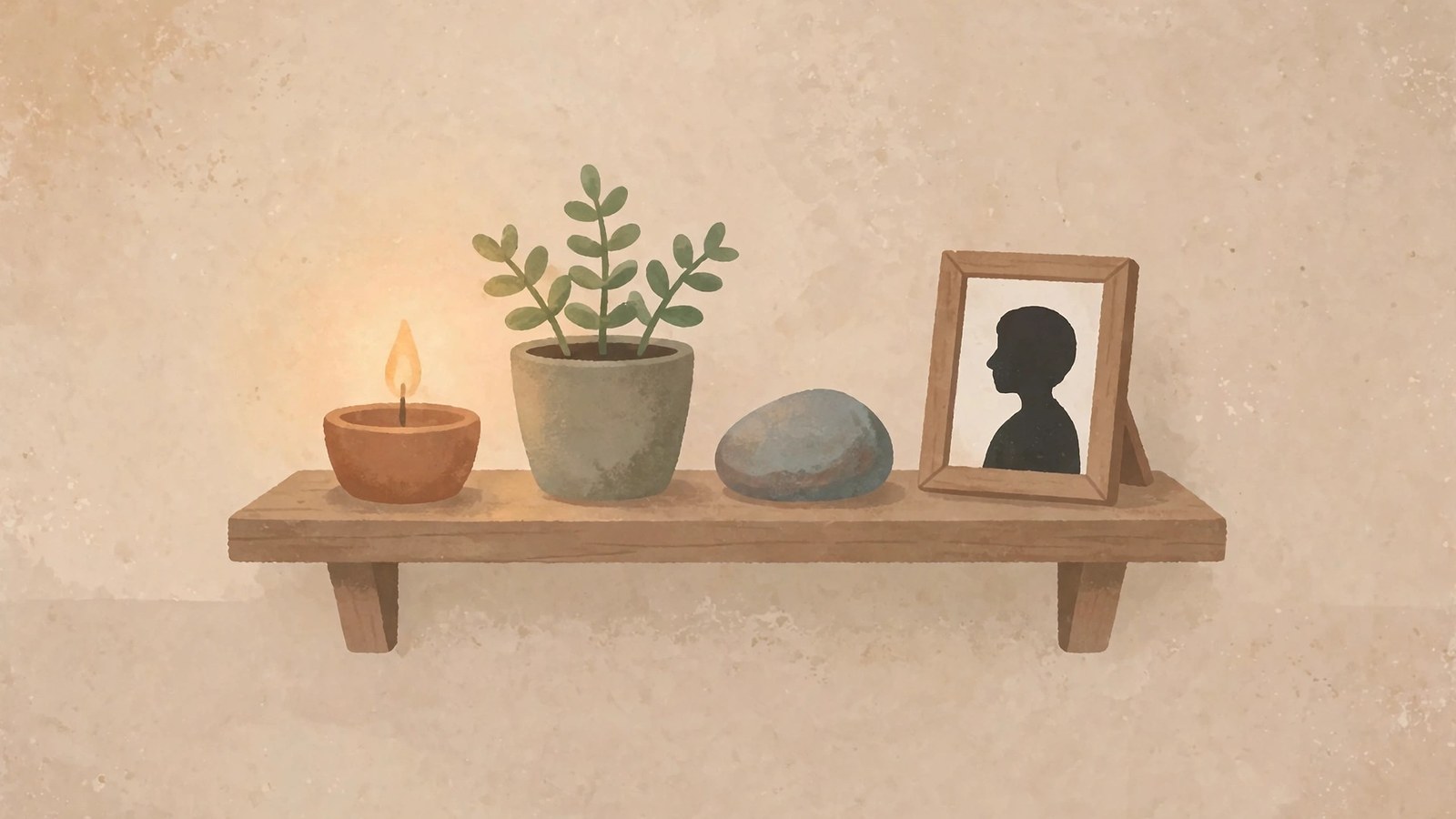
A home altar for reflection is a small, dedicated place set aside for prayer, remembrance, meditation, or quiet thought. It can be as simple as a candle and a photograph on a shelf, and its value is not display. Its value is attention. When you pass it or sit before it, it reminds you to pause, remember what matters, and spend a few minutes deliberately instead of rushing past.
Home altars and shrines appear in many religious and cultural traditions, and they also appear in personal, nonreligious forms. This guide explains how to create a simple reflection altar of your own. It describes several established traditions accurately and respectfully, so you can learn from their care and seriousness without treating sacred practice as decoration. It makes no promise of a spiritual result, an answer, or a change in fortune. What it offers is a place, a few meaningful objects, and a steady habit of quiet attention.
Start with purpose, keep the space small enough to care for, and let use, not perfection, make it part of your home.
Start With Purpose, Because Purpose Shapes Every Choice
Purpose comes first because it decides the spot, the objects, and the routine. A space for daily prayer needs to be easy to reach in the morning and evening. A space for remembrance needs privacy and room for a photograph to stay undisturbed. A space for meditation needs a clear focal point and room to sit. A space for intention needs a visible place for a written card you will actually read.
Write the purpose in one sentence before you gather anything. For example: this corner is where I will sit quietly for five minutes each morning. Or: this shelf is where our family will remember my father. A sentence sounds minor, but it prevents the most common problem, which is collecting attractive objects with no shared reason for being together.
A purpose can change. A remembrance altar set up after a death may later become a quieter gratitude corner. Changing the purpose openly, and changing the objects to match, keeps the altar honest. Leaving objects in place long after their reason has faded turns a living practice into clutter that creates guilt instead of calm.
Learn From Established Traditions Without Copying Them
Many households have kept altars and shrines for generations. The examples below describe those traditions, drawn from museum and reference sources. They are not patterns to copy item by item if the tradition is not yours.
In Mexico, much of Latin America, and Mexican American communities in the United States, families mark Dia de los Muertos, or Day of the Dead, on November 1 and November 2 by creating ofrendas, or altars, for people who have died. The Smithsonian American Art Museum describes families covering ofrendas with pictures of departed family members, lit candles, sweets, decorations, and personal offerings such as favorite foods and drinks. The Smithsonian Institution explains that every ofrenda also includes the four elements: water left in a pitcher so the spirits can quench their thirst, papel picado, or traditional paper banners, representing wind, food, especially bread, representing earth, and candles representing fire, often left in the form of a cross for the cardinal directions so the spirits can find their way. The Smithsonian National Museum of the American Latino adds that ofrendas vary with regional traditions, family resources, recent deaths, and the harvest, and that other offerings can include fruit, chocolate, and copal incense. An ofrenda is a temporary, purposeful altar inside a specific observance, not a general style of home decor.
In Japanese households, Britannica describes the butsudan as the Buddhist family altar, historically maintained in addition to the kamidana, or god shelf. It generally contains memorial tablets for dead ancestors and, in accordance with sect affiliation, representations of various Buddhist divinities. Incense and candles are lit and flowers are offered at simple daily services, and family ancestors are periodically memorialized before the butsudan.
In Hinduism, Britannica describes puja as ceremonial worship ranging from brief daily rites in the home to elaborate temple rituals. In its simplest form, puja usually consists of making an offering of flowers or fruit to an image or statue, called a murti, of a god, and its components vary greatly by sect, community, region, time of day, the needs of the worshiper, and the religious text followed. One important type of puja in temple and private worship is arti, the waving of lighted lamps before an image of a deity or a person to be honored. Home worship in this tradition follows forms learned within families and communities. It is not an improvised arrangement.
The respectful lesson is the same in all three examples. Inside a tradition, objects and handling carry shared meanings, and questions are answered by teachers, elders, family members, or texts within that tradition. If you follow a tradition, build in ways consistent with it and seek guidance inside it when you are unsure. If you do not, do not borrow its sacred objects or ritual items merely because they look attractive. Personal, natural, and handmade objects carry no such risk, and they are usually the most honest choices for a general reflection altar.
Choose a Spot That Fits Your Home
The best spot is accessible, relatively undisturbed, and easy to keep tidy. It does not need to be large. A shelf, the top of a dresser, a small side table, or the corner of a desk can all work. What matters is that the spot feels slightly set apart from daily clutter, even if the boundary is only a cloth, a tray, or a low board.
Test a candidate spot for a day before you arrange anything. Do you pass it at a time when a pause is possible, or only while rushing? Can you sit or stand before it without blocking a doorway or a drawer you need? Does it stay clear, or do keys, mail, and chargers land there by habit? A spot you pass calmly will serve reflection better than a larger spot in a busy room.
Light helps. Natural light can make a space feel alive during the day, and a small lamp can make it feel settled in the evening. You need enough light to see the objects clearly and to sit comfortably, not special lighting.
Small spaces, rentals, and shared rooms
A small home does not rule out an altar. It rules out a large one. In a studio or a small apartment, use a single wall shelf, the top section of a bookcase, or a tray on a dresser that defines the whole altar in one footprint. A tray is especially useful for renters, because the whole arrangement lifts and relocates without scattering. Keep the count low, choose flat or low objects over tall ones, and let one photograph do work that five objects would do in a bigger room.
If you share a room, choose a spot that is personally yours, such as your side of a dresser or a shelf above your desk, and keep the altar inside that boundary. If you cannot use candles under a lease, a dorm rule, or a building rule, use a battery operated candle or a small lamp from the start. The meaning sits in the pause and the objects, not in the flame itself.
Choose Objects and What Each One Means to You
Start with very little, perhaps three to five items, and add only what earns its place. A balanced starting set covers four roles. Something for light, such as a candle in a stable holder, a small lamp, or a battery operated candle. Something from nature, such as a plant, a stone, a shell, or a fresh flower. Something for memory or inspiration, such as a photograph, a letter, or a small keepsake. And something for your practice, such as a journal, a prayer book from your own tradition, or a blank notebook.
Each item should pass a simple test: you can say, in one sentence, why it is there. A stone picked up on a memorable walk carries a story. A photograph of a grandparent carries a relationship. A small bowl of water can stand, in your own practice, for clarity or for care, provided you refresh it often and keep it away from books and electronics. A written intention on a card can hold a question you are living with. If you cannot say why an item is there, it is probably decoration. Decoration is not wrong, but an altar made only of decoration rarely holds attention for long.
Choose objects you can care for. A plant you will water and a photograph in a frame you can dust will serve you better than delicate items that need handling you cannot give. Avoid fragile, sharp, or irreplaceable objects in homes with children, pets, or heavy foot traffic. Keep food out of a general reflection altar unless it belongs to a tradition you follow and you know how that tradition handles it, because food left out attracts pests and spoils quickly.
Arrange the Space Step by Step
Arrangement needs care, not a formal rule. First, clear and clean the surface, then lay a cloth or set down a tray or board if you want a visible boundary. Second, place one central item slightly toward the back, often the light, the photograph, or the main keepsake. Third, arrange the remaining items around it so each one can be seen without moving another. Fourth, step back to where you will usually sit or stand and look. If your eye settles easily, the arrangement is working. If it keeps catching on crowding, remove one item before you add anything.
Leave empty space on purpose. An altar crowded with objects can feel busy rather than calm, and empty space gives the eye and the mind room to rest. Height can help without adding clutter: a small stack of stable books can raise a photograph. Never stack fragile items precariously, and never raise a real candle on an unstable stack. Keep anything with a flame on a flat, stable base, in a stable holder, on a sturdy and uncluttered surface.
Symmetry is optional. Balanced pairs can feel formal and settled. A looser grouping can feel natural and relaxed. Either works if the result feels calm to you and every object remains reachable for dusting and care.
Use the Space in Daily Life
An altar becomes part of life through use, not perfection. A simple daily practice can take only a few minutes. Turn on the lamp or light the candle if you use one safely, sit quietly, breathe naturally, and notice what is present. Some people begin with a short prayer from their own tradition. Others sit in silence, read a brief passage, write a line in a journal, or look at the objects and remember why each one is there. The form matters less than regularity. A few minutes most days will shape the space more deeply than an hour once a month.
Give the practice a clear beginning and end, especially for meditation. A single candle or lamp, one focal object, and a cushion may be all you need, because fewer objects mean fewer distractions. A small timer or bell, kept nearby, can mark the end without a phone screen.
For intention, place a written goal, question, or value where you will see it daily. Review the card regularly, and replace it when the intention is fulfilled, changes, or no longer feels relevant. Keep expectations honest. An altar does not manifest outcomes, attract luck, or guarantee answers. Its value lies in attention, regularity, and meaning, whether you describe that value in spiritual terms or as a habit of reflection.
An altar can also hold difficult moments. Writing a weighing question down at the altar can clarify what you know and what you still need to learn. A small note of thanks can make gratitude concrete. None of these acts replaces professional support when it is needed, and this guide is not counseling or medical advice.
A Remembrance Altar Deserves Extra Care
If you are creating a space to honor someone who has died, include items that genuinely connect you to that person: a photograph, a letter, an object they used or loved, or a note in your own words about what you remember. Consider what the person would have wanted, and what other family members who share the memory would find respectful. Some families keep a remembrance altar for a specific period, such as a mourning season or around an anniversary, while others keep one for years. Both are valid, and the altar can change as grief changes.
Be gentle with yourself here. A remembrance altar can bring comfort, and it can also bring sadness, sometimes unexpectedly. If sitting before it feels overwhelming, shorten the time, invite a trusted person to sit with you, or step away and return another day. Grief has no timetable. If grief feels unmanageable or persistent, consider support from a trusted counselor, clinician, faith leader, or support organization rather than relying on a home practice alone.
If your remembrance space draws on a family or cultural tradition, such as an ofrenda for Dia de los Muertos, follow that tradition as you understand it and ask elders or knowledgeable family members when you are unsure. If it sits outside any specific tradition, keep it simple and sincere, and let personal memory, rather than borrowed symbols, guide the choices.
Refresh With the Seasons and With Life Changes
Weekly and seasonal care is part of the practice, not housework added to it. Dust the surface, replace a wilted flower, refresh water in a bowl, and rewrite an intention card when it no longer fits. That maintenance is itself a reflective act, a short pause to notice what has changed.
Many people mark seasons or anniversaries with one small change: a leaf in autumn, a flower in spring, or a different photograph on a birthday or an anniversary. One change at a time is enough. A seasonal refresh should not become a shopping project or a full redesign every month. If an object no longer carries meaning, remove it and store or pass it on respectfully rather than letting the altar accumulate items out of obligation.
Keep the altar simple enough to maintain. A space that requires extensive upkeep will eventually be neglected, and neglect can feel like failure. Three to five meaningful items, cared for regularly, will serve better than a large display that gathers dust. If the altar stops feeling meaningful, it is acceptable to simplify it, move it, or pause the practice.
Candle, Incense, and Household Safety
Fire safety decides whether a real candle belongs on your altar at all. The United States Fire Administration, or USFA, warns that candles are part of many celebrations, but open flames make them dangerous if they tip over or when they are placed too close to anything that can burn. It reports that, on average, 20 home candle fires are reported each day, citing National Fire Protection Association data.
If you use lit candles, the USFA advises placing them in stable holders where they cannot be knocked down easily, keeping candles at least 12 inches away from anything that burns, and blowing out candles when you leave a room or home or when you go to bed. It advises not using lit candles in bedrooms, bathrooms, and sleeping areas, and it recommends considering battery operated flameless candles, which can look, smell, and feel like real candles. It also advises using flashlights, not candles, during a power outage. Applied to an altar, that means no flame near curtains, bedding, paper cards, dried flowers, or a cloth that can slip toward the holder, and no candle left burning while you nap or leave the house.
Children and pets change the calculation. Keep matches and lighters out of reach, place any flame high and stable or skip the flame entirely, and never leave a child or a pet alone with a burning candle. If anyone in the home uses medical oxygen or if your building prohibits open flames, choose the flameless option without debate.
Treat incense with the same caution. Ventilate the room, keep smoke away from anyone with asthma, allergies, or sensitivity to smoke, and skip incense entirely if it bothers anyone who shares the air. Never let incense burn unattended, and set it in a stable, heat-safe holder that catches ash.
Shared Homes Need a Short Conversation
If you share your home, discuss the altar with the people who live there, especially if it includes items of religious significance or sits in shared space. A short conversation about purpose, placement, and any flame or scent can prevent misunderstanding. It can also lead to something better, such as a shared family remembrance corner, if everyone genuinely wants it.
Agree on practical boundaries: which surface is set apart, whether candles will ever be lit and by whom, and how guests and children will be guided around fragile objects. If a housemate or partner does not share the practice, a personal altar inside your own space, without scent or flame spilling into shared areas, usually works better than a large altar in a common room.
A Simple Way to Begin This Week
First, write your purpose in one sentence. Second, choose a place, even a single shelf, and clear and clean it. Third, lay a cloth or set down a tray if you wish, and place three items: something for light, something from nature, and something personal. Fourth, sit before the space for five minutes, in silence or with a short reading, and notice how it feels. Fifth, use the space briefly each day for a week, and adjust only what you have learned does not help.
You can mark the beginning with a small, personal gesture if you like: writing the purpose on a card, saying a brief prayer or dedication from your own tradition, or simply sitting quietly. No elaborate ceremony is required. A complete beginning can stay this small for as long as it serves you.
Frequently Asked Questions
Do I need to follow a religion to have a home altar for reflection?
No. Many altars belong to specific religious traditions, with forms taught inside those traditions, and many other home altars are personal and nonreligious. If you follow a tradition, build within it and seek guidance inside it. If you do not, build a personal space from your own memories, values, and natural or handmade objects, and do not present it as the altar of a tradition it does not belong to.
How big does a home altar need to be, and where should it go in a small home?
It can fit on a single shelf, a dresser top, or a tray. Size matters far less than whether the spot is stable, tidy, and slightly set apart from daily clutter. In a small home or a shared room, use one shelf or a tray inside your own space, keep three to five low and stable objects, and choose a battery operated candle or a lamp if safety or house rules make a real flame unwise.
What should I put on a simple altar, and what should I leave off?
Start with something for light, something from nature, something personal or in memory of someone, and something for your practice, such as a journal. Keep only items whose reason you can state in one sentence. Leave off sacred objects or ritual items from traditions you do not follow if you would be using them only as decoration, along with fragile, sharp, or hard to care for items that do not fit your household. Add new objects slowly, only when each one earns its place.
Is it safe to use a real candle on a home altar?
Only under strict conditions. The United States Fire Administration advises stable holders where candles cannot be knocked down easily, at least 12 inches of clearance from anything that burns, blowing candles out when you leave a room or home or go to bed, and not using lit candles in bedrooms, bathrooms, and sleeping areas. It recommends battery operated flameless candles as an alternative. If you cannot meet those conditions, use a flameless candle or a lamp instead. Never leave a burning candle unattended.
How often should I use and refresh the altar?
Use it briefly most days, even for a few minutes of quiet sitting, prayer, reading, or journal writing, because regularity builds the habit more than occasional long sessions do. Refresh it weekly with basic care, such as dusting and replacing a wilted flower, and seasonally with at most one or two thoughtful changes, such as a seasonal natural object or a new intention card. If the practice stops helping, simplify, move, or pause the altar rather than maintaining it out of guilt.
How is a personal reflection altar different from an ofrenda or a butsudan?
An ofrenda is the temporary altar families create for Dia de los Muertos on November 1 and November 2 to honor people who have died, with photographs, favorite foods and drinks, and the four elements described by the Smithsonian. A butsudan is the Buddhist family altar in Japanese households, described by Britannica as generally containing memorial tablets for dead ancestors and representations of Buddhist divinities, tended with incense, candles, and flowers at simple daily services. Both belong to specific traditions. A personal reflection altar belongs to no tradition unless you build it inside your own. Do not copy their sacred elements as decoration.
Sources & references
- Smithsonian Institution, 5 Facts About Dia de los Muertos (The Day of the Dead). Used for the ofrenda as a central and temporary altar honoring loved ones, and for the four elements on every ofrenda including water left in a pitcher so the spirits can quench their thirst, papel picado, or traditional paper banners, representing wind, food, especially bread, representing earth, and candles representing fire and often left in the form of a cross to represent the cardinal directions so the spirits can find their way.
- Smithsonian American Art Museum, Dia de los Muertos Family Zone. Used for Dia de los Muertos as a time to remember and honor those who have departed, celebrated on November 1 and 2 throughout Mexico, much of Latin America, and Mexican American communities in the United States, and for families creating ofrendas covered with pictures of departed family members, lit candles, sweets, decorations, and personal offerings such as favorite foods and drinks to nourish the spirits in their journey.
- Smithsonian National Museum of the American Latino, The Meaning of the Altar, via Google Arts and Culture. Used for ofrendas being observed in households to welcome back the spirits, for the quality and degree of ornamentation depending on regional traditions, family and individual wealth, recent deaths, and the harvest, and for other offerings on the ofrenda including fruit, chocolate, and copal incense.
- Encyclopaedia Britannica, Butsudan. Used for the butsudan in Japanese households as the Buddhist family altar, historically maintained in addition to the kamidana, or god shelf, for the altar generally containing memorial tablets for dead ancestors and, in accordance with sect affiliation, representations of various Buddhist divinities, and for incense and candles being lit and flowers being offered at simple daily services with family ancestors periodically memorialized before the butsudan.
- Encyclopaedia Britannica, Puja. Used for puja in Hinduism as ceremonial worship ranging from brief daily rites in the home to elaborate temple rituals, for puja in its simplest form usually consisting of making an offering of flowers or fruit to an image or statue, called a murti, of a god, for its components varying greatly by sect, community, region, time of day, needs of the worshiper, and religious text followed, and for arti as the waving of lighted lamps before an image of a deity or a person to be honored in temple and private worship.
- United States Fire Administration, Candle Fire Safety. Used for candles being part of many celebrations but open flames making them dangerous if they tip over or when placed too close to anything that can burn, for an average of 20 home candle fires being reported each day with National Fire Protection Association data cited as the source, for considering battery operated flameless candles, for placing lit candles in stable holders where they cannot be knocked down easily, for keeping candles at least 12 inches away from anything that burns, for blowing out candles when leaving a room or home or when going to bed, for not using lit candles in bedrooms, bathrooms, and sleeping areas, and for using flashlights, not candles, during a power outage.


