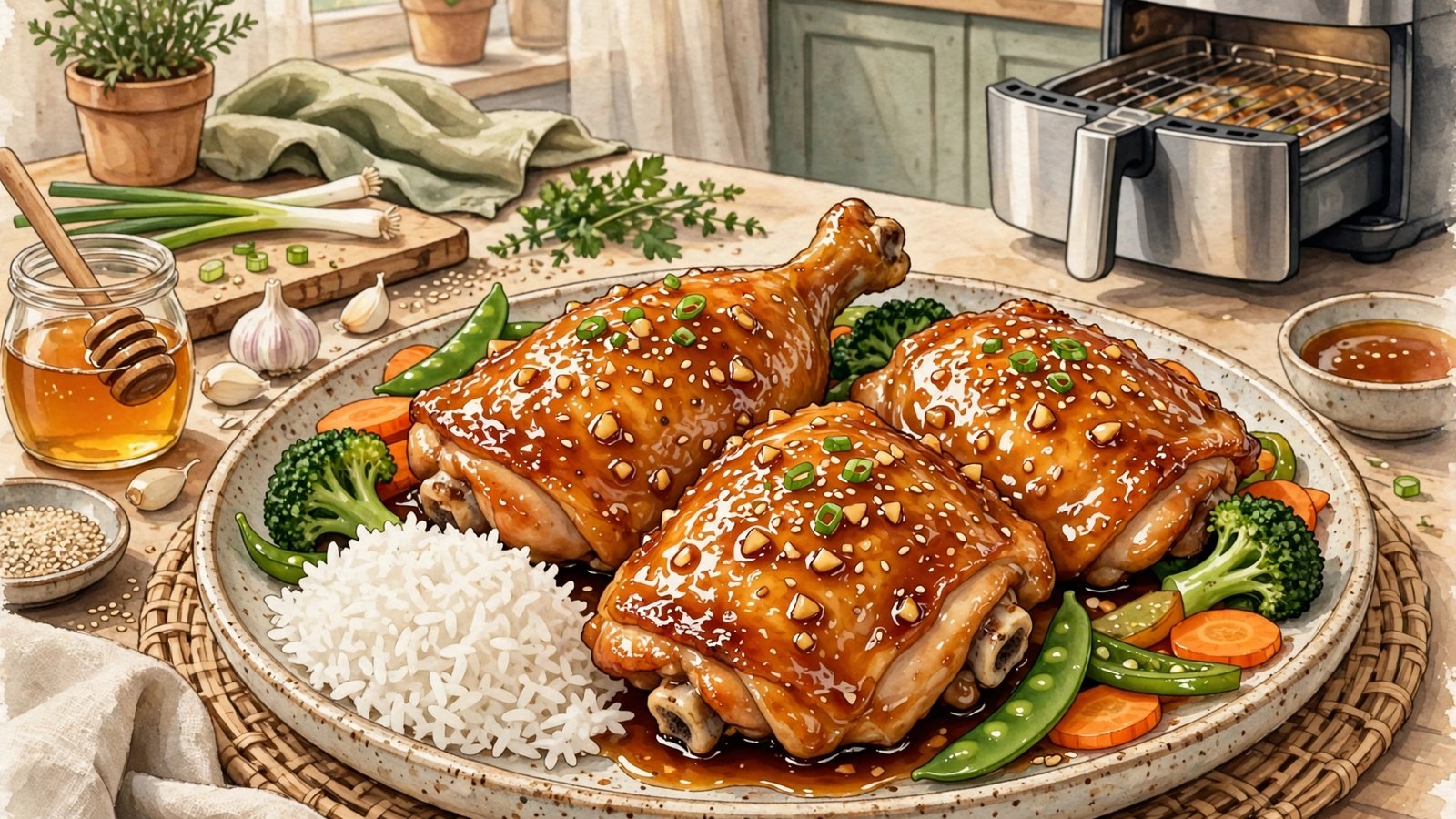
Short answer
- Pat four bone-in, skin-on chicken thighs dry, rub them with olive oil, salt, pepper, garlic powder, and paprika, and air fry them at 380 degrees Fahrenheit in a single layer, skin side down for about 10 minutes and then skin side up for about 8 to 10 minutes more. Brush on a warmed glaze of honey, soy sauce, garlic, and rice vinegar during only the last 3 to 5 minutes. Check the thickest part of each thigh, away from the bone, with a food thermometer. FoodSafety.gov lists 165 degrees Fahrenheit as the safe minimum internal temperature for all poultry, including thighs. Rest for about 5 minutes and serve. Do not feed honey, including honey in this glaze, to a child younger than 1 year old. Refrigerate leftovers promptly, use them within 3 to 4 days, and reheat them to 165 degrees Fahrenheit.
Introduction
Air fryer honey garlic chicken thighs solve two weeknight problems at once. Chicken thighs stay juicy more easily than chicken breasts, and the hot circulating air of an air fryer crisps their skin and browns their edges without a pot of frying oil. A simple glaze of honey, garlic, soy sauce, and vinegar then adds the sweet and savory finish, as long as it goes on at the right time.
That timing is the main lesson in this recipe. Honey contains sugars that caramelize and then burn quickly at high heat. A thigh coated in honey glaze from the start can blacken on the outside before the center is safely cooked. The method here cooks the seasoned thighs first, so the skin renders and crisps, and brushes the glaze on only in the last few minutes, where it can turn glossy and sticky without burning.
This article gives the full recipe for bone-in, skin-on thighs, explains how to adapt it for boneless thighs, shows how to check doneness with a food thermometer against the federal safe minimum temperature for poultry, and covers raw chicken handling, storage, reheating, and allergen and honey notes in plain factual terms. The food safety guidance was checked against FoodSafety.gov, the Centers for Disease Control and Prevention, and the Food and Drug Administration on 31 October 2026.
Why Thighs and Late Glazing Work
Thighs suit the air fryer for practical reasons. They carry more fat than breasts, so they stay moist and remain forgiving if they cook a few degrees past the target, provided they reach the safe minimum first. Their skin crisps well in circulating hot air. Breasts, by contrast, are thick at one end and thin at the other, and dry out quickly when overcooked.
The two stage glazing is the second reason the recipe works. In the first stage the thighs cook with only dry seasoning, so the skin can render and crisp without a sugary coating in the way. In the second stage the glaze goes onto hot, dry, crisp skin, where it clings and caramelizes in minutes. A single early application would expose the glaze to high heat for the full cooking time and would be likely to burn before the meat was done.
Temperature control is the third reason. A setting of 380 degrees Fahrenheit is hot enough to crisp skin and brown the glaze, but not so hot that the honey scorches at once. Higher settings make the glazing window harder to judge, and lower settings give paler, softer skin. Because air fryer models vary, every time here is a guide, and the thermometer reading in the final stage is the decision that matters.
Ingredients
This recipe makes about four servings. Have everything ready before the air fryer is loaded, because the glazing stage moves quickly.
For the chicken:
- 4 bone-in, skin-on chicken thighs, about 2 pounds total
- 1 tablespoon olive oil
- 1/2 teaspoon fine salt
- 1/4 teaspoon ground black pepper
- 1/2 teaspoon garlic powder
- 1/2 teaspoon paprika, sweet or smoked
For the honey garlic glaze:
- 1/4 cup honey
- 3 tablespoons soy sauce, or tamari
- 3 cloves garlic, finely minced or grated
- 1 tablespoon rice vinegar, or apple cider vinegar
- 1 teaspoon freshly grated ginger, optional
- 1 teaspoon toasted sesame oil, optional
- Pinch of red pepper flakes, optional
For serving:
- Sliced green onions
- Toasted sesame seeds, optional
- Lime wedges, optional
- Steamed rice, noodles, or vegetables
Ingredient Notes
Bone-in, skin-on thighs are recommended because the skin crisps into the best texture and the meat stays juicy. Boneless, skinless thighs also work and cook faster, usually in about 15 to 18 minutes total, but they have no skin to crisp and dry out more easily, so check their temperature early. Skin-on boneless thighs are a middle ground.
Honey is both the sweetener and the glazing agent. Any mild, runny honey works; strongly flavored honey, such as buckwheat, can overpower the garlic. Maple syrup makes a similar, thinner glaze if you need to avoid honey. The infant warning is separate and covered in full below: honey is not safe for a child younger than 1 year old, in any form here.
Soy sauce provides salt and savory depth. Tamari is the usual gluten free alternative, but check the label of the specific bottle. For a soy free version, coconut aminos can be used, but they are sweeter and less salty, so reduce the honey slightly and taste before brushing. Rice vinegar adds brightness that keeps the glaze from tasting flatly sweet. Apple cider vinegar is a fine, slightly fruitier substitute.
Garlic in the glaze is best finely minced or grated, because large pieces burn quickly and turn bitter. Grating gives the smoothest glaze and the most even flavor. Fresh garlic is strongly recommended in the glaze. Garlic powder belongs in the first dry seasoning, where it will not sit in a sugary surface coating during the long first stage.
Equipment You Will Need
You need an air fryer, a small saucepan or microwave safe bowl for the glaze, a pastry brush or spoon, tongs, paper towels, and an instant read food thermometer. The thermometer is not optional for chicken. Color, firmness, and juice color are unreliable indicators of doneness, and the only dependable way to know chicken is safely cooked is to measure its internal temperature in the thickest part, away from the bone. A thermometer also prevents overcooking, because you can stop as soon as the safe temperature is reached.
Choosing and Handling Raw Chicken
Buy chicken that has been kept refrigerated, keep it cold on the way home, and refrigerate it promptly. Fresh poultry pieces keep only 1 to 2 days in the refrigerator under the FoodSafety.gov cold storage chart, so cook thighs soon after buying them, or freeze them. Keep raw chicken separate from other foods in a container or a sealed, leak proof bag set on a plate, so its juices cannot drip onto foods eaten without cooking.
FoodSafety.gov groups home food safety into four steps: clean, separate, cook, and chill. Wash your hands with plain soap and water for at least 20 seconds before and after handling raw chicken. Wash cutting boards, dishes, utensils, and countertops with hot, soapy water after they have held raw chicken or its juices. Use separate plates and utensils for raw and cooked chicken, and never put cooked chicken back on a plate that held it raw.
Do not rinse or wash raw chicken under the tap. FoodSafety.gov advises against washing meat and poultry because washing can spread harmful germs around the kitchen. Pat the chicken dry with paper towels instead, which is also what this recipe needs for crisp skin, and throw the towels away at once. If raw chicken smells sour or strongly unpleasant, or feels slimy, do not cook it.
One correction matters here. Some recipes tell cooks to leave raw chicken on the counter for 20 minutes or longer. This recipe does not. Keep the thighs refrigerated until you season them. Perishable food should not be left out for more than 2 hours, or more than 1 hour above 90 degrees Fahrenheit, and raw chicken does not need counter time here.
Method: Step by Step
Step 1: Season the chicken
Pat the thighs very dry with paper towels, especially the skin. Dry skin crisps, and wet skin steams. Trim large flaps of excess skin or fat if you like, but leave the skin covering the meat. Rub the thighs with the olive oil, then season all over with the salt, pepper, garlic powder, and paprika. Set them on a clean plate while you make the glaze, and wash your hands and any surface the raw chicken touched.
Step 2: Make the glaze
Combine the honey, soy sauce, garlic, vinegar, and the ginger, sesame oil, and red pepper flakes if using in a small saucepan. Warm over low heat, stirring, for 2 to 3 minutes, just until the honey thins and the garlic smells fragrant. Do not boil it hard. Alternatively, warm the ingredients in a microwave safe bowl in short bursts, stirring between each. Set the glaze aside; it thickens slightly as it cools, which helps it cling. If you want glaze for spooning over at the table, set a small portion aside in a clean bowl before glazing begins, and never return a brush that has touched partly cooked chicken to that reserved portion.
Step 3: Preheat and load the air fryer
Preheat the air fryer to 380 degrees Fahrenheit for 3 to 5 minutes, following your model instructions. Lightly spray or brush the basket with oil, or line it with perforated parchment made for air fryers if your model allows it. Place the thighs skin side down in a single layer, with space between them. Do not stack or crowd them, because crowded chicken steams instead of crisping. If your air fryer is small, cook in two batches.
Step 4: Cook the first stage
Cook the thighs skin side down for about 10 minutes, then turn them skin side up and cook for about 8 to 10 minutes more. The skin should be starting to crisp and brown, and the meat mostly cooked through, though not yet glazed and not yet assumed done. Times vary with thigh size and model, so rely on the thermometer check in the final stage.
Step 5: Glaze and finish
Brush a generous layer of glaze over the skin side of each thigh. Cook for 3 to 4 minutes, until the glaze is bubbling and caramelized in spots. For a stickier finish, brush on a second, lighter coat and cook for 1 to 2 minutes more, watching closely. Honey can move from caramelized to burnt quickly, so do not walk away. The finished glaze should be glossy and deep golden brown, but not blackened.
Step 6: Check the temperature and rest
Check the internal temperature at once, inserting the thermometer into the thickest part of the thigh without touching the bone. FoodSafety.gov lists the safe minimum internal temperature for all poultry as 165 degrees Fahrenheit. If any thigh reads below that, return it for a few more minutes and check again. Once confirmed, rest the thighs for about 5 minutes so the meat stays juicy when cut. Garnish with green onions and sesame seeds if using, and serve with the reserved, untouched glaze spooned over the top.
How to Tell When Chicken Thighs Are Done
For poultry there is one governing figure, and this recipe uses it without substitutes. FoodSafety.gov, in its safe minimum internal temperature chart, lists chicken, turkey, and other poultry, in every form, at 165 degrees Fahrenheit. The thermometer should be placed in the thickest part of the food, making sure not to touch bone, fat, or gristle, because a probe resting against bone can give a misleading reading.
Visual signs can support the thermometer, but they cannot replace it. Cooked thigh meat loses its raw look and the skin is deeply browned, yet thighs can keep a pink tint near the bone, and from smoked paprika, even when the temperature is safe, and can also look pale before the center is done. If the look and the thermometer disagree, follow the thermometer.
Thighs stay juicy at 165 degrees Fahrenheit and remain forgiving a few degrees above it, so there is no need to cook them well past the safe minimum. That is why the method checks the temperature in the final stage and stops there.
Keeping the Skin Crisp and the Glaze From Burning
Crisp skin and a burnt glaze are opposite failures of the same recipe, and both are controlled by moisture and timing. For crisp skin, pat the thighs thoroughly dry, load them in a single layer with space around each piece, and make sure the air fryer is preheated. Crowding is the most common cause of pale, soft skin, because the pieces block the circulating air. Cooking in batches takes a little longer and gives a much better result.
For a glaze that does not burn, keep it off the chicken until the last 3 to 5 minutes, keep the temperature at 380 degrees Fahrenheit during glazing, and watch the basket through the final minutes. A single coat in the last 3 minutes is enough for a glossy, flavorful result. If a glaze has already blackened, scrape off the blackened parts where you can and serve the chicken with the reserved, uncooked portion of glaze warmed separately.
Variations and Swaps
For boneless thighs, reduce the total cooking time to about 15 to 18 minutes, turn them halfway, and glaze in the last 3 minutes. Check the temperature early, because boneless thighs cook faster and dry out sooner. The safe minimum is the same 165 degrees Fahrenheit. For skinless thighs, the method still works, but there will be no crisp skin. Brush them lightly with oil before cooking to help them brown.
For a spicier glaze, add a spoonful of chili garlic sauce or increase the red pepper flakes. For a citrus version, add a tablespoon of orange juice and a teaspoon of orange zest. For a ginger forward version, double the grated ginger. Each version keeps the same rule: dry seasoning first, glaze only at the end.
For a soy free version, use coconut aminos and reduce the honey by about a tablespoon, because coconut aminos are sweeter and less salty. Taste and add a little more vinegar if it is too sweet. For a sesame free version, leave out the sesame oil and the sesame seed garnish. Read the allergen section before using any swap for a guest, because a swap changes the allergen profile.
Without an air fryer, roast the thighs on a wire rack over a baking sheet at 425 degrees Fahrenheit for about 25 to 30 minutes, turned halfway, then glaze for about 5 minutes, watched closely. Chicken breasts can be used, but they dry out more easily, so pound them even, shorten the time, and check the temperature early. The glaze timing and the 165 degrees Fahrenheit check stay the same.
Serving Ideas and a Simple Timing Plan
Steamed rice or fried rice soaks up extra glaze well. Stir fried or roasted vegetables, especially broccoli, green beans, or bok choy, add freshness and crunch. A simple cucumber salad with rice vinegar cuts through the sweetness. For a lighter meal, serve sliced rested thighs over a green salad. Sparkling water with lime or iced tea suits the glaze, because both are refreshing rather than heavy.
Make the glaze first and set the reserved portion aside. Prepare garnishes and start rice or vegetables next, so they finish with the chicken. Season the thighs last, just before loading. Then allow about 18 to 20 minutes for the first stage, 3 to 5 minutes for glazing, a thermometer check, and about 5 minutes of resting, about 10 to 15 minutes of preparation and about 25 minutes of cooking and resting in total.
For a larger group, double the recipe and cook in batches rather than crowding one basket. Keep finished thighs warm briefly in a low oven at about 200 degrees Fahrenheit while the second batch cooks, and serve within about 20 minutes if crisp skin matters, because the skin softens when held.
Make-Ahead, Storage, Reheating, and Food Safety
You can season the thighs and make the glaze up to a day ahead, storing each separately in the refrigerator, and cook the chicken within the 1 to 2 day window FoodSafety.gov gives for fresh poultry pieces. Warm the glaze gently before brushing. Do not glaze raw chicken ahead of time, because the honey can draw moisture from the skin.
For leftovers, follow the chill step. Refrigerate cooked chicken within 2 hours of cooking, or within 1 hour if it has been exposed to temperatures above 90 degrees Fahrenheit. Bacteria that cause food poisoning multiply quickest between 40 degrees Fahrenheit and 140 degrees Fahrenheit. Keep your refrigerator at 40 degrees Fahrenheit or below and your freezer at 0 degrees Fahrenheit or below. Place leftovers in shallow containers and refrigerate them promptly so they cool quickly.
The FoodSafety.gov cold storage chart gives cooked meat or poultry 3 to 4 days in the refrigerator and 2 to 6 months in the freezer, with freezer times given for quality. When reheating, bring leftovers to 165 degrees Fahrenheit throughout, measured with a food thermometer. The air fryer restores the most crispness: heat at about 350 degrees Fahrenheit for 4 to 5 minutes, then check the temperature, because time alone does not confirm the center is hot enough. A microwave works but softens the skin. Thaw frozen leftovers safely in the refrigerator, in cold water in a leak proof bag, or in the microwave, never on the counter, and cook food thawed by the cold water or microwave methods immediately.
Allergen and Honey Notes
This section is factual information for planning and serving, not medical advice. As written, the dish contains soybeans, from the soy sauce, and wheat, because ordinary soy sauce is commonly brewed with wheat. It contains sesame if the optional sesame oil or sesame seeds are used. The Food and Drug Administration lists nine foods, and ingredients containing their proteins, as major food allergens: milk, egg, fish, crustacean shellfish, tree nuts, wheat, peanuts, soybeans, and sesame. Sesame became the ninth major food allergen under the Food Allergy Safety, Treatment, Education, and Research Act, with labeling required from 1 January 2023.
Those facts shape the swaps. Tamari is often sold as gluten free, which can remove the wheat, but it is still made from soybeans, so a tamari version is not soy free. Coconut aminos can make the dish soy free, subject to the label. Check all labels, because the Food and Drug Administration notes that recipes can change and advises reading the entire ingredient list every time. Ask a guest with an allergy before you plan the dish.
The honey note is separate from allergy. The Centers for Disease Control and Prevention states that honey is not safe for infants, because honey can contain the bacteria that cause botulism, and instructs: do not feed honey to a child who is younger than 1 year old. That rule covers honey cooked into this glaze, any reserved glaze served at the table, and products made with honey, including honey pacifiers, which the Centers for Disease Control and Prevention specifically warns against. Cooking the glaze does not make it suitable for an infant. If a child younger than 12 months will be eating, serve that child chicken cooked without honey, kept separate from the glaze, or choose a different dish.
Troubleshooting
If the skin is not crisp, the likely causes are wet skin, a crowded basket, or no preheat. Pat the skin dry, cook in a single layer, and confirm the preheat. If the glaze burns, it was applied too early or the heat was too high for your model. If the chicken is dry, it was probably overcooked, or the thighs were very small or boneless. Use the thermometer and remove the chicken as soon as it confirms 165 degrees Fahrenheit. If the glaze slides off, let it cool slightly so it thickens and brush it on in a thin coat. If the chicken sticks, lightly oil the basket and let the thighs cook undisturbed until they release more easily.
Frequently Asked Questions
What temperature should chicken thighs reach?
165 degrees Fahrenheit, measured with a food thermometer in the thickest part of the thigh, away from the bone. FoodSafety.gov lists that figure as the safe minimum internal temperature for all poultry, including thighs, breasts, wings, and ground poultry. Color and juices are not reliable substitutes for the thermometer.
Can I cook chicken thighs from frozen in the air fryer?
Not for this recipe. Frozen thighs cook unevenly, the skin does not crisp well, and the glazing timing becomes unreliable. Thaw thighs safely in the refrigerator, sealed in a bag in cold water, or in the microwave, and cook food thawed by the cold water or microwave methods immediately. Never thaw chicken on the counter.
Should I use bone-in or boneless thighs?
Bone-in, skin-on thighs give the juiciest result and the crispest skin, and they are the recommendation here. Boneless thighs cook faster, in about 15 to 18 minutes, and are easier to eat, but they dry out more easily and have no skin to crisp. Both types have the same safe minimum temperature of 165 degrees Fahrenheit.
Why does my honey glaze burn?
Honey contains sugars that caramelize and then burn quickly at high heat. Glazing too early, raising the temperature during glazing, or leaving the air fryer unattended in the final minutes all cause burning. Glaze only in the last 3 to 5 minutes at 380 degrees Fahrenheit, use a second coat only in the final minute, and watch the chicken throughout that stage.
Can a baby or young infant have a taste of the chicken?
Do not give honey, or food made with honey such as this glazed chicken, to a child younger than 1 year old. The Centers for Disease Control and Prevention states that honey can contain the bacteria that cause botulism and that honey is not safe for infants. Cook a separate, unglazed portion if an infant will be eating, and keep the glaze and glazed pieces away from that portion.
Is this recipe gluten free?
It can be, with changes and label checks. Ordinary soy sauce commonly contains wheat. Use a tamari labeled gluten free instead, and check the labels of the other ingredients each time you buy them. A gluten free version made with tamari still contains soy, so it is not soy free, and it contains sesame if you use the optional sesame oil or seeds.
How long do leftovers keep, and how should I reheat them?
Refrigerate leftovers in shallow covered containers within 2 hours of cooking, or within 1 hour if the room is above 90 degrees Fahrenheit, and use them within 3 to 4 days, or freeze them for 2 to 6 months for quality. Reheat them to 165 degrees Fahrenheit throughout, measured with a food thermometer. The air fryer, at about 350 degrees Fahrenheit for 4 to 5 minutes followed by a temperature check, restores the most crispness.
Sources & references
- FoodSafety.gov, Cook to a Safe Minimum Internal Temperature. Used for the safe minimum internal temperature chart: chicken, turkey, and other poultry in all forms, including thighs, at 165 degrees Fahrenheit, leftovers of any type reheated to 165 degrees Fahrenheit, and the instruction to always use a food thermometer, placed in the thickest part of the food without touching bone, fat, or gristle.
- FoodSafety.gov, 4 Steps to Food Safety. Used for the four steps clean, separate, cook, and chill, washing hands with plain soap and water for at least 20 seconds, washing boards, dishes, utensils, and countertops with hot soapy water after raw poultry, using separate plates and utensils for raw and cooked foods, not washing meat or poultry, keeping food hot at 140 degrees Fahrenheit or above, microwaving food thoroughly to 165 degrees Fahrenheit or above, keeping a refrigerator at 40 degrees Fahrenheit or below and a freezer at 0 degrees Fahrenheit or below, bacteria multiplying quickest between 40 degrees Fahrenheit and 140 degrees Fahrenheit, refrigerating perishable food within 2 hours or within 1 hour above 90 degrees Fahrenheit, placing leftovers in shallow containers, and thawing or marinating in the refrigerator rather than on the counter.
- FoodSafety.gov, Cold Food Storage Chart, last reviewed 19 September 2023. Used for fresh poultry pieces at 1 to 2 days in the refrigerator and 9 months in the freezer, and cooked meat or poultry leftovers at 3 to 4 days in the refrigerator and 2 to 6 months in the freezer, with freezer guidelines given for quality only.
- Centers for Disease Control and Prevention, Botulism Prevention. Used for infant botulism: honey can contain the bacteria that cause botulism, honey is not safe for infants, do not feed honey to a child who is younger than 1 year old, and do not give honey or products made with it, including honey pacifiers, to infants.
- Food and Drug Administration, Have Food Allergies? Read the Label. Used for the nine major food allergens, milk, egg, fish, crustacean shellfish, tree nuts, wheat, peanuts, soybeans, and sesame, for sesame becoming the ninth major food allergen under the Food Allergy Safety, Treatment, Education, and Research Act with labeling required from 1 January 2023, and for the advice to read the entire ingredient list every time a product is bought because ingredients can change at any time.


