Short answer
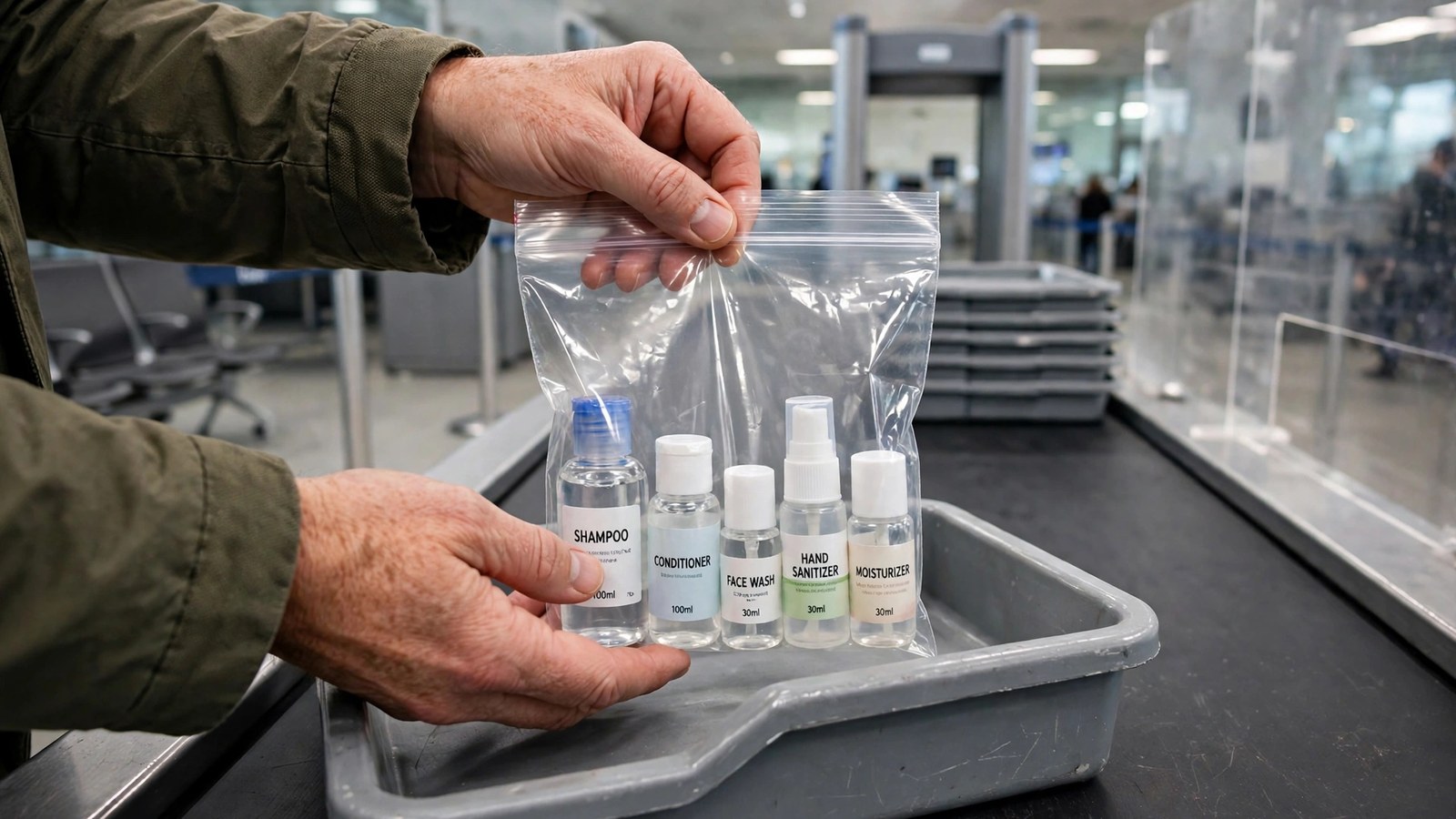
- You can take liquids on a plane in your carry-on bag only in containers of 3.4 ounces (100 milliliters) or less. Every container must fit inside one clear quart-size bag, and each passenger is limited to one bag. This is the TSA 3-1-1 liquids rule, and it applies to liquids, gels, aerosols, creams, and pastes, including toothpaste, shampoo, conditioner, mouthwash, and lotion. The limit is per container, not a total number of ounces per passenger. TSA publishes no total ounce allowance for carry-on liquids. The quart bag is the practical limit on how much you can carry, because every container has to fit inside it with the bag closed. A container larger than 3.4 ounces does not pass the checkpoint in a carry-on bag, even if it is nearly empty. Larger containers belong in checked baggage. A small number of exceptions apply. Medically necessary liquids and infant and child nourishments, including formula and breast milk, may exceed 3.4 ounces under separate screening. Duty-free liquids bought internationally may also exceed the limit on an inbound connecting flight if strict conditions are met. Those exceptions are explained below.
By Emma Hudson
If you are packing a carry-on bag, the liquid question comes down to one rule. The Transportation Security Administration (TSA) limits each liquid container to 3.4 ounces, requires all containers to fit in a single quart-size bag, and allows one bag per passenger. This guide explains that rule in full, what counts as a liquid, which exceptions apply, and how to pack so that nothing has to be left behind at the checkpoint. It is general information, not legal or travel advice, and TSA rules can change, so check TSA.gov again before you fly.
The 3-1-1 Rule in Full
The name 3-1-1 is a memory aid for the three parts of the rule.
3 stands for 3.4 ounces. Each container of liquid, gel, aerosol, cream, or paste in your carry-on may hold 3.4 ounces (100 milliliters) or less. The TSA liquids rule page states the limit this way: you are allowed to bring a quart-sized bag of liquids, aerosols, gels, creams, and pastes in your carry-on bag and through the checkpoint, limited to travel-sized containers of 3.4 ounces (100 milliliters) or less per item.
The first 1 stands for one quart-size bag. All of your small containers must fit inside a single quart-size bag. A quart is 32 fluid ounces, or about 946 milliliters, but that figure describes the size of the bag, not an allowance of liquid. You may not fill the bag with 32 ounces of liquid in large containers. Each container inside the bag must still be 3.4 ounces or less, and the bag must close with the containers inside.
The second 1 stands for one bag per passenger. Each passenger is limited to one quart-size bag of liquids, gels, and aerosols. You cannot carry a second bag and call it your own, and traveling companions cannot pool their containers into one oversized bag. Each person packs a separate bag.
Placing the containers in the small bag and separating that bag from your carry-on baggage facilitates the screening process, in TSA wording. Any liquid, aerosol, gel, cream, or paste that alarms during screening will require additional screening, and the final decision on whether an item is allowed through the checkpoint rests with the TSA officer.
The Container Rule: Size, Not Contents
The most misunderstood part of the rule is that it judges the container, not the amount left inside it. TSA directs travelers to pack items that are in containers larger than 3.4 ounces or 100 milliliters in checked baggage. A 6 ounce bottle of shampoo with only an ounce left in it is still a 6 ounce container, so it does not meet the carry-on limit. A 200 milliliter bottle with 50 milliliters remaining is still a 200 milliliter container.
The size printed on the container is what counts. If a bottle is unlabeled, or its size is unclear, replace it with a labeled travel container rather than guessing at the checkpoint. The same point explains why a full water bottle cannot pass the checkpoint while an empty bottle can. The empty bottle holds no liquid, so there is nothing for the liquid limit to measure. Fill the bottle after security instead.
What Counts as a Liquid
Under the TSA rule, liquid covers far more than drinks. The rule names five forms: liquids, gels, aerosols, creams, and pastes. Common travel items that must comply include toothpaste, shampoo, conditioner, mouthwash, and lotion. The same treatment applies to hair gel, sunscreen, liquid foundation and other liquid cosmetics, cologne and perfume, shaving cream, and aerosol products such as hairspray and spray deodorant. Hand sanitizer is a gel for this purpose and follows the standard rule described in its own section below.
Toothpaste surprises many travelers, but TSA treats it as a paste, so a tube of toothpaste in a carry-on bag must be 3.4 ounces or less and must go in the quart bag. Lotion is a cream, so it follows the same limit. Liquid and gel makeup counts toward the quart bag, while powder makeup does not, because powder is not a liquid, gel, aerosol, cream, or paste.
There is no separate list of banned beauty products behind these questions. What happens at screening is size based. A beauty product in liquid, gel, cream, paste, or aerosol form, in a container larger than 3.4 ounces, cannot go through the checkpoint in a carry-on bag. The traveler must check it, leave it behind, or surrender it. Ask two questions about each product. Is it a liquid, gel, cream, paste, or aerosol? Is its container 3.4 ounces or less? If the first answer is yes and the second is no, it does not fly in the cabin in that container.
Solid toiletries sit outside the rule. Bar soap, shampoo bars, and solid deodorant are not liquids, so they do not need to fit in the quart bag and are not held to the 3.4 ounce limit. Switching one or two items to solid form is the simplest way to free space in the bag.
For anything beyond liquids, including sharp objects, flammable items, and other prohibited categories, the rule in this article does not decide the answer. Check the item in the TSA What Can I Bring list before you pack it.
Ounces and Milliliters: The Conversion Table
TSA states the container limit in both units: 3.4 fluid ounces or 100 milliliters. The two figures are treated as the same limit, so a container marked in either unit can be checked directly against it. The table below gives the conversions travelers use most when a product is labeled in only one unit. One fluid ounce is about 29.57 milliliters.
| Amount | Fluid ounces | Milliliters |
|---|---|---|
| TSA container limit | 3.4 fl oz | 100 ml |
| Small travel bottle | 1.7 fl oz | 50 ml |
| Common travel bottle | 2.0 fl oz | 59 ml |
| Common travel bottle | 3.0 fl oz | 89 ml |
| Quart bag size | 32 fl oz (1 quart) | 946 ml (about 0.95 liters) |
| One liter | 33.8 fl oz | 1,000 ml |
Read the table with the container rule in mind. A bottle labeled 125 milliliters is over the limit, even though it sounds small, because 125 milliliters is about 4.2 fluid ounces. A bottle labeled 3 ounces is within the limit. When a label shows both units and they appear to disagree, pack the item in checked baggage or choose a smaller container, rather than arguing the conversion at the checkpoint.
The Quart Bag and How to Pack It
The rule requires a quart-size bag. In practice, travelers use a standard clear resealable quart-size bag. The bag must be clear so that screeners can see the containers, and it must close with the containers inside. TSA does not require a special branded bag. Any clear, resealable quart-size bag that holds your containers and closes meets the description in the rule.
Packing well follows directly from the rule itself:
- Decant full size products into travel containers of 3.4 ounces or less, or buy travel sizes. Anything larger goes in checked baggage.
- Pack the bag so that it closes. A bag that cannot seal because a container is too tall, or because too many containers are crammed in, does not meet the rule, even if every container is individually small enough.
- Keep the bag accessible. TSA advises separating the liquids bag from your carry-on baggage for screening, so pack it where you can reach it quickly, and follow the instructions at your lane, because procedures vary by airport and equipment.
- Put solids elsewhere. Bar soap, shampoo bars, and solid deodorant travel outside the bag, which leaves more room for the liquids you actually need.
- Check unlabeled bottles at home. If you cannot read a container size, move the item to checked baggage or a labeled travel bottle before you leave.
Exceptions: Medically Necessary Liquids
Medications are one of the two exemption categories TSA names on its liquids rule page. TSA allows larger amounts of medically necessary liquids, gels, and aerosols in reasonable quantities for your flight, but you must declare them to TSA officers at the checkpoint for inspection.
The process has set steps. Before screening begins, inform the TSA officer that you have medically necessary liquids or medications. Remove them from your carry-on bag and place them in a bin or bowl, separate from your other belongings, along with accessories such as freezer packs, IV bags, pumps, and syringes. You are not required to place liquid medication in the quart bag or in a plastic zip-top bag.
TSA officers may test liquids, gels, or aerosols for explosives or concealed prohibited items, and screening will never include placing anything into the medically necessary liquid. If a medically necessary item alarms, additional screening will be required, and if the alarm cannot be resolved, the item may not be allowed. If you do not want your liquid medication to be screened by X-ray or opened, tell the officer. Additional steps will be taken to clear the liquid, and you will undergo additional screening procedures. Ice packs, freezer packs, and gel packs used to keep medically necessary items cool may be presented in a frozen, partially frozen, or melted state, and liquids associated with a nebulizer are also exempt from the 3-1-1 rule.
Keep quantities reasonable for the trip. The exemption covers what you need for the flight, in reasonable amounts, not a full household supply.
Exceptions: Formula, Breast Milk, and Baby Food
Infant and child nourishments are the second exemption category on the TSA liquids rule page. Formula, breast milk, toddler drinks, and baby or toddler food, including puree pouches, in quantities greater than 3.4 ounces or 100 milliliters are allowed in carry-on baggage and do not need to fit within a quart-size bag. TSA classifies these items as medically necessary liquids. Formula, breast milk, and juice in quantities greater than 3.4 ounces are likewise exempt.
You do not need to travel with your child to bring breast milk, and the exemption also covers breast milk pumping equipment, whether or not breast milk is present. Cooling accessories, such as ice packs, freezer packs, and gel packs, are allowed regardless of the presence of breast milk. Gel or liquid filled teethers and canned, jarred, and processed baby food may also travel in a carry-on bag, subject to additional screening.
At the checkpoint, inform the TSA officer at the beginning of the screening process that you are carrying these items in amounts over 3.4 ounces, and remove them from your carry-on bag so that they can be screened separately. Officers may need to test the liquids for explosives or concealed prohibited items. Screening will never include placing anything into the liquid. To expedite screening, TSA recommends transporting formula and breast milk in clear, translucent bottles rather than plastic bags or pouches. If you do not want these items X-rayed or opened, inform the officer. Additional steps will be taken to clear the liquid, and you or the traveling guardian will undergo additional screening.
Duty-Free Liquids and Purchases After Security
Duty-free liquids follow a narrow inbound rule, not a general exemption. You may carry duty-free liquids in secure, tamper-evident bags, in amounts more than 3.4 ounces or 100 milliliters, in your carry-on bag only if all of the following are true. The liquids were purchased internationally and you are traveling to the United States with a connecting flight. The liquids are packed in a transparent, secure, tamper-evident bag by the retailer and do not show signs of tampering when presented to TSA for screening. The original receipt for the liquids is present, and the purchase was made within 48 hours.
The items inside the bags must still be screened and cleared. Any item that alarms, or that cannot be screened, will not be permitted in your carry-on bag. TSA recommends packing all liquids, gels, and aerosols over 3.4 ounces or 100 milliliters in checked baggage, even if they are in a secure, tamper-evident bag. Liquids over 3.4 ounces that are not in such a bag must be packed in checked baggage.
Liquids you buy after you have passed the checkpoint for your own flight, such as a bottle of water at a shop inside the secure area, are a different situation, because you will not pass through TSA screening again before boarding that flight. The duty-free conditions above matter when you land in the United States and go through screening again for a connecting flight. If you have such a connection, keep the bag sealed and the receipt with it until screening is complete.
Frozen Liquids and Ice Packs
Frozen liquid items are allowed through the checkpoint as long as they are frozen solid when presented for screening. If a frozen liquid item is partially melted, slushy, or has any liquid at the bottom of the container, it must meet the 3-1-1 liquids requirements, which in practice means 3.4 ounces or less in the quart bag for an ordinary item.
This is why a frozen water bottle can pass while the same bottle, thawed, cannot. Timing matters. An item that is frozen solid at home may be slushy by the time you reach the checkpoint, so treat freezing as a backup plan rather than a guarantee. The cooling accessories for medically necessary liquids and for formula and breast milk are handled under those exemptions instead, as described above, and may be presented partially frozen or slushy for the same screening as the items they cool.
Water Bottles and Hand Sanitizer
Water bottles cause more checkpoint arguments than any other item, and the answer depends on one fact: whether the bottle holds liquid at screening. A bottle of water larger than 3.4 ounces cannot pass the checkpoint in a carry-on bag. An empty bottle of any size holds no liquid, so travel with the bottle empty and fill it after security. A bottle frozen solid is covered by the frozen liquids rule above.
Hand sanitizer is a gel under the liquids rule. It follows the standard limit: a container of 3.4 ounces or less, inside the quart bag. The current TSA liquids rule page names only two exemption categories, medications and infant and child nourishments, and hand sanitizer is not one of them. If you see advice that a large bottle of hand sanitizer, such as 12 ounces, is allowed in a carry-on bag, treat that advice as out of date and check TSA.gov before relying on it. A larger bottle belongs in checked baggage.
Checked Baggage: Where Larger Containers Go
A container larger than 3.4 ounces is not banned from flying. It is banned from the cabin in that size. TSA directs travelers to pack items in containers larger than 3.4 ounces or 100 milliliters in checked baggage, and liquids over 3.4 ounces that are not in a secure, tamper-evident duty-free bag must be packed in checked baggage.
That is the practical answer when the amount you need exceeds the carry-on limits. Full size shampoo, conditioner, lotion, and similar toiletries travel in a checked bag instead of the quart bag. The 3-1-1 rule is a carry-on rule, so it does not set a per container cap for checked baggage in the same form. Separate safety rules still apply in checked baggage, and some items, including certain flammable liquids and restricted aerosols, are prohibited in both carry-on and checked baggage. Check the specific item, not just its size, before you pack it in either bag.
International Flights
The 3-1-1 rule described in this article is the United States rule, applied at TSA checkpoints, including checkpoints for flights departing the United States to other countries. Many other countries use a similar 100 milliliter container limit with a single small bag, which is why the 3.4 ounce figure will look familiar abroad. Details, bag sizes, and screening procedures vary by country and airport, and some airports have changed their procedures as new screening equipment arrives.
For a flight departing another country, check that country security authority before packing, and do not assume that an exception granted by TSA, such as the duty-free conditions for inbound connections, will be honored in the same form elsewhere.
Carry-On Toiletries Checklist
Use this checklist, built from the rule, before you close your bag:
- Every liquid, gel, aerosol, cream, and paste is in a container of 3.4 ounces (100 milliliters) or less, judged by the size printed on the container.
- Every such container fits inside one clear, resealable quart-size bag, and the bag closes.
- You have one quart bag in total, for yourself only.
- Solid toiletries, such as bar soap, shampoo bars, and solid deodorant, are packed outside the bag.
- Medically necessary liquids and infant nourishments are packed separately, ready to declare and to place in a bin or bowl.
- Anything larger than 3.4 ounces that is not exempt is in checked baggage.
- Any duty-free liquid over 3.4 ounces is still sealed in its tamper-evident bag, with its receipt, and was bought within 48 hours of your connecting screening.
- Your water bottle is empty, or frozen solid, for the checkpoint.
Frequently Asked Questions
How many ounces can you take on a plane?
In a carry-on bag, you can take containers of 3.4 ounces (100 milliliters) or less, all fitting in one quart-size bag, with one bag per passenger. There is no published total ounce allowance. The bag is the limit. Larger containers go in checked baggage, apart from the medical, infant nourishment, and duty-free exceptions described in this article.
What is the TSA liquid limit?
The TSA liquid limit is the 3-1-1 rule: 3.4 ounces (100 milliliters) per container, one quart-size bag, and one bag per passenger, for liquids, gels, aerosols, creams, and pastes in carry-on baggage. Toothpaste, shampoo, conditioner, mouthwash, and lotion are among the common items that must comply.
How many milliliters can you take on a plane?
100 milliliters per container in a carry-on bag, which TSA treats as the same limit as 3.4 fluid ounces. One fluid ounce is about 29.57 milliliters, so check labels in either unit against the same rule. A container labeled 125 milliliters is over the limit.
Does toothpaste count as a liquid for TSA?
Yes. TSA treats toothpaste as a paste under the liquids rule, and its liquids page names toothpaste among the common travel items that must comply with the 3-1-1 rule. A tube in a carry-on bag must be 3.4 ounces or less and must go in the quart bag. The same container rule applies to lotion, which TSA treats as a cream and also names on its liquids page.
Can you bring a full water bottle through security?
No, if the bottle holds more than 3.4 ounces of water at screening. Travel with the bottle empty and fill it after the checkpoint, or freeze the water solid so that the bottle is frozen solid when presented for screening. If it is partially melted or slushy, it must meet the 3-1-1 requirements.
Can you bring hand sanitizer on a plane?
Yes, in a carry-on bag, in a container of 3.4 ounces or less inside your quart bag. Hand sanitizer is not in either exemption category on the current TSA liquids rule page, so the standard limit applies. Put larger bottles in checked baggage, and check TSA.gov before you fly if you have seen a larger allowance quoted elsewhere.
What happens if a container is larger than 3.4 ounces but almost empty?
It still does not meet the carry-on rule. The rule judges the container size printed on the bottle, not the amount left inside. TSA directs travelers to pack items in containers larger than 3.4 ounces in checked baggage, so move the product to a labeled travel container of 3.4 ounces or less, or check the original bottle.
Do you have to take the liquids bag out at the checkpoint?
Be ready to. TSA states that placing the containers in the small bag and separating the bag from your carry-on baggage facilitates the screening process. Procedures vary by airport, lane, and equipment, so follow the instructions at your checkpoint. Medically necessary liquids and infant nourishments must be removed and placed separately in any case.
Can you bring medication, formula, or breast milk over 3.4 ounces?
Yes, under the exemptions. TSA allows larger amounts of medically necessary liquids, gels, and aerosols in reasonable quantities for your flight, declared to an officer and screened separately, outside the quart bag. Formula, breast milk, toddler drinks, and baby or toddler food in quantities greater than 3.4 ounces are also allowed, do not need to fit in the quart bag, and are screened separately. You do not need to travel with your child to bring breast milk.
Can duty-free liquids over 3.4 ounces go in a carry-on bag?
Only on the inbound terms TSA publishes. The liquids must have been purchased internationally, you must be traveling to the United States with a connecting flight, the liquids must remain in a transparent, secure, tamper-evident bag with no signs of tampering, and the original receipt must be present with a purchase made within 48 hours. The items must be screened and cleared, and TSA recommends packing liquids over 3.4 ounces in checked baggage even when they are in such a bag.
What size shampoo or lotion can you take on a plane?
3.4 ounces (100 milliliters) or less per container in a carry-on bag, inside the quart bag. The same figure answers the question for conditioner, mouthwash, cologne, hairspray, and other liquids, gels, aerosols, creams, and pastes. Full size bottles belong in checked baggage, and solid alternatives, such as a shampoo bar or solid deodorant, are not limited by this rule.
Keep reading: How Many Ounces in a Gallon
Keep reading: Cups to Ounces: How Many Ounces in a Cup?
Keep reading: Milliliters to Ounces: Exact Conversion Table & Examples
Sources & references
- Transportation Security Administration, Liquids, Aerosols, and Gels Rule. Used for the core rule (a quart-sized bag of liquids, aerosols, gels, creams, and pastes, in travel-sized containers of 3.4 ounces or 100 milliliters or less per item), for the instruction to pack larger containers in checked baggage, for additional screening when an item alarms, for the two exemption categories (medications and infant and child nourishments), and for the inbound duty-free conditions (international purchase, travel to the United States with a connecting flight, transparent secure tamper-evident bag with no signs of tampering, original receipt present, purchase within 48 hours, items screened and cleared). https://www.tsa.gov/travel/security-screening/liquids-aerosols-gels-rule
- Transportation Security Administration, Liquids, Aerosols, and Gels Rule, Frequently Asked Questions. Used for the statement that each passenger may carry liquids, gels, and aerosols in travel-size containers of 3.4 ounces or 100 milliliters, for the one quart-size bag limit per passenger, and for the list of common items that must comply, including toothpaste, shampoo, conditioner, mouthwash, and lotion. https://www.tsa.gov/travel/frequently-asked-questions/liquids-aerosols-and-gels-rule
- Transportation Security Administration, Travel Tips: 3-1-1 Liquids Rule. Used for the statement that you are allowed to bring a quart-sized bag of liquids, aerosols, gels, creams, and pastes through the checkpoint, limited to 3.4 ounces (100 milliliters) or less per item, also known as the 3-1-1 liquids rule. https://www.tsa.gov/videos/travel-tips-3-1-1-liquids-rule
- Transportation Security Administration, Disabilities and Medical Conditions. Used for the medically necessary liquids exemption (larger amounts in reasonable quantities for the flight, declared to officers at the checkpoint), for the bin or bowl procedure and associated accessories, for testing and alarm handling, for the X-ray and opening opt-out with additional screening, for cooling accessories in frozen, partially frozen, or melted state, and for the nebulizer liquids exemption. https://www.tsa.gov/travel/tsa-cares/disabilities-and-medical-conditions
- Transportation Security Administration, Traveling with Children. Used for formula, breast milk, toddler drinks, and baby or toddler food, including puree pouches, in quantities over 3.4 ounces, for cooling accessories regardless of whether breast milk is present, for the points that these items do not need to fit within a quart-sized bag and are considered medically necessary liquids, and for the inform, remove, and separate screening process. https://www.tsa.gov/travel/tsa-cares/traveling-children
- Transportation Security Administration, What Can I Bring: Breast Milk. Used for the same infant nourishment exemption in item form, for pumping equipment and cooling accessories, for the recommendation to use clear, translucent bottles, for the point that screening will never include placing anything into the liquid, and for the X-ray opt-out with additional screening. https://tsa.gov/travel/security-screening/whatcanibring/items/breast-milk
- Transportation Security Administration, Is Breast Milk, Formula and Juice Exempt from the 3-1-1 Liquids Rule? Used for the exemption of formula, breast milk, and juice in quantities greater than 3.4 ounces or 100 milliliters, for the point that you do not need to travel with your child to bring breast milk, and for gel or liquid filled teethers and canned, jarred, and processed baby food. https://www.tsa.gov/travel/frequently-asked-questions/breast-milk-formula-and-juice-exempt-3-1-1-liquids-rule
- Transportation Security Administration, What Can I Bring: Ice. Used for the frozen liquids rule: frozen liquid items are allowed through the checkpoint as long as they are frozen solid when presented for screening, and items that are partially melted, slushy, or have any liquid at the bottom of the container must meet 3-1-1 liquids requirements. Also used for the statement that the final decision rests with the TSA officer. https://www.tsa.gov/travel/security-screening/whatcanibring/items/ice


