Short answer
- There is no single number of grams in a cup, because a cup measures volume and a gram measures mass, and different ingredients pack different amounts of mass into the same volume. For one level US cup of 236.588 milliliters, the weights used here are about 120 grams for all-purpose flour spooned and leveled, 200 grams for granulated sugar, 220 grams for brown sugar firmly packed, 227 grams for butter, 237 grams for water, and 339 grams for honey. Every figure in this article names its ingredient, because a grams in a cup figure without an ingredient is incomplete. If a recipe gives grams, use those grams directly. If it gives only cups, find the weight for that ingredient in the tables below, or weigh one cup of your own ingredient once and keep the result.
By Emma Hudson
A brief Introduction: If you have ever searched for how many grams in a cup and found three different answers on three different pages, the pages were probably not all wrong. They were probably answering about different ingredients, different cup sizes, or different ways of filling the cup, without saying so. A cup is a volume, a gram is a mass, and the weight that fills a cup changes with the ingredient. This guide gives the per ingredient weights for one US cup, shows how to scale them to part cups, explains how to convert in the reverse direction from grams to cups, and shows why a kitchen scale removes the guesswork when a recipe needs precision.
Why Volume to Mass Needs Density
A cup answers the question how much space, and a gram answers the question how much matter. The bridge between them is density, which is mass per unit of volume. The working formula is simple: grams equal volume multiplied by density. For a US cup, the volume is 236.588 milliliters. Multiply that volume by an ingredient density in grams per milliliter and the result is the grams in one US cup of that ingredient.
Water is the reference case. Its density is about 1.00 gram per milliliter at ordinary kitchen temperatures, so a US cup of water weighs about 237 grams, which is 236.588 milliliters multiplied by 1.00 and rounded. All-purpose flour spooned lightly into a cup has a bulk density of about 0.51 grams per milliliter, because much of the cup is air trapped between fine particles, so the same cup weighs only about 120 grams. Honey has a density of about 1.43 grams per milliliter, so a US cup of honey weighs about 339 grams. One fixed volume, three very different weights, and the only thing that changed was the ingredient.
That is also why published tables disagree. A grams per cup table is really a density table in disguise, and for dry ingredients density is not a fixed property of the ingredient alone. It also depends on how finely the ingredient is ground, how much it has settled, and how the cup was filled. Two honest tables can differ by several grams for the same ingredient because they assumed different filling methods. The tables here state the filling method wherever method changes the weight, and round to the nearest gram.
One more distinction matters before the tables. A fluid ounce is a volume unit, and an ounce without the word fluid is a mass unit. One US cup is 8 fluid ounces by volume, and also 16 tablespoons or 48 teaspoons. One ounce by mass is 28.3495 grams. Butter is the rare case where the two systems line up in US packaging, because one cup of butter is 8 ounces by mass as well as 8 fluid ounces by volume. For almost every other ingredient, volume ounces and weight ounces give different answers.
Grams per US Cup: Flours
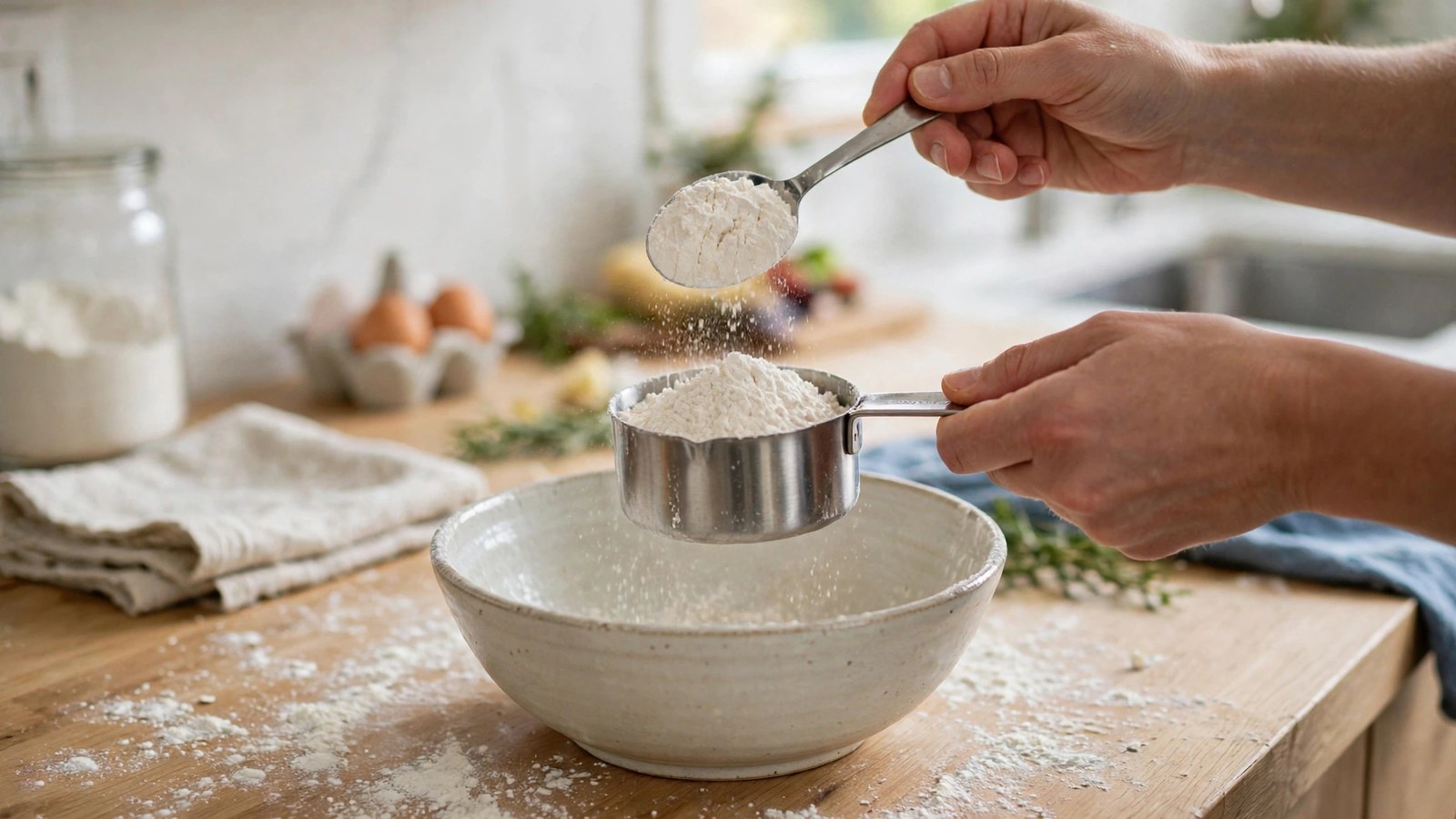
Flour is the ingredient where the filling method matters most, so the flour table states the method for every row. Spooned and leveled means the flour was spooned into the cup without shaking or tapping and the top was leveled with a straight edge. Scooping means the cup itself was dipped into the flour container, which compresses the flour as it fills.
| Ingredient, 1 US cup, level | Grams | Per tablespoon | Notes |
|---|---|---|---|
| All-purpose flour, spooned and leveled | 120 g | 7.5 g | Standard baking weight used in this article |
| All-purpose flour, scooped from the container | 140 to 150 g | about 9 g | Scooping compresses flour and adds weight |
| Bread flour, spooned and leveled | 127 g | 7.9 g | Slightly heavier per cup than all-purpose flour |
| Whole wheat flour, spooned and leveled | 120 g | 7.5 g | Coarser grind, similar cup weight to all-purpose |
| Cornmeal, whole grain | 122 g | 7.6 g | Degermed cornmeal is heavier, about 157 g per cup |
Reference databases do not all list the same flour weight, and that is expected. The United States Department of Agriculture lists a generic cup of all-purpose flour at 125 grams in its standard reference data, while the spooned and leveled baking standard used in most US recipe testing is 120 grams. The 5 gram gap is the filling method, not an error in either figure. This article uses 120 grams throughout, so every scaled value is computed from the same base. Scooped flour, or a recipe developed with the heavier reference cup, can run from 125 to 150 grams per cup, which is exactly why weighing beats both conventions.
Grams per US Cup: Sugars and Sweeteners
Sugars are denser than flours because their crystals pack with far less trapped air. The exception in this group is powdered sugar, which is ground so fine that it traps air again and falls back to a flour like weight.
| Ingredient, 1 US cup, level unless stated | Grams | Per tablespoon | Notes |
|---|---|---|---|
| Granulated sugar | 200 g | 12.5 g | Poured or scooped and leveled |
| Superfine sugar, also called caster sugar | 200 g | 12.5 g | Finer crystals, similar cup weight to granulated |
| Brown sugar, firmly packed | 220 g | 13.8 g | Packed is the standard recipe instruction |
| Brown sugar, loosely spooned | about 145 g | about 9 g | Shown only to show how much packing matters |
| Powdered sugar, unsifted | 120 g | 7.5 g | Also called confectioners sugar |
| Powdered sugar, sifted | 100 g | 6.3 g | Sifting adds air and lowers the cup weight |
The brown sugar rows deserve attention because the word packed does real work. Loosely spooned brown sugar weighs about 145 grams per cup, and firmly packed brown sugar weighs about 220 grams per cup. A recipe that says packed and is measured loosely receives roughly a third less sugar than intended, which changes sweetness, spread, and moisture. Powdered sugar runs the other way: sifting makes the cup lighter, so a careful recipe states sifted or unsifted, and the weight to use matches the word in the recipe.
Grams per US Cup: Fats, Liquids and Syrups
Liquids and melted fats are the best behaved group, because a liquid fills its container completely with no trapped air. Their cup weights are stable, and they change only slightly with temperature, by an amount too small to matter in ordinary cooking.
| Ingredient, 1 US cup | Grams | Per tablespoon | Notes |
|---|---|---|---|
| Water | 237 g | 14.8 g | The reference case, density about 1.00 g per ml |
| Whole milk | 244 g | 15.3 g | Slightly denser than water |
| Butter | 227 g | 14.2 g | Exactly 8 ounces by mass, or 2 US sticks |
| Vegetable oil | 218 g | 13.6 g | Lighter than water, so a cup weighs less than water |
| Olive oil | 216 g | 13.5 g | Similar to other liquid cooking oils |
| Honey | 339 g | 21.2 g | Often rounded to 340 g in published tables |
| Maple syrup | 315 g | 19.7 g | Commonly published standard weight, thinner than honey |
Butter is the well behaved exception. In the United States, butter is sold in sticks marked by both volume and mass: one stick is half a cup, 8 tablespoons, and about 113 grams, so one cup is two sticks and 227 grams, or 8 ounces by mass. No scooping judgment is involved, which is why butter conversions agree almost everywhere. A cup of oil weighs less than a cup of water because oil is less dense than water, which is also why oil floats on water. A cup of honey weighs far more than a cup of water because honey is mostly sugar dissolved in a small amount of water, and sugar is dense.
Grams per US Cup: Other Common Ingredients
| Ingredient, 1 US cup, level | Grams | Per tablespoon | Notes |
|---|---|---|---|
| Cocoa powder, unsweetened | 86 g | 5.4 g | Spooned and leveled, unsifted |
| Rolled oats, old fashioned | 90 g | 5.6 g | Published values range from about 80 to 90 g by flake |
| Long grain white rice, uncooked | 185 g | 11.6 g | Cooked rice weighs more per cup because it absorbs water |
| Chocolate chips | 170 g | 10.6 g | Varies a little with chip size and shape |
| Chopped nuts | about 120 g | about 7.5 g | Commonly published standard weight, varies by nut and chop |
Cocoa powder corrects a figure that circulates widely. Many charts list cocoa at about 100 grams per cup, but the United States Department of Agriculture standard reference weight for unsweetened cocoa powder is 86 grams per cup, spooned and leveled. The difference matters, because 100 grams measured against an 86 gram standard adds about a sixth more cocoa than intended. Rolled oats vary for a physical reason: thick flakes trap more air than thin flakes, so published values run from about 80 to 90 grams per cup. This article uses 90 grams and treats the range as part of the answer.
Scaling: Half, Three Quarter and Quarter Cups
Most recipes use part cups far more often than whole cups, so the table below scales the core ingredients. Every value is the per cup weight from the tables above multiplied by the fraction, rounded to the nearest gram. Because of that rounding, a rounded fraction multiplied back can differ from the per cup weight by a gram or two, which is normal rounding and not a different conversion.
| Ingredient | 1 cup | 3/4 cup | 2/3 cup | 1/2 cup | 1/3 cup | 1/4 cup |
|---|---|---|---|---|---|---|
| All-purpose flour, spooned and leveled | 120 g | 90 g | 80 g | 60 g | 40 g | 30 g |
| Granulated sugar | 200 g | 150 g | 133 g | 100 g | 67 g | 50 g |
| Brown sugar, firmly packed | 220 g | 165 g | 147 g | 110 g | 73 g | 55 g |
| Powdered sugar, unsifted | 120 g | 90 g | 80 g | 60 g | 40 g | 30 g |
| Butter | 227 g | 170 g | 151 g | 113 g | 76 g | 57 g |
| Honey | 339 g | 254 g | 226 g | 170 g | 113 g | 85 g |
| Water | 237 g | 178 g | 158 g | 119 g | 79 g | 59 g |
| Whole milk | 244 g | 183 g | 163 g | 122 g | 81 g | 61 g |
| Cocoa powder, unsweetened | 86 g | 65 g | 57 g | 43 g | 29 g | 22 g |
| Rolled oats, old fashioned | 90 g | 68 g | 60 g | 45 g | 30 g | 23 g |
Check the flour row by multiplying back: a quarter cup at 30 grams multiplied by 4 gives the 120 gram cup, a third of a cup at 40 grams multiplied by 3 gives 120 grams, and three quarter cups at 90 grams each would be 270 grams, which is also 120 multiplied by 2.25, the same total reached by adding one cup, one cup, and one quarter cup. The same check works for honey: a third of a cup at 113 grams multiplied by 3 gives the 339 gram cup exactly, and a quarter cup at 85 grams multiplied by 4 gives 340 grams, one gram above the cup weight because 84.75 grams was rounded up to 85. When a recipe needs an exact total, weigh the full amount once rather than adding rounded part cup weights together.
Grams to Cups: The Reverse Direction
Conversion runs both ways, and the reverse formula is just as simple: cups equal grams divided by the grams per cup for that ingredient. The same 100 grams therefore fills very different amounts of a cup depending on what is being measured.
| 100 grams of | Fills about | Working |
|---|---|---|
| Honey | 0.29 cup | 100 divided by 339 |
| Butter | 0.44 cup | 100 divided by 227 |
| Granulated sugar | 0.50 cup | 100 divided by 200 |
| Water | 0.42 cup | 100 divided by 237 |
| All-purpose flour, spooned and leveled | 0.83 cup | 100 divided by 120 |
| Powdered sugar, unsifted | 0.83 cup | 100 divided by 120 |
| Rolled oats, old fashioned | 1.11 cups | 100 divided by 90 |
| Cocoa powder, unsweetened | 1.16 cups | 100 divided by 86 |
Read the extremes carefully. One hundred grams of honey fills less than a third of a cup, while 100 grams of cocoa powder fills more than a full cup. A chart that turns 100 grams into one fixed cup amount for every ingredient is wrong for almost every ingredient, in one direction or the other. Always divide by the weight for the ingredient in front of you.
How Measuring Method Changes the Weight
For dry ingredients, method is part of the measurement. The spoon and level method, spooning the ingredient into the cup and leveling the top with a straight edge without shaking or tapping, gives the lightest and most consistent result, and it is the method behind the spooned and leveled weights in this article. Dipping the cup into the container and scooping compresses flour in particular, and can add 20 to 30 grams per cup of flour compared with spooning. Sifting before measuring makes flour and powdered sugar lighter again, because sifting introduces air that stays in the cup.
Settling matters too. Flour settles in storage and transit, so a cup scooped weeks later from a settled container can weigh more than a cup from a freshly stirred one. Stirring flour in its container before spooning gives a more consistent cup. A cup of a dry ingredient is really a range wearing a single label, and the honest way to report it is with the method named, as the tables above do.
Liquids avoid most of this. A liquid traps no air, so a cup of water, milk, or oil has a stable weight set by its density alone. Temperature changes liquid density slightly, but by well under one percent, which does not affect cooking. That is why cup to gram conversions are trustworthy for liquids and approximate for dry goods, and why flour most rewards weighing.
US Cups, Metric Cups and the Label Cup
Everything above uses the US cup of 236.588 milliliters. A metric cup, used in Australia, New Zealand, Canada, and many other countries, is 250 milliliters, which is about 5.7 percent larger. The exact factor is 250 divided by 236.588, which is about 1.057. To turn a US cup weight into a metric cup weight for the same ingredient, multiply by about 1.057. A metric cup of water weighs 250 grams. A metric cup of all-purpose flour, spooned and leveled, weighs about 127 grams, because 120 multiplied by 1.057 is about 127. A metric cup of granulated sugar weighs about 211 grams, because 200 multiplied by 1.057 is about 211.
The difference is small for one cup and meaningful across a recipe. Four US cups of flour weigh 480 grams at the spooned and leveled standard, while four metric cups weigh about 507 grams, a gap of about 27 grams, roughly a quarter of a US cup of flour by weight. In bread dough, that gap changes hydration enough to notice. When a recipe gives both grams and cups, trust the grams, because grams do not depend on which cup the author owned. When it gives only cups, check the country of the source first.
Two other cups cause quiet confusion. United States nutrition labels use a cup of 240 milliliters, set by the Food and Drug Administration for labeling. That is a labeling convention, not a measuring cup size, but it explains why a label serving sometimes sits between US and metric values. The older imperial cup is about 284 milliliters, about 20 percent larger than the US cup, and appears mainly in older British recipes. Modern British recipes usually give grams directly.
Worked Examples
Example one, flour in a cake. A recipe calls for 2 US cups of all-purpose flour and gives no weight. At the spooned and leveled standard, 2 multiplied by 120 gives 240 grams. If you usually scoop, your two cups would have weighed about 290 grams, at about 145 grams per scooped cup, so 240 grams will look like less flour than you are used to. That is the point: the recipe was very likely developed with the lighter measure, and the extra 50 grams from scooping can make a cake denser and drier.
Example two, honey in a dressing. A recipe calls for half a cup of honey. Half of the 339 gram cup weight is 169.5 grams, which rounds to 170 grams. A quarter cup is 85 grams, which is also the weight in the scaling table, and two quarter cups weighed separately would total 170 grams, matching the half cup figure.
Example three, sugar from grams to cups. A recipe calls for 500 grams of granulated sugar and you have only a cup measure. Divide 500 by the 200 gram cup weight to get 2.5 cups. The same division handles any amount: 350 grams of granulated sugar is 350 divided by 200, which is 1.75 cups, or 1 and 3/4 cups.
Example four, butter from grams to cups and tablespoons. A recipe calls for 250 grams of butter. Divide 250 by 227 to get about 1.10 cups. The extra tenth of a cup is 23 grams, and at 14.2 grams per tablespoon that is about 1.6 tablespoons, so 250 grams is one cup plus about one and a half tablespoons.
Example five, a part cup of brown sugar. A recipe calls for 3/4 cup of firmly packed brown sugar. Multiply the 220 gram cup weight by 0.75 to get 165 grams. If the same recipe is later doubled, double the weight to 330 grams rather than remeasuring by volume, because doubling a weight is exact while doubling a packed volume repeats the packing judgment twice.
Example six, cocoa from grams to cups. A recipe calls for 300 grams of unsweetened cocoa powder. Divide 300 by the 86 gram cup weight to get about 3.49 cups, which is close enough to 3 and 1/2 cups for most baking. This example also shows why the corrected 86 gram standard matters: dividing by the widely copied 100 gram figure would give 3 cups, short by about half a cup of cocoa.
Why Weighing Wins for Baking
Baking depends on ratios: flour to liquid, flour to fat, sugar to flour, and leavening to flour. Those ratios work by weight, because weight is what reacts, hydrates, and sets. A variation of 20 to 30 grams in one cup of flour changes the flour to liquid ratio enough to change texture, and scooping versus spooning can produce exactly that variation. Weighing removes the variation at the source. A gram is the same in every country and every kitchen, and a scale does not care how fluffy the flour is or how firmly the sugar was packed.
That does not make cup measures useless. For soups, stews, salads, dressings, and everyday cooking where ratios are forgiving, cups are fast and entirely adequate. The practical rule is to use cups where tolerance is wide, weigh where tolerance is narrow, and always convert through the ingredient in front of you, never through a single universal number. A basic kitchen scale is inexpensive, and for anyone who bakes regularly it removes the largest single source of variation in home baking.
How to Build Your Own Conversion for Any Ingredient
For an ingredient that is not in these tables, there are two reliable routes. If you know the ingredient density in grams per milliliter, multiply it by 236.588 to get the grams per US cup. If you do not know the density, weigh one cup of the ingredient yourself, filled the way you normally fill it, and write the result down with the date and the method. That personal figure is more useful for your cooking than any published table, because it already includes your brand, your grind, and your technique, which are the largest sources of variation.
Record the method with the weight, whether the cup was spooned, scooped, sifted, or packed, because a weight without a method cannot be compared with anything later. For an ingredient you use often, weigh three separate cups and average the results. From that one base weight, every part cup follows by multiplication, and every grams to cups conversion follows by division.
Frequently Asked Questions
How many grams are in a cup?
There is no single answer, because a cup measures volume and a gram measures mass. One US cup holds about 120 grams of all-purpose flour spooned and leveled, 200 grams of granulated sugar, 227 grams of butter, 237 grams of water, and 339 grams of honey. Always ask grams in a cup of what, and measured how.
How many grams are in a cup of flour?
About 120 grams for all-purpose flour, spooned and leveled, in a US cup. The United States Department of Agriculture standard reference lists 125 grams per cup, and flour scooped directly from the container can weigh 140 to 150 grams per cup, so the method matters as much as the ingredient.
How many grams are in a cup of sugar?
About 200 grams for granulated sugar in a US cup. Brown sugar firmly packed is about 220 grams per cup, powdered sugar unsifted is about 120 grams per cup, and powdered sugar sifted is about 100 grams per cup.
How many grams are in a cup of water?
About 237 grams in a US cup, because a US cup is 236.588 milliliters and water has a density of about 1.00 gram per milliliter. In a metric cup of 250 milliliters, a cup of water weighs 250 grams.
How many grams are in a cup of butter?
About 227 grams, which is exactly 8 ounces by mass, or two US sticks. Half a cup of butter is one stick at about 113 grams, and a quarter cup is about 57 grams.
How many grams are in half a cup?
It depends on the ingredient. Half a US cup is about 60 grams of all-purpose flour spooned and leveled, 100 grams of granulated sugar, 113 grams of butter, 119 grams of water, and 170 grams of honey. The scaling table in this article gives half, quarter, third, and three quarter cup weights for ten core ingredients.
How many cups is 100 grams?
It depends on the ingredient. One hundred grams is about 0.83 cup of all-purpose flour, 0.50 cup of granulated sugar, 0.44 cup of butter, 0.29 cup of honey, and about 1.16 cups of unsweetened cocoa powder. Divide 100 by the grams per cup for your ingredient to get the figure for anything else.
Can I use one conversion number for all ingredients?
No. Density differs by ingredient, so a cup of flour, a cup of sugar, and a cup of honey weigh very different amounts. Any single conversion number is correct for at most one ingredient and wrong for the rest. Use the weight for the ingredient you are measuring, or weigh the ingredient directly.
What is the difference between a US cup and a metric cup?
A US cup is 236.588 milliliters and a metric cup is 250 milliliters, so a metric cup is about 5.7 percent larger. Multiply a US cup weight by about 1.057 to get the metric cup weight for the same ingredient. United States nutrition labels use a third value, a 240 milliliter cup, for labeling only.
Should I buy a kitchen scale?
If you bake regularly, yes. A scale makes recipes repeatable, removes the difference between spooning and scooping, and works the same way in every country. For forgiving everyday cooking, cups remain fast and adequate, and weighing matters most for flour and other dry ingredients in baking.
Keep reading: How Many Tablespoons in a Cup
Keep reading: How Many Grams in an Ounce? The Everyday Answer and the Exceptions
Keep reading: Cups to Ounces: How Many Ounces in a Cup?
Sources & references
- United States Department of Agriculture, Agricultural Research Service, FoodData Central. Used for the standard reference cup weights for all-purpose flour, whole wheat flour, granulated sugar, brown sugar, powdered sugar, butter, honey, unsweetened cocoa powder, rolled oats, rice, cornmeal, milk, and oils, including honey at 339 grams per cup and unsweetened cocoa powder at 86 grams per cup. https://fdc.nal.usda.gov/
- National Institute of Standards and Technology, Metric Kitchen: Cooking Measurement Equivalencies. Used for household volume and mass equivalencies, including the tablespoon at 15 milliliters, the rounded household cup at 240 milliliters, and the ounce at 28 grams. https://www.nist.gov/pml/owm/metric-si/metric-kitchen/metric-kitchen-cooking-measurement-equivalencies
- National Institute of Standards and Technology, Handbook 44, Appendix C, General Tables of Units of Measurement. Used for the United States customary volume relationships behind the US cup of 8 fluid ounces and the gallon of 231 cubic inches, from which the exact US cup volume of 236.588 milliliters follows. https://www.nist.gov/document/2026-nist-handbook-44-appendix-c
- United States Food and Drug Administration, Guidance for Industry: Guidelines for Determining Metric Equivalents of Household Measures. Used for the nutrition labeling rule that, for labeling purposes, 1 cup means 240 milliliters, 1 tablespoon means 15 milliliters, and 1 ounce means 28 grams. http://www.fda.gov/regulatory-information/search-fda-guidance-documents/guidance-industry-guidelines-determining-metric-equivalents-household-measures


