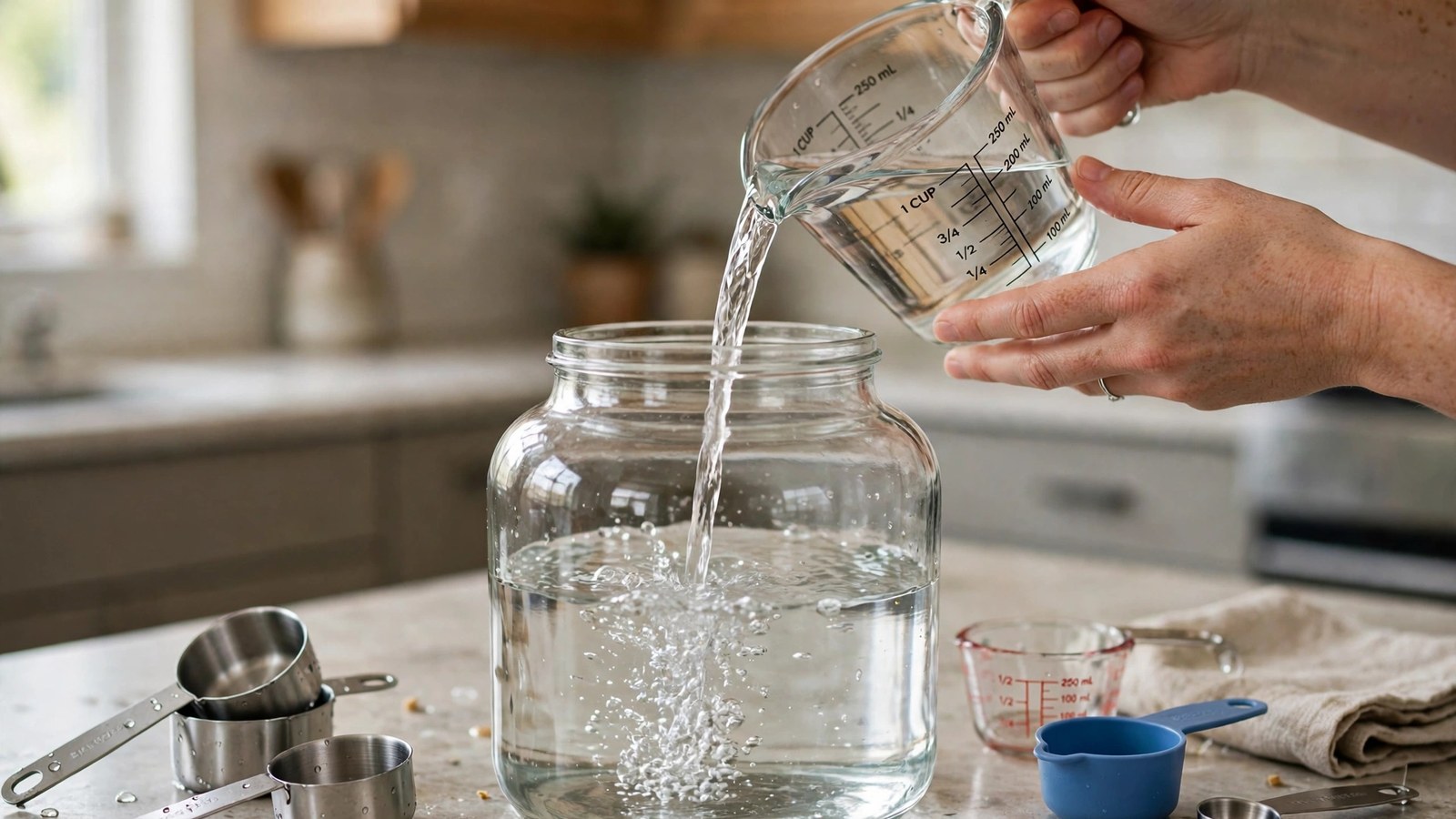
Short answer
- There are 16 US cups in 1 US gallon. The check is simple arithmetic. One US cup holds 8 US fluid ounces, and 1 US gallon holds 128 US fluid ounces, so 128 divided by 8 equals 16. The same answer comes from the volume ladder: 1 gallon equals 4 quarts, 1 quart equals 2 pints, and 1 pint equals 2 cups, so 4 times 2 times 2 equals 16 cups. A half gallon holds 8 US cups, and a quarter gallon, which is 1 quart, holds 4 US cups. The liquid does not change the answer. A gallon of water, a gallon of milk, and a gallon of juice each fill 16 US cups by volume, even though the three liquids weigh different amounts. Cups in a gallon of water and cups in a gallon of any other liquid are the same conversion, because cups measure volume, meaning space taken up, not weight. Two qualifications matter. First, this is the US answer. An imperial gallon, the older British gallon still used for some purposes in the United Kingdom, is larger, at 4.54609 liters compared with 3.785411784 liters for a US gallon, so it does not hold 16 US cups. Second, a metric cup of 250 milliliters is larger than a US cup of about 236.588 milliliters, so 1 US gallon holds only about 15.14 metric cups. Both cases are explained in full below. In US measures, gallon to cups is always multiply by 16, and cups to gallons is always divide by 16.
By Emma Hudson
This short introduction sets the scope. Unless a section says otherwise, every figure in this article uses United States customary units for liquid volume, the system used by recipes, drink containers, and household measures in the United States. Where a British imperial or metric figure differs, the difference is stated in full, because the word gallon and the word cup do not mean the same size in every system.
The US Volume Ladder, Step by Step
US liquid volume is built as a ladder in which each larger unit contains a small whole number of the next unit down. Learning the ladder once is more reliable than memorizing isolated conversions, because any step can be checked against its neighbors.
At the top sits the gallon. One US gallon equals 4 US quarts. The quart takes its name from being a quarter of a gallon, and that relationship holds exactly in US customary measure: 4 quarts make 1 gallon, with no remainder and no rounding.
One US liquid quart equals 2 US liquid pints, so 1 gallon equals 8 pints. One US liquid pint equals 2 US cups, so 1 gallon equals 16 cups. One US cup equals 8 US fluid ounces, so 1 gallon equals 128 US fluid ounces. One US fluid ounce equals 2 US tablespoons, so 1 cup equals 16 tablespoons and 1 gallon equals 256 tablespoons. One US tablespoon equals 3 US teaspoons, so 1 cup equals 48 teaspoons and 1 gallon equals 768 teaspoons.
Written as a single chain, the ladder reads: 1 gallon equals 4 quarts, equals 8 pints, equals 16 cups, equals 128 fluid ounces, equals 256 tablespoons, equals 768 teaspoons. The search phrase gallon quart pint cup points to exactly this chain. Each step either doubles or follows a fixed small ratio, which is why the chain is easy to reconstruct from memory if one figure is forgotten. If you remember only that a pint holds 2 cups and a quart holds 2 pints, you can rebuild the rest in seconds.
In metric terms, the exact sizes are as follows. One US fluid ounce equals about 29.574 milliliters. One US cup equals about 236.588 milliliters. One US pint equals about 473.176 milliliters. One US quart equals about 946.353 milliliters, just under 1 liter. One US gallon equals 3,785.412 milliliters, or 3.785411784 liters. Household tables often round these figures for kitchen use. The National Institute of Standards and Technology Metric Kitchen table, for example, lists approximate cooking equivalents of 240 milliliters for 1 cup and 3.84 liters for 1 gallon. Those rounded values are practical for cooking, but they are approximations, and the exact customary definitions above are the figures to use when precision matters or when checking a conversion table.
Note that US dry volume uses a different quart and pint for dry goods such as grain and berries. This article covers liquid volume only, which is the volume used for water, milk, and other liquids, and the volume meant by almost every kitchen and drinks question about cups in a gallon.
Gallons to Cups Conversion Table
The table below gives the most requested gallon amounts in US cups, US fluid ounces, and milliliters. Every milliliter figure was recomputed from 1 US cup equals 236.588 milliliters, rounded to the nearest whole milliliter, and every fluid ounce figure is cups multiplied by 8.
| US gallons | US cups | US fluid ounces | Milliliters (approx.) |
|---|---|---|---|
| 1/4 gallon (1 quart) | 4 cups | 32 fl oz | 946 ml |
| 1/2 gallon | 8 cups | 64 fl oz | 1,893 ml |
| 3/4 gallon | 12 cups | 96 fl oz | 2,839 ml |
| 1 gallon | 16 cups | 128 fl oz | 3,785 ml |
| 1.5 gallons | 24 cups | 192 fl oz | 5,678 ml |
| 2 gallons | 32 cups | 256 fl oz | 7,571 ml |
| 3 gallons | 48 cups | 384 fl oz | 11,356 ml |
| 5 gallons | 80 cups | 640 fl oz | 18,927 ml |
| 10 gallons | 160 cups | 1,280 fl oz | 37,854 ml |
For amounts between table rows, use the formulas in the next section rather than estimating from the nearest row. A container marked in quarts can also be read directly: multiply quarts by 4 to get cups, so a 2 quart container holds 8 cups, a 3 quart container holds 12 cups, and the 4 quart mark on a gallon jug is the full 16 cups.
How to Convert in Both Directions
To convert gallons to cups, multiply the number of gallons by 16. For example, 2.5 gallons times 16 equals 40 cups. Half a gallon times 16 equals 8 cups. Even an awkward figure follows the same rule: 0.75 gallons times 16 equals 12 cups.
To convert cups to gallons, divide the number of cups by 16. For example, 8 cups divided by 16 equals 0.5 gallons. Twenty four cups divided by 16 equals 1.5 gallons. Forty cups divided by 16 equals 2.5 gallons. One single cup is 1 divided by 16, which is 0.0625 gallons, a figure that is rarely useful on its own but confirms the direction of the calculation.
A useful cross check runs through fluid ounces. If a volume is given in fluid ounces, divide by 8 to get cups, then divide by 16 to get gallons. A bottle holding 64 fluid ounces therefore holds 8 cups, which is half a gallon. If a volume is given in milliliters, divide by about 236.588 to get US cups. A 1,000 milliliter bottle, which is 1 liter, holds about 4.23 US cups. That also shows why 1 liter is a little more than a US quart: a quart is about 946 milliliters, so a liter exceeds it by about 54 milliliters, roughly a quarter of a cup.
Fractions deserve care. Keep the fraction through the calculation and round only at the end. A third of a gallon is 16 divided by 3, which is 5 and one third cups. Rounding early to 5.33 cups and multiplying back gives 85.28 fluid ounces instead of the exact 85 and one third. The difference is tiny for drinks, but the habit of rounding last matters for large batches where proportions must stay exact.
US Gallons and Imperial Gallons Are Different Sizes
The most important exception to the figure of 16 is the imperial gallon. The United States kept an older English wine gallon of 231 cubic inches, which is exactly 3.785411784 liters. Britain later standardized a larger imperial gallon, defined today as exactly 4.54609 liters. The imperial gallon is therefore about 20 percent larger than the US gallon. A British fuel economy figure, an older British recipe, or a container marked in imperial gallons is describing more liquid than the same number in US gallons.
The subdivisions differ too. An imperial gallon divides into 4 imperial quarts, 8 imperial pints, and 160 imperial fluid ounces. An imperial pint holds 20 imperial fluid ounces, not 16, and equals about 568.261 milliliters. An imperial fluid ounce equals about 28.413 milliliters, slightly smaller than a US fluid ounce at about 29.574 milliliters, even though the imperial pint and gallon are larger overall. That reversal happens because the imperial system fits more, smaller fluid ounces into its larger pint.
There is no standard imperial cup for cooking in the same sense as the US cup. British recipes today are usually written in milliliters and grams, or in imperial pints and fluid ounces for older sources. A half imperial pint is sometimes informally called a cup and holds about 284 milliliters, but it is not a defined standard cooking unit, and treating it as if it were a US cup of about 237 milliliters would under measure by about 47 milliliters per cup. For accuracy, this article does not give an imperial cups per gallon figure as a headline conversion, because the unit itself is not standard. Converted into US cups instead, 1 imperial gallon of 4,546.09 milliliters divided by 236.588 milliliters per US cup equals about 19.22 US cups. Converted into metric cups, it equals about 18.18 metric cups.
One common error needs correcting directly. Dividing 160 imperial fluid ounces by 8 gives 20, but that calculation mixes two systems, because 8 US fluid ounces make a US cup while an imperial fluid ounce is a different size. The figure of 20 cups in an imperial gallon is therefore wrong in both systems: it is not the count in US cups, which is about 19.22, and there is no standard imperial cup to count in. If a source gives 20 cups for an imperial gallon without naming its cup, treat the figure as unreliable and convert through liters or milliliters instead: state the volume in milliliters first, then divide by the cup size your recipe actually uses.
In practice, check the origin of the recipe or instruction. A recipe from a US publisher uses US gallons and US cups, and the answer is 16. A modern British recipe rarely uses gallons at all. An older British or Commonwealth source that does use gallons means imperial gallons, and the safest route is to convert its gallon to 4,546 milliliters and then measure in milliliters.
Metric Cups and Milliliters
Many countries that cook with cups use the metric cup, defined as exactly 250 milliliters. It is the cup used in Australia, New Zealand, and Canada for many recipes, and in metric measuring jug sets elsewhere. Because a metric cup is larger than a US cup by about 13.4 milliliters, the counts per gallon change.
One US gallon holds 3,785.411784 milliliters. Divided by 250 milliliters, that is about 15.14 metric cups. So a recipe written for metric cups that calls for a gallon of liquid needs about 15 and one seventh metric cups, not 16. Filling 16 metric cups would give 4,000 milliliters, which is about 215 milliliters more than a US gallon, an excess of nearly a full US cup. In a soup or a drink mixture that excess may be harmless. In baking, in brewing, or in any mixture where the ratio of liquid to other ingredients sets the result, it is enough to change the outcome.
United States food labels add one more figure that causes confusion. For nutrition labeling, a cup is treated as 240 milliliters, a rounded legal value for labels rather than the exact customary cup of about 236.588 milliliters that a measuring cup holds. That is why a carton may print 1 cup as 240 milliliters while a conversion table gives about 237 milliliters. Both are describing a cup, but for different purposes: the label value keeps serving arithmetic simple, while the customary value is the measured volume. For cooking, follow the measuring cup. For comparing label servings, follow the label. The difference per cup is about 3.4 milliliters, which only matters when multiplied across a full gallon, where it grows to about 55 milliliters.
To convert any cup figure to milliliters, multiply US cups by 236.588, label cups by 240, or metric cups by 250, according to which cup the source means. To convert milliliters back to US cups, divide by 236.588. Keeping the three cup sizes separate on paper, even with a quick note beside the recipe, prevents the quietest and most common conversion error in this whole topic, which is using the right number with the wrong cup.
Recipe Scaling: Worked Examples
Scaling recipes is where the gallon to cups conversion earns its keep, because large recipes, catering quantities, and batch drinks are often written in gallons while home cooks measure in cups.
Example one: a full gallon batch. A recipe for a party drink calls for 1 gallon of water plus flavoring. How many cups of water in 1 gallon? Sixteen US cups. In practice, filling a 4 cup measuring jug four times is faster and more accurate than filling a 1 cup measure sixteen times, because each fill is a chance for a small reading error, and four fills carry fewer errors than sixteen.
Example two: half a gallon of milk. A sauce recipe scaled for a group calls for half a gallon of milk. Half of 16 cups is 8 cups, which is also 2 quarts or 64 fluid ounces. If the recipe instead calls for 4 cups of milk, that is a quarter of a gallon, exactly 1 quart, so one quart carton covers it with nothing left over.
Example three: scaling down. A recipe written for 1 gallon, or 16 cups, needs to be made at quarter size. A quarter of 16 cups is 4 cups. Every other ingredient is also divided by 4 to keep the proportions. A full size recipe using 2 cups of sugar would use half a cup at quarter size, and one using 8 fluid ounces of lemon juice would use 2 fluid ounces.
Example four: scaling up from cups to gallons. A lemonade recipe makes 6 cups and is written for a small jug. An event needs about 5 gallons. Five gallons is 80 cups. Dividing 80 by 6 gives about 13.3 batches, so making 13 full batches gives 78 cups, and a final partial batch of 2 cups worth of proportions brings the total to 80 cups. Working in cups throughout, and converting to gallons only to check the container size, keeps the arithmetic in the unit the cook actually measures.
Example five: a mixed unit recipe. A stock recipe calls for 1.5 gallons of water, 8 cups of chopped vegetables, and 16 fluid ounces of wine. In cups, that is 24 cups of water, 8 cups of vegetables, and 2 cups of wine, a total of 34 cups. Since 32 cups make 2 gallons, the pot must hold more than 2 gallons, before any simmering space is allowed.
In every example the method is the same: convert gallons to cups by multiplying by 16, do the scaling in cups, and convert back only if the final instruction is stated in gallons.
Drinks, Coffee, and Everyday Uses
Outside recipes, the same conversion answers everyday questions about drink containers, water intake tracking, and bulk preparation.
A standard US gallon jug of drinking water holds 16 cups. Someone tracking intake by the cup can count a finished gallon jug as 16 cups without any further conversion. A half gallon milk carton holds 8 cups, which is why a recipe calling for 8 cups of milk empties exactly one half gallon carton. A quart of milk or cream holds 4 cups, and a pint holds 2 cups, the pint and quart sizes printed on many US dairy containers.
For coffee and tea, a typical mug holds about 12 fluid ounces, which is 1.5 US cups. A gallon of brewed coffee therefore fills about 10 to 11 such mugs, because 128 fluid ounces divided by 12 is about 10.7. A smaller 8 fluid ounce serving is exactly 1 cup, so a gallon yields 16 of those servings. For batch iced tea or infused water made in a 2 gallon dispenser, the dispenser holds 32 cups, and any sweetener or concentrate written per cup can be multiplied by 32 directly.
For aquariums and cleaning mixtures, the volume rule is identical. A 10 gallon tank holds 160 US cups of water, and a 5 gallon bucket holds 80 US cups. If a treatment is dosed per gallon, dose on the gallon figure rather than converting the dose to cups, because dosing instructions are tested and printed in gallons. If a cleaning concentrate is mixed at a stated number of fluid ounces per gallon, a half gallon batch needs half that amount. One fluid ounce equals one eighth of a cup, so 4 fluid ounces of concentrate is half a cup.
Measuring a Gallon Accurately
A conversion is only as good as the measuring that follows it. A few habits keep a gallon measured in cups close to a true gallon.
Use a liquid measuring cup for liquids, the kind with a spout and the scale printed so it can be read from above at an angle, and place it on a flat surface. Fill it, then bend or crouch so your eyes are level with the liquid surface and read the bottom of the curved surface of the liquid, called the meniscus, against the line. Reading from above while the cup sits on a counter makes the volume look larger than it is, and across 16 cups a small repeated over read or under read adds up to a visible error.
For a full gallon, prefer fewer, larger fills. A 4 cup jug filled four times, or an 8 cup measure filled twice, gives fewer chances for error than sixteen single cups. If only a 1 cup measure is available, keep a tally on paper rather than counting from memory, because losing count at cup eleven or twelve is the most common way a home measured gallon goes wrong.
Sticky liquids such as honey, syrup, and oil cling to the measure. The volume conversion does not change, since a gallon of honey is still 16 cups by volume, but coating the cup lightly with a neutral oil before measuring honey or syrup helps the full volume pour out instead of leaving a layer behind. That layer, repeated over several cups, is a real loss in a large batch.
Dry ingredients need a different warning. A cup of flour and a cup of sugar do not weigh the same, and flour packs down, so two cooks can fill the same cup measure with noticeably different weights of flour. The table in this article converts volume to volume for liquids only. It does not convert dry ingredients by weight, and no volume table can. For dry ingredients in large amounts, weigh them where a recipe gives weights.
Finally, check the markings on imported measuring jugs. A jug may carry metric and US scales that do not line up, because a metric cup is 250 milliliters and a US cup is about 237 milliliters. Read the scale that matches the recipe, and if a jug shows only milliliters, measure a gallon as about 3,785 milliliters and a cup as about 237 milliliters.
Common Mistakes
Mixing gallon systems is the first mistake. Using US cups with an imperial gallon, or the reverse, produces a volume that is wrong by about 20 percent. Confirm which gallon a source means before converting, and convert through milliliters when the origin is unclear.
Confusing fluid ounces with weight ounces is the second mistake. A fluid ounce measures volume and a weight ounce measures mass. A cup of water weighs a little more than 8 weight ounces, and a cup of honey weighs much more, yet both occupy 8 fluid ounces. A kitchen scale reading cannot be turned into cups without knowing which ingredient is being weighed.
Assuming every cup is the same size is the third mistake. US customary cups, US label cups, and metric cups hold about 237, 240, and 250 milliliters respectively. The differences look small per cup and become real across a gallon.
Rounding too early is the fourth mistake, covered in the conversion section above. Keep fractions until the final step.
The fifth mistake is treating a fuel economy figure as a kitchen conversion. Miles per gallon figures in British sources use imperial gallons, so a figure of 4.546 liters per gallon describes the imperial gallon, not the US gallon of 3.785 liters used in US kitchens.
Frequently Asked Questions
How many cups in a gallon?
There are 16 US cups in 1 US gallon. One US cup holds 8 US fluid ounces and 1 US gallon holds 128 US fluid ounces, and 128 divided by 8 equals 16.
How many cups is a gallon?
It is the same question with the words in a different order, and the answer is the same: 16 US cups. Gallon to cups is always multiply gallons by 16 in US customary measure.
How many cups of water in a gallon?
There are 16 US cups of water in a US gallon. The liquid does not change a volume conversion, so cups in a gallon of water, cups of water in a gallon, and how many cups to a gallon of water all give 16, the same as for milk, juice, or any other liquid.
How many cups are in a half gallon?
A half gallon holds 8 US cups, which is 64 US fluid ounces, 2 quarts, or about 1,893 milliliters.
How many cups are in a quarter gallon?
A quarter gallon is 1 quart, and it holds 4 US cups, which is 32 US fluid ounces, 2 pints, or about 946 milliliters.
How many cups are in 2 gallons?
Two US gallons hold 32 US cups. Multiply gallons by 16, so 2 times 16 equals 32. Five gallons hold 80 cups, and 10 gallons hold 160 cups.
How many cups of water in 1 gallon, measured in metric cups?
About 15.14 metric cups. One US gallon is 3,785.41 milliliters and a metric cup is 250 milliliters, and 3,785.41 divided by 250 equals about 15.14. The count is lower than 16 because a metric cup is larger than a US cup.
How many US cups are in an imperial gallon?
About 19.22 US cups. One imperial gallon is 4,546.09 milliliters, and dividing by about 236.588 milliliters per US cup gives about 19.22. The often quoted figure of 20 cups mixes imperial fluid ounces with the US cup and is not correct in either system.
What is the gallon quart pint cup chain?
It is the US liquid volume ladder in order from largest to smallest of those four units: 1 gallon equals 4 quarts, equals 8 pints, equals 16 cups. Each step down halves the unit above it except the naming, since a quart is a quarter gallon, a pint is half a quart, and a cup is half a pint.
How many tablespoons and teaspoons are in a gallon?
One US gallon holds 256 US tablespoons and 768 US teaspoons. One cup holds 16 tablespoons and 48 teaspoons, and multiplying each figure by 16 cups gives the gallon totals.
Does a gallon of water weigh the same as a gallon of milk?
No. Both fill 16 cups by volume, but weight depends on the liquid. Volume conversions such as cups per gallon are identical for all liquids, while weight per gallon differs, which is why recipes measure liquids by volume and why a scale reading cannot replace a cup measure without an ingredient specific conversion.
How many cups are in a gallon jug?
A jug labeled 1 US gallon holds 16 US cups. A jug labeled 1 imperial gallon holds a larger volume, 4.54609 liters, which is about 19.22 US cups. Check the label and the country of sale if the jug does not state which gallon it uses.
Keep reading: How Many Ounces in a Gallon
Keep reading: Cups to Ounces: How Many Ounces in a Cup?
Keep reading: Liters to Gallons: How Many Liters in a Gallon?
Keep reading: How Many Tablespoons in a Cup
Sources & references
- National Institute of Standards and Technology, Metric Kitchen: Cooking Measurement Equivalencies. Used for the US customary ladder as listed for home cooking: 1 gallon listed as 4 quarts, 128 fluid ounces, 16 cups; 1/2 gallon as 64 fluid ounces, 8 cups; 1 quart as 32 fluid ounces, 4 cups; 1 pint as 16 fluid ounces, 2 cups; and tablespoon and teaspoon equivalents including 1 tablespoon as 1/2 fluid ounce and 1 teaspoon as 5 milliliters in the approximate cooking table. The page states that its metric values are approximate equivalents for home cooking, including 240 milliliters for 1 cup and 3.84 liters for 1 gallon, and this article distinguishes those rounded cooking values from the exact customary definitions used for its tables. https://www.nist.gov/pml/owm/metric-si/metric-kitchen/metric-kitchen-cooking-measurement-equivalencies
- National Institute of Standards and Technology, Handbook 44, Appendix C, General Tables of Units of Measurement. Used for the exact US customary relationships underlying the metric figures in this article: 1 gallon equals 231 cubic inches and 3,785.412 milliliters; 1 fluid ounce equals 29.57353 milliliters. From those, 1 US cup equals 8 fluid ounces, which is about 236.588 milliliters, and 1 US gallon equals about 3.785411784 liters.
- UK Weights and Measures Act 1985, Schedule 1, as published on legislation.gov.uk. Used for the imperial gallon definition: gallon equals 4.54609 cubic decimetres, which is 4.54609 liters, with quart as one quarter gallon and the imperial pint and fluid ounce relationships from which the imperial figures in this article are derived, including 160 imperial fluid ounces per imperial gallon and about 28.413 milliliters per imperial fluid ounce.
- Australian Government, Eat for Health (the Australian Dietary Guidelines site), Milk, yoghurt, cheese and/or their alternatives (mostly reduced fat). Used for the metric cup value of 250 milliliters: the page gives a standard serve as 1 cup (250ml) of fresh, UHT long life, reconstituted powdered milk or buttermilk, and as 1 cup (250ml) of soy, rice or other cereal drink, equating the cup used in Australia with 250 milliliters. Corroborated by Queensland Health, Nutrition Education Materials Online (NEMO), Nutrition Support Action Plan: Assessing a consumer's diet, which likewise gives 1 cup (250ml) milk and 1 cup (250ml) soy/rice milk. Used for the metric cup counts of about 15.14 metric cups per US gallon and about 18.18 metric cups per imperial gallon. https://www.eatforhealth.gov.au/food-essentials/five-food-groups/milk-yoghurt-cheese-andor-their-alternatives-mostly-reduced-fat?wpmobileexternal=true and https://www.health.qld.gov.au/__data/assets/pdf_file/0024/152484/mh_nsapassessdiet.pdf


