Short answer
- A Hermann Missouri day trip works best in this order: walk the historic core first, and tour the Deutschheim State Historic Site before any tasting, because the houses explain the town the wineries grew out of. Then visit two or three Hermann Missouri wineries at most, one large and historic with stone cellars and one smaller tasting room, with a full lunch in between. Leave the rest of the Hermann Wine Trail for another visit: the trail runs between Hermann and New Haven and holds more stops than one day can do well. Plan transport before you taste: a designated driver who is not tasting, booked local transport, or the train plus walking for downtown stops. Check every opening time, tour time, and tasting policy with the venue itself before you travel, because hours are seasonal and festival weekends change everything.
Introduction
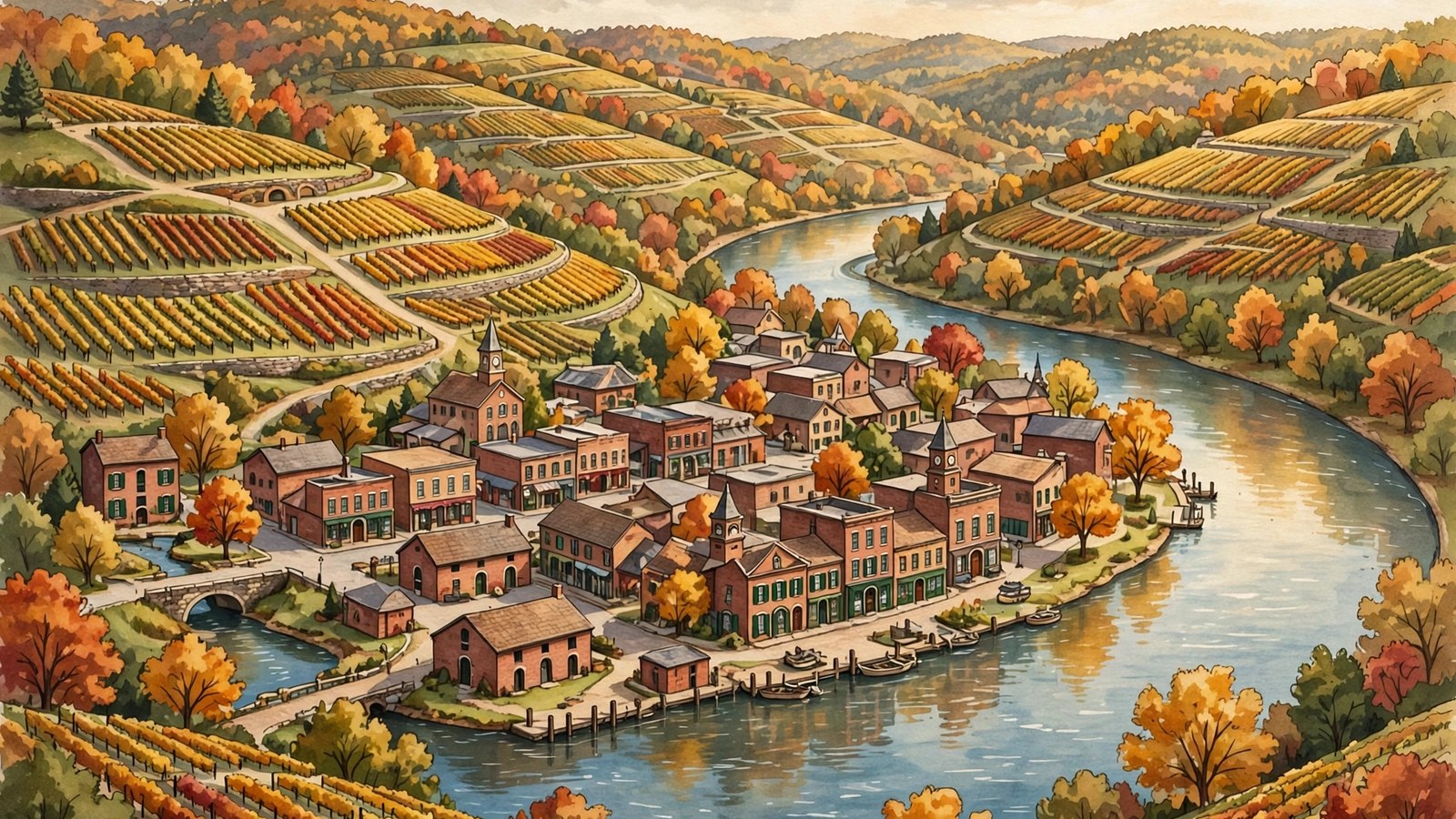
Hermann, Missouri, sits on the south bank of the Missouri River, between St. Louis and Jefferson City, and it rewards a slow day far more than a rushed one. This Hermann Missouri historic town is small enough to walk, old enough to feel genuinely historic, and shaped so clearly by its German founders that the heritage is not a theme pasted onto a main street. It is the reason the town exists, the reason the hillsides were terraced with vines, and the reason the calendar still fills with festivals rooted in the nineteenth century. A day trip here works best as two trips woven together: a walk through a planned German settlement, and a careful tasting tour through one of the oldest wine regions in the United States.
This guide is written for a first time visitor planning a single day. It makes no claim of a personal visit. Hours, admission details, and tasting policies change with the season and the venue, so any figure tied to a date here is stamped as of October 2026, and the planning section tells you what to check directly before you go.
Why Hermann Exists: A Planned German Colony
Hermann was not founded by accident. Missouri State Parks records that the German Settlement Society of Philadelphia prepared a constitution in 1836 and sold shares to fund a deliberate colony: a self supporting settlement built around farming, commerce, and industry, described as the heart of German America, where the customs, language, and traditions of the fatherland could be carried into a New World setting. Visit Hermann puts the ambition more bluntly: dismayed at how quickly German immigrants were being assimilated, the founders wanted a new city that would be German in every particular.
The society agent was George Bayer, a schoolteacher. Visit Hermann records that in 1837 Bayer purchased 11,000 acres of steep, rugged terrain on the Missouri River. Some secondary accounts give 11,300 acres, so treat the acreage as approximate and the scale as the point: a whole town bought at once. Planners in Philadelphia drew the town as if the land were flat, and Visit Hermann notes the main street was made ten feet wider than Market Street in Philadelphia. The land was anything but flat. When the first 17 settlers stepped off the last steamboat of the season, they found what one writer called a howling wilderness, with lots residents later joked were vertical acreage.
Missouri State Parks notes that Gottfried Duden’s widely read report of his journey encouraged German migration to Missouri. It is also commonly believed, as Visit Hermann phrases it, that the area’s resemblance to the Rhine Valley prompted the site choice. That is a belief about motive, not a documented society decision. The nickname it produced is documented: Missouri State Parks calls the area the Little Rhineland on the Missouri, and the wider region is known as the Missouri Rhineland. Hermann became the county seat of Gasconade County in 1842, and it remains a small city of roughly 2,200 residents in recent census reporting, although secondary tallies differ.
Start With the Town, Not the Tasting Room
The most common mistake on a Hermann Missouri day trip is to drive straight to the largest winery and never see the town. Hermann German heritage is written into the street plan and the building stock, and an hour on foot before lunch makes everything you taste later make more sense. Much of downtown is a historic district where, as Visit Hermann describes it, brick homes from the 1800s hug the sidewalk in the traditional German style, with thick brick walls, stone foundations, and cellars dug into the hillside for storing wine. The architecture is practical and solid rather than ornate: buildings made by people who expected to stay.
One caution on the numbers, because sources disagree. Visit Hermann says more than 150 buildings in town appear on the National Register of Historic Places. Hermannhof Winery says its cellars and brick building are among the 100 early Hermann buildings placed on the National Register. Those figures count different things, and neither page reconciles the other, so this article reports both rather than merging them into one total. The density itself is not in dispute: historic buildings here are the ordinary fabric of downtown, best seen on foot without a strict schedule.
Deutschheim State Historic Site: The One Essential Stop
The Deutschheim State Historic Site is the best single stop for understanding who the settlers were, and it should come before the wineries. Missouri State Parks says Deutschheim preserves several structures dating from 1840 to 1890, from the period when Germans first settled the Missouri River valley. Guided tours of two houses carry the interpretation: the Pommer-Gentner house, built in 1840 and one of the oldest surviving buildings in Hermann, and the Carl Strehly house, built in 1842. The Hermann Brush and Palette Club donated the site buildings to the state in 1978.
The tours show the daily life and traditions of German immigrants in the mid nineteenth century, through interiors furnished as they were in the 1800s, a traditional German four square garden behind the Pommer-Gentner house, and, behind the Strehly house, an arbor with grapevines more than 100 years old. The Strehly house is a modest timber frame structure, lived in by the same family for more than 100 years, with a brick winery and cellar beside it. From that house, Carl Strehly and Eduard Muehl published the first German newspaper west of the Mississippi in 1843, as the parks history page puts it. The parks tours page phrases the same milestone as west of St. Louis, so the year and the achievement are firm and the geographic wording varies between the agency’s own pages.
Practical details need a date stamp. As of October 2026, the Missouri State Parks tours page lists guided tour fees of 5 dollars for adults, 3 dollars for youth ages 6 to 17, and free entry for children ages 0 to 5. The Visit Hermann listing says tours run daily from April 1 to October 31 and Thursday through Sunday from November 1 to March 31, at set times of day. Treat that pattern as a planning guide, not a promise, and confirm the schedule for your date. The visitor center stands at 101 West Second Street. The site also runs Weihnachtsfest, a traditional German Christmas celebration held the first two weekends in December in the Pommer-Gentner house.
How Wine Took Over the Hillsides
The settlers’ poor farmland turned out to be good vine land. The Hermann Wine Trail history records that town leaders sold grape lots: vacant city lots a settler could buy for 50 dollars, interest free, over five years, on the single condition that the lot be planted in grapes. A total of 600 grape lots were eventually sold, and Hermann quite literally grew grapes in its own streets and yards.
The Wine Trail history and the Visit Hermann wine history agree on what came next, with one wording difference. Both credit the first cultivated varieties, Isabella, Virginia Seedling, Catawba, and Delaware, with a dramatic improvement in quality. The Wine Trail dates that improvement to the 1840s, while Visit Hermann gives 1843, so the safe statement is the early 1840s. Both single out George Husmann. The Wine Trail map calls him the Father of the Missouri Grape Industry, records that he immigrated to Hermann in 1838, and that he planted his first vineyard in 1847. The Wine Trail history adds that he crossed wild and cultivated grapes to create hybrids that could tolerate Missouri’s hot, humid summers and freezing winters, and that Missouri growers later shipped phylloxera resistant rootstock to France when its vineyards were devastated.
Hermann held its first Weinfest in the fall of 1848, a tradition the Wine Trail traces into today’s Oktoberfest celebrations. By the turn of the century the scale was remarkable. The Wine Trail history states that one twelfth of all United States wine placed on the market in 1904, nearly three million gallons, was from Missouri, practically all of it from Hermann, with some 11,000 acres of terraced vineyards in and around the town. Hermannhof’s own history gives the same order of figure for 1904. Read those as period production claims reported by the region’s own wine institutions, not modern audited statistics: for a time, this small river town was one of the largest wine producing centers in the country.
Prohibition, Mushroom Cellars, and the 1965 Revival
That golden age ended in stages. The Hermann Wine Trail history dates the end to 1919, with passage of the Volstead Act, the federal law that enforced Prohibition. Stone Hill’s own history dates its closure to 1920, when Prohibition took effect and its vineyards were destroyed. Those are two steps of the same event, a law passed in 1919 and a shutdown in 1920, reported here with their steps labeled. Visit Hermann adds the local verdict: Prohibition, combined with anti German sentiment from World War I, sent Hermann into the Great Depression a decade before the rest of the country.
The stone cellars found other uses. Stone Hill records that from 1923 its cellars were used to grow mushrooms, for decades. The revival began at Stone Hill. Jim and Betty Held moved into the remnants of the winery in 1965, made 1,200 gallons that fall including, Stone Hill says, the first Norton wine since Prohibition, bought the property in 1968, and saw it designated a National Historic District in 1969. Stone Hill describes itself as the first Missouri winery to reopen after Prohibition, the winery’s own claim, reported here as such. The broader point is in no dispute: Hermann today is not a replica German village with a wine theme. It is a real town where the original project was interrupted for a generation, then deliberately picked up again.
What Missouri Wine Tastes Like: Grapes to Know
Missouri wine is not California wine, and that is the point. The state wine program, Missouri Wine, describes a roster of American grapes and French American hybrids that handle humid summers and cold winters. Five names will make any Hermann tasting menu readable.
Norton comes first. Missouri Wine calls Norton the official Missouri state grape, an American grape found in 1835 near Richmond, Virginia, and the premium red wine grape in Missouri: a bold, full bodied dry red with berry, cherry, and currant flavors. Stone Hill timeline adds that Norton became the official state grape in 2003. Chambourcin is the second red, a French American hybrid known for rich color and dark juice, producing a smooth, medium bodied wine. Among whites, Vignoles is the versatile one, made from dry to sweet to late harvest dessert styles, with tropical fruit notes. Catawba is the historic name that still appears today: a sweet, fragrant wine from a hardy grape that thrives in humid summers and cold winters. Beyond those four, expect Vidal Blanc, Seyval Blanc, Chardonel, Traminette, Concord, and Niagara.
At each stop, ask which Norton and Vignoles bottlings the staff would pour for a first time visitor. Expect unfamiliar names and sweeter styles alongside dry ones.
Choosing Wineries for One Day
Two historic anchors and one smaller stop is the right shape for a day trip, and the two anchors explain different halves of the story.
Stone Hill Winery is the scale stop. Stone Hill records that in 1847 German immigrant Michael Poeschel sold his first barrels of commercial wine, founding what became Stone Hill, and the winery calls itself Missouri’s oldest winery. Its arched cellars, which Stone Hill describes as the largest underground cellars in North America, were mostly finished by 1869. That wording is the winery’s own description, attributed here rather than adopted as a measured record. The honors are firmer ground: top honors at eight World Fairs, and at Vienna in 1873 its Norton was declared the Best Red Wine of All Nations. By 1900, Stone Hill says, it was the second largest winery in the nation, at over 1,250,000 gallons a year.
Hermannhof Winery is the downtown stop, walkable in the historic core. Its own history records ten stone cellars and a brick superstructure, with construction begun in 1848 and completed in 1852, among the early Hermann buildings on the National Register of Historic Places. One detail is genuinely unsettled. The Hermann Wine Trail map says the Dierberg family purchased the cellars in 1978. Other accounts, including the state tourism account of Missouri wine cellars, give the purchase as 1974. The sources opened here do not resolve that difference, so this article picks no winner. Either way, the Dierberg renewal returned the cellars to working wine production.
For a third stop, choose by setting, not list completion. Adam Puchta Winery, whose tradition the Wine Trail dates to 1855 and which it describes as Missouri’s oldest family farm winery, sits in the Frene Valley about two miles southwest of Hermann, so it needs a driver or arranged transport. A smaller in town tasting room keeps the day on foot instead.
The Hermann Wine Trail and the Hermann AVA, With the Numbers Sources Disagree On
The Missouri Rhineland wine trail most visitors mean is the Hermann Wine Trail, a group of family owned wineries between Hermann and New Haven. Its planning page says it sponsors six ticketed wine and food pairing events a year. On an ordinary day trip you are visiting individual wineries, each with its own hours and tasting policy, which the Wine Trail itself tells visitors to check on its winery pages.
Two trail numbers need honest handling, because the official sources disagree. First, length. The Wine Trail planning page says the trail meanders for some 30 miles along the Missouri River between Hermann and New Haven. The state tourism listing says some 20 miles. No page opened here explains the difference, so plan by individual winery addresses, not by either headline mileage. Second, membership. The planning page calls the group seven family owned wineries, but the names it and the trail map actually list are six: Adam Puchta Winery, Dierberg Star Lane Tasting Room, G. Husmann Wine Company, Hermannhof Winery, Reserve Cellars, and Robller Vineyard. Stone Hill does not appear in those member lists as of October 2026, even though it is the best known winery in town, and Visit Hermann trail event listings name the same six. Do not assume a famous winery is part of a trail ticket. Check the participant list for your date.
The region’s legal identity is clearer. Visit Hermann records that Hermann was recognized as an American Viticultural Area, or AVA, on August 18, 1983, among the earliest in the United States and the second in Missouri, covering 51,200 acres between St. Louis and Jefferson City. An AVA is a delimited grape growing region with distinguishing geographic or climatic features, regulated by the Alcohol and Tobacco Tax and Trade Bureau, and Visit Hermann gives the federal minimum for using the AVA name on a label as at least 85 percent of the grapes grown inside the boundary. Cross checkers may find a Missouri Wine page listing the recognition as February 27, 1987. The federal regulation was issued in 1983 and amended in 1987, which appears to explain the two dates, but the state page does not explain its date, so this article flags the difference. The 1983 date is the one Visit Hermann, the federal record, and the Stone Hill timeline support. On scale today, the Wine Trail history and Visit Hermann both put Hermann area wine at about a third of the Missouri total, with Visit Hermann giving nearly 200,000 gallons a year. Read that as about a third, not a precise audited share.
German Heritage Beyond the Wine Glass
Wine is the most famous expression of Hermann German heritage, but it is not the only one. Missouri State Parks lists Hermann traditional festivals as Wurstfest in March, Maifest in May, Oktoberfest in October, and Kristkindl markets in December. Visit Hermann describes Maifest as an old fashioned celebration of spring and German heritage, with German music, dancing, food, and an outdoor market. Its listings, checked as of October 2026, show Oktoberfest running all weekends in October 2026, Wurstfest listed for March 19 to 21, 2027, and the next Maifest listed for May 15, 2027. Festival dates move every year, so confirm the calendar for your travel year. A festival day trip means crowds, parking pressure, and restaurant waits. A non festival day means a quieter town and easier visits. Both are good days, planned differently.
Food is another thread. Baking, sausage making, brewing, and preserving traditions survive in Hermann bakeries, butcher shops, and restaurants in adapted American forms, and the Wurstfest sausage making competition shows how seriously the town takes that inheritance. At lunch, try something you would not order at home. This article names no restaurant as a recommendation, because it claims no visit and no meal eaten.
Language is the subtler thread. You will see German words on signs, menus, and festival banners. Hermann is not a German speaking town today, and no visitor should expect it to be. The traces recall what the founders intended: a community German in character even as it became American in citizenship.
A Sample Day, Loosely Held
Arrive in the morning and spend the first hour walking the historic core: the riverfront, the main streets, and the hillside houses. Tour Deutschheim while your attention is fresh, then have coffee and a pastry. Late in the morning, visit a historic winery with cellars, such as Stone Hill or Hermannhof, then stop for a full lunch rather than a snack. In the afternoon, visit one more winery of a different size and style, leaving time between stops to walk and look at the river. Finish with an early dinner or a final stroll, rather than one last tasting when palates and drivers are tired.
That shape is deliberately loose, with one fixed element: the order. Town and museum first, tasting second, because here the wine only fully makes sense after you have seen the houses, cellars, and gardens of the people who planted it.
Getting There and Getting Around
By road, Visit Hermann group tour material lists the mileage from St. Louis as 80 miles, via Interstate 70 to Highway 19, then south 15 miles, checked as of October 2026. Allow extra time on festival weekends. This article gives no fixed drive time, because drive times vary with starting point, road work, and event traffic, and no primary source opened here gives a Jefferson City road mileage, so none is stated. Check road conditions on the day, and keep a backup stop in mind.
By rail, Amtrak Missouri River Runner trains serve Hermann, Missouri, between St. Louis Gateway Station and Kansas City Union Station, a service Amtrak notes is financed primarily through funds made available by the Missouri Department of Transportation. The Visitor Information Center sits at the Amtrak station at 301 Wharf Street, at Gutenberg, inside the walkable downtown. Timetables change, so check the current Amtrak schedule for your date. The train solves the designated driver problem for the downtown portion of the day only. Wineries outside the walkable core still require a car, a booked local service, or a non tasting driver, arranged before the first tasting.
Within town, walk the core and be driven to outlying stops. The hills are steep, so wear comfortable shoes and carry water.
Planning Notes, Responsible Tasting, and Honest Limits
Some businesses keep seasonal hours, some tasting rooms close on certain weekdays, and festival weekends change the town entirely. Verify hours, tour times, tasting policies, reservations, and routes directly with each venue before departure. This article deliberately states no winery opening hours and no tasting fees, because the pages checked show hours varying by season and day of the week, and a figure printed here could be wrong on the morning you travel. The one dated price given, the Deutschheim tour fee, is stamped as of October 2026 for the same reason. If a detail matters to your day, the venue’s own current page or a phone call outranks this guide.
Responsible tasting is part of the plan, not a footnote. Pours add up across two or three stops, and hills, highway driving, and fatigue compound the effect. Decide before you arrive who is driving and keep that person out of the tasting, or use the train plus walking for downtown stops and arranged transport beyond them. Eat a full lunch, drink water through the day, and treat spitting or skipping a pour as normal tasting room practice, because it is. For serious tasting at several outlying wineries, the honest options are a designated driver, booked transport, or an overnight stay.
One day in Hermann will not make you an expert on German immigration or Missouri wine. It will give you a first acquaintance with a distinctive place: a town founded on a cultural idea, built on grapevines, interrupted by Prohibition, and revived by people who decided the idea was still worth pursuing.
Frequently Asked Questions
How many wineries should I visit on a Hermann day trip?
Two or three. One large historic winery with cellars gives you scale and history, one smaller or in town tasting room gives you contrast, and a full lunch between them keeps the day enjoyable and responsible. Trying to cover the whole Hermann Wine Trail in one day turns the trip into driving and rushing.
What is the Deutschheim State Historic Site, and is it worth the time?
Yes, it is the one stop this guide treats as essential. Managed by Missouri State Parks, it preserves structures dating from 1840 to 1890, and guided tours of the 1840 Pommer-Gentner house and the 1842 Strehly house show German immigrant daily life in the mid nineteenth century, including furnished interiors, a traditional German garden, grapevines more than 100 years old, and the house where the first German newspaper west of the Mississippi was published in 1843. Go in the morning, before tasting. As of October 2026 the parks tours page listed fees of 5 dollars for adults and 3 dollars for youth ages 6 to 17.
What wines will I find in Hermann that I may not know?
Expect American and French American hybrid grapes suited to humid summers and cold winters: Norton, the official Missouri state grape and a bold dry red; Chambourcin, a medium bodied red hybrid; Vignoles, a white made from dry to late harvest dessert styles; and Catawba, a fragrant, often sweeter wine with a Hermann history back to the 1840s. Vidal Blanc, Seyval Blanc, Chardonel, and Traminette also appear on local lists.
Can I do a Hermann Missouri day trip without a car?
Partly, yes. Amtrak Missouri River Runner trains serve Hermann, and the station holds the Visitor Information Center at 301 Wharf Street, inside the walkable downtown. The train does not solve travel to wineries outside the walkable core, which need a driver or booked local transport. Check the current Amtrak timetable for your date, and plan the return train before you start tasting.
When is the best time of year for a day trip to Hermann?
It depends on what you want. Maifest in May celebrates spring and German heritage with music, dancing, and food. Summer brings green vineyards but also heat and humidity, so start early and carry water. Oktoberfest weekends in October are the most famous and the most crowded. Wurstfest in March and the December events, including Deutschheim Weihnachtsfest in the first two weekends of December, give colder months their own reasons to go. Festival dates change every year, so confirm the calendar for your travel year.
Is Hermann suitable for visitors who do not drink wine?
Yes. The Deutschheim houses and gardens, the historic district walk, the Historic Hermann Museum in the 1871 German School Building, the riverfront, the food, and the festivals all stand on their own without a tasting, and cellar tours are also architectural and historical experiences. No stop in this guide requires purchasing or drinking wine.
Keep reading: St. Louis Weekend Guide for First-Time Visitors
Sources & references
- Missouri State Parks, Deutschheim State Historic Site main page. Used for the site preserving several structures dating from 1840 to 1890, the Pommer-Gentner house built in 1840 as one of the oldest surviving buildings in Hermann, the Strehly house built in 1842, guided tours of both houses covering daily life and traditions of German immigrants in the mid nineteenth century, and the visitor center and mailing addresses on West Second Street.
- Missouri State Parks, Historic Site History for Deutschheim, German Americana 1830 to 1890. Used for Gottfried Duden influence on German migration, the German Settlement Society of Philadelphia preparing a constitution in 1836 and selling shares, 11,000 acres purchased and the town platted, the goal of a self supporting colony built around farming, commerce, and industry as the heart of German America, the Little Rhineland on the Missouri naming, the 1978 donation of the site buildings by the Hermann Brush and Palette Club, the Pommer-Gentner German Neoclassical furnishing, and Strehly and Muehl producing the first German newspaper west of the Mississippi in 1843.
- Missouri State Parks, Deutschheim tours page. Used for the Strehly house built circa 1842 and lived in by the same family for more than 100 years with its brick winery and cellar, the first German newspaper wording as west of St. Louis in 1843, the four square garden and the grape arbor with vines more than 100 years old, the furnished nineteenth century interiors, and tour fees as of October 2026 of 5 dollars for adults, 3 dollars for youth ages 6 to 17, and free for children ages 0 to 5.
- Missouri State Parks, Deutschheim special events page. Used for Weihnachtsfest as a traditional nineteenth century German Christmas celebration held the first two weekends in December in the Pommer-Gentner house, and for Hermann traditional festivals listed as Wurstfest in March, Maifest in May, Oktoberfest in October, and Kristkindl markets in December.
- Visit Hermann, Hermann history page. Used for the belief that the area's resemblance to the Rhine Valley prompted the site choice, the German in every particular ambition, George Bayer purchasing 11,000 acres in 1837 as the society agent, the main street ten feet wider than Market Street in Philadelphia, the first 17 settlers and the howling wilderness account, Stone Hill as the second largest winery in the country by the turn of the century in that page telling, three million gallons a year in the town glory days, anti German sentiment and the Volstead Act of 1919 sending Hermann into depression early, more than 150 buildings on the National Register of Historic Places, and brick homes from the 1800s hugging the sidewalk in the traditional German style.
- Visit Hermann, wine history page. Used for the 1837 arrival on rugged land, wild grapevines as the cue for planting, the 1843 introduction wording for Isabella, Virginia Seedling, Catawba, and Delaware, the grape lot terms of 50 dollars interest free over five years with about 600 lots sold, the first Weinfest in the fall of 1848, the 1904 figures, and the 1965 renaissance at Stone Hill.
- Hermann Wine Trail, The Legendary Roots of Missouri Wine Country. Used as the primary trail history for the grape lot system and the 600 lot total, the 1840s improvement wording, Husmann crossing wild and cultivated grapes for hot humid summers and freezing winters and the phylloxera rootstock account, the first Weinfest in the fall of 1848 continuing into Oktoberfest, the 1904 one twelfth and nearly three million gallon figures and 11,000 acres of terraced vineyards, the Volstead Act 1919 ending, the 1965 Stone Hill reopening, the native and hybrid variety lists, and Hermann area wineries accounting for about a third of state production.
- Hermann Wine Trail, plan your trip page and winery trail map. Used for the trail meandering some 30 miles between Hermann and New Haven on the planning page, the seven wineries wording alongside the six names actually listed, the six wine and food pairing events a year and their themes, the advice to check winery hours and tasting policies on the winery pages, Adam Puchta winemaking begun in 1855 as Missouri's oldest family farm winery two miles southwest of Hermann, Husmann immigrating in 1838 and planting his first vineyard in 1847, and Hermannhof ten stone cellars with the trail map Dierberg purchase year of 1978.
- Stone Hill Winery, Our History Since 1847 page and winery home page. Used for Michael Poeschel selling his first commercial wine in 1847 and founding Stone Hill, the arched cellars described by the winery as the largest underground cellars in North America and mostly finished by 1869, Vienna 1873 Norton declared Best Red Wine of All Nations and top honors at eight World Fairs, second largest winery in the nation by 1900 at over 1,250,000 gallons a year, Prohibition closure in 1920 with vineyards destroyed, mushroom growing in the cellars from 1923, Jim and Betty Held moving in during 1965 and making the first Norton since Prohibition, the 1969 National Historic District designation, Norton becoming the official state grape in 2003, and the winery's own description of itself as Missouri's oldest and first to reopen after Prohibition.
- Hermannhof Winery, official home page. Used for the ten stone cellars and brick superstructure, construction of the brewery and winery begun in 1848 and completed in 1852, the property among the early Hermann buildings on the National Register of Historic Places in the winery's own 100 buildings phrasing, and the 1904 area production of three million gallons with many small growers using Hermannhof facilities.
- Visit Hermann, Hermann AVA designation page. Used for the AVA definition and federal regulation by the Alcohol and Tobacco Tax and Trade Bureau, Hermann recognized as an AVA on August 18, 1983 as among the earliest in the United States and the second in Missouri, the 51,200 acre AVA between St. Louis and Jefferson City, the at least 85 percent grape share rule for using the AVA name, Hermann wineries selling nearly 200,000 gallons a year at about a third of the state total, and the Historic Hermann Museum located in the 1871 German School Building.
- Missouri Wine, the state wine program, varietal pages. Used for Norton as the official Missouri state grape and an American grape found in 1835 near Richmond, Virginia, with its flavor profile as the premium Missouri red; Chambourcin as a red French American hybrid with rich color, dark juice, and cherry notes; Vignoles as a versatile white made from dry to late harvest dessert styles with tropical fruit notes; Catawba as a medium bodied, sweet, fragrant wine whose hardy grape thrives in humid summers and cold winters; and the wider Missouri variety roster including Vidal Blanc, Seyval Blanc, Chardonel, Traminette, and Concord.
- Visit Hermann, festivals and events listings, checked as of October 2026. Used for Oktoberfest running all weekends in October 2026, Maifest as a celebration of spring and German heritage with music, dancing, food, and an outdoor market with the next Maifest listed for May 15, 2027, and Wurstfest listed for March 19 to 21, 2027 with sausage making competition, German dancing, and music.
- Visit Hermann, Deutschheim listing and group tour mileage material. Used for the Deutschheim seasonal tour pattern of daily tours from April 1 to October 31 and Thursday through Sunday from November 1 to March 31 with set tour times, the Visitor Information Center at the Amtrak station at 301 Wharf Street, the road mileage from St. Louis listed as 80 miles, and the route description of Interstate 70 to Highway 19 and then south 15 miles.
- Amtrak, Missouri River Runner route page. Used for the train serving Hermann, Missouri, on the route between St. Louis Gateway Station and Kansas City Union Station, and for the service being financed primarily through funds made available by the Missouri Department of Transportation. No timetable times are stated in this article, because schedules change.
- Missouri wine cellars account on the state tourism site, Visit Missouri. Used only for the Hermannhof Dierberg purchase and renewal year of 1974, reported in the article as one side of an unresolved disagreement with the Hermann Wine Trail map year of 1978, and for corroboration that the Held family began Stone Hill restoration in 1965.


