Short answer
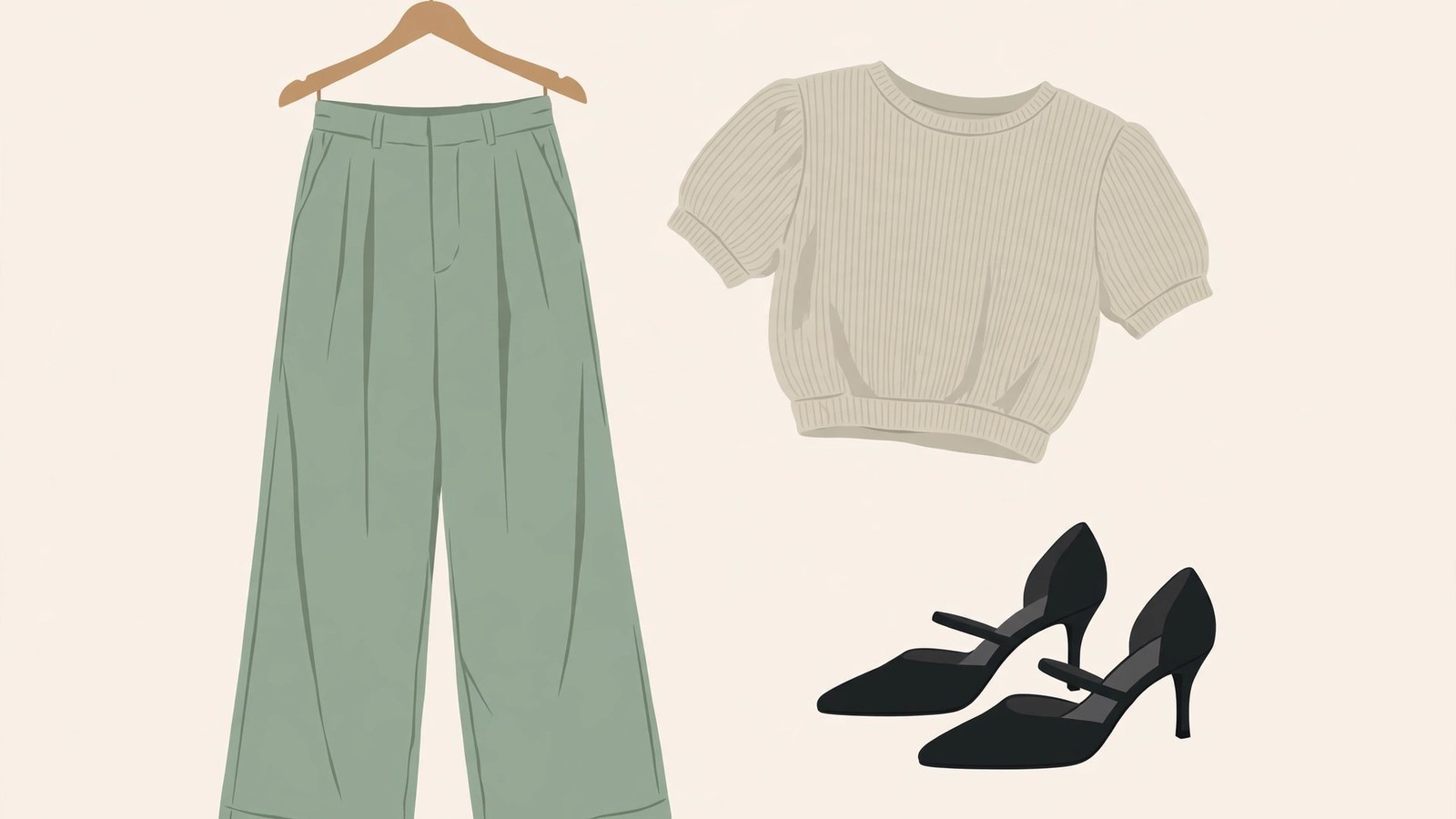
- Choose a high rise that sits at or just above your natural waist, so the visible leg starts as high as possible. Get the length exact for one shoe height: a full length hem should skim close to the floor with no pooling and at most a slight break, while a cropped wide leg should end cleanly at or just above the ankle bone. Start with a moderate width that falls straight from the hip in a fabric with enough structure to hold a clean line, such as a cotton twill or a heavier crepe. Define the waist with a full tuck, a front tuck, or a top that ends at the waistband. Finish with shoes that continue the leg line, such as a pointed toe or a stable low heel you can walk in well. Measure inseam, rise, and leg opening together, because no one number decides the fit on its own.
Introduction
Wide-leg trousers can work very well on a petite frame, and they can also overwhelm one. The difference is rarely the trousers alone. It is proportion: where the waistband sits, where the hem ends, what you wear on top, and which shoes you choose. Get those four decisions right and the trousers create one long, clean line from waist to floor. Get them wrong and the same pair can make legs look shorter and an outfit look unfinished.
Petite in clothing does not mean one body shape, one dress size, or one weight. In United States retail it usually describes a proportion block for shorter women, most often stated as 5 feet 4 inches and under, with shorter lengths and adjusted proportions through the body. Retail conventions vary, so that height line is a starting point rather than a universal standard, and this guide shows how to test any pair against your own measurements instead of trusting the label. Use the principles below in a full length mirror, standing, sitting, and walking, and let comfort have the final say.
What Petite Sizing Actually Means, and Why Labels Vary
Petite sizing is a proportion system, not simply a shorter hem. A true petite trouser adjusts more than length: the inseam is shorter, the rise is usually shorter, and the knee is placed higher, so shaping meant for the knee does not land low on the shin. A size marked short is different. Short usually keeps the body proportions of the regular size and shortens only the leg. That matters for wide legs, because hemming a regular trouser leaves the rise, pocket placement, and knee position exactly where they were.
There is no single universal petite standard every retailer follows in the same way. One widely used reference is the ASTM standard D7878/D7878M for misses petite body measurements, covering sizes 00P through 20P as a manufacturer baseline body block. A baseline is not a promise that two retailers will cut the same labeled size identically. One major United States retailer states that its petite sizes best fit women 5 feet 4 inches and under, while a university chart puts the petite line at 5 feet 3 and five eighths inches and under. Different conventions, which is why garment measurements beat labels.
Petite also does not mean small in circumference. Petite ranges run from the smallest sizes through plus sizes, because height and circumference are separate dimensions. A 14P is a size 14 cut for a shorter body, not a shrunken 14 and not the same garment as a 14W. Before you buy, measure a pair you already own and like, laid flat and smoothed without stretching, and record waist, front rise, inseam, and leg opening. Compare those numbers with the product chart for any new pair.
The Three Measurements That Decide the Fit
Inseam: where the leg ends
The inseam is the distance from the crotch seam, where the leg seams meet, down the inside of the leg to the bottom of the hem. It decides where the fabric stops, so it decides whether a full length trouser pools, breaks cleanly, or ends short. On a garment, lay the trousers flat, fold back the top leg so the inseam lies straight, and measure from the crotch point to the hem edge. On the body, stand in the shoes you plan to wear and have a helper measure to where you want the hem to sit, because bending to read the tape changes the number.
Worked example, using round illustrative numbers only. Suppose your flat shoe inseam, to a hem that just clears the floor, is 27 inches. The inseam you need over a shoe with a 2 inch heel rises by about the heel height: 27 inches plus 2 inches equals 29 inches. Hemmed at 27 inches, the pair will sit about 2 inches off the floor over the heeled shoe and look cropped. Hemmed at 29 inches, it will pool by about 2 inches over the flat shoe. Neither result is a fault in the trousers. It is arithmetic, and it is why many petite wearers dedicate one pair to flats and another to heels.
Rise: where the leg begins
The rise is the vertical distance from the crotch seam to the top of the waistband. Front rise is measured on the front, and back rise is longer, because the body needs more fabric behind. Rise decides where the trousers sit, and therefore where the visible leg line starts. A high rise sits at or above the natural waist, the narrow point you find by bending to one side and noting where the torso creases. Because the waistband sits higher, more of your total height reads as leg. A mid rise sits just below the natural waist and can work with a tucked top. A low rise sits on the hips, starts the leg line lower, and can gap at the back when you sit.
Add rise and inseam together and you get an approximation of the outseam, the full length from waistband to hem. Worked example: an 11 inch front rise plus a 27 inch inseam equals 38 inches. Two pairs can share that total and fit completely differently. A pair with a 9 inch rise needs a 29 inch inseam to reach 38 inches, so the waistband sits lower. A pair with a 12 inch rise needs only a 26 inch inseam, so the waistband sits higher and the leg starts higher. For a petite frame, the second split usually serves the leg line better. Record rise and inseam together, and check rise seated as well as standing: a rise too short for your torso can dig in when you sit, and a loose back rise can slide and gap.
Hem break: how the fabric meets the shoe
The break is the fold or dent that forms where the front of the trouser leg meets the top of the shoe. It is not a measurement you buy. It is the visible result of inseam, shoe height, and leg width together. No break means the hem ends just above the shoe with no fold, which suits cropped and ankle lengths. A slight break means the fabric rests on the shoe with one small dent and no pooling, the most useful target for full length wide legs on a petite frame. A full break means a deeper fold with extra fabric on the shoe, which adds visual weight at the ankle and tends to shorten the leg line. Wide legs have more fabric moving around the shoe, so length that looks like a slight break on a straight leg can look like pooling on a wide leg. Judge the break standing and walking, from front and side. The back of the hem should stay clear of the floor and should not drag or fold under when you step.
A Simple Proportion Method You Can Check
This method makes proportion checkable with a tape measure and a mirror. It is a styling convention, not a body standard, and no result from it means a body is wrong.
Find your natural waist and note where a high rise waistband would sit. Then estimate what share of your height sits below that point. Worked example with illustrative numbers: for a wearer who is 62 inches tall, which is 5 feet 2 inches, a waistband 40 inches above the floor leaves 62 minus 40, which equals 22 inches above it, and 40 inches below it. The leg share is 40 divided by 62, about 0.65, or about two thirds of total height. A lower waistband at 37 inches gives 37 divided by 62, about 0.60. Moving the waistband up by 3 inches has moved about five percentage points of the visible outfit from torso to leg, which is why rise has such a large visual effect on a shorter frame.
Apply the same thinking in thirds. An outfit tends to look balanced when it does not split into two equal halves at the waist. A high rise trouser with a tucked or waist length top creates a shorter top section and a longer leg section, roughly one third to two thirds. An untucked top ending at the hip over a low rise trouser moves the split closer to half and half. Mirror check: can you see where the waist is, is the leg the longest unbroken section, and is there only one main horizontal break, at the hem? A wide leg adds volume low on the body, so balance it with a clear waist and a top that does not add a second wide block at the hip. Volume in one place is the rule.
Start With the Waist, and Get the Length Right
The waistline comes first because it sets the start of the leg line. If you are between two rises, the higher one usually serves a petite frame better, provided it is comfortable seated. The waistband should sit flat without gaping or cutting in. Gaping at the center back is common when waist and hip measurements differ more, because a straight waistband cannot follow a curved waist. A belt can finish an outfit visually, but it should not be doing the structural work of holding trousers up. If you need a belt to keep a pair in place, the waist fit needs attention first, through a curved, contoured waistband or through alteration, covered below.
Tucking is the companion decision. An untucked top that covers the waistband hides the highest point of the trousers and cuts the leg line at the hip. A full tuck shows the whole waistband. A front tuck defines the front waist with a softer line. A cropped top that ends at the waistband defines the waist without tucking, provided it still meets the waistband when you reach or sit. The principle is only this: show where the trousers begin.
For full length wide legs, try the trousers on with the exact shoes you will wear most, on a hard floor rather than carpet, which hides drag. The target is a hem close to the ground without touching it, with no break or a slight break in front and a clean back. Cropped wide legs are a genuine alternative, not a compromise. The most reliable cropped length ends at or just above the ankle bone, showing a small amount of ankle or the top of the shoe. A length ending at mid calf cuts the leg at a wider point and tends to shorten it visually, so check it while walking. Wider cropped styles are sometimes called culottes when they are shorter and fuller. The same test applies: a clean end point, no pulling at the hip, and a defined waist. Remember that hemming a regular pair fixes length only. If the rise feels long or details sit low, a petite cut addresses the cause.
Choose Width, Fabric, Tops, and Color That Hold the Line
Not all wide legs are equally wide, and the leg opening tells you more than the style name. Measure the opening flat across the hem and compare it between pairs you own. A moderate wide leg falls straight from the hip and creates a long line without surrounding a small frame with fabric. A very wide, palazzo style leg can work, but it asks more of the rest of the outfit: a firmly defined waist, a closer fitting top, and an exact hem. If you are new to wide legs, start moderate.
Fabric decides whether that width falls cleanly or collapses. Drape is how a fabric hangs under its own weight. A structured twill, identified by its diagonal rib weave, holds its shape and stands slightly away from the body, which helps a wide leg keep a smooth column. Crepe, made with highly twisted yarns that give it a crinkled or pebbled surface, is known for fluid drape, so a heavier crepe falls in a smooth, moving line, while a very light or clingy fabric can collapse around the legs. Very stiff fabrics can add visual bulk. The useful middle is a fabric with both drape and enough body to fall from waist to hem without sticking or flaring. Hold the trousers up by the waistband: the legs should fall in two clean columns, not twist or bell out at the hem. Details should support the vertical line: a pressed crease, long seam, or subtle pinstripe draws the eye downward, pockets should lie flat, and flat front trousers with side seam pockets are the simplest starting point. Shallow, well pressed pleats can work. Bulky patch pockets and heavy, deep pleats add width at the hip, where a petite frame usually wants smooth.
With wide legs, the top should balance rather than compete. Fitted and semi fitted tops work most reliably: a tucked blouse, a fine knit sweater, a fitted T shirt, or a top that ends at the waistband. These define the waist and let the trousers carry the volume. An oversized, boxy top worn loose over wide trousers puts volume on both halves with no clear waist between them. You do not need tight tops. A slightly relaxed blouse, tucked in, can look balanced if the waist stays visible. If a top is cropped, raise your arms and sit down, and confirm it still meets the waistband. Layering works when it adds vertical structure rather than hip bulk: a fitted top under an open blazer, jacket, or cardigan keeps the waist visible. A long, loose layer over wide trousers and a loose top is the three volume combination that most often overwhelms a petite frame.
Color works through the same line logic. Similar tones create one continuous column and reduce horizontal breaks, which can make the leg line look longer. Strong contrast is also fine, and often sharper, when the waist is defined by a tuck and the hem is exact. The caution is only about stacking breaks at the waist, at the end of an untucked top, and at a cropped hem, which divides a short frame into small sections. If you love contrast, keep the rise high and the hem full length so the leg section stays long and unbroken.
Shoes: Pairing Logic, Not Just Heel Height
Shoes change both how wide leg trousers fall and how long the leg looks, because the shoe is where the trouser line either continues or stops. A pointed toe continues the line past the hem, flat or heeled, because the eye follows the point. A rounded toe that ends abruptly, especially one cut high at the ankle, stops the line sooner. Heels are not required. A pointed flat or a low block heel can continue the line without discomfort.
For full length trousers, the shoe is mostly hidden, so heel height is the main variable, because it sets the hem you need, as the inseam example showed. Choose the shoe for stability and comfort, and hem the trousers to it. A stable block heel is easier to walk in than a narrow heel of the same height, and a heel you cannot walk in well spoils the drape it was meant to improve. For cropped trousers, the shoe is fully visible, so shape matters as much as height. Choose a shoe that shows some foot or ankle, or continues the trouser color, to keep the gap between hem and floor connected. A contrasting shoe makes the crop a deliberate feature, which works best when the hem ends cleanly at the ankle.
Heavy, chunky shoes need a deliberate decision. A heavy boot or thick sole under a very wide leg can look intentional, but on a petite frame it can also make the lower half look bulky, because the widest hem meets the heaviest shoe at the same point. Test the combination walking in a mirror, and if the shoes dominate, a lighter shoe usually restores the balance. Never judge or pin a hem barefoot for heeled shoes, and never judge it in heels for flat shoes. Shoe height is part of the garment length.
What a Tailor Can Fix, and the Limits
Alterations are a normal part of petite trouser fit, not a sign of a failed purchase, because even a well cut petite range cannot match every leg length. Ask by measurement, bring the shoes you will wear, and have both legs pinned and checked.
Hemming is the most straightforward alteration. A tailor shortens the leg to your pinned length and rebuilds the hem. In one standard hemming method, a finished inseam of 27 inches with a 1 inch hem is cut at 28 and one quarter inches: 27 plus 1 plus one quarter, which equals 28.25. The extra quarter inch is the turn under allowance, and the 1 inch becomes the folded hem itself. Two limits follow. Shortening is limited mainly by shape: taking a very large amount off a wide or shaped leg can change the balance of the leg, so discuss large shortenings rather than assuming any amount is equal. Lengthening is limited strictly by the fabric that exists: a tailor can only let down what the existing hem allowance holds, often around an inch or less, and a let down hem can show a crease line where the old fold sat. If there is no allowance, length cannot be added.
Taking in the back waist is the second high value alteration. A tailor can take in the center back, adjust small darts, or reshape the waistband so it follows the waist and stops gaping. Its limit is proportion: a large waist reduction without adjusting the hip and seat can distort pockets and pull seams out of place, so a pair needing a very large waist change is a poorer starting point than one that fits the hip and needs only a modest adjustment. Tapering a wide leg can reduce excess width, but it changes the intended silhouette, so pin it and view it from all sides before any cutting. Lined trousers, pleats, and cuffs add complexity compared with a plain hem. The honest sequence is waist and hip first, then rise comfort seated, then length, then refinements. If waist, hip, and rise are all wrong, alteration is rarely the economical answer, because hemming cannot move a rise, a pocket, or a knee.
Common Mistakes and a Fitting Checklist
The most common mistake is wearing wide legs too long. Pooling fabric, dragging hems, and a heavy break at the ankle all shorten the leg and wear out the hem. Hem the pair, even if it means a tailor visit. The second mistake is hiding the waist with an untucked top, which makes the outfit read as one block and gives away the leg length the high rise created. The third is stacking volume: very wide trousers, an oversized top, a long loose coat, and heavy shoes together leave no defined point for the eye to measure the frame against. The fourth is choosing trousers tight at the hip that then flare abruptly below it, which pulls at the hip, opens pockets and pleats, and breaks the fall of the leg. Wide legs should fall smoothly from the waist or hip. The fifth is shopping by one number, usually dress size or total length, without checking rise and inseam separately. Two pairs with the same total length can place the waistband inches apart, and that placement decides whether the style works.
Use this checklist in order, in the shoes you plan to wear. Does the waist sit at or above your natural waist without gaping at the back or digging in at the front? Does the fabric fall smoothly without pulling across the hip or thigh, and do the pockets lie flat? Can you sit, stand, and walk without the front rise digging in or the back waistband sliding down? Does the hem skim clear of the floor with at most a slight break, or end cleanly at or just above the ankle for a cropped pair? Does your top define the waist when you move? Do the shoes continue the leg line rather than cutting it off? If you can answer yes to most of these, the trousers are working for your frame, whatever the label says. Wide leg trousers are not off limits for petite frames. Fitted with attention to rise, inseam, break, width, and fabric, they create a long, uninterrupted line from waist to floor.
Frequently Asked Questions
What rise is best for wide leg trousers on a petite frame?
A high rise that sits at or just above your natural waist is the most reliable starting point, because it starts the visible leg as high as possible. A mid rise can work with a tucked top. Test any rise seated as well as standing, since a rise too short for your torso can dig in when you sit. Comfort in both positions decides, not the rise name on the label.
Should petite wide leg trousers touch the floor?
A full length pair should fall close to the floor without dragging, pooling, or folding under, with no break or a slight break over the shoe you hemmed them for. Fabric resting in folds on the shoe or trailing at the back shortens the leg line and damages the hem. If you want a shorter finish, choose a deliberate crop at or just above the ankle bone instead of a full length pair that ends in between.
Can I wear the same wide leg trousers with flats and heels?
Only with a compromise, because heel height changes the inseam you need by about the height of the heel. A pair hemmed for flats will sit roughly the heel height above the floor in heels, and a pair hemmed for heels will pool by roughly that amount in flats. Many petite wearers keep one pair for flats and another for heels. If you want one pair to do both, hem for the shoe you wear most and accept the other result knowingly.
Is petite the same as short length?
No. Petite adjusts proportions through the garment, including a shorter inseam, a usually shorter rise, and a higher knee placement. Short length generally keeps the regular body proportions and shortens only the leg. If only the leg is too long and the rise, pockets, and waist all sit correctly in a regular size, a short length or a simple hem may be enough. If the rise feels long or details sit low, a petite cut addresses the cause.
Do I have to wear heels with wide leg trousers?
No. Heels are one way to gain hem clearance, not a requirement. A pointed toe flat continues the leg line past the hem, and a low, stable heel adds a little height while staying walkable. What matters is that the hem is set for the shoe you actually wear and that the shoe does not cut the leg line off abruptly at the ankle unless the crop is deliberate.
What if my size is between petite and regular?
That border is common, because retailer cutoffs vary and proportions vary independently of height. Compare garment measurements rather than labels: inseam, rise, waist, and hip against a pair you own that fits. Some wearers need petite trousers with regular tops, or the reverse, because torso and leg length do not always scale together. Trying both versions of one garment, where returns allow, is often the fastest way to learn your own pattern.
Keep reading: How to Style Wide-Leg Trousers for Tall Frames
Sources & references
- Nordstrom, Women's Regular and Petite Size Guides. Used for a major United States retailer stating that petite sizes best fit women 5 feet 4 inches and under, and for the petite bust, waist, and hip ranges in its chart differing from its regular chart at the same labeled sizes, showing that petite is a separate proportion block and that charts vary by retailer.
- Shop Nova Online, Petite vs. Regular Sizes: How to Tell Which Fits You. Used for petite adjusting more than the hem, including shorter inseam, shorter rise, and higher knee placement, for the distinction between petite and short length, for petite running through plus sizes, for the ASTM D7878/D7878M petite standard covering sizes 00P through 20P as a manufacturer baseline rather than a guarantee of identical fit across brands, for a university chart placing petite at 5 feet 3 and five eighths inches and under, and for hemming a regular trouser leaving rise, pocket, and knee placement unchanged.
- Simpli, Men's Suit Measurements Guide for Buying and Tailoring. Used for the measurement definitions only, which apply across tailored trousers: inseam measured from the crotch seam to the bottom hem along the inside leg, rise as the vertical distance from the crotch seam to the top of the waistband affecting where trousers sit on the body, hem depending on the desired break of no break, slight break, or full break, the natural waist being found where the torso bends to the side, and the advice to record both natural waist and pant waist and to note shoe height and styling preference when measuring.
- Spruce and Fjell, Alter Pant Leg Length, sewing lesson. Used for the hemming method and its worked numbers: pinning both legs to the same inseam and checking them in the shoes to be worn, a tailored hem cut longer in back than in front so the leg lies over the shoe in front and almost skims the floor in back, and a finished 27 inch inseam with a 1 inch hem cut at 28 and one quarter inches, allowing one quarter inch to turn under and 1 inch for the hem.
- Textile Glossary, Crepe Fabric. Used for crepe being defined by a crinkled or pebbled surface created with highly twisted yarns, weave, and finishing, for crepe being known for drape, for wool crepe retaining shape and silk crepe having graceful drape, and for crepe being made from fibers including silk, wool, polyester, rayon, and cotton.
- Wayne Arthur Gallery, Twill vs. Crepe. Used for twill being identified by diagonal parallel ribs formed by the weft passing over and under warp yarns, for twill having a stiffer and less flowing drape than crepe and holding its shape, for crepe having fluid drape, and for twill durability and common use in trousers and chinos. Used as a textile comparison source only, not as a shopping recommendation.


