Short answer
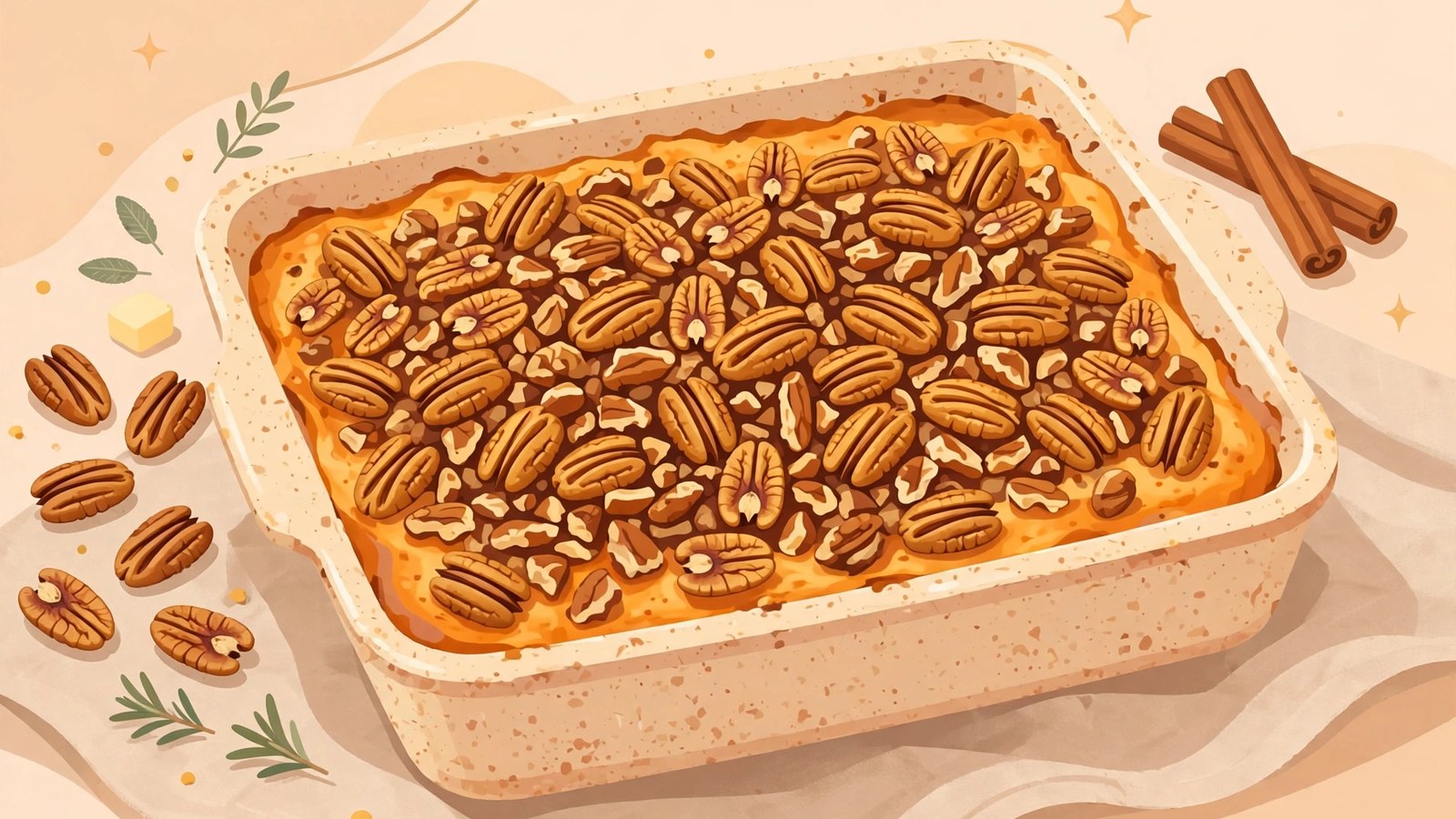
- Roast about 3 pounds of sweet potatoes at 400 degrees Fahrenheit for 45 to 60 minutes until completely tender, or boil peeled chunks for 15 to 20 minutes and drain them very well. Mash by hand, then stir in melted butter, brown sugar, milk or cream, beaten eggs, vanilla, cinnamon, nutmeg, and salt. Spread the base in a buttered 9 by 13 inch dish. Mix chopped pecans, flour, brown sugar, salt, and cold butter into pea sized clumps and scatter the topping over the base just before baking. Bake uncovered at 375 degrees Fahrenheit for 25 to 35 minutes, until the topping is golden and crisp, the edges bubble, and the center reaches 165 degrees Fahrenheit on a food thermometer. Rest uncovered for 10 to 15 minutes and serve warm. Refrigerate leftovers within 2 hours, use them within 3 to 4 days, and reheat them to 165 degrees Fahrenheit. The dish contains pecan, a tree nut, plus milk, egg, and wheat, so read the allergen note before serving guests.
Introduction
Thanksgiving sweet potato casserole with pecan topping is built on a contrast. Underneath is a smooth, warmly spiced sweet potato base. On top is a buttery pecan crumble that bakes crisp. One layer is soft, the other crunches, and a good serving spoonful needs both. That contrast is the whole reason for choosing pecans here. A marshmallow topping turns soft on soft and pushes the dish toward dessert. A pecan crumble keeps it recognizably a side dish that can sit next to turkey, gravy, and stuffing without tasting out of place.
The base needs restraint. Sweet potatoes are already sweet, and the topping adds more sugar, so the base should taste like sweet potatoes first, with brown sugar, cinnamon, and nutmeg in the background, butter for richness, and a little milk or cream for smoothness. Over sweetening is the most common fault, and it cannot be fixed once the topping is on. Balance matters more than in the cranberry sauce that often shares the table: that sauce is meant to be sharp and tart, while this casserole is meant to be rich and mellow, and the two dishes do different jobs.
This article gives the full recipe, explains why roasting beats boiling for flavor, how to mash without turning the base gluey, and how to keep the topping crisp. It also covers make ahead work, the temperature that governs a casserole containing egg, storage and reheating, and allergen notes in plain factual terms. The food safety guidance was checked against FoodSafety.gov, the United States Department of Agriculture Food Safety and Inspection Service, and the Food and Drug Administration on 31 October 2026.
Why This Casserole Works
Cooking method changes the base more than most cooks expect. Boiling peeled chunks is fast, but the potatoes take up water, and that extra water thins the mash and dilutes flavor. Roasting whole potatoes takes longer, but no water is added, the flavor concentrates, and the mash is denser and richer. This recipe gives both methods, with roasting preferred, and adjusts the liquid for each, because a boiled base needs less milk than a roasted one.
Mashing technique decides texture. A potato masher or a ricer gives a smooth mash that still has body. A food processor or blender overworks the starch and turns sweet potatoes gluey and pasty, and no topping can hide that. Mash by hand, add butter and milk gradually, and stop as soon as the mash is smooth.
The topping works because it is a crumble, not a sprinkle. Flour, brown sugar, cold butter, and chopped pecans, rubbed together until clumpy, bake into a crisp layer with distinct pieces. Pecans scattered alone on a wet base can scorch at the edges, leave bare patches, and soften where they touch the mash. Keeping the butter cold, keeping the mixture clumpy rather than creamed, and adding the topping only at baking time are what protect the crunch.
Ingredients
This recipe makes one 9 by 13 inch casserole, about 6 to 8 servings as a side dish. It is a side dish, not a main dish, and portions on a Thanksgiving plate are spoonfuls alongside other dishes. Have everything measured before you start mashing, because the base is best mixed while the potatoes are still warm.
For the base:
- 3 pounds sweet potatoes, about 4 large, weighed before cooking
- 1/2 cup unsalted butter, melted
- 1/3 cup brown sugar, packed
- 1/2 cup milk or cream, added gradually
- 2 large eggs, beaten
- 1 teaspoon vanilla extract
- 1 teaspoon orange zest, optional
- 1/2 teaspoon ground cinnamon
- 1/4 teaspoon ground nutmeg
- 1/2 teaspoon salt
For the topping:
- 1 cup pecans, chopped to about pea size
- 1/2 cup all purpose flour
- 1/2 cup brown sugar, packed
- 1/4 cup unsalted butter, cold and cut into small pieces
- 1/4 teaspoon salt
- 1/4 teaspoon ground cinnamon, optional
A few notes help the dish work the first time. Weigh the potatoes when you buy them, not after peeling, because a count alone can be off by a whole potato. Orange fleshed sweet potatoes are the standard here: they are sweet, moist, and mash smoothly. White or purple types are drier and change both color and texture. If you use canned sweet potatoes, drain them very well and use about half the milk, and taste before adding all the sugar, because some are packed in syrup.
Choosing Sweet Potatoes and Pecans Well
Choose sweet potatoes that are firm, heavy for their size, and free of soft spots, cracks, and sprouting. Store them in a cool, dry, ventilated place, not in the refrigerator, where cold can change the texture and flavor. Wash them under running water and scrub the skins before roasting, and dry them before they go in the oven.
Pecans need a freshness check that many cooks skip, because nuts go rancid quietly. Taste one pecan before chopping the batch. A fresh pecan tastes sweet and buttery. A rancid one tastes sharp, bitter, or like old oil, and no sugar in the topping hides that flavor. Buy pecans in sealed bags, store opened nuts in the refrigerator or freezer, and chop them just before mixing the topping. Pieces about the size of a pea give the best crust. Ground too fine, the topping turns sandy. Left too large, the pieces fall off instead of forming a layer.
Use eggs that have been kept refrigerated, crack each egg into a small bowl before adding it to the warm mash so a bad egg does not spoil the batch, and wash your hands after handling raw eggs, as the storage section explains.
Method: Step by Step
Step 1: Cook the sweet potatoes
For roasting, heat the oven to 400 degrees Fahrenheit. Prick each potato in several places with a fork, place them on a foil lined sheet pan, and roast for 45 to 60 minutes, until completely tender when squeezed and a knife slides in with no resistance. Cool until you can handle them, then cut them open and scoop out the flesh, discarding the skins.
For boiling, peel the potatoes, cut them into even chunks, cover them with water in a large pot, and simmer for 15 to 20 minutes, until very tender. Drain thoroughly, then leave the chunks in the hot colander for about 5 minutes so steam can escape. Skipping that drying pause is the usual cause of a watery base.
Step 2: Mash and season the base
Transfer the cooked flesh or chunks to a large bowl and mash by hand until smooth. Do not use a food processor or blender. Stir in the melted butter, the brown sugar, and the milk or cream a little at a time, stopping when the mash is smooth, thick, and spoonable rather than runny. Stir in the beaten eggs, vanilla, orange zest if using, cinnamon, nutmeg, and salt. Taste for sweetness and salt, remembering that the topping adds both. If the mash looks thin, hold back the last of the milk.
Step 3: Make the pecan topping
In a separate bowl, stir together the chopped pecans, flour, brown sugar, salt, and cinnamon if using. Add the cold butter pieces and rub them in with your fingertips until the mixture forms pea sized clumps. Work quickly so the butter stays cold, and do not cream the mixture smooth, because smooth paste bakes flat while clumps bake crisp. If you are not baking at once, cover the bowl and refrigerate the topping. Keep it separate from the base until baking time.
Step 4: Assemble and bake
Heat the oven to 375 degrees Fahrenheit. Butter a 9 by 13 inch baking dish or a 2 quart casserole and spread the sweet potato base evenly in it. Scatter the pecan topping evenly over the surface, right to the edges, so no bare base is left to dry out. Bake uncovered for 25 to 35 minutes, until the topping is golden and crisp, the edges of the base are bubbling, and the center has reached the temperature explained in the next section. If the topping browns too fast, tent the dish loosely with foil for the last 10 minutes only, and remove the foil before resting so steam does not soften the crust.
Step 5: Rest and serve
Rest the casserole uncovered for 10 to 15 minutes before serving. Resting lets the egg set the base so it spoons cleanly, and it keeps the topping crisp instead of steaming soft under a cover. Serve warm, using a spoon with a flat edge, and lift base and topping together so each portion has both layers.
How to Tell When the Casserole Is Done
Time and color are useful guides, but the governing check for this dish is temperature, because the base contains egg and the dish is a casserole. FoodSafety.gov publishes both figures, and they need to be kept distinct rather than merged into one number.
In its safe minimum internal temperature chart, last reviewed 21 November 2024, FoodSafety.gov lists egg dishes, such as frittata and quiche, at 160 degrees Fahrenheit. The same chart lists casseroles, meat and meatless, at 165 degrees Fahrenheit, and leftovers of any type at 165 degrees Fahrenheit. This casserole is a meatless casserole whose base is set with egg, so the casserole figure governs the finished dish. Bake until the center reaches 165 degrees Fahrenheit, measured with a food thermometer in the center without touching the dish itself. Reaching 165 degrees Fahrenheit also means the egg dish minimum of 160 degrees Fahrenheit has been passed, but 160 degrees Fahrenheit is not presented here as the finish temperature for the casserole.
Visual signs support the thermometer, they do not replace it. Look for a golden, crisp topping, bubbling at the edges, and a center that feels set rather than loose when the dish is gently shaken. A cold base will need extra time, often about 10 minutes more, and time alone is not a safe guide in that case. If the center is below 165 degrees Fahrenheit, return the dish to the oven, tent it if the topping is already dark enough, and check again in a few minutes.
Keeping the Topping Crisp
Most soggy toppings fail for one of three reasons: the topping was assembled hours ahead and absorbed moisture from the base, the butter was melted or warm so the mixture baked as paste instead of clumps, or the finished dish was covered while hot so steam softened the crust. The fixes follow directly. Keep the topping cold and separate until baking. Keep the butter cold and the mixture clumpy. Bake uncovered, rest uncovered, and do not cover the dish for holding until it has cooled.
If the topping still looks pale when the base is bubbling, give it a few more minutes uncovered. If it is dark but the center is not yet hot, tent loosely with foil, which shields the pecans while the center finishes. When reheating leftovers, heat covered only for the first part, then uncover for the last few minutes so the topping can crisp again instead of steaming.
Troubleshooting
If the base is watery, boiled potatoes were probably under drained, canned potatoes were used without cutting the milk, or too much milk was added at once. Next time, drain thoroughly, let the potatoes steam dry, and add milk gradually. For the dish in front of you, a little longer uncovered in the oven drives off some moisture, but it will not fully match a roasted base.
If the base is gluey, it was overworked in a processor or blender. There is no complete fix after the fact, though the topping and a full rest help. Next time, mash by hand and stop as soon as the mash is smooth.
If the topping is soggy, it was likely assembled too early, baked covered, or rested covered. If the topping is burned at the edges, the pieces were too large or uneven, or it baked too long while the center came up to temperature. Chop evenly, use a middle rack, and tent with foil once the color is right.
If the dish tastes too sweet, reduce the base sugar next time rather than the topping sugar, because the topping sugar helps the crumble set and brown. If it tastes flat, check the salt first, then consider the optional orange zest.
Variations That Keep the Method Intact
The method is a base you can vary, as long as the structure stays the same: a hand mashed base, a cold clumpy topping added at baking time, and a center that reaches 165 degrees Fahrenheit. For a brighter base without alcohol, add a tablespoon of orange juice with extra orange zest. The citrus cuts the richness and suits a table with many heavy dishes. No alcohol is needed for flavor here, and none is used in this recipe.
For a less sweet version, reduce the brown sugar in the base to 1/4 cup and in the topping to 1/3 cup. The dish will taste more like sweet potatoes and less like dessert, which suits tables where cranberry sauce and pie already supply sweetness. For a marshmallow and pecan compromise, scatter a thin layer of miniature marshmallows under the pecan topping, not instead of it, so the pecans still form the crisp top layer. Watch the marshmallows closely, because they brown quickly.
For individual portions, divide the base among buttered ramekins, top each one, and bake for 20 to 25 minutes, checking the center temperature of one ramekin rather than relying on the shorter time alone. For a dairy free version, replace the butter and milk with suitable alternatives you already use, and read the allergen note first, because the egg, wheat, and pecan remain even when the milk changes.
A walnut topping follows the same method. Walnuts are slightly more bitter and earthy than pecans, so the topping tastes less sweet. That swap does not make the dish safer for anyone with a tree nut allergy, because walnuts are also tree nuts, as the allergen note explains.
Serving Ideas and a Thanksgiving Timing Plan
Serve this casserole as a side dish, warm, in spoonfuls that include both layers. It belongs alongside turkey, gravy, stuffing, and green vegetables, and a modest spoonful per person is plenty at a full table. It is not the sharp, tart element on the plate. That job belongs to cranberry sauce, which is cooked separately on the stove and served to cut through rich foods. This casserole does the opposite work: it is soft, warm, and comforting, with crunch only on top.
For a large table, do not double the recipe into one deeper dish. A deeper layer heats unevenly. Double it across two dishes of the same size instead, baked side by side, and check the center temperature of each dish. For a smaller table, halve the recipe in a smaller dish, keep the layer depth similar, and check a few minutes early.
A simple timing plan reduces oven pressure. Make the base the day before and refrigerate it covered. Mix the topping the day before and refrigerate it separately. On the day, assemble while the oven heats and bake, allowing extra time because the base starts cold. Write the bake temperature, 375 degrees Fahrenheit, and the finish temperature, 165 degrees Fahrenheit, on a note with the dish, so the check is not forgotten while other dishes need attention.
Make Ahead, Storage, Reheating, and Food Safety
Make ahead work is where this dish earns its place on a crowded menu. The base can be prepared up to 2 days ahead and refrigerated covered, and the topping can be mixed at the same time and refrigerated separately. Do not assemble the two ahead, because the topping absorbs moisture and loses its crunch. Assemble just before baking, add about 10 minutes if the base goes in cold, and let the thermometer govern the finish.
FoodSafety.gov organizes home food safety into four steps: clean, separate, cook, and chill. Wash hands with plain soap and water for at least 20 seconds, especially after handling raw eggs. Wash boards, dishes, utensils, and countertops with hot soapy water after they have held raw eggs or flour. Rinse fresh produce under running water, and do not wash eggs. Keep the refrigerator at 40 degrees Fahrenheit or below and the freezer at 0 degrees Fahrenheit or below.
Cool and store leftovers promptly. Refrigerate perishable food within 2 hours of cooking, or within 1 hour if it has been exposed to temperatures above 90 degrees Fahrenheit. Bacteria that cause food poisoning multiply quickest between 40 degrees Fahrenheit and 140 degrees Fahrenheit, so do not leave the casserole on a buffet table for hours after the meal. Transfer leftovers to shallow, covered containers and refrigerate them promptly.
The United States Department of Agriculture Food Safety and Inspection Service gives the storage window used throughout federal guidance: leftovers keep for 3 to 4 days in the refrigerator, or 3 to 4 months frozen, although frozen leftovers lose moisture and flavor and this topping loses crispness on freezing. For the best frozen result, freeze the unbaked base without topping, thaw it in the refrigerator, add fresh topping, and bake as directed. That advice for the unbaked base is recipe guidance for quality. The 3 to 4 day and 3 to 4 month figures are the federal leftover windows for the cooked dish.
When reheating, bring leftovers to 165 degrees Fahrenheit throughout, measured with a food thermometer. FoodSafety.gov lists leftovers of any type at 165 degrees Fahrenheit, and the Food Safety and Inspection Service adds that covering leftovers helps them heat through. For this dish, reheat covered with foil for most of the time, then uncover for the last few minutes to re crisp the topping. Check the temperature in the center, and in more than one place for a large dish. Thaw frozen leftovers safely in the refrigerator, in cold water in a leak proof bag, or in the microwave, never on the counter. If a leftover smells off or has been stored beyond the window above, discard it.
Allergen and Dietary Notes
This section is factual information for planning and serving, not medical advice. This dish contains four major food allergens: tree nuts, in the form of pecans in the topping, milk, in the form of butter and milk or cream, egg, in the form of the beaten eggs that set the base, and wheat, in the form of the flour in the topping. The Food and Drug Administration lists nine foods, and ingredients containing their proteins, as major food allergens: milk, egg, fish, crustacean shellfish, tree nuts, wheat, peanuts, soybeans, and sesame. Its guidance gives pecans as an example of a tree nut, alongside almonds and walnuts. Sesame became the ninth major food allergen under the Food Allergy Safety, Treatment, Education, and Research Act, with labeling required from 1 January 2023.
Pecan allergy is a tree nut allergy and can be severe. Do not serve this dish to anyone with a pecan or tree nut allergy, and do not assume that picking the topping off a serving makes the food safe for an allergic guest, because the topping and base are baked together and share the dish and serving spoon. If an allergic guest is at the table, prepare a separate dish with clean utensils and fresh ingredients, or choose a different menu. Swapping pecans for walnuts does not remove the tree nut allergen, it changes which tree nut is present.
Check labels every time you buy flour, butter alternatives, milk alternatives, and any packaged side you serve with the dish, because the Food and Drug Administration notes that recipes can change and advises reading the entire ingredient list. Keep packages until the meal is over if guests may need to check them. Readers who follow a clinician directed eating plan should follow their clinician guidance on whether this dish fits that plan. No health or nutrition claim is made here for any individual.
Frequently Asked Questions
Can I make this ahead for Thanksgiving?
Yes, and it is one of the better make ahead sides. Make the base up to 2 days ahead and refrigerate it covered, and mix the topping separately and refrigerate it. Assemble and bake on the day. Allow about 10 extra minutes if the base starts cold, and judge the finish by the center temperature, 165 degrees Fahrenheit, not by time alone.
Should I roast or boil the sweet potatoes?
Roast them if you have time. Roasting adds no water, concentrates flavor, and gives a denser mash. Boiling is a sound shortcut if you drain the chunks thoroughly and let them steam dry for about 5 minutes, and if you add the milk gradually, because a boiled base starts wetter and needs less liquid.
Can I use canned sweet potatoes?
Yes, drained very well, with about half the milk. Canned sweet potatoes are softer and wetter than roasted ones, so the base needs less added liquid. Taste before adding all the brown sugar, because some canned varieties are packed in syrup and start sweeter.
Why is my topping not crisp?
The topping was likely assembled too early, made with warm or melted butter, baked covered, or covered while hot for resting or holding. Keep the butter cold, the mixture in pea sized clumps, the topping separate until baking, and the dish uncovered while it bakes and rests.
Can I freeze the finished casserole?
You can, but the topping loses crispness. Cooked leftovers keep for 3 to 4 days in the refrigerator or 3 to 4 months frozen under federal leftover guidance, with quality loss over time. For a better result, freeze the unbaked base without topping, thaw it in the refrigerator, add fresh topping, and bake as directed, checking for 165 degrees Fahrenheit in the center.
Can I use walnuts instead of pecans?
Yes, with a flavor and allergen change to expect. Walnuts taste slightly more bitter and earthy, so the topping is less sweet and buttery, and the method is identical. Walnuts are also tree nuts, so the swap does not make the dish safe for anyone with a tree nut allergy, and it introduces a different tree nut for guests who tolerate pecans but not walnuts.
How long do leftovers keep, and how should I reheat them?
Refrigerate leftovers promptly in shallow covered containers, within 2 hours of cooking or within 1 hour above 90 degrees Fahrenheit, with the refrigerator at 40 degrees Fahrenheit or below. Use them within 3 to 4 days, or freeze them for 3 to 4 months with some loss of topping texture. Reheat to 165 degrees Fahrenheit throughout, measured with a food thermometer, covered for most of the reheating and uncovered for the last few minutes.
Sources & references
- FoodSafety.gov, Cook to a Safe Minimum Internal Temperature. Used for the safe minimum internal temperature chart, last reviewed 21 November 2024: egg dishes, such as frittata and quiche, at 160 degrees Fahrenheit, casseroles, meat and meatless, at 165 degrees Fahrenheit, casseroles containing meat and poultry at 165 degrees Fahrenheit, and leftovers of any type at 165 degrees Fahrenheit, and for the instruction to always use a food thermometer to check whether food has reached a safe minimum internal temperature.
- FoodSafety.gov, 4 Steps to Food Safety. Used for the four steps clean, separate, cook, and chill, washing hands with plain soap and water for at least 20 seconds and especially after handling uncooked eggs, washing cutting boards, dishes, utensils, and countertops with hot soapy water after raw eggs or flour, rinsing fruits and vegetables under running water, not washing meat, poultry, eggs, or seafood, using a food thermometer in the thickest part of the food, keeping hot food at 140 degrees Fahrenheit or above after cooking, keeping a refrigerator at 40 degrees Fahrenheit or below and a freezer at 0 degrees Fahrenheit or below, refrigerating perishable food within 2 hours or within 1 hour above 90 degrees Fahrenheit, placing leftovers in shallow containers and refrigerating promptly, and never thawing or marinating food on the counter.
- United States Department of Agriculture, Food Safety and Inspection Service, Leftovers and Food Safety. Used for bacteria growing rapidly between 40 degrees Fahrenheit and 140 degrees Fahrenheit, refrigerating leftovers within 2 hours of cooking or 1 hour above 90 degrees Fahrenheit, cooling food rapidly in shallow containers, hot food being placed directly in the refrigerator or rapidly chilled first, covering and sealing leftovers, keeping leftovers in the refrigerator for 3 to 4 days or frozen for 3 to 4 months with loss of moisture and flavor over longer storage, safe thawing in the refrigerator, cold water, or the microwave with use within 3 to 4 days after thawing, reheating frozen leftovers without thawing in the oven or microwave for casseroles, and reheating leftovers to 165 degrees Fahrenheit as measured with a food thermometer, with leftovers covered during reheating.
- Food and Drug Administration, Have Food Allergies? Read the Label. Used for the nine major food allergens accounting for the large majority of severe food allergic reactions: milk, egg, fish, crustacean shellfish, tree nuts, wheat, peanuts, soybeans, and sesame, with tree nuts illustrated by almonds, pecans, and walnuts, for allergen food sources having to be identified on packaged food labels, for sesame becoming the ninth major food allergen under the Food Allergy Safety, Treatment, Education, and Research Act with labeling required from 1 January 2023, and for the advice to read the entire ingredient list every time a product is bought because ingredients can change at any time.


