Short answer
- Roast cubed sweet potatoes at 425°F for 22 to 28 minutes, until tender and browned at the edges. Cook onion, garlic, drained black beans, chili powder, oregano, and cumin in a skillet, mash about a quarter of the beans, then fold in the sweet potatoes, lime juice, and cilantro. Blend crushed tomatoes with onion, garlic, chili powder, cumin, smoked paprika, oregano, and olive oil, then simmer the sauce for 8 to 10 minutes. Warm 10 to 12 corn tortillas until pliable, fill each with one third to one half cup of filling, roll seam side down into a 9 by 13 inch dish lined with sauce, cover with the remaining sauce, and bake at 375°F, covered for 20 minutes and uncovered for 10 to 15 minutes more, until bubbling. Rest 10 minutes before serving. Refrigerate leftovers within 2 hours and reheat them to 165°F.
Introduction
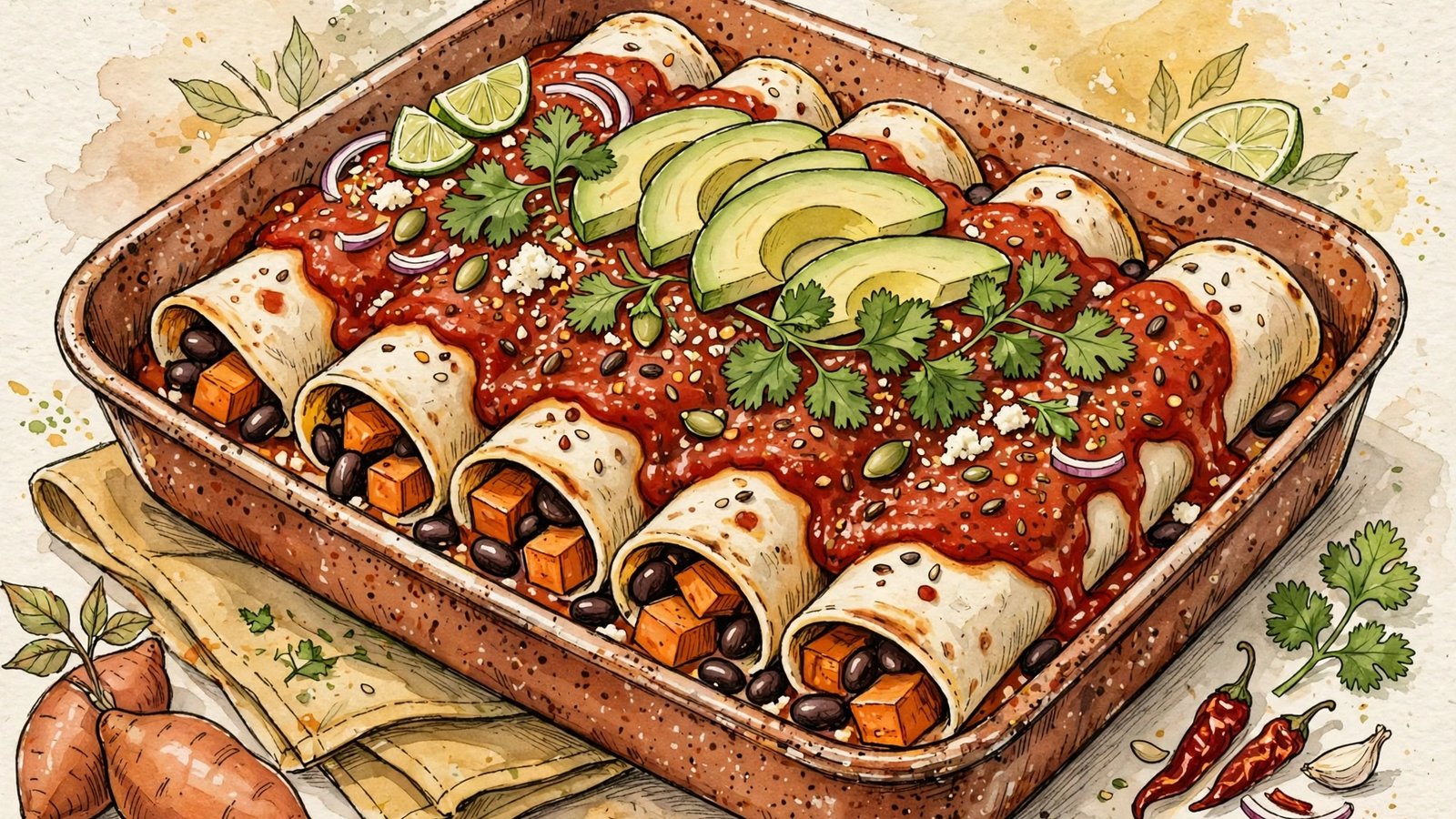
Enchiladas have a reputation as a weekend project, a dish with a dozen pans and a sauce that simmers all afternoon. These vegan sweet potato black bean enchiladas keep the comfort and the flavor while staying in weeknight territory. Sweet potatoes roast until soft with browned edges. Black beans add body. A quick blender enchilada sauce made from pantry staples ties the filling together, and a short bake turns the pan into a bubbling, scoopable dinner that feeds a family and reheats well.
The pairing at the center of the dish is practical. Sweet potatoes are sweet and starchy, so they soften into a filling that holds together without cheese or eggs. Black beans are earthy and sturdy, so the filling does not turn too sweet or too soft. Onion, garlic, cumin, and chili powder complete the filling before it meets the sauce, and a squeeze of lime at the end lifts the whole pan. The sauce carries the smoky notes: tomato, onion, garlic, chili powder, cumin, and smoked paprika give a warm, rounded flavor without a specialty shopping trip.
This recipe is written for a standard 9 by 13 inch baking dish and makes about 10 enchiladas, enough for 5 generous servings or 4 servings with leftovers. It is vegan as written, but labels still govern. Check tortillas, canned beans, broth, and canned tomatoes each time you buy them, because ingredients and facilities vary by brand. If you are cooking for someone with an allergy, confirm each product with that person rather than assuming it is safe. Food safety statements in this article were checked against the United States Department of Agriculture Food Safety and Inspection Service (USDA FSIS) and FoodSafety.gov, and allergen statements against the United States Food and Drug Administration (FDA), on 30 October 2026.
Why Sweet Potato and Black Beans Work Together
Texture is the first reason. Roasted sweet potato cubes collapse just enough to bind the filling, while black beans stay distinct and give each bite something to chew. Sweet potato alone would be soft and one note. Beans alone would be drier and less interesting. Together they balance each other in a way that feels intentional rather than improvised.
Flavor is the second reason. Sweet potato brings sweetness, beans bring earthiness, and the spices bridge the gap. Cumin adds warmth, smoked paprika adds a hint of smoke, and chili powder adds depth without necessarily adding much heat. In the United States, chili powder usually means a blend of ground chilies and spices, not pure ground chili pepper, so check the label if heat matters and taste as you go. Lime juice and fresh cilantro, added at the end, keep the dish from tasting heavy. Corn tortillas add a toasty, earthy note of their own, and they hold up well under sauce.
Nutrition is a supporting reason, stated without health promises. USDA data for the plain ingredients, not the finished dish, helps explain why the filling is satisfying. Raw sweet potato provides about 86 calories, 3 grams of fiber, and 709 micrograms of vitamin A as retinol activity equivalents per 100 grams. Cooked black beans provide about 132 calories, 8.9 grams of protein, and 8.7 grams of fiber per 100 grams. The finished dish will differ because of tortillas, oil, sauce, and toppings, and no nutrient claim is made for a serving of it.
At a Glance
| Item | Detail in this recipe |
|---|---|
| Dish | 9 by 13 inch baking dish |
| Yield | About 10 enchiladas, about 5 generous servings |
| Roast | 425°F for 22 to 28 minutes |
| Sauce simmer | 8 to 10 minutes over medium low heat |
| Bake | 375°F, 20 minutes covered, then 10 to 15 minutes uncovered |
| Rest | 10 minutes before serving |
| Leftover limit in the refrigerator | 3 to 4 days |
| Reheat leftovers to | 165°F, measured with a food thermometer |
Times are recipe guidance and vary by oven, pan, and cube size. Judge sweet potatoes by tenderness and browning, tortillas by pliability, and the baked pan by bubbling sauce and a hot center, not by the clock alone.
Ingredients
For the filling
- 2 large sweet potatoes, about 2 pounds, peeled and cut into 1/2 inch cubes
- 2 tablespoons olive oil, divided
- 1 teaspoon ground cumin, divided
- 1/2 teaspoon smoked paprika
- Salt and black pepper, to taste
- 1 small yellow onion, finely diced
- 3 cloves garlic, minced
- 2 cans (15 ounces each) black beans, drained and rinsed
- 1 teaspoon chili powder
- 1/2 teaspoon dried oregano
- 1 tablespoon lime juice, freshly squeezed
- 1/4 cup chopped fresh cilantro, optional
For the quick enchilada sauce
- 1 can (28 ounces) crushed tomatoes
- 1 small onion, roughly chopped
- 3 cloves garlic
- 2 tablespoons chili powder
- 1 teaspoon ground cumin
- 1 teaspoon smoked paprika
- 1/2 teaspoon dried oregano
- 1 tablespoon olive oil
- 1 teaspoon agave nectar or maple syrup, optional, to balance acidity
- Salt, to taste
- 1/2 to 3/4 cup low sodium vegetable broth or water, as needed to thin
To assemble and serve
- 10 to 12 corn tortillas
- 1 cup vegan shredded cheese, optional, check the label
- Sliced avocado or guacamole
- Fresh cilantro leaves
- Lime wedges
- Pickled red onion or sliced radishes, optional
- Vegan sour cream or cashew cream, optional
A note on rinsing canned beans: draining and rinsing removes the thick canning liquid, which keeps the filling from turning loose and lets you control salt and seasoning yourself. It does not need a special technique. Tip the beans into a colander, rinse under running water until the water runs mostly clear, and let them drain while the onion cooks.
Before You Cook: Clean, Separate, Cook, and Chill
FoodSafety.gov organizes home food safety into four steps, and each has a job here. Clean: wash hands with plain soap and water for at least 20 seconds, scrubbing the backs of the hands, between the fingers, and under the nails, and wash cutting boards, dishes, utensils, and countertops with hot, soapy water after each use. Rinse fruits and vegetables under running water without soap or bleach, before peeling or cutting, and dry produce with a paper towel or clean cloth towel.
Separate matters even in a meat free kitchen. Use one cutting board for fresh produce or foods that will not be cooked before eating, and separate plates and utensils for cooked and raw foods. In a mixed kitchen, keep boards and utensils that touched raw meat, poultry, seafood, or eggs apart from the enchilada ingredients.
Cook is covered in the method below. Chill is covered in the storage section: refrigerate perishable food within 2 hours, keep the refrigerator at 40°F or below and the freezer at 0°F or below, and use an appliance thermometer to be sure. The 2 hour clock starts when cooking ends.
Roasting the Sweet Potatoes
Heat the oven to 425°F. Toss the sweet potato cubes with 1 tablespoon of olive oil, 1/2 teaspoon of cumin, the smoked paprika, salt, and pepper. Spread them in a single layer on a large rimmed baking sheet lined with parchment paper. Crowding the pan steams the potatoes instead of roasting them, so use two pans if needed. Roast for 22 to 28 minutes, turning once halfway through, until the cubes are tender when pierced with a fork and browned at the edges. Smaller cubes cook faster, so check early if your dice is on the small side.
While the potatoes roast, make the filling base. Warm the remaining tablespoon of olive oil in a large skillet over medium heat. Add the diced onion and a pinch of salt and cook for 5 to 7 minutes, until soft and translucent. Stir in the garlic and cook for 30 seconds, until fragrant. Add the drained black beans, chili powder, oregano, and the remaining cumin. Stir and cook for 3 to 4 minutes, mashing about a quarter of the beans lightly with a spoon or potato masher. That partial mash is what helps the filling hold together inside the tortilla.
When the sweet potatoes are done, fold them into the bean mixture, add the lime juice and cilantro if using, and taste for salt. The filling should taste seasoned and bright on its own. If it tastes flat, add salt or lime a little at a time. If it tastes too sweet, the fix is usually salt, lime, or a touch more cumin and chili powder, not more cooking.
Making the Quick Enchilada Sauce
Combine the crushed tomatoes, chopped onion, garlic, chili powder, cumin, smoked paprika, oregano, and olive oil in a blender. Blend until smooth, then taste. If the sauce tastes sharp or overly acidic, add the sweetener a little at a time. Thin with broth or water until the sauce pours easily and coats a spoon without being watery. You want a sauce that will soften the tortillas during baking, not a thick paste that sits on top.
Pour the sauce into a saucepan and simmer over medium low heat for 8 to 10 minutes, stirring occasionally. This short simmer rounds off the raw onion and garlic flavors and lets the spices bloom. Taste again and adjust salt. The sauce should taste warm, smoky, and tomato rich, with heat that builds gently rather than hitting hard. If you prefer a spicier sauce, add a pinch of cayenne or a minced chipotle pepper in adobo, tasting as you go.
You can make the sauce up to 3 days ahead and refrigerate it in a covered container, or freeze it for longer storage. Having sauce ready turns this recipe into a fast assembly job on a busy night. Treat homemade sauce like other cooked leftovers for storage discipline: cool it promptly, refrigerate it in a covered container, and reheat it until steaming before use if it has been stored.
Assembling and Baking the Enchiladas
Reduce the oven temperature to 375°F. Spread about 1 cup of sauce over the bottom of a 9 by 13 inch baking dish. This layer keeps the first enchiladas from sticking and gives the bottom of the pan flavor.
Warm the corn tortillas so they roll without cracking. The skillet method works well: warm each tortilla in a dry skillet over medium heat for 20 to 30 seconds per side, then keep the stack under a clean towel. Alternatively, wrap a stack in a damp paper towel and microwave in short bursts, checking often. Fill each tortilla with about one third to one half cup of the sweet potato bean mixture, roll it snugly, and place it seam side down in the dish. Repeat until the dish is full. Pour the remaining sauce over the top, spreading it to cover the tortillas, and sprinkle with vegan cheese if using.
Cover the dish tightly with foil and bake for 20 minutes. Remove the foil and bake for another 10 to 15 minutes, until the sauce is bubbling around the edges and the top looks slightly thickened. For a temperature check, FoodSafety.gov lists casseroles, both meat and meatless, at a safe minimum internal temperature of 165°F. A pan of enchiladas assembled from hot filling and simmered sauce may already be hot throughout, while a pan assembled ahead and baked from the refrigerator will need the extra minutes described in the make ahead notes. In either case, bubbling edges alone do not prove the center is hot, so check the center with a food thermometer if you are in doubt.
Let the enchiladas rest for 10 minutes before serving. That rest matters: it lets the sauce settle, the tortillas firm up slightly, and the servings hold together when you lift them out. Garnish with avocado, cilantro, lime wedges, and any other toppings you like, and add fresh toppings only at serving time, not before storage.
Variations That Keep the Same Structure
Once the base recipe works, it is easy to adapt without changing the method. Add a can of drained corn for sweetness and extra texture, or a diced bell pepper cooked with the onion for a more vegetable heavy filling. Stir in a handful of baby spinach at the end of cooking the filling; it wilts quickly and adds color without changing the flavor much. For a smokier version, add a minced chipotle pepper to the sauce. For a milder table, reduce the chili powder in the sauce slightly and serve hot sauce on the side so each person controls their own heat.
Flour tortillas can be used if you prefer them, but they tend to soften more under sauce and can become mushy if overbaked. If you use flour tortillas, reduce the covered baking time slightly and check early. Readers who need a gluten free meal should use corn tortillas labeled gluten free and check every sauce and topping ingredient, since cross contact and labeling vary. That label check is not a formality: wheat is one of the nine major food allergens the FDA requires labels to identify, as the allergen section below explains.
Butternut squash is the closest substitute for sweet potato. Peel, cube, and roast it the same way, checking a few minutes early because squash cubes can soften faster. Canned sweet potato is a poor substitute here, for the texture reason given in the questions below. A second bean, such as pinto beans, can replace half the black beans without changing the timing, as long as the total bean quantity stays about the same and the partial mash step is kept.
Serving Ideas
Serve the enchiladas with a simple side: Mexican style rice, a green salad with lime dressing, roasted vegetables, or tortilla chips and guacamole. Because the dish is rich and saucy, a crisp, acidic side balances it well. Pickled red onion, sliced radishes, shredded cabbage with lime, and extra cilantro all do the same job at the table without extra cooking.
For a family style meal, put the hot pan in the center and set toppings in small bowls. Keep hot food hot if serving runs long: FoodSafety.gov advises keeping food hot at 140°F or above after cooking, using a heat source such as a chafing dish, warming tray, or slow cooker, rather than leaving a pan to cool on the counter. Once serving is over, move to storage promptly.
Allergen and Ingredient Notes
Allergen notes depend on brands and toppings, so labels govern. The FDA explains that nine foods, and ingredients containing their proteins, are defined as major food allergens: milk, egg, fish, crustacean shellfish, tree nuts, wheat, peanuts, soybeans, and sesame. Sesame became the ninth in 2021 with the signing of the Food Allergy Safety, Treatment, Education, and Research (FASTER) Act, and as of 1 January 2023 it must be labeled as an allergen on food packages, including dietary supplements.
The FDA advises reading the entire ingredient list every time you buy a product, even one you have eaten before, because ingredients can change at any time. A label identifies an allergen source either in parentheses after an ingredient, for example lecithin (soy), flour (wheat), and whey (milk), or in a Contains statement immediately after or next to the ingredient list. A separate may contain or produced in a facility advisory is voluntary, so its absence does not prove a facility is free of an allergen.
In this recipe, the base filling and sauce contain none of the nine as an intentional ingredient, but that is not a guarantee for any shopping basket. Vegetable broth may contain soy, canned tomatoes and spice blends vary, and tortillas vary by brand. Toppings change the picture again: vegan cheese and vegan sour cream may contain soy or tree nuts depending on the brand, and cashew cream contains a tree nut by definition. Label toppings clearly, use separate spoons, and tell guests what is in each topping before serving. If you are cooking for a guest with a serious allergy, serve that guest first from untouched containers, and confirm each product with that person. The word vegan on the front of a package is not a substitute for the ingredient list.
Make Ahead, Storage, Cooling, and Reheating
Make ahead in stages is the easiest pattern. The sauce keeps for up to 3 days refrigerated in a covered container, as noted above. The filling can be made a day ahead, cooled promptly, and refrigerated in a covered container. You can also assemble the full pan, cover it, and refrigerate it for up to a day before baking. Add a few extra minutes to the covered baking time if baking straight from the refrigerator, and check that the center is hot throughout, at 165°F for a meatless casserole, before serving.
For leftovers, FSIS gives the rules that govern this dish. Bacteria grow rapidly between 40°F and 140°F. After food is safely cooked, hot food must be kept hot at 140°F or warmer to prevent bacterial growth. Within 2 hours of cooking, or after food is removed from an appliance keeping it warm, leftovers must be refrigerated. Throw away perishable food left at room temperature for more than 2 hours, or more than 1 hour if the temperature is over 90°F, such as at an outdoor picnic in summer. Discard leftovers that have sat out too long even if they look and smell fine.
Cool food rapidly. FSIS advises dividing large amounts of food into shallow containers, because a deep dish takes a long time to cool and invites bacteria to multiply while the center is still warm. Hot food can be placed directly in the refrigerator; leaving enchiladas on the counter to cool first spends the 2 hour budget. Cover leftovers, wrap them in airtight packaging, or seal them in storage containers, then refrigerate or freeze them immediately.
FSIS states that leftovers can be kept in the refrigerator for 3 to 4 days or frozen for 3 to 4 months, and that frozen leftovers remain safe indefinitely but can lose moisture and flavor over longer storage. The FoodSafety.gov Cold Food Storage Chart gives a dish specific comparison for soups and stews with vegetable or meat added: 3 to 4 days refrigerated and 2 to 3 months frozen, with its freezer times for quality only. For these enchiladas, eat refrigerated portions within 3 to 4 days and freeze portions without fresh toppings such as avocado.
Thaw frozen leftovers safely in the refrigerator, in cold water, or in the microwave. Refrigerator thawing takes the longest, but the food stays safe the entire time, and after thawing it should be used within 3 to 4 days or refrozen. For cold water thawing, the food must be in a leak proof package or bag, and food thawed this way should be cooked before refreezing. Microwave thawing is fastest: keep heating until the food reaches 165°F, and food thawed this way can be refrozen after heating to that temperature. It is also safe to reheat frozen leftovers without thawing, in the oven or microwave for a casserole or combination meal.
Reheat leftovers to 165°F as measured with a food thermometer. Cover leftovers to reheat. In the microwave, cover and rotate for even heating, vent the lid or wrap, check the temperature in several places because microwaves have cold spots, and allow a resting time before the final check. Add fresh toppings after reheating. It is safe to refreeze any food remaining after reheating previously frozen leftovers to 165°F.
Troubleshooting
| Problem | Likely cause | Fix for next time |
|---|---|---|
| Tortillas cracked while rolling | Tortillas were cold or dry, or were overfilled | Warm thoroughly, keep the stack covered, and use one third to one half cup of filling |
| Filling fell apart | Beans were not mashed at all, or sweet potatoes were under roasted | Mash about a quarter of the beans and roast until the cubes are fully tender |
| Dish tasted too sweet | Sweetness concentrated in roasting, with too little salt or acid | Taste filling and sauce separately and adjust salt and lime before assembling |
| Sauce tasted sharp | Raw onion and garlic had not simmered, or tomatoes were very acidic | Simmer the full 8 to 10 minutes and add the optional sweetener a little at a time |
| Enchiladas were soggy | Too much sauce under flour tortillas, or the pan was overbaked | Use corn tortillas, cover the tortillas with sauce without flooding the pan, and check early |
| Center was lukewarm | Pan was baked from the refrigerator without extra time | Add covered minutes and check the center with a food thermometer |
Frequently Asked Questions
Why did my tortillas crack when I rolled them?
Corn tortillas crack when they are cold or dry. Warm them thoroughly, keep the stack covered while you work, and do not overfill. A tortilla that is warm and pliable rolls easily; a cold one splits no matter how careful you are. If a tortilla does crack, place it seam side down with the crack underneath and cover it well with sauce. It will still bake and serve fine.
Can I prepare these ahead?
Yes. Assemble the enchiladas, cover, and refrigerate for up to a day before baking. Add a few extra minutes to the covered baking time if baking straight from the refrigerator, and check that the center is hot throughout, at 165°F. You can also freeze the assembled, unbaked enchiladas, though the texture of the tortillas may soften slightly after thawing. Thaw in the refrigerator, in cold water in a leak proof package, or in the microwave, using the safe thawing rules in the storage section, and bake or reheat to 165°F.
Do I need vegan cheese?
No. The enchiladas are satisfying without it, thanks to the creamy sweet potatoes and rich sauce. Cheese adds a familiar melted topping, but a drizzle of cashew cream, a spoonful of guacamole, or simply extra sauce and cilantro works just as well. If you do use a vegan cheese, check its label for soy or tree nuts if allergies matter at your table, because brands differ.
How do I keep the dish from being too sweet?
Balance is key. Roasting concentrates the sweetness of the sweet potatoes, so lime juice, salt, and smoky spices matter. Taste the filling and the sauce separately before assembling, and adjust salt and lime until neither tastes one dimensional. A sauce that tastes slightly bold on its own is usually right once it is spread across tortillas and filling.
Can I use canned sweet potatoes?
Fresh roasted sweet potatoes give the best texture here. Canned sweet potatoes are much softer and often packed in syrup, which would make the filling overly sweet and mushy. If fresh sweet potatoes are unavailable, another roasted root vegetable, such as butternut squash cubed and roasted the same way, is a better substitute.
Can I freeze vegan sweet potato black bean enchiladas?
Yes, without fresh toppings. Portion the baked enchiladas, cool them rapidly in shallow containers, seal them, and freeze them. FSIS gives frozen leftovers 3 to 4 months, while noting that frozen leftovers stay safe indefinitely but lose moisture and flavor over longer storage. Thaw safely in the refrigerator, in cold water, or in the microwave, then reheat to 165°F as measured with a food thermometer and add fresh toppings after reheating.
Are these enchiladas gluten free?
Only if every ingredient you buy is labeled gluten free. Corn tortillas are the right starting point, but tortillas, broth, canned tomatoes, and spice blends vary by brand and facility, and wheat is one of the nine major food allergens labels must identify. Read the entire ingredient list and any Contains statement on each package, and do not rely on the front of the package alone. Flour tortillas contain wheat and are not gluten free.
Can I use dried black beans instead of canned?
Yes, if they are fully cooked before they go into the filling. This recipe is written for canned beans because they are already cooked, drained, and ready to season, which keeps the weeknight timing honest. If you cook dried black beans, cook them until completely tender following the package directions, drain them, and use about the same total quantity of cooked beans. Season and mash them exactly as the canned beans are handled above. Do not add dried, uncooked beans to the filling or to the baking dish, because they will not cook through in the time this dish spends in the oven.
Sources & references
- USDA Food Safety and Inspection Service, Leftovers and Food Safety (last updated 31 July 2020). Used for bacteria growing rapidly between 40°F and 140°F, hot food being kept hot at 140°F or warmer, refrigerating leftovers within 2 hours of cooking or after removal from an appliance keeping food warm (1 hour if the temperature is over 90°F), cooling food rapidly by dividing large amounts into shallow containers, hot food being placed directly in the refrigerator, covering or sealing leftovers in airtight packaging and refrigerating or freezing immediately, leftovers keeping 3 to 4 days in the refrigerator or 3 to 4 months in the freezer while remaining safe indefinitely frozen but losing moisture and flavor, the three safe thawing methods (refrigerator, cold water in a leak proof package with cooking required before refreezing, and microwave with heating to 165°F), reheating frozen leftovers without thawing in the oven or microwave for casseroles and combination meals, reheating leftovers to 165°F as measured with a food thermometer, covering leftovers to reheat, the microwave covering, rotating, venting, multi spot checking, and resting time instructions, and refreezing food remaining after reheating previously frozen leftovers to 165°F.
- FoodSafety.gov, 4 Steps to Food Safety. Used for washing hands with plain soap and water for at least 20 seconds, scrubbing the backs of the hands, between the fingers, and under the nails, washing cutting boards, dishes, utensils, and countertops with hot, soapy water after each use, rinsing fruits and vegetables under running water without soap or bleach and drying produce, using one cutting board for fresh produce or foods not cooked before eating and separate plates and utensils for cooked and raw foods, keeping food hot at 140°F or above after cooking with a chafing dish, warming tray, or slow cooker, refrigerating perishable foods within 2 hours (1 hour above 90°F), the refrigerator being set to 40°F or below and the freezer to 0°F or below with an appliance thermometer, leftovers being placed in shallow containers and refrigerated promptly, and freezing not destroying harmful germs but keeping food safe until it can be cooked.
- FoodSafety.gov, Cold Food Storage Chart (date last reviewed 19 September 2023). Used for the chart conditions of a refrigerator at 40°F or below and a freezer at 0°F or below, freezer guidelines being for quality only because frozen foods stored continuously at 0°F or below can be kept indefinitely, and the soups and stews row, vegetable or meat added, at 3 to 4 days refrigerated and 2 to 3 months frozen.
- FoodSafety.gov, Cook to a Safe Minimum Internal Temperature (Safe Minimum Internal Temperature Chart). Used for always using a food thermometer to check whether food has reached a temperature hot enough to kill harmful germs, casseroles, meat and meatless, at 165°F, and leftovers of any type at 165°F.
- United States Food and Drug Administration, Have Food Allergies? Read the Label. Used for the nine major food allergens (milk, egg, fish, crustacean shellfish, tree nuts, wheat, peanuts, soybeans, and sesame) and ingredients containing their proteins, labels being required to identify the food source of all major food allergens used to make the food, the two declaration methods (food source name in parentheses after the ingredient, or a Contains statement immediately after or next to the ingredient list), sesame becoming the ninth major food allergen in 2021 under the FASTER Act with labeling required as of 1 January 2023 including dietary supplements, voluntary may contain advisory statements and the fact that not all manufacturers use them, and reading the entire ingredient list every time because ingredients can change at any time.
- United States Food and Drug Administration, Food Allergies. Used for the FDA role in allergen preventive controls to prevent allergen cross contact in manufacturing and packaging and to ensure products are accurately labeled with respect to allergens, and for the FDA being able to treat a product that lacks required allergen information or does not qualify as gluten free as misbranded or adulterated and subject to enforcement action.
- USDA National Nutrient Database for Standard Reference and USDA FoodData Central nutrient data for the plain ingredients. Used only for the plain ingredient figures in the nutrition paragraph: raw sweet potato at about 86 calories, 3 grams of fiber, and 709 micrograms of vitamin A as retinol activity equivalents per 100 grams, and cooked black beans at about 132 calories, 8.9 grams of protein, and 8.7 grams of fiber per 100 grams. No nutrient figure is claimed for the finished dish.


