Short answer
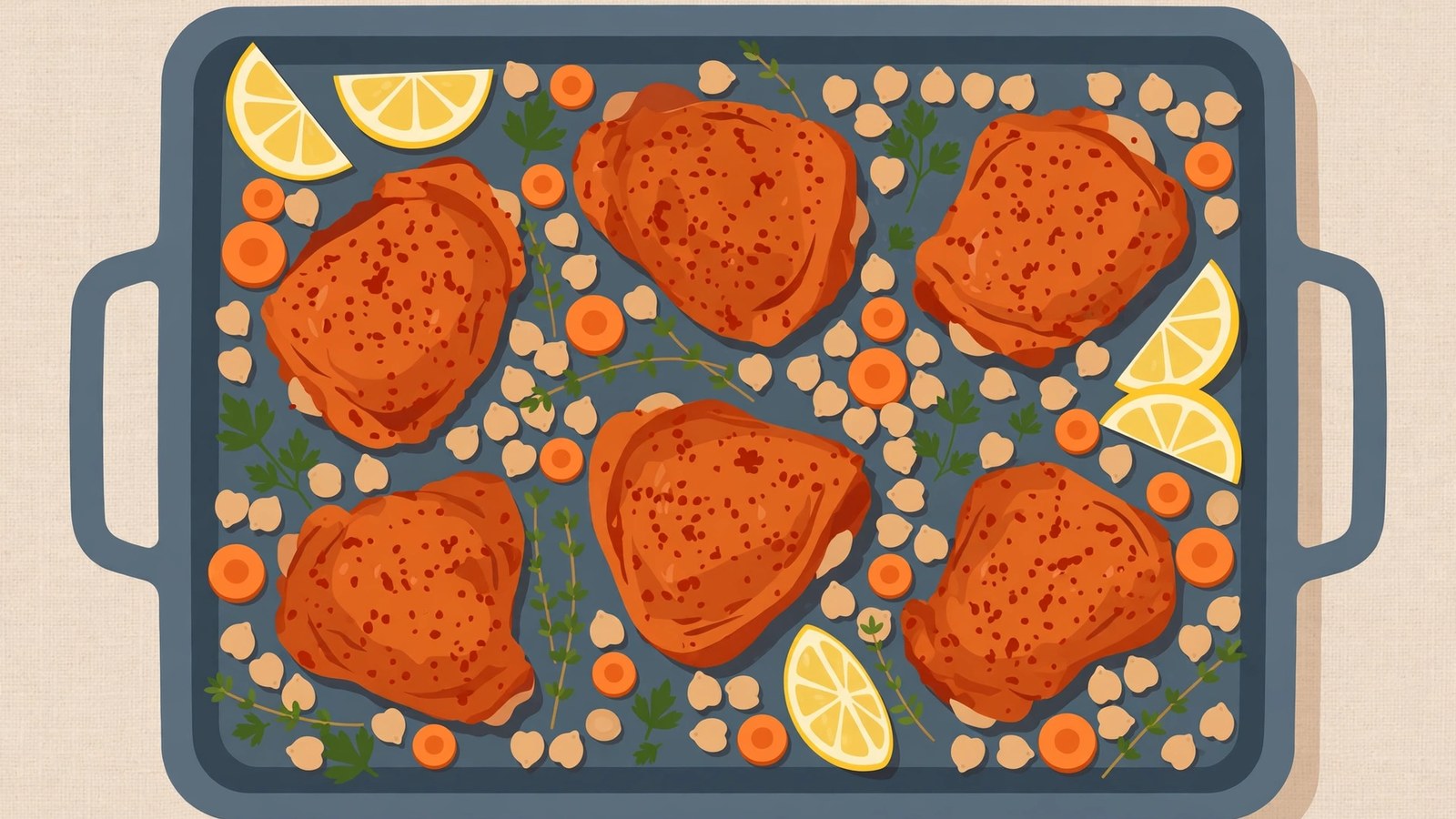
- Heat the oven to 425 degrees Fahrenheit. Whisk 3 tablespoons harissa paste with olive oil, honey if using, cumin, smoked paprika, garlic, lemon juice, salt, and pepper, and taste the marinade before it touches the chicken so you can adjust the heat. Coat 2 pounds of chicken thighs, then toss drained and well dried chickpeas, carrot batons, and red onion wedges in the same bowl. Spread everything in a single layer on a large rimmed sheet pan, with the chicken skin side up if you use skin-on thighs. Roast for 30 to 40 minutes, turning the chickpeas and carrots once halfway through if you can. The chicken is done at 165 degrees Fahrenheit in the thickest part, measured with a food thermometer, which is the safe minimum internal temperature FoodSafety.gov lists for all poultry. Rest the pan for 5 to 10 minutes, squeeze the roasted lemon wedges over it, and scatter fresh herbs. Refrigerate leftovers promptly at 40 degrees Fahrenheit or below, use them within three to four days, and reheat them to 165 degrees Fahrenheit.
Introduction
Sheet-pan harissa chicken with chickpeas and carrots earns its place in a weeknight rotation for a simple reason: one bold paste does the work that would otherwise take a spice rack, an overnight marinade, and a sauce at the end. This version pairs chicken thighs with chickpeas and carrots on a single rimmed pan, so the pan holds the main dish, the side, and most of the flavor in one layer. The chickpeas crisp at the edges where they touch the hot pan, the carrots soften and sweeten, and the chicken stays juicy because thighs forgive a few extra minutes in a way breasts often do not.
The method matters more than the brand of harissa you buy, because harissa varies widely. Some jars are fiery and thin. Others are mild, smoky, and thick with peppers. This recipe is written so you can taste and adjust before the pan goes into the oven, rather than discovering at the table that the heat level is wrong for your household. A little honey or a squeeze of lemon at the end is not decoration. It is how you balance a paste that can lean hot, salty, or sharp depending on the jar.
Everything here happens on one pan, which keeps cleanup honest. There is no separate sauce pan, no second tray for vegetables, and no last minute juggling. Preparation takes about fifteen minutes, the oven does the rest, and the finished pan can go straight to the table on a trivet. Serve it with flatbread, rice, or a simple herb salad, and you have a complete meal that tastes planned rather than assembled in a hurry. The food safety guidance in this article was checked against FoodSafety.gov, the United States Department of Agriculture Food Safety and Inspection Service, and the Food and Drug Administration on 31 October 2026.
Why This Dish Works
A sheet pan works for this dish because it gives every ingredient direct contact with heat and air. Crowd the pan and you get steaming instead of roasting: the chickpeas stay soft, the carrots stay pale, and the chicken skin never crisps. Spread everything in a single layer with a little space between pieces and the opposite happens. Moisture escapes, edges brown, and the harissa paste caramelizes in spots instead of staying wet and tasting raw.
Chicken thighs are the right cut here for two practical reasons. First, their higher fat content keeps them moist through a roast long enough to cook carrots through. Second, they reheat better than breasts, which matters if you are cooking for lunches as well as dinner. If you prefer breasts, the recipe still works, but check them earlier and pull them as soon as they reach temperature, because the window between juicy and dry is much narrower.
Chickpeas play a double role. They add protein and fiber so the dish feels substantial without a starchy side, and they act as a sponge for the seasoned oil and pan juices. Toss them well before roasting so each one carries some harissa, and leave a few in direct contact with the pan rather than buried under chicken. Those are the ones that turn crisp and become the best bites on the tray.
Choosing Harissa and Chicken Well
Harissa is not a single product, and the jar you buy shapes this dish more than any other ingredient. Read the label before you buy. Some harissa pastes list chili peppers first and taste fiery and sharp. Others list roasted red peppers first and taste smoky and mild. A few are thinned with oil or water, so they coat less evenly. If the label lists vinegar high up, expect brightness and use a little less lemon at the end. If it lists tomato paste, expect sweetness and body, and you may not need the honey at all. Taste a fingertip of the paste before it touches the chicken, because that single taste tells you more than the heat rating on the front of the jar, which is rarely standardized between brands.
Chicken choice matters almost as much. Skin-on, bone-in thighs give the best result on a sheet pan: the skin crisps, the bone slows the cooking so the meat stays juicy, and the rendered fat helps the chickpeas and carrots brown. Boneless thighs are a good second choice and cook faster, so check them earlier. If you buy a mixed pack of thighs in different sizes, group similar sizes together on the pan, or give the largest pieces the hottest part of the oven, so everything finishes at about the same time. Avoid chicken that is already marinated in a sweet sauce, because the added sugar can burn under harissa and the salt level becomes hard to control.
Keep raw chicken separate from other foods while you shop and prepare. FoodSafety.gov groups home food safety into four steps: clean, separate, cook, and chill. Wash your hands with plain soap and water for at least 20 seconds after handling raw poultry, wash boards, dishes, utensils, and countertops with hot soapy water between raw poultry and ready to eat foods, and use separate plates for raw and cooked chicken. Do not wash the chicken itself, because washing poultry can spread germs around the kitchen.
Ingredients
This recipe makes about four servings as a main dish. Read the whole list before starting, so nothing is discovered missing halfway through cooking.
- 2 pounds bone-in, skin-on chicken thighs, or boneless thighs, about 6 to 8 pieces
- 1 can (15 ounces) chickpeas, drained, rinsed, and patted dry
- 1 pound carrots, peeled and cut into batons about 1/2 inch thick
- 1 red onion, cut into wedges
- 3 tablespoons harissa paste, plus more to taste
- 3 tablespoons olive oil
- 1 tablespoon honey, optional, to balance hot harissa
- 1 teaspoon ground cumin
- 1 teaspoon smoked paprika
- 3 cloves garlic, minced
- 1 lemon, half juiced and half cut into wedges
- Salt and black pepper, to taste
- Fresh parsley or cilantro, chopped, for serving
- Optional for serving: flatbread, cooked rice, or couscous
Two notes help the dish work the first time. Pat the chickpeas dry before tossing them, because surface water is the main reason chickpeas roast soft instead of crisp. If your harissa is very hot, start with 2 tablespoons and add the third after tasting the marinade. If it is mild, the full amount gives warmth without real heat, and a pinch of chili flakes can be added at the table instead of in the pan.
Preparing the Pan and the Ingredients
Line the pan before you mix anything. A large rimmed sheet pan lined with parchment paper or foil is easiest to clean, and the rim matters. A flat baking sheet lets juices run off, while a rimmed pan keeps the seasoned oil where it belongs. If your pan is small, plan on two pans rather than crowding one. The extra washing is worth the browning.
Cut the carrots to an even thickness, about 1/2 inch, so they finish with the chicken instead of after it. Cut the onion into wedges that stay in large pieces, because small pieces scorch during a 30 to 40 minute roast. Drain and rinse the chickpeas, then spread them on a clean towel and pat them dry. The drier they are when they meet the oil and harissa, the better they crisp.
Have the lemon juiced, the garlic minced, and the herbs chopped before the chicken is coated. Once the raw chicken has been handled, you want to wash your hands and move straight to arranging the pan, not to a series of small jobs that spread raw poultry juices around the work area.
Method: Step by Step
Step 1: Heat the oven and prepare the pan
Heat the oven to 425 degrees Fahrenheit and line a large rimmed sheet pan with parchment paper or foil. Set the pan where it will be easy to load. If you are using two pans, line both now.
Step 2: Mix the harissa marinade
In a large bowl, whisk the harissa, olive oil, honey if using, cumin, smoked paprika, garlic, lemon juice, 1 teaspoon of salt, and a good grind of black pepper. Taste the mixture on a fingertip. It should taste bold and a little salty, because roasting and the unsalted chickpeas and carrots will soften it. Adjust now: more harissa for heat, more honey for balance, more lemon for brightness.
Step 3: Coat the chicken, chickpeas, and vegetables
Add the chicken to the bowl and turn each piece so it is coated on all sides, including under the skin if you are using skin-on thighs. Lift the chicken out onto a plate, then add the chickpeas, carrots, and onion to the same bowl and toss until they are evenly coated. Any marinade that goes onto the pan from the start will cook fully in the oven with everything else. Discard any marinade left in the bowl after the pan is loaded, and never drizzle marinade that has touched raw chicken over the finished dish at serving, because that marinade has not been cooked.
Step 4: Arrange in a single layer
Spread the carrots, onion, and chickpeas on the prepared pan first, then nestle the chicken pieces on top and between them, skin side up for skin-on thighs. Leave small gaps rather than packing pieces edge to edge. Tuck the lemon wedges around the pan. They soften in the oven and can be squeezed over the finished dish.
Step 5: Roast until done
Roast for 30 to 40 minutes, turning the chickpeas and carrots once halfway through if you can do so without disturbing the chicken too much. The chicken is done when it reaches 165 degrees Fahrenheit in the thickest part, measured with a food thermometer without touching bone, and the carrots should be tender when pierced with a fork. Skin-on, bone-in thighs may need the longer end of the range, and smaller boneless thighs may finish sooner, so trust the thermometer over the clock. Color and clear juices alone are not reliable guides to doneness.
Step 6: Rest and finish
Let the pan rest for 5 to 10 minutes before serving. Resting lets the chicken juices settle and the pan juices thicken slightly. Squeeze the roasted lemon wedges over the pan, scatter the herbs, and taste a chickpea for salt. Serve directly from the pan or transfer everything to a platter, spooning the pan juices over the top.
How to Tell When Chicken Is Done
Use a food thermometer. That is the whole rule, and federal guidance states it plainly. FoodSafety.gov advises cooks to always use a food thermometer to check whether food has reached a safe minimum internal temperature, placing it in the thickest part of the food. In its safe minimum internal temperature chart, last reviewed 21 November 2024, FoodSafety.gov lists chicken, turkey, and other poultry, including whole birds, breasts, legs, thighs, wings, and ground poultry, at 165 degrees Fahrenheit.
For this recipe, insert the thermometer into the thickest part of the largest thigh, away from the bone, because bone conducts heat and can give a misleading reading. Check more than one piece if the thighs are uneven in size. If the largest piece is short of temperature, return the pan to the oven for a few minutes and check again, rather than serving on the basis of skin color, firmness, or juice color. Those signs can look right on chicken that is not yet at temperature, which is why the thermometer reading governs.
Troubleshooting: Common Problems and Fixes
If the chickpeas are soft instead of crisp, the usual causes are a crowded pan, wet chickpeas, or too little oil. Next time, dry them thoroughly, give them direct pan contact, and check that they are in one layer. For the current pan, return it to a hot oven for 5 to 8 minutes after removing the chicken, so the chickpeas crisp without overcooking the meat.
If the carrots are still hard when the chicken is done, the pieces were probably too thick or buried under the chicken. Cut them no thicker than 1/2 inch, spread them where they touch the pan, and test one before deciding the pan is finished. If needed, remove the chicken to rest and give the vegetables a few more minutes alone.
If the chicken skin is pale, the pan was crowded or the chicken went in wet. Pat the skin dry next time, leave gaps between pieces, and make sure the oven has fully reached 425 degrees Fahrenheit before the pan goes in.
If the dish tastes too hot, do not add more honey to the whole pan at the table and hope for the best. Serve it with yogurt, flatbread, and a cooling salad instead, which let each person balance their own plate. If it tastes flat, it usually needs salt or lemon first, not more harissa.
Variations That Keep the Method Intact
For a milder version, use half harissa and half tomato paste with an extra tablespoon of olive oil. You keep the color and body with much less heat, which suits younger eaters and guests who do not like spice.
For a smokier version, add a second teaspoon of smoked paprika and roast a sliced red pepper alongside the carrots. The pepper softens into the pan juices and makes the dish taste more like a grill than an oven roast.
For a grain bowl version, serve the pan contents over cooked rice, couscous, or quinoa with a spoonful of yogurt and a cucumber salad. The pan juices dress the grain, so no extra sauce is needed.
For a vegetable swap, replace half the carrots with sweet potato chunks or cauliflower florets, keeping the pieces a similar size so everything finishes together. Sweet potato needs about the same time as carrots. Cauliflower may need a few minutes less, so add it to the pan a little later if your pieces are small. Change one element at a time, so you can tell what worked, and check the label of any substitute ingredient before cooking for guests, because a different brand can contain an allergen, added sugar, or extra salt that the original did not.
Serving Ideas and a Simple Timing Plan
This dish is complete on its own, but it pairs especially well with something soft to catch the pan juices: warm flatbread, rice, or couscous. A simple salad of cucumber, herbs, and lemon keeps the plate fresh, and a bowl of plain yogurt on the side lets each person cool the heat to their own taste. For a larger crowd, double the vegetables and chickpeas but keep the chicken to what fits in one layer across two pans. Doubling onto a single crowded pan is the fastest way to lose the roast.
Counted honestly, the timing is about fifteen minutes of preparation and 30 to 40 minutes of roasting, plus a short rest. Heat the oven first, mix and taste the marinade while it heats, coat and arrange the food, and use the roasting time to make any salad or grain and to set the table. Halving the recipe works in reverse: use a smaller pan, keep the layer depth similar, and check doneness a few minutes early. In both directions, season by taste at the end rather than doubling salt blindly, because salt, heat, and acid do not always scale in a straight line.
Storage, Reheating, and Food Safety
This dish keeps well for lunches if leftovers are handled promptly. FoodSafety.gov organizes the chill step this way: refrigerate perishable food within 2 hours of cooking, or within 1 hour if the food has been exposed to temperatures above 90 degrees Fahrenheit, because bacteria that cause food poisoning multiply quickest between 40 degrees Fahrenheit and 140 degrees Fahrenheit. Keep your refrigerator at 40 degrees Fahrenheit or below and your freezer at 0 degrees Fahrenheit or below. Cool leftovers rapidly in shallow, covered containers.
The United States Department of Agriculture Food Safety and Inspection Service gives the storage windows used in federal guidance: leftovers keep for three to four days in the refrigerator, or three to four months frozen, although frozen leftovers lose moisture and flavor over longer freezer storage.
When reheating, bring leftovers to 165 degrees Fahrenheit throughout, measured with a food thermometer. FoodSafety.gov lists leftovers of any type at 165 degrees Fahrenheit, and the Food Safety and Inspection Service adds that covering leftovers helps them heat through and that sauces, soups, and gravies should be reheated by bringing them to a rolling boil. For this dish, a hot oven on a sheet pan revives the chickpeas and chicken skin better than a microwave, which softens both. If you plan lunches, store the chicken separately from the vegetables when possible, because the chickpeas lose their crispness overnight even in the refrigerator.
Thaw frozen leftovers safely in the refrigerator, in cold water in a leak proof bag, or in the microwave, never on the counter. After refrigerator thawing, use the food within three to four days. Perishable food left at room temperature beyond the limits above should be discarded. When in doubt about a leftover, discard it. No leftover is worth a foodborne illness.
Allergen and Dietary Notes
This section is factual information for planning and serving, not medical advice. As written, the core pan of chicken, chickpeas, carrots, onion, harissa paste, olive oil, honey, spices, garlic, and lemon contains none of the nine major food allergens as a named ingredient on its own. That does not make any given serving automatically safe for an allergic guest, because packaged ingredients vary by brand. The Food and Drug Administration lists nine foods, and ingredients containing their proteins, as major food allergens: milk, egg, fish, crustacean shellfish, tree nuts, wheat, peanuts, soybeans, and sesame. Sesame became the ninth major food allergen under the Food Allergy Safety, Treatment, Education, and Research Act, with labeling required from 1 January 2023.
Check every label, every time. Harissa paste can contain sesame, soy, or other allergens depending on the brand, and canned chickpeas can carry advisory statements. The serving suggestions change the allergen picture as well: yogurt adds milk, flatbread and couscous usually add wheat, and rice and quinoa do not. The Food and Drug Administration notes that a product recipe can change at any time and advises reading the entire ingredient list each time you buy. If you cook for someone with a diagnosed allergy, read all packages, avoid shared utensils and surfaces that have touched allergen foods without washing them first, keep the substitute packages until the meal is over in case someone asks what was used, and follow that person’s clinician guidance rather than a general recipe note.
Frequently Asked Questions
Can I use chicken breasts instead of thighs?
Yes, but reduce the roasting time and check the temperature early, starting at about 22 to 25 minutes. Breasts dry out quickly past 165 degrees Fahrenheit, so pull them as soon as the thickest part reaches that temperature and let them rest before slicing. The safe minimum temperature is the same as for thighs: 165 degrees Fahrenheit for all poultry.
How hot is harissa, really?
It depends entirely on the jar. Some harissa pastes are mild and smoky, and others are genuinely fiery. Taste the marinade before it goes on the chicken and adjust with honey, lemon, or extra oil. Heat also mellows slightly in roasting, but it does not disappear, so balance the pan before it goes into the oven rather than after.
Do I need to marinate the chicken ahead?
No. A short coating while the oven heats is enough, because harissa is a surface paste rather than a penetrating brine. If you do marinate for a few hours in the refrigerator, the flavor deepens slightly. Keep raw chicken refrigerated while it marinates, never on the counter, and do not leave raw chicken in an acidic marinade for more than a day.
Can I make this ahead?
Yes, with one compromise: the chickpeas will not stay crisp. Roast as written, cool and refrigerate the leftovers promptly, and reheat in a hot oven on a sheet pan to 165 degrees Fahrenheit rather than in the microwave, which restores some texture to the vegetables and chicken skin. For guests, a better plan is to cut the vegetables and mix the marinade ahead, then coat, roast, and serve on the day.
What if I do not have harissa?
A paste of tomato paste, smoked paprika, cumin, garlic, chili flakes, and olive oil gives a similar color and warmth, though it will not taste identical. Build the heat gradually and taste as you go, because chili flakes vary in strength. Check the labels of the ingredients you use, as with any substitution.
Can I use harissa powder instead of paste?
Yes, but mix it into a paste first. Stir the powder with olive oil, a little water, and a squeeze of lemon until it forms a thick, spreadable paste, and let it stand for 10 minutes so the spices hydrate. Use about 2 tablespoons of powder in place of 3 tablespoons of paste, then taste and adjust, because powder strength varies by brand and age. A paste made this way coats the chicken well, though it will taste slightly less rounded than a jarred paste that has been blended and rested.
How long do leftovers keep, and how should I reheat them?
Refrigerate leftovers promptly in shallow covered containers, within 2 hours of cooking or within 1 hour if the room is above 90 degrees Fahrenheit. Keep the refrigerator at 40 degrees Fahrenheit or below and use the leftovers within three to four days, or freeze them for three to four months. Reheat to 165 degrees Fahrenheit throughout, measured with a food thermometer.
Sources & references
- FoodSafety.gov, Cook to a Safe Minimum Internal Temperature. Used for the safe minimum internal temperature chart, last reviewed 21 November 2024: all chicken, turkey, and other poultry, including breasts, thighs, wings, and ground poultry, at 165 degrees Fahrenheit, leftovers of any type reheated to 165 degrees Fahrenheit, and the instruction to always use a food thermometer to check whether food has reached a safe minimum internal temperature, placed in the thickest part of the food.
- FoodSafety.gov, 4 Steps to Food Safety. Used for the four steps clean, separate, cook, and chill, washing hands with plain soap and water for at least 20 seconds, washing surfaces and utensils with hot soapy water after raw poultry, using separate cutting boards and plates for produce and for raw meat, poultry, and seafood and separate plates and utensils for cooked and raw foods, not washing meat, poultry, eggs, or seafood, keeping a refrigerator at 40 degrees Fahrenheit or below and a freezer at 0 degrees Fahrenheit or below, refrigerating perishable food within 2 hours or within 1 hour above 90 degrees Fahrenheit, placing leftovers in shallow containers and refrigerating promptly, and thawing or marinating meat, poultry, and seafood in the refrigerator rather than on the counter.
- United States Department of Agriculture, Food Safety and Inspection Service, Leftovers and Food Safety. Used for bacteria growing rapidly between 40 degrees Fahrenheit and 140 degrees Fahrenheit, refrigerating leftovers within 2 hours of cooking or 1 hour above 90 degrees Fahrenheit, cooling food rapidly in shallow containers, covering and sealing leftovers, keeping leftovers in the refrigerator for 3 to 4 days or frozen for 3 to 4 months with loss of moisture and flavor over longer freezer storage, safe thawing in the refrigerator, cold water, or the microwave, and reheating leftovers to 165 degrees Fahrenheit as measured with a food thermometer, with sauces, soups, and gravies reheated by bringing them to a rolling boil and leftovers covered during reheating.
- Food and Drug Administration, Have Food Allergies? Read the Label. Used for the nine major food allergens accounting for the large majority of severe food allergic reactions: milk, egg, fish, crustacean shellfish, tree nuts, wheat, peanuts, soybeans, and sesame, for allergen food sources having to be identified on packaged food labels, for sesame becoming the ninth major food allergen under the Food Allergy Safety, Treatment, Education, and Research Act with labeling required from 1 January 2023, and for the advice to read the entire ingredient list every time a product is bought because ingredients can change at any time.


