Short answer
- Use 2 cups dried brown or green lentils, rinsed and picked over, with 4 medium carrots, onion, garlic, tomato paste, ground cumin, coriander, smoked paprika, and 8 cups vegetable broth or water in a slow cooker of at least 5 quarts. Cook on low for 7 to 8 hours or on high for 4 to 5 hours, until the lentils are tender and crush easily and the carrots yield to a fork. Remove the bay leaf, finish with lemon juice, and season with salt and pepper at the end. Keep perishable ingredients refrigerated until you load the cooker, keep the lid on while cooking, refrigerate leftovers in shallow covered containers within 2 hours, use refrigerated soup within 3 to 4 days, freeze it for 2 to 3 months for best quality, and reheat it on the stove or in the microwave to 165 degrees Fahrenheit, never in the slow cooker itself.
Introduction
Slow-cooker lentil soup with carrots and cumin is built for the evening when dinner still needs making and the day has already used up its energy. You do the chopping in the morning, when it still feels manageable, load the cooker, and let it work while you get on with everything else. By evening the lentils have softened, the carrots have sweetened, and the cumin has warmed the whole pot into something that tastes like you cooked far longer than you did.
Lentils suit a slow cooker unusually well. Unlike dried beans, they do not need soaking before cooking. Unlike meat, they do not dry out if the pot runs a little long. And unlike many vegetables, they improve as they sit, thickening the broth toward a stew. This soup leans on that forgiveness. It is a weeknight recipe, not a project, and it is written for someone who has other things to do.
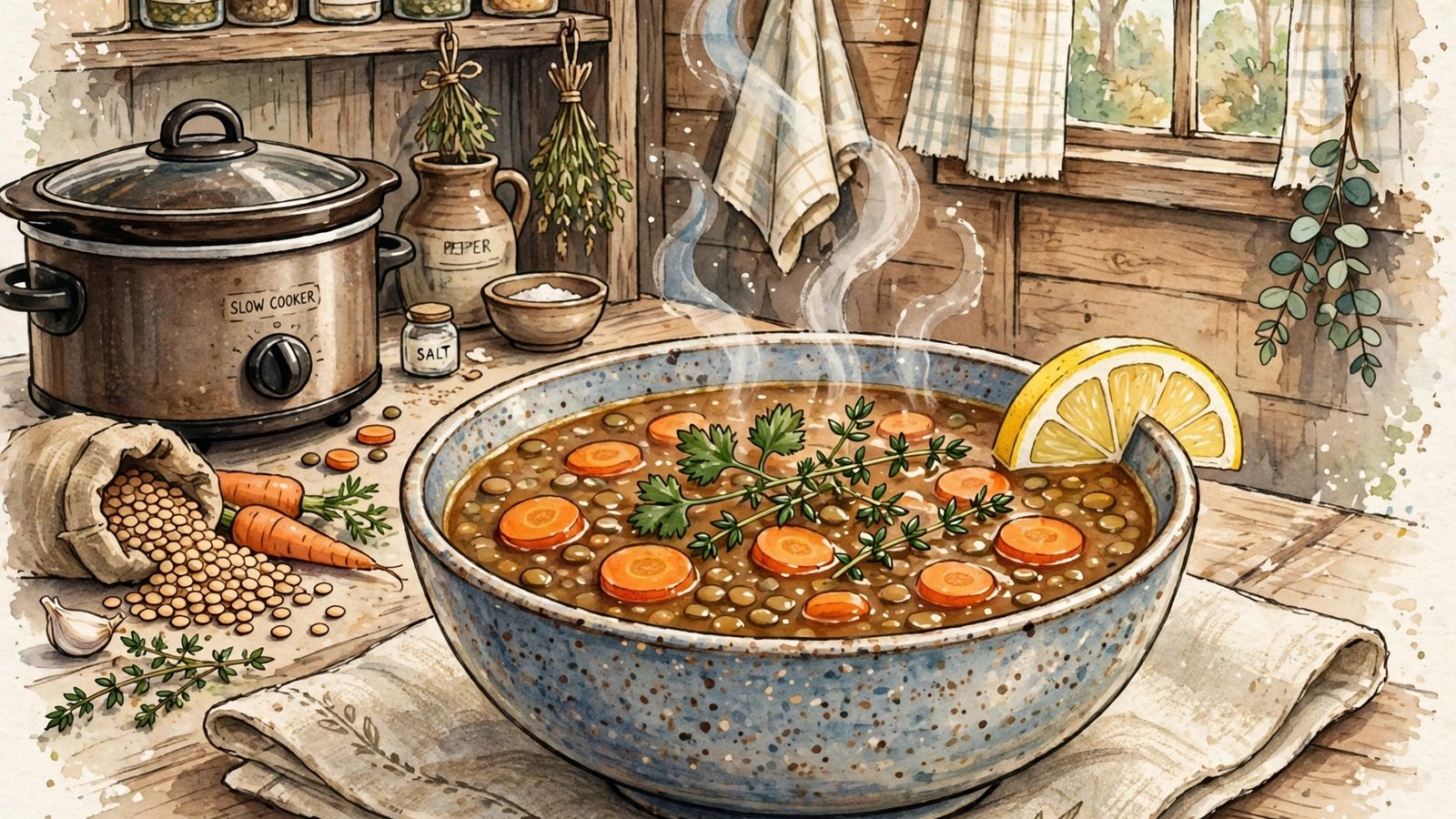
This article gives you the full recipe, timing for the low and high settings, how to choose and prepare lentils, the slow cooker safety rules that actually matter, liquid ratios and texture fixes, nutrition context, storage and freezing guidance, and variations for different diets and pantries. The recipe is working guidance, not a tested kitchen result, so check doneness by tasting and by texture rather than by the clock alone. The featured illustration is AI-generated, not a photograph of real food.
Why Lentils, Carrots, and Cumin Belong Together
Lentils bring body and earthiness. Carrots bring sweetness and color. Cumin brings warmth that ties the two together without heat. That trio is the whole flavor structure of the soup, and everything else in the pot, the onion, garlic, tomato paste, and lemon, exists to support it.
Ground cumin is used rather than whole seeds because it disperses evenly through a long cook, while whole seeds can stay gritty in a soup that is never vigorously stirred. Toasting it briefly in a dry pan deepens its flavor, but the step is optional. Coriander adds a lighter note behind the cumin, and smoked paprika adds depth without turning the soup into a chili.
The lemon juice at the end is not decoration. Acid lifts a long cooked soup in a way salt alone cannot, and a pot that tastes flat after 8 hours usually needs lemon before it needs more spice. Add it after cooking, stir, wait a minute, and taste again, because lemon and salt interact and the second taste is the honest one.
Choosing Lentils: Varieties, and What Each One Does in Soup
The most common types sold in the United States are green, brown, red, and yellow, and they do not behave the same way. University of Illinois Extension notes that lentils are sold whole, with the husk still on, or split, with the husk removed, and that whole lentils take longer to cook.
Brown and green lentils are the right choice here. Both are whole, and Illinois Extension notes that they hold their shape better and are excellent for stews and salads. In this soup they keep some texture after hours of cooking instead of turning to porridge. Montana State University Extension likewise notes that green lentils suit soups and salads, and that smaller round types such as pardina, black, and French green lentils also hold their shape well.
Red and yellow lentils are different in practice. They are usually split and hulled, break down quicker, and cook faster. Illinois Extension describes their texture as soft and creamy, and Montana State University Extension notes that golden and red lentils lose their shape, which makes them useful for thickening soups. If you use red lentils here, expect a smoother, thicker result and start checking about an hour earlier. That is a good soup, but a different dish.
Do not use canned lentils for the long cook. They are already cooked and will break down to mush over hours. Save them for a fast stovetop soup. French green and black lentils hold their shape especially firmly, which suits soup served over several days, but they can need a little longer to become tender, so taste before deciding the soup is done.
Sorting, Rinsing, and the No Soak Rule
Dried lentils need two short steps. First, sort them. Spread them on a light colored plate and pick through for small stones and debris. Illinois Extension gives the same instruction: sort through lentils for possible rocks and remove any foreign materials. Montana State University Extension likewise tells cooks to check for rocks and debris, rinse thoroughly, and strain. Sorting 2 cups takes about a minute.
Second, rinse them in a fine mesh strainer under cold water until the water runs mostly clear, to remove surface dust. Then they go straight into the cooker. There is no soaking step.
That surprises people used to dried beans. Montana State University Extension states that lentils do not need to be soaked prior to cooking like other legumes, although soaking and sprouting can increase nutrient availability. For slow cooker soup, soaking adds no practical benefit: hours of gentle heat and plenty of liquid soften brown and green lentils fully. Rinse, sort, and cook is the whole routine.
Store the rest well. Montana State University Extension advises storing dried lentils in airtight containers in a cool, dry place for up to a year. Label the container with the variety, because brown, green, and red lentils are easy to confuse once the bag is gone and they cook very differently.
Ingredients
For 6 generous servings, you will need:
- 2 cups dried brown or green lentils, rinsed and picked over
- 4 medium carrots, peeled and cut into 1/2 inch rounds or half moons
- 1 large yellow onion, diced
- 4 cloves garlic, minced
- 2 tablespoons tomato paste
- 2 teaspoons ground cumin
- 1 teaspoon ground coriander
- 1/2 teaspoon smoked paprika
- 8 cups vegetable broth or water
- 2 tablespoons olive oil
- 1 bay leaf
- Salt and black pepper to taste, added near the end of cooking
- Juice of 1 lemon, for finishing
- Optional garnish: chopped fresh parsley or cilantro, and a drizzle of olive oil
Cut the carrots to a consistent size, about 1/2 inch thick, so they finish at the same time. Thin slices can disappear over 8 hours, and thick chunks can stay firm in the center. Dice the onion small enough to soften into the base. Tomato paste adds savory depth and body, so stir it in well at the start, because a lump left on top will not distribute itself during a gentle cook.
Salt is simplest handled at the end. Broths vary enormously in saltiness, so taste the finished soup and season it then. If you use water instead of broth, the soup will need more deliberate seasoning, and the lemon, salt, and olive oil matter more.
Method, Step by Step
Combine the lentils, carrots, onion, garlic, tomato paste, cumin, coriander, smoked paprika, broth or water, olive oil, and bay leaf in a slow cooker of at least 5 quarts, putting the vegetables in first. Food Safety and Inspection Service guidance notes that vegetables cook slower than meat and poultry in a slow cooker, and advises loading them first.
Stir thoroughly to distribute the tomato paste and spices. Cover and cook on low for 7 to 8 hours or on high for 4 to 5 hours, until the lentils are tender and the carrots yield to a fork. Slow cookers vary, so start checking at the early end of the range. The soup is done when a lentil crushes easily with a spoon and the broth has thickened slightly.
Keep the lid on while the soup cooks. The Food Safety and Inspection Service lists keeping the lid in place, removing it only to stir or check doneness, as a core reminder. Every lift releases steam and drops the temperature, which extends cooking time. One check near the early end of the range and one near the end is enough.
When the lentils are tender, remove the bay leaf. Stir in the lemon juice, then season with salt and pepper and taste again after a minute. If the soup is too thick, stir in hot water or broth a half cup at a time. If it is too thin, remove the lid and cook on high for another 30 minutes, or mash a cup of the soup and stir it back in. Mashing is faster, because broken lentils release starch into the broth.
Serve in warm bowls with parsley or cilantro and olive oil. Crusty bread makes it a meal on its own. For a heartier version, stir in baby spinach during the last 15 minutes, until wilted, or serve the soup over cooked rice.
Liquid Ratios and Texture Control
The recipe ratio is 8 cups of liquid for 2 cups of dried lentils, or 4 cups per cup of lentils. That is deliberately more than lentils need alone on the stove. Montana State University Extension gives a stovetop ratio of 1 cup lentils to 1 and 1/2 cups water, simmered 15 to 20 minutes for salads or longer for a puree. A soup needs extra liquid to cover the carrots and onion, form the broth, and allow for hours of absorption as the lentils swell. Cut it toward the stovetop ratio and you get a thick stew with almost no broth.
Use the ratio as a starting point. Older dried lentils often absorb more liquid and take longer to soften, and a cooker that runs hot reduces more than one that runs cool. Judge texture in the bowl: the soup should spoon easily, coat the back of a spoon lightly, and still show distinct lentils and carrots. If you halve the recipe, keep the same ratio and use a smaller cooker if you have one. If you double it, read the fill guidance below first, because more food changes how quickly the contents heat.
Slow Cooker Safety That Actually Matters
Slow cookers are safe when used as designed, and the United States Department of Agriculture guidance behind that statement is straightforward. The Food Safety and Inspection Service explains that a slow cooker cooks foods slowly at a low temperature, generally between 170 and 280 degrees Fahrenheit, and that the direct heat from the pot, the lengthy cooking time, and the steam created inside the tightly covered container combine to destroy bacteria and make the slow cooker a safe process for cooking foods.
Start clean and start cold. Begin with a clean cooker, clean utensils, and a clean work area, and wash your hands before and during preparation. Keep perishable foods refrigerated until preparation time. The Food Safety and Inspection Service gives the reason: a slow cooker may take several hours to reach a safe, bacteria killing temperature, and constant refrigeration assures that bacteria, which multiply rapidly at room temperature, do not get a head start during the first few hours of cooking. If you cut vegetables in advance, store them in the refrigerator. This soup contains no meat, which removes the biggest slow cooker risk, but the discipline applies to any version with animal products.
Thaw before you cook, if you ever add meat. Always thaw meat or poultry before putting it into a slow cooker, and follow manufacturer instructions for a commercially frozen slow cooker meal instead. For the base vegetarian soup there is nothing to thaw, which is one reason it is such a reliable all day recipe.
Most cookers have two or more settings, and food cooks faster on high than on low. The Food Safety and Inspection Service notes that you can use the highest setting for the first hour and then turn to low, and that cooking on low the entire time is also safe. Either approach works for this soup.
Do not overfill the cooker. Fill it no less than half full and no more than two thirds full, and leave headroom under the lid. An overfilled cooker heats slowly, risks overflow as the lentils expand, and makes timing unreliable. For a crowd, two cookers beat one overfilled cooker.
Handle a power outage by the rule, not by optimism. If you are not at home and the power goes out, throw away the food even if it looks done. If you are at home, finish cooking immediately by another means, such as a gas stove. If the food was completely cooked before the power went out, it should remain safe for up to 2 hours in the cooker with the power off.
Finally, do not leave finished soup sitting in a switched off cooker all evening, and do not use the cooker to reheat leftovers, as the storage section below explains.
Nutrition Context, Without the Hype
University of Illinois Extension reports that 1 cup of cooked lentils provides about 230 calories, 40 grams of carbohydrates, 18 grams of protein, and 16 grams of fiber. Those figures are for cooked lentils alone, not for a finished bowl of this soup, which also contains carrots, onion, olive oil, and broth and will differ by portion and broth. Read them as context for why lentils make a soup filling, not as a label for this recipe.
Two points matter for a home cook. First, the protein and fiber arrive together, which is part of why lentil soup keeps people full for longer than its calorie count alone would suggest. Second, lentils provide that nutrition without meat, which is why this soup works as a complete vegetarian and, with vegetable broth, vegan main dish. Montana State University Extension notes that lentils, like other plant based foods, contain no cholesterol, and that they provide protein, iron, magnesium, phosphorus, and zinc. The carrots are not filler either: they add sweetness, color, and their own vegetable contribution, and they hold up to a long cook.
This article makes no health claim beyond the figures above. If you cook for someone managing sodium, the biggest lever is the broth, which ranges from unsalted to very salty, so read the label and season at the end. If someone needs to watch total carbohydrates, portion size is the lever, because the lentils are the main carbohydrate source in the pot.
Variations Worth Trying
The base soup is vegan as written, provided the broth is vegetable based. From that base, small changes move the soup in clear directions without breaking what makes it work.
For a richer version, use half broth and half water plus a Parmesan rind added at the start and removed before serving. That version is no longer vegan, so label it if you serve both. For heat, add a diced jalapeno with the onion or red pepper flakes with the spices. For a smokier pot, double the smoked paprika and add a chopped chipotle in adobo. For a curried direction, add a tablespoon of curry powder with the cumin and finish with coconut milk instead of lemon, knowing that this changes the character of the soup substantially.
Seasonal swaps are easy. In autumn, replace half the carrots with diced sweet potato cut to the same size. In spring, add chopped kale in the last hour. If you have celery, add 2 diced stalks with the onion to deepen the base without changing the flavor profile.
Avoid adding dairy during the long cook, since milk and cream can separate over 8 hours. Stir cream or yogurt in at serving time instead, off the heat. Fresh herbs and extra lemon also taste brighter added at the table. If you want a thicker soup on purpose, swap half the brown lentils for red lentils: the red lentils break down and thicken the broth while the brown lentils still give the bowl texture.
Storage, Freezing, and Reheating
Cool the soup promptly and refrigerate it in shallow covered containers within 2 hours. The Food Safety and Inspection Service explains why: a big pot of soup cools slowly, which invites bacteria to multiply, so dividing it into smaller containers helps it reach 40 degrees Fahrenheit or below quickly. Hot food can go directly into the refrigerator, or be chilled first in an ice or cold water bath.
Once refrigerated, use the soup within 3 to 4 days. Both the Food Safety and Inspection Service leftover guidance and the FoodSafety.gov Cold Food Storage Chart give 3 to 4 days for leftovers and for soups and stews at 40 degrees Fahrenheit or below. If the soup sat out longer than 2 hours, or 1 hour above 90 degrees Fahrenheit, discard it rather than tasting it to check.
Freeze what you will not eat in that window. FoodSafety.gov gives 2 to 3 months in the freezer at 0 degrees Fahrenheit or below for soups and stews, and notes that freezer guidelines are for quality, since frozen foods stored continuously at that temperature can be kept indefinitely even as flavor declines. The Food Safety and Inspection Service gives a general frozen leftover window of 3 to 4 months, with the same quality warning. For this soup, plan on the soup specific 2 to 3 months for best quality. Freeze it in labeled portions with a little headroom for expansion, so one container is one weeknight dinner.
Thaw frozen soup in the refrigerator, in cold water in a leak proof package, or in the microwave. Refrigerator thawing takes longest but keeps the food safe the whole time. It is also safe to reheat frozen soup without thawing, in a saucepan or microwave, though it takes longer.
Reheat leftovers safely, and never in the slow cooker. The Food Safety and Inspection Service states that reheating leftovers in a slow cooker is not recommended. Reheat soup on the stove, in a microwave, or in a conventional oven until it reaches 165 degrees Fahrenheit as measured with a food thermometer, and bring soups to a rolling boil. Only after reheating can you transfer it to a preheated slow cooker to keep it hot for serving, at 140 degrees Fahrenheit or above. If the soup has thickened in storage, thin it with water or broth while reheating. It often tastes better the next day, but better flavor is not a reason to stretch the storage window.
Allergy and Ingredient Notes
Lentils are legumes, not one of the 9 major food allergens the Food and Drug Administration lists for the United States. That list is milk, egg, fish, crustacean shellfish, tree nuts, wheat, peanuts, soybeans, and sesame. Sesame became the ninth major allergen under the Food Allergy Safety, Treatment, Education and Research Act, with labeling required as of January 1, 2023. Being off that list does not mean no one reacts to lentils. Allergies are individual, and cross contact in processing facilities is possible.
Read broth and spice labels if you cook for someone with an allergy, since broths can contain soy or wheat and spice blends can include unexpected ingredients. The Food and Drug Administration advises reading the entire ingredient list every time you buy a product, because ingredients can change. If you serve the soup to guests, put a simple written ingredient list on the table so each person can decide for themselves.
Frequently Asked Questions
Do I need to soak lentils first?
No. Brown and green lentils cook fully in a slow cooker without soaking. Montana State University Extension confirms that lentils do not need to be soaked prior to cooking like other legumes. Sort them for small stones and debris, rinse them under cold water, strain them, and they are ready for the cooker.
Can I cook this on high if I forgot to start it in the morning?
Yes. Four to 5 hours on high gives a good result, though the carrots may be slightly less sweet than after a full low cook. Start by early afternoon for an evening meal, and use the doneness test rather than the clock: a lentil should crush easily and a carrot should yield to a fork.
Why is my soup bland?
Almost always, it needs salt and acid. Add salt in small increments, then lemon juice, tasting after each addition. A long cook dulls bright flavors, and the finish is where they come back. Check the broth you used as well. A low sodium or water based pot needs more deliberate finishing than a well salted broth based pot.
Can I double the recipe?
Only if your cooker is large enough to hold it without overfilling. Leave headroom under the lid and do not fill the cooker beyond about two thirds full, because overfilling slows heating and risks overflow as the lentils expand. For a crowd, two cookers beat one overfilled cooker, and each cooker will follow the timing in the recipe more reliably.
Can I add meat to this soup?
You can, but it becomes a different soup with different safety rules. Thaw meat or poultry fully before it goes into the cooker, never add it frozen, and put the vegetables in first because they cook slower than meat and poultry in a slow cooker. For the cleanest safety picture, keep this pot vegetarian and serve meat on the side.
Why did my lentils stay firm?
The usual causes are old lentils, too little liquid, or a cooker that runs cool. Give the soup more time on high, add hot liquid if the level has dropped, and keep the lid on between checks. Taste again after 30 minutes. A firm batch is usually a timing problem, not a ruined soup.
Can I leave the soup on warm while I am out?
While food is cooking and once it is done, food stays safe as long as the cooker is operating, according to the Food Safety and Inspection Service. That is not the same as a switched off cooker on the counter. Once the cooker is off, the 2 hour refrigeration clock applies, so refrigerate the finished soup and reheat it properly when you return.
Does this soup freeze well?
Yes. Lentil soup is one of the better soups to freeze, because the lentils and carrots hold their texture and the broth thickens rather than separates, as long as you have not added dairy during cooking. Freeze it in portions for 2 to 3 months for best quality, thaw it in the refrigerator, and reheat it to 165 degrees Fahrenheit. Add any cream, yogurt, or fresh herbs after reheating, not before freezing.
Sources & references
- USDA Food Safety and Inspection Service, Slow Cookers and Food Safety. Used for slow cookers generally operating between 170 and 280 degrees Fahrenheit, direct heat, long cooking, and trapped steam combining to destroy bacteria, beginning with a clean cooker and clean work area, keeping perishable foods refrigerated until preparation time because a cooker may take several hours to reach a bacteria killing temperature, always thawing meat or poultry before slow cooking, putting vegetables in first because they cook slower than meat and poultry, keeping the lid in place and removing it only to stir or check doneness, using the highest setting for the first hour and then low as an option while cooking on low the entire time is also safe, food staying safe while the cooker is operating, the power outage rules for cooks who are away, at home, or whose food was fully cooked before the outage, storing leftovers in shallow covered containers and refrigerating within 2 hours, not reheating leftovers in a slow cooker, reheating on the stove, in a microwave, or in a conventional oven to 165 degrees Fahrenheit, and then holding hot food in a preheated slow cooker at 140 degrees Fahrenheit or above.
- USDA Food Safety and Inspection Service, Leftovers and Food Safety. Used for bacteria growing rapidly between 40 and 140 degrees Fahrenheit, refrigerating leftovers within 2 hours of cooking or 1 hour when the temperature is above 90 degrees Fahrenheit, cooling food rapidly by dividing large amounts, including a big pot of soup, into shallow containers to reach 40 degrees Fahrenheit or below, covering and sealing leftovers, keeping leftovers in the refrigerator for 3 to 4 days or frozen for 3 to 4 months with quality loss over longer freezer storage, safe thawing in the refrigerator, in cold water, and in the microwave, reheating frozen leftovers without thawing in a saucepan or microwave for soups and stews, and reheating leftovers to 165 degrees Fahrenheit with soups, sauces, and gravies brought to a rolling boil.
- FoodSafety.gov, Cold Food Storage Chart. Used for soups and stews with vegetable or meat added keeping 3 to 4 days in the refrigerator at 40 degrees Fahrenheit or below and 2 to 3 months in the freezer at 0 degrees Fahrenheit or below, and for freezer storage times being for quality only because frozen foods stored continuously at 0 degrees Fahrenheit or below can be kept indefinitely.
- University of Illinois Extension, Eat.Move.Save., Ingredient Highlight: Lentils. Used for 1 cup of cooked lentils providing about 230 calories, 40 grams of carbohydrates, 18 grams of protein, and 16 grams of fiber, the most common lentil types in the United States being green, brown, red, and yellow, whole lentils retaining their husks and taking longer to cook, split lentils having the husk removed, red lentils breaking down quicker and cooking faster with a soft and creamy texture suitable for soups and curry dishes, red and yellow lentils being similar in taste and usable interchangeably, green and brown lentils holding their shape better and being excellent for stews and salads, and sorting lentils for possible rocks and removing foreign materials and rinsing them with water.
- Montana State University Extension, Lentils fact sheet. Used for rinsing lentils thoroughly, checking for rocks and other debris, and straining them, the stovetop ratio of 1 cup lentils to 1 and 1/2 cups water simmered 15 to 20 minutes for salads or longer for a puree with time varying by variety and desired texture, the variety notes for French green, black, red, green, golden, and pardina lentils including green lentils being suitable for soups and salads, golden and red lentils cooking quickly and losing their shape for thickening soups, and pardina, black, and French green lentils holding their shape in soups and salads, storing dried lentils in airtight containers in a cool, dry place for up to a year, lentils providing protein, iron, magnesium, phosphorus, and zinc and containing no cholesterol like other plant based foods, cooking lentils in water, broth, or tomatoes and seasoning options including cumin, and lentils not needing to be soaked prior to cooking like other legumes.
- US Food and Drug Administration, Have Food Allergies? Read the Label. Used for the 9 major food allergens in the United States being milk, egg, fish, crustacean shellfish, tree nuts, wheat, peanuts, soybeans, and sesame, sesame becoming the ninth major allergen under the Food Allergy Safety, Treatment, Education and Research Act with labeling required as of January 1, 2023, food labels identifying the food source of major allergens in the ingredient list or in a Contains statement, voluntary may contain advisory statements, and reading the entire ingredient list every time a product is bought because ingredients can change.
- USDA FoodData Central, homepage and system description. Used as the federal food composition system behind the cooked lentil nutrition context in this article, described by USDA as its comprehensive source of food composition data, managed by the Agricultural Research Service Beltsville Human Nutrition Research Center. The specific per cup cooked lentil figures quoted in the article are the University of Illinois Extension figures listed above.


