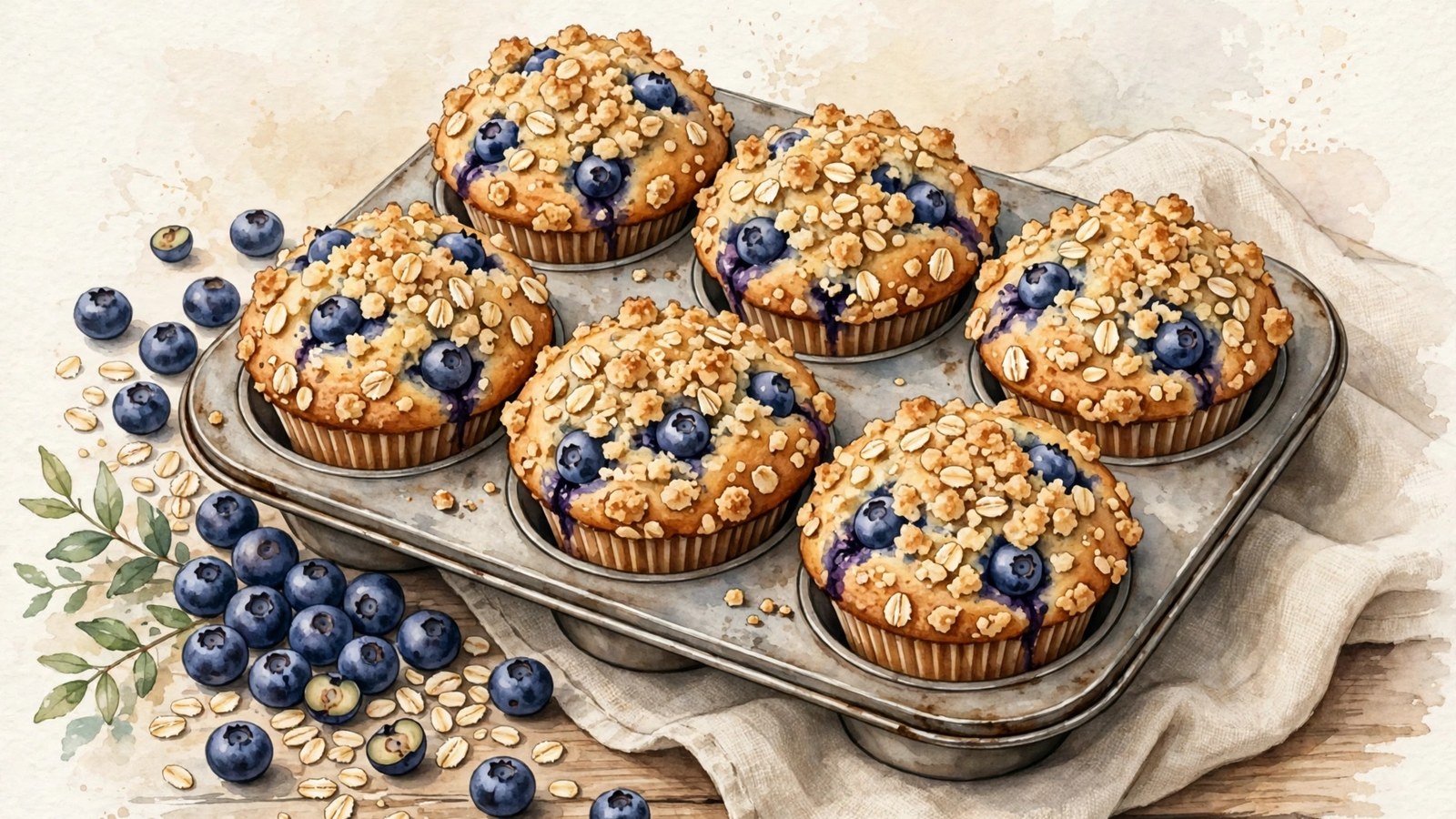
Short answer
- Make the oat crumble first and set it aside. Stir ground flaxseed with water and let it gel for about ten minutes, and stir plant milk with vinegar or lemon juice and let it sit for five to ten minutes. Whisk the dry ingredients, whisk the wet ingredients, then stir the two together just until no large streaks of dry flour remain. Fold in one and a half cups of fresh or frozen blueberries without thawing frozen berries first. Divide the thick batter among twelve lined muffin cups, top generously with crumble, and bake at 400 degrees Fahrenheit for 18 to 22 minutes, until the tops are golden and a toothpick comes out clean or with a few moist crumbs. Cool in the tin for five to ten minutes, then move the muffins to a wire rack. Store cooled muffins airtight at room temperature for up to two days for best texture, refrigerate them and use them within three to four days, or freeze them for best quality within two to three months.
Introduction
Blueberry muffins promise a lot and often deliver less. Too many are dry, or dense, or so sweet that the blueberries disappear, or topped with a crumble that turns soggy within an hour. A vegan version faces an extra question, because without eggs and dairy the muffin must find structure, moisture, and tenderness elsewhere. These vegan blueberry muffins with oat crumble answer that question with ordinary pantry ingredients: plant milk soured with vinegar, oil for moisture, a little applesauce and ground flax for binding, and a crumble made from oats, flour, sugar, and oil that stays crisp on top. The result is a muffin that is soft inside, crisp on top, and full of blueberries in every bite, without any ingredient that requires a specialty store.
This is a home baking guide, not a nutrition claim. The muffins contain fruit, oats, and plant based ingredients, but they are still a sweet baked good, and they are best enjoyed as part of a varied diet rather than presented as a health food. If you are baking for someone with allergies, the details matter. Wheat is in the flour and in regular oats unless you choose versions that meet the federal gluten free standard, and some plant milks contain soy or tree nuts. Check every label, every time, because formulations change.
The food safety and storage guidance in this article was checked against FoodSafety.gov, the United States Department of Agriculture Food Safety and Inspection Service, and the Food and Drug Administration on 31 October 2026.
Why Vegan Muffins Can Be Tender Without Eggs
Eggs do several jobs in a muffin. They bind, they add moisture, they help with rise, and they contribute richness. Removing them means replacing those jobs, not simply leaving them out. In this recipe, three ingredients share the work. First, plant milk combined with vinegar becomes acidic, which reacts with baking soda to produce lift and which also tenderizes the crumb. This is the same principle behind buttermilk in traditional baking, adapted with plant milk. Second, unsweetened applesauce adds moisture and a little binding, and it helps the muffin stay soft the next day. Third, ground flaxseed mixed with water forms a gel that binds the batter, similar to how an egg helps hold a muffin together, though the texture is not identical.
Oil, rather than butter, is used for moisture. Oil coats flour proteins and limits gluten development, which keeps the crumb tender, and it stays liquid at room temperature, so the muffin does not firm up as quickly as a butter based muffin can when it cools. A neutral oil, such as sunflower, canola, or a light vegetable oil, is best, because a strongly flavored oil can compete with the blueberries. Melted coconut oil works too, but it firms when cool, so the muffins may feel slightly denser after chilling.
Leavening needs care in a vegan batter. Baking powder provides most of the rise, and baking soda, activated by the soured plant milk, provides extra lift and helps browning. Too much baking soda, however, can leave a soapy or metallic taste and can turn the crumb yellowish or greenish around blueberries, because baking soda is alkaline and reacts with blueberry pigments. Those pigments are anthocyanins, the compounds that give blueberries their blue color, and they change color with pH, shifting toward green in alkaline conditions and toward red in acidic conditions. The amounts below are deliberately moderate, and the batter should be mixed just until combined, not beaten, because overmixing develops gluten and makes muffins tough and tunneled, with long holes inside instead of a fine, even crumb.
Ingredients
This recipe makes twelve standard muffins. Have everything measured before you mix the batter, because the batter should go into the oven promptly once the wet and dry ingredients meet.
For the muffins:
- 1 tablespoon ground flaxseed, plus 3 tablespoons water, for the flax egg
- 1 cup plant milk, such as oat, soy, or almond milk, unsweetened
- 1 tablespoon apple cider vinegar or lemon juice
- 2 cups all-purpose flour, spooned and leveled, about 240 grams
- 3/4 cup granulated sugar
- 2 teaspoons baking powder
- 1/2 teaspoon baking soda
- 1/2 teaspoon fine salt
- 1 teaspoon ground cinnamon, optional, for warmth
- 1/3 cup neutral vegetable oil
- 1/4 cup unsweetened applesauce
- 2 teaspoons vanilla extract
- 1 and 1/2 cups fresh or frozen blueberries, plus a few extra for the tops
For the oat crumble:
- 1/2 cup old-fashioned rolled oats
- 1/3 cup all-purpose flour
- 1/4 cup brown sugar, packed
- 1/4 teaspoon ground cinnamon
- A pinch of salt
- 3 tablespoons neutral vegetable oil, or melted coconut oil
Blueberry choice affects the outcome more than most bakers expect. Fresh blueberries hold their shape and give bursts of juice when bitten. Frozen blueberries work just as well and are often more affordable year round, but use them straight from the freezer, without thawing, and fold them in gently at the end, because thawed berries bleed color into the batter. If you use frozen berries, allow one or two extra minutes of baking time. Tossing berries in a tablespoon of the measured flour can help keep them from sinking, though sinking is less of a problem in a thick batter like this one. For context, the United States Department of Agriculture FoodData Central lists raw blueberries at about 57 calories per 100 grams, or about 84 calories per cup at 148 grams, with about 3.6 grams of fiber per cup. Those figures describe the raw fruit only, not the finished muffin.
Flour measuring matters, because it is the most common source of dry muffins. Spoon flour into the cup and level it, rather than scooping from the bag, which compacts the flour and can add a quarter cup or more without you noticing. If you own a scale, weighing is more reliable. About 120 grams per cup, or about 240 grams for two cups, is the standard weight for spooned and leveled all-purpose flour.
Sugar choice has a vegan nuance worth knowing. In some countries, and in some refineries in the United States, granulated cane sugar is filtered using bone char, which some vegans avoid, even though the sugar itself contains no animal product and the bone char does not remain in the finished sugar. If that matters to you or to someone you are baking for, choose sugar labeled vegan or organic, or choose beet sugar, which is not filtered with bone char. The recipe works the same with any granulated sugar, so this is a sourcing choice, not a baking change.
Making the Crumble First
Make the crumble before the batter, because the batter should go into the oven promptly once mixed, and you do not want to be assembling a topping while the leavening is already working. In a small bowl, combine the oats, flour, brown sugar, cinnamon, and salt, and stir to mix. Drizzle in the oil and stir with a fork until the mixture forms clumps, some pea sized and some smaller, with no large patches of dry flour. If it looks powdery, add oil one teaspoon at a time. If it looks greasy or paste like, add a spoonful of oats. The crumble should hold together when squeezed, then break into pieces easily.
Set the crumble aside. Too little sugar and it tastes like plain oats. Too much sugar and it melts into a sticky sheet rather than staying crumbly. Brown sugar helps here, because its molasses content adds a caramel note that complements blueberries. If you prefer a crunchier topping, add a tablespoon of chopped nuts, such as pecans or almonds, but only if nuts are safe for everyone eating the muffins, and label them clearly.
Making the Batter, Step by Step
Preheat the oven to 400 degrees Fahrenheit, and line a standard twelve cup muffin tin with paper liners, or grease it well. Higher initial heat helps muffins rise tall with a domed top, which is part of the appeal, and the oven should be fully preheated before the batter is mixed, so the muffins go in without waiting.
First, make the flax egg. Stir the ground flaxseed and water together in a small bowl and let it sit for about ten minutes, until it thickens into a gel. It will not look like a beaten egg, and that is fine. It should look like a thick, slightly viscous mixture that holds together when stirred. While it rests, combine the plant milk and vinegar or lemon juice in a measuring jug and let it sit for five to ten minutes as well. It may curdle slightly, with small flecks, which is expected, especially with soy milk. Oat milk curdles less visibly, but the acidity still does its work.
In a large bowl, whisk together the flour, granulated sugar, baking powder, baking soda, salt, and cinnamon if using, until evenly combined and no pockets of baking soda remain. Baking soda that is not distributed will leave bitter spots, so whisk thoroughly. In a second bowl or jug, whisk together the oil, applesauce, vanilla, the soured plant milk, and the flax gel, until smooth.
Pour the wet ingredients into the dry ingredients and stir with a spatula or wooden spoon just until no large streaks of dry flour remain. The batter will be thick, and a few small lumps are fine, even desirable. They are not a flaw. Overmixing at this stage is the fastest way to tough muffins, so stop as soon as the flour disappears. Gently fold in the blueberries with three or four strokes, trying not to crush them. If a few berries break, the batter will streak slightly purple, which is harmless, but a gentle hand keeps the color cleaner and the berries whole.
Divide the batter evenly among the muffin cups, filling each about three quarters full. An ice cream scoop or a large spoon helps keep portions even, which matters because uneven muffins bake unevenly. Small ones dry out while large ones stay wet in the center. Press a few extra blueberries gently into the tops if you like, for appearance, then sprinkle each muffin generously with crumble, pressing it very lightly so it adheres without sinking into the batter.
Baking and Cooling
Bake at 400 degrees Fahrenheit for 18 to 22 minutes, until the tops are golden, the crumble is crisp, and a toothpick inserted into the center of a muffin comes out clean or with a few moist crumbs, but not wet batter. Check at 18 minutes, because ovens vary, and muffins can go from perfect to dry quickly. If the tops are browning too fast but the centers are still wet, loosely tent the tin with foil for the last few minutes, though this can soften the crumble slightly, so use it only if needed.
Let the muffins cool in the tin for five to ten minutes, then transfer them to a wire rack to cool completely, or at least until warm rather than hot. Muffins left in a hot tin continue to cook from residual heat and can become soggy on the bottom as steam collects. Muffins moved too soon can break apart, because they are still soft. Five to ten minutes is the practical middle ground. The crumble will crisp further as the muffins cool, so do not judge its final texture straight from the oven, when it is still soft from heat and steam.
Cooling matters for taste as well as texture. If you can wait twenty minutes, the muffins will taste better, because flavors settle as the crumb sets, and the blueberries will be less likely to burn your mouth.
Storage, Freezing, and Food Safety
Store cooled muffins in an airtight container at room temperature for up to two days for best texture, with a paper towel in the container to absorb moisture if your kitchen is humid. The crumble will soften gradually, especially in a sealed container, because moisture from the muffin migrates to the topping. To restore some crispness, warm a muffin in a 300 degree Fahrenheit oven for five to eight minutes, or in an air fryer for two to three minutes, and let it cool for a few minutes before eating. Microwaving restores warmth but not crispness, and it can make the crumble soggy, so use the oven when texture matters.
For longer keeping, follow the federal leftover guidance rather than stretching the batch across a week at room temperature. FoodSafety.gov organizes home food safety into four steps: clean, separate, cook, and chill. Under the chill step, keep your refrigerator at 40 degrees Fahrenheit or below and your freezer at 0 degrees Fahrenheit or below, and refrigerate perishable food within 2 hours, or within 1 hour if the food has been exposed to temperatures above 90 degrees Fahrenheit, because bacteria that cause food poisoning multiply quickest between 40 degrees Fahrenheit and 140 degrees Fahrenheit. The United States Department of Agriculture Food Safety and Inspection Service gives the storage window used throughout federal guidance: leftovers keep for three to four days in the refrigerator, or three to four months frozen, although frozen food loses moisture and flavor over time. Applied to these muffins, that means refrigerate any muffins you will not eat within two days and use them within three to four days, bringing a refrigerated muffin to room temperature or warming it briefly before eating for the best flavor. Discard muffins that smell sour, look moldy, or have been left out for an extended time, especially in warm weather. When in doubt, throw it out, and never taste food to decide whether it is safe.
Freezing is the best long term option. Place cooled muffins in a single layer in a freezer bag or container, with parchment between layers if stacked, and label with the date. For best quality, use them within two to three months, inside the broader federal frozen leftover window of three to four months. Thaw overnight in the refrigerator, then warm briefly in the oven to refresh the crumble. FoodSafety.gov also notes that breads, rolls, muffins, and cakes without custard fillings can be refrozen, so freeze half the batch on baking day if you will not finish it quickly. These muffins do not keep longer than traditional muffins in any meaningful way. The moisture, fruit, and crumble still support mold growth, and the same storage care applies.
Allergen and Dietary Notes
This section is factual information for planning and serving, not medical advice. As written, this recipe contains wheat, in the flour and in regular oats. Depending on the plant milk and any optional nuts you choose, it can also contain soybeans or tree nuts. Wheat, soybeans, and tree nuts are all major food allergens in the United States. The Food and Drug Administration lists nine foods, and ingredients containing their proteins, as major food allergens: milk, egg, fish, crustacean shellfish, tree nuts, wheat, peanuts, soybeans, and sesame. Sesame became the ninth major food allergen under the Food Allergy Safety, Treatment, Education, and Research Act, with labeling required from 1 January 2023.
If you are cooking for guests, ask about allergies before you bake, not at the table. Check labels on plant milk, oats, and any plant based spreads or yogurts you serve alongside each time you buy them, because the Food and Drug Administration notes that recipes can change and advises reading the entire ingredient list. Oats are naturally free of wheat, but regular oats are often grown and processed alongside wheat. For a gluten free version, use a gluten free all-purpose flour blend designed for baking, with xanthan gum included or added according to the blend instructions, and use oats and other ingredients that meet the federal standard. The Food and Drug Administration defines gluten free for labeling as containing less than 20 parts per million of gluten, along with ingredient conditions that exclude unprocessed gluten containing grains. Do not simply swap in a single gluten free flour, such as rice flour alone, and expect the same result. Blends are formulated to mimic wheat flour behavior. Gluten free muffins may need a minute or two longer to bake, and they benefit from cooling fully before eating, because their structure sets as they cool.
The word vegan in the title describes the ingredient choices in this recipe: no eggs, no dairy milk or butter, and no other animal derived ingredients as written, subject to the sugar sourcing note in the ingredients section. No claim is made here about treating or managing any health condition.
Troubleshooting
Dense, heavy muffins usually mean overmixing, too much flour, or old leavening. Check that your baking powder is fresh. It should fizz vigorously when a teaspoon is stirred into hot water. If it does not, replace it. Measure flour by spooning and leveling, mix only until combined, and check the oven temperature with a thermometer if you suspect your oven runs cool, because a cool oven gives muffins time to spread before they rise.
Muffins that sink in the center usually were underbaked, had too much leavening, or were jostled while still wet inside. Bake until a toothpick test passes, not just until the tops look golden, and avoid opening the oven door repeatedly in the first fifteen minutes, which drops the temperature. A sunken muffin is still edible, and it makes good toast if sliced and warmed, so do not discard a batch for appearance alone.
Blueberries that all sink to the bottom usually mean the batter was too thin, the berries were very large and wet, or the batter was overmixed and lost its body. Tossing berries in flour helps a little, and using smaller berries helps more. A thick batter, like this one, holds berries better than a thin one, so resist adding extra plant milk to thin it, even if it looks thick. Thickness is part of the design.
Crumble that melts into the muffin usually means too much oil or sugar, or crumble pressed too hard into wet batter. Sprinkle it lightly and check the oil amount. Crumble that falls off usually was not pressed at all, or the muffins were moved while still hot. A very light press, plus cooling in the tin for a few minutes, helps it stay put.
Dry muffins the next day usually mean they were overbaked by a few minutes, or stored uncovered. Bake to the toothpick test, not beyond, and store airtight once cool. Serving with a spread, such as jam or plant based butter, is a practical rescue for a slightly dry batch.
Variations That Keep the Muffin Recognizable
Once the base works, variations are easy. For lemon blueberry muffins, add the zest of one lemon to the dry ingredients and replace the vinegar with lemon juice, keeping the total liquid the same. The lemon brightens the blueberries without making the muffin taste like a lemon cake. For a spiced version, increase cinnamon to one and a half teaspoons and add a quarter teaspoon of nutmeg. This suits autumn baking and pairs well with a hot drink. For a mixed berry version, replace half the blueberries with raspberries, but fold them even more gently, because raspberries break apart easily, and expect more color streaking.
For a lower sugar version, reduce granulated sugar to two thirds of a cup, but expect a less tender, less sweet muffin. Sugar does structural work in baking, not just sweetening, so large reductions change texture, and this recipe is not designed as a low sugar bake. If you need a significantly lower sugar muffin, choose a recipe designed for that purpose.
For mini muffins, divide the batter among mini muffin cups and bake for 10 to 13 minutes, checking early. For a loaf version, pour the batter into a greased loaf pan, top with crumble, and bake at 375 degrees Fahrenheit for 45 to 55 minutes, checking with a skewer. Treat the time as a guide and test for doneness.
Serving Ideas
These muffins suit breakfast, brunch, lunchboxes, and afternoon snacks. For breakfast, serve one muffin with fruit and a drink, rather than two muffins alone, for a more balanced start. For a brunch table, arrange muffins on a plate with fresh blueberries scattered around, and label them vegan if guests may be choosing for dietary reasons. For lunchboxes, wrap a cooled muffin individually, or pack it in a small container so the crumble is not crushed.
For a simple dessert, warm a muffin, split it, and serve with a spoonful of plant based yogurt or a small scoop of sorbet and fresh berries. For a coffee morning, serve muffins with coffee or tea and a jug of plant milk, and keep the ingredient list nearby for anyone who asks. Children can help with age appropriate tasks, such as stirring dry ingredients and sprinkling crumble, with an adult handling the oven.
Frequently Asked Questions
Can I use a different plant milk?
Yes. Oat, soy, and almond milk all work. Soy milk curdles most visibly with vinegar and gives a slightly richer crumb. Oat milk gives a mild, slightly sweet crumb. Almond milk is thinner, so the batter may be slightly looser, but the difference is small. Choose unsweetened milk, because sweetened milk adds sugar you have not accounted for, and check for allergens. Soy milk contains soybeans, almond milk contains tree nuts, and oat milk should meet the gluten free standard described above if gluten is a concern.
Do I need the flax egg?
It helps binding, but the muffins will still hold together without it if you add an extra two tablespoons of applesauce instead, though they may be slightly more fragile. Do not replace it with a whole banana, which changes the flavor and makes the crumb denser and wetter. If you have an egg allergy rather than a vegan diet, the same flax method works, and the rest of the recipe is already egg free.
Can I use frozen blueberries?
Yes, straight from the freezer, folded in gently, with one or two extra minutes of baking time. Do not thaw them first, and expect some color streaking, which is normal and harmless. Rinse fruits and vegetables under running water before use, as FoodSafety.gov advises for produce, and dry fresh berries gently so extra surface water does not thin the batter.
Why did my muffins turn greenish around the berries?
That is a reaction between alkaline baking soda and blueberry pigments. The pigments are anthocyanins, and they shift toward green in alkaline conditions. The discoloration is more likely if baking soda is overmeasured or unevenly mixed. It is harmless, and the muffins are still safe to eat on that point alone, but measuring carefully and whisking the dry ingredients thoroughly reduces it. Storage safety still depends on time and temperature, not on color, so apply the storage guidance above as usual.
How long do the muffins keep, and how should I store them?
For best texture, keep cooled muffins airtight at room temperature for up to two days. Refrigerate muffins you will not eat in that window and use them within three to four days, with the refrigerator at 40 degrees Fahrenheit or below. Freeze muffins for longer keeping and use them within two to three months for best quality. Warm a stored muffin briefly in a 300 degree Fahrenheit oven to refresh the crumble. Discard any muffin that smells sour or shows mold.
Can I make these muffins gluten free?
Yes, with the changes described in the allergen notes. Use a gluten free all-purpose flour blend designed for baking and oats that meet the federal gluten free standard of less than 20 parts per million of gluten. Expect a minute or two of extra baking time, and let the muffins cool fully before eating so the structure sets. A home batch made with compliant ingredients is not the same as a labeled commercial product, so readers with celiac disease should use ingredients they trust and avoid cross contact in the kitchen.
Sources & references
- FoodSafety.gov, 4 Steps to Food Safety. Used for the four steps clean, separate, cook, and chill, washing hands with plain soap and water for at least 20 seconds, rinsing fruits and vegetables under running water without soap, keeping a refrigerator at 40 degrees Fahrenheit or below and a freezer at 0 degrees Fahrenheit or below, refrigerating perishable food within 2 hours or within 1 hour above 90 degrees Fahrenheit, bacteria multiplying quickest between 40 degrees Fahrenheit and 140 degrees Fahrenheit, and placing leftovers in shallow containers and refrigerating promptly.
- United States Department of Agriculture, Food Safety and Inspection Service, Leftovers and Food Safety, as summarized in FoodSafety.gov guidance. Used for leftovers keeping for three to four days in the refrigerator or three to four months frozen with loss of moisture and flavor over longer freezer storage, refrigerating leftovers within 2 hours of cooking or 1 hour above 90 degrees Fahrenheit, and bacteria growing rapidly between 40 degrees Fahrenheit and 140 degrees Fahrenheit.
- FoodSafety.gov, Food Safety During Power Outage. Used for breads, rolls, muffins, and cakes without custard fillings being listed as keep after exposure above 40 degrees Fahrenheit for more than 2 hours in the refrigerated food chart, and as refreeze in the frozen food chart, and for the instruction never to taste food to determine safety and to throw food out when in doubt.
- Food and Drug Administration, Have Food Allergies? Read the Label. Used for the nine major food allergens accounting for the large majority of severe food allergic reactions: milk, egg, fish, crustacean shellfish, tree nuts, wheat, peanuts, soybeans, and sesame, for sesame becoming the ninth major food allergen under the Food Allergy Safety, Treatment, Education, and Research Act with labeling required from 1 January 2023, and for the advice to read labels because ingredients can change.
- Food and Drug Administration, Gluten and Food Labeling, and Gluten-Free Means What It Says. Used for gluten free labeling requiring less than 20 parts per million of gluten, for the ingredient conditions excluding wheat, rye, barley, and crossbreeds that have not been processed to remove gluten, and for gluten free being a voluntary claim that must meet the federal definition when used.
- United States Department of Agriculture, FoodData Central, Blueberries, raw. Used for raw blueberries at about 57 calories per 100 grams, about 84 calories per cup at 148 grams, about 21 grams of carbohydrate and about 3.6 grams of fiber per cup, and about 9.7 milligrams of vitamin C per 100 grams. Anthocyanin color behavior with pH was checked against general food science explanations of anthocyanins as pH sensitive pigments, consistent with the FoodData Central identification of blueberries as the source fruit in this recipe.


