Short answer
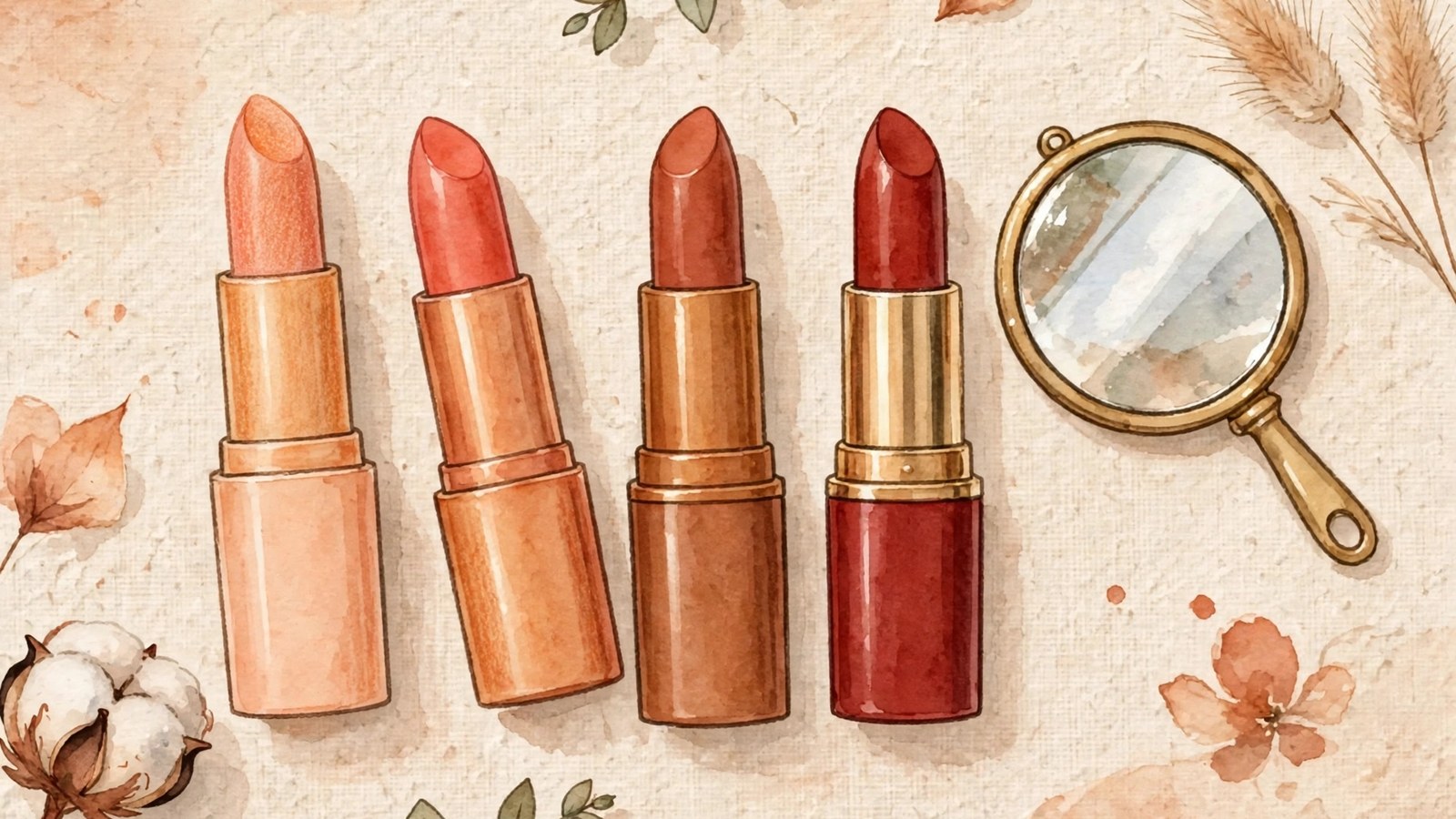
- If you have warm undertones, look for lipsticks with golden, peachy, orange, or brown hints: warm nudes in peach or caramel, coral and peach pinks, orange reds, brick reds and terracottas, warm berries with a brown hint, and cinnamon or warm chocolate browns. Check for warm undertones with several clues together, such as golden or yellow hints next to white, greenish looking wrist veins, and gold jewelry that flatters your skin, because no single check is definitive. Test any shade on your lips in natural light, judge it by how your whole face looks, and adjust an almost right shade with liner, blotting, gloss, or layering before you replace it.
Introduction
Choosing a lipstick shade for warm undertones starts with a simple idea. Warm skin has golden, peachy, or yellow hints beneath the surface color, and lipsticks with warm hints tend to look harmonious against it, while lipsticks with strong cool hints can look disconnected or harsh. That idea is a starting point, not a rule that limits you to a handful of colors. Warm undertones suit a wide range of shades, from soft peach nudes to rich terracotta, warm reds, and deep brick tones, and personal taste, occasion, and your natural lip color all shape the final choice.
This guide explains how to identify warm undertones, how to read lipstick color families, how to test shades without buying every tube, and how to adjust a shade that is almost right. It covers nudes, pinks, reds, berries, and browns, and it includes guidance for different depths of skin tone, for aging lips, and for everyday wear compared with evening wear. The advice here is general makeup information only. It does not promise a particular appearance outcome, and it does not replace professional advice for skin or lip conditions.
What Warm Undertones Mean, and How to Check Yours
Skin tone and undertone are different. Skin tone is how light or deep your skin looks on the surface. Undertone is the subtle hue beneath that surface: warm, cool, or neutral. Warm undertones lean golden, peachy, or yellow. Cool undertones lean pink, red, or blue. Neutral undertones have a balance of warm and cool hints, or hints that are hard to place in either group. Two people with the same surface skin tone can have different undertones, and that is why the same lipstick can look perfect on one person and off on another.
Several simple checks can suggest warm undertones, though no single check is definitive on its own. Look at the veins on the inside of your wrist in natural light. Greenish veins often suggest warm undertones, because yellow toned skin over blue veins can read green. Bluish or purplish veins often suggest cool undertones. If you see a mix, or if your veins are hard to read, you may be neutral. Look at how gold and silver jewelry look against your skin. Gold often flatters warm undertones, making skin look brighter and more even, while silver often flatters cool undertones. If both look good, you may be neutral, or you may simply like both metals for different reasons.
Another check is how your skin reacts to sun, though this is only a loose guide and should never be used to test sun exposure deliberately. People with warm undertones often tan more easily and are less likely to burn quickly, while people with cool undertones often burn more easily. Skin history, sunscreen use, and individual variation matter more than undertone alone, so treat this check as a hint, not a diagnosis. The white paper test can also help: hold a plain white sheet near your face in natural light and look in a mirror. If your skin looks golden or yellowish next to white, warm undertones are likely. If it looks pinkish or rosy, cool undertones are likely.
The most reliable check is often a lipstick comparison. Try a clearly warm shade, such as a terracotta or a warm brick red, and a clearly cool shade, such as a blue based pink or a blue red, on clean lips, in natural light, with no other makeup competing for attention. Notice which shade makes your skin look more even and your face look more rested. The shade that blends harmoniously, rather than standing out as a separate color on your face, usually matches your undertone better. If both look good, you may be neutral, and you can enjoy a wider range.
Undertones can be subtle, and they do not change with tanning, though surface tone does. A person with warm undertones who tans in summer still has warm undertones in winter, even if their surface color is lighter. Choose lipsticks by undertone and depth together, not by season alone, though you may prefer lighter, sheerer shades in summer and deeper, richer shades in winter for practical and stylistic reasons.
Reading Lipstick Color: Warm, Cool, and Neutral Families
Lipstick colors are often described by family, such as nude, pink, red, berry, or brown, but within each family, shades vary from warm to cool. Learning to spot warm hints helps you choose across families, rather than limiting yourself to one family that happens to suit you.
Warm nudes lean peach, caramel, or golden beige. They look like a slightly deeper, warmer version of your natural lip color, with a hint of peach or honey. Cool nudes lean pink, mauve, or gray beige, and they can make warm skin look washed out or ashy, especially if they are too pale. A good warm nude should not disappear into your skin, nor should it look like concealer on your lips. It should define lips softly, with a warm tint that reads as natural.
Warm pinks lean coral, peach pink, or salmon. They have a golden or orange hint beneath the pink. Cool pinks lean blue pink, fuchsia, or bubblegum, with a blue or purple hint. Warm skin often looks brighter in coral pinks, while cool pinks can look disconnected, as if the pink belongs to a different palette. That does not mean people with warm undertones cannot wear pink. It means they often prefer pinks with a warm, peachy base.
Warm reds lean orange red, brick, terracotta, or tomato. They have a golden or orange hint that harmonizes with warm skin. Cool reds lean blue red, cherry, or raspberry, with a blue or purple hint that suits cool skin and can make teeth look whiter on some people, but can look harsh or separate on warm skin. A warm red is often the most flattering red for warm undertones, because it echoes the golden hints in skin without competing with them.
Warm berries lean plum brown, brick berry, or warm wine, with a brown or golden hint. Cool berries lean purple berry, magenta, or blue wine, with a blue hint. Warm berries suit evening wear for warm undertones, because they give depth without a cold, purple cast. Warm browns lean caramel, cinnamon, chocolate with a golden hint, or terracotta brown. Cool browns lean gray brown, taupe, or mauve brown, which can look muddy on warm skin if they are too gray.
Finish also affects how a shade reads. A matte finish shows true color most clearly, but it can emphasize lip lines and dryness. A satin or cream finish adds a little light and moisture, and it often looks more forgiving. A sheer or glossy finish softens color, making a bold shade easier to wear daily. A warm shade in a sheer finish can be a good starting point if you are unsure about a deeper color, because you can build it gradually.
Warm Shades by Skin Depth
Warm undertones appear at every skin depth, and depth changes which shades within a warm family look best. The principle is balance: a shade should be deep enough to show against your skin, but not so deep or pale that it overwhelms or washes out your face. The same warm family can work across depths, with lightness and depth adjusted.
For fair skin with warm undertones, soft warm shades often work well: peach nude, soft coral, light terracotta, and warm rose with a peach base. Very pale nudes can disappear or look like concealer, so choose a nude that is one or two shades deeper than your natural lip color, with a warm tint. Very dark browns and deep wines can look dramatic, which is fine for evening, but they may dominate a fair face in daylight. A sheer version of a deeper shade can give evening depth without heaviness.
For light to medium skin with warm undertones, a wider range opens up: caramel nude, coral pink, brick red, terracotta, and warm berry. These shades have enough depth to show clearly, without overwhelming the face. Medium skin often suits classic warm reds beautifully, because the red has room to read as red, not as a stain. If a nude looks too pale, try a caramel or honey nude with more warmth, rather than reaching for a paler shade.
For medium to deep skin with warm undertones, rich warm shades often look striking: deep terracotta, brick, warm chocolate, cinnamon, and deep warm wine. Pale nudes can look ashy on deep skin if they lack warmth and depth, so choose nudes with a golden, caramel, or brown base that is close to or slightly deeper than your lip color. Bright warm reds and oranges, such as tomato red and vivid coral, can look vibrant and harmonious on deep warm skin, because the skin has enough depth to balance the brightness.
For very deep skin with warm undertones, deep, rich warm shades are often most flattering: chocolate brown with a warm hint, deep brick, warm plum brown, and rich terracotta. Sheer or glossy versions of these shades can soften them for daytime, while matte versions give evening drama. Avoid nudes that are much lighter than your lips and lack warmth, because they can look gray or chalky. A nude that matches your lip depth, with a golden or caramel hint, will look natural and polished.
These depth guides are starting points, not restrictions. Personal taste, lip pigmentation, and occasion matter. Some people with fair warm skin love deep brick for everyday wear, and some people with deep warm skin love soft coral. Try shades in natural light, trust how your whole face looks, and let depth guide you toward a range, not a single prescribed color.
Your Natural Lip Color Matters Too
Lipstick does not sit on a blank canvas. Your natural lip color, which can range from pale pink to deep brown, affects how a lipstick shade appears. A sheer lipstick over deep natural lips will look deeper than the same shade over pale lips. A matte lipstick covers more, so it shows truer color, but it can still shift with underlying lip tone. Understanding your natural lip color helps you predict that shift.
If your lips are naturally pale, warm nudes and corals will show close to their tube color, and deeper shades will stand out more dramatically. If your lips are naturally medium pink or brown, warm shades will blend with that base, often looking richer than expected. If your lips are naturally deep, a light nude may need a lip liner or a base to show its true color, or you may prefer a nude that is closer to your lip depth, with warmth added.
Lip liner can help, but it should match the lipstick, not the skin, and it should be blended, not left as a visible outline. A warm toned liner in a shade close to the lipstick helps define lips, prevents feathering, and gives a base that evens out natural lip color. For a natural look, choose a liner that matches your lips, not a liner much darker than the lipstick. For a bold look, a liner matching the lipstick gives a clean, intentional edge.
If your lips are two toned, with a darker outer edge and a lighter center, or the reverse, a lipstick applied evenly may still show variation. A thin layer of foundation or concealer over lips, blotted and powdered lightly, can even the base, but it can also dry lips. A simpler approach is to choose a cream or satin lipstick with good coverage, apply it in two thin layers, and blot between layers. That builds even color without a heavy base.
Aging lips also affect shade choice. Lips may become thinner, drier, or less defined with age, and lipstick can feather into fine lines around the mouth. Hydrating formulas, lip liner used lightly, and blotting excess product help. Matte lipsticks can emphasize lines and dryness, so a satin, cream, or sheer finish often looks more flattering on mature lips. Warm shades with a little luminosity, rather than flat, very dark mattes, can make lips look fuller and healthier.
How to Test Shades Without Wasting Money
Testing lipstick well saves money and frustration. Start in natural light, with clean lips and no other bold makeup. Natural light shows true color better than store lighting, which can be warm, cool, or overly bright. If you are testing in a store, step near a window or doorway to check the shade in daylight before deciding. If you are testing at home from an online order, check the shade in daylight, in bathroom light, and in evening light, because a shade can shift subtly under different lighting.
Test on your lips, not only on your hand. Hand skin has a different undertone and texture from lips, and a shade that looks warm on the back of your hand may look different on lips. If a store does not allow lip testing for hygiene reasons, test on the fingertip, which is closer to lip texture than the back of the hand, or use a disposable applicator on the lips if the store provides one. Do not share lipstick testers directly on lips, for hygiene.
Apply a single, even layer, blot lightly, and look at your whole face, not just your lips in isolation. Ask three questions: Does the shade make my skin look even and rested? Does it make my teeth look natural, not yellowed or grayed? Does it feel like me, or does it feel like a costume? A shade that passes all three is a good candidate, even if it is not the shade you expected to love. A shade that makes skin look sallow, teeth look yellow, or your face look tired, even if it looks beautiful in the tube, is probably the wrong undertone or depth for you.
Test shades against your usual makeup, not just bare skin. A warm red that looks perfect bare may compete with a warm blush or a bold eye, while a softer coral may balance a full face better. Conversely, a nude that looks perfect with a full eye may disappear with no other makeup. Test a new lipstick with the makeup you actually wear most days, so you know how it performs in real life.
Keep a simple shade diary, especially if you buy online. Note the brand, shade name, finish, and whether it looked warm, cool, or neutral on you, and whether it was too light, too dark, or just right. A diary prevents rebuying shades that looked good in a photo but not on you, and it helps you notice patterns: perhaps you consistently love terracotta and coral, and consistently struggle with blue pink. Patterns are more useful than single purchases.
Adjusting a Shade That Is Almost Right
Many lipsticks are almost right: the color family is good, but the shade is slightly too light, too dark, too cool, or too bright. You do not always need to discard it. Small adjustments can save a shade and teach you about your preferences.
If a shade is too light, layer it over a warm lip liner in a slightly deeper shade, or apply it over a warm nude base. The liner adds depth without changing the lipstick family. If a shade is too dark, blot it after application, apply a thin layer, or press a lighter, warm gloss over the center of lips to soften the overall effect. Blotting alone often transforms a dramatic shade into a wearable stain.
If a shade is too cool, layer a warm gloss, a peach balm, or a warm nude lipstick lightly over it. The warm layer shifts the overall tone toward warmth, without requiring a new purchase. If a shade is too warm or too orange, layer a cooler, pink toned gloss lightly, or blot and apply a thin layer of a neutral pink over the top. Layering works best with sheer or cream products, because heavy mattes resist blending.
If a shade is too bright for daytime, apply it as a stain: dab a small amount on the center of lips with a finger, blend outward, and blot. A stain version of a bold warm red or coral can be perfect for work, while the full version suits evening. If a shade is too matte and drying, apply a hydrating balm first, blot the excess, then apply lipstick, or press a clear or warm gloss lightly over the top. That adds moisture and light without changing the shade much.
Mixing two lipsticks can also create a custom warm shade. Mix a small amount on the back of your hand, test the blend on lips, and note the ratio if you love it. A warm nude mixed with a brick red, for example, can create a personalized terracotta that suits you better than either shade alone. Mixing is a good way to use shades that are almost right, rather than discarding them.
Building a Small, Versatile Warm Lipstick Wardrobe
A versatile wardrobe does not require dozens of lipsticks. Five shades, chosen well, can cover most occasions for warm undertones. Start with a warm nude for everyday wear, in a satin or cream finish, close to your natural lip color but with a peach or caramel hint. Add a coral pink for fresh, daytime color, in a sheer or cream finish, that brightens the face without looking bold. Add a warm red for classic, polished occasions, in a satin finish, leaning brick or terracotta rather than blue red. Add a warm berry or brick berry for evening, in a cream or satin finish, with a brown or golden hint. Add a warm brown or cinnamon for depth, in a finish that suits your lips, for days when you want a grounded, sophisticated look.
With those five, you can adjust for occasion by changing finish or application, not by buying more shades. A warm red applied as a stain works for daytime. A coral pink layered over a nude works for a soft evening. A warm berry blotted lightly works for work. A warm brown with gloss works for a casual weekend. Versatility comes from knowing how to wear shades, not from owning every shade.
Consider your lifestyle when building the wardrobe. If you eat and drink frequently, or prefer low maintenance, long wearing satin formulas or stains may suit you better than high maintenance mattes that need frequent reapplication. If you prefer comfort over longevity, cream and sheer formulas, reapplied as needed, may suit you better. There is no best formula for warm undertones. There is a best formula for your lips, your day, and your tolerance for reapplication.
Keep lipsticks in good condition. Store them away from heat, close caps tightly, and discard any lipstick that smells unusual, has changed texture, or has been used during a cold sore or lip infection. Clean lip liner pencils by sharpening, and do not share lip products. Follow product labels, test new products carefully, and stop using any product that causes irritation. Good hygiene protects lips and ensures that a shade you love performs consistently.
Common Mistakes to Avoid
One common mistake is choosing lipstick by tube color alone. Tube color can look very different on lips, because lighting, lip base, and finish change it. Always test on lips, in natural light, before deciding. Another mistake is choosing by trend alone. A trendy cool pink or blue red may look striking on a model with cool undertones, but it may not suit warm skin. Trends can inspire, but undertone should guide the final choice.
Another mistake is matching lipstick exactly to clothing or nail polish, rather than to skin. A lipstick that matches a top perfectly may clash with skin, while a lipstick that harmonizes with skin will work with many outfits. Choose lipstick for your face first, and let clothing be a secondary consideration.
A further mistake is ignoring lip condition. Dry, cracked lips make any lipstick look uneven, and a matte lipstick on dry lips can emphasize flaking. Exfoliate lips gently, if needed, with a soft toothbrush or a gentle lip scrub, moisturize with balm, and choose a hydrating formula when lips are dry. Lipstick looks best on lips that are cared for, not just colored.
Finally, avoid judging a shade in isolation, under one light, on one day. Skin, lighting, and other makeup change how a shade reads. Test a shade on two or three days, with your usual makeup, in different lights, before deciding it does not work. A shade that looks off on a tired day may look perfect on a rested day, and the reverse can also be true. Give shades a fair trial.
Frequently Asked Questions
How do I know if I have warm undertones?
Look for golden, peachy, or yellow hints beneath surface skin, greenish veins on the wrist, gold jewelry that flatters skin, and warm shades such as terracotta and coral that make skin look even. No single check is definitive. A comparison of a warm shade and a cool shade on lips, in natural light, is often the most helpful test.
Can people with warm undertones wear pink lipstick?
Yes. Choose pinks with a warm, peachy, or coral base, rather than blue pinks or fuchsias. Coral pink, peach pink, and warm rose often suit warm undertones well, giving fresh color without a cool cast.
What red suits warm undertones best?
Warm reds leaning orange, brick, terracotta, or tomato usually suit warm undertones best, because they echo golden hints in skin. Blue reds and cherry reds, which suit cool undertones, can look harsh or separate on warm skin, though personal taste always matters.
What nude should I choose for warm undertones?
Choose a nude with a peach, caramel, or golden beige base, one or two shades deeper than your natural lip color, rather than a pale, pink, or gray nude. The nude should define lips softly, not disappear into skin or look like concealer.
Can I wear a cool lipstick if I have warm undertones?
Yes, if you love it. Makeup guidance is a guide, not a law. A cool shade can be softened with a warm gloss or liner, worn as a stain, or worn for a specific occasion where contrast is intentional. Undertone guidance helps you choose shades that harmonize easily, but it does not forbid experimentation.
How does lipstick finish affect warm shades?
Matte finishes show true color but can emphasize dryness and lines. Satin and cream finishes add light and moisture, often looking more forgiving. Sheer and glossy finishes soften color, making bold warm shades easier for daytime. Choose finish by lip condition and occasion, as well as by shade.
Keep reading: How to Choose a Foundation Shade and Undertone
Keep reading: How to Choose a Concealer Shade for Dark Circles
Keep reading: Beginner’s Guide to Applying Cream Blush
Sources & references
- Huda Beauty, How to Pick the Most Flattering Lipstick to Suit Your Skin Tone. Recorded in the package research file for warm undertones described as golden, peachy and yellow, and for warm lipsticks leaning coral, peach, orange and brown.
- Lipstick Queen, Lipstick Colors for Warm Undertones. Recorded in the package research file for warm undertones suiting shades with orange, yellow or brown pigment, including coral, peach, terracotta, brick red and warm nude.


