Short answer
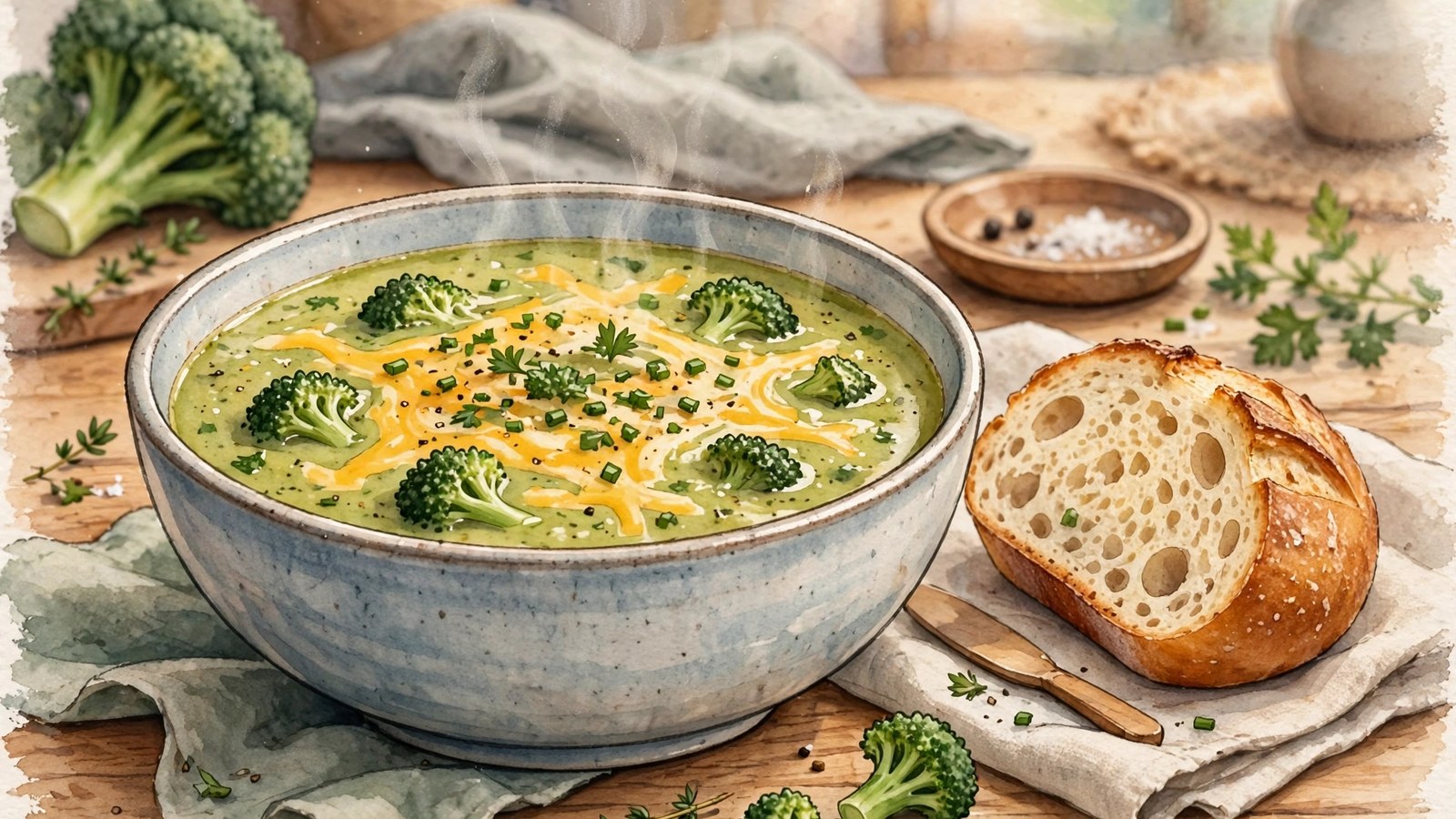
- Soften onion, carrot, and celery in butter and olive oil, stir in flour and cook it for two minutes, then whisk in vegetable stock and whole milk and simmer until slightly thickened. Add small broccoli florets and diced stalks with mustard, nutmeg, salt, and pepper and simmer gently for ten to twelve minutes until tender. Blend roughly a third to a half of the soup and return it to the pot. Take the pot off the heat and stir in freshly grated sharp cheddar a handful at a time until smooth. Serve at once with thick slices of crusty bread. Refrigerate leftovers promptly at 40 degrees Fahrenheit or below, use them within three to four days, and reheat leftovers to 165 degrees Fahrenheit, bringing this soup to a rolling boil. The dish contains milk and wheat, so read the allergen note before serving guests.
Introduction
Few bowls are more reassuring on a cold evening than broccoli cheddar soup, thick and steaming, with crusty bread for dipping. This vegetarian version keeps what people love about the classic, the deep green color, the creamy body, the sharp tang of good cheddar, and tender pieces of broccoli in every spoonful. It uses vegetable stock instead of meat based stock, a careful roux for body, and cheese added gently off the heat so the soup stays smooth rather than grainy.
Balance is the whole recipe. Too much cheese and the soup turns heavy and greasy. Too little and it tastes like broccoli in milk. Too much flour and it feels pasty. Too little body and it will not hold up to bread. The method below aims for the middle: unmistakably cheesy, clearly green, and thick enough to coat a spoon without becoming a sauce. A little mustard, a pinch of nutmeg, and a small splash of lemon juice or vinegar at the end keep the richness in check.
This article gives the full recipe, explains how the roux and the partial blend create the texture, covers broccoli and bread choices, variations, and troubleshooting, and sets out storage, reheating, and allergen guidance in plain factual terms. The food safety guidance was checked against FoodSafety.gov, the United States Department of Agriculture Food Safety and Inspection Service, and the Food and Drug Administration on 31 October 2026.
How the Soup Gets Its Body
Broccoli cheddar soup is thickened in two ways, by a roux and by the broccoli itself. The roux is flour cooked in butter. Cook it for a minute or two, stirring constantly, until it smells nutty and loses its raw, pasty edge. Undercooked flour tastes starchy and dull, and no amount of cheese fixes that later. Add the stock and milk gradually, whisking as you go, so lumps do not form. If small lumps do appear, steady whisking will usually smooth them out, and the blending step will finish the job.
The second thickener is the broccoli. After simmering, blend part of the soup, usually about a third to a half, and leave the rest in pieces. That creates a creamy base that still has distinct broccoli to spoon up, which is the texture most people mean by this soup. Blending all of it gives a smooth puree that is pleasant but less interesting. Blending none of it leaves a thin broth with floating broccoli. The partial blend is the sweet spot, and you can adjust it, more blending for a smoother soup and less for a chunkier one.
Milk choice matters too. Whole milk gives a soup that is creamy without being heavy, and it is the best everyday choice here. Half and half gives a richer result and is a little more forgiving on heat. Heavy cream gives the richest soup, but it can mute the broccoli and cheese flavors. This recipe uses whole milk, with an optional splash of cream at the end. Low fat milk can work, but the soup will be thinner and more likely to curdle if it boils, so keep the heat gentle after the milk goes in.
The order protects the cheese. Cheese added to a boiling soup can seize, turn grainy, or release oil that pools on the surface. Remove the pot from the heat, or turn it to the lowest setting, and add the cheese a handful at a time, stirring until each addition melts before adding the next. The soup should be hot enough to melt cheese but not boiling. That single rule is the difference between a smooth soup and a grainy one.
Cheese choice matters more here than in most recipes. Sharp cheddar gives the most flavor per handful, so you can taste it clearly without using so much that the soup turns greasy. Mild cheddar melts smoothly but tastes faint. Pre shredded cheese is convenient, but its anti clumping coating can make a soup grainy or stop it melting smoothly. Grating a block yourself takes a few minutes and gives a noticeably smoother result.
Choosing Broccoli and Preparing It
Fresh broccoli is the best choice when it is firm, deep green, and tight headed, with stalks that feel solid rather than woody or hollow. Rinse it under running water and drain it well. Cut the florets into small, bite size pieces, roughly an inch across, so they cook evenly and fit on a spoon. Peel the stalks and dice them too. The stalks are sweet and tender when cooked, and throwing them away wastes good soup material. Trim only the toughest base if a stalk is very thick or woody. A single large head, about a pound, is usually enough, though a little more never hurts.
Frozen broccoli is a respectable substitute, and it may be better than tired fresh broccoli that has sat in the refrigerator too long. Use it straight from frozen without thawing, add a few extra minutes to the simmering time, and choose a bag of plain broccoli with no added sauces or seasonings. Frozen broccoli tends to be softer, so it breaks down more readily, which suits a partially blended soup. The color may be slightly less vivid, but the flavor is sound.
Cook the broccoli just until tender, not until it collapses. Overcooked broccoli turns olive colored and develops a strong sulfurous smell that can dominate the soup. Ten to twelve minutes of gentle simmering is usually enough for fresh florets, and the residual heat will finish them. Check at ten minutes and stop while the color is still bright green.
Ingredients
This recipe serves four to six as a main course, with bread. Have everything chopped and measured before you start, because the roux and the cheese steps need steady attention.
For the soup:
- 2 tablespoons butter
- 1 tablespoon olive oil
- 1 medium yellow onion, finely diced
- 2 carrots, peeled and finely diced
- 2 stalks celery, finely diced
- 3 cloves garlic, minced
- 1/4 cup all purpose flour, or a gluten free flour blend, see the allergen note
- 2 cups vegetable stock, low sodium if possible
- 2 cups whole milk
- 1 pound fresh broccoli, cut into small florets, stalks peeled and diced, or about 5 cups frozen broccoli florets
- 1 teaspoon Dijon mustard
- 1/4 teaspoon ground nutmeg, optional
- 1/2 teaspoon fine sea salt, plus more to taste
- 1/4 teaspoon black pepper, freshly ground
- 2 and 1/2 cups sharp cheddar cheese, freshly grated from a block, about 10 ounces
- 1 tablespoon lemon juice or white wine vinegar, to taste, optional
- 1/4 cup heavy cream, optional, for extra richness
For serving:
- 1 loaf crusty bread, such as sourdough, ciabatta, or a rustic country loaf, sliced thickly
- Butter or olive oil, for the bread if you like
- Extra grated cheddar, for topping
- Chopped fresh chives or parsley
- Red pepper flakes, optional
- Cracked black pepper
Method: Step by Step
Step 1: Soften the vegetables
Melt the butter with the olive oil in a large, heavy pot over medium heat. Add the onion, carrots, and celery with a pinch of salt and cook for seven to eight minutes, stirring occasionally, until the onion is soft and translucent and the carrots have begun to soften. Do not rush this step. Properly softened vegetables give the soup a sweet, rounded base that cannot be added later. Add the garlic and cook for one minute more, stirring constantly, until fragrant and not browned.
Step 2: Make the roux and add the liquids
Sprinkle the flour over the vegetables and stir well to coat them. Cook for two minutes, stirring constantly, until the flour smells nutty and the mixture looks like a thick paste. Pour in the vegetable stock a little at a time, stirring or whisking constantly to prevent lumps and scraping the bottom of the pot. Once the stock is smooth, pour in the milk in the same gradual way. Bring the soup to a gentle simmer over medium heat, stirring occasionally, and cook for three to four minutes, until it has thickened slightly and coats the back of a spoon.
Step 3: Cook the broccoli
Add the broccoli, mustard, nutmeg if using, salt, and pepper. Stir well, reduce the heat to medium low, and simmer gently for ten to twelve minutes, until the broccoli is tender when pierced with a fork but still bright green. Stir occasionally to prevent sticking, and do not let the soup boil hard, which can curdle the milk and overcook the broccoli. If the soup seems too thick, add a splash more stock or milk. If it seems too thin, simmer a few minutes longer before blending, because blending will thicken it further.
Step 4: Blend part of the soup
Remove the pot from the heat. Using an immersion blender, blend briefly in a few spots, pureeing roughly a third to a half of the soup while leaving plenty of distinct broccoli pieces. If you do not have an immersion blender, ladle about two cups of soup into a standard blender, blend until smooth, and return it to the pot. Take care with hot liquid: fill the blender no more than halfway, hold the lid down with a towel, and start on low speed. Taste at this stage and adjust the salt and pepper. The base should taste seasoned and savory before the cheese goes in, because cheese alone cannot fix an under seasoned soup.
Step 5: Add the cheese gently
Return the pot to very low heat, or leave it off the heat if it is still very hot. Add the grated cheddar a handful at a time, stirring gently after each addition until it has melted before adding the next. This should take three to four minutes. Do not let the soup boil after the cheese is added. Stir in the cream if using, and the lemon juice or vinegar a teaspoon at a time, tasting as you go. The acid brightens the soup and cuts the richness, but too much makes it sharp. Taste once more and adjust salt and pepper. Serve immediately in warmed bowls, topped with extra cheddar, chives or parsley, and black pepper, with thick slices of crusty bread alongside.
The Bread: Choosing and Preparing It
Crusty bread is not an afterthought in this meal. It is half the experience. The ideal loaf has a crisp, crackling crust and a chewy, open crumb that soaks up soup without disintegrating at once. Sourdough is an excellent choice because its tang echoes the sharp cheddar. Ciabatta, with its airy interior, is also good, as is a rustic country loaf or a good French style loaf. Soft sandwich bread turns to mush on contact with soup, and very dense rye can fight the broccoli with its strong flavor.
Slice the bread thickly, about three quarters of an inch, so each piece can be dunked repeatedly without falling apart. Serve it plain, toast it lightly and rub it with a cut clove of garlic, or butter the slices before toasting. For a more substantial accompaniment, make grilled cheese soldiers: butter two slices of bread, fill with cheddar, grill until golden, and cut into strips for dipping.
If you need gluten free bread, choose a sturdy loaf and toast it well, because gluten free breads tend to be more fragile when wet. Keep crusty bread at room temperature in a paper bag or a bread box for a day or two. Plastic bags soften the crust. Freeze any remainder in a sealed bag, and revive day old bread by sprinkling it lightly with water and warming it in a hot oven for five to ten minutes.
Variations
A cauliflower and broccoli version replaces half the broccoli with cauliflower florets. The soup is paler, milder, and slightly sweeter, and it is a good choice if you have cauliflower to use up or want a gentler soup for young children. Cook it exactly the same way and blend the same proportion.
A spicy version adds a diced jalapeno with the onions, or a pinch of cayenne with the cheese, and finishes with hot sauce at the table. The heat should warm without overwhelming the cheddar. Start small and taste, because the richness of the soup can mask heat until it builds.
A potato enriched version adds one medium potato, peeled and diced, along with the broccoli. The potato breaks down during simmering and blending, giving the soup extra body and a heartier feel. It also stretches the soup to feed an extra person without more cheese.
A lighter version uses low fat milk and reduces the cheese to two cups, relying on a little extra mustard and a good squeeze of lemon to keep the flavor bold. The soup will be thinner and less rich, but still recognizably broccoli cheddar soup. Be especially careful not to let it boil after the milk is added, because low fat milk curdles more readily.
A baked version turns the soup into a party dish. Ladle it into oven safe bowls, top each with a slice of crusty bread and a handful of grated cheddar, and bake at 400 degrees Fahrenheit for ten to twelve minutes, until the cheese is bubbling and spotted brown. Use bowls that can handle the heat and warn everyone that they are hot.
For a vegan table, this recipe is not the right starting point, because cheddar and milk are central to it. A blended cashew and potato soup with nutritional yeast can be a satisfying plant based soup in its own right, but it is a different soup and should be judged on its own terms.
Troubleshooting
Grainy soup usually means the cheese was added while the soup was too hot, or pre shredded cheese was used. Next time, remove the pot from the heat before adding cheese, add it gradually, and grate your own from a block. If the soup is already grainy, an immersion blender can smooth it somewhat, though it will not fully restore the texture. Serve it promptly, while it is hot and freshly stirred.
Soup that is too thin may need a longer simmer before blending, or a little more blending, because pureed broccoli thickens the base considerably. If it is still thin after blending, simmer it gently for a few more minutes, stirring often, or whisk a tablespoon of flour into a little cold milk, stir that in, and simmer for three minutes to cook out the flour taste. Soup that is too thick simply needs more stock or milk, added a splash at a time. Soup thickens as it cools, so aim for slightly thinner than your target while it is hot.
Curdled soup, where the milk separates, usually results from boiling after the milk is added or from adding a large amount of acid at once. Keep the heat gentle, add lemon or vinegar gradually at the end, and do not boil the soup once the cheese is in during the original cooking. If curdling happens, blending can improve the appearance, but the texture will not be quite the same.
Bland soup is usually under salted or missing acid. Add salt in small pinches, tasting after each, then a teaspoon of lemon juice or vinegar. Mustard also sharpens the flavor without adding heat.
Broccoli that is olive colored and overcooked means it simmered too long or at too high a heat. Next time, keep the simmer gentle and check at ten minutes. Slightly undercooked broccoli will finish in the residual heat, while overcooked broccoli cannot be rescued.
Storage, Freezing, and Reheating
This soup is best fresh, but leftovers can be kept safely if they are handled promptly. FoodSafety.gov organizes home food safety into four steps, clean, separate, cook, and chill, and the chill step governs leftovers. Bacteria that cause food poisoning multiply quickest between 40 degrees Fahrenheit and 140 degrees Fahrenheit. Refrigerate perishable food within 2 hours of cooking, or within 1 hour if the food has been exposed to temperatures above 90 degrees Fahrenheit. Keep your refrigerator at 40 degrees Fahrenheit or below and your freezer at 0 degrees Fahrenheit or below.
Cool the soup rapidly in shallow, covered containers rather than leaving a big pot to cool slowly. The United States Department of Agriculture Food Safety and Inspection Service states that leftovers can be kept in the refrigerator for three to four days or frozen for three to four months. Frozen leftovers stay safe indefinitely in principle, but they lose moisture and flavor over longer storage, so that window is the quality guidance used here.
Reheating needs care, because the safety rule and the texture of a cheese soup pull in opposite directions, and safety governs. The Food Safety and Inspection Service states that when reheating leftovers, be sure they reach 165 degrees Fahrenheit as measured with a food thermometer, and that sauces, soups, and gravies should be reheated by bringing them to a rolling boil. Cover leftovers to reheat, which retains moisture and helps the food heat all the way through. For this soup, that means bringing the reheated soup to a rolling boil and checking that it has reached 165 degrees Fahrenheit, stirring so it heats evenly. Do not present a gentle, below boiling warm through as the safe method for leftovers, even though boiling can make cheese soup more likely to separate. If the reheated soup separates slightly, whisk it well and serve it promptly. Thinning it with a splash of milk or stock after it has reached temperature can help the texture. In the microwave, cover the soup, stir it during heating, and check the temperature in more than one place, because microwaves leave cold spots.
Freezing works best if you freeze the soup before adding the cheese. Make the soup through the blending step, cool it promptly, and freeze it in portions. Thaw it overnight in the refrigerator, reheat it following the rule above, and then add the cheese off the heat as in the original method. Soup frozen with the cheese already in it can turn grainy or separate on thawing. It is still usable if it has been stored safely, but the texture is noticeably worse. Label containers with the date and contents. Safe thawing is in the refrigerator, in cold water in a leak proof package, or in the microwave, never on the counter. After refrigerator thawing, use the food within three to four days.
Allergen and Dietary Notes
This section is factual information for planning and serving, not medical advice. This dish contains milk, in the form of butter, milk, cheddar cheese, and the optional cream, and wheat, in the form of the all purpose flour in the roux and the crusty bread. Both are major food allergens in the United States. The Food and Drug Administration lists nine foods, and ingredients containing their proteins, as major food allergens: milk, egg, fish, crustacean shellfish, tree nuts, wheat, peanuts, soybeans, and sesame. Sesame became the ninth major food allergen under the Food Allergy Safety, Treatment, Education, and Research Act, with labeling required from 1 January 2023.
If you are cooking for guests, ask about milk and wheat allergy before you plan the menu, not at the table. Check labels on stock, mustard, flour blends, and bread each time you buy them, because the Food and Drug Administration notes that ingredients can change at any time and advises reading the entire ingredient list. As written, the soup is not gluten free, because of the flour roux and the bread. With a gluten free flour blend in the same quantity, certified gluten free bread, and stock and mustard whose labels fit, it can be made without wheat based ingredients, but anyone cooking for a person with a wheat allergy or celiac disease should verify each product for that person rather than relying on the recipe title. The word vegetarian in the title describes the recipe as written, with vegetable stock and no meat among its listed ingredients. It is not vegan, because it contains milk in several forms. Cheese products differ by brand, so their labels govern for any stricter household definition.
Serving Ideas
For a weeknight supper, soup and bread are enough, especially with a simple salad of bitter leaves and a sharp vinaigrette. For a lunch gathering, serve smaller bowls with a platter of sandwiches, such as grilled cheese, so people can choose how substantial their meal will be.
Children often enjoy this soup with grilled cheese soldiers for dipping. If a child is wary of green vegetables, blending a larger proportion makes the broccoli less visible while keeping its flavor. Keep the pepper light in the main pot so adults can add their own at the table.
Frequently Asked Questions
Can I use frozen broccoli?
Yes. Use it straight from frozen, add a few extra minutes to the simmering time, and expect a slightly softer texture and a slightly less vivid color. The flavor is sound, and for a partially blended soup the difference is modest. Choose plain frozen broccoli with no added sauces or seasonings.
Why did my cheese turn grainy?
The most likely causes are soup that was too hot when the cheese was added and pre shredded cheese with anti caking coatings. Take the pot off the heat, add the cheese gradually a handful at a time, and grate it from a block. Low, gentle heat while the cheese melts during the original cooking also helps. Boiling after the cheese is added is the most common cause.
Can I make this soup ahead?
Yes, with the storage rules above. For the best texture, make it through the blending step, cool it promptly, and refrigerate it for up to three to four days, then reheat it following the reheating rule in the storage section and add the cheese fresh. A finished soup with the cheese already in it can also be refrigerated for three to four days and reheated the same way, though the texture will be less smooth.
Is this soup gluten free?
No, as written, because of the flour roux and the crusty bread, both of which contain wheat. With a gluten free flour blend, certified gluten free bread, and a check of the stock and mustard labels, it can be made without wheat based ingredients. If you are cooking for someone with a wheat allergy or celiac disease, verify every product for that person.
Can I use a different cheese?
Sharp cheddar is the classic choice, but a mixture of cheddar and a milder melting cheese, such as Monterey Jack, gives a smoother, milder soup. Avoid cheeses that release a great deal of oil when melted, or that have very strong flavors that would overwhelm the broccoli, unless you are deliberately aiming for a different soup. Whatever cheese you use, grate it from a block and add it off the heat.
How do I keep the soup from curdling?
Keep the heat gentle after the milk is added during the original cooking, do not boil it hard before the cheese goes in, and add acid gradually at the end. Whole milk and half and half are more forgiving than low fat milk. That gentle heat advice applies to cooking the fresh soup. Reheating leftovers follows the separate safety rule in the storage section, 165 degrees Fahrenheit and a rolling boil for soup.
Can I double the recipe?
Yes. Use a large pot, allow extra time for the vegetables to soften and the soup to come to a simmer, and add the cheese gradually as usual. A doubled batch is a good candidate for freezing before the cheese step, in portions, for future meals. Cool a large batch in shallow containers so it chills rapidly.
Sources & references
- United States Department of Agriculture, Food Safety and Inspection Service, Leftovers and Food Safety. Used for bacteria growing rapidly between 40 degrees Fahrenheit and 140 degrees Fahrenheit, refrigerating leftovers within 2 hours of cooking or 1 hour above 90 degrees Fahrenheit, cooling food rapidly in shallow containers with a big pot of soup given as the example, covering and sealing leftovers, keeping leftovers in the refrigerator for 3 to 4 days or frozen for 3 to 4 months with loss of moisture and flavor over longer freezer storage, safe thawing in the refrigerator, cold water, or the microwave, reheating leftovers to 165 degrees Fahrenheit as measured with a food thermometer, sauces, soups, and gravies reheated by bringing them to a rolling boil, covering leftovers during reheating, and checking microwave reheated food in several places.
- FoodSafety.gov, Cook to a Safe Minimum Internal Temperature. Used for leftovers of any type reheated to 165 degrees Fahrenheit and for the instruction to always use a food thermometer to check whether food has reached a safe minimum internal temperature, chart last updated 21 November 2024.
- FoodSafety.gov, 4 Steps to Food Safety. Used for the four steps clean, separate, cook, and chill, washing hands with plain soap and water for at least 20 seconds, rinsing fruits and vegetables under running water without soap or commercial produce washes, keeping a refrigerator at 40 degrees Fahrenheit or below and a freezer at 0 degrees Fahrenheit or below, refrigerating perishable food within 2 hours or within 1 hour above 90 degrees Fahrenheit, placing leftovers in shallow containers and refrigerating promptly, and never thawing or marinating foods on the counter.
- Food and Drug Administration, Have Food Allergies? Read the Label. Used for the nine major food allergens accounting for the large majority of severe food allergic reactions, milk, egg, fish, crustacean shellfish, tree nuts, wheat, peanuts, soybeans, and sesame, for allergen food sources having to be identified on packaged food labels including flour (wheat) and whey (milk) as examples, for sesame becoming the ninth major food allergen under the Food Allergy Safety, Treatment, Education, and Research Act with labeling required from 1 January 2023, and for the advice to read the entire ingredient list every time a product is bought because ingredients can change at any time.


