Short answer
- Cook diced onion gently in olive oil or butter until soft and translucent, with no browning. Add garlic, diced potato, and vegetable stock and simmer until the potato is tender, about 10 to 12 minutes. Add frozen peas, and spinach if using, and cook for only 3 to 4 minutes, until tender and bright green. Take the pot off the heat, add fresh mint and lemon juice, and blend at once for 2 to 3 minutes until smooth. Season, and serve warm with a swirl of cream, yogurt, or olive oil. Refrigerate leftovers promptly at 40 degrees Fahrenheit or below, use within 3 to 4 days, and reheat to 165 degrees Fahrenheit, bringing soups to a rolling boil.
Introduction
Easter spring pea and mint soup captures the change of season in a bowl. After months of root vegetables and heavy cooking, tender peas and fresh herbs taste bright and new. This soup is vivid green, silky, and fresh. It is light enough as a starter before a larger Easter meal, and satisfying enough for lunch with good bread.
Peas bring natural sweetness. Mint brings cool freshness. Together they taste more complex than either alone, if the balance is right. Too much mint tastes sharp and medicinal. Too little leaves plain pea soup. This recipe adds most of the mint at the end, so its flavor survives, and finishes with lemon and an optional swirl of cream or yogurt.
It is also practical. It takes about 30 minutes, uses frozen peas well, and can be made ahead and reheated to 165 degrees Fahrenheit. This article gives the full recipe, how to keep the color vivid and the texture silky, and storage and allergen notes. Food safety guidance was checked against FoodSafety.gov, the United States Department of Agriculture Food Safety and Inspection Service, and the Food and Drug Administration on 31 October 2026.
Why Peas and Mint Work Together
Young peas are sweet because their natural sugars are strongest before they convert to starch as peas age. Frozen peas are typically frozen at peak freshness, shortly after picking, which locks in sweetness and color. That is why frozen peas often outperform fresh peas that have spent days in transit. Unless you have garden peas picked the same day, frozen peas are not a compromise here. They are a reliable, excellent choice.
Mint gives a cool sensation that contrasts with the warm sweetness of peas. The pairing is traditional in British and Mediterranean cooking, in salads, side dishes, and soups. Timing decides whether it works. Mint added early loses freshness and can turn bitter. Mint added at the end, just before blending, keeps its bright aroma. Reserve a little for garnish.
Color is part of the appeal and the main technical challenge. Green vegetables lose bright color when overcooked, because prolonged heat breaks down chlorophyll. Cook the peas briefly, blend immediately, and avoid prolonged simmering after blending. A cup of spinach, added with the peas, can deepen the color without changing the flavor much. Lemon at the end brightens both color and taste. Serve promptly for the best color, and if reheating, reach the safe endpoint without holding the soup at a prolonged vigorous boil.
Ingredients
This recipe serves 4 to 6. For an Easter starter, plan on smaller portions from the same batch.
- 2 tablespoons olive oil or butter
- 1 large yellow onion, diced
- 2 cloves garlic, minced
- 1 medium potato, peeled and diced, for body
- 4 cups vegetable stock, low sodium if possible
- 1 pound frozen peas, about 4 cups, plus extra for garnish if desired
- 1 cup baby spinach leaves, optional, for deeper color
- 1/2 cup fresh mint leaves, loosely packed, plus extra for garnish
- 1 tablespoon fresh lemon juice, plus more to taste
- 1/2 teaspoon kosher salt, plus more to taste
- 1/4 teaspoon black pepper
- 1/4 teaspoon sugar, optional, only if the peas taste less sweet than expected
To serve: 1/2 cup heavy cream, creme fraiche, or plain yogurt for swirling, extra mint, a drizzle of olive oil, and optional croutons, toasted seeds, or crumbled feta. Crusty bread or a simple salad suits a lunch serving.
Taste the stock before salting, because a salty stock needs less added salt. Keep potato pieces small and even so they cook in the stated time. Omitting the potato and using a little less stock gives a lighter, thinner soup.
Equipment and Blender Safety
You need a large pot or Dutch oven, an immersion blender or a countertop blender, a knife, a cutting board, and a ladle. An immersion blender blends directly in the pot. A countertop blender can give a silkier result, but needs batches and care with hot liquid. A fine mesh strainer is optional, for an extra smooth finish worth doing for a formal starter. Warmed bowls help a starter stay hot at the table.
Hot soup blending is a common cause of kitchen burns. With an immersion blender, keep the blade fully submerged and move it slowly. With a countertop blender, fill the jar no more than halfway, remove the center cap if your blender allows it, cover the opening with a folded towel to vent steam, and start on low speed. Never blend a full jar of boiling soup with the lid sealed tightly, because steam pressure can force the lid off.
Method: Step by Step
Step 1: Cook the onion and potato
Heat the oil or butter over medium heat. Add onion and a pinch of salt and cook for 6 to 8 minutes, stirring occasionally, until soft and translucent, with no browning. Browning would darken the soup and compete with the fresh pea flavor. Add garlic and cook for 30 seconds, just until fragrant. Add potato and stir to coat.
Step 2: Add the stock and simmer
Pour in the stock, bring to a gentle simmer, reduce the heat to medium low, cover partially, and cook for 10 to 12 minutes, until the potato is tender when pierced with a fork. The potato gives body and a silky texture without needing much cream.
Step 3: Add the peas and spinach
Add frozen peas and spinach if using. No thawing is needed. Return to a simmer and cook for just 3 to 4 minutes, until the peas are tender and bright green. Do not overcook. Peas go from bright and sweet to dull and starchy quickly. Fresh peas may need only 2 to 3 minutes. Taste one. It should be tender and sweet, not chalky or firm.
Step 4: Add the mint and lemon, then blend
Remove the pot from the heat. Add mint, lemon juice, salt, pepper, and sugar if using. Stir once, then blend immediately for 2 to 3 minutes until completely smooth. A quick pulse is not enough. For an extra smooth texture, strain through a fine mesh strainer into a clean pot, pressing with a ladle and discarding the small amount of pulp that remains.
Step 5: Taste, adjust, and serve
Pea soup needs enough salt to bring out sweetness, but oversalting flattens it. Add lemon a teaspoon at a time until the flavor brightens without tasting sour. Add sugar only if the peas taste starchy. If too thick, thin with warm stock or water until it coats a spoon but pours easily. If too thin, simmer gently for a few minutes, though this dulls color slightly.
Serve warm in warmed bowls, with a swirl of cream, yogurt, or olive oil and a few mint leaves. For whole pea garnish, blanch a handful in boiling water for 1 minute, drain, and cool quickly in ice water. Serve small portions as an Easter starter, larger portions with bread and salad for lunch.
Timing at a Glance
Total time is about 30 minutes. The onion takes 6 to 8 minutes, the stock and potato simmer takes 10 to 12 minutes, the peas take 3 to 4 minutes, and blending and seasoning take about 5 minutes. Do not extend pea cooking in hope of a smoother soup. Blending, not longer cooking, creates smoothness, and longer cooking only dulls color and flavor.
Variations
For a richer soup, use butter, add 1/2 cup heavy cream during blending, and finish with creme fraiche. For a lighter, dairy free soup, use olive oil, omit cream, and finish with olive oil and lemon. The potato gives enough body that cream is not essential.
For a more substantial soup, blend in cooked white beans or cooked rice. For a spring vegetable version, add asparagus tips or broad beans with the peas, noting that broad beans need peeling for a smooth texture. For a chilled version, cool completely, refrigerate promptly, and serve cold with yogurt and mint. Cold dulls flavor, so taste and adjust salt and lemon after chilling.
Basil can replace part of the mint. Chives or parsley can be added in small amounts. Do not replace all the mint with rosemary or thyme, which will overwhelm the peas. A little tarragon gives an anise note some cooks enjoy, but use it sparingly. Garnishes change the character: toasted seeds add crunch, feta adds salt, pancetta adds smokiness, and croutons add substance. Match the choice to the meal and dietary needs.
Serving Ideas
For Easter, serve small bowls with a cream swirl and mint, followed by the main course. The light flavor sets a spring tone without filling guests up. For lunch, serve larger bowls with crusty bread and a salad of mixed leaves and radishes. For an outdoor gathering, serve warm in insulated cups or chilled in jars, keeping the time limits in the storage section in mind.
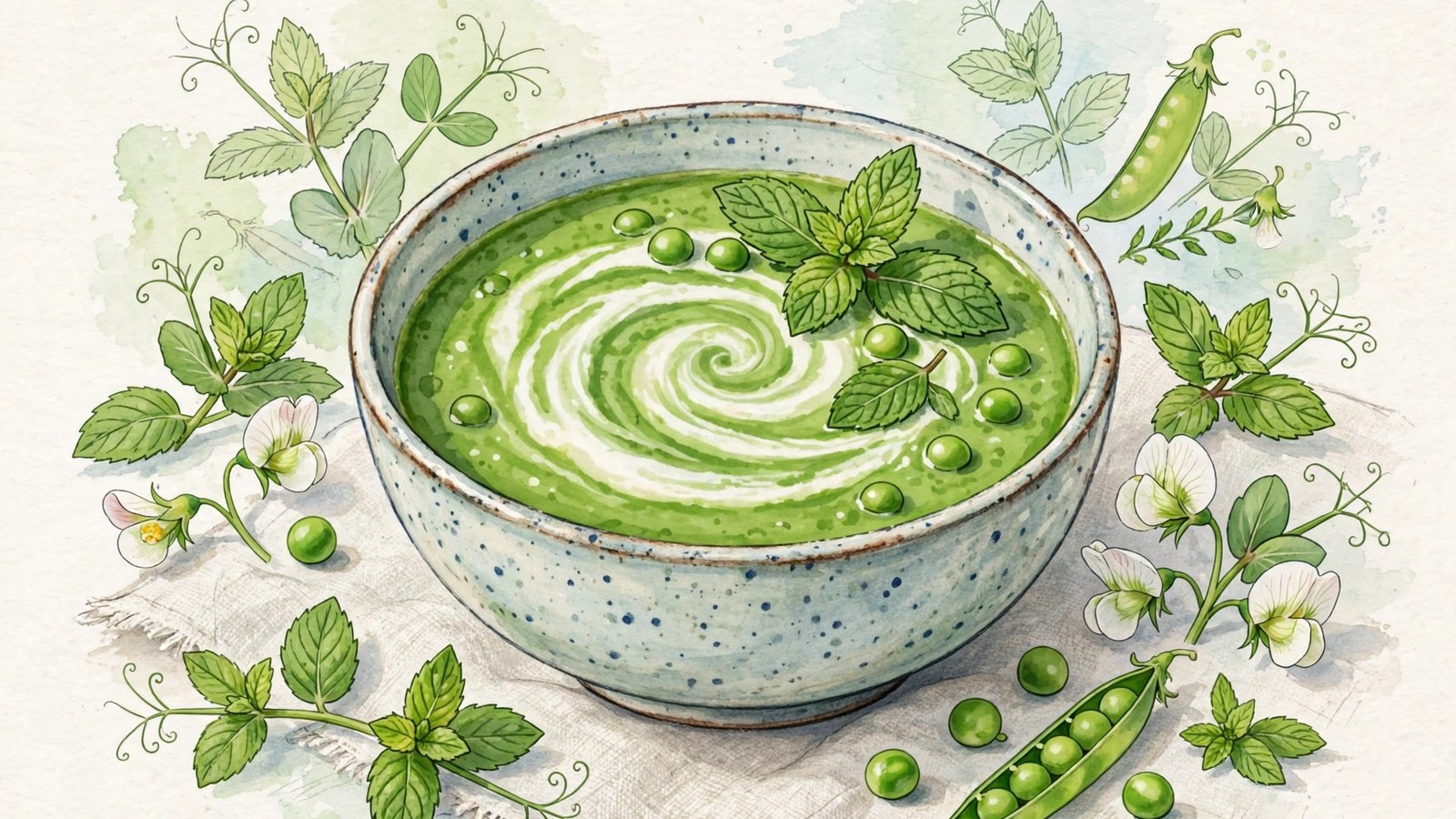
Use white or light colored bowls, which show off the green, and swirl cream in a spiral rather than stirring it in, so the contrast stays visible. A few whole peas, a mint leaf, and a drizzle of oil look simple and elegant. Dark bowls hide the color, and over garnishing makes the soup look busy rather than fresh.
Other spring soups differ in character. Asparagus soup is earthy and slightly bitter, spinach soup is mineral and deep green, and watercress soup is peppery and sharp. Pea and mint soup is the sweetest and freshest of the group, which is why it suits a rich Easter main course as a starter that does not compete with what follows.
Storage, Reheating, and Food Safety
FoodSafety.gov organizes home food safety into four steps: clean, separate, cook, and chill. The chill step governs leftovers. Refrigerate perishable food within 2 hours of cooking, or within 1 hour if it has been exposed to temperatures above 90 degrees Fahrenheit. Bacteria that cause food poisoning multiply quickest between 40 degrees Fahrenheit and 140 degrees Fahrenheit, so do not leave soup on the counter or at an Easter buffet for more than 2 hours.
Keep the refrigerator at 40 degrees Fahrenheit or below and the freezer at 0 degrees Fahrenheit or below. The Food Safety and Inspection Service advises cooling food rapidly by dividing large amounts into shallow containers, giving a big pot of soup as its example, because a large pot cools slowly. Cover leftovers or seal them in storage containers and refrigerate or freeze immediately for rapid cooling.
Leftovers keep for 3 to 4 days in the refrigerator, or 3 to 4 months frozen, although frozen leftovers lose moisture and flavor over longer storage. For best quality in this soup, use frozen soup within 2 to 3 months on the source recipe timing. Freeze without the cream garnish, in airtight containers with room for expansion, and add fresh garnish at serving. Color will be slightly less vivid after freezing, but flavor remains good.
When reheating, bring leftovers to 165 degrees Fahrenheit throughout, measured with a food thermometer. FoodSafety.gov lists leftovers of any type at 165 degrees Fahrenheit. The Food Safety and Inspection Service adds that sauces, soups, and gravies should be reheated by bringing them to a rolling boil, and that covering leftovers helps them heat through. Heat this soup over medium low heat, stirring frequently, and bring it steadily to that endpoint rather than holding it at a prolonged vigorous boil, which dulls color and flattens flavor. Thin with a splash of stock or water if it has thickened, and adjust salt and lemon after reheating.
Thaw frozen soup in the refrigerator, in cold water in a leak proof package, or in the microwave, never on the counter. After refrigerator thawing, use within 3 to 4 days. Food thawed in a microwave should be heated until it reaches 165 degrees Fahrenheit. It is also safe to reheat frozen soup without thawing, in a saucepan or microwave, although it will take longer.
You can make this soup up to 2 days ahead for Easter on the source recipe timing, refrigerated promptly in a covered container and reheated as above. Add garnishes at serving time.
Allergen and Dietary Notes
This section is factual information for planning, not medical advice. As written with olive oil and no cream swirl, the base soup contains none of the nine major food allergens listed by the Food and Drug Administration as an ingredient: milk, egg, fish, crustacean shellfish, tree nuts, wheat, peanuts, soybeans, and sesame. Sesame became the ninth major food allergen under the Food Allergy Safety, Treatment, Education, and Research Act, with labeling required from 1 January 2023.
Choices and garnishes change that. Butter, cream, creme fraiche, yogurt, and feta contain milk. Croutons usually contain wheat. Some vegetable stocks contain soy or other allergens, and labels vary, so read the entire ingredient list every time you buy, because the Food and Drug Administration notes that ingredients can change at any time. Pancetta is pork and changes whether the dish is vegetarian, though it is not one of the nine major allergens.
The soup is vegetarian with vegetable stock and no pancetta. It can be vegan and gluten free with olive oil, no cream or a plant based swirl, a checked stock label, and gluten free bread or no croutons. Mention the ingredients to guests in advance, because some people strongly dislike mint.
Peas are legumes. The source recipe notes that pea allergy exists, although it is less common than peanut or soy allergy, and that people with legume allergies should be asked about peas specifically. Peas are not on the nine major allergen list above. If a guest has a pea allergy, do not serve this soup to that person, and cook a separate starter in a clean pot with clean utensils. For very young children, the source recipe notes added salt should be omitted for babies and advises checking with a pediatrician about textures and ingredients. Follow clinician guidance for the specific child.
Troubleshooting
If the soup is dull green, the peas were overcooked or the soup was boiled long after blending. Cook peas for only 3 to 4 minutes, blend immediately, and reheat only to the safe endpoint. Spinach deepens color but cannot rescue long boiled soup. Browned onion and old peas also dull color.
If it tastes flat, add salt or lemon gradually, tasting after each addition. If it tastes too minty, reduce mint to 1/3 cup next time. If it is grainy, blend for a full 2 to 3 minutes and strain. If too thick, thin with warm stock or water. If too thin, reduce gently or blend in cooked potato or white beans. If it tastes starchy, use fresher peas and shorter cooking next time. Separation after standing is normal for a blended vegetable soup. Stir well, provided storage was proper and the soup is within its safe window.
Frequently Asked Questions
Can I use fresh peas?
Yes. Garden peas picked the same day will be superb. Use about 4 cups shelled, and cook for only 2 to 3 minutes. Fresh peas kept several days in the refrigerator may taste less sweet than frozen peas, so fresh is not always better.
Can I make this soup ahead for Easter?
Yes, up to 2 days ahead. Refrigerate promptly in a covered container at 40 degrees Fahrenheit or below, reheat to 165 degrees Fahrenheit, bringing the soup to a rolling boil, and adjust salt and lemon after reheating. Add garnishes at serving time.
Do I need to strain the soup?
No. A full 2 to 3 minutes of blending gives a smooth soup most people will enjoy. Straining gives a silkier texture and is worth doing for a formal starter, but it is optional for lunch.
Can I serve this soup cold?
Yes. Cool completely, refrigerate promptly, and serve chilled with yogurt and mint, within the 3 to 4 day refrigerated window. Taste and adjust salt and lemon after chilling, because cold needs more seasoning.
What if I do not like mint?
Reduce mint to 1/4 cup, or replace it with basil or parsley. Without any fresh herb the soup tastes simpler, so some herb is recommended even if it is not mint.
Can I add cream during cooking?
Yes, during blending for a richer soup, but a swirl at serving is better, so guests who prefer a lighter or dairy free soup can omit it. Keep heat gentle after adding cream, because boiling can make it more prone to splitting.
Is this soup suitable for freezing?
Yes, without the cream garnish, for 2 to 3 months at best quality on the source recipe timing, within the general federal freezer window of 3 to 4 months. Thaw overnight in the refrigerator and reheat to 165 degrees Fahrenheit, bringing the soup to a rolling boil.
Why is my soup brownish rather than green?
Overcooking the peas or boiling after blending breaks down chlorophyll. Cook peas briefly, blend immediately, keep the onion pale, and reheat only to the safe endpoint without a prolonged vigorous boil.
Sources & references
- FoodSafety.gov, Cook to a Safe Minimum Internal Temperature. Used for leftovers of any type reheated to 165 degrees Fahrenheit, and for always using a food thermometer to check whether food has reached a safe minimum internal temperature. Chart last updated 21 November 2024.
- United States Department of Agriculture, Food Safety and Inspection Service, Leftovers and Food Safety. Used for bacteria growing rapidly between 40 degrees Fahrenheit and 140 degrees Fahrenheit, refrigerating leftovers within 2 hours or 1 hour above 90 degrees Fahrenheit, cooling rapidly in shallow containers with a big pot of soup as the example, covering and sealing leftovers, keeping leftovers 3 to 4 days in the refrigerator or 3 to 4 months frozen, safe thawing in the refrigerator, cold water, or microwave, reheating leftovers to 165 degrees Fahrenheit as measured with a food thermometer, reheating sauces, soups, and gravies by bringing them to a rolling boil, covering leftovers during reheating, and reheating frozen soup without thawing in a saucepan or microwave.
- FoodSafety.gov, 4 Steps to Food Safety. Used for the four steps clean, separate, cook, and chill, a refrigerator at 40 degrees Fahrenheit or below and a freezer at 0 degrees Fahrenheit or below, refrigerating perishable food within 2 hours or 1 hour above 90 degrees Fahrenheit, bacteria multiplying quickest between 40 degrees Fahrenheit and 140 degrees Fahrenheit, placing leftovers in shallow containers, and never thawing foods on the counter.
- Food and Drug Administration, Have Food Allergies? Read the Label. Used for the nine major food allergens: milk, egg, fish, crustacean shellfish, tree nuts, wheat, peanuts, soybeans, and sesame, for allergen sources having to be identified on packaged labels, for sesame becoming the ninth major allergen under the Food Allergy Safety, Treatment, Education, and Research Act with labeling required from 1 January 2023, and for reading the entire ingredient list every time because ingredients can change.


