Short answer
- Stir crushed tomatoes, tomato paste, onion, garlic, vegetable broth, and seasonings in a slow cooker and cook the base on low for 4 to 5 hours, or on high for 2 to 3 hours. Turn the cooker to high if needed, add refrigerated cheese tortellini, and cook for 20 to 25 minutes until tender. Stir in heavy cream, fresh spinach, and Parmesan, cover, and cook 5 to 10 minutes more until the spinach wilts. Serve at once. Keep perishable ingredients refrigerated until you load the cooker, refrigerate leftovers in shallow covered containers within 2 hours, use them within 3 to 4 days, and reheat them on the stove, in a microwave, or in an oven to 165 degrees Fahrenheit, bringing this soup to a rolling boil. Do not reheat leftovers in the slow cooker.
Introduction
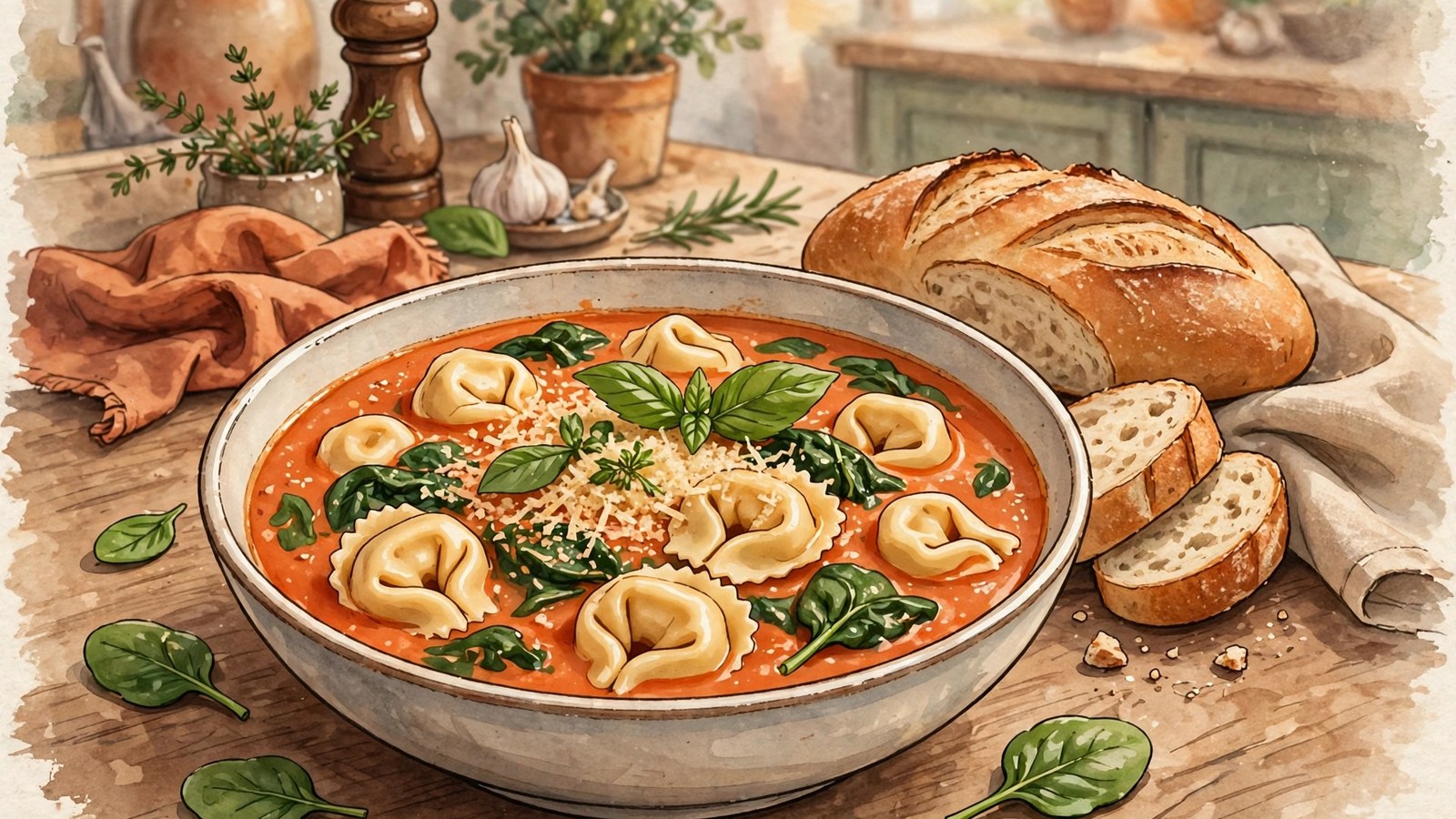
Some soups feel like a project and some feel like a kindness, and this one belongs firmly in the second group. This creamy tomato tortellini soup with spinach is warm, comforting, and substantial enough to count as dinner, and the slow cooker does almost all of the work. You stir together tomatoes, broth, and seasonings, let the cooker simmer them into a rich base, and add the tortellini, cream, and spinach near the end, when they need only minutes to become tender and silky.
The slow cooker suits tomato soup well because tomatoes benefit from a long, gentle simmer that rounds off their acidity and deepens their flavor. Tortellini does not benefit from a long simmer at all. Left for hours, it swells, softens, and falls apart. The method in this recipe respects that difference: a long simmer for the base and a short finish for the pasta. That timing is the whole secret, and it is easy once you know it.
This article gives the full recipe, explains the choices behind the tomato base, the tortellini, and the cream and spinach finish, and covers variations, serving ideas, and troubleshooting. It also covers slow cooker food safety in full, including keeping perishable ingredients refrigerated before cooking, thawing meat before it goes into a slow cooker if you use a meat variation, why leftovers should not be reheated in a slow cooker, and reheating soup to 165 degrees Fahrenheit, with soups brought to a rolling boil. The safety guidance was checked against the United States Department of Agriculture Food Safety and Inspection Service and FoodSafety.gov on 31 October 2026. In the body of this article the appliance is called a slow cooker, which is the generic name for this type of cooker.
Why This Recipe Works
Three decisions make this soup work. The first is the tomato base. Crushed tomatoes give body without chunkiness, and a spoonful of tomato paste adds depth so the soup feels rich rather than thin. A small pinch of sugar rounds off acidity without making the soup sweet.
The second decision is the timing of the base. It simmers for several hours, which gives the flavors time to meld and the tomatoes time to mellow. The result tastes like a soup that simmered on the stove all afternoon, without anyone standing over a pot.
The third decision is the finish. Tortellini, cream, and spinach all go in during the last 20 to 30 minutes. Tortellini stays tender rather than mushy. Cream added at the end stays silky instead of separating. Spinach wilts in minutes and keeps its color. Adding these three late preserves the best quality of each one.
Ingredients
This recipe makes about six servings in a 6 quart slow cooker. Measure and chop everything before you load the cooker, even though the hands on work is brief.
- 2 cans (28 ounces each) crushed tomatoes
- 2 tablespoons tomato paste
- 1 small yellow onion, finely diced
- 3 cloves garlic, minced
- 4 cups low sodium vegetable broth
- 1 teaspoon dried Italian seasoning
- 1/2 teaspoon dried basil, optional, for a stronger basil note
- 1/2 teaspoon fine sea salt, plus more to taste
- 1/4 teaspoon ground black pepper
- 1/2 teaspoon granulated sugar, optional, to balance acidity
- 1 package (about 20 ounces) refrigerated cheese tortellini
- 1 cup heavy cream, or half and half for a lighter version
- 4 cups fresh baby spinach (about 4 ounces)
- 1/2 cup finely grated Parmesan cheese, plus more for serving
- Fresh basil leaves, for serving, optional
- Olive oil, for drizzling, optional
Ingredient Notes
Crushed tomatoes give a smooth, thick base without blending. Diced tomatoes work, but they leave chunks and may need a brief blend at the end. Whole peeled tomatoes, crushed by hand, also work but take more effort. If your tomatoes taste very acidic, the pinch of sugar and the cream both help, and a longer simmer also mellows acidity.
Vegetable broth keeps the soup vegetarian as written. Chicken broth works if you are not vegetarian, but the soup is then no longer vegetarian. Low sodium broth is recommended because the Parmesan and the tortellini filling both add salt. Taste before adding extra salt, especially after the Parmesan goes in.
Refrigerated cheese tortellini is the best choice because it cooks quickly and holds its shape in the short finishing time. Frozen tortellini works with a few extra minutes. Dried tortellini needs significantly longer and turns mushy easily, so cook it separately following the package directions and add it just before serving. Check package directions and adjust the finishing time accordingly. Meat filled tortellini works if you are not vegetarian, but follow the safety section below if you use it.
Heavy cream gives the richest, silkiest result and is the most stable in hot soup. Half and half gives a lighter soup but separates more easily, so stir it in at the end on the lowest setting and do not let the soup boil afterward. Coconut cream is a dairy free option with a noticeable coconut flavor.
Fresh baby spinach wilts quickly and has a mild flavor. Regular spinach works too, but remove thick stems and chop the leaves first. Frozen spinach is not recommended because it releases a great deal of water. If you must use it, thaw it completely, squeeze it very dry, and add it with the tortellini.
Equipment You Will Need
You need a slow cooker, a 6 quart model works well for this quantity, a cutting board and knife, a can opener, a wooden spoon, and a ladle. A food thermometer is needed for checking reheated leftovers and for holding temperatures. An immersion blender is optional, useful only if you want a smoother soup or if you used diced tomatoes. No other special equipment is needed, which is part of the appeal of a slow cooker soup.
Slow Cooker Safety Before You Start
A slow cooker is a safe way to cook when a few rules from the United States Department of Agriculture Food Safety and Inspection Service are followed. That agency explains that a slow cooker cooks foods slowly at a low temperature, generally between 170 degrees Fahrenheit and 280 degrees Fahrenheit, and that the direct heat from the pot, the lengthy cooking time, and the steam created inside the tightly covered container combine to destroy bacteria and make the process safe.
Begin with a clean cooker, clean utensils, and a clean work area, and wash your hands before and during food preparation. Keep perishable foods refrigerated until preparation time. That rule matters here for the tortellini, the cream, the Parmesan, and the spinach. Do not leave them on the counter while the base cooks. Add them from the refrigerator at the finishing stage. If you cut up ingredients in advance, store them separately in the refrigerator. The Food Safety and Inspection Service notes that a slow cooker may take several hours to reach a safe, bacteria killing temperature, and that constant refrigeration assures that bacteria do not get a head start during the first hours of cooking. FoodSafety.gov adds: keep the refrigerator at 40 degrees Fahrenheit or below, and never thaw food on the counter.
Always thaw meat or poultry before putting it into a slow cooker. The base recipe here contains no meat, so this rule matters only if you change it, for example by using a meat product the maker directs you to thaw first or by adding raw meat. Follow package directions for a commercially prepared frozen product, and for raw meat or poultry, thaw it in the refrigerator first and never add it frozen. Keep the lid in place while the base cooks, removing it only to stir or check the food, and make sure the cooker is plugged in and turned on. While food is cooking, and once it is done, food will stay safe as long as the cooker is operating. If the power goes out while you are away, the Food Safety and Inspection Service advises throwing the food away even if it looks done.
Reheating leftovers in a slow cooker is not recommended. That point is covered again in the storage section because it is the rule readers most often get wrong with soup. Cooked food should be reheated on the stove, in a microwave, or in a conventional oven until it reaches 165 degrees Fahrenheit. Only then can hot food be placed in a preheated slow cooker to keep it hot for serving, at least 140 degrees Fahrenheit as measured with a food thermometer.
Method: Step by Step
Step 1: Build the base
Combine the crushed tomatoes, tomato paste, diced onion, garlic, vegetable broth, Italian seasoning, basil if using, salt, pepper, and sugar if using in the slow cooker. Stir well, making sure the tomato paste is dissolved and not sitting in a lump at the bottom. The mixture will look thin at this stage. It thickens slightly during cooking and again when the cream and Parmesan are added. Put the tortellini, cream, Parmesan, and spinach back in the refrigerator at this point if you prepared them early. They are perishable and should stay refrigerated until their stage in the recipe.
Step 2: Slow cook the base
Cover and cook on low for 4 to 5 hours, or on high for 2 to 3 hours. The base should be hot, fragrant, and slightly darker in color than when it started, with the onion fully softened. The long, gentle simmer is what mellows the tomatoes and melds the flavors, so do not rush this stage by adding the tortellini early. If you are home, you may stir the soup once or twice during cooking, though this is not essential. Keep the lid in place the rest of the time.
Step 3: Add the tortellini
About 25 to 30 minutes before you plan to serve, turn the slow cooker to high if it is on low. Add the refrigerated tortellini, stirring gently to separate the pieces and submerge them in the soup. Cover and cook for 20 to 25 minutes, or until the tortellini are tender and floating, following the package directions as a guide. Check a piece at 20 minutes. It should be tender all the way through, not doughy in the center, but still firm enough to hold its shape. Do not leave the tortellini for much longer than this, or it will soften and begin to fall apart. For frozen tortellini, add a few extra minutes and judge by tenderness rather than by the clock alone.
Step 4: Finish with cream, spinach, and Parmesan
Stir in the heavy cream, the fresh spinach, and the Parmesan cheese. The spinach will look like a large pile at first, but it wilts down within a few minutes in the hot soup. Cover and cook for 5 to 10 minutes more, just until the spinach is wilted and the soup is hot and creamy throughout. Do not let the soup come to a hard boil after the cream goes in. Taste and adjust the seasoning: more salt if it tastes flat, a pinch more sugar if it tastes sharp, more Parmesan if you want it richer. The soup should be creamy and well seasoned, with the tomato flavor still clear and not masked by the cream.
Step 5: Serve
Ladle the soup into warm bowls. Top with extra grated Parmesan, fresh basil leaves, and a drizzle of olive oil if you like. Serve immediately, while the tortellini are tender and the spinach is bright. The soup thickens as it sits because the tortellini absorb liquid, so serve promptly for the best texture, or add a splash of warm broth when reheating leftovers.
Tips for the Best Results
Do not add the tortellini at the start. That is the mistake that ruins more slow cooker pasta soups than any other. Tortellini cooked for hours becomes mushy and thickens the soup into a starchy paste. The last 25 minutes is the right window for refrigerated tortellini.
Do not add the cream at the start either. Cream simmered for hours in an acidic base can separate or turn grainy. Adding it at the end keeps it silky, and this matters even more for half and half.
Taste the base before adding the tortellini. Once the cream is in, adjustments are harder to judge because cream softens flavors. A base that tastes slightly too salty or acidic will usually be balanced by the cream, but a flat base will stay flat. Season the base well, then fine tune at the end.
Warm the bowls if you have time. Rinse them with hot water and dry them, or place them in a low oven for a few minutes. A warm bowl keeps a creamy soup hot longer.
Variations and Swaps
For a richer soup, add a spoonful of mascarpone or cream cheese with the heavy cream, stirring until melted. For a lighter soup, use half and half, reduce the Parmesan slightly, and add an extra handful of spinach.
For a heartier soup, add a can of drained white beans or chickpeas with the tortellini. For a spicier soup, add red pepper flakes to the base or a spoonful of chili paste at the end. For a smoky version, add a teaspoon of smoked paprika to the base.
For a dairy free version, use coconut cream and a dairy free Parmesan style cheese, or omit the Parmesan and finish with olive oil and basil. Use dairy free tortellini if you can find one, because most refrigerated tortellini contains cheese or egg.
For a stovetop version, simmer the base in a large pot over low heat for 30 to 40 minutes, then add the tortellini and cook until tender, usually 5 to 7 minutes for refrigerated tortellini, then finish as described. Any meat variation must still follow the thaw first rule in the safety section.
Serving Suggestions
This soup is a complete meal in a bowl, but a few accompaniments make it feel like an occasion. Crusty bread, garlic bread, or a grilled cheese sandwich for dipping are classic pairings. A simple green salad with a lemon vinaigrette adds freshness and contrast. For a dinner party, serve smaller bowls as a first course. For a family dinner, serve generous bowls and let people add extra Parmesan at the table. Sparkling water with lemon or iced tea pairs well, as does a medium bodied red wine for readers who drink alcohol.
For children, this soup is often a hit because the tortellini are fun to eat and the base is familiar. If your children are wary of visible spinach, chop it finely before adding it, so it blends into the soup.
If you are holding the soup for serving, keep it hot rather than letting it sit at room temperature. FoodSafety.gov advises keeping hot food at 140 degrees Fahrenheit or above after cooking, using a heat source such as a slow cooker, and the Food Safety and Inspection Service gives at least 140 degrees Fahrenheit, measured with a food thermometer, as the holding temperature for hot food placed in a preheated slow cooker.
Make Ahead, Storage, and Reheating
The tomato base can be made ahead and refrigerated for up to 3 days, or frozen for up to 3 months, before the tortellini, cream, and spinach are added. This is the best make ahead strategy because the base improves with a day in the refrigerator, while cooked tortellini softens over time. When you are ready to serve, reheat the base on the stove, in a microwave, or in an oven until hot. Do not use the slow cooker itself to reheat the cold base. Then add the tortellini and finish with cream and spinach as described.
For finished soup, the Food Safety and Inspection Service guidance on leftovers governs. Bacteria grow rapidly between 40 degrees Fahrenheit and 140 degrees Fahrenheit. Store leftovers in shallow covered containers and refrigerate within 2 hours after cooking is finished, or within 1 hour if the temperature is above 90 degrees Fahrenheit. A big pot of soup takes a long time to cool, so divide it into shallow containers so it cools quickly. Cover leftovers well to keep bacteria out and retain moisture.
Leftovers keep for 3 to 4 days in the refrigerator or 3 to 4 months frozen, although frozen leftovers lose moisture and flavor over longer storage. The finished soup does not freeze at its best once tortellini and cream are added, because the pasta becomes mushy and the cream can separate, so freeze the base only and add those fresh when you serve. Thaw frozen leftovers safely in the refrigerator, in cold water in a leak proof package, or in the microwave, never on the counter. After refrigerator thawing, use the food within 3 to 4 days.
Reheat leftovers safely and not in a slow cooker. Be sure they reach 165 degrees Fahrenheit as measured with a food thermometer. Reheat sauces, soups, and gravies by bringing them to a rolling boil. Cover leftovers to reheat. In a microwave, cover and rotate the food, check the temperature in several places because microwaves have cold spots, and allow a resting time. Stir well on the stove and add a splash of broth or water if the soup has thickened. The tortellini will be softer after reheating, which is normal. Once reheated, the soup can be placed in a preheated slow cooker for serving and held at least 140 degrees Fahrenheit.
Do not leave the finished soup at room temperature for more than 2 hours, or 1 hour if the room is above 90 degrees Fahrenheit, including time at the table. Refrigerate it promptly after serving.
Allergen and Dietary Notes
This section is factual information for planning and serving, not medical advice. As written, with vegetable broth and cheese tortellini, this soup contains milk, in the cream and Parmesan and in the cheese filling, egg and wheat, which are typical in tortellini pasta and filling, and it may contain soy or other ingredients depending on the brand of tortellini and broth you buy. Milk, egg, and wheat are among the major food allergens in the United States, and tortellini and broth formulations vary by maker.
Read the entire ingredient list on the tortellini, broth, and cheese every time you buy them, because recipes can change. If you are cooking for a guest with a food allergy, ask about that allergy before you plan the menu, not at the table, and do not assume that removing visible pieces from a shared pot makes the remaining soup safe for that guest, because the ingredients cooked together in the same liquid. Cook a separate dish with clean utensils and a clean pot, or choose a different menu.
As written with vegetable broth and cheese tortellini, the soup is vegetarian in its ingredients, subject to the label check above, because some tortellini fillings and broth powders include meat derived ingredients. It is not vegan as written. A vegan version needs dairy free tortellini, coconut cream in place of heavy cream, and no Parmesan or a dairy free alternative, all verified on the labels of the specific products used. No nutrition total, calorie count, or health claim is made for a home cooked serving, which will vary with the tortellini brand, the amount of cream and cheese, and portion size.
Troubleshooting
If the soup tastes too acidic, add a pinch more sugar, a little more cream, or a small knob of butter at the end. A longer simmer also mellows acidity. Baking soda is sometimes suggested, but it can change flavor and color, so sugar and cream are safer adjustments.
If the soup is too thin, add more tomato paste, simmer longer with the lid slightly ajar, or stir in more Parmesan. If it is too thick, especially after sitting or reheating, add warm broth a little at a time. Tortellini absorb liquid over time, so leftover soup is almost always thicker than fresh soup.
If the cream separates, the soup was probably too hot when the cream was added, or it boiled afterward. Next time, add the cream at the end on low heat and do not let the soup boil. A vigorous stir can sometimes smooth a slightly separated batch, though a badly separated soup cannot be fully restored.
If the tortellini are mushy, they cooked too long. Check them earlier next time and serve as soon as they are tender. A mushy batch still tastes good with extra Parmesan and basil. If the spinach is dark, it was added too early. Spinach needs only a few minutes to wilt, so add it with the cream at the very end.
Frequently Asked Questions
Can I use frozen tortellini?
Yes, but add a few extra minutes to the finishing time and check for doneness rather than relying on time alone. Frozen tortellini takes longer to cook through than refrigerated tortellini, and the exact time depends on the brand and size. Follow the package directions as a guide and taste a piece to confirm it is tender all the way through before serving. Frozen tortellini is a pasta product cooked in the hot soup base. It is not the same as adding frozen raw meat or poultry to a slow cooker, which the Food Safety and Inspection Service says should always be thawed first.
Can I use dried tortellini?
Dried tortellini works, but it needs a longer cooking time, often 10 to 15 minutes or more in a finished soup context, and it is more likely to become mushy if left in the slow cooker too long. The more reliable method is to cook dried tortellini separately following the package directions and add it to the finished soup just before serving. That gives you full control over its texture.
Is this soup vegetarian?
Yes, as written, with vegetable broth and cheese tortellini, subject to checking the tortellini label, because some brands use broth powder or other meat derived ingredients in the filling. If you use chicken broth or meat filled tortellini, the soup is no longer vegetarian.
Can I make this soup vegan?
You can make a vegan version with vegetable broth, dairy free tortellini, coconut cream, and a dairy free Parmesan style cheese, or by omitting the cheese and finishing with olive oil and basil. The soup will taste different from the dairy version, but it can still be creamy and comforting. Dairy free tortellini is less widely available, so check the labels carefully wherever you buy it.
Why is my soup orange instead of red?
The cream lightens the tomato base, turning it from red to a warm orange pink color. That is normal and expected for a creamy tomato soup. If you want a deeper red color, use less cream or add an extra tablespoon of tomato paste to the base. The color does not affect the flavor significantly.
Can I blend this soup smooth?
Yes, if you prefer a smooth soup, blend the base with an immersion blender before adding the tortellini. Blend carefully, because hot soup can splatter. A smooth base gives a more refined texture, while an unblended base gives a more rustic soup. Both are good. It is a matter of preference.
How do I keep the tortellini from getting mushy in leftovers, and how should I reheat them?
You mostly cannot keep combined tortellini firm, because tortellini in soup continues to absorb liquid and soften in the refrigerator. The best strategy is to store the base separately from cooked tortellini if you know you will have leftovers, and combine them only when serving. Reheat combined leftovers on the stove, in a microwave, or in an oven, not in the slow cooker, until they reach 165 degrees Fahrenheit measured with a food thermometer, bringing the soup to a rolling boil, and add fresh spinach and Parmesan to revive the portion if you like.
Can I reheat leftovers in the slow cooker if I turn it to high?
No. The Food Safety and Inspection Service states that reheating leftovers in a slow cooker is not recommended. Reheat the soup first on the stove, in a microwave, or in a conventional oven until it reaches 165 degrees Fahrenheit and comes to a rolling boil, then, if you need to hold it for serving, transfer the hot soup to a preheated slow cooker and keep it at least 140 degrees Fahrenheit, measured with a food thermometer.
Sources & references
- United States Department of Agriculture, Food Safety and Inspection Service, Slow Cookers and Food Safety. Last updated 8 August 2013. Used for a slow cooker cooking slowly at a low temperature, generally between 170 degrees Fahrenheit and 280 degrees Fahrenheit, direct heat, lengthy cooking, and steam inside the tightly covered container combining to destroy bacteria, beginning with a clean cooker, utensils, and work area and washing hands, keeping perishable foods refrigerated until preparation time and storing cut up meat and vegetables separately in the refrigerator, a slow cooker taking several hours to reach a safe, bacteria killing temperature, always thawing meat or poultry before putting it into a slow cooker, preparing a commercially frozen slow cooker meal following the manufacturer instructions, keeping the lid in place and removing it only to stir food or check doneness, food staying safe while the cooker is operating, throwing food away if the power goes out while you are away, storing leftovers in shallow covered containers and refrigerating within two hours after cooking is finished, reheating leftovers in a slow cooker not being recommended, reheating cooked food on the stove, in a microwave, or in a conventional oven until it reaches 165 degrees Fahrenheit, and then placing hot food in a preheated slow cooker to keep it hot for serving at least 140 degrees Fahrenheit as measured with a food thermometer.
- United States Department of Agriculture, Food Safety and Inspection Service, Leftovers and Food Safety. Last updated 31 July 2020. Used for cooking food to a safe minimum internal temperature with a food thermometer, bacteria growing rapidly between 40 degrees Fahrenheit and 140 degrees Fahrenheit, refrigerating leftovers within 2 hours of cooking or 1 hour if the temperature is above 90 degrees Fahrenheit, keeping cold perishable food at 40 degrees Fahrenheit or below and hot food at 140 degrees Fahrenheit or warmer, cooling food rapidly by dividing large amounts, including a big pot of soup, into shallow containers, covering and sealing leftovers, leftovers keeping for 3 to 4 days in the refrigerator or 3 to 4 months frozen with loss of moisture and flavor over longer freezer storage, safe thawing in the refrigerator, cold water in a leak proof package, or the microwave and never by implication on the counter, reheating leftovers to 165 degrees Fahrenheit as measured with a food thermometer, reheating sauces, soups, and gravies by bringing them to a rolling boil, covering leftovers during reheating, and, for microwave reheating, covering and rotating the food, checking the temperature in several places, and allowing a resting time.
- FoodSafety.gov, 4 Steps to Food Safety. Last updated 18 September 2023. Used for the four steps clean, separate, cook, and chill, washing hands with plain soap and water for at least 20 seconds, washing cutting boards, dishes, utensils, and countertops with hot soapy water, not washing meat, poultry, eggs, or seafood, using a food thermometer in the thickest part of the food, keeping food hot at 140 degrees Fahrenheit or above after cooking with a heat source such as a slow cooker, bacteria that cause food poisoning multiplying quickest between 40 degrees Fahrenheit and 140 degrees Fahrenheit, keeping a refrigerator at 40 degrees Fahrenheit or below and a freezer at 0 degrees Fahrenheit or below, refrigerating perishable foods within 2 hours or within 1 hour above 90 degrees Fahrenheit, placing leftovers in shallow containers and refrigerating promptly, and never thawing or marinating foods on the counter.
- FoodSafety.gov, Cook to a Safe Minimum Internal Temperature. Last reviewed 21 November 2024. Used for always using a food thermometer to check whether food has reached a safe minimum internal temperature, casseroles at 165 degrees Fahrenheit, and leftovers of any type at 165 degrees Fahrenheit.


