Short answer
- Start with the story. Kansas City was founded in 1838 as the Town of Kansas, incorporated as a town in 1850, and incorporated as the City of Kansas in 1853, according to the City of Kansas City, Missouri. It grew at the confluence of the Missouri and Kansas rivers, and its turn into a rail center was sealed when the Hannibal Bridge opened on 3 July 1869 as the first permanent rail crossing of the Missouri River. Walk the River Market and the City Market, whose market dates to 1857, then the downtown core of hotels, theaters, and commercial buildings, then Union Station, which opened on 30 October 1914, and the Liberty Memorial, dedicated in 1926. Add 18th and Vine as its own cluster for the American Jazz Museum and the Negro Leagues Baseball Museum. Save the Country Club Plaza, opened in 1923, as a separate extension south of downtown. Plan two to four hours for the downtown core alone, choose one or two interiors as anchors, and check every interior before you travel.
Introduction
Downtown Kansas City, Missouri, rewards walkers who look up, look around, and ask how the city got here. Beneath the modern skyline is a river town that became a rail hub, a stockyards and warehouse city, a place of grand hotels and theaters, of fountains and boulevards, and of a jazz district that shaped American music. A good history walk does not need to cover every landmark. It needs clusters you can walk comfortably, a story you can follow, and enough pauses to actually look at the buildings and public spaces that carry that story.
One correction matters before you plan. The places in this guide are not all on one short loop. The River Market, the downtown core, and Union Station sit within walking reach of each other for a fit walker, but the West Bottoms lie west of downtown, the Historic 18th and Vine Jazz District lies east, and the Country Club Plaza lies well south of downtown. The source draft described a single walk of two to three miles covering all of them, and that does not hold. Treat this as a downtown core walk plus linked clusters, and use transit, a rideshare, or a car between clusters. That framing keeps the day honest and comfortable.
This guide is a general travel and history guide, not a report of a personal visit. It states no current hours, prices, admission fees, or tour schedules, because those change. Check official listings close to your visit for any museum, site, or tour, and confirm opening times, access, closures, and booking requirements on the day. As checked on 31 October 2026, the American Jazz Museum warned that ongoing construction in the 18th and Vine district may affect parking and street access, so recheck access there before you go.
How Kansas City Grew: The Story to Carry With You
Kansas City’s story begins with rivers. The city grew near the confluence of the Missouri and Kansas rivers, a natural meeting point for trade, travel, and settlement. In the nineteenth century, river traffic and then railroads turned the area into a major hub for moving goods, livestock, and people. Stockyards, warehouses, and rail lines shaped the economy and the physical layout, and the West Bottoms, low land near the rivers, became an industrial and commercial center whose large historic buildings still stand.
The bridge was the hinge. Kansas City Public Library history notes that Kansas City won approval to build the first bridge across the Missouri River, and that the completion of the Hannibal Bridge in 1869 was the catalyst for its change from a small frontier town into a thriving city. Goods no longer had to stop at the river. They could cross it, and the warehouses, yards, and depots followed the rails.
As the city prospered, it invested in beauty as well as commerce. Guided by the City Beautiful movement, Kansas City built boulevards, parks, and fountains intended to make a working city also a pleasant one. Union Station’s own history, drawn from Kansas City Public Library material, calls architect Jarvis Hunt an outspoken supporter of that movement and calls the station its most prominent architectural contribution in the city. Kansas City became known as the City of Fountains, and its public spaces still reflect that ambition.
Music is the other great thread. Kansas City jazz, centered historically at 18th and Vine, developed a swinging, blues based style in the early to mid twentieth century. The American Jazz Museum describes the district as internationally recognized as one of the cradles of jazz music and a historic hub of African American businesses, and names Charlie Parker as the most notable Kansas City musician of the 1930s and 1940s there. That heritage is honored in museums in the district and remains a living tradition, with live music still part of the city’s nights.
Downtown itself moved through cycles familiar to many American cities: grand early growth, mid century decline as shopping and residents moved outward, and recent revival, with renovated hotels, new homes, restaurants, theaters, and public spaces bringing life back to historic streets. Walking today means walking through those layers at once. The layers are the story, and noticing them is the tour.
Planning Your Walk: Clusters, Pace, and Practicalities
Plan by cluster, not by checklist. A comfortable downtown core walk, covering the River Market, the central business streets, and the walk south toward Union Station and the Liberty Memorial, runs to several miles with stops and takes two to four hours depending on how many interiors you enter. Add 18th and Vine or the West Bottoms as a separate leg, with a ride between clusters, rather than assuming you will simply walk on. For the downtown core spine, the modern KC Streetcar runs from the River Market to Union Station. As checked on 31 October 2026, it was free to ride at the time of checking. If you are walking with children, older adults, or anyone with limited mobility, shorten each cluster, choose flatter streets, and build in seated breaks at cafes, parks, or museum lobbies. Parts of the city include hills and uneven surfaces, especially in historic areas, so comfortable shoes are essential.
Start in the morning if you can, when light is good for architecture and summer temperatures are cooler. Carry water, sunscreen, and a hat in warm weather, and layer in winter, because wind between downtown buildings can be sharp. Bring a phone for maps and photos, and a small notebook for names, dates, or questions to look up later.
Decide in advance how many interiors you will enter. Trying to enter every museum, lobby, and theater will exhaust you and blur the experience. Choose one or two interiors as anchors, such as Union Station or a museum at 18th and Vine, and treat the rest as exterior stops: facades, plaques, materials, and the street in an earlier era. Recheck hours, tour availability, construction, and accessibility close to the day, because all of them vary, and some historic buildings are private or only partly open.
Cluster One: River Market, City Market, and the Working City
Begin where the city began, with movement. In the River Market, just north of the downtown loop and close to the Missouri River, look for the physical traces of the working city: brick warehouse buildings with large windows and loading bays, rail lines and bridges, street names that recall markets and freight, and the low, flat land near the river that suited industry and also flooded.
The City Market anchors this cluster. Market histories put the first market shed on this site in 1857, and the City Market describes itself as operating since 1857, one of the largest and most enduring public farmers markets in the Midwest. Standing in a working market and imagining earlier markets, with different goods and different customers, is a simple but powerful historical exercise. Note the street pattern and the scale of the buildings, and how a trading place still organizes the neighborhood around it.
Allow time here for the Arabia Steamboat Museum, on Grand Boulevard in the River Market, if its current status suits your trip. Visit KC records that the steamboat Arabia struck a submerged tree and sank in the Missouri River on 5 September 1856 with about 130 people aboard, all of whom reached shore, while close to 200 tons of cargo were lost. The river later shifted, leaving the wreck buried under farmland, and excavation began in November 1988. The raised cargo of tools, dishware, clothing, and frontier goods makes the river trade concrete in a way no plaque can. Because the museum’s location and opening arrangements were reported to be changing, check its official site close to your visit for its current address and status rather than relying on any guide, including this one.
From the River Market, the West Bottoms make a short separate leg rather than a casual stroll. Go to read scale: large, solid buildings built for storage and work, with cornices, window patterns, and old signage that reveal original uses. Some now hold shops, studios, and event spaces, a working district adapting while keeping its bones. Notice the low ground and the closeness of rail lines. That geography explains why the original Union Depot stood here and why flooding forced a new station on higher ground, the story you will meet at Union Station. As you walk, ask how goods arrived, where they were stored, and who worked and lived here. Those questions turn buildings from scenery into evidence.
Cluster Two: Grand Downtown, Hotels, Theaters, and Stores
Move from the working city to the grand downtown that prosperity built. In the early twentieth century, downtown Kansas City boasted grand hotels, ornate theaters, and large department stores that served as civic landmarks as well as businesses. Look for the architectural signals of ambition: lobbies with marble and chandeliers, theater facades with decorative detail, storefronts built for window shopping, and upper floors that once held offices and homes.
Historic hotels reward a pause even if you only admire the exterior and, where public access allows, the lobby. A grand lobby tells you how a city wanted visitors to feel: welcomed, impressed, and comfortable. Note the materials, scale, and artwork, and imagine arriving by train and stepping out into a downtown of theaters, restaurants, and shops.
Theaters tell a parallel story. Their marquees and auditoriums reflect the importance of shared entertainment before television and streaming, and some still host performances. Check current programming through the venue itself, and consider building an evening around a show. Department stores complete the picture: look for large display windows, entrances built for crowds, and adaptation, a former store turned into offices or homes, a former office building turned into a hotel. A building that has served three purposes in a century has a richer story than one that has served only one.
End this cluster by looking south to two landmarks that belong on any downtown history walk. Union Station, at 30 West Pershing Road, opened on 30 October 1914. Its own history records that it was then the third largest train station in the country, that its ticket window opened at 11 p.m. that day, and that the first trains ran at midnight on 31 October. Train travel declined in the 1950s, the building deteriorated, and restoration followed only after voters in Kansas and Missouri approved a bi state sales tax in 1996, described in that history as the first such tax in the country. You do not need to enter to read it: the scale alone tells you what rail meant to this city. If you do enter, allow real time rather than treating it as a photo stop.
Above the station to the south stands the Liberty Memorial, now the National WWI Museum and Memorial. The museum records that in 1919 Kansas Citians raised $2.5 million in 10 days to build the memorial, that the Liberty Memorial Tower was completed in 1926 at 217 feet tall, and that the memorial was dedicated in 1926 by President Calvin Coolidge. That sequence, a city raising memorial money within a year of the Armistice and dedicating the result eight years later, is civic history written in stone. Whether or not you visit the museum galleries, walk the grounds, read the inscriptions, and note the Guardian Spirits and the Great Frieze as the museum describes them. Tower access involves an elevator plus a further climb of steps according to the museum’s accessibility page, so check that page before planning a tower visit for anyone with limited mobility.
Cluster Three: Fountains, Boulevards, and Public Space
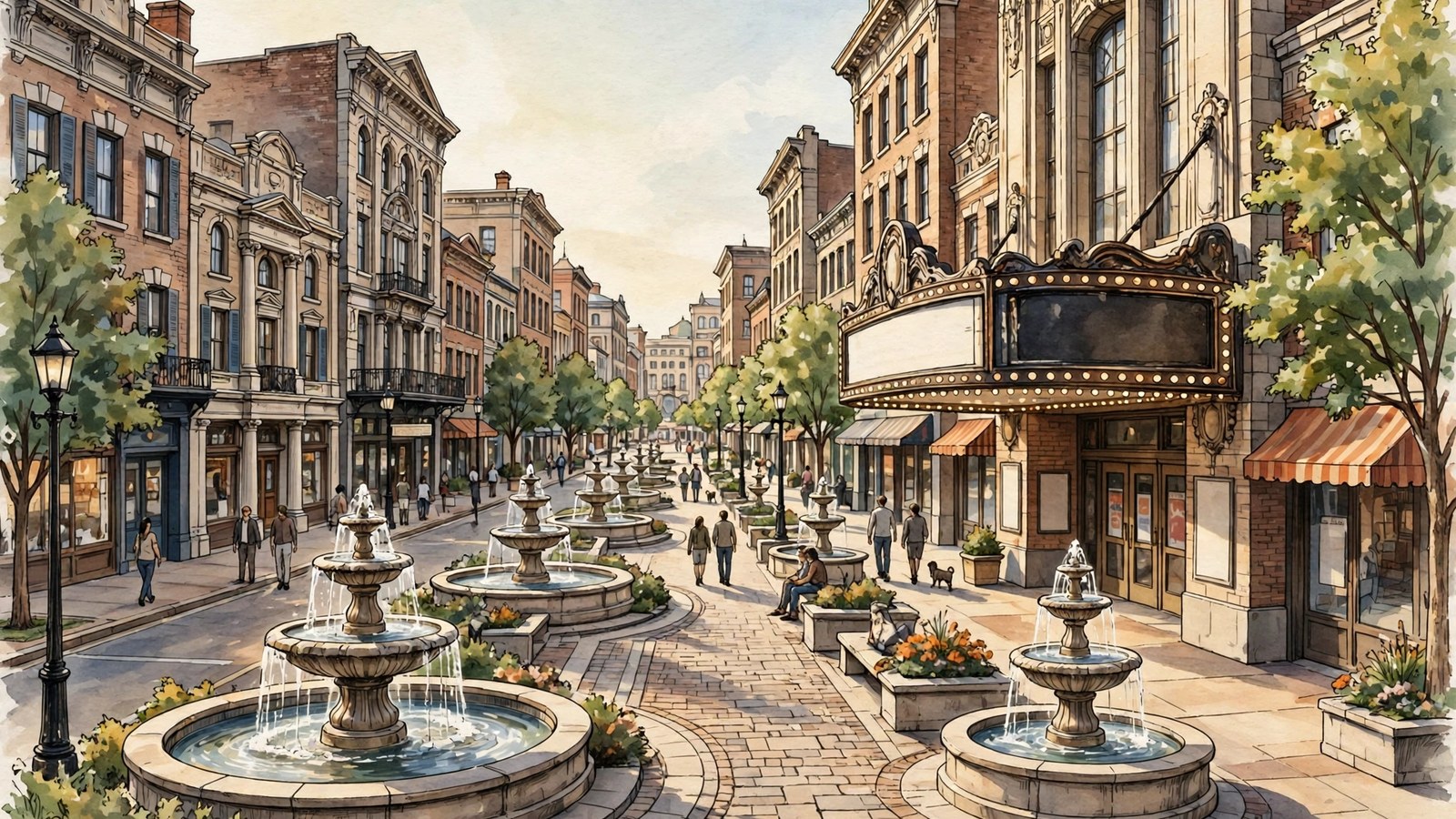
Kansas City’s identity as the City of Fountains is not a recent slogan. Visit KC records that the city’s first fountains date to the late 1800s and served a practical purpose, giving water to dogs, horses, and birds passing through the city, and that drinking fountains for residents followed in the downtown area. The City of Fountains Foundation was established in 1973 to build new fountains and to manage and maintain existing ones. Visit KC now counts more than 200 fountains across the metro, of which 48 are publicly owned. Fountain Day, when publicly operated fountains return to life, falls in early April each year, so a winter walker should expect some fountains to be dry and should check the seasonal status rather than assume every fountain is running.
Treat fountains, parks, and boulevards as historical evidence, not just decoration. A fountain in a public square tells you that a city valued shared beauty, invested in water and maintenance, and believed public space should delight as well as function. Boulevards tell a similar story. Wide, tree lined streets with medians and varied architecture were built to make movement through the city pleasant and to connect neighborhoods to parks and civic buildings. Notice trees, setbacks, and the mix of homes and businesses, and how such a street feels different from a purely commercial road. That difference was intentional.
Public art, monuments, and memorials deserve critical attention as well. A monument tells you what a past generation wanted to honor, and sometimes what it wanted to forget. Read plaques carefully, note dates and donors, and ask whose stories are represented and whose are missing. Parks and squares are also places to rest. Build one into your route about halfway through a cluster, and use it as generations before you did, for pause, conversation, and watching the city go by.
Cluster Four: Jazz, 18th and Vine, and African American History
No Kansas City history walk is complete without the Historic 18th and Vine Jazz District, the historic center of African American life, business, and music in the city. In an era of segregation, when Black Kansas Citians were excluded from many downtown establishments, 18th and Vine became a thriving community of its own, with businesses, theaters, clubs, churches, and social institutions, and jazz as its most famous expression. The district’s vibrancy is remarkable precisely because it flourished under those constraints, and understanding the constraints is essential to understanding the achievement. Do not let nostalgia erase that honesty.
Two museums share one address here, 1616 East 18th Street, and together they make the strongest interior anchor on this whole tour. The American Jazz Museum opened its doors on 5 September 1997. Its site also records the district’s older layers: the Gem Theater was built in 1912 as the Star Theater, a silent movie palace serving the city’s African American population, and was renamed the Gem in 1913. The Negro Leagues Baseball Museum was established in 1990, opened to the public in a one room office in 1991, and moved in November 1997 into its 10,000 square foot home in the same Museums at 18th and Vine complex. The league behind it began close by: Andrew Rube Foster established the Negro National League in 1920 at the Paseo YMCA, two blocks from the museums. In July 2006 the museum received national designation from Congress as America’s National Negro Leagues Baseball Museum.
Plan these museums as anchors and allow enough time to listen, read, and reflect rather than rushing through to check them off. Walking the district itself, look for the scale and character of its commercial buildings and theaters, and imagine the street at night in its heyday, clubs with live music and crowds on the sidewalks. Then make the tradition present tense: live music remains part of the district, and the American Jazz Museum presents performances through the year, including in the Blue Room, its club named for the famed 1930s Street Hotel club. Check the museums’ own sites for current hours, programs, and access before you go. As noted above, the jazz museum warned on its visit pages, as checked on 31 October 2026, that construction in the district may affect parking and street access.
Extension: Revival Downtown and the Country Club Plaza
End the downtown part of your walk by noticing the present as history in the making. Notice which buildings have been restored, which replaced, and which still await a new use, and who is downtown now compared with earlier eras.
The Power and Light District shows revival’s entertainment side: a concentrated district of dining and nightlife built to draw people downtown in the evening. City wayfinding material records that it is named for the Kansas City Power and Light Building, a landmark since 1931 and an example of Art Deco architecture, and that the district itself opened in 2008. Notice it as a planning choice: destinations shape who feels welcome and when. Adaptive reuse is the more encouraging story everywhere on this walk: warehouses becoming lofts, hotels regaining their lobbies, theaters reopening. When you see a reused building, ask what was kept, what was changed, and why.
Keep the Country Club Plaza for a separate half day rather than tacking it onto the downtown walk. It lies south of downtown and was built for a different way of arriving. The Plaza opened in 1923, planned by developer J. C. Nichols for his Country Club District and designed with the architecture of Seville, Spain, in mind, and it is widely described as the first shopping center designed to accommodate shoppers arriving by automobile, with parking tucked into garages rather than spread across lots. Read it as the counterpoint to downtown: the moment retail began planning around the car instead of the train and the streetcar. Its fountains and small parks also tie it back to the City Beautiful thread you walked downtown.
End any cluster where you can sit and reflect: a cafe, a park bench, or a hotel lobby. Write down three things you noticed, three questions you still have, and one place you want to revisit. That simple reflection turns a walk into learning and gives your next visit a starting point.
Guided Tours, Self Guided Tools, and Further Learning
Guided walking tours, where available, add value through storytelling and local knowledge. Check availability, duration, meeting points, and accessibility with the operator before booking, and choose a theme that matches your interests: general history, architecture, jazz, or food each tells a different version of the city’s story.
Self guided walkers can use maps, apps, and guidebooks, but the simplest tool is observation plus curiosity. Photograph plaques and details that intrigue you, and look them up later; delayed research often sticks better because you have already connected it to a place you stood in. Learn a few terms before you go, such as cornice, facade, and terracotta. Naming sharpens looking. For further learning, the Kansas City Public Library and its Missouri Valley Special Collections hold local history books and archival photographs. Comparing an old photograph of a street with its present appearance makes change visible in a single glance.
Practical Tips: Safety, Comfort, and Etiquette
Walk in daylight for your main tour, especially if you are unfamiliar with the city, and stay on main streets and public spaces. Use normal city awareness: keep valuables secure, watch traffic, and avoid isolated areas after dark if you are unsure. Keep children close near streets, and plan restroom stops in advance using museums, cafes, and public facilities.
Respect private property and residents. Many historic buildings are now homes or offices. Admire from the sidewalk, do not enter lobbies that are not public, and follow posted signs. Ask before photographing individuals.
Weather shapes the walk. Summer heat calls for early starts, water, shade, and indoor breaks. Winter cold calls for layers and shorter outdoor stretches with warm interiors between them. Spring and autumn generally offer the most comfortable walking. Check the forecast on the day, and be willing to shorten a cluster if weather turns.
Frequently Asked Questions
How long should a downtown Kansas City history walk take?
Allow two to four hours for the downtown core, the River Market, downtown streets, Union Station, and the Liberty Memorial grounds, with stops. Add separate time, and a ride between clusters, for 18th and Vine, the West Bottoms, or the Country Club Plaza. Shorten each cluster and add breaks if you walk with children, older adults, or anyone with limited mobility.
Is this really one walking route?
No, and any guide that presents it as one short route misleads you. The downtown core is walkable. The West Bottoms, 18th and Vine, and the Country Club Plaza are distinct areas in different directions from downtown, so link them by transit, rideshare, or car and walk within each cluster.
Do I need a guided tour, or can I walk on my own?
Both work. A guided tour adds stories and context, while a self guided walk offers flexibility and time to linger. Many visitors enjoy a guided tour first and a self guided revisit afterward. Check any tour’s meeting point, duration, and accessibility with the operator before booking.
What should I wear and bring?
Comfortable walking shoes, water, sun protection in warm weather, layers in cold weather, a phone for maps and photos, and a small notebook for questions and observations.
Are downtown Kansas City landmarks accessible?
Accessibility varies by building and street. Newer centers and renovated buildings tend to be more accessible, while some historic streets and older buildings have limits. The National WWI Museum and Memorial notes, for example, that its galleries are accessible to visitors with mobility limitations but that the Liberty Memorial Tower, opened in 1926, is not wheelchair accessible and requires an elevator ride plus 45 further steps. Check each specific site in advance if accessibility matters to your group.
What is the 18th and Vine district known for?
It is the historic center of African American life, business, and jazz in Kansas City, internationally recognized as one of the cradles of jazz. Today it holds the American Jazz Museum, opened in 1997, and the Negro Leagues Baseball Museum, both at 1616 East 18th Street. It is an essential cluster for understanding the city’s cultural history.
Can I visit museums as part of the walk?
Yes, and choosing one or two museum interiors as anchors is recommended. Check hours, admission, closures, and booking requirements on each museum’s official site before you go, because those details change and this guide states none of them.
Keep reading: Kansas City Shopping Districts Tour: Boutiques and Markets
Sources & references
- City of Kansas City, Missouri, official budget and council publications. Used for Kansas City being founded in 1838 as the Town of Kansas, incorporated as a town in 1850, and incorporated as the City of Kansas in 1853.
- Kansas City Public Library, KCQ: How did Kansas City come to be, and Hannibal Bridge materials from Missouri Valley Special Collections. Used for Kansas City winning approval to build the first bridge across the Missouri River, the Hannibal Bridge opening on 3 July 1869 as the first permanent rail crossing of the Missouri River, designed by Octave Chanute, and the bridge acting as the catalyst for the city's growth into a rail and commercial center.
- City Market, Kansas City, and Project for Public Spaces, City Market profile. Used for the City Market operating since 1857, the first market shed built on the site in 1857, and the market's place at the center of the River Market district.
- Visit KC, Arabia Steamboat Museum fact page. Used for the Arabia striking a submerged tree and sinking on 5 September 1856 with about 130 people aboard who reached shore and close to 200 tons of cargo, the river shifting to leave the wreck buried, and excavation beginning on 12 November 1988.
- Union Station Kansas City, Trains history page, with copy courtesy of Kansas City Public Library. Used for the old Union Depot in the West Bottoms, the 1903 flood, Jarvis Hunt as a supporter of the City Beautiful movement, the grand opening on 30 October 1914 as the third largest train station in the country, the ticket window opening at 11 p.m. that day and the first trains running at midnight on 31 October, decline from the 1950s, listing on the National Register of Historic Places in 1972, and the bi state sales tax approved in 1996 to fund restoration.
- National WWI Museum and Memorial, Story of the Museum and Memorial and Accessibility pages. Used for Kansas Citians raising $2.5 million in 10 days in 1919 to build the Liberty Memorial, the memorial being dedicated in 1926 by President Calvin Coolidge, the Liberty Memorial Tower completed in 1926 at 217 feet tall, the galleries being accessible to visitors with mobility limitations, and the tower requiring an elevator ride plus 45 further steps and not being wheelchair accessible.
- Visit KC, Fountains of Kansas City. Used for the first fountains dating to the late 1800s as water sources for dogs, horses, and birds, drinking fountains following in the downtown area, the City of Fountains Foundation being established in 1973, more than 200 fountains across the metro with 48 publicly owned, and Greater Kansas City Fountain Day falling in early April.
- American Jazz Museum, About, Visit, and Blue Room pages. Used for the museum opening on 5 September 1997, its location in the Historic 18th and Vine Jazz District at 1616 East 18th Street, the district being internationally recognized as one of the cradles of jazz and a historic hub of African American businesses, Charlie Parker as the most notable Kansas City musician there of the 1930s and 1940s, the Gem Theater being built in 1912 as the Star Theater and renamed the Gem in 1913, the Blue Room name coming from the 1930s Street Hotel club, and the visit page warning, as checked on 31 October 2026, that ongoing construction in the district may affect parking and street access.
- Visit KC, Negro Leagues Baseball Museum fact page. Used for the museum being established in 1990, opening to the public in a one room office in 1991, moving in November 1997 into a 10,000 square foot home in the Museums at 18th and Vine complex at 1616 East 18th Street, Andrew Rube Foster establishing the Negro National League in 1920 at the Paseo YMCA two blocks away, and national designation by Congress in July 2006 as America's National Negro Leagues Baseball Museum.
- City of Kansas City, Missouri, citywide wayfinding material. Used for the Power and Light District being named for the Kansas City Power and Light Building, a landmark since 1931 and an example of Art Deco architecture, and the district itself opening in 2008.
- Johnson County Library local history and Kansas City Public Library material on the Country Club Plaza. Used for the Country Club Plaza opening in 1923, developed by J. C. Nichols south of the downtown of its day, and being the first shopping center designed to cater to shoppers arriving by automobile. The Plaza's exact current tenant mix and hours are not stated in this article and should be checked on its official site.


