Short answer
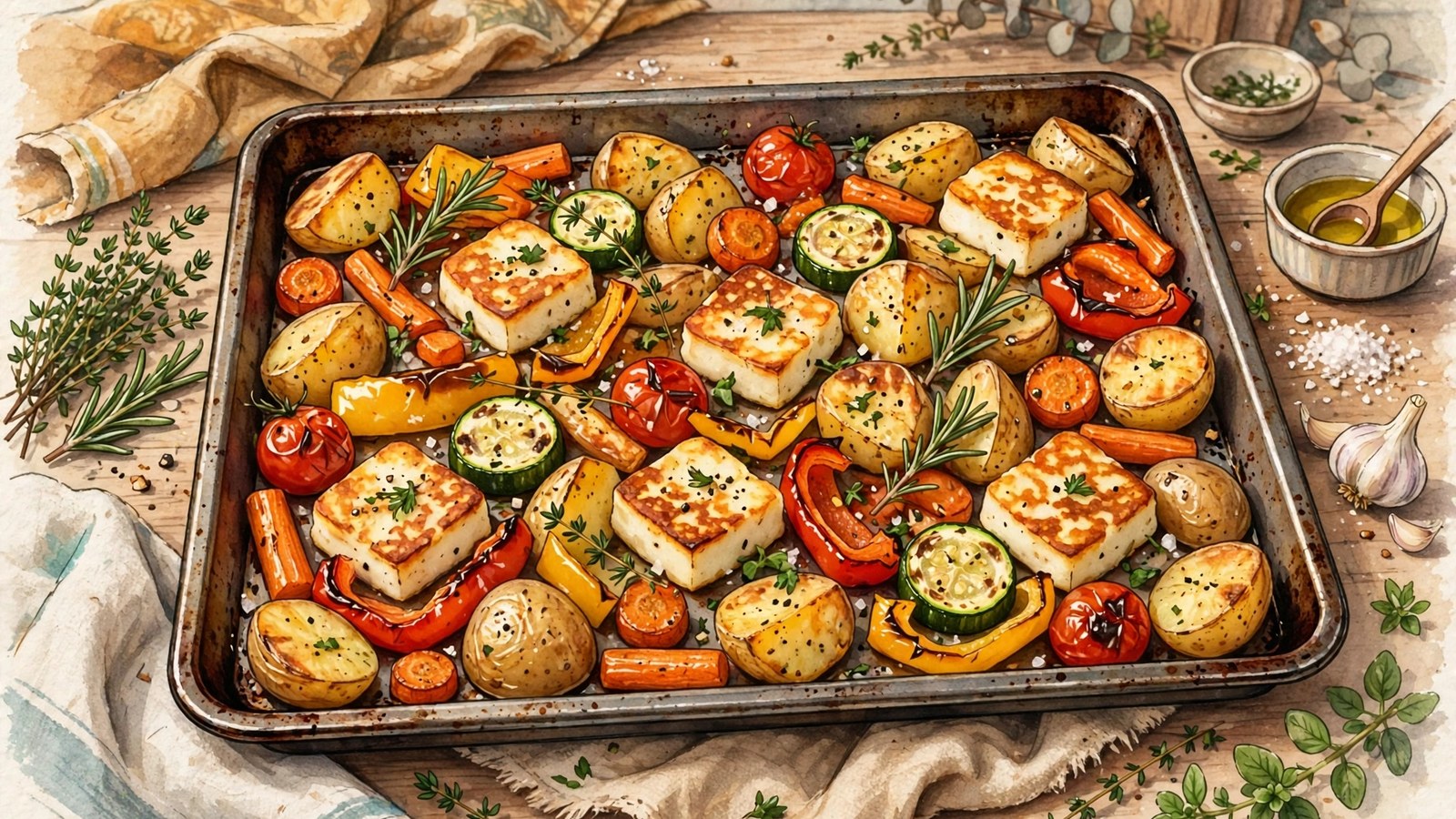
- Heat the oven to 425 degrees Fahrenheit and line a large rimmed sheet pan. Roast potatoes, carrots, and red onion in olive oil, smoked paprika, and cumin for 20 minutes. Add bell peppers and zucchini and roast for 12 minutes more. Add dried halloumi slices and cherry tomatoes and roast for 10 to 12 minutes, until the halloumi is golden and the tomatoes have softened. Drizzle with a lemon herb dressing and serve at once. Refrigerate leftovers within 2 hours, or within 1 hour above 90 degrees Fahrenheit, keep the refrigerator at 40 degrees Fahrenheit or below, use leftovers within 3 to 4 days, and reheat them to 165 degrees Fahrenheit. The dish contains milk, from the halloumi, so read the allergen note before serving guests.
Introduction
A good sheet pan dinner makes a simple promise: everything cooks on one pan, the oven does most of the work, and dinner arrives with crisp edges, tender centers, and very little washing up. This roasted vegetable and halloumi dinner keeps that promise in a way that feels complete on its own. Halloumi is a firm, salty cheese that holds its shape when heated instead of melting, so it roasts into golden pieces with a chewy bite. Around it, vegetables caramelize in olive oil, and a lemon herb dressing ties the pan together.
The method turns on one fact: not all vegetables cook at the same speed. Dense root vegetables need time and high heat. Softer vegetables need less time or they collapse. Halloumi needs only a short spell in the oven, long enough to turn golden without drying out. This recipe staggers the additions so potatoes and carrots get a head start, peppers and zucchini join in the middle, and halloumi and tomatoes go on near the end. Each ingredient is then cooked as it should be, instead of a compromise where some pieces are burned and others are still raw.
The recipe is also flexible. The vegetable mix can shift with the season, and the dish can be served on its own, over grains, or tucked into flatbreads. Food safety and allergen statements were checked against primary sources from the Food Safety and Inspection Service, FoodSafety.gov, the Food and Drug Administration, and the Centers for Disease Control and Prevention on 31 October 2026.
Why Halloumi Works on a Sheet Pan
Halloumi is unusual among cheeses because it stays firm at high heat. It is traditionally made from sheep milk, goat milk, or a mixture of the two, and some versions also use cow milk. It is heated during production, which gives it a firm, layered texture. Roasted, the outside browns while the inside softens but keeps its shape. That salty, savory flavor and chewy texture provide the richness that vegetables alone sometimes lack.
Three handling points decide how well it turns out. First, halloumi is salty, so season the vegetables lightly and taste the dressing before adding extra salt. Second, halloumi firms up quickly as it cools, so serve it hot from the oven. If it cools and turns rubbery, a brief return to a hot oven will soften it again. Third, halloumi releases a little liquid as it cooks, so give each piece space and avoid piling pieces on wet vegetables, where trapped steam prevents browning.
Some brands are saltier than others. If yours tastes very salty, soak the sliced halloumi in cold water for about 20 minutes, then pat it completely dry before cooking. Do not soak it for hours, which makes the texture waterlogged. The squeak some people notice in warm halloumi is normal and is not a sign that the cheese is undercooked or unsafe.
Choosing the Vegetables and the Density Rule
The mix below balances starchy, sweet, savory, and bright. Baby potatoes provide substance and crisp edges. Carrots add sweetness as they caramelize. Red onion turns soft and sweet. Bell peppers soften and char at the edges. Zucchini adds tenderness but releases water, so it goes in later and is cut thick. Cherry tomatoes, added near the end, burst into a light sauce.
Even sizing matters more than the exact mix. Cut dense vegetables into pieces no larger than about 1 inch, and cut softer vegetables slightly larger so they do not disappear. If you swap vegetables, follow the density rule. Roots and winter squash go in early. Peppers and onions go in the middle. Tomatoes, zucchini, and leafy additions go in late. Broccoli or cauliflower can replace the peppers at the middle stage, butternut squash can replace the potatoes with the same early start, and asparagus can replace the zucchini and be added with the halloumi.
Choose firm zucchini without soft spots, peppers with glossy, taut skin, and potatoes without sprouts or green patches. The green color itself is chlorophyll, but green areas can also carry higher levels of solanine, a bitter natural compound in potatoes. Cut a small green area away generously. Discard a potato that is widely green, heavily sprouted, soft, or bitter, and do not rely on cooking to fix it.
Dry the vegetables before tossing them in oil. FoodSafety.gov advises rinsing produce under running water without soap or produce washes, scrubbing firm produce with a clean brush, and drying it with a clean cloth or paper towel. Drying matters for roasting too: surface water creates steam, and steam prevents crisping.
Ingredients
This recipe makes about 4 servings. Have everything cut and measured before the pan goes into the oven, because each stage is timed.
For the sheet pan
- 1 pound baby potatoes, halved or quartered into even pieces
- 3 medium carrots, peeled and cut into 1 inch chunks
- 1 large red onion, cut into wedges
- 2 bell peppers, any color, seeded and cut into wide strips
- 1 medium zucchini, cut into thick half moons
- 8 ounces cherry tomatoes, halved
- 8 ounces halloumi, cut into 1/2 inch slices or cubes
- 4 tablespoons olive oil, divided
- 1 teaspoon smoked paprika
- 1 teaspoon ground cumin
- 3/4 teaspoon kosher salt, divided
- 1/2 teaspoon black pepper, divided
For the herb lemon dressing
- 3 tablespoons olive oil
- 2 tablespoons fresh lemon juice
- 1 tablespoon chopped fresh parsley
- 1 tablespoon chopped fresh mint or basil
- 1 clove garlic, finely minced
- 1 teaspoon honey, optional
- Salt and pepper to taste
To serve, optional
- Warm flatbreads or pita
- Cooked couscous, quinoa, or rice
- A handful of salad leaves
- Extra lemon wedges
- A dollop of plain yogurt
Even potato pieces matter more than perfect shapes, because pieces of the same size finish together. Halve the tomatoes just before they go on the pan, since cut tomatoes release juice as they sit. If you use the honey, read the infant note in the allergen section before serving anyone else.
Equipment and Pan Size
You need a large rimmed baking sheet, parchment paper, a knife, a cutting board, a large bowl for tossing, and a small bowl or jar for the dressing. Pan size is critical. Use the largest rimmed sheet you own, at least 18 by 13 inches, or divide the vegetables between two pans. A crowded pan steams instead of roasts, and extra oven time does not fix soggy vegetables. Parchment prevents sticking, and lightly oiling it helps the potatoes crisp on the underside.
Method: Step by Step
Step 1: Heat the oven and prepare the pan
Preheat the oven to 425 degrees Fahrenheit and line a large rimmed baking sheet with parchment paper, brushed lightly with olive oil. Position a rack in the center. High heat is essential for caramelization, so let the oven fully preheat. While it heats, prepare the vegetables so everything is ready at the right stage.
Step 2: Roast the dense vegetables first
Toss the potatoes, carrots, and red onion with 2 tablespoons of the olive oil, the smoked paprika, the cumin, 1/2 teaspoon of the salt, and 1/4 teaspoon of the pepper. Spread them in a single layer, cut sides down where possible, leaving space between pieces. Roast for 20 minutes. This head start lets the dense vegetables soften and crisp before softer vegetables join them. Adding everything at once is the most common cause of uneven results.
Step 3: Add the peppers and zucchini
Remove the pan and turn the potatoes and carrots. Toss the bell peppers and zucchini with 1 tablespoon of the olive oil and a pinch of salt and pepper, then spread them over the pan in a single layer. Return the pan to the oven and roast for 12 minutes. The peppers should soften and char at the edges, and the zucchini should be tender but not collapsed.
Step 4: Add the halloumi and tomatoes
Remove the pan again. Pat the halloumi very dry, brush it lightly with the remaining tablespoon of olive oil, and nestle the pieces among the vegetables with space around each one so they brown rather than steam. Scatter the tomato halves over the pan. Roast for 10 to 12 minutes, until the halloumi is golden and the tomatoes have softened and begun to burst. You can flip the halloumi halfway through this stage if only the underside is browning.
Step 5: Make the dressing and finish
While the final stage roasts, whisk or shake together the dressing ingredients. Taste before adding much salt, because halloumi is salty. Drizzle the dressing over the hot vegetables and halloumi. Serve immediately, while the halloumi is still soft, directly from the pan or spooned onto plates.
Timing at a Glance
Total time is about 55 to 60 minutes, with roughly 15 minutes of active preparation. The dense vegetables roast alone for 20 minutes, the peppers and zucchini join for 12 minutes, and the halloumi and tomatoes finish in 10 to 12 minutes. These times are recipe guidance. They assume even cuts and a fully preheated oven, and home ovens vary. If potato pieces are larger, add about 5 minutes to the first stage. Judge by appearance too: potatoes tender when pierced and halloumi visibly golden.
Variations That Keep the Method Intact
Vary the dish freely, as long as the staging stays the same: dense vegetables first, softer vegetables in the middle, halloumi last. For a Mediterranean version, add pitted Kalamata olives and dried oregano with the peppers, and finish with crumbled feta alongside the halloumi. For a warm spiced version, increase the cumin, add a pinch of cinnamon to the first stage vegetables, and serve with a yogurt sauce. For a spicy version, add red pepper flakes and a sliced fresh chile with the peppers. For an autumn version, replace the zucchini with butternut squash cubes at the first stage and finish with chopped sage instead of mint.
The dressing can change too. A balsamic drizzle gives a sweeter finish, a tahini and lemon sauce makes the dish creamier, and a pesto drizzle works well in summer. Keep the dressing light, because the roasted vegetables already carry plenty of flavor. For a vegan table, do not simply remove the halloumi, since the cheese is central. Serve the same vegetables with crispy roasted chickpeas or marinated tofu instead.
Serving Ideas
Served straight from the pan with crusty bread, this is a casual, rustic dinner. Spooned over grains, it becomes a hearty bowl. Tucked into flatbreads with salad and yogurt, it becomes handheld food that suits a gathering. A simple green salad adds freshness and contrast. For a larger group, make two pans with different vegetable mixes and let guests serve themselves. Halloumi is at its best within about 15 minutes of coming out of the oven, so time the rest of the meal around this dish.
Storage, Reheating, and Food Safety
This dish is best eaten fresh, but leftovers keep safely if handled promptly. FoodSafety.gov organizes home food safety into four steps: clean, separate, cook, and chill. The chill step governs leftovers. Refrigerate perishable food within 2 hours of cooking, or within 1 hour above 90 degrees Fahrenheit. Bacteria that cause food poisoning multiply quickest between 40 and 140 degrees Fahrenheit, so do not leave the dish sitting out for a long buffet session. If food has sat out longer than those limits, throw it away.
Keep the refrigerator at 40 degrees Fahrenheit or below and the freezer at 0 degrees Fahrenheit or below. Cool leftovers rapidly in shallow, covered containers. The Food Safety and Inspection Service states that leftovers keep for 3 to 4 days in the refrigerator or 3 to 4 months frozen, although frozen leftovers lose moisture and flavor over time.
Reheat leftovers to 165 degrees Fahrenheit throughout, measured with a food thermometer. A hot oven at 400 degrees Fahrenheit for about 10 minutes restores some crispness, while the microwave softens the vegetables. Halloumi firms up in the refrigerator and softens again on reheating, but never quite to its fresh texture. Thaw frozen leftovers in the refrigerator, in cold water in a leak proof bag, or in the microwave, never on the counter.
Allergen and Dietary Notes
This section is factual information for planning and serving, not medical advice. The dish contains milk, in the form of halloumi, and is not suitable for people with a milk allergy or for vegans. Milk is one of the nine major food allergens in the United States. The Food and Drug Administration lists those nine as milk, egg, fish, crustacean shellfish, tree nuts, wheat, peanuts, soybeans, and sesame. Sesame became the ninth under the Food Allergy Safety, Treatment, Education, and Research Act, with labeling required from 1 January 2023.
Check labels each time you buy an ingredient or a side. The Food and Drug Administration notes that recipes can change and advises reading the entire ingredient list every time. Some halloumi brands are made in facilities that handle other allergens, so check the label if cross contact is a concern. For a guest with a milk allergy, do not simply leave the halloumi off a serving from the same pan. Cook a separate protein, such as chickpeas or tofu, on a clean pan with clean utensils.
The dish itself is naturally gluten free as written, but the sides decide the meal. Couscous contains wheat, and flatbreads commonly contain wheat and sometimes milk. For a gluten free meal, serve it with checked rice or quinoa.
Honey, if used, is not suitable for vegans and can simply be omitted. It must not be given to a child younger than 12 months. The Centers for Disease Control and Prevention states that honey given to children younger than 12 months may cause a severe food poisoning called botulism, and advises not adding honey to a baby food, water, formula, or pacifier. Halloumi is also salty, so keep portions for young children modest and cut pieces small.
Troubleshooting
Soggy vegetables usually mean the pan was overcrowded, the pieces were wet, or the oven was not hot enough. Use two pans, dry the vegetables thoroughly, and verify the oven temperature. Hard potatoes were cut too large or did not get a long enough head start. Cut them smaller and extend the first stage by 5 to 10 minutes. Mushy zucchini was cut too thin or added too early. Cut it thick and add it at the middle stage only.
Halloumi that did not brown was probably wet, crowded, or sitting on wet vegetables. Pat it very dry, give each piece space, and let it touch the hot pan. Rubbery halloumi cooled too much before serving. Serve immediately, or return it briefly to a hot oven. A dish that tastes too salty usually means a very salty brand. Soak the halloumi briefly next time and season more lightly.
Watery tomatoes were very ripe or added too early. Use firmer cherry tomatoes, halve them just before adding, and keep them to the final stage. If the pan floods, drain a little liquid before dressing.
Frequently Asked Questions
Can I use frozen vegetables?
Fresh vegetables give the best texture, but frozen vegetables can work if thawed and patted very dry first. They release a lot of water, so roast them in a single layer with extra space and expect a softer result. Frozen peppers and zucchini are the riskiest swap.
Do I need to soak halloumi?
Not necessarily. Soaking draws out some salt and suits people who find halloumi very salty. If you do soak, limit it to about 20 minutes in cold water, then pat the slices completely dry before oiling them, because wet halloumi steams instead of browning.
Can I prepare the vegetables ahead?
Yes. Cut the potatoes, carrots, onion, peppers, and zucchini up to a day ahead and store them separately in covered containers in the refrigerator. Do not cut the tomatoes until shortly before cooking. The dressing can be made a day ahead and refrigerated. Shake or whisk it again before serving.
Can I double the recipe?
Yes, but use two pans and rotate them halfway through cooking. Do not double the recipe onto one pan, because crowding steams the vegetables. Check each pan separately, since oven hot spots can make one pan finish first.
What can I use if I cannot find halloumi?
Look for a firm grilling cheese or bread cheese, which behaves similarly, though flavor and saltiness differ. Feta is not a substitute on the pan, because it softens and crumbles rather than holding slices. Paneer can be roasted, but it is milder and less salty, so season it more generously.
How long do leftovers keep, and how should I reheat them?
Refrigerate leftovers promptly in shallow covered containers, within 2 hours, or within 1 hour above 90 degrees Fahrenheit. Keep the refrigerator at 40 degrees Fahrenheit or below and use leftovers within 3 to 4 days, or freeze them for 3 to 4 months. Reheat to 165 degrees Fahrenheit throughout, measured with a food thermometer.
Sources & references
- United States Department of Agriculture, Food Safety and Inspection Service, Leftovers and Food Safety. Used for growth between 40 and 140 degrees Fahrenheit, refrigerating within 2 hours or 1 hour above 90 degrees Fahrenheit, shallow containers, storage for 3 to 4 days refrigerated or 3 to 4 months frozen, safe thawing, and reheating to 165 degrees Fahrenheit. Page last updated 31 July 2020 in the copy opened.
- FoodSafety.gov, 4 Steps to Food Safety. Used for clean, separate, cook, and chill, hand washing for at least 20 seconds, rinsing and drying produce, refrigerator and freezer temperatures, and the refrigeration limits. Page updated 18 September 2023 in the copy opened.
- Food and Drug Administration, Have Food Allergies? Read the Label. Used for the nine major food allergens, sesame becoming the ninth allergen with labeling from 1 January 2023, and reading the entire ingredient list every time.
- Centers for Disease Control and Prevention, Foods and Drinks to Avoid or Limit. Used for honey before 12 months possibly causing botulism and for not adding honey to a baby food, water, formula, or pacifier.


