Short answer
- There are 16 US tablespoons in 1 US cup. The same US cup also holds 48 US teaspoons and 8 US fluid ounces, so the four measures fit together as one set: 1 cup, 8 fluid ounces, 16 tablespoons, 48 teaspoons. Half a US cup is 8 tablespoons, a quarter cup is 4 tablespoons, and three quarters of a cup is 12 tablespoons. To convert cups to tablespoons, multiply by 16. To convert tablespoons back to cups, divide by 16, so 2 tablespoons equal 0.125 cups, which is one eighth of a cup. That answer belongs to the US customary system. A US cup is 236.588 milliliters, usually rounded to 237 milliliters, and a US tablespoon is half a US fluid ounce, which is 14.7868 milliliters. A metric cup is larger, at 250 milliliters, and a metric tablespoon is 15 milliliters, so a metric cup holds 16 metric tablespoons plus 2 teaspoons rather than a neat 16 tablespoons. An Australian tablespoon is larger still, at 20 milliliters, so a 250 milliliter Australian cup holds only 12.5 Australian tablespoons. The sections below show the full tables, the reverse conversions, and worked examples, and explain how to tell which system a recipe uses.
By Emma Hudson
If a recipe calls for a cup of something and your cup measure is missing, in the wash, or the wrong size for the recipe in front of you, tablespoons are the usual fallback. The conversion is simple in the US system, but it changes when the recipe comes from a country that uses a different cup or a different tablespoon. This guide gives the US answer first, shows the arithmetic behind it, and then explains the metric, imperial, and Australian cases where the familiar number no longer applies.
Why One US Cup Equals 16 Tablespoons
The US result follows from two exact relationships in the US customary system. One US cup equals 8 US fluid ounces. One US tablespoon equals half a US fluid ounce. Divide the cup by the tablespoon and the fluid ounces cancel out: 8 divided by 0.5 equals 16. That is the whole derivation, and it is why the number is exact rather than approximate. There is no rounding hidden in it, as long as both measures come from the same US system.
The teaspoon count follows the same way. One US tablespoon equals 3 US teaspoons, so 16 tablespoons times 3 equals 48 teaspoons in one US cup. Working from the other end, one US teaspoon is one sixth of a US fluid ounce, and 48 times one sixth equals 8 fluid ounces, which brings the chain back to the cup. Every step checks against every other step. If a chart ever tells you a cup holds 15 tablespoons or 50 teaspoons, it is mixing systems or simply wrong for US measures.
The metric equivalents confirm the same result. A US fluid ounce is 29.5735 milliliters, so eight fluid ounces give 236.588 milliliters for the cup, and half a fluid ounce gives 14.7868 milliliters for the tablespoon. Dividing 236.588 by 14.7868 gives 16, exactly as the fluid ounce arithmetic does.
These are volume relationships, not weight relationships. A tablespoon measures how much space an ingredient occupies, not how heavy it is. Sixteen tablespoons of water and sixteen tablespoons of flour fill the same volume, but they do not weigh the same, because flour is much less dense than water. That distinction matters when a recipe gives weights, and a later section returns to it. For cup to tablespoon work, the volume rule is all you need, provided you stay inside one measuring system from start to finish.
Cups to Tablespoons: The Full US Table
Use this table for US recipes. Every row is the cup amount multiplied by 16 for tablespoons, by 48 for teaspoons, and by 8 for fluid ounces. The milliliter column uses the exact US cup of 236.588 milliliters, rounded to two decimal places.
| US cups | Tablespoons | Teaspoons | US fluid ounces | Milliliters |
|---|---|---|---|---|
| 1/8 cup | 2 tbsp | 6 tsp | 1 fl oz | 29.57 mL |
| 1/4 cup | 4 tbsp | 12 tsp | 2 fl oz | 59.15 mL |
| 1/3 cup | 5 tbsp plus 1 tsp | 16 tsp | 2.67 fl oz | 78.86 mL |
| 3/8 cup | 6 tbsp | 18 tsp | 3 fl oz | 88.72 mL |
| 1/2 cup | 8 tbsp | 24 tsp | 4 fl oz | 118.29 mL |
| 5/8 cup | 10 tbsp | 30 tsp | 5 fl oz | 147.87 mL |
| 2/3 cup | 10 tbsp plus 2 tsp | 32 tsp | 5.33 fl oz | 157.73 mL |
| 3/4 cup | 12 tbsp | 36 tsp | 6 fl oz | 177.44 mL |
| 7/8 cup | 14 tbsp | 42 tsp | 7 fl oz | 207.01 mL |
| 1 cup | 16 tbsp | 48 tsp | 8 fl oz | 236.59 mL |
| 1 1/2 cups | 24 tbsp | 72 tsp | 12 fl oz | 354.88 mL |
| 2 cups | 32 tbsp | 96 tsp | 16 fl oz | 473.18 mL |
| 3 cups | 48 tbsp | 144 tsp | 24 fl oz | 709.76 mL |
| 4 cups | 64 tbsp | 192 tsp | 32 fl oz | 946.35 mL |
Most rows are whole numbers, because the common cup fractions divide 16 cleanly: half of 16 is 8, a quarter of 16 is 4, and an eighth of 16 is 2. Thirds are the exception, and they are where people most often go wrong. One third of a cup is 16 divided by 3, which is 5.333 tablespoons. Measured in spoons, that is 5 tablespoons plus 1 teaspoon, because 5 tablespoons equal 15 teaspoons and one more teaspoon makes 16 teaspoons, which is exactly one third of the 48 teaspoons in a cup. Two thirds of a cup is 10 tablespoons plus 2 teaspoons, by the same logic: 10 tablespoons equal 30 teaspoons, plus 2 more makes 32 teaspoons, exactly two thirds of 48. If you round a third of a cup to the nearest whole tablespoon, you will be one teaspoon out. In a soup that rarely matters. In baking, where a teaspoon of liquid more or less can change a batter, it is worth measuring the extra teaspoon.
The larger rows are worth memorizing for batch cooking. Two cups make a US pint, so a pint is 32 tablespoons. Four cups make a US quart, so a quart is 64 tablespoons, and four cups also equal 946.35 milliliters, a little under one liter. Sixteen cups make a US gallon, which is 256 tablespoons.
Tablespoons to Cups: The Reverse Conversion
The reverse question comes up when a recipe gives a spoon amount and you want to know whether a cup measure would be easier, or when you are scaling a small amount up. The rule is the mirror image of the first one: tablespoons divided by 16 equals US cups, and US cups multiplied by 16 equals tablespoons.
| Tablespoons | US cups | Decimal cups | US fluid ounces |
|---|---|---|---|
| 1 tbsp | 1/16 cup | 0.0625 cups | 0.5 fl oz |
| 2 tbsp | 1/8 cup | 0.125 cups | 1 fl oz |
| 3 tbsp | 3/16 cup | 0.1875 cups | 1.5 fl oz |
| 4 tbsp | 1/4 cup | 0.25 cups | 2 fl oz |
| 5 tbsp | 5/16 cup | 0.3125 cups | 2.5 fl oz |
| 6 tbsp | 3/8 cup | 0.375 cups | 3 fl oz |
| 7 tbsp | 7/16 cup | 0.4375 cups | 3.5 fl oz |
| 8 tbsp | 1/2 cup | 0.5 cups | 4 fl oz |
| 9 tbsp | 9/16 cup | 0.5625 cups | 4.5 fl oz |
| 10 tbsp | 5/8 cup | 0.625 cups | 5 fl oz |
| 12 tbsp | 3/4 cup | 0.75 cups | 6 fl oz |
| 14 tbsp | 7/8 cup | 0.875 cups | 7 fl oz |
| 16 tbsp | 1 cup | 1 cup | 8 fl oz |
| 20 tbsp | 1 1/4 cups | 1.25 cups | 10 fl oz |
| 24 tbsp | 1 1/2 cups | 1.5 cups | 12 fl oz |
| 32 tbsp | 2 cups | 2 cups | 16 fl oz |
A few of these answers appear constantly in real recipes. How many cups is 2 tbsp? Two divided by 16 is 0.125, so 2 tablespoons make one eighth of a US cup, which is also 1 fluid ounce. Four tablespoons make a quarter cup, a handy fact because many measuring cup sets mark the quarter cup line clearly while small spoon amounts are fiddly to count. Eight tablespoons make half a cup. Twelve tablespoons make three quarters of a cup, which is the amount in many sauce and dressing recipes.
The formula also tells you when a conversion is not tidy, and that is useful information in itself. A recipe calling for 6 tablespoons of oil converts to 0.375 cups, or three eighths of a cup. There is no standard three eighths cup measure in most sets, so measuring 6 level tablespoons is the easier and more accurate route. The practical rule is this: convert to cups when the result lands on a quarter, a third, a half, or a whole cup, and stay with spoons when it does not.
Half a Cup, a Quarter Cup, and Other Everyday Amounts
Most kitchen questions are not about a full cup at all. They are about a fraction of one, usually because a recipe is being halved. Each one gets a direct answer here.
How many tbsp in 1/2 cup? Eight tablespoons, because half of 16 is 8. Half a US cup is also 4 fluid ounces, 24 teaspoons, and 118.29 milliliters. It is the amount that appears when a one cup sauce, dressing, or batter is halved.
How many tablespoons is 1/4 cup? Four tablespoons, because a quarter of 16 is 4. The same question is phrased several ways, as 1/4th cup in tablespoons, or as 1/4 cup is how many tablespoons, and the answer never changes with the wording: 4 tablespoons, which is also 12 teaspoons, 2 fluid ounces, and 59.15 milliliters. A quarter cup of butter, to take a common case, is half of a standard US butter stick, and it is also 4 tablespoons, which is why butter wrappers are often printed with tablespoon marks.
Three quarters of a cup is 12 tablespoons, worked out as three times the quarter cup amount of 4. One eighth of a cup is 2 tablespoons, a surprisingly common amount for vinaigrettes and marinades, where 2 tablespoons of oil or vinegar is a typical single component. If a recipe doubles a one eighth cup ingredient, the result is a quarter cup, or 4 tablespoons, and either measure works.
Odd amounts combine these building blocks. Five eighths of a cup is a half cup plus an eighth, so 8 plus 2 equals 10 tablespoons. Seven eighths of a cup is a full cup minus an eighth, so 16 minus 2 equals 14 tablespoons. Building awkward fractions from halves, quarters, and eighths you already know is faster than reaching for a phone with floury hands.
Worked Examples: Scaling and Substituting
Worked examples show the conversions doing real work, using only the multiply or divide by 16 rule, plus the teaspoon rule for thirds.
Example one: halving a recipe. A pancake batter calls for 1 1/2 cups of milk, and you are making half the batch. Half of 1 1/2 cups is 3/4 cup. Three quarters of a cup is 12 tablespoons, or 6 fluid ounces. If your measuring cup is a full cup size only, measuring 12 level tablespoons or filling a liquid measure to the 6 fluid ounce line both give the right amount.
Example two: doubling a small amount. A dressing calls for 3 tablespoons of lemon juice, and you are doubling it for a crowd. Six tablespoons is 0.375 cups, which is three eighths of a cup. Since that is not a marked cup size, the cleanest measure is 6 tablespoons again, or 3 fluid ounces on a liquid measure, because each tablespoon is half a fluid ounce and 6 times 0.5 is 3.
Example three: replacing a missing cup measure. A soup recipe needs 2 1/2 cups of stock and only spoons are clean. Two cups are 32 tablespoons and the extra half cup is 8 tablespoons, so the total is 40 tablespoons, or 20 fluid ounces. At that volume, a liquid measuring jug marked in fluid ounces or milliliters is far more practical: 20 US fluid ounces is 591.47 milliliters, worked out as 20 times 29.5735. The conversion still matters, because it tells you which jug size you need.
Example four: converting a metric amount into US spoons. A recipe gives 100 milliliters of cream. Dividing by the US tablespoon of 14.7868 milliliters gives about 6.76 tablespoons, best measured as 6 tablespoons plus 2 teaspoons, since 6 tablespoons are 88.72 milliliters and 2 teaspoons add 9.86 milliliters, for a total of 98.58 milliliters, within a teaspoon of the target. For a sauce that is close enough. For anything more exact, measure 100 milliliters directly on a jug or scale, because spoon conversions of round metric amounts rarely land on whole spoons.
US, Metric, Imperial, and Australian Measures
The number 16 belongs to the US customary cup. Other systems define the cup and the tablespoon differently, and the spoon count per cup changes with them. Mixing systems without noticing is one of the most common causes of a recipe that looks right but turns out wrong.
The metric cup, used in Australia, New Zealand, Canada, and many other places, is 250 milliliters. The metric tablespoon is 15 milliliters. Dividing 250 by 15 gives 16.667, so a metric cup holds 16 metric tablespoons plus 2 teaspoons, because the leftover 10 milliliters is exactly 2 metric teaspoons of 5 milliliters each. If you apply the US rule of 16 tablespoons to a metric cup using metric spoons, you measure 240 milliliters instead of 250, which is 10 milliliters short, an error of 4 percent. That is small for one cup of stock. Across four cups in a large bake, it becomes 40 milliliters, and in a recipe where the liquid ratio matters, it can change the result.
The difference between the cups themselves is also worth knowing directly. A metric cup of 250 milliliters minus a US cup of 236.588 milliliters is 13.412 milliliters, a little under one US tablespoon. So a recipe written for metric cups and made with a US cup runs short by roughly one tablespoon per cup. Each US tablespoon is also slightly smaller than a metric one: 15 minus 14.7868 is 0.2132 milliliters, a difference of about 1.4 percent per spoon. That spoon difference alone rarely matters in everyday cooking. The cup difference, and the Australian tablespoon below, are the ones that do.
Australia is the outlier on spoons. The Australian tablespoon is 20 milliliters, defined as 4 teaspoons of 5 milliliters. A 250 milliliter Australian cup divided by 20 gives 12.5 Australian tablespoons per cup. An Australian tablespoon is one third larger than a US tablespoon, so 3 Australian tablespoons of cocoa or oil contain 60 milliliters, while 3 US tablespoons contain 44.36 milliliters. That gap is large enough to taste, so convert Australian tablespoons through milliliters, not spoon for spoon.
The United Kingdom needs care of a different kind. Modern UK recipes usually give volumes in milliliters and weights in grams, and there is no single official UK cup in current everyday use. Older UK recipes used imperial measures: an imperial fluid ounce is 28.4131 milliliters, and an imperial cup in older books was commonly 10 imperial fluid ounces, which is 284.13 milliliters, larger than both the US and metric cups. Because old imperial spoon sizes also varied, convert older UK recipes through milliliters rather than guessing a spoon count. If a modern UK recipe does use cups, it almost always means the 250 milliliter metric cup with 15 milliliter tablespoons.
US nutrition labeling adds one more set of numbers. For labeling purposes under US federal food labeling rules, a cup is treated as 240 milliliters, a tablespoon as 15 milliliters, a teaspoon as 5 milliliters, and a fluid ounce as 30 milliliters. Those are rounded labeling values, not the customary definitions used by measuring cups. They explain why a label and a measuring cup can disagree slightly: a label cup of 240 milliliters divided by a label tablespoon of 15 milliliters still gives 16, so label servings convert neatly among themselves, but a label cup holds about 3.4 milliliters more than a customary cup. For following a recipe, use the customary values in this article. For reading a label, use the label values.
The safest habit covers every case: use the cups and spoons that match the recipe country of origin, check whether the recipe also gives milliliters, and if you must mix systems, convert through milliliters. Milliliters mean the same thing in every system, which is why they settle arguments that spoon counts cannot.
Volume Is Not Weight
Sixteen tablespoons equal one cup as a volume, for every ingredient, in the US system. The weight of that cup is a different question, and it depends on the ingredient. A US cup of water has a volume of 236.588 milliliters, and water is close to one gram per milliliter, so that cup of water weighs about 237 grams, which is about 8.35 ounces by weight. Notice that even water does not weigh exactly 8 ounces: the 8 in the cup definition is fluid ounces, a volume, and a fluid ounce of water weighs a little more than one ounce of weight.
Flour shows the gap clearly. A cup of flour fills the same 8 fluid ounces of space as a cup of water, but flour is mostly air between fine particles, so it weighs far less than the water does. The exact weight depends on the flour type and on how it was spooned or scooped, which is why serious baking recipes give flour in grams. Sugar, rice, oats, and chopped nuts each have their own weight per cup. There is no single cups to grams number, and any chart that offers one without naming the ingredient is misleading.
The practical consequences are threefold. First, keep the words separate: fluid ounces are volume, ounces alone are weight. Second, never convert a spoon count to a weight with the fluid ounce figure; 16 tablespoons of honey and 16 tablespoons of flour are both one cup by volume, and their weights are nowhere near each other. Third, when a recipe gives both a volume and a weight and the two seem to disagree, trust the weight for dry ingredients and the volume for liquids.
How to Measure Accurately With Tablespoons
Spoon counts are only as good as the measuring. A level US tablespoon is the standard: the ingredient fills the spoon and is scraped flat, level with the rim. A heaped tablespoon can hold half as much again for a dry ingredient, and a scant tablespoon holds less, so recipes that mean level spoons will drift if every spoonful is mounded.
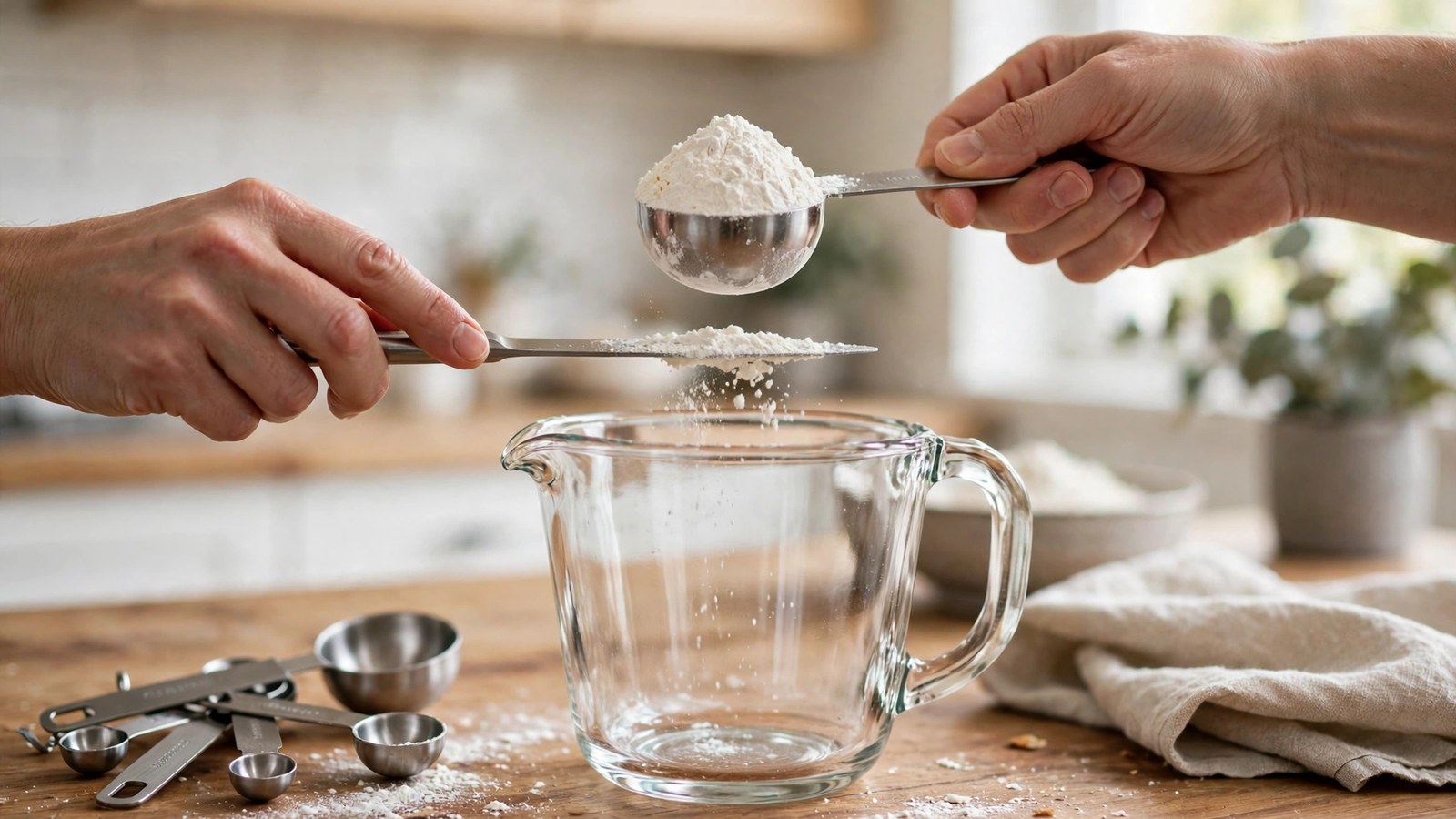
For dry ingredients such as flour, cocoa, or cornstarch, spoon the ingredient lightly into the tablespoon and level it off with the straight edge of a knife. Scooping the spoon directly through the bag compacts the ingredient and can add a surprising amount. For sticky ingredients such as honey, syrup, or peanut butter, a lightly oiled spoon helps the ingredient release cleanly instead of leaving a portion behind. For liquids, fill the spoon to the brim without spilling, over a small bowl rather than over the mixing bowl, so a shaky hand adds the excess to the bowl you can discard from, not to the recipe.
Counting matters too. Sixteen tablespoons is a lot of spoonfuls, and losing count halfway is easy. Count in groups that match the table: four sets of 4 tablespoons make a cup, and each set of 4 is also a quarter cup, so you can pause and check at each quarter. Better still, use tablespoons for what they do best, small amounts and fractions, and use a cup or a jug for full cups, reserving spoon counting for the remainder. If a recipe needs 1 3/4 cups, measure the cup and the half cup with cups and the final quarter cup as 4 tablespoons, rather than counting 28 spoonfuls.
Finally, use real measuring spoons. A tablespoon from a cutlery set, the kind used for eating soup or serving vegetables, is not a standard measure, and cutlery tablespoons vary widely in capacity. Only a spoon from a measuring set, or one marked with its capacity, can be trusted to hold half a US fluid ounce.
Common Mistakes
The first mistake is mixing weight and volume, covered above: reading 8 fluid ounces as 8 ounces by weight for every ingredient. It works approximately for water and milk and fails for almost everything else, worst of all for flour and other dry goods.
The second mistake is applying the US count to a metric or Australian recipe without converting. Sixteen Australian tablespoons hold 320 milliliters, which overshoots even a metric cup by 70 milliliters. Sixteen US tablespoons in a recipe written for metric cups leaves you 10 milliliters short per cup once the spoons are metric, and more if both the cup and the spoons are US. Checking the recipe origin takes seconds and prevents the whole class of error.
The third mistake is rounding thirds. Five tablespoons is not a third of a cup; it is one teaspoon short. The missing teaspoon is small, but the same habit applied to a strong flavoring, or multiplied across a doubled recipe, stops being trivial. Measure the extra teaspoon.
The fourth mistake is trusting a drinking cup, a mug, or a cutlery spoon as a measure. Kitchen containers are made to look pleasing, not to hold standard volumes. If no measuring set is available, a liquid jug marked in milliliters is the most reliable substitute, because milliliters do not change between systems.
The fifth mistake is mixing label values with recipe values. A nutrition label cup of 240 milliliters and a recipe cup of 236.588 milliliters are close, but using label tablespoons of 15 milliliters with customary cups in the same calculation quietly blends two systems. Pick one system per calculation and finish in it.
Frequently Asked Questions
How many tablespoons are in 1 cup?
Sixteen US tablespoons in 1 US cup, which is also 48 US teaspoons and 8 US fluid ounces. In metric measures, a 250 milliliter cup holds 16 tablespoons of 15 milliliters plus 2 teaspoons, because 250 divided by 15 is 16.667 rather than a whole number.
How many tbsp is 1/2 cup?
Eight tablespoons. That is half of 16, and it equals 4 US fluid ounces, 24 teaspoons, or 118.29 milliliters.
How many tablespoons is 1/4 cup?
Four tablespoons. A quarter of 16 is 4, and the same amount is 12 teaspoons, 2 US fluid ounces, or 59.15 milliliters. The question is also asked as 1/4th cup in tablespoons, and the answer is identical.
How many cups is 2 tbsp?
One eighth of a US cup, or 0.125 cups, because 2 divided by 16 is 0.125. Two tablespoons also equal 1 US fluid ounce and 6 teaspoons.
How many tablespoons are in 3/4 cup?
Twelve tablespoons. Three quarters of 16 is 12, and the amount equals 6 US fluid ounces or 36 teaspoons.
How many tablespoons are in 1/3 cup?
Five tablespoons plus 1 teaspoon. A third of 16 tablespoons is 5.333, and the third of a tablespoon is exactly 1 teaspoon, since a tablespoon holds 3 teaspoons. In teaspoons alone, a third of a cup is 16 teaspoons.
Is a tablespoon the same everywhere?
No. A US tablespoon is 14.7868 milliliters, a metric tablespoon is 15 milliliters, and an Australian tablespoon is 20 milliliters. The US and metric spoons differ by about 1.4 percent, which rarely matters, but the Australian spoon is one third larger than the US spoon, which does matter. Use the spoon that matches the recipe system.
Does 16 tablespoons always equal a cup?
As a US volume conversion, yes: any ingredient measured in level US tablespoons fills a US cup at 16 spoonfuls. It does not hold across systems. Sixteen metric tablespoons make 240 milliliters, not a 250 milliliter metric cup, and 16 Australian tablespoons make 320 milliliters. The weight of a cup also varies by ingredient, because density varies, even though the volume does not.
What is the easiest way to measure a cup with only spoons?
Count in quarters. Four tablespoons make a quarter cup, so measure four groups of 4 tablespoons and you have a full cup, with a natural pause to check the count at each quarter. Level every spoonful, because heaped spoons are the main source of error in long counts.
Keep reading: Tablespoons in an Ounce
Keep reading: How Many Grams in a Cup? Why There Is No Single Answer
Keep reading: Cups to Ounces: How Many Ounces in a Cup?
Sources & references
- National Institute of Standards and Technology, NIST Handbook 44, Appendix C, General Tables of Units of Measurement. Used for the US customary liquid measure chain, including the gallon of 128 fluid ounces, the cup as 8 fluid ounces, the tablespoon as one half fluid ounce, the teaspoon as one third of a tablespoon, and the metric equivalents of the US fluid ounce (29.5735 milliliters) and the liquid quart (0.946 liter).
- US Food and Drug Administration, 21 CFR 101.9, Nutrition labeling of food, paragraph (b)(5)(viii), read in the Code of Federal Regulations text hosted by the US Government Publishing Office. Used for the nutrition labeling values: for labeling purposes a teaspoon means 5 milliliters, a tablespoon means 15 milliliters, a cup means 240 milliliters, and 1 fluid ounce means 30 milliliters. https://www.govinfo.gov/content/pkg/CFR-2002-title21-vol2/pdf/CFR-2002-title21-vol2-sec101-9.pdf
- Volume conversion reference citing NIST Handbook 44, NIST SP 811, and 21 CFR 101.9, U2C Volume Converter and Guide. Used for the metric cup of 250 milliliters as the standard cup in Australia, New Zealand, and parts of Europe, for the imperial fluid ounce of 28.4130625 milliliters derived from the imperial gallon of 4.54609 liters, and for confirming the US customary cup of 236.5882365 milliliters and the US teaspoon of about 4.9289 milliliters. https://u2c.app/volume


