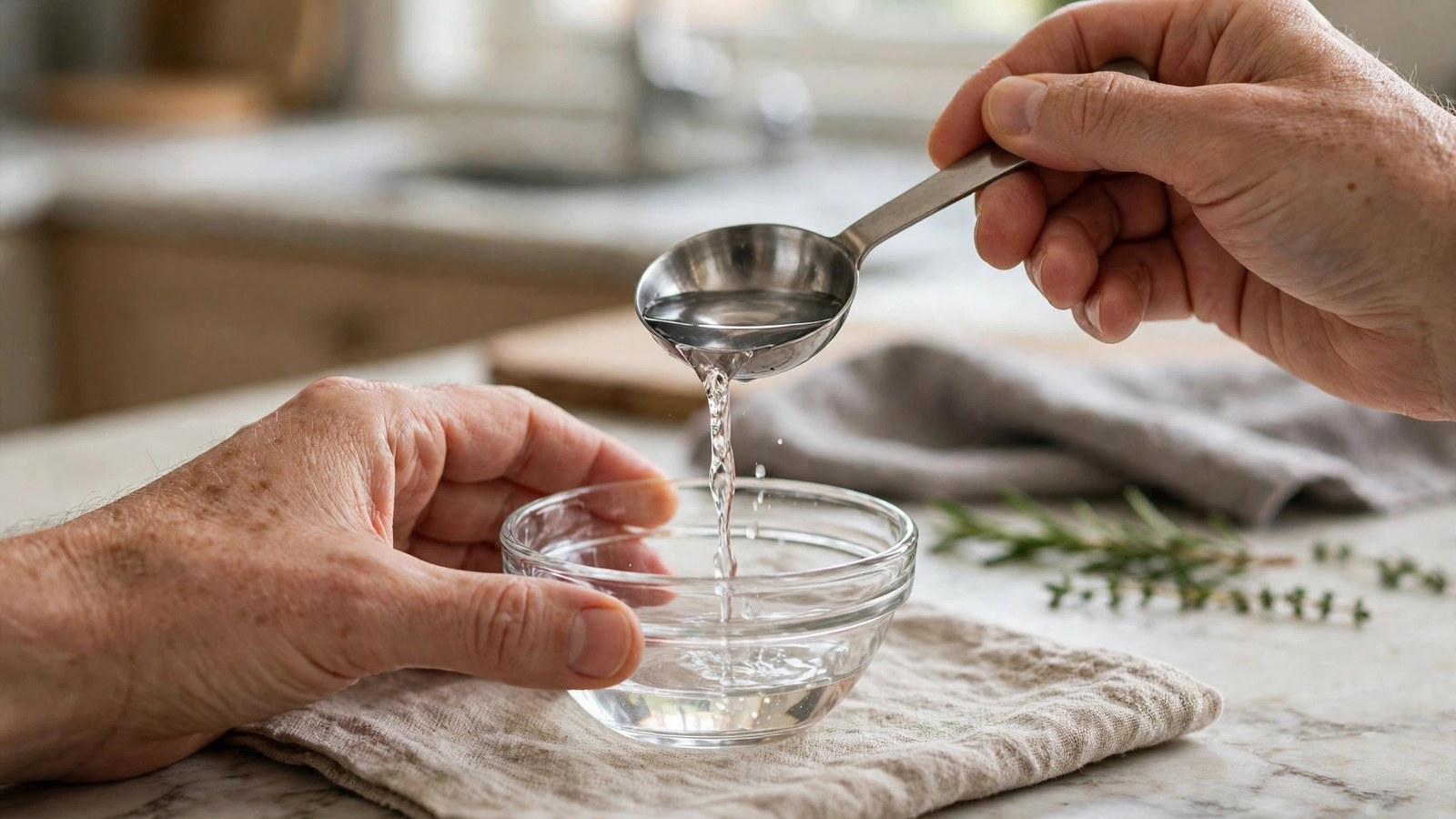
Short answer
- There are 2 tablespoons in 1 US fluid ounce. One US tablespoon equals exactly 0.5 US fluid ounces, so the conversion works with a single factor in both directions: multiply fluid ounces by 2 to get tablespoons, and divide tablespoons by 2 to get fluid ounces. One tablespoon also equals 3 teaspoons, so 1 fluid ounce equals 6 teaspoons. In metric volume, 1 US fluid ounce is 29.5735 milliliters, and 1 US tablespoon is half of that, 14.7868 milliliters, usually rounded to 14.79 milliliters in tables and to 15 milliliters in everyday kitchen use and on food labels. That answer is a volume answer. A tablespoon measures volume, meaning the space an ingredient occupies, and a fluid ounce also measures volume, so the two units convert exactly. An ounce without the word fluid is a different unit: it measures weight, meaning mass. There is no fixed number of tablespoons in a weight ounce, because the same spoonful holds different weights of different ingredients. Two tablespoons of water weigh a little over 1 weight ounce, two tablespoons of honey weigh about one and a half weight ounces, and two tablespoons of flour weigh only about half a weight ounce. If a recipe gives fluid ounces, use the factor of 2. If it gives weight ounces for a dry or thick ingredient, a kitchen scale is the reliable tool, and the weight section later in this guide explains why, with examples for water, flour, honey, sugar, and butter. Two smaller points complete the short answer. First, the factor of 2 belongs to US measures: a British imperial fluid ounce is a slightly smaller volume, and an Australian tablespoon is a larger spoon, so the same clean figure does not hold across those systems. Second, United States food labels use rounded labeling values set by regulation, 15 milliliters to the tablespoon, 5 milliliters to the teaspoon, and 30 milliliters to the fluid ounce, and those rounded values still give 2 tablespoons to the fluid ounce.
By Emma Hudson
A recipe lists an amount in ounces, the measuring jug is in the dishwasher, and the only clean measure in the drawer is a tablespoon. The conversion itself takes one step, but only if the ounce in the recipe is the ounce the tablespoon can measure. This guide gives the exact answer, full tables in both directions, the teaspoon and milliliter equivalents, and a clear explanation of the one case where counting spoons gives the wrong result: when the ounce is a weight, not a volume.
Why the Factor Is Exactly 2
The factor of 2 is not an approximation. It comes from how the units are defined inside the US customary system. The US gallon is defined as 128 US fluid ounces. The cup is defined as 8 fluid ounces, the tablespoon is defined as one half of a fluid ounce, and the teaspoon is defined as one sixth of a fluid ounce. NIST, the National Institute of Standards and Technology, states the definitions directly: in the United States, the cup, tablespoon, and teaspoon are defined as 8, 1/2, and 1/6 fluid ounces respectively. Because the tablespoon is defined as half a fluid ounce, two tablespoons fill one fluid ounce by definition, with no rounding at any step.
The milliliter figures follow from the same definitions. NIST conversion tables give the fluid ounce as 29.57353 milliliters, and the exact defined value is 29.5735295625 milliliters. Halving that value gives the tablespoon: 14.78676478125 milliliters, rounded to 14.7868 or 14.79 milliliters in this guide. Dividing the tablespoon by 3 gives the teaspoon: 4.92892159375 milliliters, rounded to 4.9289 milliliters. Every figure in the tables that follow is built from these defined values and the two factors, 2 between tablespoons and fluid ounces and 3 between teaspoons and tablespoons, and every row can be checked with those two multiplications alone.
The tablespoon also sits on a simple ladder. Six teaspoons make 1 fluid ounce. Eight fluid ounces make 1 cup, so a cup holds 16 tablespoons or 48 teaspoons. Two cups make 1 pint, or 32 tablespoons; two pints make 1 quart, or 64 tablespoons; four quarts make 1 gallon, or 256 tablespoons. Remembering two rungs, 2 tablespoons to the fluid ounce and 16 to the cup, rebuilds every other step by doubling or halving.
Fluid Ounces to Tablespoons: Full Table
The table below converts fluid ounces into tablespoons, teaspoons, and milliliters: tablespoons are fluid ounces multiplied by 2, teaspoons are tablespoons multiplied by 3, and milliliters use 29.5735295625 milliliters per fluid ounce, rounded to two decimal places.
| US fluid ounces | Tablespoons | Teaspoons | Milliliters |
|---|---|---|---|
| 0.25 fl oz | 0.5 tbsp | 1.5 tsp | 7.39 mL |
| 0.5 fl oz | 1 tbsp | 3 tsp | 14.79 mL |
| 1 fl oz | 2 tbsp | 6 tsp | 29.57 mL |
| 1.5 fl oz | 3 tbsp | 9 tsp | 44.36 mL |
| 2 fl oz | 4 tbsp | 12 tsp | 59.15 mL |
| 3 fl oz | 6 tbsp | 18 tsp | 88.72 mL |
| 4 fl oz | 8 tbsp | 24 tsp | 118.29 mL |
| 5 fl oz | 10 tbsp | 30 tsp | 147.87 mL |
| 6 fl oz | 12 tbsp | 36 tsp | 177.44 mL |
| 8 fl oz | 16 tbsp | 48 tsp | 236.59 mL |
| 12 fl oz | 24 tbsp | 72 tsp | 354.88 mL |
| 16 fl oz | 32 tbsp | 96 tsp | 473.18 mL |
| 32 fl oz | 64 tbsp | 192 tsp | 946.35 mL |
A few rows appear constantly in recipes. The 4 fluid ounce row, 8 tablespoons, is half a US cup. The 8 fluid ounce row, 16 tablespoons, is 1 full cup, and it is the best self check in the table: any method that does not land on 16 tablespoons for a cup has gone wrong. The 16 fluid ounce row is 1 pint, and the 32 fluid ounce row is 1 quart. A quarter of a fluid ounce is half a tablespoon, a common amount for extracts, and 1.5 fluid ounces is 3 tablespoons.
Tablespoons to Fluid Ounces: Reverse Table
Most real kitchen questions run in the reverse direction: a recipe written in spoons needs checking against a bottle labeled in fluid ounces. The reverse table divides by 2, and it includes the cup equivalent because tablespoons often bridge a spoon measure and a cup measure.
| Tablespoons | US fluid ounces | Teaspoons | Milliliters | Cup equivalent |
|---|---|---|---|---|
| 1 tbsp | 0.5 fl oz | 3 tsp | 14.79 mL | 1/16 cup |
| 2 tbsp | 1 fl oz | 6 tsp | 29.57 mL | 1/8 cup |
| 3 tbsp | 1.5 fl oz | 9 tsp | 44.36 mL | 3/16 cup |
| 4 tbsp | 2 fl oz | 12 tsp | 59.15 mL | 1/4 cup |
| 5 tbsp | 2.5 fl oz | 15 tsp | 73.93 mL | 5/16 cup |
| 6 tbsp | 3 fl oz | 18 tsp | 88.72 mL | 3/8 cup |
| 8 tbsp | 4 fl oz | 24 tsp | 118.29 mL | 1/2 cup |
| 10 tbsp | 5 fl oz | 30 tsp | 147.87 mL | 5/8 cup |
| 12 tbsp | 6 fl oz | 36 tsp | 177.44 mL | 3/4 cup |
| 16 tbsp | 8 fl oz | 48 tsp | 236.59 mL | 1 cup |
| 32 tbsp | 16 fl oz | 96 tsp | 473.18 mL | 2 cups |
The rows worth memorizing are the even ones. Two tablespoons make 1 fluid ounce and an eighth of a cup. Four tablespoons make 2 fluid ounces and a quarter cup. Eight tablespoons make 4 fluid ounces and half a cup. Sixteen tablespoons make 8 fluid ounces and a full cup. Odd counts are easier by splitting: 5 tablespoons is 4 plus 1, so it is 2 fluid ounces plus 0.5 fluid ounces, which is 2.5 fluid ounces. The same habit handles counts above a cup, where it is usually faster to convert the cup part first and then the remaining spoons.
The Teaspoon Bridge
Teaspoons enter this conversion because many recipes give small amounts in teaspoons while bottles, jugs, and nutrition panels use fluid ounces. The bridge has two exact steps: 3 teaspoons equal 1 tablespoon, and 2 tablespoons equal 1 fluid ounce, so 6 teaspoons equal 1 fluid ounce. To convert teaspoons to fluid ounces, divide by 6. To convert fluid ounces to teaspoons, multiply by 6. Half a tablespoon is 1.5 teaspoons, and half a fluid ounce is 1 tablespoon, or 3 teaspoons.
Worked examples show the pattern. Two teaspoons of vanilla extract is two thirds of a tablespoon, one third of a fluid ounce, about 9.86 milliliters. A sauce needing 4.5 teaspoons of soy sauce needs 1.5 tablespoons, or 0.75 fluid ounces, about 22.18 milliliters. A marinade with 12 teaspoons of oil has 4 tablespoons of oil, which is 2 fluid ounces, or a quarter cup. Running the bridge the other way, 0.5 fluid ounces of lemon juice is 1 tablespoon, or 3 level teaspoons. The teaspoon is the least accurate measure in practice, because small leveling errors are a larger share of a small spoon, so for amounts of a tablespoon or more the tablespoon measure is the better tool.
One caution belongs here. The 3 to 1 ratio is a US, British, and metric spoon ratio. The Australian tablespoon breaks it, because the Australian tablespoon holds 4 teaspoons, not 3. The international section below explains that case in full.
Worked Examples From Recipes
Each example below states the unit first, then applies the factor. The habit of checking which unit a recipe is using matters more than the arithmetic.
Example 1: a salad dressing calls for 3 fluid ounces of olive oil. Three multiplied by 2 is 6, so the amount is 6 level tablespoons, which is also three eighths of a cup.
Example 2: a cake recipe calls for 2 tablespoons of milk. Two divided by 2 is 1, so 2 tablespoons is 1 fluid ounce. Doubled, that is 2 fluid ounces, and halved it is 0.5 fluid ounces, or 1 tablespoon.
Example 3: a soup recipe calls for 5 fluid ounces of stock. Five multiplied by 2 is 10, so the cook measures 10 tablespoons, or pours half a cup plus 2 tablespoons, since half a cup is 8 tablespoons.
Example 4: a bottled sauce label gives a serving as 1 fluid ounce. Each serving is 2 level tablespoons, and a dish for four people needs 8 tablespoons, which is half a cup.
Example 5: a recipe calls for 0.75 fluid ounces of vinegar. Three quarters multiplied by 2 is 1.5, so the amount is 1.5 tablespoons, measured as 1 tablespoon plus 1.5 teaspoons.
Example 6: halving and doubling by spoons. A recipe for two calls for 6 tablespoons of cream. Halved for one person, it is 3 tablespoons, which is 1.5 fluid ounces. Doubled for four people, it is 12 tablespoons, which is 6 fluid ounces, or three quarters of a cup. Scaling in spoons and converting at the end keeps the arithmetic in whole numbers for most common amounts.
Reading Medicine and Label Amounts as Conversions
Liquid medicines and supplements often state amounts in milliliters, teaspoons, tablespoons, or fluid ounces on the same label, which makes this section a conversion exercise and nothing more. The facts below are unit facts only, not dosing guidance for any product or person: the amount to use for any medicine is the amount in that product’s own directions.
United States labeling uses rounded values set in federal regulation. For nutrition labeling purposes, the Food and Drug Administration regulation defines a teaspoon as 5 milliliters, a tablespoon as 15 milliliters, a cup as 240 milliliters, 1 fluid ounce as 30 milliliters, and 1 ounce in weight as 28 grams. NIST publishes the same rounded equivalents for home cooking. Under those values, 15 milliliters is 1 tablespoon or 3 teaspoons, and 30 milliliters is 2 tablespoons or 1 fluid ounce.
Converting a label amount is then a matter of matching the unit. Ten milliliters is 2 labeling teaspoons, 15 milliliters is 1 labeling tablespoon, and 30 milliliters is 1 labeling fluid ounce, or 2 labeling tablespoons. Two teaspoons convert to two thirds of a tablespoon, and 1 tablespoon converts to 3 teaspoons, under both systems. The one mismatch to know about is the gap between the exact customary values and the rounded labeling values: an exact US teaspoon holds 4.9289 milliliters, not 5, and an exact US tablespoon holds 14.7868 milliliters, not 15, a gap of about 1.4 percent. Label amounts refer to standard measuring spoons and to the measuring device supplied with a product, not to eating spoons from a cutlery drawer, which vary widely in size.
US, Imperial, Metric, and Australian Spoons
The headline answer, 2 tablespoons in an ounce, is exact only when both units come from the US customary system. Four related systems produce different figures, and keeping them separate is the whole task in this section.
The US customary tablespoon holds 14.7868 milliliters, and the US fluid ounce holds 29.5735 milliliters, so the ratio is exactly 2. The US teaspoon holds 4.9289 milliliters, and 3 teaspoons fill the tablespoon.
The metric tablespoon used in many countries, and in modern British recipes, is 15 milliliters exactly, with a 5 milliliter teaspoon, so 3 teaspoons still fill the spoon. Against a US fluid ounce, a 15 milliliter spoon gives 29.5735 divided by 15, which is about 1.97 spoons per fluid ounce. That difference, about 1.4 percent, is below the level most cooking can detect, but it is why precise work states volumes in milliliters instead of spoon names.
The imperial fluid ounce, the British volume unit, is 28.4130625 milliliters, smaller than the US fluid ounce because the imperial gallon is divided into 160 fluid ounces while the US gallon is divided into 128. Measured with a 15 milliliter metric tablespoon, one imperial fluid ounce holds about 1.89 tablespoons; measured with a US customary tablespoon, it holds about 1.92 tablespoons. Neither figure is the clean 2, and confusing the two fluid ounces introduces an error of about 4 percent before any spoon is picked up.
The Australian tablespoon is the largest common spoon: 20 milliliters, equal to 4 Australian teaspoons of 5 milliliters each. One US fluid ounce is 29.5735 divided by 20, about 1.48 Australian tablespoons. The trap runs the other way: an Australian recipe calling for 2 tablespoons means 40 milliliters, while a US cook using a US tablespoon pours about 29.57 milliliters, roughly a quarter less, which can matter in baking and seasoning. With any recipe from another country, convert its spoons to milliliters using that country’s spoon size first.
Fluid Ounces and Weight Ounces Are Different Units
This section prevents the most damage, because the word ounce names two unrelated units in US recipes. The fluid ounce measures volume. The ounce, written on scales, packages of flour, and deli labels, measures weight. A tablespoon can only convert to the first kind directly. Converting a spoonful to a weight requires knowing what is in the spoon, because ingredients pack different masses into the same volume. That property is density. All ingredient weights in this section are approximate reference values, because the weight of a spoonful also depends on how the spoon is filled.
Water is the case where the two ounces nearly agree, which is why the confusion survives. Water weighs about 1 gram per milliliter, so a tablespoon of water, 14.7868 milliliters, weighs about 14.8 grams, or about 0.52 weight ounces. Two tablespoons weigh about 1.04 weight ounces, close to 1 weight ounce but slightly over it. For most other ingredients the gap is far larger.
Flour sits at the light end. King Arthur Baking, a flour miller that publishes a widely used ingredient weight chart, lists 1 cup of all purpose flour, spooned into the cup and leveled, as 120 grams, or 4.25 weight ounces. Dividing by the 16 tablespoons in a cup gives about 7.5 grams per tablespoon, so 2 tablespoons of flour weigh about 15 grams, which is about 0.53 weight ounces, roughly half a weight ounce. Turning the question around, 1 weight ounce of flour, about 28.35 grams, needs a little under 4 tablespoons, about 3.8 tablespoons at that chart weight. Scooping flour directly packs it tighter and raises the weight, which is why the figure is approximate and why baking recipes that need precision give flour in grams.
Honey sits at the heavy end. A standard reference weight for honey is about 21 grams per tablespoon, so 2 tablespoons weigh about 42 grams, which is about 1.48 weight ounces, roughly one and a half weight ounces. Because 2 spoonfuls already weigh about 1.5 ounces, a recipe calling for 1 weight ounce of honey needs only about 1.35 tablespoons. Syrups behave similarly to honey, though the exact weight varies with the syrup. Granulated sugar falls between flour and water: at about 198 grams per cup, it is about 12.4 grams per tablespoon, so 2 tablespoons weigh about 24.8 grams, or about 0.87 weight ounces.
Butter is the neat exception. In US packaging, a standard stick of butter is labeled as 4 weight ounces and is marked into 8 tablespoons, so 1 tablespoon of butter weighs 0.5 weight ounces by the package’s own markings, and 2 tablespoons weigh exactly 1 weight ounce on that basis, about 14.2 grams per tablespoon. Butter lands on the water like answer by coincidence of its density, not because spoons convert to weight.
The working rule is short. If the ounce is a fluid ounce, count spoons with the factor of 2. If it is a weight ounce, weigh the ingredient, or look up a weight for that specific ingredient, and treat any spoon equivalent as approximate. Context usually resolves ambiguity: liquids listed with cups and pints nearby are almost always fluid ounces, while dry ingredients listed with pounds nearby are almost always weight ounces.
Measuring Accurately With Spoons
A correct conversion factor cannot rescue an incorrect spoonful, and spoon measuring has three common failure points worth naming.
First, use measuring spoons, not eating spoons. A tablespoon measure is a standardized tool holding 14.7868 milliliters when level, while eating spoons vary by maker and can hold far more or far less. Spoon sets state their sizes on the handle: a rounded metric set shows 15 milliliters for the tablespoon, while a US customary set is the half fluid ounce size.
Second, level dry ingredients and fill liquids to the brim. For flour, sugar, cocoa, and similar dry ingredients, a tablespoon means a level tablespoon: spoon the ingredient in and sweep the excess off with a straight edge, unless the recipe says heaped or rounded. A heaped spoon can hold half again as much as a level one. For liquids, fill to the brim and pour steadily, because liquid lost in transit is liquid missing from the recipe.
Third, match the spoon system to the recipe system: a US recipe assumes a US tablespoon, an Australian recipe a 20 milliliter tablespoon, and a metric recipe a 15 milliliter tablespoon. Converting spoon amounts to milliliters removes the question entirely. For amounts of 4 tablespoons or more, a liquid measuring cup with fluid ounce markings is usually easier to read than a long count of spoonfuls: tablespoons divided by 2 gives the fluid ounce line to fill to.
Frequently Asked Questions
How many tablespoons in an ounce?
There are 2 tablespoons in 1 US fluid ounce, exactly, because the US tablespoon is defined as half a fluid ounce. If the ounce is a weight ounce, there is no single spoon count, because the weight of a tablespoon depends on the ingredient: about 2 tablespoons of water or butter weigh 1 weight ounce, while flour needs about 3.8 tablespoons and honey needs only about 1.35 tablespoons to reach the same weight. Those weight figures are approximate, and a scale is the reliable tool for weight ounces.
How many tablespoons per ounce in a recipe from the UK?
The imperial fluid ounce is 28.4130625 milliliters, and a modern British tablespoon is usually the 15 milliliter metric spoon, so an imperial fluid ounce holds about 1.89 metric tablespoons. Most current British recipes give milliliters: divide by 15 for metric tablespoons, or by 14.7868 for US tablespoons. The clean figure of 2 applies to US fluid ounces with US tablespoons.
A tablespoon is how many ounces?
One US tablespoon is 0.5 US fluid ounces by volume, 3 teaspoons, and 14.7868 milliliters. As a weight, a tablespoon has no fixed ounce value: a tablespoon of water weighs about 0.52 weight ounces, of all purpose flour about 0.26 weight ounces, and of honey about 0.74 weight ounces, all approximately. Without more context, the volume answer, half a fluid ounce, is the one almost always meant.
How many ounces in 2 tablespoons?
Two US tablespoons equal 1 US fluid ounce by volume, the reverse of the headline conversion. Two tablespoons also equal 6 teaspoons, 29.57 milliliters, and an eighth of a US cup. By weight, 2 tablespoons equal 1 weight ounce only for ingredients with a density close to butter or water; the weight section gives the flour, honey, and sugar figures separately.
What is the tablespoon to ounces conversion formula?
For volume, tablespoons divided by 2 equals fluid ounces, and fluid ounces multiplied by 2 equals tablespoons. For teaspoons, divide by 6 to get fluid ounces. For milliliters, multiply fluid ounces by 29.5735, or tablespoons by 14.7868. There is no formula of this kind for weight ounces, because a weight conversion needs the density or a published weight for the specific ingredient.
How many tablespoons are in a cup?
There are 16 tablespoons in 1 US cup. The cup is 8 fluid ounces, and 8 multiplied by 2 gives 16. A quarter cup is 4 tablespoons, a third of a cup is 5 tablespoons plus 1 teaspoon, and half a cup is 8 tablespoons. A metric cup of 250 milliliters holds a different count, about 16.67 metric tablespoons, or 12.5 Australian tablespoons, because cup sizes, like spoon sizes, belong to a named system.
How many teaspoons are in an ounce?
There are 6 teaspoons in 1 US fluid ounce: 2 tablespoons at 3 teaspoons each. Half a fluid ounce is 3 teaspoons, and a quarter is 1.5 teaspoons. In Australian measures the count is built differently, because the Australian tablespoon holds 4 teaspoons: a US fluid ounce is about 1.48 Australian tablespoons, or about 5.91 Australian teaspoons, very close to 6 but built from a different spoon.
Is 2 tablespoons the same as 1 ounce for dry ingredients?
By volume, in a limited sense: 2 tablespoons of any ingredient occupy 1 fluid ounce of space. By weight, no. Two tablespoons of all purpose flour weigh about 0.53 weight ounces, while 2 tablespoons of granulated sugar weigh about 0.87 weight ounces. Recipes that list dry ingredients in ounces almost always mean weight ounces, so a scale, or an ingredient specific weight chart, is the correct route.
Why do food labels say a tablespoon is 15 milliliters?
Because United States labeling regulation defines rounded household measure equivalents. The Food and Drug Administration rule at 21 CFR 101.9 states that, for nutrition labeling purposes, a teaspoon means 5 milliliters, a tablespoon means 15 milliliters, a cup means 240 milliliters, 1 fluid ounce means 30 milliliters, and 1 ounce in weight means 28 grams. NIST uses the same rounded values for home cooking. The exact customary tablespoon is 14.7868 milliliters, about 1.4 percent smaller, and both systems keep 2 tablespoons to the fluid ounce.
How do I convert tablespoons to ounces without a calculator?
Use the factor of 2 and split awkward numbers into even parts. Seven tablespoons is 6 plus 1, so it is 3 plus 0.5, which is 3.5 fluid ounces. Nine tablespoons is 8 plus 1, so it is 4.5 fluid ounces. Going the other way, double the fluid ounces: 2.5 fluid ounces is 2 plus 0.5, so it is 4 plus 1, which is 5 tablespoons. If a result ends in half a tablespoon, measure that half as 1.5 teaspoons.
Keep reading: How Many Tablespoons in a Cup
Keep reading: Cups to Ounces: How Many Ounces in a Cup?
Sources & references
- National Institute of Standards and Technology, NIST Special Publication 1038, The International System of Units (SI): Conversion Factors for General Use. Used for the definitions that in the United States the cup, tablespoon, and teaspoon are defined as 8, 1/2, and 1/6 fluid ounces respectively, with practical metric equivalents of 250 milliliters, 15 milliliters, and 5 milliliters; for the fluid ounce conversion factor of 29.57353 milliliters; for the gallon of 128 fluid ounces (231 cubic inches); and for the avoirdupois ounce conversion factor of 28.34952 grams. https://doi.org/10.6028/NIST.SP.1038
- National Institute of Standards and Technology, Metric Kitchen: Cooking Measurement Equivalencies. Used for the home cooking equivalencies of 5 milliliters to 1 teaspoon, 15 milliliters to 1 tablespoon (1/2 fluid ounce), 30 milliliters to 1 fluid ounce, 240 milliliters to 1 cup, and 28 grams to 1 ounce by weight. https://www.nist.gov/pml/owm/metric-si/metric-kitchen/metric-kitchen-cooking-measurement-equivalencies
- U.S. Food and Drug Administration, Guidance for Industry: Guidelines for Determining Metric Equivalents of Household Measures, restating 21 CFR 101.9(b)(5)(viii). Used for the labeling definitions that 1 cup means 240 milliliters, 1 tablespoon means 15 milliliters, 1 teaspoon means 5 milliliters, 1 fluid ounce means 30 milliliters, and 1 ounce means 28 grams for nutrition labeling purposes. http://www.fda.gov/regulatory-information/search-fda-guidance-documents/guidance-industry-guidelines-determining-metric-equivalents-household-measures
- King Arthur Baking, Ingredient Weight Chart. Used for the approximate reference weight of 1 cup of all purpose flour, spooned and leveled, as 120 grams or 4 1/4 ounces, from which the per tablespoon flour figures in the weight section are divided. Search result read 1 November 2026; the chart also underlies the granulated sugar figure of about 198 grams per cup and the honey figure of 21 grams per tablespoon (3/4 ounce) used in this guide.
- Australian Women's Weekly Food, How to: Measurement conversions. Used for the Australian tablespoon of 20 milliliters, the Australian metric cup of 250 milliliters, and the statement that Australia is the only country whose standard tablespoon measure is 20 milliliters. https://www.womensweeklyfood.com.au/how-to/measurement-conversions-1313/


