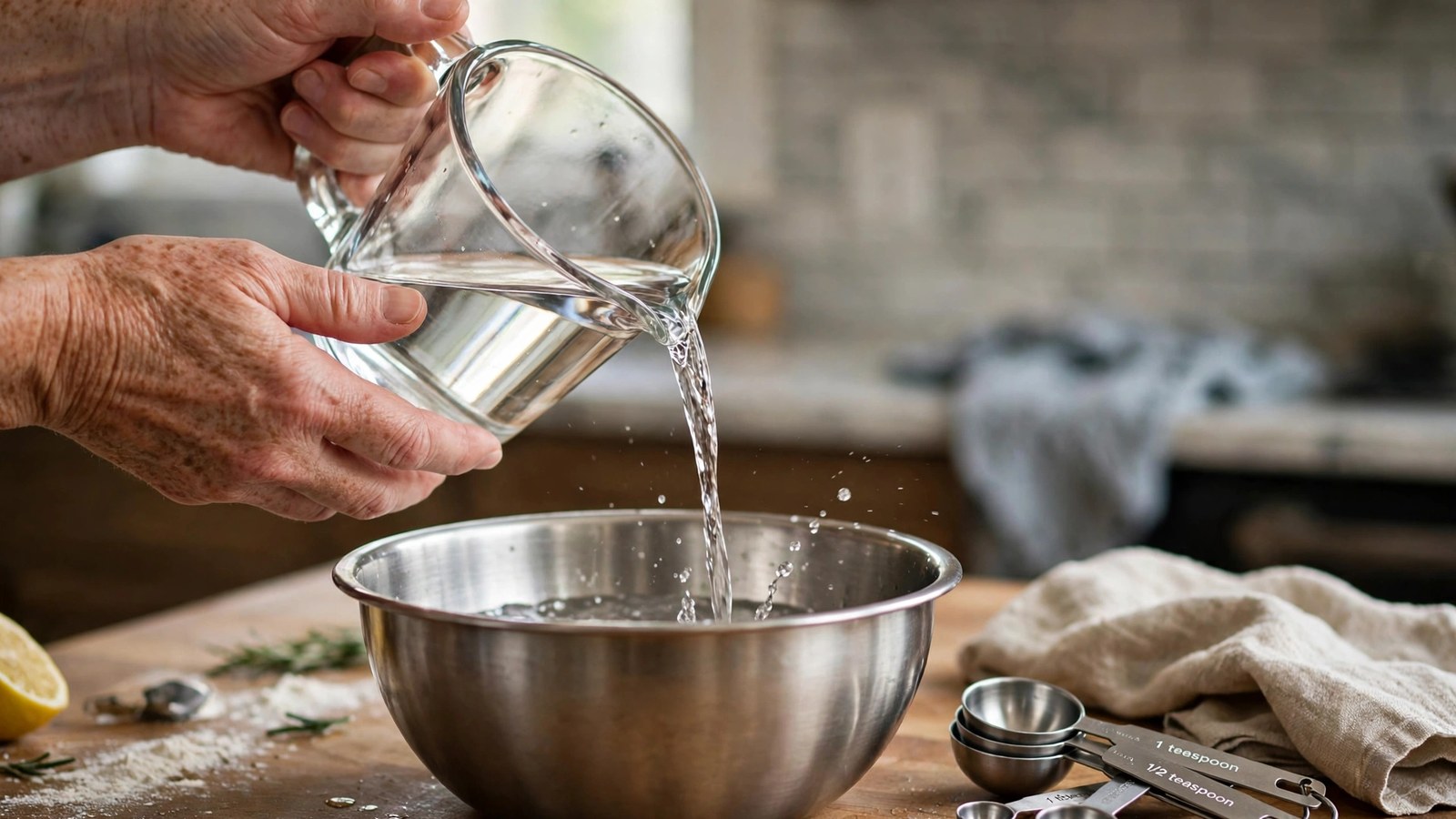
Short answer
- One US cup equals 8 US fluid ounces. That is the whole conversion for liquids and for anything measured by volume: multiply cups by 8 to get fluid ounces, and divide fluid ounces by 8 to get cups. Half a cup is 4 fluid ounces, a quarter cup is 2 fluid ounces, 2 cups are 16 fluid ounces, and 4 cups are 32 fluid ounces. The answer changes only when ounce means weight. A fluid ounce measures space. An ounce without the word fluid usually measures weight, and the weight of a cup depends on what is in it. A US cup of water weighs about 8.3 ounces. A cup of all purpose flour weighs about 4.25 ounces. A cup of granulated sugar weighs about 7 ounces. So the rule is this: for volume, 1 cup is always 8 fluid ounces. For weight, there is no single number, and the ingredient decides the answer.
By Emma Hudson
Introduction
Almost every US recipe uses cups, and almost every bottle, carton and food label uses fluid ounces, so cooks constantly move between the two. The conversion is one of the simplest in the kitchen, but one word causes most of the confusion: ounce. An ounce can mean a fluid ounce, which measures volume, or an ounce of weight, which measures how heavy something is. This guide gives the volume conversion first, with full tables in both directions, then explains where weight ounces differ, because a cup of flour does not weigh 8 ounces even though a cup holds 8 fluid ounces.
The Core Conversion
In US customary measurement, the cup and the fluid ounce are both units of volume, linked by definition. NIST, the National Institute of Standards and Technology, lists the measuring cup as 8 fluid ounces exactly, equal to half a liquid pint, and lists 1 fluid ounce as 29.57353 milliliters. Multiply 8 by 29.57353 and a US cup is 236.588 milliliters, rounded to 237 milliliters in reference tables. NIST also publishes approximate kitchen equivalents that round the cup to 240 milliliters and the fluid ounce to 30 milliliters, which is why both 237 and 240 appear on jugs and labels: roundings of the same cup, not different cups.
Three formulas cover every question in this article. Cups to fluid ounces: multiply by 8. Fluid ounces to cups: divide by 8. Cups to milliliters: multiply by 236.588, or by 240 for a quick estimate. Tablespoons, pints, quarts and gallons all connect back to the first fact: 1 cup is 16 tablespoons and 48 teaspoons, 2 cups make 1 pint, 4 cups make 1 quart, and 16 cups make 1 gallon of 128 fluid ounces.
The wording does not change the answer. Is 1 cup 8 oz? Yes, for fluid ounces. Does 8 oz equal 1 cup? Yes. Is 8 ounces one cup? Yes. How many fl oz in 1 cup, how many fluid ounces in one cup, and ounces in one cup are the same question, with the answer 8 every time, provided both units are US units and the ounce is a fluid ounce.
Cups to Ounces Table
Every fluid ounce figure below is the cup amount multiplied by 8, every tablespoon figure is the cup amount multiplied by 16, every teaspoon figure is the cup amount multiplied by 48, and every milliliter figure is the cup amount multiplied by 236.588 and rounded to the nearest whole number. Fractional cups are included because recipes use them constantly, and because questions such as how many oz in 3/4 of a cup and how many oz 2/3 cup contains are among the most common searches on this topic.
| Cups | Fluid ounces | Tablespoons | Teaspoons | Milliliters |
|---|---|---|---|---|
| 1/8 cup | 1 fl oz | 2 tbsp | 6 tsp | 30 ml |
| 1/6 cup | 1.33 fl oz | 2.67 tbsp | 8 tsp | 39 ml |
| 1/4 cup | 2 fl oz | 4 tbsp | 12 tsp | 59 ml |
| 1/3 cup | 2.67 fl oz | 5.33 tbsp | 16 tsp | 79 ml |
| 1/2 cup | 4 fl oz | 8 tbsp | 24 tsp | 118 ml |
| 2/3 cup | 5.33 fl oz | 10.67 tbsp | 32 tsp | 158 ml |
| 3/4 cup | 6 fl oz | 12 tbsp | 36 tsp | 177 ml |
| 1 cup | 8 fl oz | 16 tbsp | 48 tsp | 237 ml |
| 1 1/2 cups | 12 fl oz | 24 tbsp | 72 tsp | 355 ml |
| 2 cups | 16 fl oz | 32 tbsp | 96 tsp | 473 ml |
| 2 1/2 cups | 20 fl oz | 40 tbsp | 120 tsp | 591 ml |
| 3 cups | 24 fl oz | 48 tbsp | 144 tsp | 710 ml |
| 4 cups | 32 fl oz | 64 tbsp | 192 tsp | 946 ml |
| 5 cups | 40 fl oz | 80 tbsp | 240 tsp | 1183 ml |
| 6 cups | 48 fl oz | 96 tbsp | 288 tsp | 1420 ml |
| 8 cups | 64 fl oz | 128 tbsp | 384 tsp | 1893 ml |
| 10 cups | 80 fl oz | 160 tbsp | 480 tsp | 2366 ml |
| 12 cups | 96 fl oz | 192 tbsp | 576 tsp | 2839 ml |
| 16 cups | 128 fl oz | 256 tbsp | 768 tsp | 3785 ml |
Read the table against common questions. How many ounces is 3 cups? 24 fluid ounces. How many oz is 4 cups? 32 fluid ounces. How many oz is 3/4 of a cup? 6 fluid ounces. Two landmarks are worth memorizing: 8 cups is 64 fluid ounces, or half a gallon, and 16 cups is 128 fluid ounces, or a full US gallon.
Ounces to Cups: The Reverse Conversion
Divide fluid ounces by 8 to get cups. Two ounces to cups is 2 divided by 8, which is 0.25 cups, or a quarter cup. Six ounces to cups is 0.75 cups, or three quarters of a cup. Fourteen ounces to cups is 1.75 cups, so how many cups is 14oz has the answer 1.75 cups. How many cups is 24 ounces? 3 cups. One fluid ounce to cups is 0.125 cups, exactly 2 tablespoons, which also answers how many cups in a fluid ounce and oz to fluid cups questions in general.
| Fluid ounces | Cups | Kitchen form |
|---|---|---|
| 1 fl oz | 0.125 cups | 2 tablespoons |
| 2 fl oz | 0.25 cups | 1/4 cup |
| 3 fl oz | 0.375 cups | 1/4 cup plus 2 tablespoons |
| 4 fl oz | 0.5 cups | 1/2 cup |
| 5 fl oz | 0.625 cups | 1/2 cup plus 2 tablespoons |
| 6 fl oz | 0.75 cups | 3/4 cup |
| 7 fl oz | 0.875 cups | 3/4 cup plus 2 tablespoons |
| 8 fl oz | 1 cup | 1 cup |
| 10 fl oz | 1.25 cups | 1 1/4 cups |
| 12 fl oz | 1.5 cups | 1 1/2 cups |
| 14 fl oz | 1.75 cups | 1 3/4 cups |
| 16 fl oz | 2 cups | 1 pint |
| 20 fl oz | 2.5 cups | 2 1/2 cups |
| 24 fl oz | 3 cups | 3 cups |
| 32 fl oz | 4 cups | 1 quart |
| 48 fl oz | 6 cups | 6 cups |
| 64 fl oz | 8 cups | 1/2 gallon |
| 128 fl oz | 16 cups | 1 gallon |
The kitchen form column matters because few cooks own a measure marked in decimal cups. A result like 0.625 cups is correct arithmetic but awkward at the counter, while half a cup plus 2 tablespoons is easy to measure. Results ending in .125, .375, .625 or .875 can be built by adding or subtracting 2 tablespoons, the spoon measure of 1 fluid ounce, from the nearest familiar fraction.
Fractions of a Cup, Worked Out
Each answer below is the fraction multiplied by 8 for fluid ounces, by 16 for tablespoons, or by 48 for teaspoons. A third of a cup is 2.67 fluid ounces, about 5.33 tablespoons or 16 teaspoons. Two thirds of a cup is 5.33 fluid ounces. Three quarters of a cup is exactly 6 fluid ounces, or 12 tablespoons. A quarter of a cup is exactly 2 fluid ounces, or 4 tablespoons. An eighth of a cup is exactly 1 fluid ounce, or 2 tablespoons.
What is half of 1 3rd cup? Half of a third is a sixth, so half of 1/3 cup is 1/6 cup. In fluid ounces that is 1.33 fluid ounces. In teaspoons it is exact: 1/6 times 48 is 8 teaspoons. The teaspoon answer is usually the most useful form, because 1.33 fluid ounces cannot be read accurately on most jugs, while 8 level teaspoons can be counted with confidence.
A quarter of an ounce works in the opposite direction. The search phrasing 1 4 ounce to cups means a quarter of a fluid ounce in cups: 0.25 divided by 8 is 0.03125 cups. Nobody measures that directly. In kitchen units it is half a tablespoon, because 1 tablespoon is half a fluid ounce, and half a tablespoon is 1.5 teaspoons. Small amounts are better measured in spoons than in cups.
How many 5 ounces in a cup is best read as asking what fraction of a cup 5 fluid ounces is. A cup holds 8 fluid ounces, so 5 fluid ounces is 5 divided by 8, which is 0.625 cups, or 5/8 of a cup. Measured into a cup measure, 5 fluid ounces fills it to a little above the half cup line and below the three quarter cup line.
Tablespoons, Teaspoons and Milliliters
Cups, fluid ounces, tablespoons and teaspoons form one connected chain, and milliliters give the same volumes in metric units. One cup is 8 fluid ounces, 16 tablespoons, 48 teaspoons and 236.588 milliliters. One fluid ounce is 2 tablespoons, 6 teaspoons and 29.57353 milliliters. One tablespoon is half a fluid ounce, 3 teaspoons and about 14.79 milliliters by exact conversion. One teaspoon is about 4.93 milliliters by exact conversion.
Labels use rounded versions of these figures. For nutrition labeling, the US Food and Drug Administration uses 1 cup as 240 milliliters, 1 tablespoon as 15 milliliters, 1 teaspoon as 5 milliliters, 1 fluid ounce as 30 milliliters and 1 ounce of weight as 28 grams. NIST publishes the same rounded figures as approximate equivalents for home cooking. The rounded set is fine for everyday cooking, where a difference of about 1.4 percent on a cup is smaller than the difference between two people filling the same cup. The exact set explains why a jug shows 237 milliliters at the cup line while a label says 240: both describe the same US cup, one exactly and one rounded.
Fluid Ounces and Weight Ounces Are Different Units
This is the most important distinction in the topic, and the one the simple answer hides. A fluid ounce measures volume, meaning how much space something takes up. An ounce without the word fluid measures weight in the avoirdupois system used for everyday weighing in the United States, meaning how heavy something is. NIST lists them in separate tables for a reason: the fluid ounce belongs with pints and gallons, while the weight ounce belongs with pounds, at 16 ounces to the pound and 28.349523125 grams to the ounce. Food labels make the same split, at about 30 milliliters for a fluid ounce and 28 grams for an ounce of weight.
Because the units measure different things, no fixed conversion exists between a cup and weight ounces. A cup fixes the space. The weight of what fills that space depends on the density of the ingredient, meaning how much mass is packed into each unit of volume. Water is the reference case, and even water does not give exactly 8. One US cup of water occupies 8 fluid ounces and 236.588 milliliters, and since water has a density of about 1 gram per milliliter, that cup weighs about 236.6 grams. Divided by 28.349523125 grams per ounce, the weight is about 8.3 ounces. So a cup of water in oz is 8 fluid ounces by volume and about 8.3 ounces by weight. Both statements are true at once, because they describe different properties of the same water.
Every other ingredient moves away from water in its own direction. Light powders weigh far less than the same volume of water, because much of the cup is air between particles. Dense syrups weigh more. That is why how many solid ounces in a cup has no single honest answer: the word solid signals weight, and weight needs a named ingredient. The same point answers how many g to a cup. Grams measure weight and cups measure volume, so there is no universal grams to cups figure. The honest version is a per ingredient table, like the next section, and the most accurate version is a kitchen scale.
What a Cup of Common Ingredients Weighs
The weights below are for one US cup of each ingredient, from the ingredient weight chart published by King Arthur Baking, a widely used baking reference that lists volume, ounces and grams side by side. Read them as standard reference weights, not as guarantees for every bag and every scoop. Flour varies with handling, as the notes under the table explain.
| Ingredient, 1 US cup | Weight in ounces | Weight in grams |
|---|---|---|
| All purpose flour | 4.25 oz | 120 g |
| Whole wheat flour | 4 oz | 113 g |
| Rolled oats, old fashioned | 3.125 oz | 89 g |
| Granulated sugar | 7 oz | 198 g |
| Brown sugar, packed | 7.5 oz | 213 g |
| Butter | 8 oz | 227 g |
| Vegetable oil | 7 oz | 198 g |
| Milk | 8 oz | 227 g |
| Water, baking chart equivalent | 8 oz | 227 g |
| Chocolate chips | 6 oz | 170 g |
| Cocoa powder, unsweetened, per 1/2 cup | 1.5 oz per 1/2 cup | 42 g per 1/2 cup |
First, a cup of flour does not weigh 8 ounces. At 4.25 ounces and 120 grams, it weighs a little over half of what the volume figure of 8 might suggest, and a cook who weighs out 8 ounces of flour for a recipe that means 1 cup has added nearly double the flour. That error explains many dense cakes and dry breads. Second, pouring liquids are not all equal: a cup of vegetable oil weighs about 7 ounces, less than a cup of milk at about 8 ounces on the same chart, because oil is less dense than water based liquids. Third, the water row needs care. Baking charts commonly list a cup of water as 8 ounces and 227 grams as a convenient equivalent. The exact physical weight of a US cup of water is about 236.6 grams, or about 8.3 ounces, as worked out above. The chart figure is a rounded equivalent, not a contradiction, but the exact figure is the one to use when checking a scale against a measured cup of water.
The 120 gram flour figure assumes flour spooned into the cup and leveled, the method the chart is built on. Flour scooped directly with the cup packs down and can weigh substantially more in the same volume, and sifted flour can weigh less. That variation is the strongest practical reason to weigh flour in grams when a recipe gives a weight.
US Cups, Label Cups and Metric Cups
A cup is not the same size everywhere, and the differences can change a recipe. The US customary cup in American recipes is 8 US fluid ounces, or 236.588 milliliters. The cup on US nutrition labels is 240 milliliters by regulation: the Food and Drug Administration defines a cup as 240 milliliters for nutrition labeling, along with a fluid ounce of 30 milliliters. That label cup is a rounding for consistent labels, about 1.4 percent larger than the exact customary cup, invisible in a single serving but worth knowing when you compare label values with recipe amounts.
The metric cup used in Australia, New Zealand and Canada is 250 milliliters, larger than the US cup by about 13.4 milliliters, close to a tablespoon. One metric cup is about 1.057 US cups, so a recipe written for metric cups and made with US cups comes out short by about 5 percent on every cup. In a pot of soup that rarely matters. In baking, where liquid to flour ratios decide texture, it can, and the safest approach is to follow the cup standard of the country the recipe comes from, or convert the recipe to milliliters and grams and work in metric throughout.
British measures add a further caution. The imperial fluid ounce used historically in the United Kingdom differs slightly from the US fluid ounce, and the imperial pint holds 20 imperial fluid ounces rather than 16. Where an imperial cup appears in an older recipe, it is larger than a US cup. For any imported recipe, identify the system the author used before converting.
A related question is how much is 2 ounces in a cup, sometimes typed with a zero in place of the letter o. Two fluid ounces is a quarter of a cup, since 2 divided by 8 is 0.25. Two ounces by weight has no cup answer until the ingredient is named: 2 ounces of flour is a little under half a cup by volume, while 2 ounces of granulated sugar is a little over a quarter cup, using the table above. Checking whether an ounce is a fluid ounce or a weight ounce prevents almost every error in this topic.
Worked Examples From Real Recipes
Example one: scaling a sauce. A sauce for four calls for 1 1/2 cups of stock, and you double it for eight people. Doubled, the stock is 3 cups, which is 3 times 8, or 24 fluid ounces. If your stock comes in a 32 fluid ounce quart carton, you need three quarters of the carton, and 8 fluid ounces, or 1 cup, will be left over.
Example two: a drink bottle and a jug. A party drink calls for 5 cups of juice, sold in bottles marked 12 fluid ounces. Five cups is 40 fluid ounces. Three bottles give 36 fluid ounces, 4 fluid ounces short, so you need a fourth bottle, and 8 fluid ounces, or exactly 1 cup, will be left unused. Working in fluid ounces first makes the shortfall visible before you start mixing.
Example three: flour by weight. A US bread recipe lists 3 cups of all purpose flour, and you prefer to weigh it. At 120 grams per cup, 3 cups is 360 grams, or 12.75 ounces by weight, since 3 times 4.25 is 12.75. Treating the recipe as 3 times 8 ounces by weight would give 24 ounces of flour, nearly double the intended amount. In reverse, a metric recipe calling for 360 grams of flour is asking for 3 US cups, because 360 divided by 120 is 3.
Example four: a dressing calls for 1/6 cup of lemon juice, a fraction with no line on most jugs. One sixth of a cup is 1.33 fluid ounces, 2.67 tablespoons, or exactly 8 teaspoons. Measuring 2 tablespoons plus 2 teaspoons gives the same amount, since 2 tablespoons is 6 teaspoons. Breaking an awkward fraction into a spoon combination works for any small fraction in the main table.
How to Measure Accurately
Use a liquid measuring cup for liquids and dry measuring cups for dry ingredients, because they are filled differently. A liquid cup has a spout and lines below the rim, so you can set it on a flat surface and read the line at eye level, using the bottom of the curved surface of the liquid. Dry cups are filled to the very top and leveled, which is why they come in nested sizes rather than as a graduated jug.
For flour and other powders, spoon the ingredient lightly into the dry cup until it heaps above the rim, then sweep a straight edge across the top to level it. Do not tap the cup, shake it down, or scoop with the cup itself, because all three pack more flour into the same volume and raise the weight well above the reference figures here. For brown sugar, packed means pressing the sugar in firmly enough that it holds the shape of the cup when turned out.
When accuracy matters most, weigh. A digital kitchen scale removes the density and packing problems in one step, because 120 grams of flour is 120 grams however it was scooped, which is why weighing is the professional standard for baking. Volume measures remain serviceable for liquids, where the conversion in this article is exact. Problems begin only when a volume unit and a weight unit are treated as interchangeable.
Frequently Asked Questions
How many ounces in a cup?
There are 8 US fluid ounces in 1 US cup, for liquids and anything measured by volume. Multiply cups by 8 to convert. If you mean ounces by weight, there is no single answer: about 4.25 ounces for a cup of all purpose flour, about 7 ounces for granulated sugar, and about 8.3 ounces for water.
Is 1 cup 8 oz?
Yes, if oz means fluid ounces and the cup is a US cup. One US cup is exactly 8 US fluid ounces by volume. It is not true for weight ounces in general, because a cup of flour weighs about 4.25 ounces, not 8 ounces. The 8 oz equals 1 cup rule is a volume rule.
How many ounces is 3 cups?
3 cups is 24 fluid ounces, because 3 times 8 is 24, or about 710 milliliters. As a weight, 3 cups has no fixed ounce figure until the ingredient is named: 3 cups of all purpose flour weighs about 12.75 ounces, using 4.25 ounces per cup.
How many oz is 4 cups?
4 cups is 32 fluid ounces, because 4 times 8 is 32. That amount is also 1 US quart, 2 pints, and about 946 milliliters. A carton marked 32 fl oz therefore holds exactly 4 cups by volume.
How many oz is 3/4 of a cup?
Three quarters of a cup is 6 fluid ounces, because 3/4 times 8 is 6. It is also 12 tablespoons, 36 teaspoons, and about 177 milliliters. The same answer covers how many oz in 3/4 of a cup and how many ounces are in 3/4 of a cup.
How many cups is 14oz?
14 fluid ounces is 1.75 cups, because 14 divided by 8 is 1.75, or 1 3/4 cups in kitchen form. If the 14 ounces are weight ounces, the answer depends on the ingredient: 14 ounces of all purpose flour by weight is about 3.3 cups by volume, using 4.25 ounces per cup.
How many cups is 24 ounces?
24 fluid ounces is 3 cups, because 24 divided by 8 is 3. That is also 1 1/2 pints and about 710 milliliters, so a bottle marked 24 fl oz holds exactly 3 cups.
How many cups in a fluid ounce?
One fluid ounce is 0.125 cups, because 1 divided by 8 is 0.125. In practical units that is 2 tablespoons, or 6 teaspoons. Small fluid ounce amounts are almost always easier to measure accurately as tablespoons than as a decimal fraction of a cup.
What is half of 1/3 cup?
Half of 1/3 cup is 1/6 cup. That is 1.33 fluid ounces, about 2.67 tablespoons, or exactly 8 teaspoons. The teaspoon form is exact and easiest to measure: count out 8 level teaspoons, or use 2 tablespoons plus 2 teaspoons.
How many solid ounces in a cup?
There is no single answer, because solid ounces are weight ounces and a cup is volume. Reference weights for one US cup include about 4.25 ounces for all purpose flour, about 7 ounces for granulated sugar, and about 3.125 ounces for rolled oats. For an ingredient not listed, weighing is more reliable than guessing.
How many grams in a cup?
It depends on the ingredient, because grams measure weight and cups measure volume. One US cup of all purpose flour is about 120 grams, one cup of granulated sugar is about 198 grams, and one cup of water is about 236.6 grams by exact volume and density. Always use a figure for the specific ingredient, or weigh it directly.
Is a US cup the same as a metric cup?
No. A US customary cup is 236.588 milliliters, a US label cup is 240 milliliters, and a metric cup used in Australia, New Zealand and Canada is 250 milliliters, about a tablespoon larger than the US cup. Use the cup standard from the country the recipe was written in, or convert to milliliters and grams.
Keep reading: How Many Ounces in a Gallon
Keep reading: How Many Cups in a Gallon? 16 US Cups, Explained
Keep reading: Liters to Gallons: How Many Liters in a Gallon?
Keep reading: Tablespoons in an Ounce
Keep reading: How Many Tablespoons in a Cup
Sources & references
- National Institute of Standards and Technology, Handbook 44, Appendix C, General Tables of Units of Measurement. Used for the US customary liquid volume tables, for 1 fluid ounce as 29.57353 milliliters, for 1 gallon as 3785.411784 milliliters, for the measuring cup listed as 8 fluid ounces exactly and 237 milliliters, and for the avoirdupois ounce as 28.349523125 grams. https://www.nist.gov/system/files/documents/2024/01/14/NIST%20HB%2044%202024%20Appendix%20C%20General%20Tables%20of%20Units%20of%20Measurement.pdf
- National Institute of Standards and Technology, Metric Kitchen: Cooking Measurement Equivalencies. Used for the approximate home cooking equivalents of 240 milliliters for 1 cup, 30 milliliters for 1 fluid ounce, 15 milliliters for 1 tablespoon or half a fluid ounce, 180 milliliters for 6 fluid ounces or 3/4 cup, 480 milliliters for 16 fluid ounces or 2 cups, and 28 grams for 1 ounce by weight. https://www.nist.gov/pml/owm/metric-si/metric-kitchen/metric-kitchen-cooking-measurement-equivalencies
- US Food and Drug Administration, Guidance for Industry: Guidelines for Determining Metric Equivalents of Household Measures, and 21 CFR 101.9(b)(5)(viii) as cited in that guidance. Used for the nutrition labeling definitions of 1 cup as 240 milliliters, 1 tablespoon as 15 milliliters, 1 teaspoon as 5 milliliters, 1 fluid ounce as 30 milliliters, and 1 ounce as 28 grams. http://www.fda.gov/regulatory-information/search-fda-guidance-documents/guidance-industry-guidelines-determining-metric-equivalents-household-measures
- King Arthur Baking, Ingredient Weight Chart. Used for the per ingredient weights of a cup of all purpose flour at 4 1/4 ounces and 120 grams, whole wheat flour at 4 ounces and 113 grams, rolled oats at 3 1/8 ounces and 89 grams, granulated sugar at 7 ounces and 198 grams, packed brown sugar at 7 1/2 ounces and 213 grams, butter at 8 ounces and 227 grams per cup, vegetable oil at 7 ounces and 198 grams, milk and water at 8 ounces and 227 grams as chart equivalents, chocolate chips at 6 ounces and 170 grams, and unsweetened cocoa at 1 1/2 ounces and 42 grams per half cup. https://www.kingarthurbaking.com/learn/ingredient-weight-chart


