Short answer
- OSS has no single meaning that fits every chat, and the honest answer is that context decides. In a technology conversation, OSS almost always means open source software, software released under a license that lets people use, study, modify, and share the code. In a martial arts or fitness conversation, OSS is not an abbreviation at all. It is an expression borrowed from the Japanese martial arts word osu, also written ossu, and it communicates respect, acknowledgement, agreement, and readiness, roughly like saying "got it, I am ready" with feeling behind it. In school and history contexts, OSS means two unrelated formal things, out of school suspension and the wartime Office of Strategic Services. A fourth reading, Oh So Sorry, is reported by one secondary slang page but is not established, and this guide keeps it in that weaker category throughout. The practical rule is simple. Look at the topic of the conversation first, then at the community using the word, then at the words around OSS. A chat about code, licenses, or software projects points to open source software. A chat about training points to the martial arts expression. A chat with neither topic gives you no safe basis for guessing, and asking the sender is a better move than assuming.
The Meanings at a Glance
| Where you meet OSS | What it means | How settled it is |
|---|---|---|
| Developer forums, coding chat, software projects | Open source software | Established; the standard tech short form |
| Martial arts halls, gyms, fitness and gaming chats influenced by them | An expression of respect, acknowledgement, agreement, and readiness, from Japanese osu | Established as a usage, though it is an expression rather than an abbreviation |
| School letters, discipline records, education news | Out of school suspension | Established formal term |
| Second World War history, intelligence history | Office of Strategic Services | Established historical name |
| Casual chat, claimed by one secondary slang page | Oh So Sorry | Reported only; not established |
| Anywhere, spelled OSWS | No verified meaning | Excluded; not a variant of OSS |
The rest of this guide takes each meaning in turn, explains how it is actually used, and shows how to tell them apart in a real message.
OSS in Casual Chat: The Martial Arts Reply, Borrowed
When OSS appears in an ordinary friendly chat, group message, or gaming lobby, it is usually the expressive use, not the software abbreviation. The sender is not spelling anything out. They are sending a short burst of agreement and energy, and the closest plain English equivalents are “got it,” “understood,” “respect,” “I am in,” or “let’s do this,” depending on the moment.
A few original examples show the range. A coach writes in a training group: “Saturday session moves to seven, bring water.” A reply of “OSS” says the message landed, the plan is accepted, and the sender is ready. A teammate posts a hard workout result, and a friend replies “OSS” as respect and encouragement, the chat equivalent of a nod. Two training partners settle a plan with “See you at the gym at six” and “OSS,” which closes the exchange the way “sounds good” would, but warmer and more committed.
Notice what OSS does in each case. It acknowledges, and it adds attitude. A plain “ok” acknowledges without attitude. OSS carries the borrowed discipline and team spirit of the training hall with it, which is exactly why fitness groups, martial arts communities, and gaming groups influenced by them reach for it. It sounds motivated because its home context is a place where people show up and work.
That borrowed quality also sets its limits. OSS works where the other readers share the reference. In a message to a client, a teacher, a manager, or a professional contact who does not train, the same three letters are likely to read as a puzzle or as carelessness, and “understood,” “thanks,” or “agreed” will do the job better. Chat shorthand generally works this way: it is a shared code, and it only speeds things up for people inside the code. Our guide to HMU meaning in text makes the same point about a different abbreviation, which is friendly and clear among friends and simply unclear outside that circle.
One more caution belongs here. Because casual OSS is an expression rather than an abbreviation, asking “what does OSS stand for” in this context has no tidy answer. It does not stand for words. It stands in for a whole attitude, and the next section explains where that attitude comes from.
OSS in Martial Arts
Where you hear it
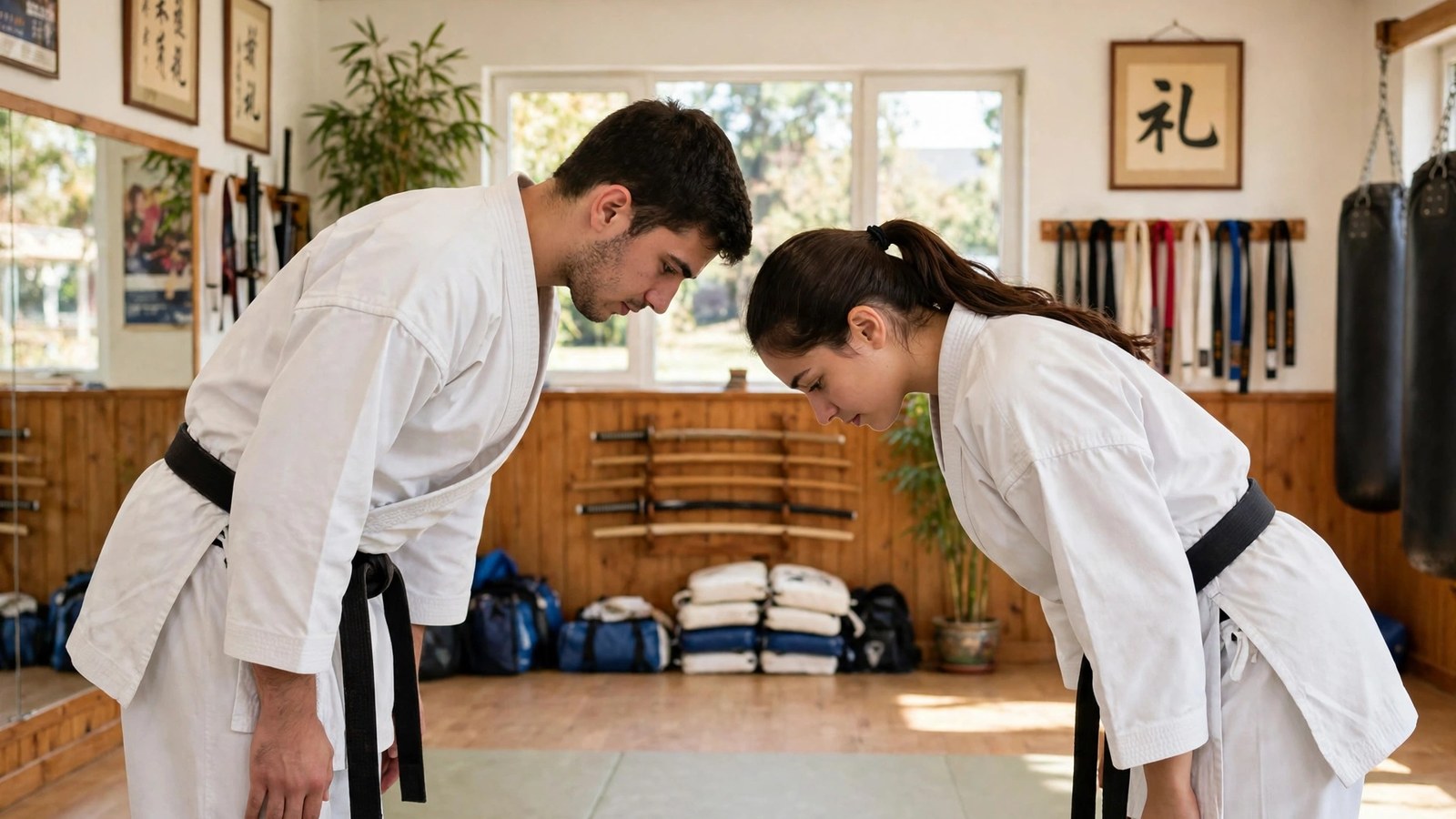
In martial arts, OSS is the written form of a spoken word, osu or ossu, used during training in karate, judo, Brazilian jiu jitsu, and related arts. The European Kyokushin Organisation, a karate federation, describes the pattern in its own tradition: a question in class is answered with osu, a greeting is osu, instructions are answered with osu instead of “yes” or “I understand,” techniques in basic training are accompanied by a loud osu, and fighters at a tournament bow and say osu to the front, to the referee, and to each other before and after a fight.
Brazilian jiu jitsu uses the word in the same spirit. NAGA Fighter, a grappling competition organization, describes oss in BJJ as a versatile expression with no single definition: a greeting to other practitioners, a show of respect, acknowledgement, or agreement, and at times an exclamation of motivation that works as an alternative way of saying “well done.” Its listed moments will be familiar to anyone who trains. You say it when entering or leaving the mat as a greeting or farewell, when a teacher gives an instruction and you acknowledge it, and after a training partner lands a good technique and you want to recognize it.
So a single OSS in a training chat can be doing any of several jobs: hello, yes, understood, thank you, good work, or goodbye. The shared core underneath all of them is acknowledgement with respect. That is why the word survives translation into chat so well. A typed OSS keeps the core and drops the bow.
What sits behind the word
Kyokushin tradition explains osu through its two written characters: oshi, meaning to push, and shinobu, meaning to endure. Read together, they give the phrase osu no seishin, the spirit of osu, which the European Kyokushin Organisation sums up as patience, determination, appreciation, respect, and perseverance, and as a willingness to push yourself to the limit of endurance and persevere under pressure. When a student answers a hard instruction with osu, that background is the point. The word is a small promise to keep going.
Treat that explanation as the tradition’s own account of what the word means to practitioners, which is how this guide presents it. It is the meaning schools teach and students intend, whether or not it is the word’s literal origin, and the origin question is genuinely unsettled, as the next subsection explains.
The honest complications
A careful guide should say plainly that osu is neither universal in martial arts nor fully agreed about, because package summaries often present it as if every Japanese art uses it the same way.
First, its use is concentrated, not universal. Karate sources note that the word became widespread through Kyokushin karate, founded in Japan and spread worldwide from the 1960s, and that it is notably absent from traditional Okinawan karate, the birthplace of the art. Traditional Goju-Ryu, Wado-Ryu, and Shito-Ryu do not use it in their classical forms, and Shotokan practice varies by organization. A student who walks into a traditional Okinawan dojo saying osu at every turn may be corrected, not because the word is wrong everywhere, but because it is not that school’s word.
Second, its origin is disputed. Theories include an early twentieth century Imperial Japanese Navy academy greeting, a Tokyo university sumo club greeting built on enduring pressure, and a linguistic account, researched by a Nagoya University professor, that ossu is a contraction of the polite morning greeting ohayo gozaimasu, with the push and endure characters possibly assigned later because they fit the martial spirit. No single theory commands consensus. What the evidence does support is that the word developed in mainland Japan, not Okinawa, and spread through Kyokushin and cross training.
Third, register matters in Japan itself. Outside the dojo, osu is a very casual, historically masculine greeting among friends and club members in Japan, not a polite all purpose word, and the formal acknowledgement in Japanese karate settings is “hai,” meaning yes or understood. The practical advice from karate sources is to match your environment: use osu where your school uses it, follow the senior students when visiting somewhere new, and choose “hai” when in doubt.
None of this weakens the chat meaning. It explains it. The OSS that appears in a fitness or gaming chat carries the Kyokushin flavored version of the word, the motivational one, because that is the version that traveled.
Pronunciation and spellings
You will meet three spellings: osu, ossu, and oss. They are the same word, filtered through different writing habits. The final vowel is barely pronounced in Japanese, so “oss” is close to what the ear hears, and NAGA Fighter notes that oss rhymes with the word “boss,” while karate practitioners often say osu instead. In chat, capitalization varies just as freely. OSS, Oss, and oss in a training context are the same expression, and the capital form is common because the word began as a spoken shout of acknowledgement.
OSS in Technology: Open Source Software
What the term actually covers
In technology, OSS is the standard short form of open source software, and this is the meaning you should assume in any developer forum, coding discussion, software project page, or technology news chat. The topic is the giveaway. Licenses, repositories, source code, releases, and project names all point here.
Open source is a licensing idea, not just a visibility idea, and the distinction matters. The Open Source Initiative maintains the Open Source Definition, which opens with the point that open source does not just mean access to the source code. Under that definition, the license terms must allow free redistribution, must include the source code or a well publicized way to obtain it, must allow modifications and derived works distributed under the same terms, and must not discriminate against any person, group, or field of endeavor. Software you can merely look at, under a license that forbids modifying or sharing it, is not open source software in this established sense, however open its code page appears.
That definition explains the everyday texture of OSS chat. When developers write “the project is OSS,” “we switched to an OSS alternative,” or “is it really OSS if the license changed,” they are talking about those license rights, not about price. Open source software can be sold, and commercial support can be charged for. What makes it OSS is the license, and arguments in tech communities about whether something counts as OSS are almost always arguments about license terms measured against that definition.
Compressed labels are the normal dialect of technology chat, and OSS is one of a large family. Readers who decode phone and network shorthand meet the same pattern in guides such as our explainer on what LTE means, where a few letters carry a whole technical standard. In every case the expansion only helps if you also know the field the letters belong to.
A second tech reading worth knowing
Within telecommunications and large IT operations, OSS can also mean operations support system, the software systems a network operator uses to manage its network, services, and faults. This reading is established inside that industry and rare outside it. If the chat is about telecom networks, provisioning, or network operations, operations support system may be the intended expansion. If the chat is about apps, code, or licenses, it is open source software. The two tech readings almost never collide in practice, because their conversations happen in different rooms.
Two Older, Formal Meanings: School and History
Two further meanings are fully established but belong to formal contexts, not to chat slang. They appear in this guide because readers searching for OSS meet them, and because a school letter or a history text is exactly where a chat based guess would go wrong.
In United States school terminology, OSS means out of school suspension. The US Department of Education’s Civil Rights Data Collection defines an out of school suspension as an instance in which a child is temporarily removed from their regular school for disciplinary purposes, for at least half a day but less than the remainder of the school year, to another setting such as home or a behavior center. If OSS appears in a message from a school, a discipline notice, or an education news story, this is the meaning, and it has nothing to do with software or martial arts.
In Second World War history, OSS was the Office of Strategic Services, the United States wartime intelligence agency. The US National Archives records that the earlier Coordinator of Information became the Office of Strategic Services on June 13, 1942, that the OSS gathered intelligence across the war, and that it was terminated on September 20, 1945, with its records later passing mainly to the Department of State and to what became the Central Intelligence Agency. In a history book, a documentary discussion, or a genealogy chat about wartime service, OSS means this agency.
Abbreviations that change meaning completely between a workplace, a school, and a history text are common, and the reading skill is always the same. Our guide to what PTO means works through the same problem for a workplace abbreviation whose expansion depends entirely on which conversation you are standing in.
Oh So Sorry: A Reported Reading, Not a Settled One
Oh So Sorry appears in this guide because the source package for this article reports it, and reporting it honestly means labeling its strength correctly. It is a reading offered by one secondary slang page. It is not recorded here as an established dictionary meaning, it has no visible community of use comparable to the martial arts expression, and it is not given the same weight as open source software anywhere in this article.
There is also a practical reason to doubt it as a default reading. An apology only works if the other person understands it instantly. A sender who is genuinely sorry will usually write the apology out, or use a clear and familiar short form, because burying “sorry” inside an ambiguous three letter code that most readers would decode as software or as a martial arts reply defeats the purpose of apologizing. That logic does not prove no one has ever meant Oh So Sorry by OSS. It does show why the reading should never be your first guess.
If you meet OSS in a message that is clearly apologetic in its surrounding words, with no technology topic and no training context anywhere in the conversation, Oh So Sorry is a possible reading to hold lightly. The correct move is to read the sentences around it, and if they still leave you unsure, ask. Do not repeat the reading to others as the meaning of OSS. Weak readings spread exactly that way, one confident repetition at a time.
This corner of slang research is full of contested expansions, and the honest pattern is worth copying. Our companion guides to the OMK abbreviation in text and to HGS meaning in text take the same approach with their letters: separate what is established, what is reported, and what is simply guessed, rather than printing every expansion as if all of them were equal.
OSWS: No Verified Meaning
The package for this article also recorded a search phrase about OSWS, and the honest finding is that OSWS has no verified meaning in the evidence available. It is not a spelling variant of OSS in any established sense, and this guide does not invent a full form for it.
If OSWS appears in a message you receive, treat it as unclear. It may be a typo, an internal code from the sender’s workplace or school, or a private shorthand inside one group. Check the surrounding words, and ask the sender what they meant. Similar letters are not evidence of a shared meaning, and merging OSWS into OSS would mislead you in exactly the way this guide exists to prevent.
How to Work Out Which OSS You Are Looking At
When a bare OSS lands in your messages, work through three checks in order. They settle the great majority of cases in seconds.
Check the topic first. Software, code, apps, licenses, or a named project means open source software. Training, gyms, matches, or martial arts means the expressive martial arts reply. School discipline means out of school suspension. Wartime or intelligence history means the Office of Strategic Services. Topic beats spelling every time.
Check the community second. A developer server, a training group chat, a school parents group, and a history forum each have a house meaning for OSS, and the house meaning is almost always the intended one. Newer members of a group misread imported abbreviations most often, precisely because they apply the house meaning of a different group.
Check the grammar third. The martial arts OSS stands alone as a complete reply: “OSS.” The software OSS behaves like a noun inside a sentence: “try the OSS version,” “it is an OSS project.” If the letters are part of a sentence about a product, they are the abbreviation. If they are the whole message, they are the expression.
Where all three checks fail, the message is genuinely ambiguous, and a five word question, “Do you mean the software?” or “Is that a yes?”, beats a confident wrong reading. Context dependent abbreviations reward that habit generally. Our guide to MS meaning in text and chat is built around the same situation, one short form whose right reading changes with the conversation around it.
How to Reply, and How to Use OSS Well
Replying well starts with replying to the meaning, not the letters. If a training partner sends OSS after you confirm a session time, they have said yes with respect and energy, and a matching short reply, naming the time once more, keeps the plan solid. If a colleague writes that a tool “is OSS,” they have told you something about its license, and the useful reply asks about the license, the project, or the support model, not about the letters. If a school message uses OSS, reply to the suspension itself, its dates and arrangements, and ask the school office directly if anything about it is unclear.
Using OSS yourself is mainly a matter of audience. Use the expressive OSS with training partners, martial arts friends, fitness group members, and others who already use it the same way, to show respect, acknowledgement, agreement, encouragement, or readiness. Use the abbreviation freely in tech writing where your readers work with software. Spell everything out, in either case, when the reader might not share the code: a first professional contact, a formal email, a teacher, a client, or anyone you know prefers full sentences. The clearer phrase costs a few seconds and never needs a follow up explanation.
One specific warning follows from the Oh So Sorry section. Do not use OSS to apologize. If you mean sorry, write sorry, in full, with the reason attached. An apology that needs decoding is not an apology yet.
Common Mistakes and Confusions
Assuming OSS always means open source software. That is the right reading in tech rooms and the wrong one in a gym group chat, where nobody is discussing licenses. The letters are shared; the meanings are not.
Assuming the martial arts word is an abbreviation. Osu does not break down into three English words, and expansions invented for it in chat are guesses. Its written characters and its spoken history are Japanese, and its origin is disputed even among karate sources.
Using osu in every martial arts setting. The word belongs strongly to Kyokushin and to arts and gyms influenced by it. Traditional Okinawan styles and several classical Japanese styles do not use it, and “hai” is the safe acknowledgement when you are visiting and unsure.
Treating Oh So Sorry as a standard meaning. It is a reported reading from one secondary page, with no established pattern of use behind it. Quoting it as fact spreads a weak claim.
Reading OSWS as OSS. OSWS has no verified meaning and is not a variant. Slow down and ask, rather than importing a meaning from a similar looking string.
Sending OSS to the wrong audience. To a reader outside the training or tech worlds, OSS communicates nothing except that a message was short. If clarity matters more than flavor, write the full phrase.
Frequently Asked Questions
What does OSS mean in chat?
In casual chat, OSS is usually an expression of respect, acknowledgement, agreement, encouragement, or readiness, borrowed from martial arts culture. In a technology chat, the same letters mean open source software. The topic and the community decide which one you are looking at.
What does OSS mean in martial arts?
It is the written form of osu or ossu, a spoken expression used in karate, judo, Brazilian jiu jitsu, and related arts to greet, to answer an instruction with “understood,” to acknowledge a partner’s technique, and to show respect and readiness. Kyokushin tradition connects it with the characters for push and endure, and with patience, determination, appreciation, respect, and perseverance.
What does OSS stand for in software?
Open source software. The phrase means software distributed under a license that, under the Open Source Initiative’s definition, allows free redistribution, includes or makes available the source code, allows modifications and derived works, and does not discriminate against people, groups, or fields of endeavor.
Does OSS mean Oh So Sorry?
Only as a reported reading. One secondary slang page offers Oh So Sorry as an expansion, but it is not an established meaning and has no pattern of use comparable to the software or martial arts senses. Consider it only when a message is unmistakably apologetic and no other context fits, and even then, confirm rather than assume.
What does OSS mean in school?
Out of school suspension, a disciplinary removal in which a student is temporarily removed from their regular school, for at least half a day, to another setting such as home. The US Department of Education uses this definition in its Civil Rights Data Collection.
What was the OSS in the Second World War?
The Office of Strategic Services, the United States wartime intelligence agency. It was formed on June 13, 1942, from the Coordinator of Information, and was terminated on September 20, 1945, according to the US National Archives.
Is OSS the same as OSU?
Yes, in the martial arts sense. Osu, ossu, and oss are spellings of the same spoken expression. The final vowel is barely pronounced, so oss is close to how it sounds, and each spelling is common in different communities, with oss especially common in Brazilian jiu jitsu.
What does OSWS mean?
No verified meaning was found for OSWS in the evidence behind this guide. It is not a variant of OSS. If you receive it, read the surrounding message and ask the sender what they meant.
Should I use OSS in a work message?
Only where the abbreviation or the expression is already the house style of that team. A software team will read OSS as open source software without effort. A general work audience may read it as neither meaning, so in formal or first contact messages, write the full words instead.
Sources & references
- Open Source Initiative, The Open Source Definition (version 1.9). States that open source does not just mean access to the source code, and sets the license criteria used in this guide, including free redistribution, source code availability, derived works, and no discrimination against persons, groups, or fields of endeavor. Text opened and read in full for this adaptation. https://www.opensourcesociety.org/p/definition.html
- European Kyokushin Organisation, The Meaning of Osu. Describes how osu answers questions and instructions in class, accompanies techniques and tournament bows, and is explained through oshi (push) and shinobu (to endure) as patience, determination, appreciation, respect, and perseverance. https://www.european-kyokushin.org/wp/wp-content/uploads/2019/05/The_meaning_of_Osu.pdf
- NAGA Fighter, What Does OSS Mean? Describes oss in Brazilian jiu jitsu as a greeting and a versatile show of respect, acknowledgement, agreement, and motivation, used when entering or leaving the mat and when acknowledging instruction, rhyming with boss. https://www.nagafighter.com/oss-meaning-bjj/
- Karate Lifestyle, What Is Oss and Should You Use It? Records that the origin of osu is disputed, with navy academy, university sumo club, and morning greeting contraction theories, that it spread through Kyokushin, and that it is absent from traditional Okinawan karate and several classical styles. https://karatelifestyle.uk/training/what-is-oss/
- US National Archives, OSS Records. Records that the Coordinator of Information became the Office of Strategic Services on June 13, 1942, and that the OSS was terminated on September 20, 1945. https://www.archives.gov/research/military/ww2/oss
- US Department of Education, Civil Rights Data Collection resource document, Out-of-School Suspension, Instances of Suspension, and School Days Missed (revised December 11, 2024). Defines out of school suspension as an instance in which a child is temporarily removed from their regular school for disciplinary purposes, for at least half a day but less than the remainder of the school year. https://crdc.communities.ed.gov/sites/default/files/2024-12/Out-of-School%20Suspension,%20Instances%20of%20Suspension,%20and%20School%20Days%20Missed%20(K-12)_0.pdf


