Short answer
- Drain and rinse one 15 ounce can of chickpeas, dry them thoroughly on towels, and rub off loose skins. Toss with 1 tablespoon olive oil and 1/4 teaspoon fine salt. Air fry at 390 degrees Fahrenheit for 15 to 20 minutes in a single layer, shaking every 5 minutes, until golden, dry, and crisp, then cool in a single layer because they crisp further as they cool. For smoky paprika, toss the spice blend on before cooking. For garlic parmesan, cook with the garlic spices only and toss the hot chickpeas with finely grated parmesan at once after cooking. For cinnamon sugar, add the blend in the last few minutes and lightly again while warm, because sugar browns fast. Serve within 2 hours, or within 1 hour if the room is above 90 degrees Fahrenheit. Refrigerate leftovers promptly at 40 degrees Fahrenheit or below, use them within 3 to 4 days, and reheat them to 165 degrees Fahrenheit.
Introduction
Air-fryer roasted chickpeas solve a familiar snack problem: the craving for something crisp and salty that is not another handful of chips. In an air fryer, a can of chickpeas can turn golden and crunchy in about 15 to 20 minutes with only a tablespoon of oil, and the same base batch can carry very different flavors. This guide gives one base method and three seasonings, smoky paprika, garlic parmesan, and cinnamon sugar, so you can make one version or all three for a small snack spread.
The air fryer suits chickpeas because circulating hot air dries the surface quickly, and a dry surface is what crispness needs. Oven roasting can also work, but it usually takes longer. The basket is small, which limits large batches but suits snack sized batches that cook in a single layer.
This article covers choosing canned or home cooked chickpeas, drying them properly, the step by step method, the timing change each seasoning needs, serving, troubleshooting, and storage. Storage is handled carefully. Roasted chickpeas are crispest on the day they are made, and any leftover portion is treated here as a cooked leftover under federal food safety guidance, not as a shelf stable pantry snack. The food safety guidance was checked against FoodSafety.gov and United States Department of Agriculture Food Safety and Inspection Service guidance recorded as directly fetched in the package quality reports on 31 October 2026.
Why This Method Works
Two things decide whether roasted chickpeas are crisp or disappointing, and both are about moisture. The first is drying. Chickpeas straight from a can are wet, and wet chickpeas steam instead of crisping. Draining, rinsing, towel drying, and a short air dry give the hot air a dry surface to work on.
The second is space and movement. A single layer, shaken every 5 minutes, lets hot air reach every side. A crowded basket traps steam, so the top chickpeas crisp while the ones underneath stay soft. If your basket is small, cook in two batches rather than piling one batch deep.
Seasoning timing is the third factor. Dry savory spices tolerate the full cooking time when tossed with oil first. Parmesan browns quickly, so it goes on after cooking while the chickpeas are hot. Sugar caramelizes and then darkens fast, so cinnamon sugar goes on late and as a light finish.
Ingredients
This recipe makes about 2 cups from one can. To make all three seasonings, repeat the base for each batch, or divide a larger amount only if your basket can still hold it in a single layer.
Base for one batch
- 1 can (15 ounces) chickpeas, drained and rinsed, or 1 and 1/2 cups cooked chickpeas, drained very well
- 1 tablespoon olive oil
- 1/4 teaspoon fine sea salt
Seasoning 1: Smoky paprika
- 1 teaspoon smoked paprika
- 1/2 teaspoon garlic powder
- 1/2 teaspoon ground cumin
- 1/4 teaspoon onion powder
- Pinch of cayenne pepper, optional
Seasoning 2: Garlic parmesan
- 1/2 teaspoon garlic powder
- 1/4 teaspoon onion powder
- 1/4 teaspoon dried oregano or Italian seasoning
- 3 tablespoons finely grated parmesan cheese
- 1 teaspoon olive oil, extra, for tossing after cooking, optional
Seasoning 3: Cinnamon sugar
- 1 tablespoon granulated sugar
- 1 teaspoon ground cinnamon
- Pinch of ground nutmeg, optional
- Pinch of fine sea salt
Ingredient Notes
Canned chickpeas are the practical choice and the most consistent. Drain them, rinse well under cold running water to remove can liquid and excess surface salt, and drain again. Home cooked chickpeas also work if they are tender but intact and drained very well. Undercooked chickpeas stay hard in the center after air frying, and very soft chickpeas fall apart when tossed.
Olive oil helps seasoning adhere and promotes browning, but only a little is needed. More oil does not make chickpeas crisper. It makes them greasy and can cause seasoning to slide off. An oil spray gives an even lighter coating if you prefer it.
Smoked paprika defines the first seasoning. Sweet paprika gives color and mild flavor but not the same smoky depth. Garlic powder is used instead of fresh garlic because fresh garlic burns quickly in an air fryer and can turn bitter, while garlic powder distributes evenly and tolerates the heat.
For garlic parmesan, use finely grated cheese so it coats instead of falling to the bottom of the bowl. Traditional parmesan style cheeses may be made with animal rennet, so check the label if that matters. For cinnamon sugar, granulated sugar gives the clearest coating. A sugar substitute for baking will not caramelize the same way, so treat that swap as a different texture.
Equipment You Will Need
You need an air fryer, a colander, clean kitchen towels or paper towels, a large bowl, and a baking sheet or large plate for cooling. No other special equipment is needed.
Air fryer models vary in fan strength and in how hot a stated setting runs. The time and temperature here are recipe guidance, not a guarantee for every model. Use the visual and texture checks in the method, check earlier the first time you make this in your machine, and follow your appliance manual for basket limits and preheating.
Preparing the Chickpeas
Drain the chickpeas into a colander and rinse thoroughly under cold running water. Drain well, then spread them in a single layer on a clean kitchen towel or several layers of paper towels. Pat dry, rolling them gently in the towel.
Some thin skins will come off during drying. Pick out loose skins and discard them, because loose skins can brown faster than the chickpeas and removing them helps crispness. You do not need to remove every skin. That is slow and unnecessary, and the chickpeas will still crisp well if only the loose skins are removed.
Let the chickpeas air dry for 10 to 15 minutes if you have time. The drier they are going in, the crisper they come out. Wash your hands with soap and water for at least 20 seconds before handling food. FoodSafety.gov groups home food safety into clean, separate, cook, and chill, and clean and chill matter most here.
Method: Step by Step
Step 1: Mix the seasoning
For smoky paprika, stir the paprika, garlic powder, cumin, onion powder, and cayenne, if using, in a small bowl. For garlic parmesan, stir the garlic powder, onion powder, and oregano in a small bowl and keep the parmesan separate. For cinnamon sugar, stir the sugar, cinnamon, nutmeg, if using, and pinch of salt in a small bowl and keep it aside until late in cooking.
Step 2: Coat with oil and salt
Place the dried chickpeas in a large bowl, drizzle with the olive oil, and toss until lightly coated. Sprinkle with the salt and toss again. For smoky paprika, add the full spice blend now. For garlic parmesan, add only the garlic spice blend now. For cinnamon sugar, cook with oil and salt only at this stage.
Step 3: Preheat and load in a single layer
Preheat the air fryer to 390 degrees Fahrenheit for 3 to 5 minutes if your model uses preheating. Place the chickpeas in the basket in a single layer with space between them where possible. Do not overfill. If they form more than one layer, cook in two batches.
Step 4: Air fry, shaking often
Cook for 15 to 20 minutes, shaking the basket vigorously or stirring every 5 minutes. Start checking at 15 minutes, because models vary. They are ready when golden, dry, rattling when the basket is shaken, and crisp in the center once a test chickpea has cooled.
For cinnamon sugar, pause when about 3 to 4 minutes remain, toss quickly with about two thirds of the blend, and return to finish. Watch closely in those final minutes, checking every 1 to 2 minutes, because sugar can move from golden to burnt quickly.
If chickpeas are still soft at 20 minutes, continue for a few more minutes, checking frequently. If a few brown much faster, shake again and lower the heat slightly for the remaining time.
Step 5: Finish each version while warm
For smoky paprika, taste a cooled chickpea and add a tiny pinch more salt if needed while the rest are warm. For garlic parmesan, transfer the hot chickpeas to a clean bowl at once, drizzle with the extra teaspoon of olive oil if using, sprinkle over the parmesan, and toss vigorously so the cheese softens from residual heat and clings. Do this right away, not after cooling, or the cheese will mostly fall off. For cinnamon sugar, toss the hot chickpeas with the remaining blend while warm, then taste a cooled one before adding more.
Step 6: Cool in a single layer
Spread the finished chickpeas in a single layer on a baking sheet or plate and let them cool completely before judging final texture. They crisp further as they cool. A chickpea that feels slightly soft while hot often turns crisp as it cools, so do not send a good batch back for long extra cooking based only on a hot taste.
The Three Seasonings in Detail
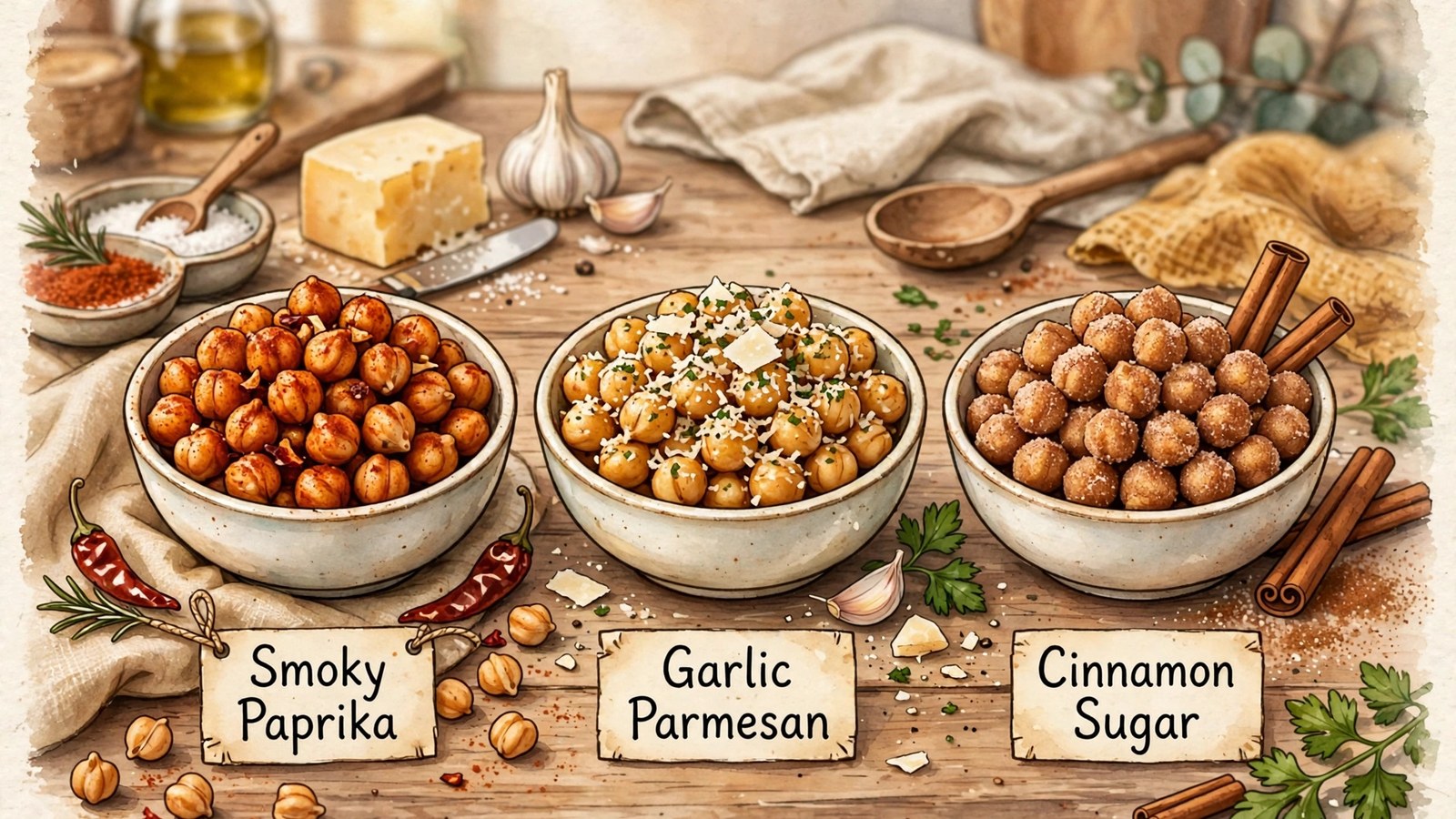
Smoky paprika chickpeas are the most versatile, savory and gently smoky, working as a snack, salad topping, soup garnish, or grain bowl crunch. A squeeze of lemon after cooking brightens them. Add lemon after cooking only, because liquid before cooking works against crispness.
Garlic parmesan chickpeas are the richest version and soften sooner because of the cheese coating, so serve them promptly and refrigerate any leftover portion.
Cinnamon sugar chickpeas are the sweet version, with warm cinnamon and a light caramelized coating. Watch them most closely. The right stopping point is deep golden and crisp after cooling, not dark brown in the basket.
Dry thoroughly, cook in a single layer, shake often, and season while warm. Those habits prevent most failures.
Serving Ideas
Serve in small bowls, or scatter over salads, soups, and grain bowls for crunch. Smoky paprika suits a taco salad or grain bowl, garlic parmesan suits tomato soup, and cinnamon sugar suits yogurt with berries if the yogurt stays chilled. For a spread, serve the three versions in separate labeled bowls, put out only what will be eaten within 2 hours, and keep the rest refrigerated.
Storage, Reheating, and Food Safety
This section separates crispness from safety, because they are not the same question. Crispness is best on the day the chickpeas are made. They stay crisp for several hours in a dry environment while being served, then gradually absorb moisture and soften. That softening is a quality change. Safety is governed by how long cooked food sits at room temperature and how leftovers are chilled and reheated.
FoodSafety.gov advises refrigerating perishable food within 2 hours, or within 1 hour if exposed to temperatures above 90 degrees Fahrenheit, such as at a summer picnic or in a hot car. Bacteria that cause food poisoning multiply quickest between 40 degrees Fahrenheit and 140 degrees Fahrenheit. Keep your refrigerator at 40 degrees Fahrenheit or below and your freezer at 0 degrees Fahrenheit or below.
Do not follow common advice to keep homemade roasted chickpeas in a jar at room temperature for days and treat them as shelf stable. This home method was not tested here as a shelf stable process, and the package draft claim of room temperature storage for up to 3 days is not carried forward. Cool leftovers promptly, place them in shallow covered containers, and refrigerate them. The United States Department of Agriculture Food Safety and Inspection Service states that leftovers can be kept in the refrigerator for 3 to 4 days or frozen for 3 to 4 months, although frozen leftovers lose moisture and flavor and roasted chickpeas lose crisp texture after freezing and thawing.
That correction matters in two ways. Refrigeration may soften the chickpeas, but it is the safe place for leftovers, and brief reheating can restore some crunch. And the time limit is not only for the parmesan version. The 2 hour rule, and the 1 hour rule above 90 degrees Fahrenheit, is applied here to all three versions at a gathering or in a lunchbox. Keep a lunch portion chilled until eating.
When reheating refrigerated leftovers, reheat them to 165 degrees Fahrenheit as measured with a food thermometer, as listed for leftovers. In practice, reheat in the air fryer at about 350 degrees Fahrenheit for 3 to 5 minutes, shaking once, until hot throughout and crisped again, and check the temperature where you can. Texture will be less even than a fresh batch. If leftovers were left out beyond the limits above, discard them. Reheating does not make food that sat out too long a good choice.
Thaw frozen leftovers in the refrigerator, in cold water in a leak proof bag, or in the microwave, never on the counter. For maximum crunch, make a fresh small batch instead of a large batch for the week.
Allergen and Dietary Notes
This section is factual information for planning and serving, not medical advice. The garlic parmesan version contains milk, in the form of parmesan cheese. Milk is one of the nine major food allergens listed by the Food and Drug Administration: milk, egg, fish, crustacean shellfish, tree nuts, wheat, peanuts, soybeans, and sesame. Sesame became the ninth major allergen under the Food Allergy Safety, Treatment, Education, and Research Act, with labeling required from 1 January 2023.
The base chickpeas, oil, salt, and single spices in the other versions do not contain those allergens as written, but that is not a guarantee about any specific product. Spice blends and pre grated cheeses can vary. Read the entire ingredient list every time you buy a product, because ingredients can change, and check with the person affected if you cook for someone with an allergy. Do not rely on picking cheese coated chickpeas out of a shared bowl to make the rest safe for a guest with a milk allergy. Make a separate batch with clean utensils if needed, or choose a different snack.
On gluten, the careful statement is qualified rather than absolute. Chickpeas, oil, salt, and single spices are not wheat ingredients, but this guide does not certify any version as gluten free for another household. Check any pre mixed blend and cheese label, and consider cross contact if you cook for someone who must avoid gluten for medical reasons.
On nutrition, cooked chickpeas provide fiber and plant protein in United States Department of Agriculture FoodData Central entries, but no specific calorie, protein, or fiber promise is made here for a home serving, because oil, sugar, cheese, and portion size vary. Calculate from your own labels if you track nutrition.
Troubleshooting
If chickpeas are soft, they were probably wet going in, crowded, or undercooked. Return them to the air fryer for a few more minutes, shaking often, provided they have not sat out beyond the serving limits. Next time, dry more thoroughly and cook in a single layer.
If chickpeas are burnt, the temperature was high for your model or they cooked too long, especially the cinnamon sugar version. Burnt chickpeas taste bitter and cannot be rescued. Next time, check earlier and consider a slightly lower setting for the final minutes.
If seasoning falls off, toss with oil before adding dry spices and season while warm. For parmesan, toss at once after cooking. If cooking is uneven, the basket was crowded or shaking was too infrequent, so cook in smaller batches. If flavor is bland, add a little more salt to the warm batch, because the rinsed chickpeas carry little salt of their own.
Oven Variation
If you do not have an air fryer, spread seasoned chickpeas in a single layer on a baking sheet lined with parchment and roast at 400 degrees Fahrenheit for about 25 to 35 minutes, stirring every 10 minutes, until crisp after cooling. Apply the same seasoning timing, parmesan after roasting and cinnamon sugar late, and the same storage guidance. Do not pile chickpeas deep, because depth recreates the crowding problem.
Frequently Asked Questions
Can I use dried chickpeas I cooked myself?
Yes, if they are cooked until tender and drained very well. Undercooked chickpeas stay hard in the center after air frying, and very soft chickpeas fall apart. Aim for tender but intact, drain thoroughly, and dry as described for canned chickpeas. Canned chickpeas are more consistent for a first attempt.
Do I need to remove all the skins?
No. Removing loose skins improves crispness, because loose skins brown fast. Removing every skin is time consuming and unnecessary. Rub gently in a towel, pick out skins that come off easily, and leave the rest.
How long do roasted chickpeas stay crisp?
They are crispest on the day they are made, for several hours while serving in a dry environment. After that they gradually soften. That is a quality point, not permission to store them at room temperature for days. Refrigerate leftovers within 2 hours, or within 1 hour above 90 degrees Fahrenheit, use them within 3 to 4 days, and reheat them to 165 degrees Fahrenheit, using a short air fryer reheat to restore some crunch.
Can I make these in the oven instead?
Yes. Use the oven variation above, 400 degrees Fahrenheit for about 25 to 35 minutes in a single layer, stirring every 10 minutes. Keep the seasoning timing for parmesan and cinnamon sugar, and follow the same serving and leftover rules.
Can I make a spicy version?
Yes. Add cayenne pepper, chili powder, or chipotle powder to the smoky paprika blend, starting small and tasting a cooled chickpea before adding more, because heat builds as you eat. Keep drying and the single layer unchanged.
Are these suitable for a lunchbox?
They can be, with chilling. Pack a cooled portion in a lunch that stays refrigerated or chilled with an ice pack until eating, and eat it within the 2 hour window once out of chilling, or within 1 hour in heat above 90 degrees Fahrenheit. Do not pack a morning portion to sit at room temperature until afternoon on the assumption that roasted chickpeas are shelf stable. They are a cooked leftover in this guide.
Sources & references
- FoodSafety.gov, 4 Steps to Food Safety. Used for the four steps clean, separate, cook, and chill, washing hands for at least 20 seconds, keeping a refrigerator at 40 degrees Fahrenheit or below and a freezer at 0 degrees Fahrenheit or below, bacteria multiplying quickest between 40 degrees Fahrenheit and 140 degrees Fahrenheit, and refrigerating perishable food within 2 hours or within 1 hour above 90 degrees Fahrenheit.
- United States Department of Agriculture, Food Safety and Inspection Service, Leftovers and Food Safety. Used for refrigerating leftovers within 2 hours or 1 hour above 90 degrees Fahrenheit, cooling rapidly in shallow containers, keeping leftovers in the refrigerator for 3 to 4 days or frozen for 3 to 4 months, safe thawing in the refrigerator, cold water, or the microwave, and reheating leftovers to 165 degrees Fahrenheit as measured with a food thermometer.
- Food and Drug Administration, Food Allergies. Used for the nine major food allergens, milk, egg, fish, crustacean shellfish, tree nuts, wheat, peanuts, soybeans, and sesame, for sesame becoming the ninth major allergen under the Food Allergy Safety, Treatment, Education, and Research Act with labeling required from 1 January 2023, and for reading ingredient labels because ingredients can change.
- United States Department of Agriculture, FoodData Central, entries for chickpeas (garbanzo beans), cooked. Used only for the general statement that cooked chickpeas provide fiber and plant protein, with no specific figure promised for a home serving, because oil, cheese, sugar, salt, and portion size vary.


