Short answer
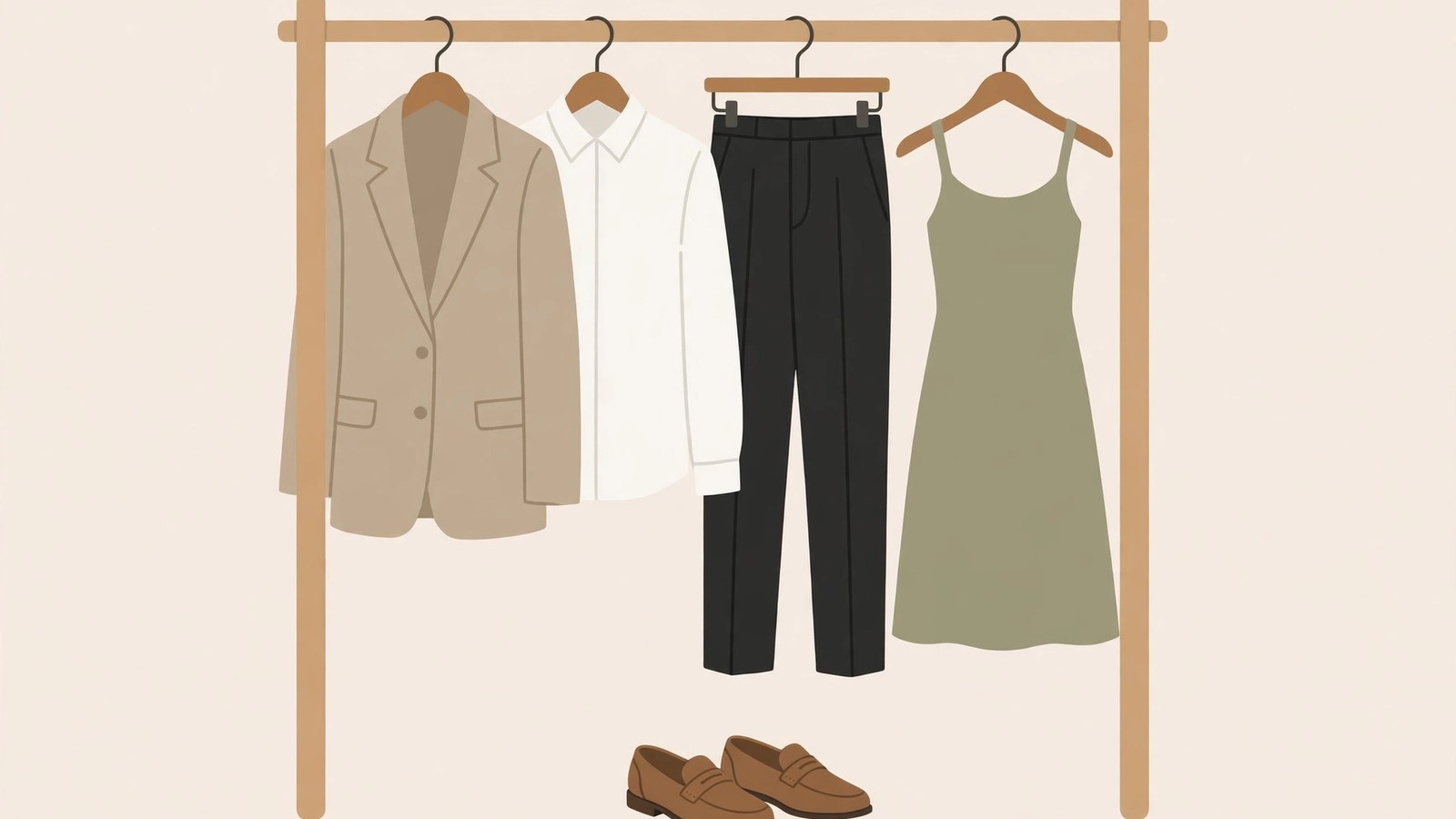
- Build the capsule around pieces you already own and wear, then fill only the gaps. A workable spring example uses 15 pieces: 3 bottoms, 5 tops, 2 dresses, a blazer, a cardigan, a trench coat, and 2 pairs of shoes. If every top works with every bottom and each combination can be worn with the blazer, the cardigan, or no indoor layer, the tops and bottoms give 45 distinct indoor combinations, and the dresses add 6 more, for 51 in total. Plan ten of those as a two-week rotation so no outfit repeats across the fortnight. Match the capsule to your dress code tier, check fiber content and care on the garment label before you rely on any piece, and accept the limits: a capsule this size needs laundry during the week and fails if the fit is wrong, however good the arithmetic looks.
Introduction
A capsule wardrobe for spring work week dressing has to solve several problems at once. Spring mornings can be cool, afternoons can turn warm, rain can arrive during a commute, and many offices run cool once air conditioning starts. A small wardrobe only helps if every piece works at more than one of those temperatures, mixes with most of the other pieces, and still looks right for the meetings on the calendar.
This guide builds one worked example in full: a 15-piece capsule, counted piece by piece, with the outfit arithmetic shown rather than asserted. It then lays out a two-week rotation of ten distinct work outfits, explains how the same capsule shifts across three dress code tiers, and shows how to judge fabric and care from the labels the law already requires on clothing sold in the United States. Nothing here promises that a capsule will save a set amount of money or time, and no figure is given for how much waste a capsule avoids. Those outcomes depend on what a reader already owns, what their job requires, and what they stop or keep buying, so this guide sticks to what can be counted, checked, and planned. Adapt the colors, fabrics, and formality to your own workplace. The structure is the transferable part: few pieces, a limited palette, layers for temperature swings, and a rotation planned in advance.
Start With Your Real Week, Not an Ideal One
Before counting pieces, count days and demands. How many days are spent in the office, how many are remote, and how many involve clients, presentations, or senior meetings? A week of desk work with one presentation day needs a different capsule from a week of client visits, even at the same piece count. Write the week down as it actually runs, including the commute, because the commute decides whether shoes must survive a long walk and whether a coat must handle rain rather than just cold.
Office temperature is the second check. A building that is cool in the morning and warm by afternoon punishes any outfit built for a single temperature, which is why layers here are structural, not decorative. Test each candidate against three conditions: a cool morning, a warm afternoon, and a rainy commute.
The third check is what you already own. A capsule built from scratch in one trip is expensive and risky, because new pieces are unproven: they may not mix, may need alterations, or may demand care you will not give them. Start with the pieces that already fit well and that you reach for often, check them for wear at seams, hems, buttons, and soles, and treat them as the fixed core. The capsule below is a target shape, not a shopping list. Note one honest limit: a capsule reduces morning decisions only after this setup is done, and skipping the try-on work is the usual reason a capsule appears not to work.
The Counted Capsule: 15 Pieces
The worked example uses a limited palette so the mixing claim can be tested rather than assumed. The neutrals are navy and charcoal, with white and cream as light options, and one accent carried by a patterned blouse and a striped top. Every top must work with every bottom, and both indoor layers must work over every top and both dresses. A piece that only pairs with one other item does not belong in this count, because it breaks the multiplication that makes a small wardrobe produce many outfits.
The 15 pieces are:
- Bottoms, 3 pieces: navy trousers, charcoal trousers, and a navy midi skirt. If you never wear skirts, substitute a second style of trousers in a third neutral; the counts below stay the same.
- Tops, 5 pieces: a white button shirt, a cream blouse, a striped long-sleeve top, a patterned blouse, and a fine-knit sweater worn as a top on cooler days.
- Dresses, 2 pieces: a navy dress and a second dress in charcoal or the accent color, each wearable alone or under either indoor layer.
- Indoor layers, 2 pieces: a navy blazer and a lighter cardigan in cream or gray.
- Outer layer, 1 piece: a trench coat or another water-resistant coat long enough to protect hems on a wet commute.
- Shoes, 2 pieces: loafers or block-heeled shoes for everyday wear, and a dressier pair for presentation or client days.
The addition is 3 plus 5 plus 2 plus 2 plus 1 plus 2, which equals 15. Accessories are deliberately not counted. A scarf, a belt, and a tote are useful, and Purdue Extension guidance makes the underlying point well: accessories should go with several items rather than one outfit only. But accessories change the finish of an outfit rather than creating a new core combination, so counting them would inflate the number. Shoes are counted in the 15 but are not multiplied into the outfit count below, for a similar reason: a shoe swap changes formality and comfort, but calling it a new outfit would double the total on paper while changing very little in the mirror.
Two conditions make or break this inventory. First, palette discipline: if the patterned blouse clashes with the skirt, the honest count falls. Second, layer fit: the blazer and the cardigan must both close comfortably over the thickest top, the fine-knit sweater. A layer that only fits over thin blouses is not a layer for the whole capsule.
The Arithmetic: How 15 Pieces Give 51 Combinations
The outfit count follows from the mixing conditions above, and each step can be checked. Step one is tops with bottoms: 5 tops and 3 bottoms, with every top working with every bottom, give 5 multiplied by 3, which equals 15 basic combinations. Extension wardrobe guidance uses the same logic at a smaller scale: one pair of pants that pairs with four tops creates four outfits, and a sweater across tops and two pairs of pants expands the total further. The principle is coordination first, then multiplication.
Step two adds the indoor layer choice. Each of those 15 combinations can be worn with the blazer, with the cardigan, or with no indoor layer, so 15 multiplied by 3 equals 45 distinct indoor combinations. Distinct means a different set of core pieces: changing only a scarf, a belt, or shoes does not create a new counted combination.
Step three adds the dresses: 2 dresses multiplied by 3 layer choices equals 6. The total is 45 plus 6, which equals 51 distinct indoor combinations. The trench is not multiplied in, because it is worn over any of the 51 for the commute and removed indoors, so counting it would add no new indoor outfit.
Read that total honestly. Fifty-one is a ceiling for a fully coordinated capsule, not a promise that all 51 will suit your calendar. Formal days, laundry timing, and preference all rule some out. The useful conclusion is narrower: even after discarding the combinations you dislike, a coordinated capsule leaves far more than the ten distinct outfits a two-week rotation needs, which is exactly the margin that makes the rotation below possible.
A Two-Week Rotation: Ten Distinct Outfits
The rotation uses ten of the 51 combinations, one for each workday across two weeks. Every line is a different core combination of bottom or dress, top where one applies, and indoor layer. Shoes alternate by day, and the trench is worn over any outfit on a wet commute without changing the count.
Week one:
- Monday: navy trousers, white button shirt, blazer. The most formal pairing, placed on the likeliest meeting day. Dressier shoes.
- Tuesday: navy midi skirt, patterned blouse, cardigan. A softer combination, sharing no core set with Monday. Everyday shoes.
- Wednesday: navy dress, blazer. A single-piece outfit for a presentation or client day. Dressier shoes.
- Thursday: charcoal trousers, striped long-sleeve top, cardigan. A quieter desk day, with the striped top appearing for the first time. Everyday shoes.
- Friday: navy trousers, cream blouse, cardigan. The trousers repeat from Monday with a different top and layer, so the combination is new. Everyday shoes.
Week two:
- Monday: charcoal trousers, white button shirt, blazer. The shirt and blazer return from week one Monday, but the trousers differ and a full week separates the uses. Dressier shoes.
- Tuesday: second dress, cardigan. The second dress appears for the first time, in its softest layer pairing. Everyday shoes.
- Wednesday: navy midi skirt, fine-knit sweater, blazer. The warmest top, suited to a cool day, with the blazer adding structure over the knit. Everyday shoes.
- Thursday: navy trousers, patterned blouse, blazer. Both pieces have appeared before, but never together and never with this layer. Dressier shoes if the day needs it.
- Friday: charcoal trousers, cream blouse, cardigan. The blouse returns from week one Friday with different trousers, closing the fortnight with no repeated combination. Everyday shoes.
Three planning points make the rotation work. First, no bottom is scheduled on consecutive days, which gives each pair of trousers and the skirt a rest day and spreads wear. Second, laundry is assumed midweek and at the weekend: the white shirt is worn in week one Monday and week two Monday, so it must be washed in between, and the same applies to the cream blouse across the two Fridays. A capsule this size does not remove laundry; it concentrates it into predictable loads. Third, the rotation is a default, not a rule. Swap days when weather or meetings demand it, but swap whole combinations rather than improvising piece by piece, or the no-repeat structure collapses. Listing the ten combinations once, on a Sunday, turns the plan into a routine and exposes weak pieces quickly: a top skipped every fortnight is not earning its place.
Dress Code Tiers: One Capsule, Three Settings
Dress code language varies by employer, and no tier below overrides a written workplace policy. Read your own handbook or ask your manager where the wording is unclear. The tiers are a planning framework, not a claim about what any particular employer requires.
Tier one is formal or traditional business dress, still found in parts of law, finance, and client-facing work. The blazer becomes the default layer, the cardigan drops out of weekday use, and the dressier shoes become the everyday pair. Expect the capsule to feel tight: a strict code narrows the usable combinations well below 51, because the no-layer and cardigan versions no longer count as appropriate. This tier usually needs the second layer slot to become a second blazer, keeping the count at 15 while shifting its balance toward tailoring.
Tier two is business casual, the setting this capsule was built for. The blazer is reserved for meetings and presentations, the cardigan carries ordinary days, loafers or block heels are the default shoes, and the full rotation above applies without adjustment. Most of the 51 combinations are usable here, subject to local judgments about necklines, hem lengths, and how sheer or close-fitting a top can be. Where a policy is written down, its specific exclusions govern over any general description here.
Tier three is smart casual or creative casual, where workplaces allow more color, texture, and relaxed footwear. The capsule loosens rather than shrinks: the trench can be swapped for a denim or utility jacket, clean and simple sneakers can take the everyday shoe slot if the workplace allows them, and the accent color can widen. The risk is the opposite of the formal tier: with fewer rules, pieces drift apart in style until they stop mixing, and the multiplication collapses. A relaxed piece that only works in one outfit is a weekend piece, not a capsule piece.
Hybrid work cuts across all three tiers. Video calls show the upper half, so tops and layers carry the professional signal, while comfort decides the rest. Run the same rotation for office days and a reduced version at home, but do not build a separate home wardrobe that duplicates the tops: the blazer kept ready for calls is the same blazer in the rotation.
Fabrics and Labels: Judge the Piece, Not the Promise
Fabric advice is often given as confident generalities. How a fabric behaves depends on its fiber content, its weave or knit, its finish, and its care, so the most reliable spring fabric check is not a memorized list. It is the garment label, which United States law already standardizes in two ways a capsule shopper can use directly.
First, fiber content. The Federal Trade Commission guide to the labeling requirements under the Textile and Wool Acts explains that most textile products must carry a label listing fiber content, country of origin, and the identity of the manufacturer or another business responsible for the item. For covered products, generic fiber names and percentages by weight are listed in descending order of predominance, so the first fiber named is the largest share. In general only fibers making up 5 percent or more of the fiber weight are named individually, with fibers below that share grouped as other fiber, although wool must be named even below 5 percent, and a fiber below 5 percent may be named when it has a definite functional significance, as a small share of spandex does for elasticity. That rule turns a vague description such as a cotton blend shirt into a checkable fact: read the order and the percentages to see whether cotton leads the blend or merely appears in it.
Second, care. A separate Federal Trade Commission rule, the Care Labeling Rule at 16 CFR Part 423, requires manufacturers and importers to provide regular care instructions through care labels. A care label is a permanent label that must remain legible during the useful life of the product, and labels must in general carry either a washing instruction or a drycleaning instruction. A washing instruction must cover washing, drying, ironing where regularly needed, bleaching, and any necessary warnings. The rule also defines its temperature words: for machine washing, cold means an initial water temperature up to 86 degrees Fahrenheit, warm means 87 to 111 degrees, and hot means 112 to 145 degrees. University of Kentucky Cooperative Extension guidance adds the point that matters most for a capsule: only one safe method of care has to be listed, regardless of how many could be used, and the label does not have to warn about other methods that might prove unsafe, so clothing labeled washable may not dry clean well. The University of Tennessee Extension guide states the same limit.
Applied to spring pieces, the label method gives practical tests instead of slogans. A linen blend trouser is not automatically easier than a pure linen one; compare the fiber order on both labels, then judge wrinkle and drape by handling the garment, because the label states content, not how the fabric will look after a commute. A knit whose label gives only a drycleaning instruction carries a different weekly cost from one that allows machine washing, and a drycleaning-only dress or blazer is a slower piece: it cannot be refreshed midweek at home, so the rotation must not depend on wearing it twice in a fortnight unless turnaround allows it.
Fit is the other half of the judgment. Purdue Extension guidance gives a usable test: try the garment on and check movement standing, sitting, and walking, including swinging the arms, bending, and sitting down, because clothing that is too tight will feel uncomfortable and trousers or skirts that pull under strain are not fitting as they should. Add two work checks: sit at desk height and confirm the waistband stays comfortable, and raise both arms as if reaching a shelf. A piece that needs constant adjusting will be avoided on busy mornings, and an avoided piece silently reduces the real combination count below the arithmetic one.
Care That Keeps a Small Wardrobe Working
A capsule piece is worn and washed far more often than a piece in a large wardrobe, so care is what keeps the counted combinations available. Purdue Extension laundry guidance starts with sorting: sort by color, washing whites with whites, light colors with light colors, and dark colors with dark colors; sort by amount of soil; and sort by fabric type, following each care label, such as washing in cold water or laying an item flat to dry. Careful sorting matters because incorrect sorting can leave clothing gray or stained, which in a small wardrobe can mean a planned outfit is missing on its scheduled morning.
Three capsule habits follow. First, check each care label again at sorting time, not just at buying time. Purdue guidance warns that if a label says dry clean only, laundering the item can cause damage, and in a rotation that damage removes every combination built on that piece at once. Second, use the return protection the system already provides. University of Kentucky Extension explains that if you followed the cleaning instructions on the care label and the garment was damaged, you can return it to the retailer and ask for an exchange or a refund, and the Tennessee guide makes the same point, describing the safe method on the label as, in effect, a care warranty. Keep receipts for core pieces for that reason. Third, do small repairs promptly, and let the rotation rest days spread wear across the bottoms and dresses instead of concentrating it on a favorite. Spring adds one weather habit: the trench and the everyday shoes take the rain load, so let both dry fully before the next wear where the schedule allows, and keep the dressier shoes out of wet commutes.
Filling Gaps Without Breaking the System
If your starting closet does not match the 15-piece shape, fill gaps one named piece at a time: second trousers in charcoal, a cardigan that closes over the knit sweater, a dress that works under the blazer. Purdue Extension guidance states the coordination rule plainly: try to buy clothes that go with at least two other items you already own, and make sure accessories go with several items as well. For this capsule, set the bar higher. A new top should work with all three bottoms and under both indoor layers, because anything less lowers the multiplication the whole plan rests on.
Try a candidate on with pieces you already own, and read both labels before paying: fiber content for what the garment mainly is, and care for whether its method fits your weekly routine. Avoid a second version of a piece you already have unless the first is worn out, because a duplicate adds no combination, while a missing layer or second dress adds several. Judge cost across the season: count your planned wears from the rotation and divide the price you paid by that count.
Honest Limits of a 15-Piece Capsule
A capsule is a planning tool with real limits. It will not fit every body, budget, or job without adjustment, and the piece counts here are one worked example, not a standard anyone is required to meet. Readers whose work involves uniforms, protective clothing, frequent travel across climates, or physical work that soils clothes quickly will need more pieces or faster laundry, and the arithmetic should be rerun for their week rather than borrowed from this one.
This guide makes no claim that a capsule saves a particular amount of money, because that depends on prior spending, and no claim about environmental impact figures, because none were verified for this article and capsule ownership alone does not establish them. It also cannot guarantee that an outfit will be judged appropriate in a particular office, because that judgment belongs to the employer. What the capsule can do, when the pieces genuinely coordinate, is narrower and verifiable within a fortnight: fewer morning decisions, no repeated outfit across ten workdays, and a clear record of which pieces earn their place.
Review the capsule at the end of spring with that record: which pieces appeared most, which were avoided, whether the trench handled the rain, and whether the shoes survived the commute. Replace roles, not just garments. If the cardigan was worn constantly and the second dress rarely, next spring the balance should shift.
Frequently Asked Questions
How many pieces should a spring work capsule have?
There is no required number. This guide uses 15 pieces as a worked example because the count can be shown in full: 3 bottoms, 5 tops, 2 dresses, a blazer, a cardigan, a trench coat, and 2 pairs of shoes. A smaller set can work for a mostly remote week, and a stricter dress code or a longer gap between laundry days can require more. Judge any proposed number by whether its arithmetic is shown and whether every top genuinely works with every bottom.
How many outfits can 15 pieces really make?
In this example, 51 distinct indoor combinations, counted in steps: 5 tops multiplied by 3 bottoms equals 15 basic combinations; each can be worn with the blazer, the cardigan, or no indoor layer, so 15 multiplied by 3 equals 45; and 2 dresses, each wearable the same three ways, add 2 multiplied by 3, which equals 6; 45 plus 6 equals 51. That is a ceiling for a fully coordinated set, not a usable total for every reader. Dress code, laundry timing, weather, and preference all reduce what you will actually wear, which is why the rotation in this guide uses only ten of them.
Can the same capsule work in a formal office and a casual one?
The same core can, with the balance changed. In a formal setting the blazer becomes the default layer, the cardigan leaves weekday use, and a second blazer may need to replace the cardigan while the total stays at 15. In a smart casual setting the outer layer and everyday shoes can relax. What cannot change is the coordination rule: every top with every bottom, and every layer over every top. A written employer policy always governs over these tiers.
How do I know if a fabric will work for a busy work week?
Read the two labels instead of relying on fabric reputation. The fiber content label lists generic names and percentages by weight in descending order, so you can see whether a named fiber leads or only appears. The care label gives at least one safe cleaning method, and only one has to be listed, so a washable label does not promise that dry cleaning is also safe. Then test fit by moving, sitting, and reaching in the garment. A piece that fails either check will undermine the rotation.
What should I do if a capsule piece is damaged after I follow its care label?
Return it to the retailer and ask for an exchange or a refund. University extension guidance states that if you followed the cleaning instructions on the care label and the garment was damaged in that cleaning, the retailer is the first place to seek that remedy, and if the retailer does not cooperate, you can ask for the manufacturer name and address and write to the company directly, describing the garment and the label information. Keeping the receipt and noting roughly how many times the garment was washed or dry cleaned strengthens that request.
Sources & references
- Federal Trade Commission, Threading Your Way Through the Labeling Requirements Under the Textile and Wool Acts. Used for most textile products requiring a label listing fiber content, country of origin, and manufacturer or dealer identity, care labels being required under a separate FTC rule, fiber content for covered products being stated with generic fiber names and percentages by weight in descending order of predominance, fibers below 5 percent generally grouped as other fiber, wool being named even below 5 percent, and a fiber below 5 percent being nameable where it has definite functional significance, illustrated by spandex for elasticity.
- Federal Trade Commission, Care Labeling of Textile Wearing Apparel and Certain Piece Goods, 16 CFR Part 423. Used for the care label as a permanent label that must remain legible during the useful life of the product, manufacturers and importers being required to provide regular care instructions, labels in general requiring either a washing instruction or a drycleaning instruction, a washing instruction covering washing, drying, ironing where regularly needed, bleaching, and warnings, the ASTM care symbol system reference, and the Appendix A temperature definitions for machine washing: cold up to 86 degrees Fahrenheit, warm from 87 to 111 degrees, and hot from 112 to 145 degrees.
- University of Kentucky Cooperative Extension Service, Care Labels and Your Clothes, CT-MMB.160, by Marjorie M. Baker, February 2007, adapted in part from Texas Agricultural Extension Service material. Used for manufacturers tagging clothing sold in the United States with at least one safe cleaning method, only one safe method having to be listed, the label not having to warn about other unsafe methods, clothing labeled washable potentially not dry cleaning well, care instructions applying to permanently attached parts of the garment, and the remedy of returning a garment for exchange or refund when it is damaged after its label instructions were followed, with escalation to the manufacturer if the retailer does not cooperate.
- University of Tennessee Agricultural Extension Service, Care Symbols, Label SP519, by Bridgett W. Smith. Used for care labels having to provide either washing or dry cleaning instructions with only one safe method required, the label having to warn against any procedure that might harm the item during reasonable care, washable clothing potentially not dry cleaning well because only one safe method has to be listed, the listed safe method being in effect a care warranty, and returning the item to the store for exchange or refund when problems result after following the instructions.
- Purdue Extension, Consumer Clothing, Beginner Level, 4-H-730-W, by Renee McKee and contributors. Used for wardrobe coordination (a pair of pants pairing with four tops creating four outfits, a sweater across tops and two pairs of pants expanding the total to eight to twelve outfits, coordination being key to a workable wardrobe, buying clothes that go with at least two other owned items, and accessories going with several items), care labels telling how to wash, dry, or dry clean an item and the warning that laundering a dry clean only item can cause damage, fiber content labels stating the generic name and percentage of each fiber in a blend, fit checking by moving, swinging the arms, bending, and sitting, and laundry sorting by color (whites with whites, light colors with light colors, dark colors with dark colors), by amount of soil, and by fabric type following care label procedures, with incorrect sorting risking gray or stained clothing.


