Short answer
- For Fourth of July watermelon feta mint salad, toss 8 cups of cold, 1-inch watermelon cubes with 8 ounces of crumbled feta, 1/2 cup of torn fresh mint, the juice of 1 to 2 limes, black pepper, and 2 tablespoons of olive oil if you like, then serve at once. Chill every ingredient first, toss only once and very gently, and add little or no extra salt, because feta is already salty and salt draws water out of watermelon quickly. Prepare the components up to a day ahead and keep them separate and refrigerated at 40 degrees F or below, but assemble no more than about 30 minutes before serving. At a cookout, keep the bowl cold on ice and follow the United States Department of Agriculture rule for perishable food outdoors: no more than 2 hours out, and no more than 1 hour when the temperature is above 90 degrees F. Food left out longer should be discarded, not saved. Refrigerate leftovers promptly in a covered container and use them within the general 3 to 4 day leftover window.
Introduction
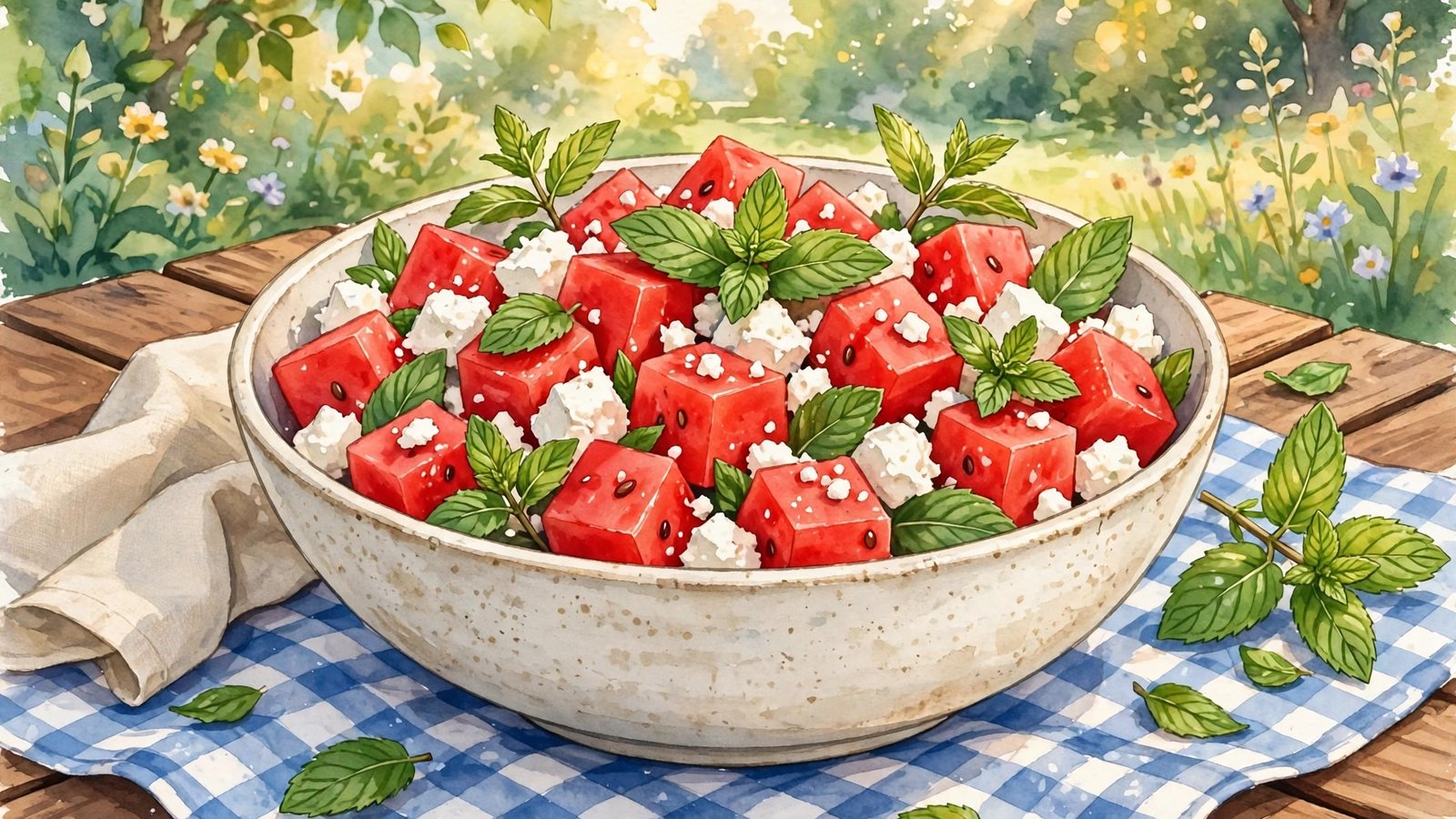
On a hot Fourth of July afternoon, the side dish that helps most is often the one that cools people down. Watermelon feta mint salad does that work with contrast. Cold, juicy watermelon brings sweetness and water. Crumbled feta brings salt and tang. Fresh mint brings a cool, aromatic note, and lime juice ties the bowl together with acidity. No single ingredient dominates, and the finished salad tastes more interesting than any one part on its own.
This version serves six to eight people as a side dish and takes about 15 minutes to assemble once the ingredients are cold and cut. It needs no grill space and no oven, it contains no bread or grain ingredient as written, and it can be adjusted for guests who do not eat dairy by serving the feta on the side. Two things decide whether it succeeds: choose a genuinely ripe watermelon, and assemble the salad close to serving time. The sections below cover both, along with the drainage method that keeps the bowl crisp, the nutrition the main ingredients actually provide, and the verified hot-day food safety limits for serving cut melon outdoors.
Why This Salad Fits a Cookout
Cookout menus lean heavy: burgers, hot dogs, chicken, potato salad, baked beans, buns, and chips are all rich, warm, and filling. A cold watermelon salad cuts across that register, with water, acidity, and fresh mint resetting the palate between bites of grilled food. It also needs no cooking at serving time, so it does not compete for grill space or the cook’s attention. Choosing, washing, cutting, and chilling can be done earlier, and assembly is a single gentle toss. Red watermelon, white feta, and green mint give a holiday table a bright note with no decoration effort.
Ingredients
For six to eight side-dish servings:
- 8 cups seedless watermelon, cut into 1-inch cubes, from about half a medium watermelon, well chilled
- 8 ounces feta cheese, crumbled, about 1 1/2 cups
- 1/2 cup fresh mint leaves, torn or thinly sliced, plus extra whole leaves for garnish
- Juice of 1 to 2 limes, to taste
- 2 tablespoons extra-virgin olive oil, optional
- 1/4 teaspoon black pepper
- Flaky salt, to taste, used sparingly and only if needed after tasting
Optional additions:
- 1/2 small red onion, very thinly sliced
- 1 cucumber, peeled, seeded, and diced
- A handful of arugula, used as a base under the salad
- A small handful of blueberries or blackberries, added last, for color
Buy the watermelon whole if you can, so you can judge ripeness and control when it is cut. If you buy pre-cut, follow Food and Drug Administration produce guidance opened for this article: choose only pre-cut produce that is refrigerated or surrounded by ice. Check the feta label: traditional feta is made from sheep milk or a sheep and goat blend, and feta-style cheeses are also made from cow milk.
A Note on Feta, Milk Allergy, and Dairy-Free Serving
Feta contains milk. The Food and Drug Administration page on food allergies opened for this article lists milk as one of the nine major food allergens that federal labeling law requires to be declared on packaged food labels in the United States. The other eight are egg, fish, crustacean shellfish, tree nuts, peanuts, wheat, soybeans, and sesame. Sesame became the ninth under the Food Allergy Safety, Treatment, Education, and Research Act, effective January 1, 2023.
A guest who avoids milk needs to know the white crumbles are cheese, even in a bowl that looks like plain fruit. Mention the feta when you set the bowl down. For a dairy-free table, omit the feta from the main bowl and serve it separately, so each guest adds it or not. Watermelon, mint, and lime still make a good salad without cheese, with a small pinch of salt in the main bowl to replace some of the salt the feta would have provided. Do not describe a bowl that contains feta as dairy-free. As written, the base salad contains no wheat ingredient. If gluten is a concern, check the label of any added item, such as a balsamic glaze.
Choosing a Ripe Watermelon
A good watermelon makes this salad, and a bland one cannot be fully rescued by lime, salt, or feta. Two university extension sources opened for this article, from the University of Missouri Extension and the University of Georgia Extension, agree on the core checks and on an important limit: watermelon does not get sweeter after it is harvested, so the ripeness you buy is the ripeness you serve. Use several checks together.
Start with the field spot, also called the ground spot, the pale patch where the melon rested on the ground. Missouri Extension describes a large yellow or cream-colored spot as a sign the melon was ripe when harvested, and advises that the bigger the spot, the better. A white or pale green spot is a sign it was harvested too early. Georgia Extension gives the same direction: the underside should be creamy yellow, and pale green or white suggests likely underripeness.
Next, judge weight and rind together. Both sources advise choosing a melon that feels heavy for its size, and Missouri Extension links that to water content, noting that watermelons are about 92 percent water. Choose the heaviest sound melon among similar sizes, without bruises, cuts, or dents. Missouri Extension advises a dull green, firm rind and says to avoid shine. Georgia Extension agrees that dull skin is a good sign and shiny melons tend to be underripe. For striped varieties, Georgia Extension also notes that the dark green bands often begin to break up near the blossom end when ripe, though that varies by variety.
Use sound last. Missouri Extension calls the thump test the least trustworthy indicator, useful at most to confirm a hunch. Georgia Extension describes a dull, hollow sound from a ripe melon, compared with a higher-pitched sound from an unripe one. Because both sources rank other checks higher, do not buy or reject a melon on sound alone. If a tendril is attached, both sources describe the curly tendril nearest the fruit: when dried and brown, the melon is ready to pick. Most store melons have no useful tendril. Walk away from a melon with an unpleasant smell, which Missouri Extension notes could mean it is overripe, or with soft spots or damage.
Cutting and Chilling the Watermelon Safely
Wash before you cut, every time. FoodSafety.gov guidance opened for this article advises rinsing fruits and vegetables under running water without soap, bleach, or commercial produce washes, rinsing before peeling or cutting, scrubbing firm produce such as melons and cucumbers with a clean produce brush, and drying produce with a paper towel or clean cloth towel. Food and Drug Administration produce guidance gives the same instruction, including washing even when you will not eat the rind, so surface dirt and bacteria are not transferred to the flesh by the knife.
FoodSafety.gov also advises washing hands with plain soap and water for at least 20 seconds, and washing cutting boards, dishes, utensils, and countertops with hot, soapy water, especially after they have held raw meat, poultry, seafood, or eggs. Georgia Extension adds: wash your hands, the outside of the melon, and cutting surfaces before slicing, and use clean knives and cutting boards. Do not cut melon on a board that has just held raw patties or raw chicken without washing it first.
To cut, halve the melon, cut each half into thick slices, trim away the rind, and cut the flesh into roughly 1-inch cubes. Remove any pale seeds, even in a seedless melon, and cut away bruised flesh. Chill the cubes thoroughly in a covered container in a refrigerator set to 40 degrees F or below. Cold is a flavor requirement as well as a safety one: warm watermelon tastes flat and releases juice faster once salted, while chilled cubes stay firmer through a gentle toss. Chill the serving bowl as well if you can.
How to Make Watermelon Feta Mint Salad
1. Chill everything
Refrigerate the watermelon cubes, the feta, and the serving bowl until cold.
2. Drain the cubes briefly
Lift the chilled cubes with a slotted spoon, leaving pooled juice behind, or tip them into a colander for a few minutes while you crumble the feta and tear the mint. This drain, covered in the next section, is the difference between a salad dressed with lime and a salad swimming in melon juice.
3. Combine gently
Place the drained cubes in the chilled bowl. Sprinkle the feta and mint over the top. Drizzle with lime juice and olive oil if using, and scatter the black pepper. Add no salt yet, because feta varies in saltiness and you cannot judge the bowl until you have tasted a combined bite.
4. Toss once, lightly, and taste
Toss very gently with a large spoon, folding from the bottom, just enough to distribute the feta and mint. Hard tossing breaks cubes and releases juice. Fold in cucumber or red onion now, if using. Taste one cube together with feta and mint, because the flavors balance only in combination. Add more lime for brightness, and a small pinch of salt only if the feta has not provided it.
5. Garnish and serve immediately
Top with reserved whole mint leaves and serve right away. If service is delayed briefly, refrigerate the assembled salad for no more than about 30 minutes. If the delay will be longer, hold the components separately and assemble at serving time.
The Drainage Method: Why the Salad Turns Watery, and How to Prevent It
Almost every disappointing version of this salad turns watery, for four reasons. Cutting opens the fragile, water-filled cells of the melon at every cut surface. Salt draws water out of the cut melon, which is why this recipe warns against early salting. Tossing breaks pieces and releases more juice. Time lets the dressed salad pool as it sits.
The method that addresses each cause needs no special equipment. Cut 1-inch cubes, not small dice, so there is less cut surface for the volume. Chill before you drain, because cold cubes break less. Drain pooled juice before dressing, because juice already released only dilutes the lime and softens the feta. Dress late and toss once, because lime and salt start their work on contact. Serve in a wide, shallow bowl where practical, so cubes sit in less pooled juice, and if a bowl pools while waiting, lift servings out with a slotted spoon rather than stirring again.
This buys quality across the normal serving window, within the food safety limits below. It does not remove the need for late assembly, and it does not make the finished salad a make-ahead dish.
Nutrition in Context
The figures below are ingredient figures, not a calculated label for the finished bowl. Your bowl will vary with the exact feta, the amount of olive oil, and the serving size each person takes.
United States Department of Agriculture data for raw watermelon, as reproduced from the Department’s nutrient database in the sources opened for this article, gives 1 cup of diced watermelon at 152 grams as about 46 calories, 11.5 grams of carbohydrate, 9.4 grams of sugars, 0.6 grams of fiber, 0.9 grams of protein, and 0.2 grams of fat, with 139 grams of water. The same data gives 12.3 milligrams of vitamin C, about 43 micrograms of vitamin A, 170 milligrams of potassium, and about 6,889 micrograms of lycopene per cup. Extension summaries describe watermelon as about 92 percent water. The melon therefore contributes volume, water, and sweetness for very few calories.
Feta contributes concentrated flavor, salt, protein, and calcium in a small amount. United States Department of Agriculture data for feta, as reproduced in the sources opened for this article, gives about 75 calories, 4.0 grams of protein, 6.0 grams of fat, and about 316 milligrams of sodium per ounce, with about 140 milligrams of calcium per ounce. The recipe uses 8 ounces across six to eight servings, so each serving carries roughly 1 ounce of feta if divided evenly. The feta already brings substantial sodium, which is why tasting before adding salt matters nutritionally as well as culinarily.
| Ingredient, reference amount | Calories | Notable figures from the sources above |
|---|---|---|
| Watermelon, raw, 1 cup diced (152 grams) | 46 | 139 grams water, 9.4 grams sugars, 12.3 milligrams vitamin C, about 6,889 micrograms lycopene |
| Feta cheese, 1 ounce (about 28 grams) | About 75 | 4.0 grams protein, about 316 milligrams sodium, about 140 milligrams calcium |
Read the table as context, not as a health claim. This article does not claim the salad treats, prevents, or improves any medical condition. Readers who track sodium, carbohydrate, or sugar should check the label of the specific feta they buy, because sodium in feta varies by product.
Food Safety for a Hot-Day Salad
Cut watermelon is a perishable food, and a July cookout is where time and temperature limits matter most. The guidance here comes only from the United States Department of Agriculture Food Safety and Inspection Service and FoodSafety.gov pages opened for this article.
The central concept is the Danger Zone. The Service states that bacteria grow rapidly between 40 degrees F and 140 degrees F. Cold perishable food should be kept at 40 degrees F or below, and leftovers must be refrigerated within 2 hours. FoodSafety.gov states the same standard and timing: never leave perishable foods out of refrigeration for more than 2 hours, and refrigerate within 1 hour if the food is exposed to temperatures above 90 degrees F, as at a summer picnic.
Applied here: keep the melon and the assembled salad refrigerated at 40 degrees F or below until serving. At the table, nest the bowl in a larger bowl of ice where practical, keep it in shade, serve a smaller bowl and refill it from a refrigerated reserve if guests will graze, and start a mental clock when the bowl goes out. The Service’s buffet guidance advises exactly that pattern: keep food cold by nesting dishes in bowls of ice, or use small serving trays and replace them often.
The discard rule is part of the same guidance. The Service advises throwing away perishable foods left at room temperature for more than 2 hours, or more than 1 hour above 90 degrees F. If you do not know how long the bowl has been out, discard it. Do not taste it to decide, and do not refrigerate an over-held bowl for later, because chilling does not reverse time at warm temperatures.
Leftovers that stayed within the limits should be refrigerated promptly in covered containers. The Service states that leftovers can be kept in the refrigerator for 3 to 4 days. For this salad, quality will usually end first: mint darkens, feta softens, and melon loses firmness. Discard any leftover that smells off or feels slimy. Keep the salad separate from raw meat, poultry, and seafood, with its own utensil, and wash hands again before assembly if you have handled raw grill items.
Make-Ahead Plan and Transport
The honest make-ahead plan is a components plan, not a finished-dish plan. Up to a day ahead, cut the watermelon into cubes and refrigerate them covered, and crumble the feta and refrigerate it separately. On the day, wash and dry the mint and store it wrapped in a dry paper towel inside a sealed bag in the refrigerator, tearing it only at assembly. Lime juice can be squeezed ahead and refrigerated in a small sealed jar, though fresh-squeezed at assembly tastes brighter. At serving time: chill the bowl, drain the melon, assemble, toss once, taste, garnish, and serve on ice.
Do not assemble the salad the night before. Salt will draw water from the melon overnight, mint will darken, and feta will soften into the juice. The components keep well separately. The finished salad does not, in quality terms, even when it remains within safety limits.
For transport, pack the components in a cooler with ice or frozen gel packs, keep the cooler closed and in shade, and keep ready-to-eat components in sealed containers away from raw meat. A cooler counts only while it genuinely holds food at 40 degrees F or below, so a warmed cooler does not extend the 2-hour and 1-hour clocks. Assemble after arrival.
Variations That Still Work
The variations that work respect three rules: cold ingredients, gentle handling, and late assembly.
Cucumber adds crunch and stretches the salad for a larger crowd. Peel, seed, and dice it so its seeds do not add water, and fold it in at the gentle toss. Thinly sliced red onion adds a sharp note that suits feta. Soak the slices in cold water for about 10 minutes first for a milder flavor, then drain and pat dry. Arugula as a base, with the watermelon mixture spooned over it at serving rather than tossed through, turns the salad into a more substantial first course. A drizzle of balsamic glaze at serving, never in advance, adds sweetness and depth, though it darkens the appearance.
For a spicier version, add a finely diced jalapeno with seeds removed, or a pinch of red pepper flakes, and taste carefully, because heat reads stronger against cold, sweet melon than in a warm dish. For a festive presentation, scatter blueberries or blackberries over the top after the toss, rather than folding them through.
Scaling is simple proportion. For three to four servings, halve everything: 4 cups watermelon, 4 ounces feta, 1/4 cup mint, juice of 1 lime to start, and 1 tablespoon olive oil if using. For twelve to sixteen servings, double everything: 16 cups watermelon, 16 ounces feta, 1 cup mint, juice of 2 to 4 limes, and 4 tablespoons olive oil if using. Keep cubes at about 1 inch, assemble a crowd batch in two bowls, and taste at any new scale.
Troubleshooting
If the salad turns watery, it was probably assembled too early, tossed too vigorously, cut too small, or salted too heavily. Next time, drain the cubes, assemble at the last minute, toss once, and let the feta provide most of the salt. For a bowl that has already pooled, serve with a slotted spoon and leave the juice behind.
If the salad tastes flat, it usually needs more lime juice or a very small pinch of salt, not more feta. Add lime first, and taste a combined bite before each adjustment. If the mint has disappeared, tear fresh leaves over the top.
If the watermelon is underripe or bland, extra lime and a small drizzle of honey can help, though honey adds added sugar, so mention it if you use it or serve it on the side. If the feta is very salty, use less in the bowl and let guests add more from a side bowl. If it is mild, a small pinch of flaky salt at the end may be needed.
If the mint darkens, it was likely torn too early, bruised by hard tossing, or held in a warm bowl. Tear it at assembly and reserve garnish leaves until the bowl goes to the table.
Frequently Asked Questions
How far ahead can I make this salad?
Prepare the components up to a day ahead and refrigerate them separately at 40 degrees F or below, but assemble the finished salad no more than about 30 minutes before serving. Overnight assembly draws water from the melon, darkens the mint, and softens the feta.
How long can it sit out at a cookout?
No more than 2 hours, and no more than 1 hour when the temperature is above 90 degrees F, following United States Department of Agriculture Food Safety and Inspection Service guidance. Keep the bowl on ice and in shade, and discard food left out beyond those limits.
Can I make it dairy-free?
Yes. Omit the feta from the main bowl and serve it separately. The watermelon, mint, and lime salad stands on its own, with a small pinch of salt in the main bowl. Feta contains milk, one of the nine major food allergens under United States labeling law.
Is it gluten-free as written?
Yes, as written, with no bread or grain ingredients in the base recipe. Check the label of any added item, such as balsamic glaze, if gluten is a concern for a guest.
How long do leftovers last?
Refrigerate leftovers promptly in a covered container, within the 2-hour limit, or the 1-hour limit above 90 degrees F, and use them within the general 3 to 4 day refrigerator window given by the Food Safety and Inspection Service. Discard anything that smells off, feels slimy, or was left out too long.
Do I need to wash a watermelon I am going to cut?
Yes. Scrub the whole melon under running water with a clean produce brush before cutting, even though you will not eat the rind. The knife passes through the rind into the flesh, so surface dirt and bacteria can be transferred inward. Wash your hands, knife, and cutting board as well.
Can I use pre-cut watermelon?
You can, if you choose only pre-cut produce that is refrigerated or surrounded by ice, as Food and Drug Administration produce guidance advises, and keep it refrigerated at 40 degrees F or below until assembly. Drain pooled juice before tossing. Whole melon gives you more control over ripeness and cutting time.
Sources & references
- United States Department of Agriculture, Food Safety and Inspection Service, Leftovers and Food Safety. Used for bacteria growing rapidly between 40 degrees F and 140 degrees F, cold perishable food kept at 40 degrees F or below, refrigerating leftovers within 2 hours, discarding perishable food left out for more than 2 hours or more than 1 hour when the temperature is above 90 degrees F, keeping cold food cold by nesting dishes in bowls of ice or using small serving trays and replacing them often, wrapping leftovers in covered or sealed containers, and leftovers keeping in the refrigerator for 3 to 4 days.
- FoodSafety.gov, 4 Steps to Food Safety. Used for washing hands with plain soap and water for at least 20 seconds, washing cutting boards, dishes, utensils, and countertops with hot, soapy water, rinsing fruits and vegetables under running water without soap, bleach, or commercial produce washes, scrubbing firm produce such as melons and cucumbers with a clean produce brush, drying produce with a paper towel or clean cloth towel, keeping the refrigerator at 40 degrees F or below, and refrigerating perishable food within 2 hours or within 1 hour above 90 degrees F.
- United States Food and Drug Administration, Food Allergies: What You Need to Know. Used for the nine major food allergens (milk, eggs, fish, crustacean shellfish, tree nuts, peanuts, wheat, soybeans, and sesame), milk being a major allergen, sesame becoming the ninth major allergen under the Food Allergy Safety, Treatment, Education, and Research Act signed on April 23, 2021, with the change effective on January 1, 2023, and federal labeling requiring the food source of a major allergen to be identified on packaged food labels.
- United States Food and Drug Administration produce guidance, Raw Produce: Selecting and Serving It Safely, as summarized in the agency materials opened for this article. Used for choosing only pre-cut produce, such as half a watermelon, that is refrigerated or surrounded by ice, washing all produce thoroughly under running water before eating, cutting, or cooking even when the rind will not be eaten, scrubbing firm produce such as melons and cucumbers with a clean produce brush, cutting away damaged or bruised areas, and refrigerating pre-cut or peeled produce.
- University of Missouri Extension, via Show Me Mizzou, Sweeten the Fourth With Juicy Watermelon, June 30, 2025, reporting horticulture specialist Matthew Huchteman. Used for watermelons being about 92 percent water and choosing a melon heavy for its size, a large yellow or cream-colored field spot indicating ripeness at harvest with a white or pale green spot indicating early harvest, a dull green firm rind and avoiding shine, a dried brown curly tendril indicating readiness to pick, the thump test being the least trustworthy indicator, and avoiding melons with an unpleasant smell.
- University of Georgia Extension, How to Pick a Ripe Watermelon and Why You Should Enjoy One This Summer. Used for watermelon not getting sweeter after harvest and field maturity deciding quality, a brown dried tendril as a ripeness sign, a creamy yellow ground spot with pale green or white indicating likely underripeness, a dull hollow thump compared with a high-pitched metallic sound for an unripe melon, striped bands breaking up near the blossom end for some varieties, a melon feeling heavy for its size, dull skin as a good sign with shiny melons tending to be underripe, and washing hands, the outside of the melon, and cutting surfaces before slicing.
- North Carolina State Extension, Franklin County Center, Watermelon Nutrition Facts and Benefits, reproducing United States Department of Agriculture data. Used for 1 cup of diced watermelon (152 grams) providing 46 calories, 0.9 grams protein, 11.5 grams carbohydrates, 0.2 grams fat, 0.6 grams fiber, 9.4 grams sugars, and 12.3 milligrams vitamin C, and for watermelon being almost 92 percent water.
- United States Department of Agriculture nutrient data for watermelon, raw, and for cheese, feta, as reproduced in the nutrient tables opened for this article. Used for watermelon per cup diced (152 grams): 139 grams water, 46 calories, about 43 micrograms vitamin A, 170 milligrams potassium, and about 6,889 micrograms lycopene; and for feta per ounce: about 75 calories, 4.0 grams protein, 6.0 grams fat, about 316 milligrams sodium, and about 140 milligrams calcium.


