Short answer
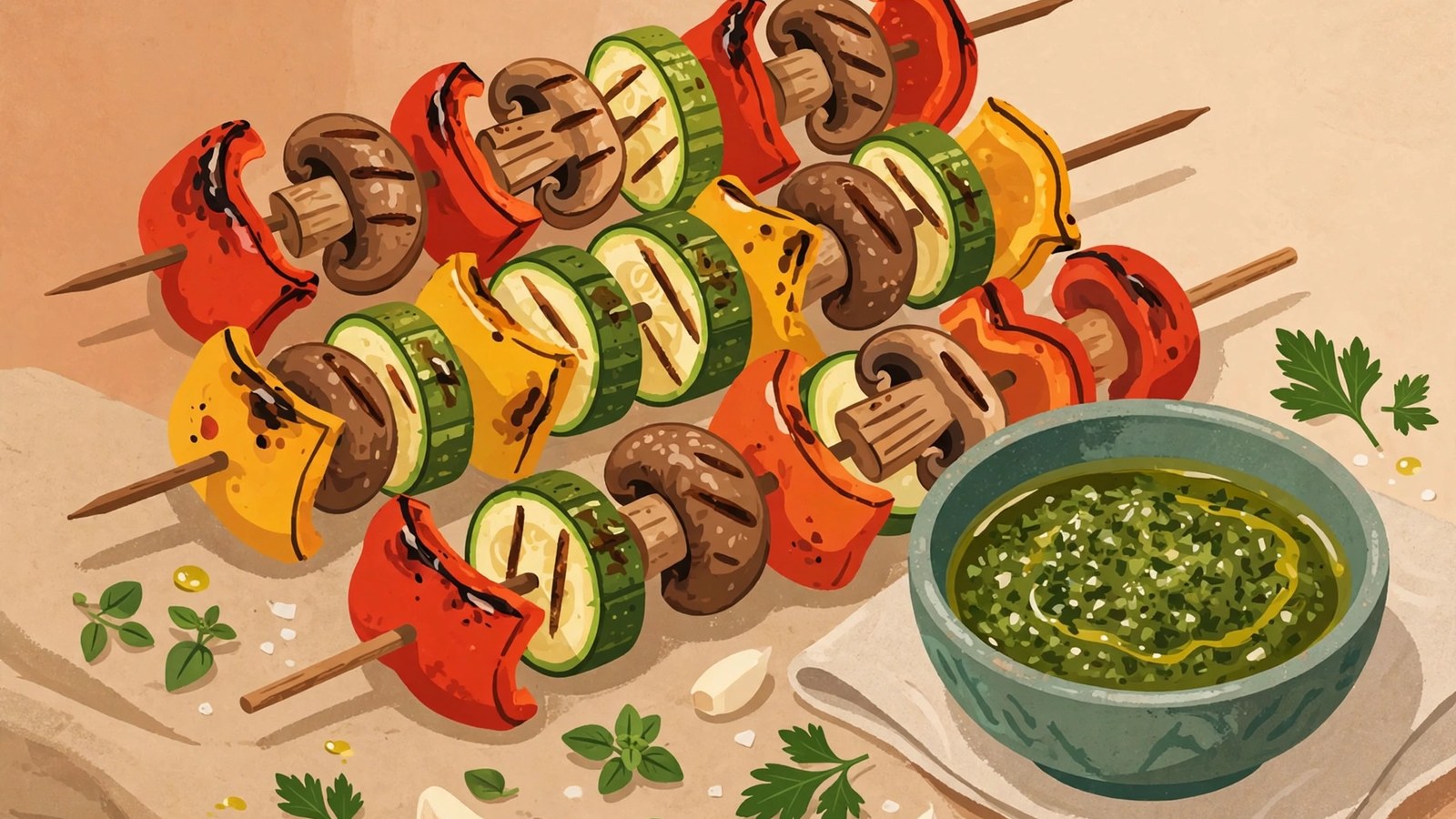
- Make the chimichurri first and let it rest for at least 15 minutes while you prepare the vegetables. Cut peppers, zucchini, mushrooms, and red onion into even pieces about 1 to 1 and a half inches across, toss them with olive oil, smoked paprika, garlic powder, salt, and black pepper, and thread them onto skewers with a small gap between pieces. Grill over medium high heat, about 400 to 450 degrees Fahrenheit, for 10 to 14 minutes, turning every 3 to 4 minutes, until the vegetables are tender and charred in spots. Spoon chimichurri over the hot skewers or serve it alongside, and rest the skewers for about 5 minutes before serving. Do not leave perishable food out for more than 2 hours, or more than 1 hour if the temperature is above 90 degrees Fahrenheit. Refrigerate leftovers at 40 degrees Fahrenheit or below, use them within 3 to 4 days, and reheat them to 165 degrees Fahrenheit.
Introduction
Vegetable skewers are often treated as an afterthought at a cookout, a token dish for the one guest who does not eat meat. Grilled properly and sauced with chimichurri, they are better than that. They are smoky, charred at the edges, tender inside, and bright from a fresh herb sauce that cuts through the richness of everything else on the table. This recipe treats them as a dish in their own right, with attention to cutting, skewering, and grill heat that most cookout versions skip.
The grill is the right tool here because it does two things an oven cannot match for this dish. It chars quickly at high heat, and it adds smoke. Charring is not burning. It is a brief, hot sear on the outside while the inside stays tender. That contrast is what makes a grilled vegetable taste different from a roasted one, even with the same seasoning. A clean, hot, oiled grill grate is the difference between vegetables that release easily and vegetables that stick and tear.
Chimichurri is the sauce that makes the whole dish work at a summer gathering. It is fresh, acidic, and garlicky, it needs no cooking, and it can be made ahead and brought to the cookout in a jar. This article gives the full recipe, explains how to cut and thread the vegetables so they finish together, shows how to judge doneness by sight and texture, and covers outdoor serving and storage in plain terms. The food safety guidance was checked against FoodSafety.gov, the United States Department of Agriculture Food Safety and Inspection Service, and the Food and Drug Administration on 31 October 2026. On a hot July day, that safety guidance matters as much as the grilling itself.
Why These Skewers Work as a Main Dish
A skewer succeeds or fails on contrast. The outside should take color and a light char, the inside should become tender without collapsing, and the sauce should add freshness the grill cannot supply. Peppers blister and sweeten, zucchini softens and picks up grill marks, mushrooms shrink slightly and deepen in flavor, and red onion turns sweet at the edges while holding its shape at the root. No single vegetable carries the dish. The mix does.
Chimichurri supplies the second contrast. The vegetables are warm, smoky, and rich from olive oil. The sauce is cool, sharp from red wine vinegar, and fresh from parsley and oregano. Spooned over hot skewers, it wilts slightly and perfumes them. Served on the side, it lets each person choose how much they want. Because it is made ahead, it also removes work from the busiest part of the cookout. Skewers can come off the grill in batches and be eaten warm or at room temperature, but that flexibility does not extend the outdoor time limit explained in the storage section.
Ingredients
This recipe makes about 4 servings as a main dish, or 6 to 8 servings as a side dish. Have everything ready before the grill is lit, because the grilling itself takes only 10 to 14 minutes.
- 2 bell peppers, mixed colors, cut into 1 and a half inch pieces
- 2 medium zucchini, cut into half inch thick rounds or half moons
- 8 ounces mushrooms, cremini or button, whole if small and halved if large
- 1 large red onion, cut into wedges with the root end intact
- 1 pint cherry tomatoes, optional, see the note below
- 3 tablespoons olive oil, plus more for the grill
- 1 teaspoon smoked paprika
- 1 teaspoon garlic powder
- Salt and black pepper, to taste
- Metal skewers, or wooden skewers soaked in water for at least 30 minutes
For the chimichurri:
- 1 cup fresh flat leaf parsley leaves, finely chopped
- 1/4 cup fresh oregano leaves, finely chopped, or 1 tablespoon dried oregano
- 3 cloves garlic, finely minced
- 1/2 cup extra virgin olive oil
- 3 tablespoons red wine vinegar
- 1/2 teaspoon chili flakes, or to taste
- 1/2 teaspoon salt, plus more to taste
Cherry tomatoes are optional because they cook faster than the other vegetables and can burst and fall off the skewer. If you include them, thread them at the ends of skewers where they are easier to manage, or grill them separately in a grill basket. Keep onion wedges attached at the root so they do not fall apart on the grill. Mixed pepper colors are for appearance and for a small range of flavor, not a requirement. One color works if that is what you have, as long as the peppers are thick walled and firm.
Choosing Vegetables and Herbs That Grill Well
Choose vegetables for firmness, not just color. Peppers should feel heavy and thick walled, with tight, glossy skin. Thin walled peppers collapse before the inside softens. Zucchini should be small to medium, firm, and heavy for their size, because oversized zucchini are watery and seedy. Mushrooms should be dry and firm, not slimy, and onions firm with tight, papery skin. A soft or bruised vegetable will not improve on the grill.
Pieces about 1 to 1 and a half inches across cook through in the time it takes to char the outside, while tiny pieces burn and huge pieces stay raw inside. Skewers cook as a unit, so even cutting is the most important preparation step in the recipe.
Parsley is the herb to judge most carefully. Flat leaf parsley gives a cleaner, more robust flavor than curly parsley. Look for bright green leaves, no yellowing, and stems that snap rather than bend. Dried oregano is much more concentrated than fresh, so 1 tablespoon of dried replaces a quarter cup of fresh. Wash herbs gently and dry them thoroughly, because wet herbs make a watery sauce. FoodSafety.gov advises rinsing fruits and vegetables under running water, without soap or produce washes, and drying them with a clean cloth or paper towel.
Chimichurri: Balance, Chopping, and Resting
Chimichurri balance follows a simple set of parts: herbs, oil, acid, garlic, and salt, with chili flakes for warmth. Too much oil makes it greasy, too little acid makes it flat, and too much raw garlic makes it harsh after it sits. The amounts in the ingredient list are a starting point. Taste after the sauce rests, because that is when its real flavor appears.
Chop the herbs by hand rather than blending them, to keep the sauce textured and green. A blender or food processor can turn it into a paste and dull the color. If you use a processor, pulse briefly, add the oil last, and stir in the vinegar and salt by hand.
Resting is not optional. Stir the ingredients together and let the sauce rest for at least 15 minutes while you prepare the vegetables. The garlic and acid mellow in that time. Taste and adjust: add vinegar a teaspoon at a time if it tastes dull, and a little more oil if the garlic tastes harsh. For make ahead use, refrigerate it in a sealed jar, bring it back to room temperature, and stir well, because the oil may firm up when cold. Its color and flavor are freshest in the first day, so make it the morning of the cookout where you can.
Preparing the Skewers and the Grill
Soak wooden skewers for at least 30 minutes if you use them. Dry wood chars, can catch fire, and can splinter. Soaking reduces charring but does not make skewers fireproof, so keep them away from direct flames. Metal skewers avoid the problem and conduct heat into the center of the vegetables. Flat metal skewers also stop vegetables from spinning when you turn them, which round skewers do not.
Thread the vegetables, alternating colors and types, with denser pieces such as onion and mushroom toward the middle. Leave a small gap between pieces, so heat can circulate and char the sides, and about an inch of bare skewer at each end for handling. Thread mushrooms through their firm side and keep onion wedges joined at the root.
Clean the grates well and heat the grill to medium high, about 400 to 450 degrees Fahrenheit. Oil the grates by rubbing them with a folded, oiled paper towel held in tongs. A clean, oiled grate prevents sticking. A dirty grate sticks no matter how much oil is on the vegetables. The Department of Agriculture makes the same opening point in its Fourth of July grilling tips: scrub the grill clean before use, and keep raw meat and vegetables separate by using different cutting boards if meat is also being prepared.
Method: Step by Step
Step 1: Make the chimichurri first
Combine the parsley, oregano, garlic, olive oil, red wine vinegar, chili flakes, and half a teaspoon of salt in a bowl. Stir well and let it rest for at least 15 minutes while you prepare the vegetables, or refrigerate it for up to a day and bring it back to room temperature before serving. Taste and adjust as described above.
Step 2: Prepare the grill
Clean the grates well and heat the grill to medium high, about 400 to 450 degrees Fahrenheit. Oil the hot grates with an oiled paper towel held in tongs. Keep hands and loose clothing away from the heat.
Step 3: Cut and season the vegetables
Toss the peppers, zucchini, mushrooms, and onion with 3 tablespoons of olive oil, the smoked paprika, the garlic powder, 1 teaspoon of salt, and black pepper. Keep the pieces as even as you can. Do not add the tomatoes to this toss if you are grilling them separately. Season shortly before grilling, because salt draws out water and softens the surfaces you want to char.
Step 4: Thread the skewers
Thread the vegetables, alternating colors and types, with denser pieces toward the middle. Leave a small gap between pieces and about an inch of bare skewer at each end. Place cherry tomatoes, if using, at the ends. Set the skewers on a clean tray, entirely separate from any raw meat tray, boards, and utensils at the cookout.
Step 5: Grill the skewers
Cook the skewers for 10 to 14 minutes, turning every 3 to 4 minutes, until the vegetables are tender and charred in spots. Peppers should soften and blister, zucchini should be tender with grill marks, and mushrooms should shrink slightly and darken. Move skewers to a cooler part of the grill if they char too fast. Do not move them before a sear has formed, because early movement causes sticking and tearing.
Step 6: Sauce and serve
Transfer the skewers to a clean platter and spoon chimichurri over them while they are hot, or serve the sauce alongside. Rest them for about 5 minutes, so the vegetables settle and the sauce clings. Serve warm or at room temperature, within the outdoor time limit below.
How to Tell When the Vegetables Are Done
This dish contains no meat, poultry, or seafood, so there is no meat internal temperature to check for the skewers themselves. Judge doneness by sight and texture. Peppers are done when they soften, char lightly at the edges, and blister in spots while still holding their shape. Zucchini is done when it is tender when pierced and marked by the grate, but not so soft that it slides off. Mushrooms are done when they shrink slightly, darken, and look dry and seared rather than wet. Onion is done when the wedges soften and take color at the edges, while the root still holds each wedge together.
Use the 10 to 14 minute range as a guide, not a promise. Judge the slowest piece on each skewer, usually onion or a thick mushroom, rather than the fastest. If one type finishes early in the first batch, move its skewers to a cooler zone for the next batch.
If other foods at the cookout include meat or poultry, their doneness is a separate question and must be judged with a food thermometer, not by these vegetable cues. FoodSafety.gov publishes safe minimum internal temperatures for those foods. Check that chart rather than relying on memory at a busy cookout.
Troubleshooting: Common Problems and Fixes
If vegetables stick, the grate was probably dirty, cool, or unoiled, or the vegetables were moved too early. Let a sear form before turning, and clean and oil the grate before the next batch. Slide a thin spatula under stuck pieces rather than pulling, which tears them.
If some vegetables burn while others stay raw, the pieces were uneven or packed too tightly, or the grill had hot spots. Cut evenly, leave gaps, and learn the hot zones by watching the first batch. Move faster cooking skewers to cooler areas and slower ones to the heat.
If the chimichurri tastes harsh, the garlic is the usual cause. Let the sauce rest for 15 to 30 minutes and add a little more oil and vinegar. Next time, mince the garlic more coarsely rather than pressing it. If the sauce tastes flat, add a little more vinegar and a pinch more salt, a bit at a time.
If vegetables fall off, the pieces were likely cut too small, a mushroom was threaded only through its cap, or an onion wedge lost its root. Cut pieces at least an inch across, thread mushrooms through their firm side, and keep onion wedges joined at the root.
Variations That Keep the Method Intact
For a halloumi version, add cubes of halloumi near the ends of the skewers. Halloumi holds its shape and adds saltiness, but it cooks faster than the vegetables and goes from golden to burnt quickly, so watch it closely. It also adds milk, as explained in the allergen section.
For a corn version, grill chunks of corn on the cob on separate skewers for about the same time, with a little extra oil. Keeping corn separate respects its different shape and turning needs.
For a marinated version, toss the vegetables in half the chimichurri for about 30 minutes before grilling, in the refrigerator, and serve with the remaining untouched sauce. Wipe off excess herbs before grilling, because loose herbs burn. Do not serve used marinade as a table sauce.
For an indoor version, cook on a grill pan or under a broiler, turning often. A grill pan gives marks but less smoke. A broiler gives even char but needs watching, because the element is very close to the food. Judge by the sight and texture cues above rather than by the clock alone.
Serving Ideas and a Simple Timing Plan
Serve the skewers on a large platter with the chimichurri in a bowl and extra lemon wedges if you like. They pair with grilled corn, potato salad, coleslaw, and burgers or grilled chicken for mixed tables, and they stand alone as a main dish with rice, bread, or a grain salad. Any perishable side alongside them is under the same outdoor time limit as the skewers themselves.
For a Fourth of July gathering, make the chimichurri in the morning and refrigerate it. Wash, cut, and thread the skewers ahead, cover and refrigerate them, then oil and season them shortly before grilling for the best char. Soak wooden skewers while the grill heats. Bring the chimichurri back to room temperature and stir it while the first batch grills. The grill work takes under 15 minutes per batch.
Scaling is a question of grill space, not of a bigger pile. Cook in batches that leave gaps between skewers, and do not crowd raw and cooked skewers on the same tray. Doubling across two batches keeps the cooking time for each batch almost unchanged. Season each batch by taste rather than assuming salt and acid scale in a straight line.
Outdoor Serving, Storage, Reheating, and Food Safety
Read this section before a July cookout, not after it. FoodSafety.gov organizes home food safety into four steps: clean, separate, cook, and chill. Wash hands with plain soap and water for at least 20 seconds, especially before and during preparation and after handling raw meat, poultry, seafood, or eggs at a mixed cookout. Wash boards, dishes, utensils, and countertops with hot soapy water after each use. Use separate boards and plates for produce and for raw meat, poultry, and seafood, and separate plates for cooked and raw foods. Rinse fruits and vegetables under running water, but do not wash meat, poultry, eggs, or seafood.
The chill step governs outdoor serving. Bacteria that cause food poisoning multiply quickest between 40 degrees Fahrenheit and 140 degrees Fahrenheit. Keep the refrigerator at 40 degrees Fahrenheit or below and the freezer at 0 degrees Fahrenheit or below. Refrigerate perishable food within 2 hours, or within 1 hour if it has been exposed to temperatures above 90 degrees Fahrenheit, such as at a summer picnic. The Food Safety and Inspection Service states the same rule for leftovers, and the Department of Agriculture repeats it in its Fourth of July grilling tips as a danger zone warning. Discard perishable food left out beyond those limits. Do not taste it to check it, and do not save it as a leftover.
At the table, set out small amounts of skewers and chimichurri and replenish them from the refrigerator, rather than putting the whole batch in the sun. Keep cold foods at 40 degrees Fahrenheit or below by nesting dishes in ice, and keep hot foods at 140 degrees Fahrenheit or warmer on a warming tray or at the side of the grill.
Cool leftovers promptly in shallow, covered containers. Leftovers keep for 3 to 4 days in the refrigerator, or 3 to 4 months frozen, although frozen leftovers lose moisture and flavor and grilled vegetables lose texture most of all. Thaw frozen leftovers in the refrigerator, in cold water in a leak proof package, or in the microwave, never on the counter. Reheat leftovers to 165 degrees Fahrenheit throughout, measured with a food thermometer. FoodSafety.gov lists leftovers of any type at 165 degrees Fahrenheit, and the Food Safety and Inspection Service adds that sauces, soups, and gravies should be brought to a rolling boil and that covering leftovers helps them heat through. That figure replaces any looser instruction to reheat only until steaming hot. Serve leftover chimichurri cold or at room temperature, stirred well, and discard it if it was left out beyond the limit above. When in doubt, discard a leftover.
Allergen and Dietary Notes
This section is factual information for planning and serving, not medical advice. As written, with no variation added, this dish contains none of the nine major food allergens in the United States as an ingredient: no milk, egg, fish, crustacean shellfish, tree nuts, wheat, peanuts, soybeans, or sesame. The Food and Drug Administration lists those nine foods, and ingredients containing their proteins, as major food allergens, accounting for the large majority of severe food allergic reactions. Sesame became the ninth major food allergen under the Food Allergy Safety, Treatment, Education, and Research Act, with labeling required from 1 January 2023.
That statement is about the recipe as written, not about every product a cook might buy. Check labels on vinegar, oil, and any packaged ingredient each time, because ingredients can change at any time and the Food and Drug Administration advises reading the entire ingredient list every time. Keep the package until the meal is over if a guest may need to check it.
The halloumi variation adds milk, because halloumi is a cheese. If you serve both plain and halloumi skewers, keep them on separate platters and do not mix their utensils, so a guest avoiding milk is not left to guess. Garlic and herbs are not major allergens, but no note can rule out an individual sensitivity. Ask a guest with a diagnosed allergy about it before you plan the menu, and choose a different dish if there is doubt about cross contact at a busy outdoor grill.
Frequently Asked Questions
Do I need to soak wooden skewers?
Yes, for at least 30 minutes, to reduce charring and splintering. Soaking does not make them fireproof, so keep them away from direct flames and use metal skewers if your grill runs very hot.
Can I prepare skewers ahead?
Yes. Thread them in the morning, cover them, and refrigerate them until grilling time. Do not season them hours ahead with salt, which draws out water. Oil and season them shortly before grilling for the best char. Make the chimichurri ahead as well and bring it back to room temperature and stir it before serving.
Why do my vegetables fall off the skewer?
Pieces cut too small, mushrooms threaded only through the cap, and onion wedges without the root attached all cause this. Cut pieces at least an inch across, thread mushrooms through their firm side, and keep onion wedges joined at the root.
Can I grill these in the oven?
Yes, under a broiler or on a sheet pan at 450 degrees Fahrenheit, turning often. You will get char and tenderness, but not smoke. A grill pan gives marks with less smoke. Judge doneness by the sight and texture cues in this article.
How long does chimichurri keep?
Its color and flavor are brightest in the first 24 hours, and the color dulls after a day or two in the refrigerator. Keep it in a sealed jar in the refrigerator and stir well before serving, because the oil may firm up when cold. This article does not present a fixed refrigerated week as a verified safety figure, because no primary source checked for this article sets that window for this sauce. Use it promptly and discard it if it was left out beyond the 2 hour limit, or the 1 hour limit above 90 degrees Fahrenheit.
Can I make chimichurri with a food processor?
Yes, but pulse it very briefly and stop before it becomes a paste. A processor bruises the herbs, dulls the color, and releases more garlic harshness than hand chopping. Add the oil last, pulse only two or three times, then stir in the vinegar and salt by hand and taste after a 15 minute rest.
Sources & references
- FoodSafety.gov, 4 Steps to Food Safety. Used for the four steps clean, separate, cook, and chill, washing hands with plain soap and water for at least 20 seconds, washing surfaces and utensils with hot soapy water, using separate cutting boards and plates for produce and for raw meat, poultry, and seafood and separate plates and utensils for cooked and raw foods, rinsing fruits and vegetables under running water without soap and not washing meat, poultry, eggs, or seafood, cooking with a food thermometer placed in the thickest part of the food, keeping food hot at 140 degrees Fahrenheit or above after cooking, keeping a refrigerator at 40 degrees Fahrenheit or below and a freezer at 0 degrees Fahrenheit or below, bacteria multiplying quickest between 40 degrees Fahrenheit and 140 degrees Fahrenheit, refrigerating perishable food within 2 hours or within 1 hour above 90 degrees Fahrenheit, placing leftovers in shallow containers and refrigerating promptly, and thawing or marinating in the refrigerator rather than on the counter.
- FoodSafety.gov, Cook to a Safe Minimum Internal Temperature. Used for the safe minimum internal temperature chart, last updated 21 November 2024: leftovers of any type reheated to 165 degrees Fahrenheit, fish at 145 degrees Fahrenheit or until flesh is no longer translucent and separates easily with a fork, and shrimp, lobster, crab, and scallops cooked until flesh is pearly or white, and opaque. Used here only to confirm that this vegetable dish has no meat temperature of its own and to state the leftover reheating figure.
- United States Department of Agriculture, Food Safety and Inspection Service, Leftovers and Food Safety. Used for bacteria growing rapidly between 40 degrees Fahrenheit and 140 degrees Fahrenheit, hot food kept hot at 140 degrees Fahrenheit or warmer, refrigerating leftovers within 2 hours of cooking or 1 hour above 90 degrees Fahrenheit such as at an outdoor picnic during summer, discarding perishable food left out beyond those limits, cooling food rapidly in shallow containers, covering and sealing leftovers, keeping leftovers in the refrigerator for 3 to 4 days or frozen for 3 to 4 months with loss of moisture and flavor over longer freezer storage, safe thawing in the refrigerator, cold water, or the microwave, and reheating leftovers to 165 degrees Fahrenheit as measured with a food thermometer, with sauces, soups, and gravies reheated by bringing them to a rolling boil and leftovers covered during reheating.
- United States Department of Agriculture, Your Top 10 Food Safety Tips for Summer Grilling, published 30 June 2022. Used for scrubbing the grill clean before use, separating raw meat and vegetables by using different cutting boards, checking internal temperatures with a food thermometer for foods that have one, the danger zone warning that bacteria multiply rapidly between 40 degrees Fahrenheit and 140 degrees Fahrenheit and that perishable food should be consumed or refrigerated within 2 hours or 1 hour in room or outdoor temperatures of 90 degrees Fahrenheit and above, dividing leftovers into smaller portions in shallow containers, and keeping coolers at 40 degrees Fahrenheit or below.
- Food and Drug Administration, Have Food Allergies? Read the Label. Used for the nine major food allergens accounting for the large majority of severe food allergic reactions: milk, egg, fish, crustacean shellfish, tree nuts, wheat, peanuts, soybeans, and sesame, for allergen food sources having to be identified on packaged food labels, for sesame becoming the ninth major food allergen under the Food Allergy Safety, Treatment, Education, and Research Act with labeling required from 1 January 2023, and for the advice to read the entire ingredient list every time a product is bought because ingredients can change at any time.


