Short answer
- One inch equals 2.54 centimeters exactly. Multiply inches by 2.54 to get centimeters. Divide centimeters by 2.54 to get inches, or multiply centimeters by 0.3937007874, which is the same operation written as a multiplication. That factor has been the international definition since 1959, when the yard was defined as exactly 0.9144 meters. Since a yard is 36 inches, one inch is 0.9144 divided by 36, which is 0.0254 meters, and 0.0254 meters is 2.54 centimeters. The National Institute of Standards and Technology, usually shortened to NIST, records that history in Handbook 44: from 1893 until 1959 the yard was defined as 3600/3937 meter, and since 1959 the yard has been defined as exactly 0.9144 meter. Every figure in this article is recomputed from that one exact constant, so the tables, the worked examples, and the answers to the common search questions all agree with each other.
By Emma Hudson
If you buy a screen, read a sewing pattern, check a height, or fill in a form that asks for centimeters, you will meet this conversion quickly. The good news is that this is one of the few conversions with a perfectly exact answer. There is no rough factor to memorize and no regional version to worry about in ordinary use. One factor, applied in the right direction, handles every case in this guide, from a quarter inch seam allowance to a 65 inch television.
Why 2.54 Is Exact, Not Rounded
Before 1959, the inch was defined slightly differently in different countries, and the differences, though tiny, mattered for precision engineering and for trade. The International Yard and Pound Agreement of 1959 settled the question: the yard became exactly 0.9144 meters, the foot became exactly 0.3048 meters, and the inch became exactly 25.4 millimeters, which is 2.54 centimeters. That is why you can treat 2.54 as a definition rather than a measurement. A measured value can be revised when instruments improve. A defined value cannot, because it is the rule itself. Any rounding in a conversion comes from the number you started with or from how many decimal places you choose to show, not from the factor itself.
One consequence is that whole inch conversions always give a tidy centimeter figure with at most two decimal places. One inch is 2.54 cm, two inches are 5.08 cm, and twelve inches, which is one foot, are 30.48 cm. Centimeter to inch conversions are less tidy, because dividing by 2.54 often gives a long decimal, which is why those answers are usually rounded to two decimal places. When this article rounds a result, it says so. When it does not say so, the figure shown is exact.
A second consequence is that there is no longer a separate everyday inch for the United States and another for the United Kingdom. Both use the international inch of exactly 2.54 cm. An older United States survey inch differed by about two parts per million. NIST records that the United States survey foot, the unit built on that older definition, was deprecated on December 31, 2022, and that from January 1, 2023 the international foot of exactly 0.3048 meters applies in all applications. That history matters for old land surveying records. It does not change any conversion in this guide, and it does not change a ruler, a tape measure, or a screen size.
The Two Formulas
Two formulas cover every case, and they are exact reverses of each other.
Centimeters = inches x 2.54
Inches = centimeters divided by 2.54
Inches = centimeters x 0.3937007874
The third line is not a different method. The number 0.3937007874 is 1 divided by 2.54, carried to ten decimal places, so multiplying by it gives the same result as dividing by 2.54, apart from rounding in the last decimal places. Use whichever form your calculator or spreadsheet makes easier. In a spreadsheet, dividing by 2.54 is usually clearer, because anyone reading the formula later can see the exact constant. When you convert by hand, a useful check is the size of the answer. The centimeter number is always larger than the inch number for the same length, because a centimeter is the smaller unit. If you convert 10 inches and get an answer smaller than 10, you have divided when you should have multiplied.
Rounding deserves one rule of its own. Keep full precision through every step of a chain of conversions and round only the final answer. If you convert inches to centimeters, round the result, and then convert back, you may not return exactly to your starting figure. The error is small, but it is avoidable, and in sewing, cutting, and ordering parts, small avoidable errors are the ones that accumulate across repeated measurements.
Inches to Centimeters Table
This table is computed by multiplying each inch value by 2.54. Every result is exact, with no rounding, because a whole number of inches multiplied by 2.54 never produces more than two decimal places.
| Inches | Centimeters | Working |
|---|---|---|
| 1 | 2.54 | 1 x 2.54 = 2.54 |
| 2 | 5.08 | 2 x 2.54 = 5.08 |
| 3 | 7.62 | 3 x 2.54 = 7.62 |
| 4 | 10.16 | 4 x 2.54 = 10.16 |
| 5 | 12.70 | 5 x 2.54 = 12.70 |
| 6 | 15.24 | 6 x 2.54 = 15.24 |
| 7 | 17.78 | 7 x 2.54 = 17.78 |
| 8 | 20.32 | 8 x 2.54 = 20.32 |
| 9 | 22.86 | 9 x 2.54 = 22.86 |
| 10 | 25.40 | 10 x 2.54 = 25.40 |
| 11 | 27.94 | 11 x 2.54 = 27.94 |
| 12 | 30.48 | 12 x 2.54 = 30.48 |
| 18 | 45.72 | 18 x 2.54 = 45.72 |
| 24 | 60.96 | 24 x 2.54 = 60.96 |
| 36 | 91.44 | 36 x 2.54 = 91.44 |
| 48 | 121.92 | 48 x 2.54 = 121.92 |
The last rows double as cross checks against larger units. Twelve inches is one foot, and one foot is 30.48 cm. Thirty-six inches is one yard, and one yard is 91.44 cm, which is 0.9144 meters. Twenty-four inches is two feet, at 60.96 cm, and 48 inches is four feet, at 121.92 cm. If a table, a product listing, or a second calculator disagrees with one of these anchor values, the other source is wrong, because these values follow directly from the definition.
Centimeters to Inches Table
This table is computed by dividing each centimeter value by 2.54. Results are rounded to two decimal places unless the division is exact, and rounded rows are marked.
| Centimeters | Inches | Working |
|---|---|---|
| 1 | 0.39 (rounded) | 1 divided by 2.54 = 0.3937 |
| 2 | 0.79 (rounded) | 2 divided by 2.54 = 0.7874 |
| 2.54 | 1 exactly | 2.54 divided by 2.54 = 1 |
| 5 | 1.97 (rounded) | 5 divided by 2.54 = 1.9685 |
| 10 | 3.94 (rounded) | 10 divided by 2.54 = 3.9370 |
| 12.7 | 5 exactly | 12.7 divided by 2.54 = 5 |
| 15 | 5.91 (rounded) | 15 divided by 2.54 = 5.9055 |
| 20 | 7.87 (rounded) | 20 divided by 2.54 = 7.8740 |
| 25 | 9.84 (rounded) | 25 divided by 2.54 = 9.8425 |
| 25.4 | 10 exactly | 25.4 divided by 2.54 = 10 |
| 30 | 11.81 (rounded) | 30 divided by 2.54 = 11.8110 |
| 30.48 | 12 exactly | 30.48 divided by 2.54 = 12 |
| 40 | 15.75 (rounded) | 40 divided by 2.54 = 15.7480 |
| 50 | 19.69 (rounded) | 50 divided by 2.54 = 19.6850 |
| 75 | 29.53 (rounded) | 75 divided by 2.54 = 29.5276 |
| 100 | 39.37 (rounded) | 100 divided by 2.54 = 39.3701 |
| 150 | 59.06 (rounded) | 150 divided by 2.54 = 59.0551 |
| 180 | 70.87 (rounded) | 180 divided by 2.54 = 70.8661 |
Notice the round pairs hiding in this table. A value of 2.54 cm is exactly 1 inch, 12.7 cm is exactly 5 inches, 25.4 cm is exactly 10 inches, and 30.48 cm is exactly 12 inches, which is one foot. Manufacturers often design to one system and label in the other, so these exact pairs appear constantly in real product dimensions. Recognizing them makes mental checking much faster: if a bracket is listed as 12.7 cm in one column and 5 inches in another, the two columns agree, and no calculation is needed.
Fractional Inches to Centimeters
Rulers, tape measures, and sewing patterns rarely stop at whole inches. They divide the inch into halves, quarters, eighths, and sixteenths. Convert a fraction by turning it into a decimal first, then multiplying by 2.54. One eighth of an inch is 0.125 inches, and 0.125 x 2.54 = 0.3175 cm. The common fractions work out as follows, with each centimeter result shown as the exact product.
| Fraction of an inch | Decimal inches | Centimeters (exact product) |
|---|---|---|
| 1/16 inch | 0.0625 | 0.15875 cm |
| 1/8 inch | 0.125 | 0.3175 cm |
| 1/4 inch | 0.25 | 0.635 cm |
| 3/8 inch | 0.375 | 0.9525 cm |
| 1/2 inch | 0.5 | 1.27 cm |
| 5/8 inch | 0.625 | 1.5875 cm |
| 3/4 inch | 0.75 | 1.905 cm |
| 7/8 inch | 0.875 | 2.2225 cm |
In practice, you would round most of these to the nearest millimeter for marking on a metric ruler. One quarter inch is 0.635 cm, which is 6.35 mm, usually marked as about 6 mm or measured carefully between marks. One half inch is 1.27 cm, or 12.7 mm. Five eighths of an inch is 1.5875 cm, or about 15.9 mm, a figure that appears again in the sewing example below because 5/8 inch is a standard seam allowance. The important habit is to convert the fraction exactly first and round only when you mark or cut, rather than rounding the fraction to a nearby whole millimeter before you start.
The Three Search Questions, Answered Directly
This article covers a small cluster of related searches, and each one deserves a direct answer rather than being buried in a table.
First, how many inches is 50 cm? Divide 50 by 2.54: 50 divided by 2.54 = 19.6850 inches, which rounds to 19.69 inches. In feet and inches, that is about 1 foot 7.69 inches, because 12 inches is one foot and 19.6850 minus 12 leaves 7.6850 inches. For most practical purposes, about 19.7 inches is enough, and 19.69 inches is the two-decimal-place answer.
Second, how many cm is 2 inches? Multiply 2 by 2.54: 2 x 2.54 = 5.08 centimeters, exactly. There is no rounding here, because 5.08 is the exact product.
Third, how many cm is 4 inches? Multiply 4 by 2.54: 4 x 2.54 = 10.16 centimeters, exactly. Again, no rounding is needed.
Those three answers are consistent with each other, and checking that consistency is a good habit. If 2 inches are 5.08 cm, then doubling gives 4 inches at 10.16 cm, which is exactly what the table shows. If 50 cm are 19.6850 inches, then multiplying back, 19.6850 x 2.54, returns 50 cm, allowing for the rounding in the intermediate step. A conversion that fails a check like this has an arithmetic error in it, no matter how authoritative the source looks.
Worked Example: Screen Sizes
Screen sizes are quoted as a diagonal measurement in inches almost everywhere in the world, including in countries that use centimeters for everything else. To state a screen size in centimeters, multiply the diagonal in inches by 2.54.
| Screen size (diagonal inches) | Diagonal in centimeters |
|---|---|
| 5 inches | 12.70 cm |
| 6.1 inches | 15.49 cm (6.1 x 2.54 = 15.494, rounded) |
| 13 inches | 33.02 cm |
| 15.6 inches | 39.62 cm (15.6 x 2.54 = 39.624, rounded) |
| 24 inches | 60.96 cm |
| 32 inches | 81.28 cm |
| 43 inches | 109.22 cm |
| 55 inches | 139.70 cm |
| 65 inches | 165.10 cm |
A phone described as having a 6 inch screen, measured diagonally, has a diagonal of 6 x 2.54 = 15.24 cm. A 55 inch television has a diagonal of 139.70 cm. Two cautions apply to every row of this table. First, screen size is the diagonal, not the width or the height, so a 15.24 cm diagonal does not mean the screen is 15.24 cm wide. The width and height depend on the aspect ratio of the display. Second, the quoted size is usually the size of the display class, and the visible area can be marginally smaller. The conversion itself is exact. The thing being converted is a marketing measurement, so treat the centimeter result as the converted diagonal, not as a promise about the width of the box or the space the device needs on a shelf.
Worked Example: Heights in Feet and Inches
Height is the conversion people meet most often on forms. The reliable method has two steps. First, collapse feet and inches into total inches by multiplying the feet by 12 and adding the remaining inches. Second, multiply the total inches by 2.54.
A person who is 5 feet 7 inches tall is (5 x 12) + 7 = 67 inches tall. Then 67 x 2.54 = 170.18 cm. Common heights work out as follows, and every row is exact because each total is a whole number of inches.
| Height | Total inches | Centimeters |
|---|---|---|
| 5 feet 0 inches | 60 | 152.40 cm |
| 5 feet 4 inches | 64 | 162.56 cm |
| 5 feet 7 inches | 67 | 170.18 cm |
| 5 feet 10 inches | 70 | 177.80 cm |
| 6 feet 0 inches | 72 | 182.88 cm |
| 6 feet 2 inches | 74 | 187.96 cm |
Going the other way takes one extra step. Take 170 cm, divide by 2.54 to get 66.9291 inches, then split that into feet and inches: 60 of those inches make 5 feet, leaving 6.9291 inches, so 170 cm is about 5 feet 6.93 inches, which most people would state as about 5 feet 7 inches. Converting feet and inches separately and rounding each part before adding is a common source of small errors, so always collapse to total inches first in one direction, and split into feet and inches only at the very end in the other direction.
Worked Example: Sewing and Fabric
Sewing is where the exact factor matters most in everyday life, because small errors repeat. A pattern that calls for a seam allowance of 5/8 inch is calling for 0.625 inches, and 0.625 x 2.54 = 1.5875 cm, which rounds to 1.59 cm. Many metric patterns round this allowance to 1.5 cm for simplicity, but 1.59 cm is the exact conversion of 5/8 inch, and the difference of about a millimeter can matter on a fitted garment. If a pattern already gives a metric allowance, use the figure the pattern gives rather than converting its inch figure and rounding twice.
The same care applies to lengths of fabric and ribbon. A 36 inch cut is one yard, at 91.44 cm. A hem depth of 2 inches is 5.08 cm. A button spacing of 3 inches is 7.62 cm. If you convert each spacing separately and round each one down to a whole centimeter, a row of buttons spaced by eye from those rounded figures will drift. Convert the total span, or keep the exact converted spacing of 7.62 cm and mark it with a metric ruler that shows millimeters, so each interval is marked from the same starting point rather than chained from the previous rounded mark.
Worked Examples: Rooms, Furniture, and Everyday Objects
A shelf bracket listed as 12.7 cm long is 12.7 divided by 2.54 = 5 inches exactly, one of the round pairs noted earlier. A wall that is 3.6 meters long is 360 cm, and 360 divided by 2.54 = 141.7323 inches, which rounds to 141.73 inches, or 11 feet 9.73 inches. For a building plan, the metric figure is usually the one to work from, and the inch figure is a translation for comparison, not a replacement.
Flat pack furniture from international suppliers often lists dimensions in both systems. Checking that the two columns agree, by multiplying the inch column by 2.54, catches misprints before assembly. A panel listed as 24 inches wide should be listed as 60.96 cm, not 69.96 cm. A bookcase listed as 180 cm tall should be listed as about 70.87 inches, not 78 inches. Rainfall gives one more everyday case. Rainfall is reported in inches in the United States and in millimeters in many other countries. One inch of rain is 25.4 mm, which is the same 2.54 factor scaled by ten, because there are ten millimeters in a centimeter.
How to Read a Ruler in Both Systems
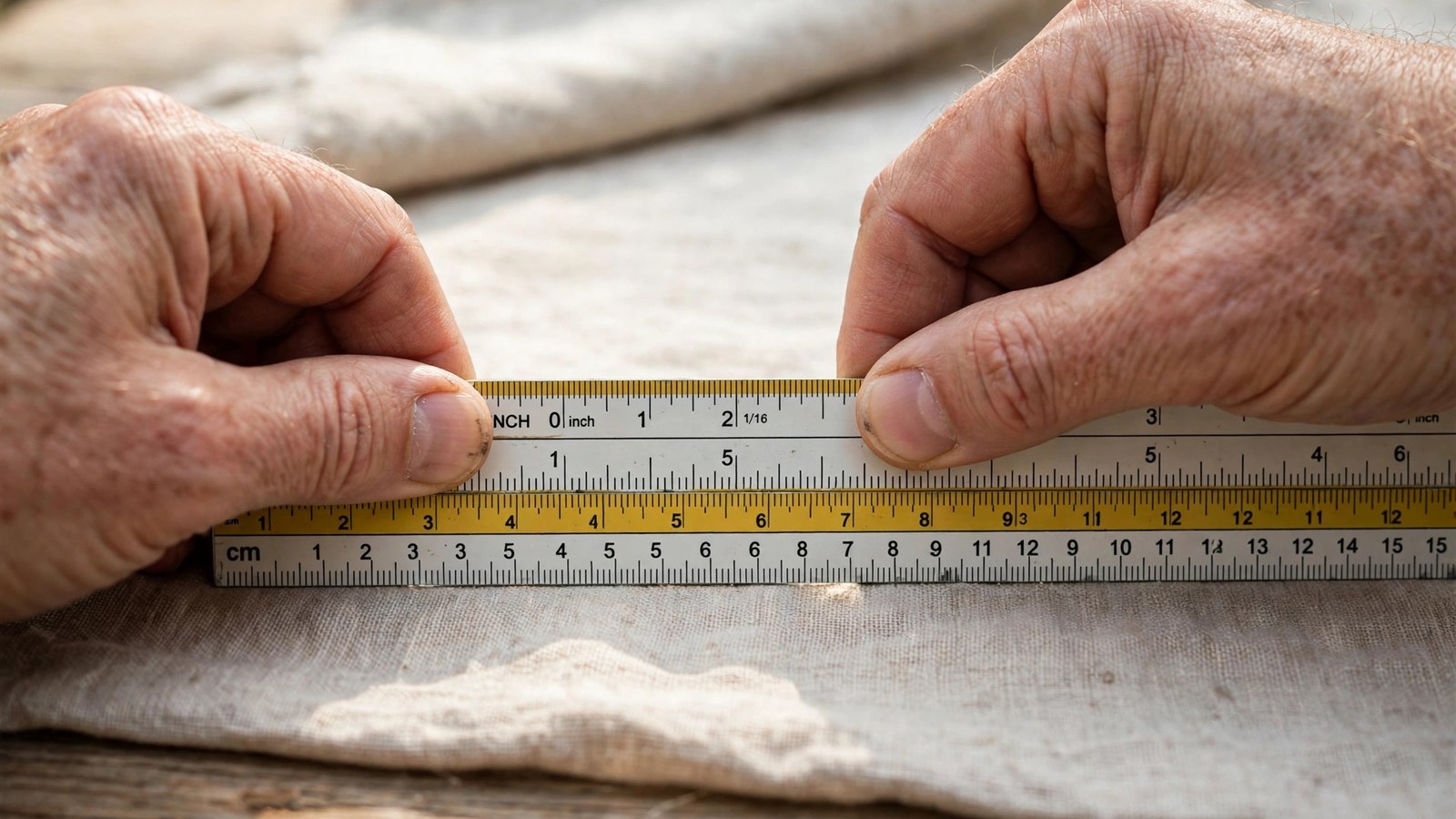
Most rulers and many tape measures carry both scales, inches on one edge and centimeters on the other, and reading them well removes most conversion work for short lengths. On the centimeter edge, the numbered marks are centimeters and the small marks between them are millimeters. There are ten millimeter marks in each centimeter, so a point that falls on the seventh small mark past the 14 cm number is 14.7 cm. On the inch edge, the inch is usually divided into 16 small marks, so each small mark is 1/16 inch, or 0.0625 inches, which is 0.15875 cm.
Three habits prevent most ruler errors. First, start from zero, and check that the zero mark is a real mark and not the worn end of the ruler. Some rulers have a deliberate blank space before zero. Second, read the scale you mean to read. On a crowded dual scale ruler, it is easy to read the inch edge when you wanted centimeters, and the numbers are close enough at short lengths that the mistake is not obvious. Third, for a length that falls between marks, convert the exact reading rather than the rounded one. A length read as 3 and 5/16 inches is 3.3125 inches, and 3.3125 x 2.54 = 8.41375 cm, about 8.41 cm. Reading it as about 3.3 inches first gives 8.382 cm, which is a third of a millimeter out. That gap rarely matters for a shelf and often matters for a fitted part.
A tape measure adds one more check. The metal hook at the end is meant to move slightly, by the thickness of the hook itself, so that inside measurements and outside measurements are both accurate. That movement is not damage, and pushing the hook hard against an edge in a way that defeats it can shift a reading by about a millimeter.
Inches, Centimeters, Millimeters, and Meters Together
The four length units in this guide connect through exact definitions, so a conversion between any two of them can be done in one or two steps.
- 1 inch = 2.54 centimeters = 25.4 millimeters exactly
- 1 foot = 12 inches = 30.48 centimeters = 0.3048 meters exactly
- 1 yard = 36 inches = 91.44 centimeters = 0.9144 meters exactly
- 1 centimeter = 10 millimeters = 0.3937007874 inches, using the multiplication factor stated above
- 1 meter = 100 centimeters = 39.3701 inches, rounded from 39.37007874
- 1 kilometer = 1000 meters = 39,370.08 inches, rounded from 39,370.07874
To convert centimeters to millimeters, multiply by 10. To convert inches to millimeters, multiply by 25.4. To convert meters to inches, multiply by 39.3701 for a rounded result, or divide the meters by 0.0254 for the most direct route. All of these routes trace back to the same definition: 1 inch is 0.0254 meters.
A quick mental shortcut is to use 2.5 instead of 2.54 for a rough estimate, then correct upward slightly. Ten inches estimated at 25 cm is actually 25.40 cm, an error of 0.4 cm, or about 1.6 percent. That is fine for judging whether a bag will fit in a locker. It is not fine for cutting, sewing, or ordering a part. For anything that will be cut or fitted, use 2.54. The reverse shortcut has the opposite bias. Dividing centimeters by 2.5 instead of 2.54 gives a slightly larger inch figure than the exact answer: 50 divided by 2.5 is 20 inches, while 50 divided by 2.54 is 19.69 inches. Knowing the direction of the error is what makes a shortcut safe to use for an estimate.
Common Mistakes
- Using 2.5 and calling it exact. Two point five is an approximation. It underestimates every inch to centimeter conversion by about 1.6 percent, which is 1.6 cm on a meter. Use 2.54 whenever the result will be used for a real measurement.
- Dividing when you should multiply. Inches to centimeters is multiplication, and the centimeter number is larger. Centimeters to inches is division, and the inch number is smaller. If your answer moves in the wrong direction in size, you have swapped the operations.
- Rounding twice. Converting inches to centimeters, rounding, and then converting back will not always return the starting figure exactly. Keep full precision through a chain of conversions and round only the final answer.
- Confusing centimeters with millimeters. A centimeter is ten millimeters. One inch is 2.54 cm but 25.4 mm. Dropping or adding a zero here is a tenfold error, and a sanity check on size exposes it at once: a 15 cm phone diagonal is plausible, a 150 cm phone is not.
- Converting feet and inches separately. Collapse a feet and inches measurement into total inches first, then multiply by 2.54. Rounding the feet part and the inches part separately introduces two rounding errors instead of none.
- Measuring a screen the wrong way. Screen size is the diagonal, not the width or the height. A diagonal figure cannot be used as a width when you are checking whether a device fits a space.
- Chaining rounded marks. When you mark repeated intervals, such as button spacing, mark each interval from a fixed starting point using the exact converted spacing. Chaining rounded marks lets a small error grow with every interval.
Frequently Asked Questions
How many centimeters are in an inch?
There are 2.54 centimeters in one inch, exactly. The figure is a definition set by international agreement in 1959, not a rounded measurement.
How many inches is 50 cm?
Fifty centimeters are 19.6850 inches, which rounds to 19.69 inches, or about 1 foot 7.69 inches.
How many cm is 2 inches?
Two inches are 5.08 centimeters, exactly, because 2 x 2.54 = 5.08.
How many cm is 4 inches?
Four inches are 10.16 centimeters, exactly, because 4 x 2.54 = 10.16.
How many inches are in a centimeter?
One centimeter is 0.3937007874 inches by the multiplication factor, usually rounded to 0.3937 inches. The exact route is to divide by 2.54.
How many centimeters are in a foot?
One foot is 12 inches, and 12 x 2.54 = 30.48 centimeters, exactly. One yard, which is 3 feet or 36 inches, is 91.44 centimeters, exactly.
Is an inch the same size in the US and the UK?
Yes, for ordinary purposes. Both countries use the international inch of exactly 2.54 cm, defined in 1959. A former United States survey inch differed by about two parts per million, and NIST records that the survey foot built on it was deprecated at the end of 2022. It affects historic surveying records, not everyday conversions.
How do I convert centimeters to inches quickly?
Divide centimeters by 2.54. For a rough estimate, divide by 2.5, remembering that dividing by the smaller number gives a slightly larger inch figure than the exact division. For example, 50 divided by 2.5 is 20 inches, while 50 divided by 2.54 is 19.69 inches. Use 2.54 for the real answer.
How many centimeters is a 6 inch phone screen?
A 6 inch screen diagonal is 6 x 2.54 = 15.24 centimeters. Screen sizes are measured on the diagonal, so this is the diagonal length, not the width of the phone.
How tall is 5 feet 7 inches in centimeters?
Five feet 7 inches is 67 total inches, and 67 x 2.54 = 170.18 centimeters, exactly.
Keep reading: How Many Inches Are in a Yard? The Exact Answer, With Worked Examples
Keep reading: Feet to Inches
Keep reading: Meters in a Foot
Keep reading: Kilometers to Miles: The Conversion, and the Distances People Actually Ask About
Sources & references
- National Institute of Standards and Technology, NIST Handbook 44 (2026), Appendix B, Units and Systems of Measurement: Their Origin, Development, and Present Status. Used for the history of the yard definition: from 1893 until 1959 the yard was defined as exactly 3600/3937 meter, and since 1959 the United States has defined the yard as exactly 0.9144 meter, from which 1 inch = 0.9144 divided by 36 = 0.0254 meters = 2.54 centimeters, 1 foot = 0.3048 meters, and the distinction between the United States survey foot and the international foot adopted in 1959. https://www.nist.gov/document/2026-nist-handbook-44-appendix-b
- National Institute of Standards and Technology, Metric Policy. Used for the deprecation of the United States survey foot on December 31, 2022, for the statement that beginning January 1, 2023 the survey foot is superseded by the international foot definition of 1 foot = 0.3048 meter exactly in all applications, and for the statement that the International System of Units is the preferred system of measurement for trade and commerce in the United States while United States customary units remain in use. https://www.nist.gov/pml/owm/metric-si/metric-policy


