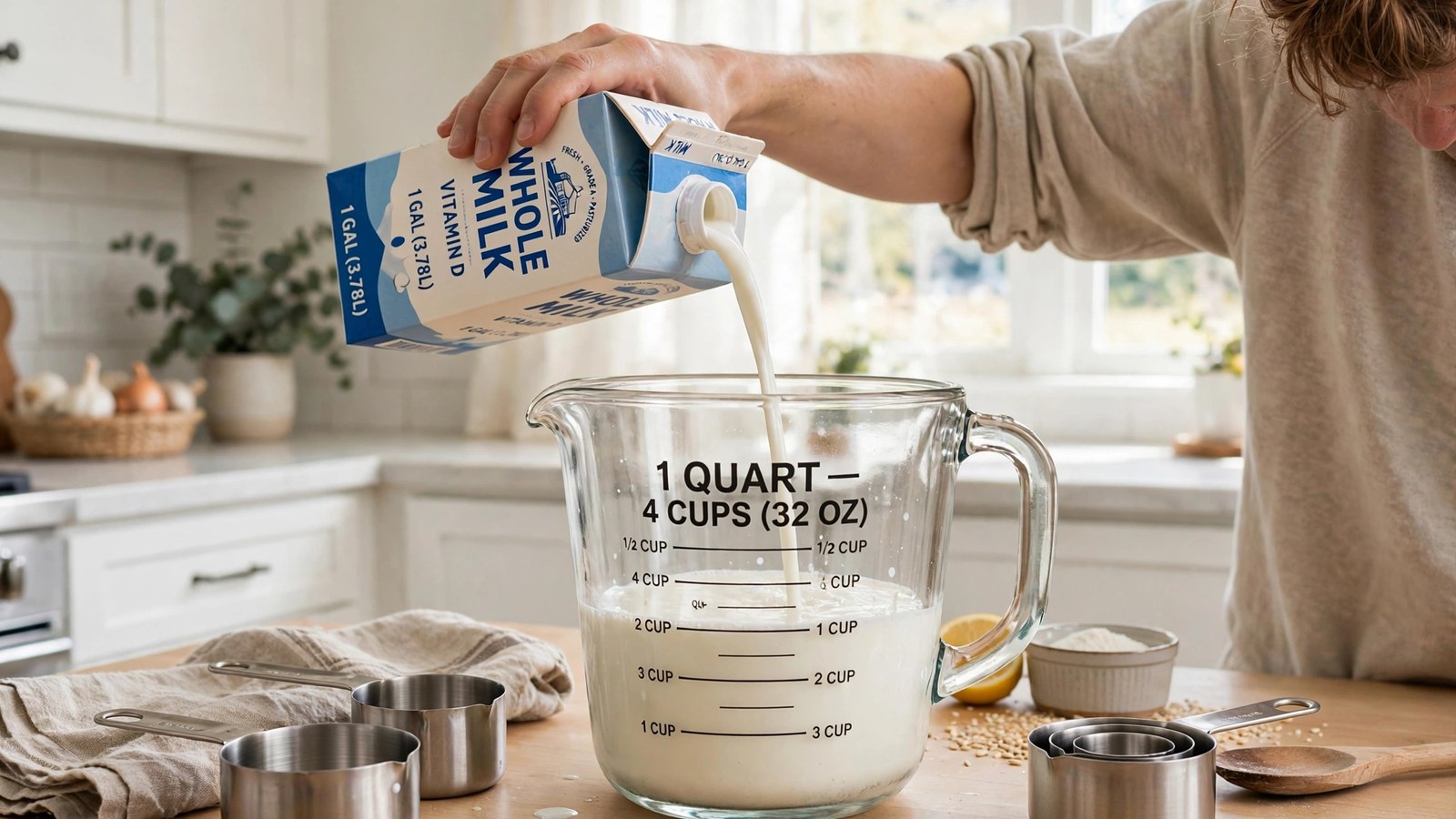
Short answer
- A US liquid quart contains exactly 32 US fluid ounces. That is the answer for almost every modern United States recipe, food label, and drinks container. One US liquid quart also equals 2 US pints, 4 US cups, one quarter of a US gallon, and about 946 milliliters, or 0.946 liters. A British imperial quart contains 40 imperial fluid ounces. One imperial quart also equals 2 imperial pints, one quarter of an imperial gallon, and about 1,137 milliliters, or 1.137 liters. The imperial quart is larger than the US liquid quart by about 190 milliliters, which is a difference of about 20 percent, so the two answers cannot be swapped. A US dry quart is a third measure, used for dry goods rather than liquids. It holds about 1,101 milliliters, or 1.101 liters, equivalent in volume to about 37.24 US fluid ounces. The 32 fluid ounce rule does not apply to it. The sections below explain where each number comes from and how to tell which quart you are working with.
By Emma Hudson
Introduction
How many ounces are in a quart sounds like a question with one answer, and in a United States kitchen it usually has one: 32 fluid ounces. The complication is that the word quart is used by more than one measurement system, and those systems do not agree. A US liquid quart, a US dry quart, and a British imperial quart are three different volumes that share one name. This guide gives the main answer first, then shows the working behind it, sets the US and imperial systems side by side, explains the dry quart, and separates fluid ounces, which measure volume, from weight ounces, which measure how heavy something is. Every figure in the tables has been recomputed from the standard definitions, so you can check any row yourself with simple multiplication or division.
The US Liquid Quart, Step by Step
The US customary system for liquid volume is built by doubling, and the quart sits in the middle of a short ladder. Each step is exact, because each unit is defined as a multiple of the one below it.
One US cup equals 8 US fluid ounces. One US pint equals 2 cups, so one pint equals 2 times 8, which is 16 US fluid ounces. One US liquid quart equals 2 pints, so one quart equals 2 times 16, which is 32 US fluid ounces. One US gallon equals 4 quarts, so one gallon equals 4 times 32, which is 128 US fluid ounces.
You can reach 32 by three routes, and all three agree. From pints: 2 times 16 equals 32. From cups: 4 times 8 equals 32. From the gallon: 128 divided by 4 equals 32. The word quart itself is a clue: a quart is a quarter of a gallon, so each quarter holds one fourth of 128, which is 32.
For smaller kitchen measures, the same ladder continues downward. One fluid ounce equals 2 tablespoons, so one quart equals 64 tablespoons. One tablespoon equals 3 teaspoons, so one quart equals 192 teaspoons. These figures follow directly from the 32 fluid ounce starting point: 32 times 2 equals 64, and 64 times 3 equals 192.
In metric terms, one US fluid ounce is defined as 29.5735295625 milliliters. Multiplying by 32 gives 946.352946 milliliters for one US liquid quart, rounded here to 946.35 milliliters or about 0.946 liters. That is why a US quart is often described as just under a liter: it is about 53.65 milliliters short, a gap of roughly 5 percent. In a pot of soup that gap rarely matters. Where the liquid ratio controls the result, such as a set custard, a brine, or a preserving recipe that must follow tested proportions, it is worth respecting rather than treating a quart and a liter as the same measure.
The Imperial Quart, Step by Step
The imperial system, standardized in Britain in the nineteenth century, follows the same doubling pattern but starts from a larger pint. One imperial pint equals 20 imperial fluid ounces. One imperial quart equals 2 imperial pints, so one imperial quart equals 2 times 20, which is 40 imperial fluid ounces. One imperial gallon equals 4 imperial quarts, so one imperial gallon equals 4 times 40, which is 160 imperial fluid ounces.
There is a second trap hidden inside that simple ladder. An imperial fluid ounce is not the same volume as a US fluid ounce. One imperial fluid ounce equals 28.4130625 milliliters, while one US fluid ounce equals 29.5735295625 milliliters. A US fluid ounce is therefore about 4.08 percent larger than an imperial fluid ounce. This means the count alone does not tell the whole story. Forty imperial fluid ounces is 40 times 28.4130625, which equals 1,136.5225 milliliters. Thirty-two US fluid ounces is 32 times 29.5735295625, which equals 946.352946 milliliters. The imperial quart is larger on both counts: it has more ounces, even though each of its ounces is slightly smaller.
The difference between the two quarts is 1,136.52 minus 946.35, which is 190.17 milliliters, about four fifths of a US cup at about 236.59 milliliters per cup. The imperial quart is therefore about 20 percent larger than the US quart. If a British recipe asks for a quart and you measure a US quart instead, the dish receives those 190 milliliters less than intended. A soup can be corrected at the stove, but in baking or brewing, where liquid is balanced against flour, setting agents, salt, or yeast, that shortfall can change the result in ways that are hard to rescue after mixing.
Modern British recipes usually avoid this problem by giving metric amounts, and imperial quarts now appear mainly in older British cookbooks and traditional recipes. If a modern British source says 1 liter, it means exactly 1,000 milliliters, which is neither quart, so do not convert it into quarts at all.
US Quart and Imperial Quart Side by Side
The table below places the two liquid quarts next to each other using each system on its own terms, with metric equivalents so the volumes can be compared directly.
| Measure | US liquid quart | Imperial quart |
|---|---|---|
| Fluid ounces in its own system | 32 US fluid ounces | 40 imperial fluid ounces |
| Pints in its own system | 2 US pints | 2 imperial pints |
| Cups | 4 US cups | About 4.80 US cups |
| Tablespoons (US) | 64 tablespoons | About 76.86 tablespoons |
| Milliliters | 946.35 milliliters | 1,136.52 milliliters |
| Liters | 0.946 liters | 1.137 liters |
| Share of its own gallon | One quarter of a US gallon | One quarter of an imperial gallon |
| Gallon it belongs to | 128 US fluid ounces, 3,785.41 milliliters | 160 imperial fluid ounces, 4,546.09 milliliters |
The cup figure for the imperial quart deserves a short explanation, because it is easy to state wrongly. Divide the imperial quart volume, 1,136.52 milliliters, by the US cup volume, 236.59 milliliters, and the result is 4.80 cups when rounded to two decimal places. Saying 5 US cups would overstate the imperial quart by about 47 milliliters. Saying 4 US cups would understate it by about 190 milliliters, almost a full cup. The accurate practical statement is 4 full US cups plus about 0.80 of a cup more.
Cross system equivalents help when a container is marked in the other system. One US liquid quart equals about 33.31 imperial fluid ounces by volume (946.35 divided by 28.4130625), and one imperial quart equals about 38.43 US fluid ounces by volume (1,136.52 divided by 29.5735295625). These are volume equivalents only and do not change the headline answers of 32 and 40.
Full US Conversion Table
The table below uses US liquid measures throughout. Quarts are converted to fluid ounces by multiplying by 32, to cups by multiplying by 4, and to pints by multiplying by 2. Milliliters are calculated at 946.352946 milliliters per quart and rounded to one decimal place. Liters are rounded to three decimal places.
| Quarts | US fluid ounces | US cups | US pints | US gallons | Milliliters | Liters |
|---|---|---|---|---|---|---|
| 1/4 quart | 8 | 1 | 1/2 | 1/16 | 236.6 | 0.237 |
| 1/2 quart | 16 | 2 | 1 | 1/8 | 473.2 | 0.473 |
| 3/4 quart | 24 | 3 | 1 1/2 | 3/16 | 709.8 | 0.710 |
| 1 quart | 32 | 4 | 2 | 1/4 | 946.4 | 0.946 |
| 1 1/2 quarts | 48 | 6 | 3 | 3/8 | 1,419.5 | 1.420 |
| 2 quarts | 64 | 8 | 4 | 1/2 | 1,892.7 | 1.893 |
| 3 quarts | 96 | 12 | 6 | 3/4 | 2,839.1 | 2.839 |
| 4 quarts | 128 | 16 | 8 | 1 | 3,785.4 | 3.785 |
| 5 quarts | 160 | 20 | 10 | 1 1/4 | 4,731.8 | 4.732 |
Read the table in either direction. To check a row, halve or double a neighboring row: two quarts must be exactly twice one quart in every column, at 64 fluid ounces, 8 cups, 4 pints, and about 1,892.7 milliliters. A conversion that does not halve and double cleanly has probably mixed systems or mixed liquid and dry measures.
The imperial ladder also doubles cleanly, around a larger starting volume. One quarter of an imperial quart is 10 imperial fluid ounces, or about 284.1 milliliters. One half is 20 imperial fluid ounces, one imperial pint, or about 568.3 milliliters. Two imperial quarts are 80 imperial fluid ounces, or about 2,273.0 milliliters, and four make one imperial gallon of 160 imperial fluid ounces, or 4,546.09 milliliters.
Converting Fluid Ounces Back to Quarts
Many real tasks run in the opposite direction. A bottle, batch, or recipe gives a total in fluid ounces, and you need to know how many quarts that makes. In the US system the rule is a single division: fluid ounces divided by 32 equals quarts.
| US fluid ounces | Quarts | Also equals |
|---|---|---|
| 8 fluid ounces | 1/4 quart | 1 cup |
| 16 fluid ounces | 1/2 quart | 1 pint, 2 cups |
| 24 fluid ounces | 3/4 quart | 3 cups |
| 32 fluid ounces | 1 quart | 2 pints, 4 cups |
| 40 fluid ounces | 1 1/4 quarts | 5 cups |
| 48 fluid ounces | 1 1/2 quarts | 3 pints, 6 cups |
| 64 fluid ounces | 2 quarts | 1/2 gallon, 8 cups |
| 80 fluid ounces | 2 1/2 quarts | 10 cups |
| 96 fluid ounces | 3 quarts | 12 cups |
| 128 fluid ounces | 4 quarts | 1 gallon, 16 cups |
A few of these totals appear constantly on packaging. A 32 fluid ounce carton is one quart, a 64 fluid ounce bottle is two quarts (also sold as a half gallon), and a 96 fluid ounce container is three quarts. If a total does not divide evenly, keep the remainder in cups rather than rounding the quarts: 40 fluid ounces is 1.25 quarts, clearer in a kitchen as 1 quart plus 1 cup, since the remaining 8 fluid ounces make exactly one cup. In the imperial system the matching rule is division by 40, so 80 imperial fluid ounces equal 2 imperial quarts. Confirming the system before you calculate matters more than the calculation itself.
Quarts, Liters, and Milliliters
Because so many modern recipes and nearly all scientific work use metric volume, the bridge between quarts and liters is one of the most useful parts of this conversion. One liter equals 1,000 milliliters exactly. One US liquid quart equals about 946.35 milliliters, so one liter equals about 1.057 US liquid quarts, and one US fluid ounce equals about 29.57 milliliters. One imperial quart equals about 1,136.52 milliliters, so one liter equals about 0.880 imperial quarts, and one imperial fluid ounce equals about 28.41 milliliters.
Three quick reference points cover most everyday cases. If a recipe calls for 1 quart and you measure in metric, use about 946 milliliters for a US recipe or about 1,137 milliliters for an imperial one. If a recipe calls for 1 liter and you measure in US quarts, use about 1.06 quarts, in practice 1 quart plus a little over 3 1/2 tablespoons, since the extra 53.65 milliliters divided by about 14.79 milliliters per tablespoon is about 3.6 tablespoons. If a container is labeled only in milliliters, the metric figure settles the system question at once: near 946 milliliters is a US quart, and near 1,136 milliliters is an imperial quart.
Rounding deserves one caution. For drinking water, stock, and most cooking, rounding 946 milliliters to 950 milliliters is harmless. For anything measured to a formula, including infant formula mixed to its package directions, medicine, home brewing, and preserving, use the figure your source specifies and measure in its unit wherever possible, rather than converting and rounding twice.
The US Dry Quart
The United States keeps a separate set of dry volume measures, inherited from grain measurement, and the dry quart is the member of that set most likely to be confused with the liquid quart. One US dry quart equals 2 dry pints and one thirty-second of a bushel. In size it equals 67.2006 cubic inches, compared with 57.75 cubic inches for the liquid quart. Converted to metric, one dry quart is about 1,101.22 milliliters, or 1.101 liters.
Dividing that volume by the US fluid ounce gives a volume equivalent of about 37.24 US fluid ounces. That figure is useful only for comparing sizes. Dry goods are not measured in fluid ounces in practice, because dry measures are filled by volume in their own containers and then usually sold or used by weight. You will meet the dry quart mainly at farms and markets, on older produce measures, and in packaging for berries and similar produce sold by the dry quart or dry pint.
The dry quart is about 16.4 percent larger than the liquid quart: 1,101.22 minus 946.35 is 154.87 milliliters, and 154.87 divided by 946.35 is about 0.164. Substituting one for the other is therefore not a small rounding error. If a source specifies a dry quart, use a dry measure or convert through milliliters, and do not apply the 32 fluid ounce rule. The imperial system, by contrast, uses the same quart for liquid and dry commodities, so there is no separate imperial dry quart to confuse with the imperial liquid quart.
Fluid Ounces and Weight Ounces Are Different Units
The most persistent source of error in this whole topic is not the US and imperial split. It is the fact that the word ounce names two different units. A fluid ounce measures volume, meaning how much space a liquid takes up. A weight ounce, formally an avoirdupois ounce, measures mass, meaning how heavy something is. A kitchen jug measures fluid ounces. A kitchen scale measures weight ounces. The shared abbreviation, oz, hides the difference.
For water, and only for water, the two numbers sit close together, which is why the confusion survives. One US fluid ounce of water weighs about 1.043 weight ounces, so 32 fluid ounces of water, one US liquid quart of water, weighs about 33.38 weight ounces, a little over 2 pounds. That relationship holds only because of the density of water at ordinary kitchen temperatures, and even for water it is an approximation that shifts slightly with temperature. It must never be treated as a conversion rule for other ingredients.
For anything else, volume and weight part company according to density. A quart of honey weighs much more than a quart of water, because honey is much denser. A quart of flour weighs much less, because flour is mostly grain particles and trapped air. Rice, sugar, oats, and oils each have their own volume to weight relationship, which is why reliable baking references give ingredient-specific weights per cup instead of one general rule.
The working rule is simple. If a recipe lists an ingredient in fluid ounces, cups, pints, or quarts, measure it by volume. If it lists ounces without the word fluid, and especially if it also uses pounds, treat it as weight and use a scale. When the wording is ambiguous, the ingredient usually settles it: liquids are almost always volume, while flour, cheese, meat, and similar solids in United States recipes are usually weight when a bare ounce figure is given.
Worked Examples
Example 1: scaling a soup. A soup recipe for four people calls for 2 quarts of stock, and you are cooking for eight. Doubling gives 4 quarts, which is 1 gallon, 128 fluid ounces, 16 cups, or about 3,785 milliliters. If your pot is described in liters, it must hold comfortably more than 3.79 liters of stock alone, before other ingredients are added.
Example 2: reading a container. A bottle is labeled 96 fluid ounces. Dividing 96 by 32 gives exactly 3 US quarts, which is 12 cups, or 3 times 946.35, about 2,839 milliliters. The same numeral read as imperial fluid ounces would give 96 divided by 40, which is 2.4 imperial quarts, so the system on the label decides which answer is right.
Example 3: following a British recipe with US cups. An older British recipe calls for 1 imperial quart of milk. You need 1,136.52 milliliters. Dividing by 236.59 milliliters per US cup gives about 4.80 US cups. In practice, measure 4 full cups plus about 0.80 of a cup. Using only 4 cups would leave the recipe about 190 milliliters short, and using 5 cups would add about 47 milliliters too much.
Example 4: halving a recipe. A sauce recipe calls for 1 quart of cream and you want half. Half a US liquid quart is 16 fluid ounces, which is 1 pint or 2 cups, or about 473 milliliters. Halving again gives a quarter of a quart: 8 fluid ounces, 1 cup, or about 237 milliliters. These clean halves are a reliable check. If your halved figure is not a clean step on the ladder, you have probably used the wrong divisor.
Example 5: drinks for a group. You plan to serve 12 glasses of 8 fluid ounces each. Twelve times 8 is 96 fluid ounces, which is exactly 3 quarts. Two quart cartons would leave you 32 fluid ounces, one full quart, short. Three quart cartons, or one gallon container with a quart to spare, covers the plan.
Example 6: a recipe given in liters. A recipe calls for 1.5 liters of water. Converting to US quarts, 1,500 divided by 946.35 is about 1.58 quarts. In fluid ounces, 1,500 divided by 29.57 is about 50.7 fluid ounces, which you can measure directly on a jug marked in fluid ounces. Choosing the unit your jug already shows is often the most accurate route, because it removes one conversion step and its rounding.
How to Tell Which Quart a Recipe or Container Means
Most of the time the answer is on the label or in the source. A United States supermarket carton marked 1 QT or 32 FL OZ is a US liquid quart, and United States recipes that say quart without qualification mean the same thing. A container that also shows milliliters removes all doubt: about 946 milliliters means US, and about 1,136 milliliters means imperial.
A traditional British cookbook, especially one written before metric amounts became standard in Britain, may mean the imperial quart of 40 imperial fluid ounces. A modern British recipe will usually give milliliters or liters, in which case no quart conversion is needed. A measure marked dry quart, or produce sold by the quart at a farm stand, points to the US dry quart of about 1,101 milliliters.
When a source gives no system and no metric figure, use its origin as the tiebreaker: United States sources mean the US liquid quart, and older British and Commonwealth sources in imperial units mean the imperial quart. If the origin is also unclear and the amount matters, convert both ways and judge which result fits the pan size and the other ingredient amounts. The figure that produces a sensible total volume is almost always the intended one.
Common Mistakes to Avoid
Using 32 ounces for an imperial recipe leaves the dish about 190 milliliters short of liquid, because the imperial quart is about 20 percent larger than the US quart. Check for the word imperial, a British source, or a 40 fluid ounce figure before you measure.
Treating US and imperial fluid ounces as equal is a second mistake. They differ by about 4 percent each, part of why the two quarts sit 190 milliliters apart. Convert through milliliters whenever a conversion crosses systems, so each ounce is valued in its own system first.
Treating a quart as a liter is a third mistake. A US quart is about 5 percent smaller than a liter, and an imperial quart is about 14 percent larger. The swap is acceptable only where a small liquid difference cannot change the result.
Confusing dry and liquid quarts is a fourth mistake. A US dry quart holds about 1,101 milliliters, not 946 milliliters, and it is not measured with the 32 fluid ounce rule.
Reading a scale as a jug is a fifth mistake. Ounces on a weighing scale are weight ounces, and ounces on a measuring jug are fluid ounces. They coincide closely only for water, and only approximately even then.
Rounding twice is a sixth mistake. Converting quarts to cups, rounding, then converting cups to milliliters compounds small errors. Convert once, directly to the unit you will measure in, and round once at the end.
Frequently Asked Questions
How many oz in quart is the answer for an American recipe?
Thirty-two US fluid ounces. One US liquid quart also equals 4 US cups, 2 US pints, one quarter of a US gallon, and about 946 milliliters. Unless an American recipe specifically says dry quart, this is the figure to use.
How many ounces is 1 quart in the UK system?
Forty imperial fluid ounces. One imperial quart equals 2 imperial pints, one quarter of an imperial gallon, and about 1,137 milliliters. Imperial fluid ounces are slightly smaller than US fluid ounces, at about 28.41 milliliters against about 29.57 milliliters, so compare the metric equivalents, not just the counts.
How many ounces are in 2 quarts?
In the US system, 2 liquid quarts equal 64 US fluid ounces, which is 8 cups or half a gallon. In the imperial system, 2 quarts equal 80 imperial fluid ounces. Always match the answer to the system of the question.
How many quarts are in a gallon?
Four quarts make one gallon in both systems. The gallons differ: a US gallon holds 128 US fluid ounces, or about 3,785 milliliters, while an imperial gallon holds 160 imperial fluid ounces, or about 4,546 milliliters.
Is a quart bigger than a pint?
Yes, in both systems. A quart is exactly two pints in the system it belongs to, so a US quart is two US pints and an imperial quart is two imperial pints. An imperial pint, at about 568 milliliters, is larger than a US pint, at about 473 milliliters.
How many cups are in a quart?
Four US cups make one US liquid quart, because each US cup holds 8 fluid ounces and 4 times 8 is 32. An imperial quart equals about 4.80 US cups, because the imperial system has no cup of its own and the imperial quart is the larger volume.
Is a quart the same as a liter?
No. A US liquid quart is about 946 milliliters, roughly 54 milliliters less than a liter. An imperial quart is about 1,137 milliliters, roughly 137 milliliters more than a liter. A US dry quart, at about 1,101 milliliters, sits between the US liquid quart and the imperial quart but is still not a liter.
What is a dry quart?
A US dry quart is a dry volume measure equal to 2 dry pints, one thirty-second of a bushel, and about 1,101 milliliters. Its volume is equivalent to about 37.24 US fluid ounces, but dry goods are measured in dry measures and usually sold by weight, so the fluid ounce figure is only a size comparison.
Does 32 ounces by weight equal a quart?
Not in general. Thirty-two fluid ounces is a volume, and 32 weight ounces is a mass of 2 pounds. The two come close only for water, where 32 fluid ounces of water weighs about 33.38 weight ounces. For other ingredients the weight of a quart depends on density, so weigh ingredients that are specified by weight.
Can I use a liter jug instead of a quart measure?
For approximate cooking, yes, if you allow for the difference. A liter is about 54 milliliters more than a US liquid quart and about 137 milliliters less than an imperial quart. Where liquid ratios matter, measure in milliliters using the equivalents in this article rather than swapping containers by eye.
Keep reading: How Many Cups in a Gallon? 16 US Cups, Explained
Keep reading: Ounces in a Pint: The US, UK, and Dry Pint, Explained
Keep reading: How Many Cups Is a Pint?
Keep reading: Liters to Gallons: How Many Liters in a Gallon?
Keep reading: Cups to Ounces: How Many Ounces in a Cup?
Sources & references
- National Institute of Standards and Technology (NIST), Handbook 44, Appendix C, General Tables of Units of Measurement. Used for the US liquid volume table (4 gills equal 1 pint, 2 pints equal 1 quart equal 57.75 cubic inches, 4 quarts equal 1 gallon equal 231 cubic inches), the fluid ounce table (1 liquid quart equals 32 fluid ounces, 1 gallon equals 128 fluid ounces), the dry volume table (2 dry pints equal 1 dry quart equal 67.2006 cubic inches), the British capacity table (20 fluid ounces equal 1 pint, 8 pints equal 1 gallon of 160 fluid ounces, from which 1 imperial quart equals 40 fluid ounces), and the milliliter equivalents (1 fluid ounce equals 29.573 milliliters, 1 liter equals 1.057 liquid quarts and 0.908 dry quart). https://www.nist.gov/document/2026-nist-handbook-44-appendix-c
- National Institute of Standards and Technology (NIST), SI Units, Volume. Used for the liter as a special name for the cubic decimeter, the milliliter as a special name for the cubic centimeter, and 1,000 milliliters equal 1 liter and 1,000 cubic centimeters equal 1 liter. https://www.nist.gov/pml/owm/si-units-volume


