Short answer
- Chocolate tube slime mold is the common name for a cluster of tiny, upright, chocolate brown tubes that grow on dead wood. Each tube is a spore producing structure, called a sporangium, held up by a thin black stalk. The growth belongs to the slime mold genus Stemonitis. It is not a fungus, not a mushroom, not a plant, and not an animal in the usual sense. It feeds on bacteria, fungal spores, protozoa, and particles of dead organic matter, not on living wood or living plants. For that reason it is not a tree disease. Wild specimens should not be eaten. In most cases the best response is to leave it alone, take a photograph if you want a record, and let it finish releasing its spores.
What You Are Looking At
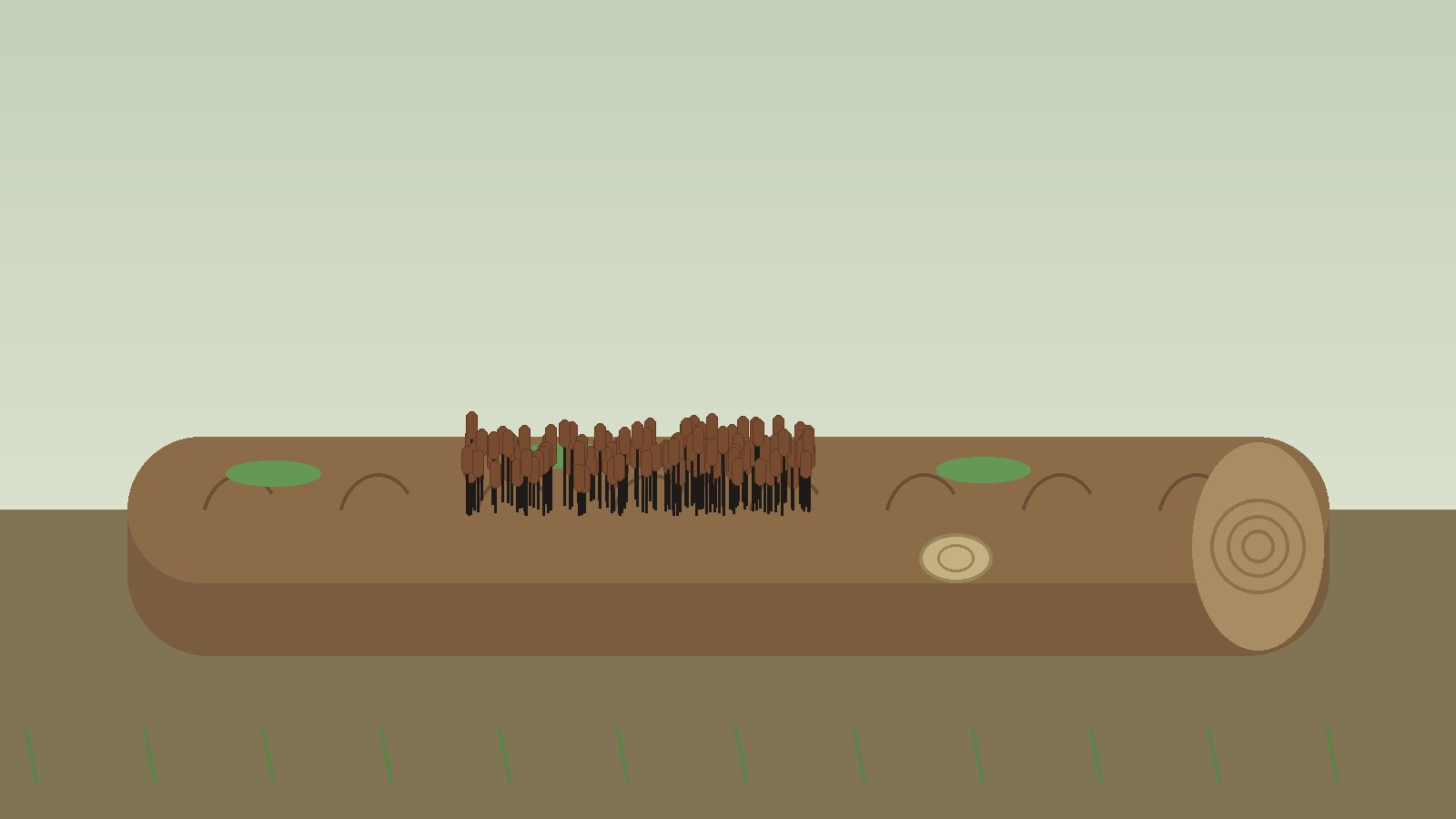
Picture a fallen log after rain, or a damp stump at the edge of a yard. On a sheltered patch of that wood sits a dense tuft that looks, at first glance, like short brown hair, a clump of tiny pipe cleaners, or a miniature stand of chocolate colored sticks. Look closer and the picture sharpens. The tuft is made of many separate, slender cylinders standing side by side. Each cylinder has a narrow, dark stalk below and a wider, brown, spore bearing top above. Together they form a cluster, not a single solid mass.
That clustered, hairlike look explains all three common names you are most likely to meet: chocolate tube slime, tree hair, and pipe cleaner slime. Chocolate tube describes the color and the tube shape. Tree hair describes the way a whole cluster can look like hair growing from a log. Pipe cleaner describes the thin stalk carrying a thicker cylinder above it.
The individual structures are small. In the MushroomExpert account of Stemonitis, the slime molds are 1 to 1.5 millimeters wide and up to 2 centimeters tall. That is roughly pinhead width to a little more, and a height no greater than about the width of an adult thumbnail. A single tube on its own would be easy to miss. A cluster is much easier to notice, because dozens or hundreds of tubes stand together and create a visible patch of brown.
One caution belongs here, before the detail that follows. When people say chocolate tube slime mold, they are usually describing what they can see with the naked eye. That visible identification is normally good enough to place the growth in the genus Stemonitis. It is not normally good enough, on its own, to name the exact species. Many web pages skip over that distinction and assign a species name too confidently. This article does not.
At a Glance
| Question | Short answer |
|---|---|
| What is it? | A plasmodial slime mold in the genus Stemonitis, seen in its spore producing stage. |
| What does it look like? | A dense cluster of tiny brown tubes on thin black stalks, growing on dead wood. |
| How big is each tube? | About 1 to 1.5 millimeters wide and up to 2 centimeters tall, in the MushroomExpert genus account. |
| Is it a fungus? | No. Slime molds are not fungi, even though they make spores and grow on decaying matter. |
| Is it a mushroom? | No. A mushroom is the fruiting body of a fungus. This is the fruiting structure of a slime mold. |
| Does it harm trees? | No. It grows on wood that is already dead and does not feed on living trees. |
| Should you eat it? | No. Do not eat wild slime molds, fungi, or mushrooms. |
| What should you do? | In most cases, nothing. Leave it alone and let it complete its life cycle. |
The Name Problem: Genus, Species, and Why Caution Matters
The common name chocolate tube slime mold is used in two related ways, and the overlap causes confusion. First, it is used for the genus Stemonitis as a whole. MushroomExpert lists chocolate tube slime, tree hair, and pipe cleaner slime as common names for Stemonitis, and describes the genus as clustered on dead wood and leaves. Second, it is also used for one species in that genus, Stemonitis splendens. The University of Florida IFAS Extension article on the subject calls the organism in its photograph Stemonitis splendens and uses chocolate tube slime mold as its title.
Both uses are understandable, but they are not interchangeable for identification. Several species of Stemonitis look very similar to the naked eye. MushroomExpert states this directly: there are several species of Stemonitis, and they vary in relative stalk length and in microscopic details such as spore morphology. In plain language, telling the species apart can require looking at spore size and shape and at the fine internal threads under a microscope, not just looking at the brown tubes on a log.
The practical conclusion is simple. If you see a dense cluster of brown tubes on thin black stalks on dead wood, chocolate tube slime mold is a reasonable common name for what you found, and Stemonitis is a reasonable genus level identification. Naming it as Stemonitis splendens specifically, from a photograph or a quick look alone, goes one step further than the visible evidence supports. A specialist with a microscope, or with DNA sequencing, could narrow it further. A casual observer should not.
This article therefore uses the wording that the evidence supports. It calls the organism chocolate tube slime mold and places it in Stemonitis. Where a source names Stemonitis splendens, this article says so and attributes that naming to that source, rather than presenting every sighting as confirmed Stemonitis splendens. That is not pedantry. It is the difference between a useful field identification and a false sense of precision.
What a Slime Mold Is, and What It Is Not
A slime mold is an organism with a life cycle that does not fit neatly into the everyday categories of plant, animal, or fungus. It can creep like an amoeba at one stage and stand still, producing spores, at another. It has no brain, no leaves, no roots, and no mushroom cap in the fungal sense. It also has no chitin in its cell walls in the way fungi do, and it does not feed the way fungi feed.
The contrast with fungi is the most useful one. Fungi, as described by the Utah State University Herbarium, do not move during any stage of their life cycle, have chitin in their cell walls, lack chlorophyll, and absorb food after breaking it down outside their cells with enzymes. Slime molds break that pattern in two obvious ways. First, they move. The feeding stage creeps over surfaces and engulfs food particles in an amoeba like manner. Second, they ingest food rather than absorbing it through a cell wall after external digestion. MushroomExpert puts the same point in structural terms: slime molds form plasmodia, which are naked masses of protoplasm without cell walls, while fungi form a penetrating and absorptive mass of hyphae in the wood. Chocolate tube slime mold does not send hyphae into wood the way a wood decay fungus does. The wood is a platform and a hunting ground, not a host being consumed from inside.
It is not a plant either. Plants make their own food using chlorophyll and sunlight. Slime molds do not photosynthesize. They obtain food by consuming other tiny organisms and particles. They are heterotrophs, meaning they depend on food from other sources, not producers that make food from light.
It is not an animal in the usual sense either, even though its feeding stage moves and engulfs food like an amoeba. It has no mouth, no gut, no nervous system, and no body plan like an animal. At the reproductive stage it stops moving altogether and produces spores, which is not animal behavior at all. Older classification placed slime molds in the kingdom Fungi, then moved them to Protista, the group used for many single celled and simple eukaryotic organisms that do not fit the plant, animal, or fungus kingdoms. Modern classification places the plasmodial slime molds in the Amoebozoa, reflecting their amoeba like stage. For a general reader the key point is simpler: slime molds are their own kind of organism, and the word mold in slime mold is a historical habit, not a classification.
The University of Georgia Extension gives a short version of the same idea: slime mold is actually not a fungus, but a type of amoeba that moves around to find sustenance, and belongs to a group called myxomycetes. Penn State Extension agrees, stating that slime molds are not classified as fungi and have been placed in the Protista kingdom, and describing them as mobile amoeba like organisms that feed mainly on bacteria. Those extension sources are talking about slime molds in general, not only about Stemonitis, but the classification point applies to chocolate tube slime mold as well, because Stemonitis is a plasmodial slime mold in that same broad group.
The Life Cycle in Plain Language
The life cycle has two main phases that a reader can picture: a feeding phase and a reproductive phase. The feeding phase is mostly hidden. The reproductive phase is the brown, hairy cluster that people notice and photograph.
It starts with spores. Spores are tiny, resistant reproductive cells. They are released into the air from mature sporangia, and they can be carried by wind, water, or animals to new places. Penn State Extension describes slime mold spores surviving adverse conditions inside specialized structures called sporangia, then being released in cool, humid weather and disseminated through air and water. A spore that lands in a suitable damp place can germinate, meaning it begins to grow again when moisture and temperature conditions are favorable.
What emerges from a germinated spore is a tiny, motile, amoeba like cell. Penn State Extension describes this directly: after germination, an amoeboid motile cell emerges, and shortly after germination the motile cells begin to unite and increase in size. The united form is called a plasmodium. This is the most distinctive stage in the whole life cycle, and also the easiest to misunderstand.
A plasmodium is not a colony of separate cells working side by side in the ordinary sense. It is a large mass of cytoplasm, the living material inside a cell, containing many nuclei but without the internal walls that would divide it into separate cells. The Utah State University Herbarium describes a plasmodial slime mold as a huge single cell, noting that unlike most cells, which have only one nucleus, this cell contains millions of nuclei. That description is given for Physarum polycephalum, a different plasmodial slime mold, and the exact number of nuclei will differ by species and by size. The structural idea carries over to Stemonitis: one flowing mass, many nuclei, no cell walls between them.
The plasmodium creeps over moist surfaces. MushroomExpert describes slime mold plasmodia creeping about over surfaces, engulfing bacteria, spores of fungi and plants, protozoa, and particles of nonliving organic matter. In other words, it eats by surrounding tiny food particles and taking them in, rather than by dissolving food outside itself and absorbing the result. It moves slowly, and its progress is best seen over hours or days rather than in a single glance. The Utah State University Herbarium notes that the giant cell moves, but only pictures taken over several days can show its progress. Do not expect to watch a chocolate tube plasmodium race across a log. Expect a slow, creeping mass that is often tucked into leaf litter, under bark, or in other damp, sheltered places where a casual walker will not see it.
The plasmodium does not stay in feeding mode forever. When conditions change, for example when food becomes scarce or the environment begins to dry, it shifts to reproduction. MushroomExpert states the transition plainly for Stemonitis: at some point, plasmodia convert into spore bearing structures, and in Stemonitis the plasmodium converts into a clustered mass of stalked sporangia. The University of Florida IFAS Extension describes the same shift in general terms: when triggered by the right, often stressful, environmental conditions, the slime mold starts forming reproductive fruiting bodies that extend out, and often up, forming tubes that serve as platforms for releasing spores into the air.
In short, the life cycle runs: spore, amoeba like cell, creeping plasmodium, clustered stalked sporangia, spores again. The brown tubes are only the final, reproductive chapter, not the whole organism.
Where It Grows, and Why There
Chocolate tube slime mold grows where two conditions meet: dead organic matter and sustained moisture. The classic site is sheltered, decaying wood: fallen logs, stumps, rotting branches, and dead wood in leaf litter. MushroomExpert lists its occurrence as clustered on dead wood and leaves. The University of Florida IFAS Extension says it is typically found on rotting material, finding food and nutrients on the forest floor. Those two statements fit together. The wood and leaves provide both the surface and the food web: bacteria, fungal spores, and other microscopic life living on and in the decaying material.
Shelter matters as much as moisture. Wind and direct sun dry a surface quickly, and a drying plasmodium cannot feed well. A log tucked under canopy, a stump in shade, a pile of damp leaves, or a wooden surface in a humid, sheltered spot stays wet longer. That is why the same kind of growth can appear in a forest and, occasionally, on a damp wooden structure such as a door or deck board, as in the Florida example. The organism is not choosing a house or a garden on purpose. It is fruiting where the plasmodium found food and moisture, and where the surface stayed damp long enough for the transformation to complete.
Season follows the same logic. MushroomExpert lists occurrence on wood substrate from May through October. That timing should be read as the pattern in the account consulted, not as a universal calendar for every climate. Warm, wet weather favors both feeding and fruiting, and the University of Florida article notes that hot, humid weather conditions are ideal for finding slime molds. In cooler or drier regions, or in a dry year, the visible stage may be briefer, later, or absent, even if spores or dormant stages remain in the area. In a wet summer after rain, a reader is more likely to notice it, especially on mulch, in shaded beds, or along a woodland trail.
Is It a Problem for Gardens or Trees?
For most readers, the answer is reassuring: no, chocolate tube slime mold is not a garden pest or a tree disease in the ordinary sense. It does not infect living plants, it does not feed on living wood, and it does not form the penetrating hyphae that a wood decay fungus uses to break down timber from inside. MushroomExpert makes the structural point explicit: although many slime mold species fruit on wood, they do not form a penetrating and absorptive mass of hyphae in the wood substrate. The wood under a Stemonitis cluster was already dead or decaying before the slime mold fruited on it. The slime mold did not kill it.
Extension guidance on slime molds in gardens points the same way. The University of Georgia Extension states that slime molds may grow on plants but do not feed on them, so the plants are largely unaffected, and that control with fungicide or other methods is typically not necessary, because the slime mold will disappear as soon as the area dries out. Penn State Extension, writing about slime molds on turfgrass, states that slime molds do not damage turfgrasses apart from shading, do not directly infect the plant, and do not need chemical control. Those statements are about slime molds in general, including species that grow on grass and mulch, not only about Stemonitis on logs. They still support the core garden point: the organism is not feeding on the plant, so it is not a plant disease.
There is one narrow exception to keep in proportion: shading. If a slime mold covers leaves for a long period, the leaves underneath receive less light and may turn pale or yellow. Penn State Extension notes this for turfgrass: if slime mold remains on the turf for long periods, the grass foliage may be deprived of sunlight and begin to turn pale green or yellow. That is a light problem, not an infection, and it resolves when the growth is removed or dries out. On a log, shading is not a concern for the log itself, because the log is already dead. On living leaves, a heavy, persistent covering is worth removing by washing or brushing, not because the slime mold is attacking the leaf, but because the leaf needs light.
Fungicide is not the answer, and extension sources are consistent on this point for garden slime molds. The University of Georgia Extension says fungicide or other control methods are typically not necessary. Penn State Extension says chemical control measures are not necessary for turfgrass slime molds. That advice makes sense once the biology is clear: a fungicide targets fungi, and this organism is not a fungus. Spraying it would not address a fungal problem, because there is none, and it would add chemical exposure for no plant health benefit. If the growth bothers you for cosmetic reasons, physical removal by raking, scooping, brushing, or washing with water, as extension sources describe, is the proportionate response.
Do Not Eat It, and How to Observe It Well
This rule is simple. Do not eat wild slime molds, fungi, or mushrooms. Chocolate tube slime mold is not presented here as food, and no edibility claim is made for it. The fact that it looks like tiny chocolate sticks does not make it chocolate, and it does not make it safe to taste. The name is a visual nickname, not a flavor guide. A small brown growth on wood can be many things, including true fungi and other slime molds. Do not use this article alone to declare a wild growth safe to eat or safe to use in any remedy. This article gives identification and general information only, and it gives no medical advice beyond the general caution not to eat wild specimens. Wash your hands after handling any wild growth, and keep it away from food preparation surfaces.
If you want a good record of a sighting, photograph the cluster from a little distance, so the size of the patch and the type of wood are clear, then take a close photograph that shows individual stalks and tubes. Include something for scale if you can, such as a coin or a ruler placed beside, not on, the cluster. Note the date, the weather in the previous few days, whether the wood was shaded or in sun, and whether the wood was a fallen log, a stump, mulch, or a wooden structure. Note the stage as well: are the tubes pale and soft, dark brown and dry, or pale again after losing spores? Those notes help a specialist much more than a description that says only brown and hairy. If you want a firmer identification, contact a local extension service, mycological society, or herbarium and ask what they need. Do not send a fresh, wet sample in a sealed plastic bag without guidance, because it will decay and become useless for microscopy.
Lookalikes
Dog vomit slime mold, Fuligo septica, is a large, yellow to tan, cushion like mass on mulch or wood, not a cluster of separate thin stalked tubes. Other Stemonitis species are often identical to the naked eye, and separation needs stalk proportions and microscopic spore and thread details, so treat a field sighting as Stemonitis unless a specialist confirms the species. Other stalked slime molds may also form small stalked sporangia, but color, size, clustering, and stalk shape differ. Small brown fungi on wood have a different structure, often with caps, pores, or a fleshy texture, and they do not form a plasmodium stage. Mosses have green leafy shoots and a different life cycle. Plant rusts and leaf spots grow on living tissue and cause symptoms on the plant itself, while chocolate tube slime mold grows on dead wood and does not infect living tissue. The most important confusion is the category confusion itself: calling anything brown and spore producing a fungus. A fungus never had a creeping, amoeba like feeding stage. A slime mold did, even if you never saw it, because the brown tubes are the end of that cycle, not the start.
Frequently Asked Questions
What is chocolate tube slime mold?
Chocolate tube slime mold is the common name for a plasmodial slime mold in the genus Stemonitis, seen as a dense cluster of tiny brown tubes on thin black stalks on dead wood. It is not a fungus, mushroom, plant, or animal. The tubes are sporangia, the spore producing structures formed when the feeding plasmodium converts to reproduction.
Is chocolate tube slime mold the same as Stemonitis splendens?
Not exactly, and the distinction is worth keeping. Chocolate tube slime is a common name for the genus Stemonitis, and it is also used for the species Stemonitis splendens. The University of Florida IFAS Extension article uses Stemonitis splendens for its example. However, several Stemonitis species look alike to the naked eye, and MushroomExpert notes that they differ in stalk proportions and microscopic spore details. A field sighting is best recorded as Stemonitis, or chocolate tube slime mold, unless microscopy or DNA work confirms the species.
Is chocolate tube slime mold a fungus?
No. Slime molds are not fungi. Fungi do not move at any stage of their life cycle, have chitin in their cell walls, and absorb food after external digestion. Slime molds move in their feeding stage, lack chitin in the way fungi have it, and engulf food particles. They were once classified with fungi and are still studied by mycologists, which explains the confusion, but their classification is separate.
Where does chocolate tube slime mold grow?
It grows on sheltered, decaying wood and leaves, including fallen logs, stumps, rotting branches, and damp leaf litter. It can also appear on damp wooden surfaces such as a door or deck board if the surface stays moist and sheltered. It needs moisture and dead organic matter, because its plasmodium feeds on bacteria, fungal spores, protozoa, and particles of dead organic matter living on that material.
Does chocolate tube slime mold harm trees or garden plants?
No, not in the way a disease harms a plant. It does not infect living tissue and does not feed on living plants. It fruits on wood that is already dead. Extension guidance for garden slime molds notes that plants are largely unaffected because the organism does not feed on them, and that chemical control is typically not necessary. The only routine garden concern is shading if a heavy growth covers leaves for a long time, which can be handled by washing or brushing the growth off.
Should I remove it from my garden?
You do not need to remove it for plant health. If it bothers you visually, or if it is on a surface you use, you can rake, scoop, brush, or wash it away with water, following extension guidance for garden slime molds. Do not use fungicide for it, because it is not a fungus and fungicide is not needed for plant health in this case. If it is on a woodland log, leaving it alone is the simplest choice and allows spores to disperse.
Can I eat chocolate tube slime mold?
No. Do not eat wild slime molds, fungi, or mushrooms. This article makes no edibility claim for chocolate tube slime mold. Its chocolate name describes its color, not its safety or flavor. Do not taste a wild growth to test it.
Sources & references
- University of Florida IFAS Extension, Escambia County. Weekly What is it? Chocolate Tube Slime Mold. Published 2 September 2020, updated 12 February 2021. https://blogs.ifas.ufl.edu/escambiaco/2020/09/02/weekly-what-is-it-chocolate-tube-slime-mold/
- MushroomExpert. Stemonitis. https://mushroomexpert.com/fungionwood/club%20and%20coral/species%20pages/Stemonitis.htm
- Utah State University, Intermountain Herbarium. The Blob: Slime Molds. https://artsci.usu.edu/herbarium/activities_fun-stuff/fun-facts-about-fungi/slime-molds
- University of Georgia Extension, Lincoln County. What is That Problem? Slime Mold. https://site.extension.uga.edu/lincoln/whats-that-problem-slime-mold/
- Penn State Extension. Turfgrass Diseases: Slime Molds. https://extension.psu.edu/turfgrass-diseases-slime-molds


