Short answer
- A US liquid pint is exactly 2 US cups. One US cup is 8 US fluid ounces and 236.588 milliliters, and one US liquid pint is 16 US fluid ounces and 473.176 milliliters, so 16 divided by 8 equals 2 cups, and 473.176 divided by 236.588 also equals 2. A UK imperial pint is different. It holds 20 imperial fluid ounces and 568.261 milliliters, which is about 2.40 US cups, not 2 US cups. Half a US pint is 1 US cup. Half an imperial pint is about 1.20 US cups. Two pints make 1 quart in both systems, and 8 pints make 1 gallon in both systems, although the quarts and gallons themselves differ in size between the two systems. A US dry pint, used for dry goods sold by volume, is yet another size, at 550.611 milliliters. When a recipe or label simply says pint, the safest check is the milliliter figure: about 473 milliliters means a US liquid pint, and about 568 milliliters means an imperial pint.
By Emma Hudson
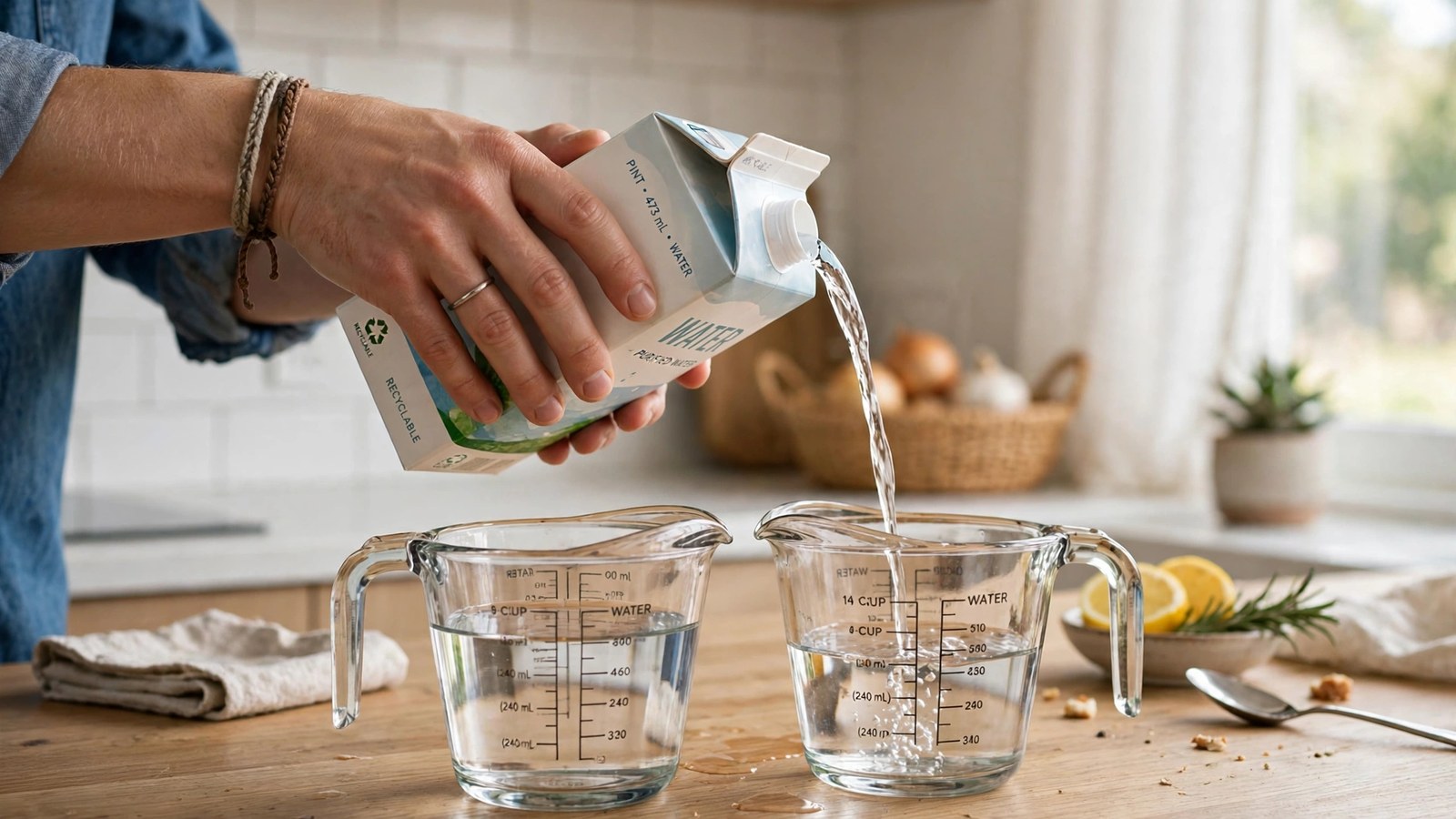
If you are asking how many cups is a pint, the everyday US answer is simple: a US liquid pint is exactly 2 US cups. That is the figure used in American recipes, on US cartons, and in US measuring sets. The complication is that a pint is not the same size everywhere. A British imperial pint is larger, and treating it as 2 US cups leaves a recipe noticeably short. This guide keeps the two systems separate, shows the arithmetic behind every figure, and gives full tables so you can convert pints to cups, fluid ounces, quarts, gallons, and milliliters without guessing.
Why a US Pint Is Exactly 2 Cups
The US customary system for liquid volume is built as a chain of doublings, and the pint sits in the middle of that chain. One US cup holds 8 US fluid ounces. Two cups make 1 pint, so a pint holds 16 US fluid ounces. Two pints make 1 quart, so a quart holds 4 cups and 32 US fluid ounces. Four quarts make 1 gallon, so a gallon holds 8 pints, 16 cups, and 128 US fluid ounces. Each step up the chain doubles the amount, and each step down halves it, which is why US recipes scale so cleanly in whole cups.
The National Institute of Standards and Technology, known as NIST, sets out the same structure in cubic inches. In NIST Handbook 44, Appendix C, a liquid pint is 28.875 cubic inches, a liquid quart is 57.75 cubic inches, and a liquid gallon is 231 cubic inches. Dividing 231 by 8 gives 28.875, which confirms that a pint is one eighth of a US gallon. The metric equivalents in the same tables give 1 liquid pint as 473.1765 milliliters, 1 liquid quart as 946.3529 milliliters, and 1 gallon as 3,785.411784 milliliters. A US fluid ounce is 29.57353 milliliters, and multiplying that figure by 16 gives 473.176 milliliters for the pint, matching the table.
Because a cup is defined as half a liquid pint, the cup figure follows directly. Half of 473.176 milliliters is 236.588 milliliters, and half of 16 fluid ounces is 8 fluid ounces. So the answer is not an approximation. Within the US liquid system, 1 pint equals 2 cups exactly, by definition, and a US pint carton commonly shows it, reading 16 fluid ounces or about 473 milliliters.
Smaller units fit the same chain. One US tablespoon is half a US fluid ounce, so 1 cup holds 16 tablespoons and 1 pint holds 32 tablespoons. One US teaspoon is one third of a tablespoon, so 1 cup holds 48 teaspoons and 1 pint holds 96 teaspoons.
Full US Conversion Table for Pints
The table below converts US liquid pints into the units cooks use most often. Every row is calculated from the same two base figures, 1 pint equals 2 cups and 1 pint equals 473.176 milliliters, so the rows are consistent with each other. Milliliter figures are rounded to two decimal places, and liter figures are rounded to three decimal places.
| US liquid pints | US cups | US fluid ounces | Tablespoons | Milliliters | Liters | Quarts | Gallons |
|---|---|---|---|---|---|---|---|
| 1/4 pint | 1/2 cup | 4 fl oz | 8 tbsp | 118.29 mL | 0.118 L | 1/8 qt | 1/32 gal |
| 1/2 pint | 1 cup | 8 fl oz | 16 tbsp | 236.59 mL | 0.237 L | 1/4 qt | 1/16 gal |
| 1 pint | 2 cups | 16 fl oz | 32 tbsp | 473.18 mL | 0.473 L | 1/2 qt | 1/8 gal |
| 1 1/2 pints | 3 cups | 24 fl oz | 48 tbsp | 709.76 mL | 0.710 L | 3/4 qt | 3/16 gal |
| 2 pints | 4 cups | 32 fl oz | 64 tbsp | 946.35 mL | 0.946 L | 1 qt | 1/4 gal |
| 3 pints | 6 cups | 48 fl oz | 96 tbsp | 1,419.53 mL | 1.420 L | 1 1/2 qt | 3/8 gal |
| 4 pints | 8 cups | 64 fl oz | 128 tbsp | 1,892.71 mL | 1.893 L | 2 qt | 1/2 gal |
| 5 pints | 10 cups | 80 fl oz | 160 tbsp | 2,365.88 mL | 2.366 L | 2 1/2 qt | 5/8 gal |
| 8 pints | 16 cups | 128 fl oz | 256 tbsp | 3,785.41 mL | 3.785 L | 4 qt | 1 gal |
| 10 pints | 20 cups | 160 fl oz | 320 tbsp | 4,731.76 mL | 4.732 L | 5 qt | 1 1/4 gal |
To use the table in reverse, start from cups. Because each pint is 2 cups, the number of pints is always half the number of cups. One cup is half a pint, 3 cups are 1 and a half pints, 6 cups are 3 pints, and 16 cups are 8 pints, which is a gallon. To convert fluid ounces to pints, divide by 16. To convert milliliters to US pints, divide by 473.176. A liter, at 1,000 milliliters, is about 2.11 US pints, because 1,000 divided by 473.176 is 2.113.
Why a UK Imperial Pint Is Not 2 US Cups
The imperial pint is larger than the US pint, and it is built from a slightly smaller fluid ounce. Both facts push in the same direction, which is why the gap is bigger than many people expect. An imperial pint holds 20 imperial fluid ounces. An imperial fluid ounce is 28.413 milliliters, while a US fluid ounce is 29.574 milliliters, so each imperial ounce is about 4 percent smaller. Multiplying 20 by 28.413 gives 568.261 milliliters for the imperial pint. United Kingdom government guidance on units of measurement uses 568 milliliters as the pint quantity, which matches this figure when rounded.
Dividing the imperial pint by the US cup gives the conversion most cooks actually need. 568.261 divided by 236.588 equals 2.402, so an imperial pint is about 2.40 US cups. The difference between the two pints is 568.261 minus 473.176, which is 95.085 milliliters. That is about 20 percent of a US pint, about 6.4 US tablespoons, and just under half a US cup. It is small enough to miss when pouring by eye, and large enough to change the texture of a sauce, a batter, or a soup.
You will sometimes see an imperial pint described as about 2.5 US cups. That figure comes from dividing 20 by 8, treating the imperial pint as 20 units of 8, without adjusting for the fact that imperial and US fluid ounces are different sizes. Two and a half US cups hold 591.47 milliliters, which overshoots a true imperial pint by about 23 milliliters, roughly one and a half tablespoons. As a rough estimate for a stew it is harmless. For baking, for custards, or for any recipe where the liquid ratio matters, use 2.40 US cups, or better still, measure 568 milliliters directly.
The cup question needs one more careful distinction, because the word cup does not mean the same thing in every system. There is no official imperial cup unit, and no standard imperial measuring cup. Where an imperial cup of 10 imperial fluid ounces, 284.131 milliliters, is used in older or imperial recipe conventions, an imperial pint holds 2 of them, because that cup is half an imperial pint. Another convention uses 8 imperial fluid ounces, 227.3 milliliters, for a cup, and on that size an imperial pint holds 2.5 cups. Many countries instead use a metric cup of exactly 250 milliliters. An imperial pint divided by 250 milliliters is 2.273, so an imperial pint is about 2.27 metric cups, not 2.5 metric cups. A US pint divided by 250 milliliters is 1.893, so a US pint is about 1.89 metric cups. Traditional British cookery did not rely on cups at all, measuring instead in pints, fluid ounces, and later in milliliters and grams, which is why converting a British pint into cups is always a translation into someone else’s unit, and why the kind of cup must be named every time.
US Pint and Imperial Pint Side by Side
| Measure | US liquid pint | UK imperial pint |
|---|---|---|
| Fluid ounces in its own system | 16 US fl oz | 20 imperial fl oz |
| Milliliters | 473.18 mL | 568.26 mL |
| Liters | 0.473 L | 0.568 L |
| US cups | 2 cups exactly | About 2.40 cups |
| Metric cups of 250 mL | About 1.89 cups | About 2.27 cups |
| Quarts in its own system | 1/2 US quart | 1/2 imperial quart |
| Gallons in its own system | 1/8 US gallon | 1/8 imperial gallon |
| Cubic inches | 28.875 in3 | About 34.68 in3 |
Both pints are one eighth of a gallon, but the imperial gallon is 4.54609 liters while the US gallon is 3.785 liters, so one eighth of each cannot be the same size. The US pint is 28.875 cubic inches by the NIST table, and the imperial pint, converted from 568.261 milliliters, is about 34.68 cubic inches. Comparing shared names through milliliters is the reliable method, because metric units do not change from country to country.
Imperial Pints Converted to US Cups
The US cup figures below are the imperial volume in milliliters divided by 236.588, rounded to two decimal places. For the larger amounts, measure in milliliters, because filling nine or more US cups one at a time invites counting errors.
| Imperial pints | Imperial fluid ounces | Milliliters | US cups (approx.) |
|---|---|---|---|
| 1/2 imperial pint | 10 imperial fl oz | 284.13 mL | About 1.20 cups |
| 1 imperial pint | 20 imperial fl oz | 568.26 mL | About 2.40 cups |
| 2 imperial pints | 40 imperial fl oz | 1,136.52 mL | About 4.80 cups |
| 3 imperial pints | 60 imperial fl oz | 1,704.78 mL | About 7.21 cups |
| 4 imperial pints | 80 imperial fl oz | 2,273.05 mL | About 9.61 cups |
| 8 imperial pints | 160 imperial fl oz | 4,546.09 mL | About 19.22 cups |
To convert imperial pints to US cups, multiply by 2.402, or 2.40 for kitchen accuracy. To convert US pints to US cups, multiply by 2 exactly. Keeping those two multipliers separate is the whole skill. In reverse, one US cup is about 0.416 of an imperial pint, because 236.588 divided by 568.261 is 0.416, so 4 US cups are about 1.67 imperial pints, or 946 milliliters.
The US Dry Pint Is a Different Measure
The United States also has a dry pint, and it is not the same size as the liquid pint. NIST lists dry volume separately from liquid volume. A dry pint is 33.600 cubic inches and 550.611 milliliters, while a liquid pint is 28.875 cubic inches and 473.176 milliliters. The dry pint is therefore about 77.43 milliliters larger, a difference of about 16 percent. Two dry pints make 1 dry quart, at 67.201 cubic inches and 1,101.221 milliliters, and dry measures continue up through pecks and bushels, units used for produce and grain rather than for kitchen liquids.
Dry pints appear on punnets and baskets of produce, such as berries, cherry tomatoes, and mushrooms. A dry pint describes the volume of the container, not a weight, and a dry pint of one food does not weigh the same as a dry pint of another, because foods pack differently. If a recipe gives a weight, weigh the ingredient. Never use a dry pint figure for a liquid ingredient, and never use the 2 cup liquid rule for a dry pint. The liquid rule belongs to the liquid pint only.
How to Convert Pints to Cups Step by Step
For a US liquid pint, the method has one step. Multiply the number of pints by 2. One pint becomes 2 cups, 2 and a half pints become 5 cups, and 6 pints become 12 cups. For part pints, the same rule holds: a quarter of a pint is half a cup, and three quarters of a pint is 1 and a half cups, because 0.75 multiplied by 2 is 1.5. To go the other way, from US cups to US pints, divide by 2. Seven cups divided by 2 is 3 and a half pints.
For an imperial pint, the method has two steps if precision matters. First, convert the imperial pints to milliliters by multiplying by 568.261. Second, either measure that milliliter amount directly, which is the most accurate option, or divide it by 236.588 to get US cups. One imperial pint becomes 568 milliliters, measured directly, or about 2.40 US cups. Two imperial pints become 1,137 milliliters, using the rounded sum of 1,136.52, or about 4.80 US cups. If you only have US cups and no milliliter jug, measure the full cups first and then add the remainder in tablespoons. One US tablespoon is 14.787 milliliters. The remainder of an imperial pint after 2 full US cups is 95.085 milliliters, and 95.085 divided by 14.787 is about 6.4, so 2 cups plus about 6 and a half tablespoons lands within about a milliliter of a true imperial pint.
A quick sanity check catches most errors. An imperial quantity must always convert to more US cups than the same number of US pints, by about one fifth. If your imperial conversion comes out equal to the US figure, or lower, the calculation has gone wrong. A container labeled near 475 milliliters is a US pint, and one labeled near 570 milliliters is an imperial pint.
Worked Recipe Examples
Example 1: an American pancake recipe needs 1 pint of buttermilk. This is a US pint, so multiply by 2. You need 2 US cups, which is 473 milliliters. Pour two level cups and the measurement is complete.
Example 2: a British recipe needs 1 pint of milk and you only have US measuring cups. This is an imperial pint. Measure 2 full US cups, then add about 6 and a half tablespoons. Two cups give 473.18 milliliters and 6 and a half tablespoons give about 96.11 milliliters, for a total of about 569 milliliters, within about a milliliter of the true 568.26 milliliters. Using only 2 cups would leave the recipe about 95 milliliters short, and using 2 and a half cups would put it about 23 milliliters over.
Example 3: a soup recipe needs 3 US pints of stock. Multiply 3 by 2 to get 6 US cups. In metric, 3 multiplied by 473.176 is 1,419.53 milliliters, about 1.42 liters. Because 2 pints make a quart, 3 pints is also 1 and a half US quarts.
Example 4: you have a 2 cup measuring jug and a recipe calling for half a pint. Half a US pint is exactly 1 cup, so fill the jug to the 1 cup line, not to the top. Half an imperial pint is 284.13 milliliters, about 1.20 US cups, so the 1 cup line would leave you about 48 milliliters short, roughly 3 tablespoons. Fill to a little above the 1 cup line, or measure 284 milliliters if the jug has metric markings.
Example 5: doubling a recipe. A sauce made with half a US pint of cream doubles to 1 full pint, which is 2 cups or 473 milliliters. Doubling does not change the system. If the original recipe is British and starts with 1 imperial pint of milk, the doubled amount is 2 imperial pints, which is 1,136.52 milliliters or about 4.80 US cups, not 4 cups. Doubling doubles the system difference as well as the quantity, so a conversion error is also doubled.
Example 6: halving a recipe. A drink recipe calling for 1 US pint of juice halves to half a pint, which is 1 cup, 8 fluid ounces, or 236.59 milliliters. A British recipe calling for 1 imperial pint halves to 284.13 milliliters, about 1.20 US cups. Halving is where the imperial difference is easiest to overlook, because half a pint sounds like 1 cup in both systems, and it is only true in one of them.
Example 7: scaling up for a group. A punch recipe calls for 5 US pints of lemonade. Five multiplied by 2 is 10 US cups, and 5 multiplied by 473.176 is 2,365.88 milliliters, about 2.37 liters. If a British version calls for 5 imperial pints, the amount is 2,841.31 milliliters, which is 475 milliliters more, almost exactly one extra US pint. At party scale, the system difference is a whole container, not a rounding issue.
Example 8: a baking recipe where ratios matter. A custard made with 1 imperial pint of milk depends on the ratio of milk to eggs and sugar. Replacing the imperial pint with 2 US cups cuts the milk by about one sixth of the intended amount, so the custard sets firmer and tastes sweeter than intended. In baking, convert through milliliters whenever a recipe crosses between systems.
How to Tell Which Pint You Have
Check the label first. A US pint container is usually marked 16 fluid ounces or about 473 milliliters. A container from the United Kingdom is usually marked 568 milliliters, and government rules in the United Kingdom keep the pint as a permitted measure for draught beer and cider and for milk in returnable containers, so pint labeling remains common there. If the label gives both a pint figure and a milliliter figure, trust the milliliter figure, because it cannot be confused with another system.
Check the origin of the recipe next. An American source that uses cups elsewhere is working in US measures, and its pint is a US liquid pint. A traditional British source that gives pints alongside grams and milliliters is using the imperial pint, and where it gives a milliliter figure, use that figure directly. Stay in one system for every ingredient. When in doubt, use milliliters: convert the pint once, 473 for US or 568 for imperial, and measure everything metrically.
Measuring a Pint Accurately
Use a liquid measuring jug for liquids, placed on a flat surface, and read the scale at eye level. For amounts of a pint or more, a jug with both cup and milliliter markings lets you cross check one scale against the other: a US pint should read 2 cups on one scale and about 473 milliliters on the other.
Do not use a drinking glass as a measure. Glasses sold as pint glasses are made to hold a served drink, often with room for foam, and their true capacity varies. Equally, do not confuse fluid ounces with weight ounces. A pint is a volume. A US pint of water weighs a little over a pound, but a US pint of honey weighs much more and a US pint of oil weighs less, because weight depends on density. Ingredients given by weight should be weighed on a scale, not poured into a jug.
Common Mistakes
The first and most common mistake is treating every pint as 2 cups. That rule is exact for US liquid pints and wrong for imperial pints, where it understates the volume by 95 milliliters, about 20 percent. The second mistake is treating every fluid ounce as the same size. An imperial fluid ounce is about 4 percent smaller than a US fluid ounce, and across the 20 ounces of an imperial pint that difference is built into the total. The third mistake is rounding an imperial pint up to 2.5 US cups for precise work. That estimate overshoots by about 23 milliliters. Use 2.40 US cups, or 568 milliliters, when accuracy matters.
The fourth mistake is confusing a dry pint with a liquid pint. A dry pint is 550.611 milliliters and is used for dry goods sold by volume. The fifth mistake is assuming a pint is 500 milliliters. A US pint is 27 milliliters short of 500, and an imperial pint is 68 milliliters over 500, so that stand in distorts baking ratios in either system. The sixth mistake is converting the pint in one system and every other ingredient in another. Convert the whole recipe into one system at the start, write the figures down, and cook from those figures.
Frequently Asked Questions
How many cups is a pint in US cooking?
Two US cups exactly. A US liquid pint is 16 US fluid ounces and 473.176 milliliters, and a US cup is 8 US fluid ounces and 236.588 milliliters, so the pint holds exactly two of those cups.
How many cups is a UK pint?
About 2.40 US cups. A UK imperial pint is 20 imperial fluid ounces and 568.261 milliliters, and dividing 568.261 by the US cup size of 236.588 milliliters gives 2.402. It is not 2 US cups, and 2.5 US cups overshoots it by about 23 milliliters. There is no official imperial cup count for it, because there is no official imperial cup unit.
How many cups are in half a pint?
Half a US pint is exactly 1 US cup, which is 236.59 milliliters. Half an imperial pint is 284.13 milliliters, which is about 1.20 US cups.
How many cups are in 2 pints?
In US measures, 2 pints are 4 US cups, which is also 1 US quart and 946.35 milliliters. Two imperial pints are 1,136.52 milliliters, which is about 4.80 US cups.
How many pints are in a quart?
Two pints make 1 quart in both systems. A US quart is 4 US cups and 946.35 milliliters. An imperial quart is 2 imperial pints and 1,136.52 milliliters, which is about 4.80 US cups.
How many pints are in a gallon?
Eight pints make 1 gallon in both systems. A US gallon is 16 US cups, 128 US fluid ounces, and 3,785.41 milliliters. An imperial gallon is 160 imperial fluid ounces and 4,546.09 milliliters, which is about 19.22 US cups.
Is a dry pint the same as a liquid pint?
No. A US dry pint is 550.611 milliliters and 33.600 cubic inches, while a US liquid pint is 473.176 milliliters and 28.875 cubic inches. Dry pints are used for dry goods sold by volume, such as berries in a punnet, and the weight of a dry pint depends on the food inside it.
Is a pint the same as 500 milliliters?
No. A US liquid pint is 473.176 milliliters, which is about 27 milliliters short of 500. An imperial pint is 568.261 milliliters, which is about 68 milliliters over 500. The 500 milliliter figure sits between the two pints and matches neither of them.
How many metric cups are in a pint?
A metric cup is exactly 250 milliliters. A US pint is about 1.89 metric cups, because 473.176 divided by 250 is 1.893. An imperial pint is about 2.27 metric cups, because 568.261 divided by 250 is 2.273.
How do you convert cups back into pints?
For US measures, divide the number of cups by 2. Four cups divided by 2 is 2 pints, and 10 cups divided by 2 is 5 pints. For a volume given in milliliters, divide by 473.176 to get US liquid pints, or divide by 568.261 to get imperial pints.
Why are the US and UK pints different sizes?
Both pints are one eighth of a gallon, but the gallons are different sizes. The US gallon is 231 cubic inches and 3.785 liters, while the imperial gallon is 4.54609 liters. One eighth of a larger gallon is a larger pint, which is why the imperial pint holds about 20 percent more than the US pint.
Keep reading: Ounces in a Pint: The US, UK, and Dry Pint, Explained
Keep reading: How Many Ounces Are in a Quart
Keep reading: How Many Cups in a Gallon? 16 US Cups, Explained
Keep reading: Cups to Ounces: How Many Ounces in a Cup?
Keep reading: How Many Tablespoons in a Cup
Sources & references
- National Institute of Standards and Technology, NIST Handbook 44, Appendix C, General Tables of Units of Measurement. Used for the US liquid volume chain (4 gills equal 1 pint, 2 pints equal 1 quart, 4 quarts equal 1 gallon of 231 cubic inches, equal to 8 pints), for the metric equivalents of the liquid pint (473.1765 milliliters), liquid quart, gallon, and fluid ounce (29.57353 milliliters), for the dry pint at 33.600 cubic inches and 550.6105 milliliters, and for the notes on British units, including the imperial gallon and its subdivisions. https://www.nist.gov/document/2026-nist-handbook-44-appendix-c
- UK Government, Department for Business and Trade, Choice on units of measurement: consultation response, GOV.UK. Used for the 568 milliliter pint quantity and for the pint remaining a permitted exception for draught beer or cider and for milk in returnable containers in the United Kingdom. https://www.gov.uk/government/consultations/choice-on-units-of-measurement-markings-and-sales/outcome/choice-on-units-of-measurement-consultation-response
- Wikipedia, Cup (unit). Used for imperial cup conventions: there is no imperial unit based culinary measuring cup; British cookery used drinking vessel measures including a tumbler of 10 imperial fluid ounces, half an imperial pint, and a breakfast cup of 8 imperial fluid ounces; and the Canadian conventional cup of 8 imperial fluid ounces at 227.3045 milliliters. https://en.wikipedia.org/wiki/Cup_(unit)
- UK Government, Weights and measures: the law, GOV.UK. Used for the imperial measures permitted on their own in the United Kingdom, which are the pint for draught beer or cider and for milk in returnable containers and the troy ounce for precious metals, with no cup among them. https://www.gov.uk/weights-measures-and-packaging-the-law


