Short answer
- A Library of Congress call number is a subject address for a book or other item. Read it from left to right in parts. The opening letters name a broad subject class, such as L for Education or Q for Science. The whole number that follows narrows the subject. The letter and number group after the decimal point, called a Cutter number, usually helps separate books on the same subject, often by author name or by a further topic. A second Cutter number, a year, a volume number, or a copy number may follow. To find a book, copy the full call number exactly from the catalog, note the location and floor shown in the same record, go to the section for the opening letters, then follow shelf order part by part: letters alphabetically, the first number as a whole number, then each Cutter number by letter and then as a decimal number. If the book is not in its place, check the books beside it, check whether the record lists a different location such as reference or oversize, and ask library staff.
Introduction
A catalog record gives you a string such as LB2395 .C65 1991 and expects you to walk straight to it. Once you know the pattern, that string becomes an address. It tells you the subject of the book, where that subject sits among other subjects, and where this one book sits among books on the same subject.
This guide explains how to break a call number into parts, what the main class letters stand for, how shelf order works, how to find a book in a real building, and how the system differs in general terms from Dewey Decimal. It also explains where local practice varies. The main class letters come from the Library of Congress Classification Outline. The worked examples and shelf order rules come from that outline and from university library guides that teach the same rules. Where a guide example is used, this article does not add a subject or an author name that the source did not support.
What a Library of Congress Call Number Is
The Library of Congress Classification system organizes library materials by subject. A call number built from that system groups books on the same topic together, so browsing can lead you to related books, and it gives each book a fixed place in order, so staff and readers can find it again. That is why a call number is often described as a book address.
The comparison has a limit. A call number points to a subject position on a shelf, and then to a position among neighboring books. It does not by itself tell you which building, floor, or room holds the book. That information comes from the catalog record for the item in a particular library, and from that library floor plan or location guide.
Most academic and research libraries in the United States use the Library of Congress system, while many public and school libraries use Dewey Decimal. That is a general pattern, not a rule for every library. Some libraries use a different system for part of a collection, such as a curriculum collection or a special collection. Always follow the call number shown in the catalog of the library you are visiting.
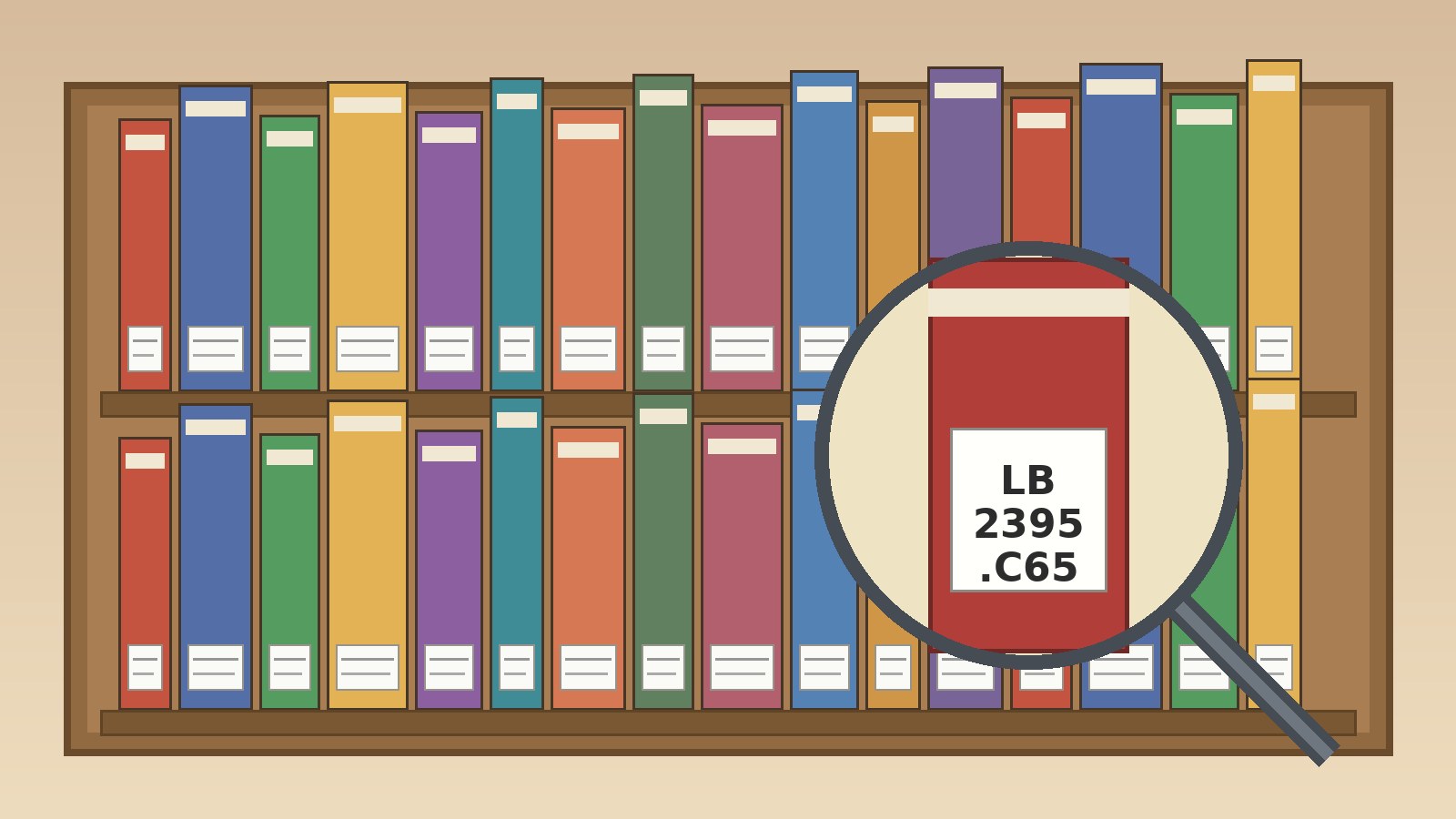
A call number appears in two layouts. In a catalog it usually appears on one line, for example LB2395 .C65 1991. On a book spine it is usually broken into lines to fit a narrow label: LB, then 2395, then .C65, then 1991. The parts are the same. Line breaks, spacing, and minor punctuation differences do not change the meaning or the shelf order. Read the parts, not the spacing.
How to Read a Call Number Part by Part
A typical call number has up to five kinds of part. Not every call number has every part. Read it from left to right and ask what each part does.
1. The class letters
The call number starts with one, two, or three letters. These name the class and, when there is more than one letter, the subclass. The first letter is the broadest subject. The second and third letters narrow it. For example, Q is Science, and QA, QB, and QC name parts of science. L is Education, and LA, LB, and LC name parts of education.
Shelf order for letters is alphabetical, with one important detail. A single letter comes before any longer combination that starts with the same letter. So L comes before LA, and LA comes before LB. Do not read the letters as a word. Read them as a sequence in which the shorter sequence comes first when it is the start of the longer one.
2. The class number
After the letters comes a number, usually from 1 to 9999, sometimes with a decimal extension. Read the part before any decimal point as a whole number. So 115 comes before 350, and 350 comes before 1150. If there is a decimal extension, read the digits after the decimal point as a decimal. For example, 212.16 comes before 212.5, because .16 is smaller than .50 when both are read as decimals.
Together, the letters and this number are the subject part of the call number. In LB2395, LB names a part of education and 2395 narrows it to a specific topic. University guides that use this example identify LB2395 as Methods of Study in Higher Education. That identification is about this exact combination. Do not guess the topic of another LB number from this one example. A nearby number can name a different topic.
3. The Cutter number
After the class number comes a Cutter number. It usually looks like a decimal point, one letter, and one or more digits, for example .C65. It is named after Charles Ammi Cutter, whose classification work was adapted by the Library of Congress. In many call numbers the letter is the first letter of the author last name, and the digits help place that name in order among other names starting with the same letter. In other call numbers the first Cutter number names a further topic rather than an author. Do not assume every Cutter number is an author name.
The reading rule for a Cutter number causes the most mistakes. Read the letter alphabetically, then read the digits as a decimal number, not as a whole number. That is why .C645 comes before .C65. Read as decimals, .645 is smaller than .650. Read as whole numbers, 645 looks larger than 65, and that wrong reading would reverse the order. The same rule puts .A3655 before .A373, and .A373 before .A4, because .3655 is smaller than .373, and .373 is smaller than .400. A useful check is to imagine the digits extended with zeros to the same length, so .C65 becomes .650 and the comparison with .645 becomes clear.
Some call numbers have a second Cutter number. It looks like a letter and digits with no decimal point shown, for example R33 in ML 420 .S77 R33 2004. Read it the same way as the first: by letter, then by digits as a decimal number, even though no decimal point is printed. The first Cutter number in a double Cutter call number often names a more precise aspect of the subject, and the second usually names the main entry, such as the author. The exact meaning depends on the schedule for that subject, so treat the order rule as the reliable part.
4. Year, volume, and copy details
Many call numbers end with a year of publication, for example 1991 in LB2395 .C65 1991. The year helps separate editions and books that otherwise share the same letters, numbers, and Cutter numbers. Read years in chronological order. A 1991 edition comes before a 1992 edition with the same earlier parts.
Volume and copy details may also appear. A volume is often shown as v.1, v.2, and so on, and a copy as c.1, c.2, and so on. Read them as whole numbers in order. A book with no volume number comes before a book with a volume number when the earlier parts are the same. Local labels can add prefixes for location or collection, such as a reference prefix. Those prefixes are not part of the subject call number itself. They tell you where to look, and they vary by library.
Worked examples
Take LB2395 .C65 1991. LB sits in the education class, in the LB subclass area. The number 2395 narrows the subject, identified in university guides as Methods of Study in Higher Education. The Cutter number .C65 separates this book from other books on that subject, and in this example the guides identify .C65 with the name Coman. The final part, 1991, is the year of publication. A book with LB2395 .C645 1993 would sit before this book, because .645 comes before .650 as a decimal. A book with LB2395 .C65 1992 would sit after it, because the earlier parts match and the later year comes second.
A second example shows the same pattern in education history. Wilmington University Library uses LA 212 .R423 2005 and explains LA 212 as Education, History of Education, United States. LA names the subclass, 212 narrows the subject, .R423 is the Cutter number, and 2005 is the year. The guide’s example book is William J. Reese’s America’s Public Schools.
A third example shows a double Cutter number without adding an unsupported subject claim. In ML 420 .S77 R33 2004, ML names the music class area, 420 narrows it, .S77 is the first Cutter number, R33 is the second Cutter number read as a decimal, and 2004 is the year. The value of this example is the structure: two Cutter numbers are read in order, letter first and then digits as a decimal, even though only the first shows a decimal point.
The Main Classes
The Library of Congress Classification Outline lists 21 main classes. Each class is named by a single letter, and most classes are then divided into subclasses with two or three letters. The letters I, O, W, X, and Y do not appear as main class letters in that outline. That is visible from the list itself. Do not treat a missing letter as a mistake in a catalog record.
Use the table below to find the right neighborhood on the shelf. Do not use it to guess a detailed topic. The detailed topic comes from the letters plus the number that follows them.
| Class | Subject area in the Library of Congress outline | | A | General Works | | B | Philosophy, Psychology, Religion | | C | Auxiliary Sciences of History | | D | World History and History of Europe, Asia, Africa, Australia, New Zealand, etc. | | E | History of the Americas | | F | History of the Americas | | G | Geography, Anthropology, Recreation | | H | Social Sciences | | J | Political Science | | K | Law | | L | Education | | M | Music and Books on Music | | N | Fine Arts | | P | Language and Literature | | Q | Science | | R | Medicine | | S | Agriculture | | T | Technology | | U | Military Science | | V | Naval Science | | Z | Bibliography, Library Science, Information Resources (General) |
Note that E and F both carry the outline title History of the Americas. They are separate classes, not a duplicate, and the class letter still matters for shelf order.
Subclasses
A subclass adds one or two letters to the main class letter and narrows the subject before any number is read. In science, university guides list QA for Mathematics and computer science, QB for Astronomy, QC for Physics, QD for Chemistry and biochemistry, QE for Geology, QH for Natural history, QK for Botany, and QL for Zoology. That list is for orientation only, not the full Q schedule. Inside each subclass, the numbers carry the detailed topics.
Other orientation examples include KF for United States law, NA for Architecture and NB for Sculpture, SB for Plant culture and SD for Forestry, and TA for Engineering. In philosophy, psychology, and religion, BD is listed for Philosophy, BF for Psychology, and BL through BX for Religion. In education, guides list LA for History of Education, LB for Theory and Practice of Education, LC for Special Aspects of Education, LD for Individual Institutions in the United States, LE for Individual Institutions in America excluding the United States, LF for Individual Institutions in Great Britain and Continental Europe, LG for Individual Institutions in Asia, Africa, and Oceania, LH for College and School Magazines and Papers, LJ for Student Fraternities and Sororities in the United States, and LT for Textbooks. Older wording in a guide does not mean the current schedule uses the same country name. For a specific book, follow its catalog record.
How Shelf Order Works
Shelf order follows the same sequence as a catalog sort, from left to right and from the top shelf down. Apply the rules in order. When two call numbers differ at an early part, the later parts do not matter for their relative order.
First, compare the letters alphabetically, with shorter sequences before longer sequences that start with the same letters. L comes before LA, LA comes before LB, and LB comes before LC.
Second, compare the class number as a whole number, with any decimal extension read as a decimal. So 11 comes before 212, 212 comes before 761, and 212.16 comes before 212.5. A common error is to read 1150 as if it came before 350. As whole numbers, 350 comes first.
Third, compare the first Cutter number by letter, then by digits as a decimal. So .B76 comes before .R227, .R227 comes before .R423, and .R423 comes before .R966. When the letters match, the decimal comparison decides, so .C645 comes before .C65.
Fourth, compare the second Cutter number, if there is one, the same way: letter first, then digits as a decimal, even though no decimal point is printed.
Fifth, compare the year, then volume and copy details, in whole number and chronological order. An earlier year comes before a later year when all earlier parts match.
Do not merge the class number decimal with the Cutter decimal. In QA 76.73, the .73 after 76 is part of the class number. In .C65, the decimal point before C marks the Cutter number.
Local practice can change the visible label without changing these rules. A library may add a location prefix or shelve oversize books in a separate sequence. In those cases the call number order still applies inside each sequence, but the sequence itself is set by the catalog location.
How to Find a Book on the Shelf
Start in the catalog, not on the shelf. Search by title or author, open the record for the exact edition you want, and copy the call number in full. Check three other fields in the same record before you walk anywhere: the location or collection, the availability or status, and any floor, aisle, or stack note. A book can be checked out, on reserve, in a special collection, or held at another branch. The call number alone cannot tell you that.
Next, find the class area. Use the opening letters to find the right section. Large libraries post class ranges on stack ends, on floor maps, or in a location guide. Go to the start of the range only to orient yourself, then follow the numbers forward.
Then walk the shelf order part by part. First find the letter sequence. Then move forward by whole class number. Then move by Cutter letter and decimal digits. Then check year, volume, and copy. At each step, compare only that part with the books in front of you. If you jump straight to the Cutter number, you can land in the wrong class area, because the same Cutter letters repeat in many classes.
When you reach the expected position, check the books immediately beside it. Books are sometimes misshelved by one position, shelved spine inward, or placed flat on a shelf end. Check the shelf above and below as well. If the book is still not there, check the catalog again for a second copy, a different edition, or a different location. Note the exact call number and ask staff to check for a misshelved, in transit, or recently returned item.
Browsing is the other use of a call number. Once you find one useful book, scan the books on either side. Because the system groups by subject, neighbors are often on closely related topics. Note the call numbers of useful neighbors, not just their titles, so you can find them again.
For ebooks and other online items, the shelf step does not apply. The catalog record may show a call number for classification even when there is no physical shelf position, and the access link is the route to the item. Check the record format and access note first.
Library of Congress Compared with Dewey, in General Terms
Dewey Decimal and Library of Congress both organize books by subject, but they use different notation and are common in different kinds of library. Dewey uses numbers only. It has 10 main classes, numbered from 000 to 900, and subdivides each class by tens and then by decimals. Library of Congress uses letters and numbers, with 21 main classes, subclasses, and numbers for detailed topics.
In general use, Dewey is mostly found in public and school libraries, where a broader and simpler scheme suits smaller and more general collections. Library of Congress is mostly found in academic and research libraries, where a more detailed scheme suits large and specialized collections. Those are tendencies, not guarantees. The catalog record for the library you are using is the authority for that library.
The same subject will have a different call number in each system, and you cannot convert one to the other by guessing. Knowing the broad difference helps you recognize which system you are looking at. It does not let you write a Dewey number from a Library of Congress number, or the reverse, without the schedule or catalog record for that specific book. Neither system ranks books by quality. Shelf neighbors are subject neighbors, not recommendations.
Common Mistakes and Local Variation
The most common mistake is reading Cutter digits as whole numbers. If you treat .C65 as 65 and .C645 as 645, you will reverse their order. Always read Cutter digits as a decimal. A second mistake is reading the class number in reverse: treating 1150 as if it came before 350. Read the class number as a whole number first, and only its decimal extension as a decimal. A third mistake is copying only part of the call number. A note that says LB2395 is useful for browsing a subject area, but it is not a reliable address for one edition. Copy the Cutter number, any second Cutter number, the year, and the volume or copy detail.
A fourth mistake is assuming that a call number tells you the book content in full. It tells you the main subject used for shelving. A book can discuss several subjects. The table of contents, the catalog subject headings, and a quick scan of the introduction will tell you far more about coverage than the call number alone.
Local variation is normal. Libraries may differ in how they display a call number, where they break it on a spine label, whether they include a year, how they label volumes and copies, and what prefixes they add for reference, oversize, reserve, or special collections. Some shelve certain formats in separate areas even when the classification is the same. Some use a different system for a children’s collection or a local history collection inside an otherwise Library of Congress library. When a guide from one university says a book is on a particular floor, that floor applies to that university only. Your library floor plan, location field, and stack signs are the correct local sources. Schedules also change over time, and some books keep an older call number even after the schedule changes.
Frequently Asked Questions
What does a Library of Congress call number tell me?
It tells you the subject position of the item and its order among items on the same subject. The opening letters name a broad subject class and subclass. The number after the letters narrows the subject. The Cutter number or numbers separate items on the same subject, often by author name or by a further topic. A year, volume number, or copy number may separate editions, volumes, and copies. It does not by itself tell you the building, floor, or room. That information is in the catalog location field for that library copy.
How do I read LB2395 .C65 1991?
Read it in parts. LB names the education subclass area. The number 2395 narrows the subject, identified in university guides as Methods of Study in Higher Education. The Cutter number .C65 separates this book from other books on that subject, and in this example guides identify .C65 with the name Coman. The final part, 1991, is the year of publication. On a spine label the parts are usually stacked vertically. In a catalog they usually appear on one line.
Why does .C645 come before .C65?
Because Cutter digits are read as a decimal number, not as a whole number. Read .C645 as .645 and .C65 as .650. Since .645 is smaller than .650, .C645 comes first. The same rule puts .A3655 before .A373 and .A373 before .A4, because .3655 is smaller than .373 and .373 is smaller than .400.
What is a Cutter number?
A Cutter number is the letter and number group after the class number, usually shown with a decimal point, such as .C65. It is named after Charles Ammi Cutter, whose classification work was adapted by the Library of Congress. In many call numbers it helps order books by author name. In other call numbers the first Cutter number names a further topic, and a second Cutter number names the author. Read the letter alphabetically and the digits as a decimal number. A second Cutter number is read the same way even though no decimal point is printed before it.
What are the main Library of Congress classes?
The Library of Congress outline lists 21 main classes, from A General Works through Z Bibliography, Library Science, Information Resources (General). The full list, with outline titles, is in the table above. The letters I, O, W, X, and Y do not appear as main class letters in that outline.
How is the Library of Congress system different from Dewey?
Dewey uses numbers only, with 10 main classes from 000 to 900, and is mostly used in public and school libraries. The Library of Congress system uses letters and numbers, with 21 main classes, and is mostly used in academic and research libraries. The same subject therefore has a different call number in each system. Do not convert one number to the other by guessing. Use the catalog record for the library you are visiting.
Why can I not find a book even when I have the call number?
The book may be checked out, on reserve, in a different location such as reference or oversize, at another branch, in transit, awaiting reshelving, or misshelved by a small amount. Check the catalog status and location again, check the shelves immediately beside the expected position and the shelves above and below it, and give staff the full call number, title, edition, and catalog location. A call number shows where a book should be. It cannot guarantee that a particular copy is in that exact place at that moment.
Can I browse by call number without a specific title in mind?
Yes. Find the class letters and number range for your topic, go to that shelf area, and scan neighboring books. Note the full call numbers of useful titles so you can find them again. Use catalog subject headings for a useful book to find neighboring subclasses as well, because a topic can touch more than one class.
Sources & references
- Library of Congress, Library of Congress Classification Outline. Used for the 21 main classes and their outline titles, including A General Works, B Philosophy, Psychology, Religion, C Auxiliary Sciences of History, D World History and History of Europe, Asia, Africa, Australia, New Zealand, etc., E History of the Americas, F History of the Americas, G Geography, Anthropology, Recreation, H Social Sciences, J Political Science, K Law, L Education, M Music and Books on Music, N Fine Arts, P Language and Literature, Q Science, R Medicine, S Agriculture, T Technology, U Military Science, V Naval Science, and Z Bibliography, Library Science, Information Resources (General), and for the note that complete schedule text is available through Classification Web.
- Saint Louis University Libraries, Interpreting Call Numbers. Used for the worked example LB2395 .C65 1991, for LB2395 identified as Methods of Study in Higher Education, for .C65 identified with the name Coman (the Saint Louis University page spells this name 'Corman'; the book's author is Marcia J. Coman, as given by the California State University, Northridge guide), for 1991 identified as the year of publication, for the reading rules that the first line is read alphabetically, the second line as a whole number, and the third line first alphabetically and then as a decimal number, and for the shelf order examples that L comes before LA, LA comes before LB, 2395 comes before 2396, .C645 comes before .C65, and 1991 comes before 1992.
- Colorado Mesa University, Tomlinson Library, Library of Congress Classification System. Used for the general form of a call number with class letters, class number, Cutter number, further detail, and year, and for the note that a call number can appear stacked on a spine label or on one line in a catalog.
- Leeward Community College Library, How to Find a Book on the Shelf: Library Call Numbers. Used for the rule that single letters come before double and triple letters, for the whole number reading of the class number, for the decimal reading of digits after a decimal point in the class number, and for the rule that Cutter letter-number groups are read first by letter and then by digits as if a decimal point stood before the digits.
- Wilmington University Library, Library of Congress Classification Tutorial. Used for the worked example LA 212 .R423 2005, for LA 212 explained as Education, History of Education, United States, for the Cutter number named after Charles Ammi Cutter, for the double Cutter example ML 420 .S77 R33 2004, and for volume numbers shown as v.1 and v.2 and copy numbers shown as c.1 and c.2, shelved in whole number order.
- Northeastern University, Snell Library, Required Training: Student Worker Manual. Used for the decimal Cutter order example in which PS 350 .A3655 comes before PS 350 .A373, which comes before PS 350 .A4, and for the note that a publication date often forms the last line and earlier dates come first for the same work.
- California State University, Northridge, Library, Finding Books Using Library of Congress Classification. Used for subclass orientation examples including QA Mathematics and computer science, QB Astronomy, QC Physics, QD Chemistry and biochemistry, QE Geology, QH Natural history, QK Botany, QL Zoology, KF United States law, NA Architecture, NB Sculpture, SB Plant culture, SD Forestry, and TA Engineering.
- State University of New York at Fredonia, Reed Library, Library of Congress Call Numbers: Education. Used for the education subclass list from L through LT, including LA History of Education, LB Theory and Practice of Education, LC Special Aspects of Education, LD Individual Institutions in the United States, LE Individual Institutions in America excluding the United States, LF Individual Institutions in Great Britain and Continental Europe, LG Individual Institutions in Asia, Africa, and Oceania, LH College and School Magazines and Papers, LJ Student Fraternities and Sororities in the United States, and LT Textbooks.
- LibreTexts, Introduction to Information Literacy, How Libraries Organize Materials. Used only for the general Dewey comparison: Dewey is mostly used by public and school libraries, Library of Congress is primarily used by academic libraries, Dewey has 10 main classes, and the Library of Congress system provides more specific subject categories for academic collections.


