Short answer
- One hectare equals 2.47105 acres, rounded to five decimal places. The fuller value is 2.47105381 acres, and the digits continue beyond that, because the conversion is a division of two exact definitions rather than a neat whole number. One acre equals 0.404686 hectares, rounded to six decimal places, and the fuller value is exactly 0.40468564224 hectares. To convert hectares to acres, multiply by 2.47105. To convert acres to hectares, multiply by 0.404686. Multiplying hectares by 2.5 works as a quick mental estimate, but it runs slightly high, so keep it for judging scale only. The two exact definitions underneath everything in this article are these. One hectare is exactly 10,000 square meters. One international acre is exactly 4,046.8564224 square meters, and exactly 43,560 square feet. Both definitions are exact, which is why this article calls them exact and reserves the word rounded for every figure shortened for display. A hectare is the larger unit. That single fact checks every conversion you do: the acre count for a piece of land is always larger than its hectare count. If a conversion breaks that pattern, the multiplier has been used the wrong way round.
By Emma Hudson
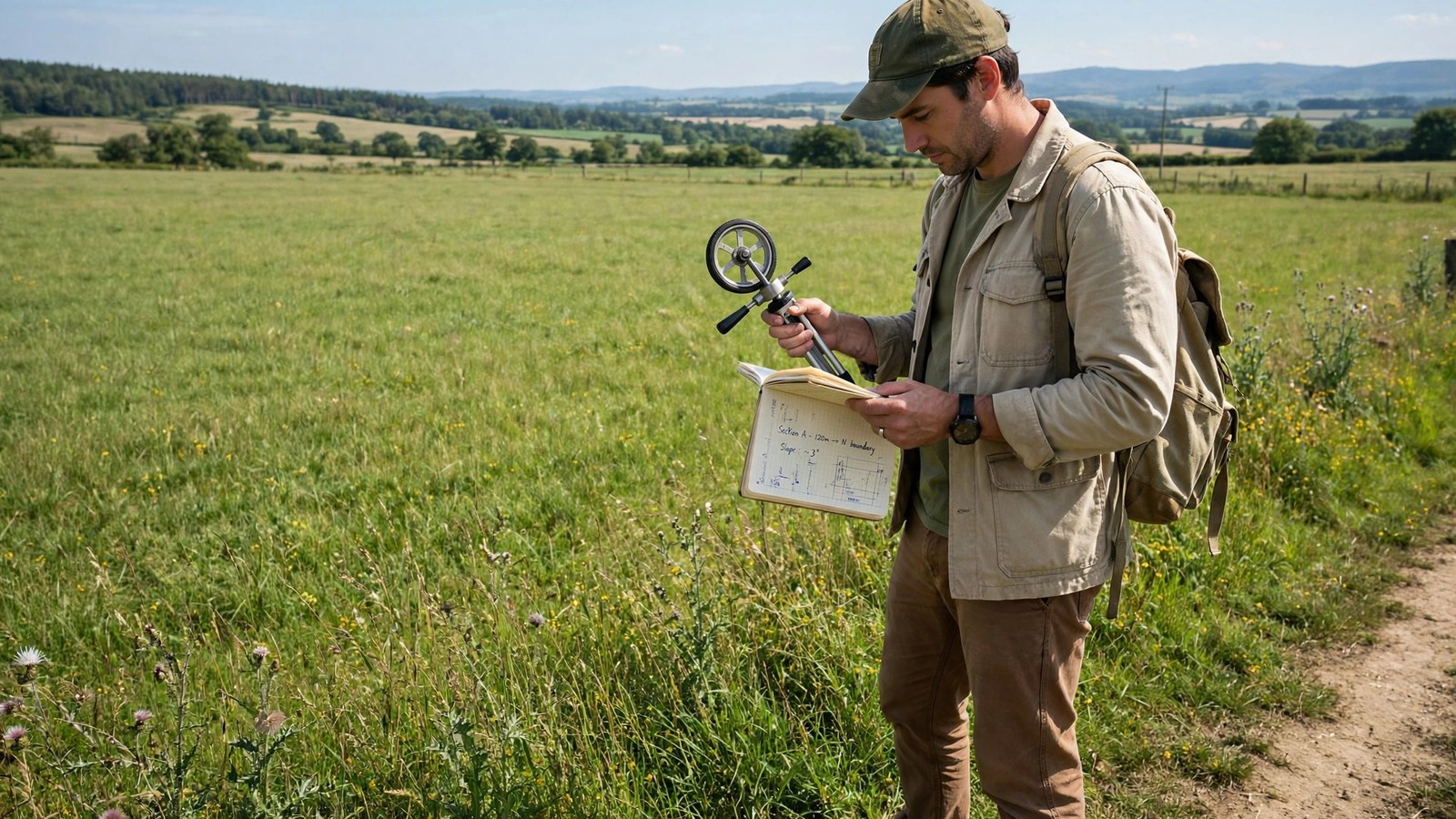
If you are reading a land listing, a farm plan, or a park guide written in another country, the same question tends to appear within the first minute: how many acres are in a hectare? The short version is that one hectare is about two and a half acres. The useful version is more precise than that, because land is bought, sold, taxed, fenced, and planted by area, and a loose figure that is harmless for one field can be wrong by a whole garden plot on a large estate. This guide gives the exact defining figures, shows the division that produces the conversion, and then works through full tables in both directions, the square meter and square foot bridges underneath them, worked examples from farms, house plots, parks, and sports fields, and the rounding mistakes that most often spoil an otherwise simple calculation.
What a Hectare Is
A hectare is a metric unit of land area, defined as exactly 10,000 square meters. The easiest way to picture it is as a square 100 meters on each side, because 100 x 100 = 10,000. The unit is built from the are, the original metric unit of land area, which is 100 square meters, or a square 10 meters on each side. A hectare is 100 ares: the prefix hecto means 100, so the name itself states the relationship. There are exactly 100 hectares in one square kilometer.
The hectare is not an SI unit in its own right. It is a non-SI unit accepted for use with the International System of Units, listed by the International Committee for Weights and Measures for expressing land area, with the value 1 hectare = 10,000 square meters. That status explains its role: the square meter is the SI unit of area, but it is an awkward size for land. A 50 hectare farm is 500,000 square meters, a count with too many digits to hold in mind, while in square kilometers the same farm is 0.5 square kilometers, a figure that hides useful detail. The hectare sits at the human scale between the two, which is why it became the standard land unit across most of the metric world.
Hectares also divide and multiply cleanly, because they are built on powers of ten. Ten hectares is 100,000 square meters, a tenth of a hectare is 1,000 square meters, and a hundredth of a hectare is 100 square meters, which is one are.
What an Acre Is
An acre is a unit of land area in the imperial and United States customary systems. Its modern definition is exact: one international acre is exactly 43,560 square feet, which is exactly 4,046.8564224 square meters. The square meter figure follows from the foot. One international foot is exactly 0.3048 meters, so one square foot is 0.3048 x 0.3048 = 0.09290304 square meters, and 43,560 x 0.09290304 = 4,046.8564224 square meters. Each step is a definition, so the final figure is exact.
The acre also has a traditional shape. It is the area of a rectangle one chain wide by one furlong long. A chain is 22 yards, or 66 feet, and a furlong is 220 yards, or 660 feet, so the rectangle is 66 x 660 = 43,560 square feet. In square yards the same area is 22 x 220 = 4,840 square yards, and in survey terms an acre is 10 square chains or 160 square rods. An acre does not have to be that shape. Any shape covering 43,560 square feet is one acre, including a square about 63.61 meters, or about 208.71 feet, on each side.
The acre remains the everyday land unit in the United States, where farms, ranches, lots, and parks are listed in acres, and it is still widely understood in the United Kingdom, where official land registration uses hectares but listings often give acres alongside. There are exactly 640 acres in one square mile, where a section of land is one square mile, or 640 acres.
One caution belongs here. Older United States surveys were made with a slightly longer foot, the US survey foot, and an acre based on that foot is 4,046.873 square meters, about 0.017 square meters, or about 0.18 square feet, larger than the international acre. Federal guidance says definitions based on the US survey foot should be avoided after December 31, 2022, except for historic and legacy records. Every figure in this article uses the international acre, and for any single modern lot the difference is far too small to see.
Where the Conversion Comes From
The conversion is one division, and showing it removes any mystery about where 2.47105 comes from. Start with the two exact definitions in the same unit, square meters:
1 hectare = 10,000 square meters exactly
1 acre = 4,046.8564224 square meters exactly
Hectares to acres: 10,000 / 4,046.8564224 = 2.471053814671653… acres
Rounded to five decimal places, that is 2.47105 acres. Rounded to two decimal places, it is 2.47 acres. The reverse conversion is the same division read the other way:
Acres to hectares: 4,046.8564224 / 10,000 = 0.40468564224 hectares exactly
Rounded to six decimal places, that is 0.404686 hectares. Note the difference in status between the two directions. The acres to hectares value terminates, because dividing by 10,000 only moves a decimal point, so 0.40468564224 is the complete exact value. The hectares to acres value does not terminate, so any decimal form of it, including 2.47105, is a rounding of the true ratio. The ratio itself, 10,000 divided by 4,046.8564224, is exact; its decimal expansion is not short.
You can check that the two working multipliers agree: 2.47105 x 0.404686 = 0.99999934, a whisker below 1. That shortfall is the combined effect of rounding both multipliers before multiplying them, not an error in the definitions. If you need a result with no rounding drift at all, convert through square meters instead: multiply hectares by 10,000 to get square meters, then divide by 4,046.8564224 to get acres, or multiply acres by 4,046.8564224 to get square meters, then divide by 10,000 to get hectares. Square meters are the exact bridge in both directions, and every table in this article was built through that bridge.
The Two Formulas You Need
Every conversion in this article uses one of two formulas. When you start with hectares and want acres, multiply:
Acres = hectares x 2.47105
When you start with acres and want hectares, multiply by the smaller figure:
Hectares = acres x 0.404686
That is the whole method. The judgment calls are about rounding, and there are three worth fixing in mind. First, round once, at the end, because a figure rounded early carries its rounding error into every later step. Second, say how you rounded: a figure based on 2.47 acres per hectare and a figure based on 2.47105 are not the same claim. Third, match the precision to the job. Two decimal places are plenty for picturing a garden or comparing listings. Five or six places, or the through square meters route, are the right choice for valuations, legal descriptions, and any area large enough that a small per hectare error grows into real land.
Using 2.47 instead of the full ratio understates every hectare by 0.00105381 acres, which is about 4.26 square meters per hectare. On one hectare nobody would notice. On 1,000 hectares the shortfall is about 1.05 acres, or about 4,265 square meters, more than a whole extra acre of land silently dropped from the total. The popular shortcut of 2.5 acres per hectare errs the other way and by more: it overstates every hectare by about 0.0289 acres, or about 117 square meters, so a 100 hectare farm described with the shortcut gains nearly 2.9 phantom acres. Shortcuts are for first impressions, not for totals.
Conversion Tables
The tables below are all recomputed from the two exact constants: 1 hectare = 10,000 square meters and 1 acre = 4,046.8564224 square meters = 43,560 square feet. Acre and hectare results are rounded as labeled in each heading, and any row can be checked by going through square meters.
Hectares to acres
| Hectares | Acres (rounded to five decimal places) | Square meters | Square feet |
|---|---|---|---|
| 0.01 | 0.02471 | 100 | 1,076.39 |
| 0.05 | 0.12355 | 500 | 5,381.96 |
| 0.1 | 0.24711 | 1,000 | 10,763.91 |
| 0.25 | 0.61776 | 2,500 | 26,909.78 |
| 0.5 | 1.23553 | 5,000 | 53,819.55 |
| 1 | 2.47105 | 10,000 | 107,639.10 |
| 2 | 4.94211 | 20,000 | 215,278.21 |
| 3 | 7.41316 | 30,000 | 322,917.31 |
| 4 | 9.88422 | 40,000 | 430,556.42 |
| 5 | 12.35527 | 50,000 | 538,195.52 |
| 7.5 | 18.53290 | 75,000 | 807,293.28 |
| 10 | 24.71054 | 100,000 | 1,076,391.04 |
| 15 | 37.06581 | 150,000 | 1,614,586.56 |
| 20 | 49.42108 | 200,000 | 2,152,782.08 |
| 25 | 61.77635 | 250,000 | 2,690,977.60 |
| 50 | 123.55269 | 500,000 | 5,381,955.21 |
| 75 | 185.32904 | 750,000 | 8,072,932.81 |
| 100 | 247.10538 | 1,000,000 | 10,763,910.42 |
| 200 | 494.21076 | 2,000,000 | 21,527,820.83 |
| 500 | 1,235.52691 | 5,000,000 | 53,819,552.08 |
| 1,000 | 2,471.05381 | 10,000,000 | 107,639,104.17 |
Two rows in this table are worth memorizing as anchors. The 1 hectare row gives the conversion itself, 2.47105 acres. The 100 hectare row is exactly one square kilometer, so a square kilometer is 247.10538 acres, or about 247 acres.
Acres to hectares
| Acres | Hectares (rounded to six decimal places) | Square meters | Square feet |
|---|---|---|---|
| 0.1 | 0.040469 | 404.69 | 4,356 |
| 0.25 | 0.101171 | 1,011.71 | 10,890 |
| 0.5 | 0.202343 | 2,023.43 | 21,780 |
| 1 | 0.404686 | 4,046.86 | 43,560 |
| 2 | 0.809371 | 8,093.71 | 87,120 |
| 3 | 1.214057 | 12,140.57 | 130,680 |
| 5 | 2.023428 | 20,234.28 | 217,800 |
| 10 | 4.046856 | 40,468.56 | 435,600 |
| 20 | 8.093713 | 80,937.13 | 871,200 |
| 25 | 10.117141 | 101,171.41 | 1,089,000 |
| 40 | 16.187426 | 161,874.26 | 1,742,400 |
| 50 | 20.234282 | 202,342.82 | 2,178,000 |
| 100 | 40.468564 | 404,685.64 | 4,356,000 |
| 160 | 64.749703 | 647,497.03 | 6,969,600 |
| 250 | 101.171411 | 1,011,714.11 | 10,890,000 |
| 320 | 129.499406 | 1,294,994.06 | 13,939,200 |
| 500 | 202.342821 | 2,023,428.21 | 21,780,000 |
| 640 | 258.998811 | 2,589,988.11 | 27,878,400 |
| 1,000 | 404.685642 | 4,046,856.42 | 43,560,000 |
The 640 acre row is the square mile row: 640 acres is one square mile, and one square mile is 258.998811 hectares, or about 259 hectares. The 160 acre row is a quarter of a section, a parcel size that appears constantly in American land records, at 64.749703 hectares, and the 40 acre row, a quarter of that quarter, is 16.187426 hectares.
The square meter and square foot bridge
| Unit | Square meters | Square feet | Hectares | Acres |
|---|---|---|---|---|
| 1 square meter | 1 | 10.76 (rounded) | 0.0001 | 0.000247 (rounded) |
| 1 square foot | 0.09290304 | 1 | 0.000009290304 | 0.000023 (rounded) |
| 1 acre | 4,046.8564224 | 43,560 | 0.40468564224 | 1 |
| 1 hectare | 10,000 | 107,639.10 (rounded) | 1 | 2.47105 (rounded) |
| 1 square kilometer | 1,000,000 | 10,763,910.42 (rounded) | 100 | 247.10538 (rounded) |
| 1 square mile | 2,589,988.11 (rounded) | 27,878,400 | 258.998811 (rounded) | 640 |
This bridge table is the working tool behind the other two. A figure in square feet becomes acres by dividing by 43,560, and hectares by multiplying by 0.09290304 and then dividing by 10,000. A figure in square meters becomes hectares by dividing by 10,000, and acres by dividing by 4,046.8564224. One hectare is also 11,959.90 square yards, rounded, and one acre is exactly 4,840 square yards.
Worked Examples
Example 1: A smallholding listed in hectares
A smallholding is listed as 3.5 hectares, and a buyer who thinks in acres wants the equivalent. Multiply by the full working figure: 3.5 x 2.47105 = 8.64868 acres, or about 8.65 acres. Through square meters the same listing is 3.5 x 10,000 = 35,000 square meters, and dividing by 4,046.8564224 gives the same 8.65 acres. The two routes agreeing is the expected check.
Example 2: A 640 acre section
A farm in the United States is described as a full section, 640 acres. In hectares that is 258.998811 hectares through the exact figure, or about 259 hectares. That is no coincidence: 640 acres is exactly one square mile, and one square mile is about 259 hectares. The section system used in American land surveying is built on 640 acre squares, so this conversion comes up whenever American farmland is described to a metric audience.
Example 3: A 12 hectare park
A park covers 12 hectares, and a local guide wants the size in acres. Multiply: 12 x 2.47105 = 29.6526 acres, or about 29.65 acres. If the guide rounds that to 30 acres, it has overstated the park by about 0.35 acres, which is about 1,406 square meters. For a guidebook that rounding is harmless. For a maintenance contract priced by area, it would be a real overcharge.
Example 4: A quarter acre house plot
You own 0.25 acres and want the size in hectares and square meters. Multiply: 0.25 x 0.404686 = 0.101172 hectares, rounded to six decimal places. In square meters that is 0.25 x 4,046.8564224 = 1,011.71 square meters, rounded to two decimal places. That is a generous house plot, roughly a rectangle 20 meters by 50 meters, which covers 1,000 square meters, with a small margin to spare.
Example 5: Checking a conversion by going back
Start with 40 hectares. Convert with the rounded multiplier: 40 x 2.47105 = 98.842 acres. Convert back: 98.842 x 0.404686 = 39.99997 hectares, rounded to five decimal places. The result is 0.00003 hectares below the starting figure, a drift of about 0.26 square meters. That drift is rounding noise from the two rounded multipliers, not an error in the method, and the through square meters route removes it entirely: 40 hectares is 400,000 square meters, or 98.84215 acres, and converting back through square meters returns exactly 40 hectares.
Example 6: A soccer pitch
A top category soccer pitch measures 105 meters by 68 meters. Its area is 105 x 68 = 7,140 square meters. In hectares that is 7,140 / 10,000 = 0.714 hectares. In acres that is 7,140 / 4,046.8564224 = 1.76 acres, rounded to two decimal places. So a hectare is noticeably larger than a full international soccer pitch: the pitch covers about seven tenths of a hectare. Pitches at lower categories can be smaller, so treat this as the standard top level pitch, not every field the game is played on.
Example 7: An American football field
An American football field, including both end zones, measures 360 feet by 160 feet. Its area is 360 x 160 = 57,600 square feet. In acres that is 57,600 / 43,560 = 1.32 acres, rounded to two decimal places. In hectares it is 0.54 hectares, rounded to two decimal places, or directly in metric, 57,600 x 0.09290304 = 5,351.22 square meters, which is 0.5351 hectares. The playing field between the goal lines, without the end zones, is 300 feet by 160 feet, or 48,000 square feet, which is 1.10 acres or 0.45 hectares, both rounded to two decimal places. This is why the common claim that a hectare is about two football fields needs care. A hectare is about 1.4 top level soccer pitches, about 1.87 American football fields including end zones, or about 2.24 playing fields measured goal line to goal line.
How Big Each Unit Feels
Numbers alone do not give a feel for land, so it helps to hold a few shapes in mind. A hectare as a square is 100 meters on each side. A hectare as a rectangle could equally be 200 meters by 50 meters, or 250 meters by 40 meters, or any other pair of sides multiplying to 10,000 square meters. The shape is free; only the area is fixed.
An acre as a square is about 63.61 meters, or about 208.71 feet, on each side, noticeably smaller than the hectare square. In its traditional shape it is the long strip described earlier, 66 feet wide and 660 feet long. A useful stacking picture follows from the ratio itself: about two and a half acre squares fill a hectare square, and the half is the part people most often forget. A hectare is not two acres with a rounding difference. It is two acres plus almost another half acre, and that extra portion beyond two acres is about 1,906 square meters on its own. Any estimate that treats a hectare as two acres understates the land by nearly a fifth.
For larger land, scale the anchors rather than the unit. Ten hectares is a square about 316 meters on each side. One hundred hectares, one square kilometer, is a square 1,000 meters on each side.
A Short History of the Two Units
The two units come from opposite ideas about how measurement should work, and their history explains why their ratio is not a round number. The hectare was designed. When the metric system was given a legal basis in France in 1795, the law of 7 April 1795 defined the are as the unit of land area, a square 10 meters on a side covering 100 square meters, alongside the meter for length and the other founding metric units. The hectare followed as 100 ares, with hecto, the prefix for 100, attached to are. The unit and its symbol were adopted by the International Committee for Weights and Measures in 1879, and when the metric system was reorganized as the International System of Units in 1960, the are itself was left out while the hectare was retained as a unit accepted for use with the SI for land area.
The acre grew instead of being designed. It began as a practical amount of work: the land that could be plowed in a day, traditionally described as the amount tillable by one man behind a team of oxen in one day. Plowing shaped its dimensions. A team pulling a heavy plow was hard to turn, so furrows were made as long as practical. The furrow length, shortened over time to the word furlong, became the length of the acre, and one chain, four rods, became its width, giving the long narrow strip of 22 yards by 220 yards. Standardized, that strip is 4,840 square yards or 43,560 square feet, and the modern international definition simply fixes that inherited area exactly in square meters. The odd figure of 4,046.8564224 square meters is therefore not a puzzle. It is what a day of plowing, frozen into law and then into an exact metric equivalent, happens to weigh.
Where Each Unit Is Used
Hectares are the working land unit across most of the world: farm and forest statistics, land registries, and planning documents in Europe, and official figures in countries such as Australia, New Zealand, South Africa, and Canada, are kept in hectares, even where acres survive in speech. Acres dominate everyday land description in the United States, from farm sales to lot listings that give both acres and square feet. International work is where the conversion earns its keep: a European buyer reading an American ranch listing, or a group comparing forest figures published on different continents, needs the same two multipliers, in the right direction and at the right precision.
Yield figures convert as ratios, not as plain areas. A yield stated per hectare becomes a yield per acre by dividing by 2.47105, since the same harvest is now spread over more, smaller units in the count, and a yield stated per acre becomes a yield per hectare by multiplying by 2.47105. Reversing that direction misstates everything the field produced, not just the field.
Common Mistakes to Avoid
Using 2.47 as if it were exact is the first mistake. It is the true ratio rounded to two decimal places. On small plots the difference is invisible; on large ones it grows to whole acres. Label it as rounded whenever you use it, and use 2.47105 or the square meter route for anything formal.
Inverting the multiplier is the second mistake. Hectares to acres uses a number larger than 1, because acres are smaller and more of them are needed. Acres to hectares uses a number smaller than 1. If converting 10 hectares gives you about 4 of anything, you have divided where you should have multiplied: 10 hectares is 24.71 acres, and 10 acres is 4.05 hectares, rounded to two decimal places.
Confusing an acre with a length is the third mistake. An acre is an area, not a distance. Forty acres means 40 x 4,046.8564224 = 161,874.26 square meters of land, rounded to two decimal places. Relatedly, a hectare is not a square kilometer: it is one hundredth of one. One square kilometer is 100 hectares, or 247.11 acres, rounded to two decimal places.
Chaining rounded conversions is the fourth mistake. Converting with one rounded figure and then converting the result again with another rounded figure compounds the rounding, as the round trip in Example 5 shows. Convert through square meters when exactness matters, and round once at the end.
Mixing the survey acre into modern work is the fifth mistake. A historic deed in survey acres and a modern listing in international acres differ by about 0.18 square feet per acre. That gap is negligible for a house plot but real across a very large historic record, and it should be named when old and new figures are compared.
Quick Reference
1 hectare = 10,000 square meters exactly = 107,639.10 square feet, rounded = 2.47105 acres, rounded to five decimal places. 1 acre = 43,560 square feet exactly = 4,840 square yards exactly = 4,046.8564224 square meters exactly = 0.40468564224 hectares exactly. 1 square kilometer = 100 hectares = 247.11 acres, rounded. 1 square mile = 640 acres exactly = 258.998811 hectares, rounded to six decimal places.
Keep the bridge in mind: hectares to square meters is multiply by 10,000, acres to square meters is multiply by 4,046.8564224, and 2.47105 is just the quotient of those two exact figures.
Frequently Asked Questions
How many acres are in a hectare?
There are 2.47105 acres in a hectare, rounded to five decimal places. The fuller value is 2.47105381 acres, from the exact division 10,000 / 4,046.8564224. The often quoted 2.47 is the same figure rounded to two decimal places, and 2.5 is a rough shortcut that overstates a hectare by about 117 square meters.
How many hectares are in an acre?
There is 0.404686 hectares in an acre, rounded to six decimal places. The exact value is 0.40468564224 hectares, because one acre is exactly 4,046.8564224 square meters and one hectare is exactly 10,000 square meters.
How many acres are in 10 hectares?
Ten hectares are 24.71054 acres, or about 24.71 acres. The working is 10 x 10,000 = 100,000 square meters, divided by 4,046.8564224 through the exact bridge.
How many hectares are in 100 acres?
One hundred acres are 40.468564 hectares, or about 40.47 hectares. The working is 100 x 0.40468564224 = 40.468564224 hectares, before rounding.
Is a hectare bigger than an acre?
Yes. One hectare is about two and a half acres, so the hectare is the larger unit by a factor of about 2.47. That is why the hectares to acres multiplier is greater than 1 and the acres to hectares multiplier is smaller than 1.
How many square meters are in a hectare?
There are exactly 10,000 square meters in a hectare: a square 100 meters on each side, and 100 x 100 = 10,000. A hectare is also exactly 100 ares, and exactly one hundredth of a square kilometer.
How many square feet are in an acre?
There are exactly 43,560 square feet in an acre: 66 feet by 660 feet, one chain by one furlong, equals 43,560 square feet. A hectare, by comparison, is 107,639.10 square feet, rounded to two decimal places.
How many hectares are in a square mile?
There are 258.998811 hectares in a square mile, rounded to six decimal places, or about 259 hectares. A square mile is exactly 640 acres, and 640 x 0.40468564224 = 258.998811 hectares.
How do I convert hectares to acres in my head?
Multiply by 2.5 for a first estimate, then remember that the estimate runs high by about 117 square meters per hectare, or about 1.17 percent. For anything beyond a first impression, use 2.47105 on paper or convert through square meters.
Keep reading: Kilometers to Miles: The Conversion, and the Distances People Actually Ask About
Keep reading: Meters in a Foot
Keep reading: Feet to Inches
Sources & references
- National Institute of Standards and Technology (NIST), Handbook 44, 2024, Appendix C, General Tables of Units of Measurement. Used for the metric area table showing 100 square meters = 1 are and 100 square dekameters = 1 square hectometer = 1 hectare, the area tables showing 1 acre = 43,560 square feet = 4,046.8564224 square meters = 0.40468564224 hectares, 1 hectare = 10,000 square meters = 0.01 square kilometers, 1 square mile = 2,589,988.110336 square meters = 258.9988110336 hectares, 1 foot = 0.3048 meters exactly, and the note that use of definitions based on the US survey foot should be avoided after December 31, 2022, except for historic and legacy applications. https://www.nist.gov/system/files/documents/2024/01/14/NIST%20HB%2044%202024%20Appendix%20C%20General%20Tables%20of%20Units%20of%20Measurement.pdf
- National Institute of Standards and Technology (NIST), Special Publication 330, 2019 Edition, Section 4, Non-SI units that are accepted for use with the SI, Table 8. Used for the hectare as a non-SI unit accepted for use with the SI, with 1 hectare = 1 square hectometer = 10,000 square meters, used to express land area, and adopted by the CIPM in 1879. https://www.nist.gov/pml/sp-330-section-4
- National Institute of Standards and Technology (NIST), Special Publication 811, 2008 Edition, Guide for the Use of the International System of Units (SI), Sections B.6 and B.8. Used for the relationships 160 square rods = 1 acre = 43,560 square feet and 640 acres = 1 square mile, for the distinction between the international foot of exactly 0.3048 meters and the US survey foot, for the survey foot acre factor of 4,046.873 square meters, and for 1 are = 100 square meters. https://doi.org/10.6028/NIST.SP.811e2008
- Hectare, Wikipedia, summarizing the BIPM SI Brochure and the French law of 18 Germinal, Year III (7 April 1795). Used only for the history of the are and hectare: the are defined as 100 square meters in 1795, the hectare as 100 ares, and the are left without international recognition when the SI was formed in 1960 while the hectare was retained. https://en.wikipedia.org/wiki/Are_(unit)
- Furlong, Wikipedia. Used only for the history of the acre shape and the plowing origin: the furlong as furrow length, the distance a team of oxen could plow without resting, standardized as 40 rods or 10 chains, an acre as one furlong long by one chain wide and as the amount of land tillable by one man behind a team of oxen in one day, and 160 square rods to the acre. https://en.wikipedia.org/wiki/Furlong
- SIS Pitches, Football Field Dimensions and Line Markings. Used only for the American football field layout figures: 120 yards total length including two 10 yard end zones, 100 yards between the goal lines, and a width of 53 and one third yards or 160 feet. All area figures for the field in this article are arithmetic from those dimensions. https://www.sispitches.com/us/news/football-field-dimensions/
- UEFA, Stadium Infrastructure Regulations, Article 5, Field of play. Used only for the top category soccer pitch size of 105 meters by 68 meters for Categories 3 and 4, with Categories 1 and 2 given as 100 to 105 meters by 64 to 68 meters. The pitch area in hectares and acres in this article is arithmetic from 105 x 68 = 7,140 square meters. https://documents.uefa.com/r/PxVtjcYr9Ntgwd0wYgq2xw/snbCQQ1y5eRWxnjVf4WgnQ?contentId=~vpHJo2UFIHgJj1YHhHZSQ


