Short answer
- Citrine is transparent yellow to brownish orange quartz, a mineral with the chemistry SiO2, made of silicon and oxygen. GIA states that a trace of iron in its structure is responsible for its yellow to orange color. Citrine rates 7 on the Mohs hardness scale and has good toughness, so GIA considers it usually durable enough for normal wear, although abrupt temperature changes can fracture it and harder gems can scratch it in storage. Natural citrine is rare. Most citrine on the market is the result of heat treatment of amethyst, a routine and permanent treatment that should be disclosed by the seller. Along with topaz, citrine is a November birthstone, and it is also the gem given for the thirteenth wedding anniversary. Clean it the safe way GIA recommends: warm soapy water. GIA says ultrasonic cleaning is usually okay for a sound stone, but steam cleaning is risky because high heat could cause the stone to crack. Its traditions, from the French word citron, meaning lemon, to the Merchant's Stone nickname and modern associations with abundance and optimism, are cultural beliefs and symbolism, not proven effects.
Introduction
Citrine is the yellow to orange variety of quartz, and it is one of the easiest warm colored gems to live with. Its color runs from pale lemon yellow through golden yellow to deep brownish orange and reddish orange, and it appears as faceted jewelry stones, beads, cabochons, carvings, polished points and clusters, and large decorative pieces. People buy it for November birthdays, for thirteenth wedding anniversaries, for collections, and for home display, and many also value the traditions and beliefs attached to it.
This citrine guide separates those two things carefully. The mineral facts, such as what citrine is made of, how hard it is, where its color comes from, how most stones on the market are produced, and how to clean it, are checked against the Gemological Institute of America, known as GIA, the Smithsonian National Museum of Natural History, and Mindat. The traditions, such as the Merchant’s Stone nickname or a belief that the stone could soothe tempers, are described as beliefs and traditions only. There is no reliable scientific evidence that citrine attracts wealth, heals illness, or produces a specific mental or physical effect, and nothing in this guide should be used in place of medical, financial, or other professional advice. A stone can be beautiful, durable, and personally meaningful without any proven effect being claimed for it.
What Citrine Is: Quartz, Iron, and Yellow Color
Quartz is one of the most abundant minerals in the crust of the Earth. The Smithsonian National Museum of Natural History describes quartz as the major constituent of beach sand and an important component of many types of rocks, composed of silicon and oxygen, and colorless in its pure state. Small amounts of impurity atoms can yield a range of vivid colors. The Smithsonian names citrine, amethyst, rock crystal, smoky quartz, and rose quartz as common varieties of quartz, and defines citrine in one sentence: it is the golden yellow to orange gem variety of quartz, and, like amethyst, it is colored by impurities of iron.
GIA gives the same core facts in its Gem Encyclopedia entry: mineral quartz, chemical composition SiO2, color yellow to orange to orangy red, refractive index 1.544 to 1.553, specific gravity 2.66, and Mohs hardness 7. A trace of iron in the structure of citrine is responsible for its yellow to orange color, in GIA wording. Mindat lists the same formula and hardness, a vitreous luster, and a trigonal crystal system.
One honest complication belongs in a careful guide. Mindat notes that the cause of color in natural citrine is still under debate, that at least some natural citrine appears to be colored by aluminum based, irradiation related color centers similar to those in smoky quartz, and that iron has also been suggested. GIA and the Smithsonian present iron as the color cause for gem citrine. The practical point is unchanged: the color sits in the crystal itself, and quartz colored only by surface inclusions or coatings is not called citrine. Mindat states that point directly, and warns that iron stained quartz should not be mistaken for citrine.
GIA also explains the oldest confusion around this stone. In the days before modern gemology, its tawny color caused citrine to be confused with topaz, the other November birthstone, and people in the past thought citrine had the same powers as topaz. The two are different minerals: topaz is not quartz, and it rates 8 on the Mohs scale, one step harder than citrine. A yellow stone sold simply as topaz, with no mineral named, deserves a direct question about what mineral it actually is.
Heat Treatment: Why Most Citrine Started as Amethyst
The single most important buying fact about citrine is its origin story. Natural citrine is rare, and GIA states it plainly: most citrine on the market is the result of heat treatment of amethyst. Yellow quartz colors are rare in nature, so heating converts less valuable shades of purple amethyst to golden shades of citrine. GIA adds two useful details: the original hue of the amethyst can determine the richness of the resulting yellow, and a lime colored citrine can result from heat treatment of smoky quartz instead. Mindat makes the same point: large quantities of amethyst, usually of lesser quality, are heated to turn it yellow or orange and sold as citrine. GIA notes the scale of the practice in a familiar form. Giant hollow, crystal lined amethyst geodes from areas such as Brazil are often heated to become giant citrine cathedrals, the tall display pieces sold for homes and offices. If a cathedral piece is golden orange rather than purple, heat is the usual reason.
A heat treated stone is not a fake stone. It is real quartz, and its color change is treated as routine in the trade. The buyer’s protection is disclosure, not detection by eye, because color alone cannot prove whether a stone is natural or heated. GIA offers a Colored Stone Identification Report for citrine, but notes that it is not commonly requested because of the cost of the report compared with the value of most citrine. For an ordinary pendant, a plain answer from a trusted seller, recorded on the receipt, is proportionate. For an unusually expensive stone sold as natural and untreated, a laboratory report is the proportionate step. Ask directly: is this stone natural citrine, heat treated amethyst or smoky quartz, or laboratory grown? GIA notes that some laboratory grown quartz becomes laboratory grown citrine, so synthetic citrine exists and should also be disclosed.
Where Citrine Is Found, and the Anahi Mine
GIA lists the top sources for citrine as Bolivia, Spain, Madagascar, Mexico, and Uruguay, and adds that the amethyst typically heat treated to a citrine color is mined mostly in Brazil. That split explains the market: Brazil supplies most raw material for commercial citrine. Origin, on its own, is a weak guide to quality. Judge a stone by color, clarity, and cut first.
One source deserves its own paragraph. Deep in the world’s largest freshwater wetland lies Bolivia’s Anahi mine, an important source for natural, unheated citrine. GIA recounts that it was discovered by a Spanish conquistador in the 1600s, given to him as a dowry when he married Anahi, a princess from the Ayoreos tribe of Paraguay, lost for three centuries, and rediscovered in the 1960s. Anahi citrine typically ranges from orange yellow to brownish or greenish yellow, softer in color than the saturated golden orange of heated material.
Anahi is also the famous source of ametrine. GIA explains that the mine produces amethyst and citrine colors in the same crystal, called ametrine when the two appear together in a fashioned gem. The Smithsonian adds that ametrine color zoning is due to differing oxidation states of iron, that most ametrine is mined in Bolivia, and that most on the market is created by heat treatment or radiation of amethyst, even though it also occurs naturally. Ametrine is one quartz crystal carrying two colors, not two stones joined together.
Size shapes how citrine is used. GIA notes that citrines of up to 20 carats are readily available in jewelry. The Smithsonian National Gem Collection holds an extreme example: a modified marquise shaped smoky citrine weighing 19,747 carats, faceted in 1987 by Michael Gray and acquired in 2013, described as the largest smoky citrine in the collection. The same abundance is why a substantial citrine point, cluster, or carving can cost far less than a rarer gem of the same size.
The Forms You Will See for Sale
A faceted stone is a cut gem with flat, polished faces, set in rings, pendants, earrings, and bracelets. GIA notes that citrine might be carved, custom cut, or calibrated for jewelry use, in standard millimeter sizes. A cabochon is a smooth, domed stone without facets. GIA notes that material with minor inclusions is often used for cabochons or carvings, while cleaner material is faceted.
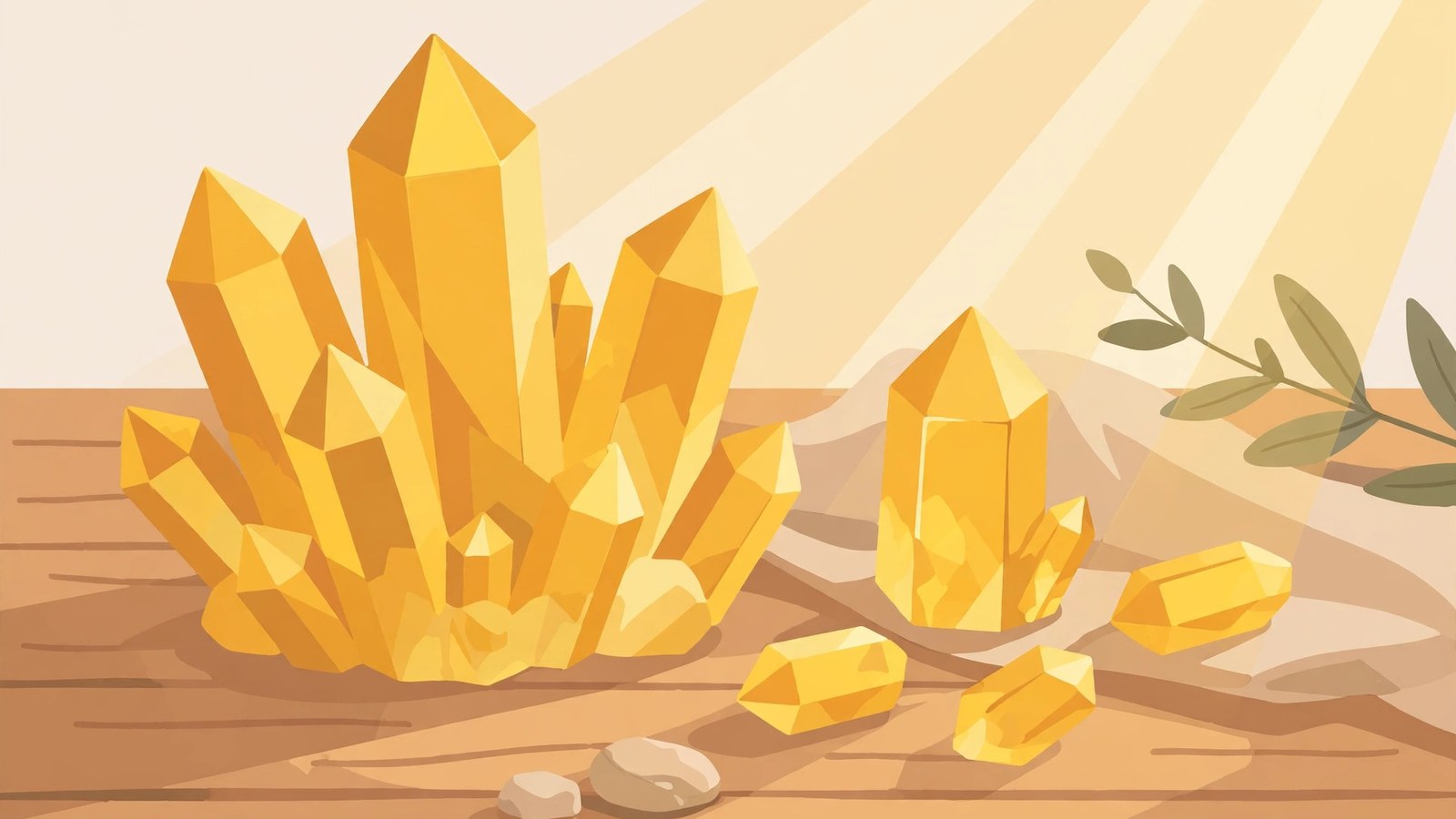
Clusters and points are the display forms. A cluster is a group of crystal points growing together on a shared base, and a point is a single crystal, natural or shaped, ending in a tip. The cathedral form is a section of a geode lining, usually amethyst heated to citrine, sold upright for display. Handle any of these by the base, on a stable surface away from an edge, because the points are the most exposed part. Beads are drilled stones for strung jewelry, and tumbled stones are small pieces polished smooth, sold loose for collections, bowls, and gifts. Small stones are a choking hazard for very young children and should be kept out of their reach.
History and Lore: A Long Record, Carefully Framed
GIA’s November birthstone account gives the documented spine of citrine history. Citrine has been used in jewelry for thousands of years, has been a popular gemstone since ancient times, has been reported in Roman jewelry, and was particularly popular in colorful Scottish jewelry from the Victorian era. Those are statements about use, and they are the strongest kind of history a gem can have: objects, not legends.
The name is part of that record. GIA states that citrine is believed to derive from the French word for lemon, citron. The Smithsonian gives the same origin, and Mindat traces the name to citrina, described as color as yellow as citron. The stone is named for a fruit color, not for a place, a person, or a claimed power.
The belief history is real history too, as long as it is reported as belief. GIA records that, because of the mistaken identity with topaz, people thought citrine had the same powers as topaz, and believed it could soothe tempers and calm the wearer. GIA also describes both November birthstones as known to have calming energies while bringing fortune and warmth to the wearer, which is the language of tradition, not measurement. No stone soothes a temper or brings fortune as a proven effect, and a belief held for centuries is still a belief.
Modern Traditions and Beliefs, Framed Honestly
In modern crystal traditions, citrine is commonly linked with abundance, optimism, confidence, and personal will, and it is often called the Merchant’s Stone, on the belief that keeping it in a shop or near a cash register invites prosperity. In chakra traditions, it is associated with the solar plexus, the energy center linked in those systems with will and self worth. Some practitioners also describe citrine as said not to accumulate negative energy, and therefore not to need cleansing, a belief that sets it apart in crystal practice. Others cleanse it anyway, as a matter of habit.
Those four associations come from crystal practice and retail tradition, not from GIA, the Smithsonian, or any scientific body, and this guide presents them only as what some people believe and practice. Three distinctions keep this section honest. First, an association is not an effect. Saying that a tradition associates citrine with abundance describes the tradition accurately. Saying that citrine attracts money or changes luck would claim an effect, and there is no reliable scientific evidence for such claims. Second, a personal ritual is not a property of the stone. If a shopkeeper keeps a citrine point by the register as a reminder to greet customers well and watch the numbers, the useful part is the attention the shopkeeper built. A reminder can be useful without the stone itself doing anything. Third, symbolism is a complete reason on its own. A November birthday gift, a thirteenth anniversary gift, or a stone bought because golden yellow is a favorite color needs no prosperity claim to justify it.
This guide does not recommend buying citrine in expectation of a change in wealth, health, mood, or fortune, using it in place of any treatment, or paying a premium for claimed powers. Decorative, jewelry, collecting, and gift uses deliver exactly what they promise: a durable yellow stone that looks the way the buyer hoped it would look.
Citrine as the November Birthstone
Along with topaz, citrine is the birthstone for November, in GIA’s wording, and GIA also recognizes citrine as the gem that commemorates the thirteenth wedding anniversary. Birthstone status is a convention, not a mineral property, but it shapes how the stone is bought: as a November birthday gift, an anniversary gift, or a self purchase. GIA notes that most topaz and citrine birthstones are affordably priced, because good quality gems are not as rare as for many counterparts.
That affordability has a specific structure. GIA notes that even fine citrine has a modest price tag, and that large gems remain affordable because price per carat does not rise dramatically for larger sizes. Its buying guide adds that smaller citrines can have strong color, making it easier to match sets of differently sized gems. A large citrine pendant or cocktail ring is therefore a realistic purchase in a way that a large stone of a rarer gem is not. GIA also calls citrine the top selling yellow to orange gem, which is why selection in shops is usually wide.
Choosing Citrine: Color First, Then Clarity, Cut, and Size
Color is the first thing to judge, and GIA states the standard directly: a saturated yellow to reddish orange color free of brownish tints is prized, and dealers look for citrines without color zoning or visible inclusions. The finest colors are saturated, with little or no brownish component, ranging from yellow to reddish orange and even orangy red. One apparent contradiction is worth explaining. Saturated color free of brownish tints is prized, and the most popular shade in the contemporary market is an earthy, deep, brownish or reddish orange. Prized and popular are not the same test. Buy the color you will enjoy, check it in more than one light, and do not pay a rarity premium for a popular earthy shade.
Clarity is usually good news. GIA states that eye visible inclusions are not common, and that, if present, they decrease value. Much faceted citrine is eye clean, and microscopic inclusions are usually not visible without high magnification. Visible inclusions in pale gems reduce value greatly, because little color draws the eye away from them. For a cluster or point, judge differently: natural variation in point size and bands of lighter quartz are normal features, not flaws.
Cut decides how lively a faceted stone looks. GIA advises buyers to look for eye clean gems with lively, pleasing color and attractive cutting styles, in a wide variety of fancy and custom shapes as well as standard calibrated sizes. Look for a stone that reflects light evenly as you tilt it, rather than one with a dull patch that stays dark.
Close every purchase with the treatment questions. Is the stone natural or heat treated? Is it laboratory grown? What is the return policy if an independent report disagrees? A seller who answers plainly is a good sign. Be cautious of stones sold with extravagant healing or wealth claims, or at prices far below market for a claimed natural, untreated stone, because natural citrine is rare and a very low price for it needs evidence.
Caring for Citrine: Rules That Follow From Hardness 7
Citrine care starts with hardness, understood correctly. At 7 on the Mohs scale, with good toughness, citrine is usually durable enough for normal wear and care, in GIA’s wording. Hardness measures resistance to scratching. It does not make a stone unbreakable, and GIA warns that citrine is fairly durable, but abrupt temperature changes can fracture it. That pair of facts, hard but heat sensitive, generates almost every care rule here.
Cleaning is simple, and the safest method is also the cheapest. GIA states that warm soapy water is always safe. Work over a soft cloth rather than an open drain, use lukewarm water with a drop of mild soap, brush gently with a soft brush, rinse, and dry with a soft cloth. For a cluster or cathedral piece, the same solution lifts dust from between the points. Rinse sparingly on a large piece and let it dry fully.
Machine cleaning needs the exact GIA position. GIA states that ultrasonic cleaning is usually okay, but steam cleaning is risky, since high heat could crack the stone. Usually okay is narrower than always safe: a reader who does not know whether a stone has fractures or a fragile setting does not know enough to use an ultrasonic cleaner on that piece. The practical rule follows: warm soapy water by default, ultrasonic only for a sound piece a jeweler has confirmed is suitable, and no steam cleaning.
Heat is the main environmental risk. Keep citrine away from high heat and sudden temperature changes, do not leave a piece in a hot car, and tell any jeweler doing repair work that the stone is citrine. Mindat adds a color specific note: natural citrines pale when heated at high temperatures and also slowly pale in ultraviolet light, because at least some of their color comes from color centers. Display a prized natural piece in bright indirect light rather than on a windowsill in direct sun for months. Ordinary daily wear in daylight is normal use.
Storage follows from hardness in the other direction. A stone at Mohs 7 can be scratched by harder gems, including diamond, sapphire, ruby, and topaz at Mohs 8, and it can scratch softer stones in return. Store citrine separately, in a fabric pouch or a separate compartment in a jewelry box. Remove citrine rings before heavy manual work, gardening, or cleaning with harsh chemicals, and have prongs and settings on a daily wear ring checked periodically. A loose stone is easier to save than a lost one. For display pieces, a flat, solid base on a stable shelf is the storage rule.
Home Uses and Display Ideas
Citrine home decor works because the color does one clear job in a room. Warm yellow to orange is a strong accent, and a single point, cluster, or cathedral piece against neutral walls or pale wood reads as a deliberate focal point, while several golden objects in one room can read as clutter. Start with one piece per sight line, where it catches bright indirect light. Indirect light shows the color well and avoids the cumulative light and heat exposure covered above. Because citrine is affordable in larger sizes, a substantial display piece does not require a substantial budget.
Workspaces and shops are where tradition and decoration meet, and the honest framing still applies. Following the Merchant’s Stone tradition, some shopkeepers and home office workers place citrine near a register or desk as a reminder of goals around prosperity, focus, or confidence. Whether a reader views that as symbolism, decoration, or simply a pleasant object to look at while working, the placement is the same: somewhere visible, stable, and out of direct sun. The stone is a cue the person chose. Any benefit comes from the habits built around it, not from a proven effect of the quartz.
Personal practice follows the same rule. In crystal practice, citrine is sometimes held during meditation, placed on a desk during journaling, or kept in a pocket as a reminder of an intention. Some practitioners leave it uncleansed, following the belief that it does not accumulate energy. Others include it in a usual cleansing routine. If a reader does that, the care rules still govern the method: warm soapy water is safe, while prolonged sunlight is the one common cleansing method this guide advises against, for the Mindat color reason above. These are customs, not verified effects.
As a gift, citrine fits November birthdays, thirteenth anniversaries, housewarmings, and new business congratulations. A small tumbled stone or modest pendant with a handwritten note about its traditions makes a thoughtful gift that does not overclaim. Add the care note that matters most, in the card: warm soapy water, no high heat, and no loose storage against harder gems.
Finally, buy display pieces with the same questions used for jewelry. Ask whether a cluster, point, or cathedral piece is natural, heat treated, or laboratory grown in any part, and expect a plain answer. Cathedral pieces should be assumed to be heated amethyst unless a seller states otherwise, because GIA describes that conversion as the usual origin of the form. Check that a large piece sits flat, that its base is not cracked through, and that no points are loose. A piece that rocks on its base is a breakage waiting to happen.
Quick Reference
| Fact | Citrine |
|---|---|
| Mineral | Quartz variety, chemistry SiO2 |
| Color cause | Trace iron, per GIA and Smithsonian; natural color centers also debated, per Mindat |
| Color range | Yellow to orange to orangy red; transparent yellow to brownish orange |
| Hardness and toughness | Mohs 7; good toughness |
| Birthstone and anniversary | November, with topaz; thirteenth wedding anniversary |
| Most commercial citrine | Heat treated amethyst; routine treatment, disclosure required in practice |
| Cleaning | Warm soapy water always safe; ultrasonic usually okay for a sound piece; no steam cleaning |
| Main risks | Abrupt temperature change, high heat, scratching by harder gems in storage |
Frequently Asked Questions
Is most citrine natural?
No. Natural citrine is rare, and GIA states that most citrine on the market is the result of heat treatment of amethyst. Heating converts purple amethyst to golden citrine, and lime colored material can result from heat treatment of smoky quartz. A heat treated stone is real quartz, not an imitation. Ask whether a stone is natural, heat treated, or laboratory grown, and seek a laboratory report for an unusually expensive stone sold as natural and untreated.
Is citrine a November birthstone?
Yes. Along with topaz, citrine is the birthstone for November, per GIA, and it is also the gem for the thirteenth wedding anniversary. GIA describes it as one of the most affordable and desired yellow gemstones, with ready availability in a broad range of sizes.
How hard is citrine, and can it be worn every day?
Citrine rates 7 on the Mohs scale and has good toughness, so GIA states it is usually durable enough for normal wear and care. The limits are specific: abrupt temperature changes can fracture it, harder gems such as diamond, sapphire, and topaz can scratch it in storage, and a daily wear ring benefits from separate storage, removal for heavy work, and periodic setting checks.
How should citrine be cleaned?
Warm soapy water is always safe, in GIA wording. Use lukewarm water with a drop of mild soap and a soft brush, rinse, and dry with a soft cloth. GIA states that ultrasonic cleaning is usually okay, but steam cleaning is risky because high heat could crack the stone. If a piece may have fractures or a fragile setting, stay with warm soapy water.
What color of citrine is most prized?
A saturated yellow to reddish orange color free of brownish tints is prized, per GIA, and dealers look for stones without color zoning or visible inclusions. GIA also notes that the most popular shade in the contemporary market is an earthy, deep, brownish or reddish orange, so prized and popular are not identical, and personal taste is a legitimate deciding factor.
Do the traditional associations of citrine have scientific support?
No. The associations, from the historical belief recorded by GIA that citrine could soothe tempers and calm the wearer, through the Merchant’s Stone nickname and modern links with abundance and optimism, are cultural and spiritual traditions. GIA and the Smithsonian document the mineral facts and the history of the beliefs. Neither presents the beliefs as proven effects, and this guide does not either.
Keep reading: Moonstone Guide: Traditions, Care, and Home Uses
Sources & references
- Gemological Institute of America, Citrine, Gem Encyclopedia. Used for citrine being rare in nature, its tawny color causing confusion with topaz before modern gemology, its attractive color plus the durability and affordability it shares with most other quartzes making it the top selling yellow to orange gem, the most popular shade in the contemporary market being an earthy, deep, brownish or reddish orange, citrine along with topaz being the birthstone for November and the gem commemorating the thirteenth anniversary, a trace of iron in the structure of citrine being responsible for its yellow to orange color, most citrine on the market being the result of heat treatment of amethyst, the facts block of mineral quartz, chemical composition SiO2, color yellow to orange to orangy red, refractive index 1.544 to 1.553, specific gravity 2.66, and Mohs hardness 7, even fine citrine having a modest price tag with large gems remaining affordable because price per carat does not rise dramatically for larger sizes, giant hollow crystal lined amethyst geodes from areas such as Brazil often being heated to become giant citrine cathedrals, and amethyst and citrine colors occurring together in the same crystal in Bolivia, called ametrine.
- Gemological Institute of America, November Birthstones: Topaz and Citrine. Used for November birthdays having two birthstones, topaz and citrine, most topaz and citrine birthstones being affordably priced, citrine being the transparent yellow to brownish orange variety of quartz used in jewelry for thousands of years, citrine having been popular since ancient times and sharing a history of mistaken identities with topaz, people believing citrine could soothe tempers and calm the wearer, citrine being reported in Roman jewelry and particularly popular in colorful Scottish jewelry from the Victorian era, the name being believed to derive from the French word for lemon, citron, citrine being given for the thirteenth wedding anniversary, most citrine in the marketplace resulting from heat treatment of amethyst, ready availability in a broad range of sizes making it one of the most affordable and desired yellow gemstones, the top sources being Bolivia, Spain, Madagascar, Mexico, and Uruguay, amethyst typically heat treated to a citrine color being mined mostly in Brazil, the Anahi mine in Bolivia being an important source of natural, unheated citrine, its discovery by a Spanish conquistador in the 1600s, its giving as a dowry on his marriage to Anahi, a princess from the Ayoreos tribe of Paraguay, its loss for three centuries and rediscovery in the 1960s, Anahi citrine typically ranging from orange yellow to brownish or greenish yellow, ametrine as the combination of amethyst and citrine in the same crystal from Anahi, and the care position that citrine at Mohs 7 with good toughness is usually durable enough for normal wear and care, can be safely cleaned with warm soapy water, is usually okay to clean in an ultrasonic machine, and steam cleaning is risky since high heat could cause the stone to crack.
- Gemological Institute of America, Citrine Buying Guide. Used for a saturated yellow to reddish orange color free of brownish tints being prized, dealers looking for citrines without color zoning or visible inclusions, the finest colors being saturated with little or no brownish component and ranging from yellow to reddish orange and even orangy red, much faceted citrine being eye clean, material with minor inclusions often being used for cabochons or carvings, visible inclusions in pale colored gems reducing value greatly, a wide variety of fancy shapes including custom cuts, many cutting styles calibrated in standard millimeter sizes, large size citrine not being priced significantly more per carat than smaller sizes, smaller citrines being able to have strong color so sets are easier to match, most citrine being the result of heating which converts less valuable shades of purple amethyst to golden shades, quartz being grown in laboratories and some of that material becoming laboratory grown citrine quartz, judging quality by eye clean gems with lively, pleasing color and attractive cutting styles, GIA offering a Colored Stone Identification Report for citrine that is not commonly requested because of cost compared with value, citrine being fairly durable but abrupt temperature changes being able to fracture it, and warm soapy water always being safe for cleaning citrine.
- Gemological Institute of America, Citrine Quality Factors. Used for colors ranging from pale brownish yellow to intense reddish orange hues, heat treatment causing some amethyst to change from pale violet to attractive yellow, the original hue of the amethyst determining the richness of the resulting yellow, lime colored citrine resulting from heat treatment of smoky quartz, microscopic inclusions usually not being visible without high magnification, in recent years many high end jewelry designers and gem carvers fashioning citrine into unusual cuts for jewelry and carvings, and citrine crystals occurring in a wide range of sizes with citrines of up to 20 carats readily available in jewelry.
- Smithsonian National Museum of Natural History, Quartz Gems (var. citrine), National Gem Collection. Used for quartz being one of the most abundant minerals in the crust of the Earth, the major constituent of beach sand and an important component of many types of rocks, quartz being composed of silicon and oxygen and colorless in its pure state, small amounts of impurity atoms yielding a range of vivid colors unmatched by any other mineral, the Greeks referring to quartz as krystallos, meaning ice, as the origin of the word crystal, citrine, amethyst, rock crystal, smoky quartz, and rose quartz being some of the most common varieties of quartz, citrine being the golden yellow to orange gem variety of quartz, citrine, like amethyst, being colored by impurities of iron, and the name coming from the French citron, meaning lemon, in reference to its color.
- Smithsonian National Museum of Natural History, Quartz (var. smoky citrine), National Gem Collection. Used for the modified marquise shaped gem weighing 19,747 carats, faceted in 1987 by Michael Gray, acquired for the collection in 2013, and described as the largest smoky citrine in the National Gem Collection, together with the same quartz, iron color, and citron name statements as the citrine entry.
- Mindat, Citrine: Mineral Information, Data and Localities. Used for citrine as a variety of quartz with formula SiO2, color yellow, yellow orange, and orange, vitreous luster, hardness 7 on the Mohs scale, trigonal crystal system, the name being from citrina, color as yellow as citron, the definition as a yellow to yellow orange or yellow green variety of quartz, quartz colored by inclusions or coatings of any kind not being called citrine and iron stained quartz not to be mistaken for citrine, the cause of color in natural citrine still being under debate with aluminum based and irradiation induced color centers proposed and iron also suggested, natural citrines paling when heated at high temperatures and slowly paling in ultraviolet light, natural citrine being very rare, and large quantities of amethyst, usually of lesser quality, being heated to turn it yellow or orange and sold as citrine.


