Short answer
- The Japanese word most often translated as demon is oni, written with the kanji 鬼. Dictionaries list oni as an ogre or demon of folklore, and also as a word for the spirit of a dead person, for a fierce or relentless person, and for the chaser in a game of tag. A female oni has her own word: kijo, written 鬼女, glossed as a demoness, witch or ogress. Those two words are the honest centre of this topic, because Japanese has no common given name that simply means demon. Names such as Akuma and Yasha, which fill online demon name lists, are vocabulary words and folklore terms rather than personal names, and several other popular entries are misreadings or inventions once their kanji are checked. What Japanese tradition does offer is rich material for fiction: the horned oni of folktale, the jealous demoness of the Noh stage whose mask is called Hannya, legendary figures such as Shuten-doji and Ibaraki-doji, and a clear pattern that anime follows when building demon names from words for darkness, flame, night and crimson. This article separates real words, folklore figures and modern compositions for characters, and labels each for what it is. One search term is flagged rather than defined: onizen could not be verified as a Japanese word in any reference opened for this article, so no meaning is claimed for it.
The Japanese Word for Demon: Oni
What oni means
Oni, written 鬼 and pronounced OH-nee, is the everyday word behind almost every demon name claim. Its dictionary senses show how wide the word reaches: the folklore ogre or demon; the spirit of a deceased person; a person who behaves like the creature, fierce, relentless or merciless; and, playfully, the child who chases in tag. As a slang prefix, oni can even mean very or extremely. A name built on oni therefore borrows a figure who can be a monster, a ghost, a strict teacher or a chasing child, depending on context, not a tidy equivalent of the English word demon.
What oni look like
Reference descriptions of oni are consistent. They are large, human shaped beings, usually shown with one or more horns, wild hair, sharp claws and fangs, and skin coloured red, blue, black or yellow. They wear loincloths of tiger pelt and carry a heavy iron club called a kanabo, a pairing so fixed that oni ni kanabo, an oni with an iron club, is an idiom for someone already strong made unstoppable. Oni are counted among the yokai, the broad class of supernatural beings in Japanese tradition, and stories link them with mountains, caves, storms and the Buddhist hells, where they punish the wicked. Oni are figures of legend and story, and this article treats them that way throughout.
Oni are not only villains
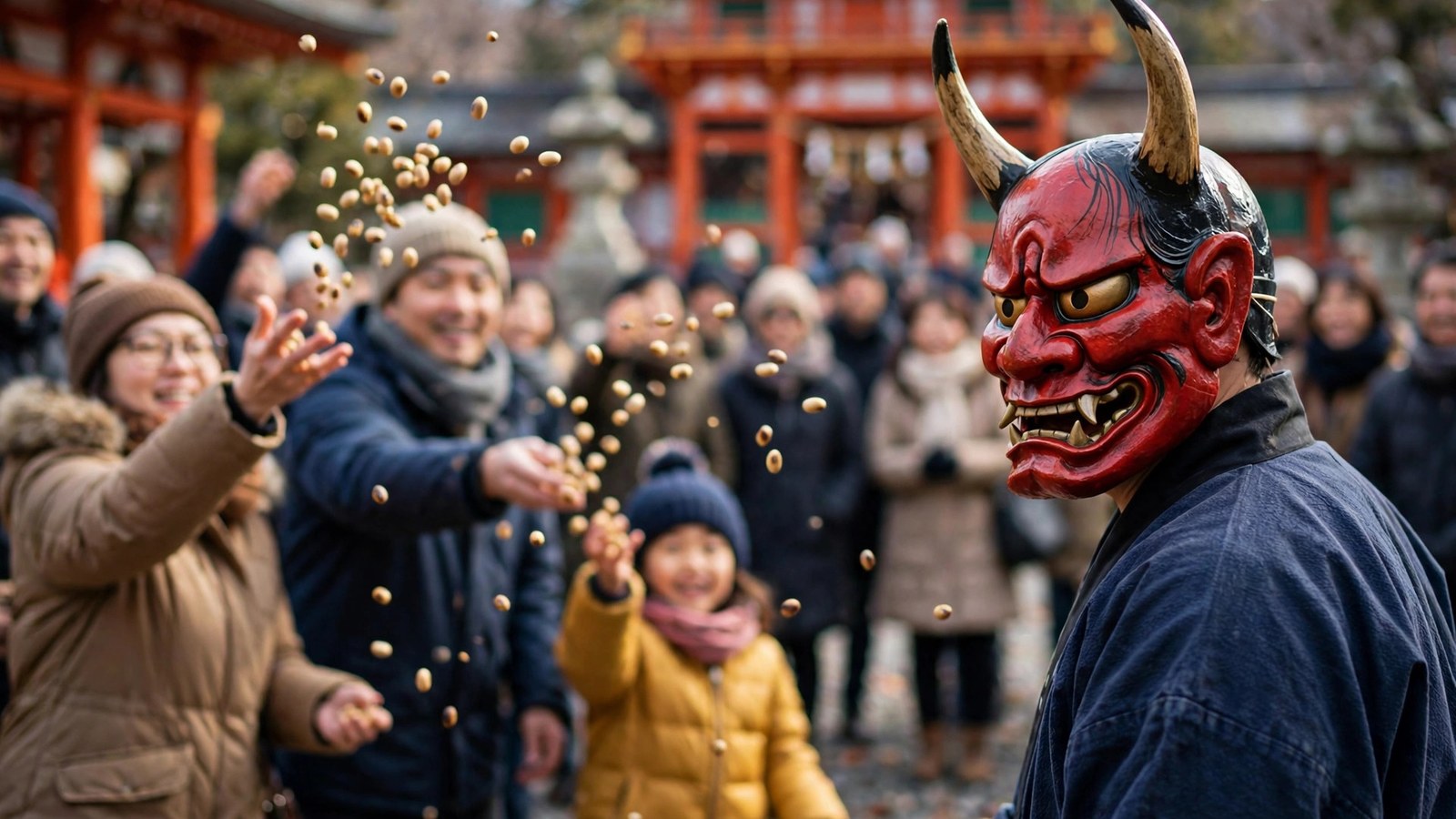
The oni changes with the story it stands in. In the folktale of Momotaro, the Peach Boy, oni raid villages from an island stronghold called Onigashima, Demon Island, and the hero sails there with a dog, a monkey and a pheasant to defeat them and recover their stolen treasure. At Setsubun, the festival held at the start of February on the day before spring in the old calendar, the oni stands for misfortune itself. Families scatter roasted soybeans, called fortune beans, out of the door or at a family member wearing an oni mask, shouting Oni wa soto, fuku wa uchi: demons out, fortune in. In a third setting, oni strength is admirable: the word praises fierce competitors, and modern stories regularly recast oni as heroes. Demon names in Japanese draw on all three settings at once, which is why they carry menace and admiration together.
Demon Is Not One Word in Japanese
English collapses several Japanese words into the single word demon, and name lists go wrong when they treat those words as interchangeable. Four distinctions matter for this topic.
Oni (鬼) is the native folklore ogre described above: horned, physical, and tied to places, festivals and tales. Akuma (悪魔) is the word closest to the Western devil or Satan. It combines the kanji for evil with the kanji for a demon or evil spirit, it is used in Buddhist contexts for the tempter Mara, and it is the word Japanese uses for Western style demons. Yokai (妖怪) is the umbrella term for supernatural beings of all kinds, and oni are one kind of yokai among hundreds. Akuryo (悪霊), also read akurei, means an evil spirit, a malign ghostly presence rather than a horned body. A writer choosing a demon word is choosing between an ogre, a devil, a whole class of beings, and a spirit. Only the first two appear in name lists with any frequency, and neither is a standard given name. Readers who want the wider moral vocabulary will find it in the companion guide to Japanese names that mean evil.
Female Oni in Folklore: Kijo, Onibaba and the Hannya
Kijo, the demon woman
The direct answer to what a female Japanese demon is called is kijo. Written 鬼女, the oni kanji joined to the kanji for woman, kijo is glossed as a demoness, a witch or an ogress. Folklore summaries describe kijo as women who became oni through karma and resentment, and distinguish the younger kijo from the onibaba, the demon hag of tales such as the onibaba of Adachigahara. Kijo is a type word, a category of being in stories, not a personal name that parents give. Its correct use is as a character type, title or epithet inside a story, rather than a baby name.
Ibaraki-doji, the lieutenant whose gender shifts
The most famous named female associated oni is Ibaraki-doji, the leading follower of Shuten-doji, the sake drinking oni chief of Mount Oe. A prefectural museum retelling describes how the pair held a stronghold above Kyoto, and how the warrior Minamoto no Yorimitsu and his men entered it disguised as mountain priests and destroyed the oni with sake that was poison to them. Ibaraki-doji escapes in many versions, after the warrior Watanabe no Tsuna cuts off the oni arm in a separate famous encounter. Reference summaries note that Ibaraki-doji gender is genuinely ambiguous across the tradition: a kijo, a female oni, in some stories and male in others. Name lists present Ibaraki-doji as a settled female demon name. It is a legendary oni name whose bearer changes sex between tellings, which makes it excellent material for a shape shifting character and a poor model for a personal name.
Hannya, the demoness of the Noh stage
The best documented female demon in Japanese culture may be a mask. The Hannya is a mask of the classical Noh theatre, and the Victoria and Albert Museum, which holds an example carved between 1650 and 1750, describes what it represents: a female serpent demon filled with malicious jealousy and hatred, with two sharp horns at the temples, metallic eyes under scowling brows, and a gaping mouth of gold teeth and fangs. The mask is worn in the second acts of plays including Aoi no Ue and Dojoji, stories of women betrayed or spurned by their lovers. The museum notes that the name is most plausibly traced to a mask carver called Hannyabo, active around 1500. Two naming lessons follow. Hannya names a mask and a stage transformation, the visible moment a woman becomes a demon through jealousy, not a woman in legend. Borrowing it as a character name borrows that specific meaning: it suits a demoness defined by betrayal and resentment, it does not work as a general word for any female demon, and it is not a given name.
The Source List, Checked Name by Name
The list this article was adapted from offered eight female demon names. Each is kept below, because readers will meet all eight on other sites, but each now carries the verdict a dictionary check produces. Three categories emerge: folklore terms that are real but are not given names, vocabulary words mislabelled as names, and modern compounds built for fiction.
Oniko. Presented as demon child. The construction is transparent: oni plus ko, the common name ending meaning child, which appears in the dictionary compound onimusume, oni daughter, glossed as a girl of terrifying appearance or temper and as a demon woman role in sideshows. Oniko is understandable as a modern coinage for a young oni character. It is not a traditional given name, and no name reference opened for this article lists it as one. Verdict: a fiction coinage, honestly labelled.
Kijo. Real, and correctly described in the source as a folklore term rather than a given name. Verdict: a type word for a demoness, usable as a title or character type.
Akuma. Real as a word, wrong as a name. Akuma means a devil or evil spirit, as the demon vocabulary section above sets out, and it functions in fiction as a title, a species name or a villain epithet. It is not a common given name for a girl or anyone else. Verdict: a vocabulary word, not a personal name.
Yasha. Real, and more complicated than the source suggested. Yasha, written 夜叉, is the Japanese form of the yaksha, a class of powerful beings from Buddhist cosmology. Reference material describes yasha as high ranking nature spirits and demon gods, feared as wrathful demons and also worshipped as guardians: the Twelve Heavenly Generals serve as bodyguards to Yakushi, the Buddha of medicine, and yasha serve in the armies of Bishamonten, one of the Four Heavenly Kings. So yasha are not simply female demons, and yasha is not a female name. Verdict: a Buddhist class term, gender neutral, not a given name.
Hannya. Real as a mask name, as the section above shows. Verdict: a theatre term for a jealous demoness, powerful as a deliberate stage reference, not a given name.
Onihime. Presented as demon princess. The parts check out: oni plus hime, the word for a princess or noble young woman, gives a compound any Japanese reader understands at sight. It works exactly as the source used it, as a fiction title for a demon royal, in the same family as story epithets rather than registered names. Verdict: a transparent fiction compound, fine for a character, not a traditional given name.
Kurayami. Presented as darkness. That part is right: kurayami, written 暗闇, means darkness or complete darkness, the physical dark of an unlit place. What it is not is a name. It is a common noun, and using it for a demoness who rules the night is a writer invention built on a real word. Verdict: a real vocabulary word used as an invented character name, credited to the writer, not to Japanese naming tradition. The fuller dark vocabulary is covered in Japanese names that mean darkness.
Benihime. Presented as crimson princess. Beni, written 紅, is a word for crimson or deep red, seen in dictionary supported compounds such as the crimson leaf writing for autumn foliage, and hime again means princess. The compound is a modern fiction construction, familiar to anime audiences as a polished, elegant epithet, but it is a composed title rather than a traditional name. Verdict: a fiction compound with correctly glossed parts.
The pattern across all eight is the finding of this article. Not one entry is a standard Japanese given name meaning demon. The list is a shelf of folklore terms, stage terms, vocabulary and fresh coinages. Used with those labels, it is good fiction material. Presented as baby names, it misleads.
Real Given Names With a Dark or Fierce Edge
Readers who want an actual Japanese girls name, rather than a folklore term, need a different promise: not a name that means demon, because that name effectively does not exist, but a real name whose verified meaning carries the colour, mood or sharpness that drew them to the topic.
Akane (茜). A well established girls name whose single kanji writing is the word for the madder plant, the source of a deep red dye, and by extension a deep red colour itself. Name references list its common writings and gloss the kanji as madder and crimson. Akane gives a character or a child the red of the classic oni palette in a name that is entirely ordinary in Japan. Its sunset red sits naturally beside the shadow vocabulary in the companion guide to Japanese names that mean shadow.
Akari. A popular modern girls name built on brightness: name references give its most common writings around the kanji for bright and for light, and the everyday noun akari means a light or lamp glow. Akari matters here for two reasons. It corrects the source list directly: pairing Akari with the word oni creates a two word description, not a name with a demon meaning. And a real bearer shows where the oni kanji actually appears in real names: the voice actress Akari Kito writes her family name with the oni kanji as its first character, a surname reading in which 鬼 is pronounced ki. In real naming, the demon character turns up in a surname while the given name beside it means light.
Beyond colour and light, the honest advice is to stop at two. Lists that extend this section with names glossed as demon, devil or hell fail the kanji checks applied in this article, and a short verified list serves a reader better than a long invented one.
Anime Style Demon Names: How They Are Built
The pattern
Anime and games name demons by borrowing and by composition. Borrowing takes a folklore word whole: oni, kijo, yasha and akuma all appear as character types, ranks or titles, carrying their dictionary meanings with them. Composition builds a fresh name from parts a Japanese audience reads instantly: a colour, an element, a time of day, or a fierce word, joined to a title such as hime. The best known recent demon series shows the method in its title: Kimetsu no Yaiba, the Japanese title of Demon Slayer, builds its invented first word on 鬼, the oni character, joined to a character for destruction, so the demon in the English title is the oni in the Japanese one. A demon name that works in this style is either a real word used accurately, or a compound whose parts the audience can parse. Names that are only Japanese sounding syllables with an English gloss attached are the ones that collapse on checking.
The source anime list, corrected
Akari Oni, glossed bright demon. Not a name. Akari is a girls given name meaning light, and oni after it is a separate word. Read as Japanese, the phrase is a description or a title in the making, Akari the oni, not a personal name with a combined meaning. Verdict: split it, and use either half honestly.
Yoru Kijo, glossed night demon woman. Yoru, written 夜, is the ordinary word for night, and kijo is the demoness term above. The phrase is again a description, night kijo, usable as an epithet for a character who appears after dark. Verdict: an epithet, not a name.
Hono, glossed flame. This entry contains a plain error. The Japanese word for a flame is honoo, written 炎, with a long final vowel. Hono without that length is not the flame word. A writer who wants the flame name should use the full form Honoo, labelled as the vocabulary word used as a character name. Verdict: corrected from Hono to Honoo, and reclassified as a word, not a given name.
Kurohime, glossed black princess. Kuro, written 黒, means black, and hime means princess, so the compound parses exactly as glossed. Like Onihime and Benihime, it is a composed fiction title rather than a traditional name. Verdict: a transparent fiction compound.
Shinra, glossed as a fierce, divine sounding name. The gloss gives the game away: it describes a sound, not a meaning. Shinra circulates in fiction as a stylish name and surname, and forms of it appear in compounds about the whole of creation, but no dictionary or name reference opened for this article supports a single demon meaning for it, and it has no special link to demons at all. Verdict: a fiction name valued for its sound, with no verified demon meaning, and any list that glosses it as one is inventing.
Meika, glossed dark song. No reference opened for this article supports this name with this meaning. The claimed gloss appears to bolt a dark element onto a song element without a checkable written form behind it. Verdict: dropped as a name claim. A writer who wants a singing demoness should build the name from verified parts, for example the word for a song, uta, joined transparently to a title, and label the result a coinage.
Raijin, correctly flagged in the source. Raijin, written 雷神, joins the thunder kanji to the god kanji, and Raijin is the god of thunder, lightning and storms, shown beating a ring of drums and often paired with Fujin, the god of wind, in famous screen paintings and temple sculpture. Raijin looks like an oni, which is why the confusion happens, but a named god of the Shinto and folk tradition is not a demon name to copy for a character. Verdict: keep the source caution. Borrow thunder imagery, drums, storm colour and the rai element meaning thunder, rather than the god name itself. The disorder such a storm god represents connects to the vocabulary in the batch companion guide to chaos in Japanese.
Building your own, transparently
A writer can build a demoness name that survives the same checks this article applies. Start from a verified element: oni for a direct claim, kijo for a female type, yami or kurayami for darkness, honoo for flame, yoru for night, beni or kuro for colour. Add a title element only if the character holds the title: hime for a princess, or ko for a child character in the modern coinage style. Then label the result as a composition, with the meaning of each part, rather than as a traditional Japanese name. Onihime, Benihime and Kurohime are legitimate fiction craft on those terms. The craft fails only when a list strips the label off and sells the composition as tradition. For characters who haunt rather than rule, the companion guide to Japanese names that mean ghost covers the spirit vocabulary, and the serpent side of the same folklore shelf is treated in Japanese names meaning snake.
How to Check a Demon Name Claim
Five checks, the same ones used throughout this naming series, clear almost every false demon name in minutes. First, demand the kanji: a meaning claim with no written form cannot be checked, and on this topic uncheckable claims are usually wrong. Second, look each character and compound up in a dictionary such as Jisho, which confirms oni, kijo and akuma in seconds and exposes shortened errors such as Hono for Honoo. Third, separate word from name: a dictionary proves a word exists, but only a name reference shows that people carry it as a name, and kijo and yasha fail that second test while passing the first. Fourth, watch for the two word trick, which presents a description such as Akari Oni as a single name, and the sound trick, which attaches a meaning to syllables, as with the dark song gloss for Meika, with no written form behind it. Fifth, for a real child name, ask Japanese speakers and check the permitted name kanji before the name is given, not after.
Choosing a Demon Name
For a fictional character, this topic is generous once its labels are respected. Kijo and the Hannya reference carry real cultural weight for a demoness shaped by resentment. Ibaraki-doji offers a lieutenant whose shifting gender suits a shape shifter. Compositions such as Onihime and Benihime give royal or colour themed demonesses names a reader can parse, and anime style builds add flame, night and darkness elements, provided each element is a real word and the whole is credited as a composition.
For a username, game avatar or stage name, the constraints relax further. Akuma, Kurayami and Honoo work as handles precisely because they are striking vocabulary. Knowing the real meaning still improves the choice: Kurayami is the physical dark, and Yasha is a Buddhist guardian class, not a generic demon.
For a real child, the honest recommendation is to give no demon name at all. No verified Japanese given name means demon, and the folklore terms name beings who devour, haunt or punish. Parents drawn to this topic usually want its colour, night or fierceness, and real names supply those safely, starting with Akane for deep red. Choose the quality, in a name whose kanji say exactly that, and leave the demons in the stories where they belong.
Pronunciation Guide
Japanese vowels keep one sound each: a as in father, i as in machine, u as in flute, e as in met, and o as in note, with long vowels held a beat longer. Oni is OH-nee. Kijo is KEE-joh. Akuma is AH-koo-mah. Yasha is YAH-shah. Hannya is HAHN-nyah. Onihime is OH-nee-hee-meh. Kurayami is KOO-rah-yah-mee. Benihime is BEH-nee-hee-meh, and Kurohime is KOO-roh-hee-meh. Yoru is YOH-roo. Honoo is HOH-noh, with the final vowel lengthened. Akane is ah-KAH-neh, and Akari is ah-KAH-ree. Raijin is RY-jin. Shuten-doji is SHOO-ten DOH-jee, and Ibaraki-doji is ee-BAH-rah-kee DOH-jee. The Japanese r sits between the English r, l and d sounds.
Frequently Asked Questions
What is the Japanese word for demon?
Oni, written 鬼, is the word most often translated as demon: an ogre or demon of folklore. Akuma, written 悪魔, is the word closest to the Western devil. Which word is right depends on whether you mean the horned folklore being or a devil in the Western sense.
What is a female demon called in Japanese?
Kijo, written 鬼女, is the term for a female oni: a demoness, witch or ogress of folklore. Older female oni are often called onibaba, demon hags. Both are story terms for types of being, not personal names.
Is there a Japanese given name that means demon?
No common one. The entries on demon name lists are folklore terms such as kijo, vocabulary words such as akuma, a theatre mask name, Hannya, or modern compounds composed for fiction, such as Onihime. Real names that share the topic mood, such as Akane, meaning deep red, carry different verified meanings.
What does onizen mean?
No definition for onizen could be verified in any dictionary or reference opened for this article, and the word does not appear as a standard Japanese term in those sources. It may be a misspelling, or a coinage from a specific work of fiction. This article claims no meaning for it rather than inventing one, and readers should distrust any list that defines it confidently without a source.
Is Hannya a demon name?
Hannya is the name of a Noh theatre mask representing a female demon transformed by jealousy, worn in plays such as Aoi no Ue and Dojoji. It is a stage term with a specific meaning, not a traditional given name, though fiction writers borrow it for demoness characters defined by betrayal and resentment.
Is Raijin a demon?
No. Raijin, written 雷神, is the god of thunder, lightning and storms, shown beating drums and often paired with Fujin, the god of wind. Raijin fierce, oni like appearance causes the confusion, but Raijin is a deity of the folk and Shinto tradition, not a demon, and the name should not be borrowed lightly for a demon character.
Can I use a demon name for a baby?
This article advises against it. No verified Japanese given name means demon, and the folklore terms name devouring or haunting beings. Choose instead a real name that carries the quality you want, such as deep red Akane, and verify its kanji in a name reference and with Japanese speakers before use.
Sources & references
- Jisho.org, dictionary entry for 鬼 (oni). Ogre or demon, spirit of a deceased person, an ogre like fierce or relentless person, the chaser in tag, and the slang prefix meaning very or extremely, with the folklore summary of horned, clawed oni in art, literature and theatre. Built on the JMdict and KANJIDIC projects.
- Jisho.org, dictionary search results for demon related words. Kijo (鬼女) glossed as demoness, witch or ogress, with a slang secondary sense, and onimusume (鬼娘), oni daughter, glossed as a girl of terrifying appearance or temper and as a demon woman role.
- Jisho.org and standard dictionary material summarised in the language references opened for this article. Akuma (悪魔) as devil or evil spirit, combining the kanji for evil and for a demon, akuryo (悪霊) as an evil spirit, and kurayami (暗闇) and yami (闇) as darkness vocabulary, with honoo (炎) as the full form of the word for flame.
- Victoria and Albert Museum, Explore the Collections, Hannya mask record (accession 578J-1886). Noh codified in the 14th century, the mask as a female serpent demon filled with malicious jealousy and hatred, with horns, metallic eyes and gold teeth and fangs, its use in Aoi no Ue, Dojoji, Kurozaka and Momijigari, and the name traced most plausibly to the carver Hannyabo.
- Japan Society, Setsubun lesson material. Setsubun on 3 or 4 February marking the beginning of spring, the mamemaki bean throwing custom, a family member dressed as an oni, and the chant Oni wa soto, fuku wa uchi, demons out, good luck in.
- KCP International, The Story of Momotaro. The Peach Boy tale: oni troubling villages from Onigashima, described as strong, red skinned, horned and carrying a kanabo club, defeated by Momotaro with a dog, a monkey and a pheasant in exchange for millet dumplings, with the stolen treasure returned.
- Hyogo Prefectural Museum of History, Shuten-doji and Mount Oe. The ogre of Mount Oe who kidnapped daughters of noble families, the expedition of Minamoto no Yorimitsu and his warriors disguised as mountain priests, the sake that was medicine to humans and poison to ogres, and Ibaraki-doji named as Shuten-doji underling.
- Wikipedia, Ibaraki-doji, summarising the tale tradition. Ibaraki-doji as the most important servant of Shuten-doji, the arm cut by Watanabe no Tsuna with the sword Higekiri, and the note that Ibaraki gender is ambiguous across stories, a kijo in some and male in others.
- Yokai.com, Yasha. Yasha (夜叉) as yaksha, demon gods from Buddhist cosmology, high ranking nature spirits feared as wrathful demons and worshipped as benevolent guardians, among the Eight Legions who protect the Buddhist teachings, with the Twelve Heavenly Generals serving Yakushi and yasha serving in the armies of Bishamonten.
- JapaneseNames.info, first name Akane. The madder plant word as the name core, the single kanji writing 茜 glossed as madder and crimson, and common writings including forms glossed red and sound and crimson and leaf.
- JapaneseNames.info, first name Akari. The most common writings built on the kanji for light and for bright, the everyday noun akari as light or lamp glow, and the bearer note for the voice actress Akari Kito, whose family name is written with 鬼 as its first character.
- Reference summaries of Raijin opened for this article, including museum and temple material on the Wind God and Thunder God screens and sculpture. Raijin as the god of thunder, lightning and storms who beats drums to make thunder, paired with Fujin the god of wind, in works including the Sotatsu school screens held by the Kyoto and Tokyo national museums and the Kamakura period statues at Sanjusangendo.
- Reference material on the title Kimetsu no Yaiba (Demon Slayer) opened for this article. The title first word as an invention built on 鬼, the oni character, joined to a destruction character, so the demon of the English title corresponds to the oni of the Japanese one.


