Short answer
- No. Angel Reese has not, in any source checked for this article, confirmed a smile makeover or any specific cosmetic dental procedure. Online discussion about her smile includes pages that state as fact that she has veneers or crowns, but those pages quote neither her nor a treating dentist speaking with her consent, so they are not evidence about her teeth. Her dental history is private information she has not chosen to publish. What can be explained honestly is the general subject behind the search. A smile makeover is not a single treatment. It is a personalized plan, built by a dentist after an examination, that can combine teeth whitening, veneers, bonding, orthodontics, and restorative work in different proportions for different people. The sections below separate what is confirmed about Reese from the discussion around her, explain why photographs cannot settle the question, and work through what each treatment involves, using guidance from the American Dental Association (ADA), the American Academy of Cosmetic Dentistry (AACD), and Cleveland Clinic. This article is general information only, not a diagnosis or treatment plan for any individual, and not a clinical assessment of Angel Reese. Only a dentist who examines a person, with that person's history, can describe that person's treatment.
What Is Actually Known, and What Is Only Discussed
The confirmed public facts about Reese concern basketball and how she experiences public attention, not dentistry. Reporting in Men’s Journal in March 2025 described her as a WNBA forward who had been an All-Rookie player in 2024 after playing college basketball at LSU and Maryland, and who hosts her own podcast, “Unapologetically Angel.”
On her teeth, the record checked for this article contains no statement from Reese confirming veneers, whitening, bonding, orthodontics, or any other dental procedure, and no statement from a dentist treating her. Searches run on November 3, 2026 found three kinds of pages making dental claims about her. The first is dental clinic marketing, including a clinic page that asserts she has veneers and crowns and uses her name to promote its own transformation services. A business selling a treatment is not a neutral source about who has bought it, and the page quotes neither Reese nor any clinical source. The second is fan and gossip writing, which wonders aloud whether she had veneers, braces, or whitening and then concedes that she has not revealed any details. Wondering is not confirming. The third is social media commentary built on photo comparisons, addressed next.
Reese has spoken on the record about appearance commentary itself. On her podcast, in a conversation with fellow WNBA player DiJonai Carrington reported by Men’s Journal in March 2025, she said the criticism that bothers her most is comments on her appearance: “I hate when people say that, ‘Oh she’s too worried about her makeup and her hair and her lashes and her nails and her outfits.’” That is her own description of what this attention feels like from the inside, and part of why this article handles dental claims about her with care. Everything after this section is about cosmetic dentistry in general, not as a claim about Reese.
Why Photographs Cannot Settle the Question
Most online claims about a public figure’s teeth rest on before and after photographs. A photograph is not a clinical record. Lighting changes tooth color: teeth under arena lights, flash, or a ring light look whiter than the same teeth in flat daylight, and cooler light pushes teeth toward blue white while warmer light pushes them toward yellow. Angle and distance change apparent shape, a wider smile shows more tooth, and sharpening makes edges look more uniform. Makeup changes contrast, because a stronger lip color makes the teeth beside it read as whiter, and filters lift brightness across an image. Teeth also change over years without cosmetic treatment, through wear, staining from food and drink, and aging, because enamel thins over time and more of the yellowish dentin beneath shows through, a process the ADA describes in its whitening guidance.
The deeper problem is overlap. Whitening alone, whitening plus bonding, orthodontics plus whitening, and veneers can produce very similar looks in a photograph, although they are entirely different treatments. A picture can show that a smile looks bright and even. It cannot show which route, if any, produced it, what material was used, or how much enamel was involved. Dentists commenting on photographs of people they have not examined can describe possibilities in general terms; they cannot diagnose a specific person from a screenshot. Our companion piece on Jo Koy’s teeth and what is not proven applies the same standard to another much discussed smile.
What a Smile Makeover Actually Is
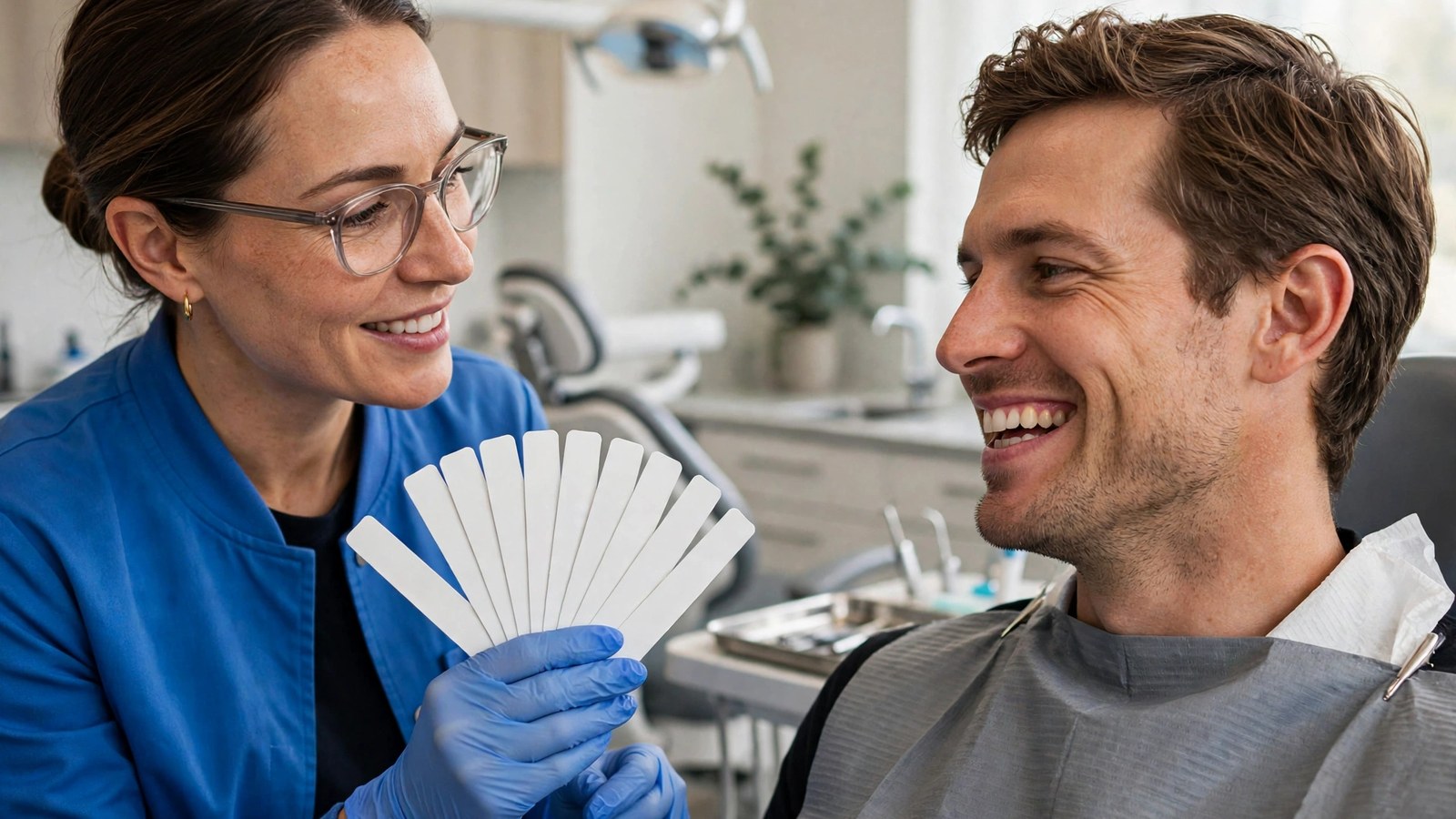
The AACD describes cosmetic dentistry as dentistry aimed at creating a positive change to a person’s teeth and smile, spanning whitening, bonding, tooth colored restorations and fillings, porcelain veneers, orthodontics, implants, and more. A smile makeover draws on that list. It is the plan, not any one item on it: a combination of procedures chosen for one person’s teeth, bite, and goals, sequenced so each step supports the next.
Three features define a genuine plan. First, it starts with an examination, not a treatment: the dentist assesses the teeth, gums, and bite, and takes photographs, impressions, or 3D scans. Second, health comes before appearance. The ADA is direct that a dentist must first treat problems such as decay or gum disease, because placing veneers over unhealthy teeth may worsen existing problems. Cleveland Clinic gives the same boundary for veneers: they are an option only for people free of extensive cavities and gum disease. Third, the plan is individualized. Two people who both want a brighter, more even smile can receive entirely different plans: one may need only whitening and a small bonding repair, the other orthodontics first.
The AACD frames its standard as responsible esthetics: aesthetic dentistry must complement overall oral health and do no harm, and minimally invasive options should be favored where appropriate. A plan that begins with the most invasive option, or is sold before an examination, fails that test.
The Treatments a Makeover Can Combine
Teeth Whitening: Color Only
Whitening is usually the simplest element in a makeover. The ADA notes, through its MouthHealthy patient site, that when the AACD asked people what they would most like to improve about their smile, the most common response was whiter teeth. Whitening changes color and nothing else: not shape, size, or length, and it cannot close a gap or repair a chip.
MouthHealthy explains that whitening products contain one of two bleaches, hydrogen peroxide or carbamide peroxide, which break stains into smaller pieces so the color is less concentrated and teeth look brighter. Options run from stain removal toothpastes, which remove surface stain only, to in office bleaching in a single visit, to custom trays a dentist supplies for home use over days to weeks, to over the counter products at lower concentrations than a dentist uses.
The limits matter for planning. Whitening will not work on caps, veneers, crowns, or fillings, because only natural tooth structure lightens. It does not correct all discoloration: yellow teeth will probably bleach well, brown teeth less well, gray toned teeth may not bleach at all, and discoloration from certain medications or a tooth injury may not respond. Side effects can include temporary sensitivity, and overuse can damage enamel or gums. Because a restoration cannot be lightened later, a dentist wants natural teeth at their final shade before any veneer or bonding is color matched to them. Our guide to teeth whitening aftercare covers how results are maintained.
Dental Veneers: A Covering for the Front of the Tooth
A veneer is a custom made covering for the front surface of a tooth. The ADA describes veneers as natural looking coverings made of high quality dental material, used to improve the appearance of teeth that are chipped or broken, stained, or crooked or misshapen, and to mask gaps. Cleveland Clinic adds teeth that are too small, plus cracks and stains that do not improve with whitening. A veneer differs from a crown because it covers only the front surface, not the entire tooth.
The ADA describes two main types. A porcelain veneer is a thin shell custom made to fit the front of the tooth. Porcelain veneers are strong, long lasting, and natural looking, and tend to cost more. A composite veneer is made from tooth colored filling material bonded directly to the tooth. Composite veneers may require less enamel removal and fewer visits, and are easier to fix if damaged, but are not as resistant to staining or wear. Cleveland Clinic notes a further category, no prep and minimal prep veneers, which require less enamel removal than traditional porcelain veneers but still require some. Our explainer on prepless veneers and no drill smile changes works through what those labels can and cannot mean, and our guide to dental veneers and dental laminates covers the terminology clinics use.
Placement shows why veneers are a process rather than a single appointment reveal. For porcelain, the ADA sets out the steps: the dentist removes a small amount of enamel from the front and sides, takes an impression or a 3D scan, and sends it to a laboratory where a technician custom makes the veneer, with a temporary worn in the meantime. At the fitting visit the dentist checks fit and shape, cleans the tooth, and bonds the veneer in place, with shade chosen with the patient. For composite, the dentist prepares the tooth, bonds and sculpts the material directly, hardens it with a special light, then smooths and polishes it. The ADA advises telling the dentist if the bite does not feel right afterward, so it can be corrected. A crown, by contrast, covers the entire tooth: Cleveland Clinic explains that a veneer’s purpose is cosmetic, while a crown’s main purpose is to restore a tooth badly damaged by decay or trauma. Some plans also address the gum line, where excess tissue or an uneven margin changes how long the teeth appear, an adjustment considered only after gum health is assessed. Our honest review of whether veneers are bad for your teeth examines the safety questions patients raise most often.
Dental Bonding: Resin Added Directly
Bonding is the technique behind composite veneers, used alone for smaller corrections. Cleveland Clinic notes that composite veneers use the same resin as dental bonding. The dentist applies the resin, shapes it, hardens it with a light, and polishes it, the process the ADA describes for composite veneers. Bonding can add length to a short tooth, repair a minor chip, close a small gap, or reshape an edge, often with little or no enamel removed.
Its trade offs follow from the material. Composite is easier to repair than porcelain, because a chip can often be patched rather than remade, and it usually costs less at the first appointment. It is also less resistant to staining and wear, so a bonded edge under heavy biting forces lives a harder life than a bonded surface elsewhere. Bonding is often the conservative first option for a few teeth, suggested before anything irreversible.
Orthodontics: Moving Teeth Instead of Covering Them
Orthodontics, including braces and clear aligners, is the one element of a makeover that changes where teeth actually are. Veneers cover teeth; orthodontics moves them. That difference decides many plans. If the concern is crowding, rotation, spacing caused by tooth position, or a bite that does not meet properly, moving the teeth addresses the cause and removes no enamel. If the concern is shade or surface shape in teeth already well positioned, orthodontics alone will not change those things, which is why the two approaches are often sequenced, alignment first and cosmetic finishing second.
Orthodontics takes longer than coverings, because teeth move gradually, and the result has to be held afterward or teeth can drift back. It also interacts with whitening: the ADA’s whitening guidance, citing the American Association of Orthodontists, notes that nearly 90 percent of orthodontic patients requested tooth whitening. Our explainer on whether Invisalign can fix crooked teeth works through who aligners help and where their limits sit. Nor should orthodontics be skipped silently: a consultation that proposes covering badly positioned teeth with veneers, without discussing moving them, has left out the option that preserves the most tooth.
How a Makeover Is Planned, Step by Step
Across the ADA, AACD, and Cleveland Clinic guidance, a responsible makeover follows the same broad sequence:
- Examination and records. The dentist examines the teeth, gums, and bite, reviews dental history, and takes photographs, impressions, or scans, identifying decay, gum disease, and failing restorations before cosmetics are discussed.
- Health treatment first. Decay is treated and gum disease is managed. Cosmetic work placed over active disease is likely to fail or worsen the underlying problem.
- Goals in plain words. The patient describes the change in ordinary language: brighter, more even, longer, less gappy, more natural. A photograph of an admired smile can start this conversation as a picture of a preference, not a blueprint.
- Options, including the smallest one. The dentist sets out what whitening, bonding, orthodontics, and veneers would each do for this specific mouth, how many teeth each treats, how much enamel each involves, and what doing nothing would mean. The AACD advises an honest discussion about whether goals are realistic, and about risks, benefits, alternatives, cost, and time frame.
- Sequencing, shade, and preview. Alignment generally precedes coverings, and whitening precedes color matched restorations, because a placed veneer cannot be lightened afterward. Where a digital preview or trial temporaries are offered, the patient sees the proposed result before any enamel is removed.
- Treatment, fitting, and review. Restorations are placed and fitted, the bite is checked and adjusted, and the patient learns what maintenance the work needs.
A plan that cannot be taken away and questioned before preparation begins is not being offered in that spirit. Our guide to celebrity veneers and what they can and cannot promise applies this standard when the reference point is a famous smile.
Risks, Lifespan, and Maintenance
The central fact about traditional veneers is the permanence of the preparation, not of the veneer. The ADA states that treatment is not reversible, because enamel is removed to place a veneer, and enamel does not grow back. A prepared tooth will need a covering of some kind from then on. The veneer itself has a finite life: the ADA notes it may chip, crack, wear down, or loosen over time, requiring rebonding, repair, or replacement. The honest price of veneers is therefore the first fee plus a lifetime cycle of maintenance and replacement, and a quote that presents only the first fee is incomplete.
Other risks and limits from the ADA guidance include:
- Grinding and bite forces. If you clench or grind your teeth, or have a deep overbite, veneers may not be a good choice, or may need those forces managed within the plan.
- Decay is still possible. You can still get cavities under or around a veneer, so restored teeth need the same daily care as natural teeth.
- Fixed shade. A veneer cannot be whitened later. If surrounding natural teeth darken, or are whitened, a mismatch can develop.
- Cost and coverage. Veneers are considered cosmetic, so they may not be covered by insurance unless deemed medically necessary.
- Who places them matters. The ADA urges care only from a licensed dentist, warns that services from unlicensed individuals carry risks including infection and nerve damage, and has specifically cautioned the public about so called veneer technicians offering services that eliminate the role of the dentist.
Daily care is undramatic: brush twice a day with fluoride toothpaste, clean between the teeth daily, avoid biting fingernails and chewing hard objects, be cautious with coffee, tea, and red wine, which can stain, and keep routine visits. Our five tips for healthy teeth and gums covers that routine in full. None of this is a reason to avoid treatment a person wants and understands. All of it is a reason to decide slowly, before preparation, not after.
The Athlete Angle: Sport, Impact, and Restorations
Because the smile behind this article belongs to a basketball player, one planning factor deserves its own section: impact. The ADA’s veneer care guidance advises wearing a mouthguard if you play a sport that could injure your mouth. That applies with extra force to anyone with veneers or bonding, because a restoration that chips on court enters the repair cycle at once, and a blow that might bruise a natural tooth can crack a covering.
For a reader who plays contact or ball sports, the practical questions are whether a custom mouthguard is part of the plan and what the repair route is if a veneer chips mid season. Our guide to sports dental injuries, prevention, and urgent care covers the first minutes after a tooth injury.
Privacy and Media Literacy: How to Read Claims Like These
The discussion around Reese’s smile is a useful case study in how appearance claims about public figures are built, because every weak element in the chain is visible. A clinic marketing page asserts a procedure list for a named athlete it does not claim to have treated, on a page designed to sell that same list. Gossip pages repeat the wondering, sometimes letting a headline imply more than the text supports. Photo collages supply the visual suggestion. None of the chain contains the element that would settle the matter: the person’s own statement, or a professional speaking with her consent.
A reader can test any such claim with three questions. First, who is the source, and what do they gain if I believe them? A clinic selling veneers gains a customer; a gossip page gains a click. Neither gain makes a claim automatically false, but both mean it needs outside support before it is repeated as fact. Second, does the claim rest on the person’s own words? Reese has used her platform to talk about appearance criticism, as the quotation earlier shows, but not to announce dental treatment. A claim that cannot point to her words is a claim about her, not from her. Third, could the evidence be explained another way? With teeth, almost always yes, because lighting, makeup, editing, aging, and different treatments produce overlapping photographic results.
Underneath the method sits a fairness point. Dental history is health information. A public figure chooses to share some parts of life, her games, her podcast, her fashion, and that choice does not transfer ownership of the parts she has not shared. Enjoying a player’s public work and being curious about cosmetic dentistry are compatible with leaving her medical details alone unless she raises them herself.
If You Are Considering Cosmetic Dentistry Yourself
Start with health, not with a photograph. Decay, gum disease, and bite problems should be assessed and treated first, because cosmetic work on an unhealthy mouth is likely to fail or cause further problems. Then ask questions that keep every option open:
- What exactly are you proposing for each tooth, and why does that tooth need it rather than whitening, bonding, orthodontics, or nothing?
- How much enamel will be removed from each tooth, and is that step reversible?
- How long should this work last with my bite and habits, what maintenance does it need, and what will repair or replacement cost?
- I grind my teeth, play a contact sport, or bite my nails. How does that change the plan, and is a mouthguard part of it?
- Can I see a preview, and can I take the plan away to think and get a second opinion before anything is prepared?
- Are you a licensed dentist, and who exactly will place the restorations?
Be wary of any provider who promises a celebrity smile without an examination, who will not discuss risks or alternatives, or who offers veneer services without a qualified dentist. Your smile should be planned around your mouth, not copied from a famous photograph. Tooth size, gum line, lip shape, and bite all differ between people, so a result that suits one person is not a template for another.
When to See a Dentist Promptly
Cosmetic questions can wait for a routine consultation. Symptoms cannot. Arrange care promptly for tooth pain, facial or gum swelling, a cracked or knocked out tooth, persistent bleeding gums, a restoration that has chipped or loosened, persistent sensitivity, or a bite that suddenly feels wrong. Do not file, glue, or adjust a tooth or restoration yourself: home repair can trap bacteria and make a professional repair harder.
Frequently Asked Questions
Has Angel Reese confirmed a smile makeover?
No. In the sources checked on November 3, 2026, no statement from Reese confirming a smile makeover or any specific cosmetic dental procedure was found, and no treating dentist has spoken on the record with her consent. Discussion, clinic marketing claims, and photo comparisons are not confirmation. If she discusses dental treatment herself in the future, that statement would be the source to cite.
Has Angel Reese had veneers?
That is not confirmed. Some clinic marketing pages assert that she has veneers and crowns, but those pages sell veneers, quote no statement from her, and name no clinical source, so they do not establish the claim. Gossip pages that raise the question generally concede she has not revealed any details. Her dental history is not public, and this article makes no claim about it in either direction.
What about claims that Angel Reese has had plastic surgery?
The same standard applies. Searches found speculation about her appearance, including surgical claims, but no reliable confirmation of a specific surgical or dental procedure from Reese herself or from a professional speaking with her consent. Speculation repeated across low quality pages does not become confirmation.
Can you tell whether someone has had cosmetic dentistry from before and after photos?
Not reliably. Lighting, flash, angle, lens distance, makeup, filters, and editing all change how teeth look, and teeth change with age as enamel thins and darker dentin shows through. Whitening, bonding, orthodontics, and veneers can produce overlapping looks on camera, so a photograph cannot identify which treatment, if any, was used. Confirming a specific person’s treatment requires that person’s own statement or clinical information.
What is a smile makeover, exactly?
It is a personalized treatment plan, not a single procedure. The AACD describes cosmetic dentistry as work aimed at a positive change to the teeth and smile, spanning whitening, bonding, veneers, orthodontics, implants, and more. A makeover selects and sequences items from that range for one person’s teeth, bite, and goals, starting with an examination and treatment of decay or gum disease first.
Are veneers permanent?
The preparation usually is, and the veneer itself is not. The ADA states that veneer treatment is not reversible because enamel is removed to place the veneer, and enamel does not grow back. The veneer on that prepared tooth can chip, crack, wear down, or loosen over time and will need rebonding, repair, or replacement. Choosing veneers means accepting a long term maintenance cycle.
Will whitening alone give me a makeover result?
Only if color is the whole concern. Whitening lightens natural teeth and cannot change shape, size, length, alignment, or gaps, and it does not work on veneers, crowns, caps, or fillings. Yellow teeth generally bleach well, brown teeth less well, and gray toned teeth may not bleach at all.
Can a dentist copy Angel Reese’s smile for me?
A dentist can discuss the qualities you admire, in plain words such as brighter, more even, or more natural, and plan toward them for your face and bite. Copying a specific person’s smile exactly is rarely realistic or wise: tooth size, gum line, lip shape, and bite differ between people, and in Reese’s case the target’s dental history is not even public. Ask instead for a natural result planned for your mouth.
Sources & references
- American Dental Association, MouthHealthy, "Veneers". Patient guidance on what veneers are, porcelain and composite types, placement steps for each type, irreversibility because enamel is removed, treating decay or gum disease first, grinding and deep overbite cautions, chipping and loosening, cavities under veneers, insurance, the warning about unlicensed providers and so called veneer technicians, and care including mouthguard use in sport. Opened November 3, 2026. https://www.mouthhealthy.org/all-topics-a-z/veneers
- American Dental Association, MouthHealthy, "Teeth Whitening". Patient guidance on how hydrogen peroxide and carbamide peroxide bleaching works, stain removal toothpastes, in office and at home options, the statement that whitening will not work on caps, veneers, crowns, or fillings, which discoloration types respond, enamel thinning and dentin show through with age, sensitivity, and overuse damage. Opened November 3, 2026. https://www.mouthhealthy.org/all-topics-a-z/teeth-whitening
- American Academy of Cosmetic Dentistry, "Responsible Esthetics of Cosmetic Dentistry", via the AACD consumer site Your Smile Becomes You. Source for the definition and scope of cosmetic dentistry (whitening, bonding, tooth colored restorations, porcelain veneers, orthodontics, implants), the responsible esthetics standard of complementing overall oral health, doing no harm, evidence based protocols, and minimally invasive treatment, and for consultation advice on realistic goals, risks, benefits, alternatives, cost, and time frame. Opened November 3, 2026. https://yoursmilebecomesyou.com/responsible-esthetics
- Cleveland Clinic, "Veneers: What Are Dental Veneers? Cost, Procedure and Advantages". Patient guidance that veneers cover the front surfaces of teeth and can camouflage chips, cracks, gaps, discoloration, small and misshapen teeth; that veneers are an option only for people free of extensive cavities and gum disease; that a crown covers the entire tooth to restore and protect while a veneer is cosmetic; that composite veneers use the same composite resin as dental bonding; and that porcelain and no prep veneers involve enamel removal. Opened November 3, 2026. https://my.clevelandclinic.org/health/treatments/23522-dental-veneers
- Men's Journal, "Angel Reese Has Blunt Message For Fans About Her Appearance", March 9, 2025. Source for Reese's career outline as reported at that date (WNBA forward, All-Rookie in 2024, college basketball at LSU and Maryland, host of the "Unapologetically Angel" podcast) and for her quoted remarks, in conversation with DiJonai Carrington on that podcast, that appearance comments are the criticism that bothers her most. Opened November 3, 2026. https://www.mensjournal.com/sports/angel-reese-has-blunt-message-for-fans-about-her-appearance


