Short answer
- After a tooth extraction, eat soft, cool or lukewarm food, chew on the opposite side of your mouth where you can, and drink from a cup rather than through a straw. Good early choices include yogurt, smooth soup that is warm rather than hot, mashed potatoes, scrambled eggs, applesauce, and smooth oatmeal once it has cooled. Avoid hard, crunchy, sharp, sticky, very hot, and very spicy food at first, and avoid alcohol and smoking while the socket heals. Solid food comes back gradually, not on a set date. Most people move from liquids and very soft food to foods that need gentle chewing over the first several days, guided by comfort, and add harder food last, often after a week or more and only when chewing no longer causes pain or bleeding. Wisdom teeth removal, especially surgical removal of lower wisdom teeth, usually sits at the slower end of that range. This article is general information only. It is not a diagnosis and it is not a substitute for the instructions your own dentist or oral surgeon gave you. If anything here differs from your written aftercare sheet, follow your dentist. If pain gets worse instead of better, bleeding will not stop, or you develop swelling, fever, or a bad taste, contact your dental team promptly rather than changing your diet and waiting.
Why Food Choices Matter: The Socket and the Blood Clot
When a tooth is removed, it leaves a hole in the jawbone called a socket. Blood fills that socket and forms a clot. That clot is not a leftover to be cleaned away. Mayo Clinic describes it as a protective layer over the bone and nerve endings in the empty socket, containing cells needed for proper healing. Kent Community Health NHS guidance puts it plainly: the clot is necessary for good healing and should not be disturbed.
Almost every food rule after an extraction exists to protect that clot during the first days, when it is most fragile. Food can threaten it in four ways. Hard or sharp food can press on, scrape, or break into the socket. Hot food and hot drinks can restart bleeding and can burn a mouth that is still numb. Suction, from a straw, a cigarette, or vigorous spitting and rinsing, can pull the clot loose. Small particles such as seeds, nuts, popcorn hulls, and rice grains can settle into the socket and irritate it.
If the clot fails to form, comes out, or dissolves before the wound has healed, the result can be dry socket, a painful condition in which the underlying bone and nerves are exposed. Mayo Clinic notes that dry socket pain usually begins one to three days after the removal, that the socket may look empty, and that pain can spread to the ear, eye, temple, or neck on the same side. Protecting the clot with soft food and gentle habits is the simplest way to lower that risk, although dry socket can still happen despite careful aftercare, particularly after difficult extractions and in people who smoke.
An open socket in the first days is normal. It does not need to be filled, packed with food, or cleaned out at home. Over the following days and weeks, gum tissue grows over the socket while bone remodels underneath, a slower process that continues long after the surface looks closed. Food debris in the socket can be uncomfortable, but the answer is gentle rinsing at the stage your dentist advises, never poking the socket with fingers, toothpicks, or utensils.
The Four Tests for Any Food
You do not need to memorize lists of approved and forbidden foods. Nearly any food can be judged with four questions, and a food that fails any one of them should wait.
First, temperature. Is it cool or lukewarm rather than hot? Heat can increase bleeding, and while your mouth is numb you cannot judge temperature reliably, so you can scald yourself without feeling it. University College London Hospitals guidance notes that local anesthetic usually wears off in two to six hours and advises avoiding hot food and drinks during that time for this reason.
Second, texture. Is it soft enough to eat with little or no chewing, with no hard edges, crunch, seeds, or sharp fragments? Texture is what matters: smooth oatmeal passes, while the same oats baked into a crunchy granola bar do not.
Third, effort. Does eating it need strong, repeated chewing, wide jaw opening, or pulling, as sticky and chewy foods do? Early on, the less work your jaw does near the socket, the better.
Fourth, residue. Will it break into small pieces that can lodge in the socket? If so, it belongs in the later stages, once rinsing is allowed and the socket is shallower.
What to Eat in the First Day or Two
Wait until the numbness has worn off before you eat if you can. Hull University Teaching Hospitals guidance is direct about why: while the area is still numb you can accidentally chew your lip or tongue, and the injury only hurts once feeling returns. Start with small amounts, chew slowly on the opposite side, and stop if eating causes bleeding.
Foods that usually work well at this stage include:
- Yogurt, plain or smooth, without crunchy granola or nut pieces mixed in.
- Smooth soups and broths, served warm rather than hot, without chunks that need chewing.
- Mashed potatoes, made smooth, and similar soft foods such as mashed sweet potato or well cooked pureed vegetables.
- Scrambled eggs, cooked soft.
- Applesauce and other smooth fruit purees.
- Pudding, custard, and ice cream without nuts, chocolate chunks, or other hard pieces.
- Smooth oatmeal or porridge, cooled to lukewarm, covered in detail in the next section.
- Nutritional drinks, smoothies, and milkshakes eaten with a spoon rather than sipped through a straw.
Drink water regularly from a cup. Staying hydrated supports healing, and plain water is the safest drink at every stage. Our guide to hydration and healthy snack swaps for workdays covers practical ways to drink steadily through the day, and the same steady approach helps here, with the extraction specific rules in this article taking priority.
If you were given gauze to bite on, follow your dentist’s instructions about how long to keep it in place. Louisiana State University School of Dentistry guidance explains that biting firmly on the gauze helps a clot form, and that slight oozing on the first day is normal. Do not keep checking the socket by lifting the gauze or poking it, because each disturbance works against the clot.
Oatmeal After a Tooth Extraction
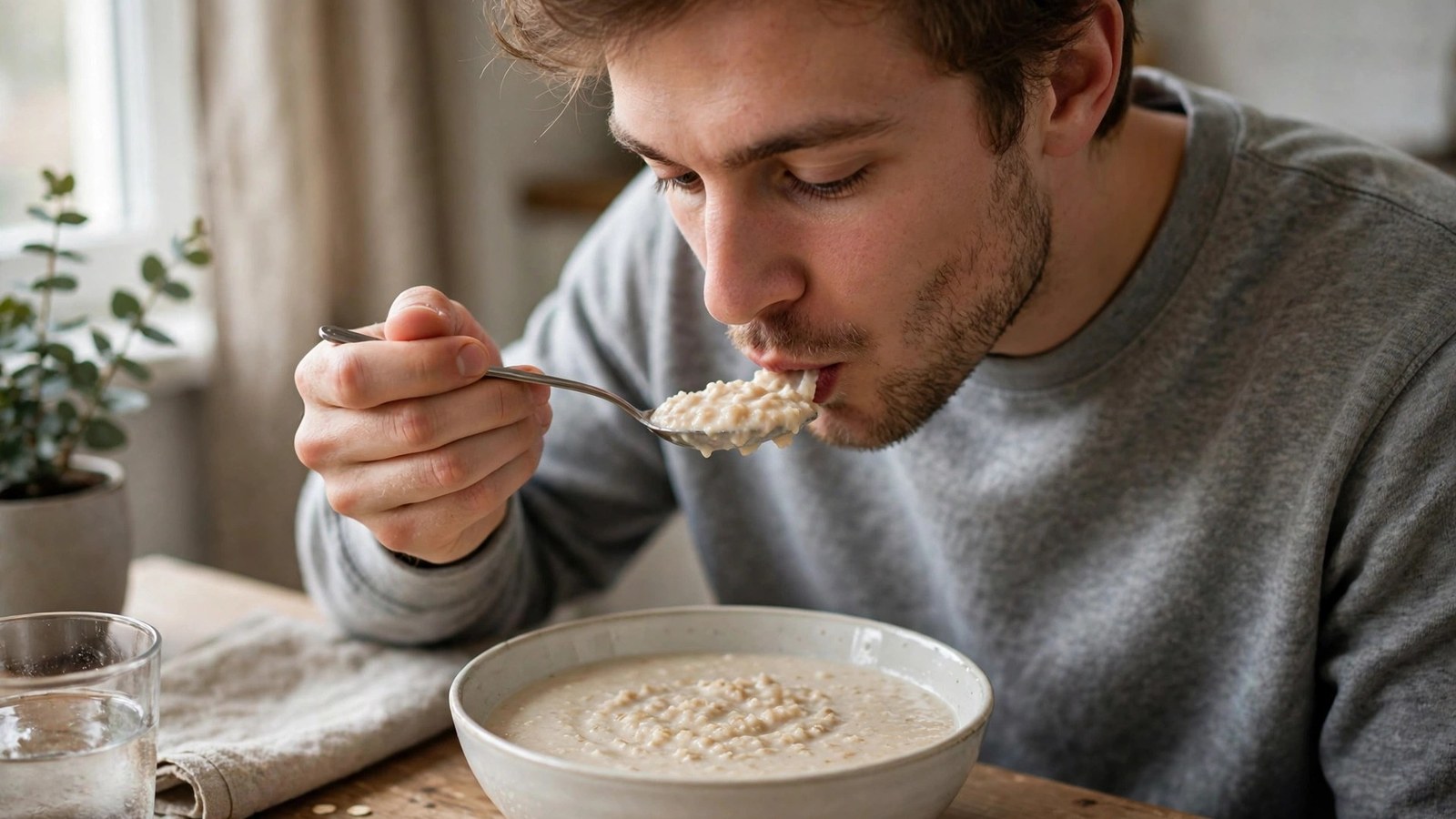
Oatmeal deserves its own section because it is one of the most common questions after wisdom teeth removal, and the honest answer is that oatmeal is usually a good choice, with two conditions: temperature and texture.
The temperature condition is simple. Serve it lukewarm, never hot. Hot oatmeal carries the same two risks as any hot food after an extraction: it can encourage bleeding at the socket, and a numb or partly numb mouth cannot protect itself from a burn. Make it, then let it sit until it feels comfortably warm on a spoon tested against your lip.
The texture condition matters just as much. Choose smooth oatmeal, such as instant oats made soft with water or milk, or rolled oats cooked until fully soft. Avoid thick, lumpy oatmeal in the first days, and leave out crunchy or seedy additions such as nuts, seeds, granola, and raw fruit pieces. Those toppings fail the texture and residue tests even though the oatmeal underneath them passes. A spoonful of smooth yogurt stirred through, or a little applesauce, keeps the bowl soft while adding flavor.
Chew, to the extent oatmeal needs chewing at all, on the opposite side of your mouth, and take small spoonfuls rather than large mouthfuls that need wide jaw opening. If oatmeal feels uncomfortable, causes pressure at the socket, or leaves you sore, there is no need to persist with it. Switch back to yogurt or smooth soup and try oatmeal again a day or two later, when chewing feels easier. As recovery progresses, oatmeal can gradually return to its normal form, thicker and with toppings, at the same pace as your other foods. Readers rethinking breakfast more generally can also see our guide to healthy breakfast swaps for busy mornings, although the soft and lukewarm rules in this article govern while a socket is healing.
Building a Soft Diet That Still Nourishes You
A few days of soft food can easily become a few days of barely eating, and that does not help healing. Your body is repairing tissue, and it needs energy and protein to do it. The goal is a soft diet with substance, not a liquid diet by default.
Build each meal around something with protein where you can: eggs, yogurt, soft fish, mashed or pureed lentils and beans, smooth bean or lentil soups, soft cheese, and finely ground meat once gentle chewing feels comfortable. Add energy with mashed potatoes, soft pasta, well cooked rice at the later soft stage, avocado, and oatmeal. Eat smaller amounts more often if a full meal is uncomfortable, and do not skip meals entirely because eating feels like effort.
Planning helps more than willpower in the first sore days. Stock soft foods before a planned extraction, and prepare a few portions ahead where you can. The planning approach in our guide to meal prep basics for busy weeknights transfers well: decide the meals in advance, shop once, and portion them so that the soft option is also the easy option when you are tired and sore.
If a medical condition shapes what you can eat, or you take medicine that must be taken with food, ask your dentist or clinician before the extraction how to handle the soft food period. This article cannot adapt general guidance to an individual medical situation.
Drinks: What Helps and What to Avoid
Water is the default drink at every stage, sipped from a cup or glass. The drinking rules are mostly about how you drink and what temperature you choose, rather than about the liquid itself.
Do not drink through a straw in the early healing period. The sucking action creates pressure that can pull the clot out of the socket. Guidance differs on how long to avoid straws: American Dental Association patient guidance advises against smoking, vigorous rinsing, and drinking through a straw for 24 hours, while Mayo Clinic advises not drinking with a straw for at least a week after a tooth removal. The cautious course, and the one most oral surgery instructions take, is to avoid straws for the first week, and longer if your own dentist advises it. The same suction logic applies to smoking and vaping, and to sucking on hard candy.
Avoid very hot drinks at first, for the bleeding and burn reasons already covered. Avoid alcohol in the early period: NHS trust guidance commonly advises avoiding it for at least the first 24 to 48 hours, and some oral surgery guidance advises longer, because alcohol can increase bleeding and interfere with healing, and it must never be combined with sedatives or certain pain medicines. Follow the period your own team specified. Mayo Clinic also advises avoiding alcoholic, caffeinated, carbonated, and hot beverages for as long as your dentist recommends, so treat fizzy drinks as an ask your dentist item in the first days.
When Solid Food Can Come Back
There is no single day on which solid food becomes safe for everyone, and any source that gives one fixed date for all extractions is oversimplifying. Healing depends on how many teeth were removed, whether the extraction was simple or surgical, whether bone was removed or stitches placed, and how your own mouth feels. University College London Hospitals guidance suggests soft food such as pasta, mashed potato, scrambled egg, or soup for the first few days, and Mayo Clinic advises soft food for the first day, then foods that do not need a lot of chewing once you feel ready, avoiding chewing on the surgery side.
A workable progression looks like this, judged by comfort rather than by the calendar. Start with liquids and very soft food. Move to soft solids that yield to a fork, such as soft pasta, flaky fish, soft bread without crusts, tender cooked vegetables, and eggs in other forms. Then add foods that need real but gentle chewing, chewed at first on the opposite side. At each step, the test is the same: if chewing a food causes sharp pain, bleeding, or a feeling of pressure in the socket, that food is too advanced for now. Stop, return to the softer stage for another day or two, and try again. If chewing feels comfortable and there is no bleeding, progress is reasonable.
For a simple single tooth extraction, many people reach gentle solid food within a few days. After surgical wisdom teeth removal, especially of lower teeth, the same step can reasonably take a week or more. Both courses are normal. Gradual progression protects the clot and lowers the chance of a setback that costs you more days than patience would have. If you want this progression laid out as a day by day schedule, see our companion guide, what to eat after a tooth extraction day by day; this article covers the food categories and the reasons behind them.
When Hard Food Can Come Back
Hard food comes back last, and it should wait until two things are true: chewing no longer causes pain or bleeding at the socket, and your mouth opening and jaw comfort have improved enough for normal chewing. Hard, sharp, and crunchy foods are the riskiest category because they combine all the hazards at once. They press directly on healing tissue, they can restart bleeding, and they shatter into fragments that lodge in the socket.
Foods to delay until this later stage include nuts and seeds, popcorn, chips and crisps, hard crackers and crusty bread, raw carrots and other hard raw vegetables, hard candy, and tough or chewy meat such as steak. Hull University Teaching Hospitals guidance specifically warns patients to be careful with hard and sharp foods such as nuts and crisps because they can cause bleeding and discomfort. Spicy food and very acidic food also deserve a delay for a simpler reason: they sting a raw socket, and a food that makes you flinch and rinse vigorously is working against the clot even if its texture is soft.
When you do reintroduce hard food, do it as a trial. Start with a small amount, chew on the opposite side first, and pay attention to the socket afterward. Pain, bleeding, or food packing into the socket that will not clear with approved gentle rinsing are signs to step back to softer food and, if they persist, to call your dentist. After lower wisdom teeth, allow extra time: those sockets are deeper, the surgery is often more involved, and jaw stiffness can limit chewing well after the surface looks healed.
Wisdom Teeth: What Is Different
The food principles are the same after wisdom teeth removal as after any extraction, but four features make eating more demanding, and they explain why wisdom teeth timelines run longer.
First, there is often more than one socket. Removing two or four wisdom teeth at once can leave no truly comfortable chewing side, which pushes you toward foods that need almost no chewing for longer. Second, lower wisdom teeth are commonly impacted, meaning they cannot come through normally, and their removal is more likely to be surgical, with gum opened and bone removed. Mayo Clinic identifies dry socket as the most common complication after tooth removals such as wisdom teeth removal, and difficult extraction is part of that risk picture. Third, jaw stiffness and reduced mouth opening are common. Hull University Teaching Hospitals notes that mouth opening may be reduced after extraction of wisdom teeth and difficult lower molars, that it can last for up to two weeks, and that it should improve day by day. Small spoonfuls are the practical answer while stiffness lasts. Fourth, stitches are common and may be dissolvable. Hull guidance notes that they disappear on their own, which can take up to 14 days, and food that pulls on the area, such as sticky and stringy foods, is best avoided while they are present.
None of this changes the direction of travel, only the pace. Expect the soft stage to last longer, and judge progress by comfort and opening rather than by what someone with a single simple extraction experienced.
Keeping the Socket Clean While You Eat
Food will get near the socket, and some debris in the area is expected. Keeping the mouth clean matters, because a clean mouth heals better, but the method changes with time, and doing the right thing too early can do harm.
For the first 24 hours, do not rinse vigorously, spit forcefully, or swish liquid around your mouth. Kent Community Health and University College London Hospitals guidance give the same first day rule: do not rinse, spit, or touch the area, and keep your tongue away from the socket. Brush your other teeth gently, taking care around the socket. Hull guidance suggests brushing as normal on the first night but avoiding the operation site, without rinsing afterward.
After the first 24 hours, gentle warm salt water rinsing is the standard advice, although the exact recipe and timing vary between dental teams, so use the version on your own aftercare sheet if you were given one. Mayo Clinic advises gently rinsing several times a day for a week after the first 24 hours, mixing half a teaspoon of table salt in 8 ounces of water. Kent Community Health advises a teaspoon of salt in a cup of warm water, two to three times a day for three days, starting 24 hours after the extraction. Louisiana State University guidance suggests rinsing four times a day after the early period, checking with your dentist first. The shared principle matters more than the recipe: warm, salty, gentle, and let the water fall from your mouth rather than spitting hard. Rinsing after meals clears debris without poking or scrubbing the socket.
If bleeding restarts, the standard first response is pressure, not rinsing. Bite firmly on clean gauze, or the cotton roll or clean cloth your team provided, for the period your dentist advised, sit quietly and upright, and avoid disturbing the area. University College London Hospitals advises biting hard on gauze for 30 minutes and repeating once if needed, and seeking help if bleeding continues after an hour of pressure. Slight blood stained saliva for a day or two is common and looks worse than it is; bleeding that will not stop with pressure is different, and it needs prompt professional help.
Warning Signs: When Food Is Not the Problem
Changing your diet fixes diet problems. It does not fix complications, and some symptoms after an extraction should never be managed by eating softer food and waiting. Contact your dentist or oral surgeon promptly, or seek urgent care if your dental team is unavailable, if any of the following happen:
- Pain that gets worse in the days after the extraction instead of steadily improving, especially severe pain starting one to three days afterward, which is the dry socket pattern Mayo Clinic describes.
- Bleeding that does not stop after firm pressure with gauze as instructed.
- Swelling that keeps increasing after the first two or three days, swelling that is hard and hot, or swelling affecting swallowing or breathing. Difficulty breathing or swallowing is an emergency.
- Fever, feeling generally unwell, pus, or a persistent bad taste or bad smell from the socket.
- Numbness of the lip, tongue, or face that is still present the day after surgery, which Hull University Teaching Hospitals advises reporting to your treating dentist or surgeon straight away.
- Mouth opening that does not improve day by day, or that gets worse.
For a fuller guide to which dental problems need same day care and which need hospital care, see our article on the emergency dentist visit, which covers urgent warning signs in detail. If you are unsure whether a symptom is normal healing or a complication, calling your dental team and describing it is always a reasonable step. That call is part of aftercare, not an overreaction.
Frequently Asked Questions
Can I eat oatmeal after wisdom teeth removal?
Yes, in most cases, once it is smooth and lukewarm. Make it soft, let it cool, leave out nuts, seeds, granola, and other crunchy toppings in the first days, and take small spoonfuls. Hot or lumpy oatmeal is the problem version of this food, not oatmeal itself. If it causes pain or pressure at the socket, switch to yogurt or smooth soup and try again later.
When can I eat solid food after wisdom teeth removal?
Gradually, as chewing becomes comfortable, often beginning with soft solids a few days after surgery. There is no fixed day that fits every case, because simple and surgical extractions heal at different speeds. Use comfort as the test, chew on the opposite side at first, and step back to softer food if chewing causes pain or bleeding. Your own dentist’s advice for your extraction takes precedence over any general timeline.
When can I eat hard food after a tooth extraction?
Last, after solid food is comfortable. Wait until chewing no longer causes pain or bleeding and, after wisdom teeth removal, until jaw opening has improved. Nuts, popcorn, chips, hard crackers, crusty bread, raw hard vegetables, and tough meat should all wait, often a week or more and longer after surgical lower wisdom teeth removal. Reintroduce hard food in small amounts and stop if pain or bleeding follows.
Can I drink through a straw after an extraction?
Not in the early healing period. Suction can dislodge the blood clot and raise the risk of dry socket. Advice on duration varies, from 24 hours in American Dental Association patient guidance to at least a week in Mayo Clinic guidance. Avoiding straws for the first week is the cautious choice unless your dentist tells you otherwise. Drink from a cup instead, and eat smoothies and shakes with a spoon.
What is the open hole after an extraction, and should food be in it?
The hole is the socket, the space in the jawbone where the root sat. A blood clot forms in it, gum tissue grows over it over days to weeks, and bone remodels underneath over a longer period. Small amounts of food debris near the socket are common and are managed with the gentle salt water rinsing your dentist advises after the first 24 hours. Never poke the socket with fingers, toothpicks, or utensils to clean it out.
What should I do if eating restarts bleeding?
Stop eating, sit upright and quietly, and bite firmly on clean gauze or the pad your dental team provided for the time they advised, commonly 20 to 30 minutes. Avoid rinsing, spitting, and hot drinks while you do this. Blood tinged saliva for a day or two is common, but bleeding that continues despite firm pressure, or heavy bleeding at any point, needs prompt contact with your dentist, oral surgeon, or urgent care service.
Does what I eat affect how fast the socket heals?
Food choices mainly affect healing by protecting or disturbing the clot, which is why texture, temperature, and suction matter so much in the first days. Eating enough also matters: regular meals with protein, energy, and fluids support tissue repair, while skipping meals works against recovery. No single food speeds healing on its own, and no food choice replaces your dentist’s aftercare instructions.
Sources & references
- Mayo Clinic, Dry socket: symptoms, causes, risk factors, and prevention, including the blood clot as a protective layer over bone and nerves, dry socket pain usually beginning one to three days after removal, soft food on the first day, no drinking with a straw for at least a week, no tobacco for at least 48 hours, and gentle warm salt water rinsing after the first 24 hours (half a teaspoon of salt in 8 ounces of water). https://www.mayoclinic.org/diseases-conditions/dry-socket/symptoms-causes/syc-20354376
- University College London Hospitals NHS Foundation Trust, Dental extractions: post-operative instructions, including anesthetic wearing off in two to six hours, avoiding hot food and drinks while numb, no rinsing, spitting, or touching the area for 24 hours, soft food such as pasta, mashed potato, scrambled egg, or soup for the first few days, warm salty rinses from 24 hours, no smoking for at least 48 hours, and gauze pressure for bleeding. https://www.uclh.nhs.uk/patients-and-visitors/patient-information-pages/dental-extractions-post-operative-instructions
- Hull University Teaching Hospitals NHS Trust, Post-operative mouth care following oral surgery (HEY1201/2024, last updated 30 April 2024), including avoiding eating while numb, soft food until chewing is comfortable, avoiding hot drinks and alcohol on the day of treatment, caution with hard and sharp foods such as nuts and crisps, reduced mouth opening for up to two weeks after wisdom teeth removal, dissolvable stitches taking up to 14 days, and dry socket pain returning three to ten days after surgery. https://www.hey.nhs.uk/patient-leaflet/mouth-care-following-oral-surgery/
- Kent Community Health NHS Foundation Trust, Tooth extraction after care, including the blood clot being necessary for healing, soft food chewed on the other side, no rinsing and spitting for 24 hours, no alcohol and no smoking for 24 to 48 hours, and salt water rinsing from 24 hours after the extraction. https://www.kentcht.nhs.uk/leaflet/tooth-extraction-after-care/
- Louisiana State University School of Dentistry, After a Tooth Extraction: Caring for Your Mouth, including biting firmly on gauze to help a clot form, soft and healthy foods with plenty of liquids, gentle brushing away from the extraction site, salt water rinsing, and avoiding straws, hot liquids, excess alcohol, and smoking. http://www.lsusd.lsuhsc.edu/omfs/docs/Toothext.pdf
- American Dental Association patient guidance on tooth extraction, as reproduced in ADA patient education material, including avoiding smoking, vigorous rinsing, and drinking through a straw for 24 hours, avoiding alcoholic beverages for 24 hours, eating soft and nutritious food, and beginning solid food when chewing is comfortable, chewing on the opposite side at first.


