Short answer
- A limp means your dog is favoring one or more legs because something hurts, feels unstable, or is not working normally. Limping, also called lameness, is a sign, not a diagnosis. The Merck Veterinary Manual makes that point directly: lameness may indicate a disorder in the musculoskeletal system, and Cornell notes that it can also involve the nervous system. A thorn in a paw, a muscle strain, a torn knee ligament, arthritis, a tick borne illness, and a spinal problem can all produce a limp, and several look alike at first. What matters most is the pattern. Note which leg is affected, whether your dog can bear weight on it, when the limp started, whether it comes and goes or shifts from leg to leg, and what else has changed. A dog that will not put a leg down, a limp after trauma, a swollen or deformed limb, a leg that drags, or a limp paired with fever or yelping needs prompt or emergency veterinary care, not home monitoring. This article is general information only. It does not diagnose any individual dog, and it does not replace veterinary advice. If you are unsure, calling your veterinarian is the safest next step.
What Limping Means
Limping is a change in gait. Your dog shifts weight away from a painful, weak, or unstable leg onto the healthier legs. Cornell describes the same instinct during a lameness exam: dogs shift weight away from painful limbs, and a veterinarian watches walking and trotting closely to spot that change.
Two broad patterns help a veterinarian narrow the list:
- Weight bearing limp: your dog still uses the leg, but puts noticeably less weight on it, with a shorter stride on that side.
- Non weight bearing limp: your dog holds the leg up entirely, or barely touches the toes down. This pattern is generally more urgent, especially when it starts suddenly.
Onset matters too. A sudden limp often follows a specific event, such as running, jumping, slipping, or landing awkwardly. A gradual limp, or stiffness that is worse after rest and eases with movement, fits more with a chronic joint problem such as osteoarthritis. A limp that shifts from leg to leg is distinctive: Merck lists shifting lameness among the common signs of Lyme disease, and Cornell lists it among the signs of panosteitis in growing dogs.
Dogs also hide pain well. A dog that limps without whining, and that still eats and wags its tail, can still be in significant pain. The absence of crying is not evidence that a cause is minor.
Common Causes of Limping in Dogs
These are possibilities a veterinarian distinguishes through history, examination, and, when needed, imaging or testing. They are not conclusions you can reach at home, because the same pattern can come from more than one cause.
Paw and lower leg injuries
The paw is the first place to check. Cuts, thorns or splinters, objects lodged between the toes, broken or torn nails, insect stings, and foot infections can all cause a sudden limp. Cornell lists foot injuries and infections among the causes of hind limb lameness in older dogs, and the same check applies to any leg.
Muscle strains and soft tissue injuries
Overexertion, rough play, slipping, or an awkward landing can strain a muscle or sprain soft tissue around a joint. Cornell lists tendon and muscle injuries among the causes to consider in young dogs. Many mild strains improve with rest, but a limp that does not improve or follows a fall should not be assumed to be a simple strain, because ligament injuries and fractures can look similar.
Cranial cruciate ligament disease
The cranial cruciate ligament, often shortened to CCL, helps stabilize the knee, called the stifle in dogs. Merck describes CCL disease as the leading cause of hindlimb lameness in dogs, arising from trauma or from progressive degeneration. Cornell names a torn CCL as the most common cause of hind limb lameness in older dogs, with dogs sometimes suddenly unable to bear weight.
A partial tear can progress, and Merck notes that partial ruptures can be harder to spot than complete ones. A sudden back leg limp after running, jumping, or turning sharply therefore deserves prompt attention even when a dog still walks on the leg. Surgical treatment is frequently required to stabilize the knee.
Osteoarthritis
Osteoarthritis, often shortened to OA, is a chronic and progressive joint disease. Cornell explains that dogs with OA lose joint cartilage, joint fluid decreases and cartilage thins, and bony changes develop, causing pain, inflammation, and stiffness. It is not only a disease of senior dogs: OA can develop at any age, especially with obesity or another orthopedic condition such as hip or elbow dysplasia, patellar luxation, or cruciate ligament damage.
The classic pattern is stiffness after rest. Cornell lists pain, stiffness, lameness, reduced activity, difficulty with stairs or getting up, muscle wasting, and behavior changes such as irritability among the signs. A dog that is stiff on rising, then loosens up, fits that pattern, but only an examination can confirm the cause.
Luxating patella
A luxating patella is a kneecap that slips out of its normal groove. The typical story is intermittent: a dog skips for a few steps, holds the back leg up briefly, may shake or extend the leg, then walks normally again. Cornell lists luxating patella, described as kneecap dislocation, among the causes of hind limb lameness in young dogs, and among the conditions that can lead to osteoarthritis. A skipping pattern that keeps recurring should be evaluated, because repeated slipping can wear the joint.
Hip and elbow dysplasia
Dysplasia means a joint formed abnormally during development, so it does not fit or move as it should.
Hip dysplasia is a common inherited condition in which the hip forms incorrectly, leading to looseness. Cornell explains that, over time, that laxity causes arthritis, pain, and discomfort, and that the condition is common in medium and large breeds. Signs can include difficulty getting up, a bunny hopping gait when running, stiffness in the back legs, and reduced activity. Merck adds that lameness can be mild to severe, and is often worse after exercise or, once arthritis develops, after rest.
Elbow dysplasia is a developmental problem of the front leg. Cornell calls it the second most common cause of elbow lameness in dogs, behind osteoarthritis, which can itself be associated with elbow dysplasia. Affected dogs are generally lame after exercise and do not recover fully with rest alone, so early intervention matters.
Panosteitis in puppies
Panosteitis, sometimes called growing pains, is a painful but self limiting inflammatory bone condition seen mainly in growing dogs. Cornell states that it primarily affects large and giant breed dogs between 5 and 16 months of age, and can occasionally occur up to two years old. It causes sudden lameness in one leg or shifting between legs. Episodes typically last two to three weeks and resolve on their own, though they may recur until skeletal maturity. Because it can resemble other developmental diseases, a limping puppy should still be examined rather than assumed to have growing pains.
Lyme disease and other tick borne illness
Lyme disease is caused by Borrelia burgdorferi bacteria, spread through the bite of infected ticks, most often the deer tick, also called the black legged tick. Merck notes that many infected animals show no signs. When signs do occur, they commonly include fever, loss of appetite, swollen or painful joints, lameness that shifts from leg to leg, and lack of energy.
That combination is why a shifting limp matters. A veterinarian may suspect Lyme disease in a dog with recent lameness, a mild fever, and tick contact, and Merck notes that antibody tests become helpful about four to six weeks after infection starts. Merck also warns that untreated Lyme disease can damage the kidneys, nervous system, and heart.
Fractures, dislocations, and spinal problems
A fracture or dislocation usually follows trauma, such as a fall or a collision. Merck describes joint fracture signs as acute lameness, pain, swelling, and joint instability, with deformity in some cases. A limb at an abnormal angle, a dangling limb, or a complete refusal to bear weight after trauma is an emergency.
Spinal disease looks different. The problem sits in the neck, back, or spinal cord, and the legs may be weak rather than simply painful. Cornell lists spinal disease among the causes of hind limb lameness in older dogs, and neck or spinal problems causing nerve related pain among the causes of front limb lameness. Rear leg weakness, stumbling, dragging of a leg or the toes, or sudden weakness in both rear legs points toward a neurological problem. A dog that suddenly cannot stand or drags its back legs needs emergency care.
Bone cancer and other serious causes
In older dogs, a persistent limp can occasionally reflect a more serious cause. Cornell lists bone cancer, named as osteosarcoma on its limping guide, among the causes of front and hind limb lameness in older dogs. It is not the common explanation, but it is one reason a limp that does not improve should be examined and imaged rather than watched indefinitely.
Front Leg Limping Versus Back Leg Limping
Front leg limping most often involves the paw, wrist, elbow, or shoulder. Paw injuries are the first thing to rule out and the easiest to check at home. Beyond the paw, Cornell lists elbow arthritis and shoulder conditions as common causes in older dogs, and elbow dysplasia, panosteitis, and shoulder conditions in young dogs. Neck or spinal problems causing nerve related pain can also show up as a front leg limp.
Back leg limping tends to involve the knee, hip, paw, or spine. CCL disease sits high on the list for sudden hind limb lameness, since Merck calls it the leading cause of hindlimb lameness in dogs. Hip dysplasia and hip arthritis cause a more gradual change, and luxating patella shows as an intermittent skip. Dragging, stumbling, knuckling, or sudden weakness in both rear legs may point to a spinal problem and needs urgent evaluation.
Limping by Age
Age changes the list. Cornell notes that young dogs are more likely to have developmental conditions, while older dogs more commonly have degenerative, or wear and tear, problems.
Puppies
Developmental conditions such as hip dysplasia, elbow dysplasia, panosteitis, and osteochondrosis can all appear during puppyhood. Growth plate fractures also matter here, because Merck notes that these fractures are relatively common in young, growing dogs. A limping puppy should not be dismissed as soreness, because early diagnosis often makes developmental problems easier to manage.
Adult dogs
Healthy adult dogs most often limp because of something acute: a paw injury, a muscle strain from an intense play session, or a cruciate ligament injury after a sudden twist. Early osteoarthritis can also begin in adult dogs, particularly when an old injury or extra weight is stressing a joint.
Senior dogs
In older dogs, degenerative causes dominate. Cornell lists CCL tears, hip arthritis, elbow arthritis, and shoulder conditions among the common causes, with bone cancer and spinal disease also on the list. Cornell frames OA care around minimizing pain, slowing progression, and maintaining muscle mass and mobility. A new limp in an older dog deserves examination rather than being written off as old age.
How to Assess Your Dog’s Limp at Home
Stay calm and keep your dog still. Home assessment has one job: gather clear information for your veterinarian and spot the warning signs in the next section. It is not a substitute for an examination, and it should stop if your dog is distressed.
A short video is genuinely useful. Cornell notes that some dogs move normally at the clinic because of excitement or adrenaline, and that videos of the limp at home are extremely helpful. Film your dog walking from the front, side, and back, and, if safe, getting up from rest.
- Note which leg is affected, when the limp started, and whether it is constant, comes and goes, or shifts between legs.
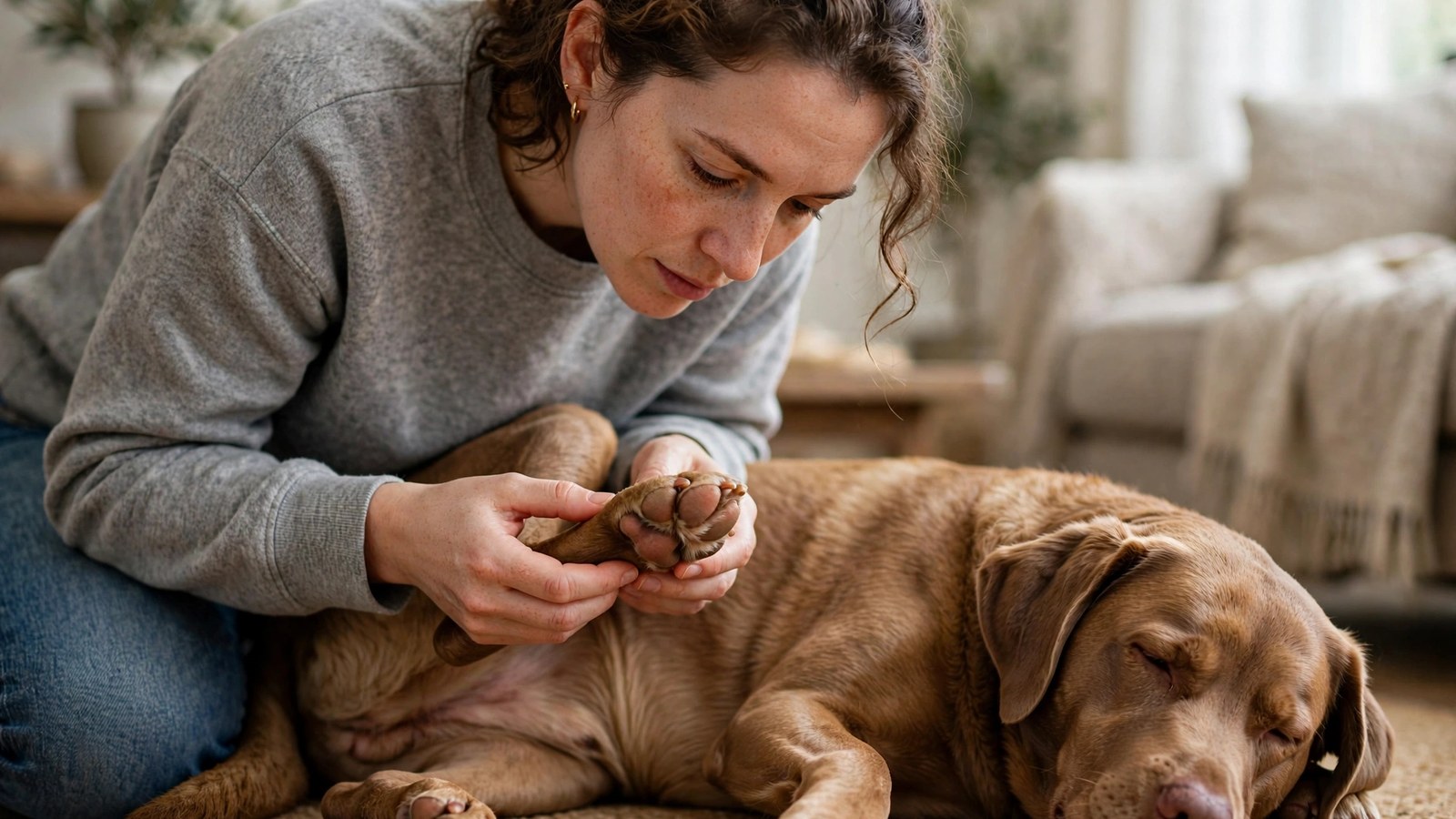
- Check the paw gently for cuts, swelling, an object between the toes, a broken nail, and tenderness. Stop if your dog reacts strongly.
- Look at the leg as a whole. Note swelling, an enlarged joint, or a limb that looks bent or deformed. Do not press firmly along a painful leg or move a joint through its range.
- Watch how much weight your dog puts on the leg, whether the limp is worse after rest or after activity, and note other changes such as appetite, energy, or withdrawn behavior.
- Rest and monitor closely only when the limp is mild, your dog bears weight, is otherwise normal, and the limp is clearly improving. Cornell advises that if a dog has limped for more than a day or two, or pain is severe, sudden, or worsening, you should not wait.
Do not give human pain medication. Cornell University Veterinary Specialists states the rule plainly: dogs and cats cannot take the same pain relieving pills as humans. It reports that ingestion of ibuprofen, acetaminophen, or aspirin can cause severe vomiting, gastric ulcers, kidney failure, and liver failure, and can be fatal without treatment. Naproxen carries the same kind of risk. Any pain medicine must be prescribed for your dog. Do not use medicine left over from another pet, and do not try to splint a leg yourself.
When to See a Veterinarian Right Away
Contact a veterinarian, or an emergency clinic if your regular clinic is closed, immediately if your dog shows any of the following:
- Complete refusal to put the leg down or bear weight, or sudden severe lameness
- A limb that appears bent at an abnormal angle, dangling, shortened, or deformed
- Moderate to severe swelling, an obviously enlarged joint, or a limb that feels hot
- Bleeding, an open wound, or a suspected fracture or dislocation after trauma
- Yelping or crying out, shaking, hiding, or a dog that will not move at all
- Rear leg weakness, stumbling, dragging a leg or the toes, knuckling over, or sudden weakness in both rear legs
- Limping with fever, loss of appetite, extreme tiredness, or swollen and painful joints, especially if the limp shifts between legs
- A limp that has not improved after a day or two of rest, or a limp that keeps returning
- A limping puppy, or a new or worsening limp in a senior dog
- A dog that suddenly cannot stand, collapses, or cannot move its back legs
For a mild limp that is clearly improving, a call for guidance is still wise, because the cause cannot be confirmed at home.
What to Expect at the Veterinary Visit
Cornell describes this visit as a structured search for the source of pain. It begins with history: when the limping started, whether it came on suddenly or gradually, whether it is improving, worsening, or shifting between legs, difficulty with stairs or exercise, recent trauma, and any medications given. Your home video and notes are directly useful here.
The examination covers two systems: the musculoskeletal system of bones, joints, muscles, tendons, and ligaments, and the neurologic system of nerves and spinal cord. Your veterinarian will observe how your dog walks and trots, watching weight bearing, and will feel the bones, joints, and soft tissue for swelling, pain, instability, reduced range of motion, and muscle wasting, as Merck describes.
When the exam does not settle the cause, testing follows. Cornell lists X rays, advanced imaging such as CT or MRI, bloodwork, and joint fluid analysis, with specialist referral in some cases. Merck notes that X rays and ultrasonography are used most often. Blood and tick testing become relevant when the pattern suggests tick borne disease.
Treatment depends entirely on the cause. Rest, pain control with veterinary prescribed medication, and weight management are common starting points. Cornell lists physical rehabilitation and, when indicated, surgery or referral among the treatment paths, and Merck notes that surgical stabilization is frequently required for CCL disease. Chronic joint disease is usually managed over time rather than cured.
Helping a Limping Dog at Home
While you wait for veterinary guidance, safe home care is narrow and simple: rest and monitoring. Keep your dog calm, allow short leash walks for bathroom breaks only, and stop running, jumping, stairs, rough play, and off leash activity. Provide a comfortable, non slip resting area, and keep food and water within easy reach.
Do not massage a swollen or painful joint forcefully, do not press on a leg you suspect is fractured, and do not start any leftover pet medicine or home remedy without veterinary advice. Keep a simple record of weight bearing, appetite, and whether the limp is better or worse each day.
For chronic stiffness from osteoarthritis, longer term support is a veterinary guided plan, not a home experiment. Cornell includes weight control, low impact activities such as leash walks or swimming, and non slip rugs and ramps among the lifestyle measures for OA. Weight matters because obesity adds force on joints and fat cells produce inflammatory mediators that worsen OA progression.
Frequently Asked Questions
Why is my dog limping but not in pain?
A limping dog may not look painful in the ways owners expect. Dogs often keep eating, wagging, and engaging while favoring an injured leg, and some causes are structural rather than sharply painful in the moment, such as an unstable knee or a slipping kneecap. A limp itself shows that something interferes with normal use of the limb.
Why is my dog limping but not crying?
Whining or yelping is only one way dogs show pain, and many dogs limp quietly even with significant discomfort. Withdrawal, reluctance to move, reduced appetite, irritability, or a behavior change can be the only signals. Cornell lists sudden behavior changes among the signs of osteoarthritis. The absence of crying should never be taken as proof that a cause is minor.
Why does my dog limp when he gets up, then seem fine?
Stiffness after rest that eases with movement is a classic pattern of osteoarthritis. Cornell lists stiffness, difficulty getting up, and difficulty with stairs among the signs of OA, and Merck notes that hip dysplasia lameness, once arthritis develops, is often worse shortly after rest. If the pattern repeats daily, raise it with your veterinarian, because earlier OA management gives a better long term outcome.
Why is my dog limping all of a sudden?
Sudden limping usually points to something acute: a paw injury, a muscle strain, an insect sting, or a cruciate ligament injury from an awkward jump or twist. Merck confirms that traumatic CCL rupture follows overload of the ligament, and Cornell notes sudden inability to bear weight as a presentation of a torn ligament. Sudden limping that does not settle within hours warrants a call the same day.
Why is my dog limping on and off?
Intermittent limping fits several causes: a luxating patella that slips in and out, panosteitis in a growing puppy, early osteoarthritis that flares with activity, or a partial ligament tear. Merck notes that partial CCL ruptures can be harder to recognize than complete ruptures, which is one reason an on and off limp can hide a progressing problem. A limp that keeps returning should not be ignored.
Why is my puppy limping?
Puppies limp for many of the same reasons as adults, plus developmental conditions adults do not get. Cornell lists hip dysplasia as the most common cause of hind limb lameness in young dogs, panosteitis and hypertrophic osteodystrophy as growing pain conditions, luxating patella, and elbow dysplasia and osteochondrosis for the front legs. A limping puppy should be examined promptly, because growth plate injuries and developmental joint disease are easier to address early.
Why is my old dog limping?
Osteoarthritis is a leading consideration in senior dogs, often with stiffness after rest that eases with movement. Cornell lists torn cranial cruciate ligament as the most common cause of hind limb lameness in older dogs, with hip, elbow, and shoulder arthritis also common, and bone cancer and spinal disease among the other possibilities. A new or worsening limp in an older dog deserves examination rather than being written off as old age.
Can Lyme disease cause my dog to limp?
Yes. Merck lists lameness that shifts from one leg to another among the common signs of Lyme disease, along with fever, loss of appetite, swollen or painful joints, swollen lymph nodes, and lack of energy. A veterinarian may suspect it in a dog with recent lameness, a mild fever, and tick exposure risk, and antibody testing can support the diagnosis.
Is it OK to walk a limping dog?
Short, controlled leash walks for bathroom breaks are the safe rule while a limp is unexplained. Running, jumping, and off leash activity should stop until the cause is known, because activity can worsen a ligament injury or an unstable joint. For a dog under veterinary care for osteoarthritis, Cornell instead includes regular low impact activity in OA management.
What can cause a dog to limp on a back leg?
Common back leg possibilities include cruciate ligament disease, hip dysplasia or hip arthritis, luxating patella, muscle strains, paw injuries, panosteitis in a growing dog, and spinal disease. Sudden onset after activity fits injury or a ligament problem, gradual onset fits hip disease or arthritis, intermittent skipping fits a luxating patella, and dragging or weakness in both rear legs fits a spinal problem and needs urgent care.
Keep reading: Flea and Tick Treatment and Prevention for Pets: Safe Options for Kittens, Cats, and Dogs
Sources & references
- Cornell University College of Veterinary Medicine, Riney Canine Health Center. What to Expect When Taking Your Limping Dog to the Veterinarian. Guidance opened and read in full for this adaptation: limping means something painful is interfering with normal use of a limb; lameness ranges from mild stiffness to complete inability to bear weight and may involve muscles, joints, bones, or the nervous system; dogs shift weight away from painful limbs; home videos are extremely helpful because some dogs move normally at the clinic; common causes by age and limb, including torn cranial cruciate ligament as the most common cause of hind limb lameness in older dogs, hip dysplasia in young dogs, elbow dysplasia, panosteitis, luxating patella, bone cancer, and spinal disease; if a dog has been limping for more than a day or two, or pain is severe, sudden, or worsening, do not wait. https://www.vet.cornell.edu/departments-centers-and-institutes/riney-canine-health-center/canine-health-information/what-to-expect-when-taking-your-limping-dog-to-the-veterinarian
- Merck Veterinary Manual, Pet Owner Version (MSD Veterinary Manual). Lameness in Dogs. Guidance opened and read in full for this adaptation: lameness is a sign of illness, not a specific disease, and may indicate a disorder in the musculoskeletal system; the lameness examination observes the dog resting, getting up, and walking, notes one limb or several, head raising with forelimb lameness and head dropping with hindlimb lameness, and palpation for swelling, pain, instability, reduced range of motion, and muscle wasting; X rays and ultrasonography are the imaging techniques used most often; pain relief must be prescribed by a veterinarian. https://www.msdvetmanual.com/dog-owners/bone-joint-and-muscle-disorders-of-dogs/lameness-in-dogs
- Merck Veterinary Manual. Joint Trauma in Dogs and Cats, Cranial Cruciate Ligament Disease section. Guidance opened and read for this adaptation: CCL disease is the leading cause of hindlimb lameness in dogs and can result from trauma or progressive ligament degeneration; partial ruptures can be harder to recognize; radiographic evaluation is essential to rule out causes such as neoplasia or fracture; surgical treatment is frequently required to stabilize the stifle; joint fracture signs include acute lameness, pain, localized swelling, and joint instability, with deformity in some cases. https://www.merckvetmanual.com/musculoskeletal-system/arthropathies-and-related-disorders-in-small-animals/joint-trauma-in-dogs-and-cats
- Cornell University College of Veterinary Medicine, Riney Canine Health Center. Osteoarthritis. Guidance opened and read in full for this adaptation: osteoarthritis is a chronic, progressive joint disease in which cartilage is lost and joint fluid decreases, causing pain, inflammation, and stiffness; it can develop at any age and is linked to hip dysplasia, elbow dysplasia, patella luxation, cruciate ligament damage, previous fractures, repetitive high impact activity, and obesity, which adds joint force and inflammatory mediators; signs include stiffness, lameness, difficulty with stairs and getting up, reduced activity, muscle wasting, and behavior changes; management includes weight control, low impact activity, non slip rugs and ramps, physical rehabilitation, and prescribed pain management; earlier diagnosis gives a better long term outcome. https://www.vet.cornell.edu/departments-centers-and-institutes/riney-canine-health-center/canine-health-topics/osteoarthritis
- Cornell University College of Veterinary Medicine, Riney Canine Health Center. Canine Hip Dysplasia. Guidance opened and read in full for this adaptation: hip dysplasia is a common inherited condition in which the hip forms incorrectly, causing laxity that leads over time to arthritis, pain, and discomfort, and is common in medium and large breeds; signs include difficulty getting up, bunny hopping when running, limping or stiffness in the back legs, reduced activity, hip swaying, and shifting weight to the front legs; maintaining a healthy body weight and regular low impact exercise are part of management. https://www.vet.cornell.edu/departments-centers-and-institutes/riney-canine-health-center/canine-health-topics/canine-hip-dysplasia-chd
- Cornell University College of Veterinary Medicine, Riney Canine Health Center. Elbow Dysplasia. Guidance opened and read in full for this adaptation: elbow dysplasia is the second most common cause of elbow lameness in dogs, behind osteoarthritis; affected dogs are generally lame after exercise and do not recover fully with rest alone; a shortened stride and reduced joint range of motion can be the visible clues in a stoic dog; early intervention is best, and treatment aims to slow arthritis progression. https://www.vet.cornell.edu/departments-centers-and-institutes/riney-canine-health-center/canine-health-topics/elbow-dysplasia
- Cornell University College of Veterinary Medicine, Riney Canine Health Center. Panosteitis in Dogs. Guidance opened and read in full for this adaptation: panosteitis is a painful but self limiting inflammatory bone condition, sometimes called growing pains, that primarily affects large and giant breed dogs between 5 and 16 months of age and can occur up to two years old; it causes sudden lameness in one leg or shifting between legs; episodes typically last two to three weeks and may recur until skeletal maturity; it can resemble hip or elbow dysplasia, osteochondritis dissecans, hypertrophic osteodystrophy, or immune mediated joint disease, so added testing may be recommended when signs are severe, atypical, or not improving. https://www.vet.cornell.edu/departments-centers-and-institutes/riney-canine-health-center/canine-health-topics/panosteitis-dogs
- Merck Veterinary Manual, Pet Owner Version. Lyme Disease (Lyme Borreliosis) in Dogs. Guidance opened and read in full for this adaptation: Lyme disease is caused by Borrelia burgdorferi bacteria spread by infected ticks, most often the deer tick; many infected animals show no signs; common signs in dogs include fever, loss of appetite, swollen or painful joints, lameness that shifts from one leg to another, swollen lymph nodes, and lack of energy; untreated disease can damage the kidneys, nervous system, and heart, and kidney involvement is one of the most serious forms; a veterinarian may suspect Lyme disease in a dog with recent lameness, mild fever, and tick exposure risk; antibody tests become helpful about four to six weeks after infection starts; tick control and prompt tick removal reduce risk. https://www.merckvetmanual.com/dog-owners/disorders-affecting-multiple-body-systems-of-dogs/lyme-disease-lyme-borreliosis-in-dogs?query&
- Cornell University Veterinary Specialists. Human Pain Relievers Are Toxic to Dogs and Cats. Guidance opened and read in full for this adaptation: dogs and cats cannot take the same pain relieving pills as humans; ingestion of ibuprofen, acetaminophen, or aspirin can cause severe vomiting, gastric ulcers, kidney failure, and liver failure, and can be fatal without medical treatment; owners should never give pills to a dog or cat without veterinary direction, and a dog in pain should be brought to a veterinarian, who can prescribe safely. https://www.cuvs.org/blog/human_pain_relievers_are_toxic_dogs_and_cats


