Short answer
- Repeated paw licking is a symptom, not a diagnosis. Occasional licking is normal grooming. Licking that is persistent, intense, or paired with redness, swelling, odor, hair loss, sores, or limping needs attention.
- Allergies are a leading cause. Environmental allergens such as pollen, mold, and dust mites can make the feet itch, and the paws are one of the areas most often affected in allergic skin disease in dogs. Food related itching is another possibility a veterinarian may explore.
- One paw and several paws point in different directions. A sudden focus on one paw often points to a local problem such as a cut, sting, splinter, broken nail, or burn. Itching across several paws points more toward allergy, infection, or a wider skin condition.
- Yeast is an overgrowth, not a first cause by itself. A yeast called Malassezia normally lives on dog skin in small numbers. It multiplies when the skin barrier is damaged or the skin stays warm and moist, often alongside allergy. Odor and appearance can suggest it, but only a veterinary test such as skin cytology can confirm it.
- Hot pavement can burn pads quickly. Asphalt holds heat and can be far hotter than the air. Press the back of your hand to the surface for seven seconds. If you cannot keep it there, it is too hot for your dog.
- Burn first aid has limits. Move the dog off the hot surface, cool the paw with cool running water, protect it loosely, and stop the dog licking it. Blistering, peeling, raw, pale, or dark pads need prompt veterinary care, not home treatment.
- Pain and anxiety also cause licking. Dogs may lick near a sore joint, and licking that began with itch or pain can become a reinforced habit. A behavior label should come only after medical causes are ruled out.
- See a veterinarian when licking persists. Raw skin, swelling, discharge, a swelling between the toes, refusal to bear weight, bleeding that will not stop, or any suspected burn with blistering means the dog should be seen promptly.
Introduction
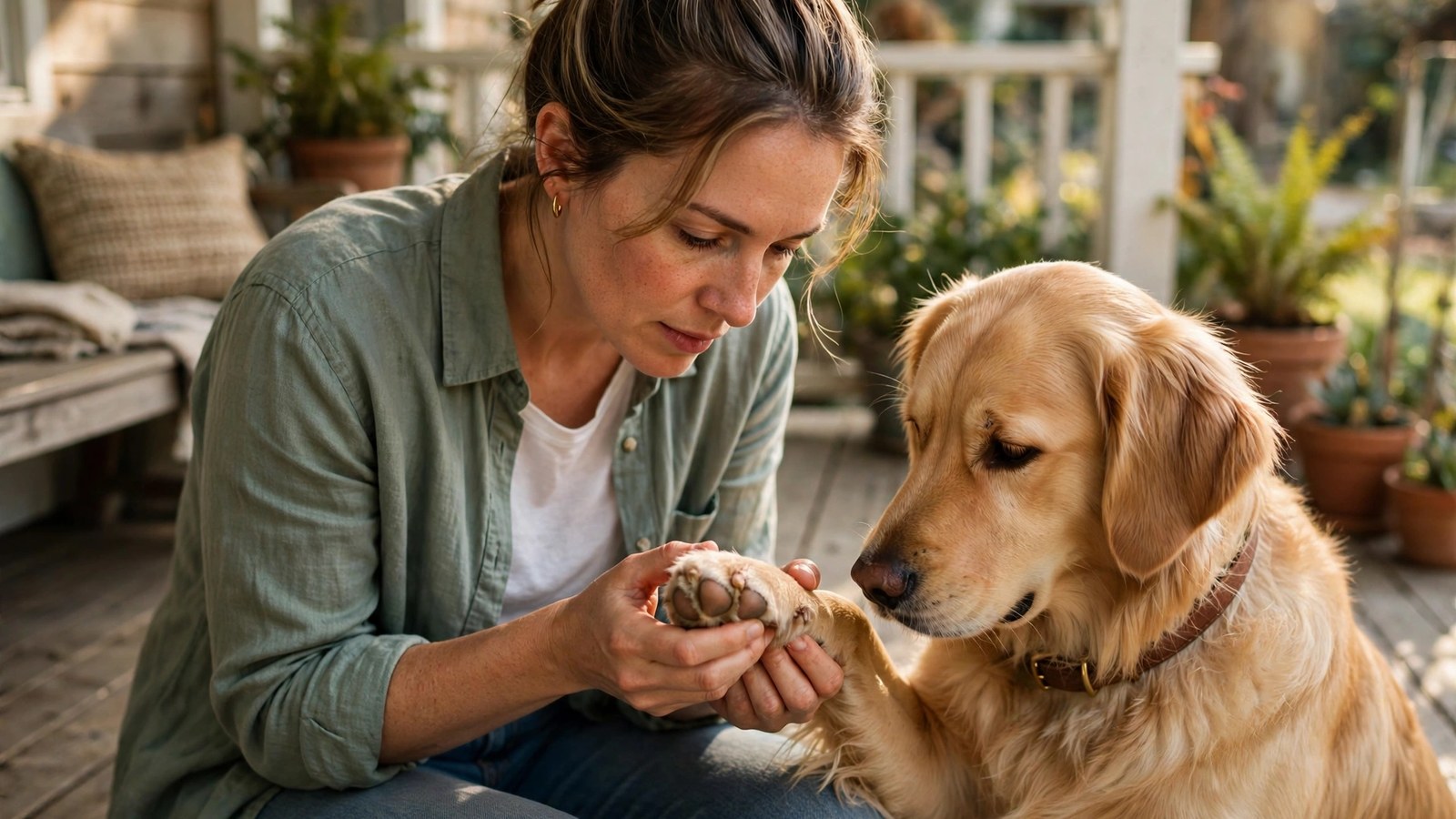
A dog that keeps licking its paws is giving you information, but not a diagnosis. A brief lick after a walk, or during ordinary grooming, is normal. Licking that repeats through the day, wakes the dog at night, leaves the fur stained, or comes with redness, swelling, odor, sores, or a limp is a sign that something is driving it. That driver may sit in the paw itself, such as a cut, a broken nail, a burn, or something lodged between the toes. It may sit in the skin, such as an allergy or an infection. It may sit higher up the leg, in a painful joint. Or it may be a habit that took hold after an earlier problem has already healed.
This article sorts those possibilities in plain language. It explains how the pattern of licking helps narrow the cause, why allergies are such a common driver, what yeast overgrowth on the paws looks like and why it cannot be confirmed by appearance alone, how hot pavement burns pads and what first aid can and cannot do, and which swellings between the toes need prompt attention. It also sets out a gentle home check and the warning signs that mean a veterinarian, not home care, is the right next step.
This article gives general information only. It does not diagnose any individual dog, and it does not prescribe treatment, medication, or doses for any individual dog. Persistent paw licking is a sign that needs a veterinary diagnosis, because the same outward behavior can come from very different causes that need very different responses.
Why Dogs Lick Their Paws
Licking is one of the few tools a dog has for dealing with itch, pain, and irritation, so many problems funnel into the same behavior. The useful first question is not how to stop the licking, but what pattern it follows: which paws, when it started, whether the skin looks changed, and what else is happening in the body.
A sudden focus on a single paw, especially after a walk, often points to something local: a small cut, a torn nail, a thorn or splinter, a sting, a grass seed in the webbing, or a burn. The dog may also limp or pull away when that paw is handled.
Licking across several paws, with scratching elsewhere, face rubbing, or ear problems, points more toward a body wide cause such as allergy or skin infection. A seasonal rhythm suggests an environmental trigger. Licking all year suggests a trigger present all year, such as dust mites, a food related problem, or a long term skin condition.
Licking can also be aimed at pain that is not in the paw at all. Dogs often lick the skin over or near a sore area, so a dog licking a front leg may be responding to discomfort in a joint or muscle in that leg rather than to a skin problem on the surface. Rear paw licking is not a separate category of disease. It deserves the same check as front paw licking: the skin between the toes, the pads, the nails, any odor, and whether the dog itches elsewhere.
Finally, licking changes the paw itself. Saliva keeps the skin between the toes damp, and repeated friction breaks the skin barrier. Damaged, moist skin is easier for yeast and bacteria to overgrow in, which makes the paw itch more and drives more licking. This cycle explains why a small problem can still be active months later, and why simply blocking the licking rarely settles it.
Allergies: A Common Reason for Paw Licking
When allergies drive paw licking, itch is the engine. In atopic dermatitis, the allergic skin disease linked to environmental allergens, the skin barrier is impaired and allergens such as pollens, molds, and dust mites provoke an inflammatory response. Veterinary references list the paws among the areas most frequently affected, along with the face, ears, abdomen, and the flexing surfaces of the front legs. Dogs commonly respond by licking and chewing their feet, rubbing their faces, and scratching. Cornell University College of Veterinary Medicine notes that atopic dermatitis may affect as much as 10 to 15 percent of the dog population, that signs often begin between six months and three years of age, and that the itch is seasonal in many cases but can progress to a year round problem.
The skin changes follow the behavior. At first the skin may look normal even though the dog is clearly itchy. Over time there can be hair loss, redness, darker and thickened skin, and brown staining of the fur where saliva has marked it. Secondary infections are a regular part of the picture: Merck Veterinary Manual notes that secondary skin and ear infections with Staphylococcus bacteria and Malassezia yeast are common in atopic dogs and often make the signs worse. An itchy dog may therefore improve only partly when an infection is treated and then relapse, because the allergy underneath is still active.
Food related itching tends to run through the year rather than in one season, and it can come with ear inflammation, recurring skin infections, or digestive signs such as vomiting or loose stools. Paw licking alone cannot confirm either kind of allergy, and there is no single test that diagnoses atopic dermatitis. Merck Veterinary Manual describes the diagnosis as resting on history, signs, and the exclusion of other itchy skin diseases, and notes that allergy testing on its own is not diagnostic; testing is mainly used to identify allergens for allergen specific immunotherapy, when a veterinarian judges that appropriate. If a food cause is suspected, a veterinarian may recommend a strict elimination diet trial using a prescribed food. Extras such as table scraps, treats, chews, and flavored medications can make the result impossible to read, so the trial only works when followed exactly as directed.
Home care for the allergic paw is supportive, not curative. Rinsing with lukewarm water after walks, or after contact with lawn treatments, fertilizers, cleaning products, or deicing products, removes surface irritants, and drying between the toes matters because trapped moisture feeds other problems. Harsh soaps, alcohol, hydrogen peroxide, and human skin products should not be used unless a veterinarian advises them for that dog. A recovery collar can protect skin a dog is chewing raw while you wait to be seen. Home care cannot establish which allergy is present, and a dog whose paws stay itchy needs the workup, not a stronger home remedy.
Pain, Anxiety, and the Licking Habit
Not all paw licking is itch. Pain is a quieter driver, easy to miss because the paw may look normal. A dog with a sore toe joint, an arthritic change higher in the leg, a muscle strain, or a nail bed problem may lick steadily at the nearest reachable skin. Clues include a limp, stiffness after rest, reluctance to jump, licking centered on one leg, and guarding that leg. Pain driven licking is often misread as a behavior problem; a leg that is licked and favored needs a physical examination.
Anxiety and habit form the third strand. Licking can begin as a response to itch, pain, or a small injury and then outlast its trigger. Licking and chewing can start as a soothing response to itch and, over time, become reinforced habits that persist, evolving into a coping mechanism in which cause and effect are hard to separate. Owners often assume licking comes from boredom or anxiety when it is in fact a sign of itchy skin disease, which is why a full skin workup matters for a dog showing new or worsening self directed behavior.
Stress, boredom, and changes at home can contribute, and a dog that mainly licks when alone or resting may have a behavioral component. But labeling the problem behavioral before medical causes are excluded risks leaving an allergy, an infection, or a painful joint untreated. The safe sequence is medical causes first; then, if the skin and legs check out, a veterinarian can help you address routine, exercise, enrichment, and anxiety in the same plan.
Yeast on the Paws: Malassezia Overgrowth
Yeast is a normal resident of dog skin. The yeast most often involved is Malassezia pachydermatis, which lives in small numbers on healthy skin, including the skin of the feet and between the toes. Problems begin when conditions let it multiply. Warmth, trapped moisture, excess skin oil, and a damaged skin barrier all favor overgrowth, and the spaces between the toes provide warmth and moisture in one place. Dogs that lick often, swim often, or live in humid conditions give yeast more opportunity, and licking itself adds the moisture and friction that help it along. In practice, yeast overgrowth is usually secondary. Something else, very often an allergy, has disturbed the skin first, and the yeast has taken advantage.
Signs that suggest yeast overgrowth include redness and swelling between the toes, greasy feeling skin, scaling or thickened skin, dark discoloration, and a reddish brown saliva stain on light fur. Many owners notice a distinctive musty odor. The dog may chew at the paws or seem sore when walking. These signs are useful but not proof: they overlap with bacterial infection, mites, contact irritation, and allergy, and several can be present in the same paw.
That overlap is why diagnosis needs a test, not an opinion based on smell or color. A veterinarian can take a sample from the skin surface and examine it under a microscope, a process called skin cytology, which shows whether yeast, bacteria, or both are present in increased numbers. Merck Veterinary Manual lists cytological evaluation among the important diagnostics for inflamed skin between the toes, and notes that a commonly overlooked concurrent infection is Malassezia. Cytology also protects against treating for yeast when the real driver is bacteria, mites, allergy, or pain.
Treatment decisions belong to the veterinarian who has seen the test results. Depending on what is found, a veterinarian may prescribe topical antifungal treatment, medicated bathing, or, for severe or recurring cases, oral antifungal medication, and will also want to address the underlying condition, since treating yeast alone in an allergic dog tends to buy only a short remission. This article does not recommend specific products or doses. Owners can safely keep paws clean and dry, dry between the toes after wet walks and swimming, keep long fur around the paws trimmed, and use a recovery collar if the dog is breaking the skin. Do not start an antifungal cream, a human product, or a home remedy on your own. The wrong product can irritate inflamed skin, and anything put on a paw is likely to be licked and swallowed.
Hot Pavement and Burned Pads
A dog’s pads look tough, and for ordinary ground they are. They are not protection against a surface baking in the sun. Asphalt absorbs and holds solar heat, so its surface can run far hotter than the air, and it can stay hot after the sun has moved off it. Concrete in full sun, metal covers, and sand can also injure skin on contact. A dog cannot step off the route you choose and may keep walking through discomfort, especially if it is excited or distracted. The first signs may be subtle: shortening steps, seeking grass at the edge of the path, slowing, or sitting down.
The simplest safeguard is a test you do with your own skin. Before a warm weather walk, press the back of your hand flat against the pavement and hold it there for seven seconds. If you have to pull away before the count ends, the surface is too hot for your dog’s pads. Standard warm weather veterinary guidance for owners makes the same point: avoid hot surfaces such as asphalt, walk during the cooler hours rather than the hottest part of the day, and remember that a dog on hot ground has no way to step off it. Grass, dirt, and shaded paths stay cooler than open asphalt. Early morning walks reduce exposure. Evening walks help too, but pavement can hold the day’s heat into the evening, so test it rather than assuming it has cooled.
Signs of a pad burn include limping, sitting down or refusing to continue, licking at the pads, and redness or swelling on the pad surface. More serious burns show blistering, peeling, pads that look pale, dark, or blackened, or skin that has come away leaving a raw surface. Mild burns may show only redness, slight swelling, and a mild limp, which is one reason burns are easy to underestimate at first. Puppies, senior dogs, dogs with thin pads, and dogs with existing skin disease may be hurt more easily and heal more slowly.
First aid for a suspected pad burn is deliberately narrow, and its limits matter as much as its steps. Move the dog off the hot surface at once, onto grass, shade, or indoors. Cool the paw under cool running water; cool means cool, not ice cold, and ice should not be applied to burned skin. Pat dry gently without scrubbing. Do not apply butter, cooking oil, hydrogen peroxide, rubbing alcohol, or human burn creams, especially products containing lidocaine or benzocaine, which can be harmful to a dog that licks them off. Apply no product your veterinarian has not approved. If a veterinarian advises protecting the paw, cover it loosely and use a recovery collar to stop licking. Watch the paw afterward: increasing redness, swelling, discharge, or odor can mean the injury is deeper than it first looked or that infection is developing.
Some burns should not be managed at home beyond those first minutes. Blistering, an open or raw wound, peeling, pale or dark tissue, refusal to bear weight, or pain that is not settling are reasons to be seen promptly, the same day. First aid cools and protects; it does not grade the depth of a burn, and damaged pads are open to infection with every step.
Swellings Between the Toes: Interdigital Furuncles
Owners often meet this problem under a misleading name. Painful swellings in the webbing between the toes are commonly called interdigital cysts. Merck Veterinary Manual explains that these lesions, called interdigital furuncles, are usually not true cysts. They are areas of deep bacterial skin infection and inflammation, appearing as painful single or multiple nodules in the webs between the toes, typically one to two centimeters across, reddish purple and shiny. They may rupture and leak bloody material, and affected dogs are commonly lame and lick at the lesions.
The mechanism is mechanical as much as infectious. Short, bristly hairs on the webbing can be forced backward into the hair follicles as the dog walks, and hair in the deeper skin sets off a foreign body reaction that keeps the infection going. Breeds with short bristly webbing hair or prominent webbing, including Chinese Shar Peis, Labrador Retrievers, and English Bulldogs, are predisposed. A splinter, burr, or grass awn can trigger a similar lesion; those cases are usually single, often on a front foot, and less likely to recur. Merck also identifies atopic dermatitis as a common cause of recurrent cases, because the licking and itching of allergic skin disease traumatize the follicles. Recurrence is information: furuncles that keep coming back despite proper treatment can signal an underlying disease such as allergy, demodicosis, or a hormonal condition.
Diagnosis is often based on the signs, supported by tests. Merck lists cytological evaluation, bacterial culture, hair examination for mites, and, where needed, biopsy among the useful steps. Treatment is veterinary treatment, commonly care at the site combined, for severe or multiple lesions, with systemic medication over weeks, because these infections sit deep. Do not squeeze, lance, or dig at a swelling between the toes, and do not assume a recurring swelling is a harmless cyst. A painful nodule, a draining spot, or lameness centered on one foot should be examined.
A Gentle Home Check
A home check cannot diagnose, but it gives your veterinarian a better history and catches problems that need prompt care. Work gently, and stop if your dog is painful or resists. A painful paw can make even a gentle dog snap, so do not persist with a distressed dog.
Look at the tops and bottoms of all four paws, not only the one being licked. Part the fur and look between the toes for redness, swelling, discharge, a nodule, or something lodged in the webbing. Check each nail for a break or swelling at its base, and the pads for cuts, cracks, blistering, peeling, or color change. Note any odor, and whether it is new. Watch the dog walk a few steps and note any limp.
While you check, build the short history your veterinarian will ask for. Which paws are involved? When did the licking start? Is it seasonal, or tied to particular walks, surfaces, or times of day? Does the dog also scratch, rub its face, or have ear trouble or a rash on the belly? Has anything new entered the routine, such as a floor cleaner, a lawn treatment, or deicing salt? Has the dog been swimming, or walking on hot pavement or sand? Write the answers down. Pattern is often the most useful evidence an owner can bring.
Set clear limits. Do not dig into the skin, extract anything deeply embedded, cut away skin, squeeze a swelling, or probe a wound. A loose surface splinter is different from an object driven into tissue. Anything deep, very painful, or bleeding that will not stop belongs to a veterinarian.
Everyday Paw Care and Prevention
Prevention cannot remove every cause, but steady basic care removes several common ones and makes the rest easier to spot. Keep nails trimmed, because overlong nails change how the foot lands and can crack or tear. Keep fur between the pads trimmed on long coated dogs so mud, burrs, and moisture do not pack into the webbing. Rinse paws after walks on treated lawns, salted paths, or dirty ground, and dry them, including between the toes.
Match the walk to the conditions. In hot weather, test the pavement, choose grass, dirt, or shade, walk in the cooler hours, and carry water for the dog as well as yourself. In cold weather, watch for ice balls between the toes and for irritation from deicing products, and rinse after salted routes. After any walk, a brief look at the paws catches most thorns, seeds, cuts, and early redness while they are still small. Dogs that swim or are bathed often need their feet dried properly afterward, since feet that stay damp are friendlier to yeast.
Know your own dog’s baseline. A change from that dog’s normal is more meaningful than a comparison with another dog, and a monthly paw check done when nothing is wrong makes a new swelling, stain, odor, or area of hair loss stand out quickly.
When to Call a Veterinarian
Call a veterinarian promptly if licking continues for more than a few days, keeps coming back, or disturbs sleep. Call if it causes or accompanies redness, swelling, odor, discharge, hair loss, sores, or bleeding, or if there is a damaged nail, a swelling between the toes, or any sign of pain. A dog chewing its paws raw has already broken the skin barrier, so infection becomes more likely and home care alone is unlikely to be enough.
Seek prompt, same day care if your dog cannot put weight on a leg, a paw swells rapidly, bleeding will not stop, you suspect a burn or a deep puncture, a foreign object is deeply embedded, or a pad is blistered, peeling, raw, pale, or dark. Seek emergency care for facial swelling, widespread hives, difficulty breathing, collapse, or repeated vomiting after a possible sting or exposure. If you are unsure whether it is urgent, call and describe it.
Frequently Asked Questions
Why does my dog keep licking its paws?
The most common reasons are allergies, yeast or bacterial infection of the skin, a local injury or foreign object, parasites, irritation from surfaces or household products, pain in the paw or higher in the leg, and stress or a habit that formed after an earlier problem. Which paws are involved, when the licking happens, and other signs such as ear problems, odor, or limping help a veterinarian narrow the cause. Because the same behavior has so many possible drivers, persistent licking needs an examination rather than a guess.
My dog is chewing its paws raw. What should I do first?
Protect the skin from further damage with a properly fitted recovery collar if your dog will tolerate one, do a gentle visual check without digging or squeezing, and rinse and dry the paws if they may have contacted an irritant. Then call your veterinarian. Chewing until the skin is raw means the barrier is already broken, infection becomes more likely, and home care alone is unlikely to settle it.
Can allergies really make a dog lick its paws?
Yes. The paws are among the areas most frequently affected in canine atopic dermatitis, the allergic skin disease linked to environmental allergens such as pollens, molds, and dust mites, and affected dogs commonly lick and chew their feet. Food related itching can produce similar signs through the year. Seasonal licking of several paws suggests an environmental trigger, while year round itching can reflect an indoor allergen, a food problem, or a chronic skin condition. Only a veterinary examination, and testing or a diet trial where indicated, can separate those causes.
How can I tell a yeast infection from a burn?
The histories usually differ. A yeast problem more often develops gradually, with redness between the toes, greasy or thickened skin, discoloration, and a musty odor, often after moisture, allergies, or repeated licking. A burn more often follows a walk on hot ground and brings limping, pad redness or blistering, and clear pain when the pads are pressed. Appearance alone cannot confirm yeast in any case. That confirmation comes from a veterinary test such as skin cytology. When both explanations could fit, or when a paw is blistered, open, or very painful, ask a veterinarian rather than guessing.
Is paw licking ever an emergency?
Yes. Seek emergency care for inability to bear weight, rapid swelling, bleeding that will not stop, a suspected burn with blistering or dark tissue, a deep puncture, a deeply embedded object, facial swelling, difficulty breathing, collapse, or repeated vomiting after a sting or exposure. Those signs point to injury, deep infection, or a serious allergic reaction, none of which should wait.
Why does the yeast keep coming back after treatment?
Usually because the condition that allowed the overgrowth is still present. Yeast multiplies on skin whose barrier has been disturbed, and allergy is a frequent underlying disturbance. If the allergy, moisture, or other skin problem continues, the yeast population can rebuild once treatment stops. Recurring yeast is a reason to ask a veterinarian about the underlying cause, not simply to repeat the same treatment.
Keep reading: Dog Skin Allergies: Home Remedies That May Soothe Itching and When to See a Veterinarian
Keep reading: Why Is My Dog Limping? Causes, Signs, and When to Act
Keep reading: Dog Injuries and Emergencies: Heatstroke, Stings, Snake Bites, Knee Injuries, and Sunburn
Sources & references
- Merck Veterinary Manual. Atopic Dermatitis in Dogs. Professional reference on the causes, signs, diagnosis, and management of allergic skin disease in dogs, including the paws as a frequently affected area and secondary Staphylococcus and Malassezia infections.
- Merck Veterinary Manual. Interdigital Furunculosis in Dogs. Professional reference on painful swellings between the toes, their causes, diagnosis including cytological evaluation, and the role of allergic skin disease in recurrent cases.
- Cornell University College of Veterinary Medicine, Riney Canine Health Center. Atopic dermatitis (atopy). Owner facing reference on environmental allergy in dogs, its signs including licking and chewing the feet, and how the condition is diagnosed and managed.


