Short answer
- Betel nut is the seed of the areca palm, Areca catechu. Chewed as part of a betel quid, it leaves a distinctive reddish brown to dark brown or near black stain on teeth, turns saliva red, and, with long term use, is often found alongside heavy tartar buildup, gum disease, worn teeth, and damaged soft tissue in the mouth. Archaeologists have used that visible staining for decades as a sign of betel chewing in ancient skeletons from Southeast Asia and the Pacific. Newer laboratory work goes further: a 2025 study of dental calculus, the hardened plaque on teeth, from a roughly 4,000 year old burial at Nong Ratchawat in central Thailand found the betel compounds arecoline and arecaidine in one person's molar, even though that person's teeth showed no visible stain. The study's authors describe it as the earliest direct biomolecular evidence of betel nut use in Southeast Asia. The historical interest does not soften the modern health evidence. The International Agency for Research on Cancer (IARC), part of the World Health Organization, classifies areca nut itself, betel quid without tobacco, and betel quid with tobacco all as Group 1 carcinogens, meaning carcinogenic to humans. Chewing is an established cause of oral cancer and of oral submucous fibrosis, a scarring, potentially malignant condition that can stiffen the mouth and limit opening. Removing tobacco from the quid does not make it safe. This article is general historical and health information only. It is not a guide to using betel nut, and it is not personal medical or dental advice. If you chew betel nut, or have chewed it in the past, the practical steps are to stop, to tell your dentist and doctor about the habit, and to ask about oral screening, especially if you have a sore that does not heal, a white or red patch, difficulty opening your mouth, or persistent pain.
What Betel Nut Is, and What a Betel Quid Contains
The naming is confusing, so it helps to separate the ingredients. The areca nut is the seed inside the fruit of the areca palm. The betel leaf is a separate plant, the leaf of the Piper betle vine. The areca seed is widely called the betel nut because it is so often chewed wrapped in betel leaf, but the nut and the leaf come from different plants.
A typical betel quid, also called paan in parts of South Asia, contains areca nut, betel leaf, and slaked lime, which is mainly calcium hydroxide. Tobacco is often added, and catechu, spices, and other flavorings are added in some regions. The World Health Organization’s summary of the IARC evaluation describes that same basic composition and notes that recipes vary with local preference. Some people chew areca nut on its own, and commercially packaged products are also sold. The form varies, but the areca nut is the constant ingredient, and it is the ingredient the cancer classification turns on.
Chewing releases the nut’s alkaloids, principally arecoline, along with arecaidine, guvacine, and guvacoline. Reviewing the human evidence in the Journal of Dental Research, Warnakulasuriya and Chen describe areca nut products as the fourth most frequently used addictive substance in the world, after tobacco, alcohol, and caffeine, and estimate use by more than 600 million people, mainly in South Asia, East Asia, and the Pacific, and in migrant communities elsewhere. Users describe alertness, energy, euphoria, and relaxation. Those effects, and the social role of offering and sharing a quid, help explain why the habit spread so widely and why it can be difficult to stop. None of that changes the risk profile set out below.
Why Betel Nut Stains Teeth
Where the color comes from
Areca nut is rich in polyphenols, including tannins, which make up a large share of its dry weight and give it an astringent taste. During chewing, those colored compounds, the lime, and saliva mix into a red juice that coats the teeth, gums, and lips. With repeated chewing, the color does not simply rinse away. It builds into the surface deposits and irregularities on teeth and darkens over time, from reddish brown toward dark brown or black in heavy, long term users. The Frontiers in Environmental Archaeology study team puts the usual result plainly: chewing betel nuts typically results in dark, reddish brown to black stained teeth.
That is why betel stain looks different from the lighter yellow brown discoloration many people get from tea or coffee. It is usually heavier, redder, and more persistent, and it tends to be most obvious where deposits collect and cleaning is hardest, including near the gumline and between teeth. For a comparison with everyday food and drink staining, and the timing of brushing after acidic foods, see our explainer on foods that stain teeth and when to brush after acidic foods.
Stain, calculus, and the gumline
Stain rarely appears on its own. Betel quid is held in the cheek, often in the same spot, for a prolonged period, and chewers often show thick calculus, the mineralized form of plaque, alongside the color. Lime makes the mouth environment alkaline, and clinical and community studies of chewers link the habit with calculus buildup and periodontal, or gum, disease. A dentist therefore looks at a pattern, not a single color: red brown staining, deposits, gum inflammation or recession, and changes in the soft tissue where the quid sits.
That distinction between soft plaque and hard calculus matters beyond betel nut. Once plaque has mineralized into calculus, brushing at home cannot remove it, and professional cleaning is needed. Our guide to how to remove plaque from teeth explains that boundary in detail. In betel chewers the same boundary applies, with an added problem: removing the deposit improves appearance and gum health, but it does not undo soft tissue damage or remove cancer risk.
What Archaeology Shows From Ancient Teeth
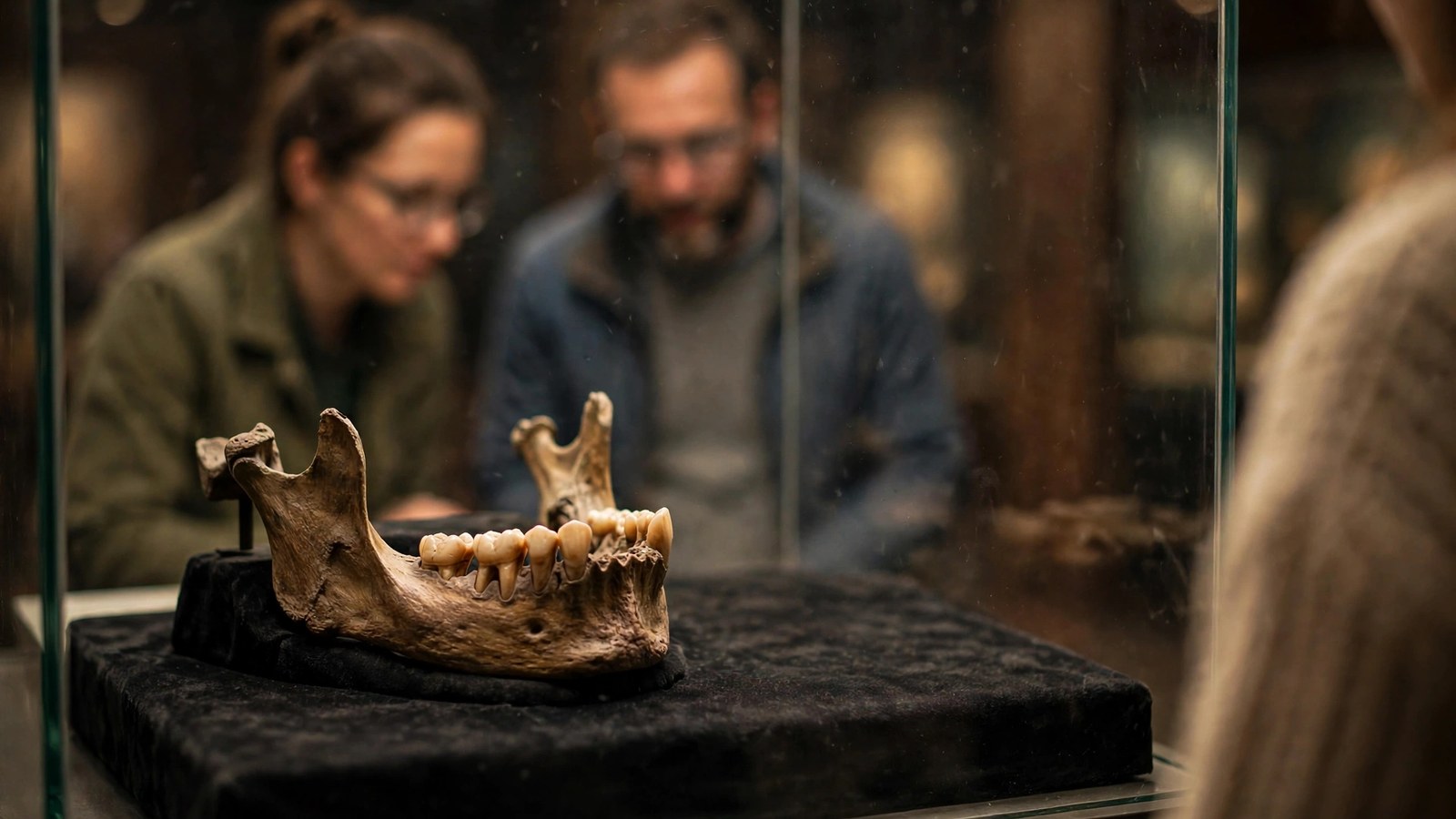
Teeth survive in the ground far better than soft tissue, food remains, or leaf objects. Enamel is the hardest substance in the human body, and dental calculus can trap chemical traces of what a person chewed during life. That durability is why teeth carry so much of the evidence for ancient betel use, and why the evidence needs careful reading. Teeth can show that a substance was used repeatedly. They cannot, on their own, show exactly why a person used it or what it meant in a particular ceremony.
Stained teeth as the classic sign
For most of the archaeological record, the sign researchers relied on was visible staining. Skeletons from sites across Southeast Asia and the Pacific with reddish brown or blackened teeth, sometimes alongside betel nut remains or lime containers in burials, have been interpreted as betel chewers. The logic is sound as far as it goes: the pattern matches what dentists see in living long term chewers.
The limit is just as clear. Not every chewer develops heavy visible stain, staining can fade or be altered after burial, and other practices can darken teeth. Absence of stain is not proof of absence of chewing, and dark teeth alone are not proof of betel use. Good dental anthropology treats staining as one line of evidence to be checked against context, grave goods, plant remains, wear patterns, and, increasingly, chemistry.
The Thailand calculus finding: use without visible stain
The 2025 study by Moonkham and colleagues, published in Frontiers in Environmental Archaeology, is the clearest recent example of that chemical check. The team worked at Nong Ratchawat, a Bronze Age site in central Thailand where 156 burials have been excavated since 2003. They collected 36 dental calculus samples from six individuals and analyzed them with liquid chromatography mass spectrometry, a method that identifies compounds by their chemical signatures. To validate the method, they also made experimental quid samples using dried betel nut, pink limestone paste, betel leaves, and, in some preparations, catechu bark and tobacco, ground with human saliva.
Three samples, all from a molar of one individual known as Burial 11, contained traces of arecoline and arecaidine. The burial is about 4,000 years old. The team’s conclusion, in its own terms, is that this is the earliest direct biomolecular evidence of betel nut use in Southeast Asia. Two cautions belong with that headline. First, the positive result comes from one individual out of six sampled, so it proves use by that person, not the prevalence of chewing in the whole community. Second, Burial 11’s teeth did not show the classic staining, and the researchers state there is no proof that this person received special treatment or held elevated status compared with the other burials. The finding widens the evidence, because it shows chewing can be present when the eye sees nothing. It does not turn one molar into a complete social history.
Wear, grooves, and an earlier claim that needs care
Staining and chemistry are not the only dental signals. How a substance is held and worked in the mouth can wear teeth in characteristic ways, and researchers read unusual wear alongside diet, age, and other tooth using activities, such as processing fibers. Wear is rarely unique to one habit, so a wear pattern alone is a weaker claim than a chemical identification.
A much earlier origin has also been reported. In 2026, a Griffith University led team reported in Science Advances on two foragers from Sulawesi, Indonesia, one dated broadly to about 25,000 to 16,000 years ago and the other to about 7,600 to 6,300 years ago, whose teeth showed deep, rounded grooves and chemical traces of arecoline in dental tissue. The team interpreted the pattern as habitual sucking of whole betel nuts, rather than chewing a prepared lime quid, and suggested the practice may have begun as pain relief for poor teeth. If that interpretation holds up, it would push the roots of betel use far earlier than the Bronze Age. It should be read as a reported finding with wide date ranges and an inferred behavior, not as a settled date for the invention of betel quid chewing. Sucking a whole nut and chewing a prepared quid are related uses of the same plant, but they are not the same practice.
Tooth blackening is a different practice
Archaeologists also have to separate betel staining from deliberate tooth blackening, a cosmetic practice documented in parts of Southeast Asia and the Pacific in which teeth were intentionally dyed black, often around puberty, as a sign of maturity and beauty. Researchers studying Early Iron Age sites at Go O Chua in Vietnam and Prohear in Cambodia, dating roughly from 400 BC onward, developed systematic ways to distinguish staining patterns, interpreting the main pattern in their sample as intentional blackening and identifying one individual whose staining they interpreted as the result of betel nut chewing instead. The point is simple: dark ancient teeth are a starting question, not an automatic answer. Color, distribution, chemistry, and context all have to agree before a cause is named.
What the ancient record can and cannot show
Taken together, the ancient teeth support a limited, well evidenced set of conclusions. Betel nut was used repeatedly in Southeast Asia by at least about 4,000 years ago, on direct chemical evidence. Visible staining on many later skeletons shows the habit became widespread and long lasting in the region. Burial contexts and the later historical record show the quid became social and economic as well as personal, offered in hospitality, exchanged in trade, and used in ceremony. Trade in plant goods across the region has a long history, as our explainer on the Indian Ocean trade route shows for a later period.
What teeth cannot show is safety. An ancient practice can be culturally central and physically harmful at the same time, and the archaeological record preserves some of that harm, in worn, damaged, and diseased mouths. Longevity of a custom is evidence about culture, not evidence that the substance is harmless. For another example of how much, and how little, an ancient tooth can prove, see our explainer on mastodon teeth and what an ancient tooth teaches about enamel.
Betel Nut, Enamel, and Living Teeth
The title of this article mentions enamel, so the enamel claim needs precision. Betel stain is mainly a deposit and discoloration story, not a story of enamel dissolving in the way acid erosion dissolves it. The stain sits in and on surface deposits, pellicle, and calculus, and it can be extremely persistent, but staining alone is not the same as loss of enamel tissue. The real hard tissue concerns are different: abrasive wear from chewing a fibrous, gritty quid over years, which can flatten teeth and in severe cases expose the inner dentin or pulp; chipping in heavily worn teeth; and the gum and bone damage of periodontal disease, which threatens the support of the tooth rather than its crown.
Enamel lost to wear or erosion does not regrow in the ordinary sense, which is why claims in this area need care. Our explainer on the gel reported to regrow tooth enamel sets out what that early research does and does not show. No enamel product changes the advice for a betel chewer: stop the habit that is wearing the teeth and injuring the soft tissue, then have a dentist assess wear, gum health, and the mouth lining.
The Modern Health Evidence
A Group 1 carcinogen, with or without tobacco
IARC evaluations are hazard classifications based on the strength of evidence that something can cause cancer. In the evaluation summarized by the World Health Organization in 2003 and published as IARC Monographs Volume 85 in 2004, the working group concluded that betel quid with tobacco causes oral cancer, cancer of the pharynx, and cancer of the esophagus; that betel quid without tobacco causes oral cancer; and that areca nut itself is carcinogenic to humans. All three were placed in Group 1. That classification was reaffirmed in the later IARC review of personal habits in Monographs Volume 100E.
Group 1 is a statement about certainty of evidence, not a ranking of risk size compared with other Group 1 agents. The size of the risk is addressed by the epidemiology. Warnakulasuriya and Chen, summarizing a meta analysis of betel quid chewers without tobacco alongside more recent work, report a pooled adjusted relative risk for oral cancer of 7.9, with a 95 percent confidence interval of 7.1 to 8.7. Risk rises in a dose response pattern with the number of quids chewed per day and the number of years of chewing, and in Taiwan and the Indian subcontinent roughly half of reported oral cancers have been attributed to betel quid chewing in population attributable fraction estimates. Those figures describe populations in high use regions, not a personal prediction for any one reader, but they rule out describing the habit as a minor or theoretical risk.
Oral submucous fibrosis and other precancerous changes
Cancer is not the first harm. Areca nut causes oral submucous fibrosis, usually shortened to OSF or OSMF, a chronic condition in which the lining of the mouth becomes scarred and stiff. IARC identifies OSF as a precancerous condition that can progress to malignant oral cancer, and it was part of the basis for classifying areca nut itself as carcinogenic. Clinical guidelines describe OSF as a chronic, progressive, and potentially malignant disorder and list betel nut chewing as its central habit related cause. Arecoline is implicated in driving the excess collagen production behind the fibrosis, and the copper content of areca nut has also been hypothesized to contribute.
OSF is not the only potentially malignant change. Warnakulasuriya and Chen identify oral leukoplakia, a white patch that cannot be wiped off, and oral submucous fibrosis as the two main oral potentially malignant disorders caused by areca nut chewing that can progress to oral cancer with continued use. Red patches and a discolored, encrusted change where the quid is held, sometimes called betel chewer’s mucosa, are also described in the dental literature. A patch or sore is not a diagnosis, and most mouth sores are not cancer. The point is narrower: in a current or former chewer, a persistent patch, sore, or stiffness needs prompt professional assessment, not monitoring at home for months.
Dose, duration, and added tobacco
Three patterns run through the evidence. First, more exposure means more risk: risk climbs with daily frequency and with years of chewing. Second, tobacco makes a bad exposure worse. Estimates for quid with tobacco are higher than for quid alone in the Indian studies summarized by Warnakulasuriya and Chen, and the joint effect of tobacco with betel quid has repeatedly been larger than expected from simply adding the two risks. Third, tobacco is not required for harm. Studies from Taiwan and Pacific Island communities, where quid is commonly chewed without tobacco, are central to why areca nut alone carries the classification it does. A tobacco free quid and a sweetened packaged product both still contain the Group 1 agent.
Dependence and stopping
Betel quid dependence is a recognized pattern, not a failure of willpower. The stimulant effect, the ritual, and the social setting reinforce each other, and withdrawal can involve craving and irritability. Warnakulasuriya and Chen note that former chewers in the studies seem to show lower risks than current chewers, while also noting that the effect of stopping on oral cancer risk has not been tested in randomized controlled trials. The honest summary is that stopping removes ongoing exposure and is the step every health authority recommends, that some observational evidence points toward lower risk after stopping, and that existing tissue damage still needs monitoring afterward. Stopping is necessary. It is not a guarantee, and it is not a substitute for screening.
If You Chew Betel Nut Now: Screening, Symptoms, and Dental Care
Tell your dentist and your doctor that you chew, or used to chew, betel nut or areca nut products, including packaged products and local names for the quid such as paan. In countries where the habit is less common, that history can be missed unless you volunteer it, and it changes what a careful oral examination looks for. Ask about oral cancer screening at your dental visits, and keep regular appointments even if your teeth feel fine. Potentially malignant changes can be painless early on.
Seek prompt assessment, rather than waiting for a routine appointment, if you notice any of the following:
- A mouth sore or ulcer that does not heal within about two weeks.
- A persistent white patch, red patch, or mixed red and white patch inside the mouth.
- Increasing stiffness of the cheeks or lips, or difficulty opening your mouth fully.
- Persistent pain, numbness, bleeding without an obvious cause, or a lump in the mouth or neck.
- A tooth that becomes loose without an injury, or a change in how your teeth meet.
These symptoms have many possible causes, and only an examination, and in some cases a biopsy or referral, can establish what one means. Do not try to treat a persistent patch or sore with whitening products, antiseptics, or home remedies while postponing that examination.
Support to stop is a health service question, not just a personal resolve question. Ask your dentist, doctor, or pharmacist what cessation support is available locally, tell people whose social offers of quid you will need to decline, and plan a substitute routine for the times of day when you usually chew.
Stain Removal, Whitening, and What Cleaning Can and Cannot Do
Professional scaling and polishing can remove calculus and much of the external betel stain, and it can substantially improve appearance. Its limits matter more than the cosmetic result. Cleaning does not reverse submucous fibrosis, does not remove a leukoplakia patch’s risk, and does not reset cancer risk to that of a never chewer. A mouth that looks cleaner after treatment can still contain soft tissue changes that need monitoring or referral.
Whitening is a narrower tool still. It lightens tooth color. It does not treat gum disease, fibrosis, or precancerous change, and bleaching products can irritate already damaged soft tissue if used without dental advice. Heavy betel stain may also respond incompletely, because the problem includes deposits and tissue change, not just tooth shade. Anyone considering whitening after betel use should have an oral examination first, and should read general aftercare guidance, such as our guide to teeth whitening aftercare, as general information rather than as clearance to bleach a damaged mouth.
The order of priorities is therefore fixed. Stop the exposure. Have the soft tissue examined. Treat gum disease and decay. Then discuss appearance, including stain removal, with the clinician who has seen the whole mouth.
Frequently Asked Questions
Does betel nut stain go away if you stop chewing?
Stopping prevents new stain from building up, and professional cleaning can remove calculus and much of the external color, so appearance usually improves. Heavy, long term staining can persist in part even after cleaning, and soft tissue damage such as fibrosis does not reverse simply because chewing has stopped. Stopping is still the most important step, because it ends the ongoing carcinogenic exposure.
Is betel nut without tobacco safe?
No. IARC classifies areca nut itself and betel quid without tobacco as Group 1 carcinogens, based in part on evidence from regions where tobacco is not usually added to the quid. Adding tobacco increases the risk further, but removing tobacco does not make betel nut, paan without tobacco, or sweetened areca nut products safe.
What is oral submucous fibrosis?
Oral submucous fibrosis is a chronic, progressive scarring of the lining of the mouth caused mainly by chewing areca nut. The tissue becomes stiff, opening the mouth can become difficult, and the condition is classed as an oral potentially malignant disorder because it can progress to oral cancer. It requires professional diagnosis and monitoring. There is no home treatment that reverses it, and continued chewing allows it to progress.
How long have people used betel nut?
On direct chemical evidence, at least about 4,000 years in Southeast Asia: Moonkham and colleagues detected arecoline and arecaidine in dental calculus from a burial of that age at Nong Ratchawat, Thailand. Visible staining on later skeletons shows much wider use after that. A 2026 Science Advances report on Sulawesi foragers has been interpreted by its authors as evidence of a much earlier practice, sucking whole nuts, but that is a reported interpretation with broad date ranges, not the established date for betel quid chewing.
Can archaeologists tell betel chewing just from dark teeth?
Not reliably from color alone. Dark teeth can also result from deliberate tooth blackening, a separate cultural practice, as well as from burial conditions and other staining. Researchers use the distribution of the staining, archaeological context, plant remains, wear, and, in recent work, chemical analysis of dental calculus. The Thailand finding shows the reverse problem as well: a confirmed chewer, on chemical evidence, had no visible staining at all.
Does chewing betel nut damage enamel itself?
The stain is mainly in and on surface deposits and calculus rather than a dissolving of enamel, but years of chewing a fibrous, gritty quid can wear teeth down, and chewers commonly show calculus and gum disease that threaten the teeth’s support. Enamel lost to wear does not regrow. The larger dangers are to the soft tissue: fibrosis, potentially malignant patches, and oral cancer.
What should I do if I chew betel nut and notice a mouth patch or sore?
Book a prompt dental or medical assessment and say clearly that you chew betel nut. A sore that does not heal in about two weeks, a persistent white or red patch, stiffness or difficulty opening your mouth, or persistent pain or numbness should not be watched at home or treated with whitening or antiseptic products. Only an examination, with referral or biopsy if needed, can establish the cause.
Sources & references
- International Agency for Research on Cancer (IARC), part of the World Health Organization, IARC Monographs Programme finds betel-quid and areca-nut chewing carcinogenic to humans, 7 August 2003. https://www.who.int/news/item/07-08-2003-iarc-monographs-programme-finds-betel-quid-and-areca-nut-chewing-carcinogenic-to-humans
- IARC Working Group on the Evaluation of Carcinogenic Risks to Humans, Betel-quid and Areca-nut Chewing and Some Areca-nut-derived Nitrosamines, IARC Monographs Volume 85, 2004 (Group 1 evaluations for betel quid with tobacco, betel quid without tobacco, and areca nut).
- Warnakulasuriya, S., and Chen, T.H.H., Areca Nut and Oral Cancer: Evidence from Studies Conducted in Humans, Journal of Dental Research, 2022; 101(10): 1139 to 1146. https://pmc.ncbi.nlm.nih.gov/articles/PMC9397398/
- Moonkham, P., Tushingham, S., Zimmermann, M., Brownstein, K.J., Devanwaropakorn, C., Duangsakul, S., and Gang, D.R., Earliest direct evidence of Bronze Age betel nut use: biomolecular analysis of dental calculus from Nong Ratchawat, Thailand, Frontiers in Environmental Archaeology, 2025; 4: 1622935. https://www.frontiersin.org/journals/environmental-archaeology/articles/10.3389/fearc.2025.1622935
- Frontiers in Environmental Archaeology study release via EurekAlert, 4,000-year-old teeth record the earliest traces of people chewing psychoactive betel nuts, 31 July 2025. https://www.eurekalert.org/news-releases/1092342


