Short answer
- Most dogs that need the Bordetella vaccine receive it every 6 to 12 months. The American Animal Hospital Association (AAHA) lists Bordetella as a noncore vaccine and gives annual boosters as the guideline default for dogs with ongoing exposure risk. Dogs that board, attend daycare, visit busy groomers, or mix with many unfamiliar dogs are often boosted every 6 months instead, sometimes because a facility requires a dose within the last 6 months and sometimes because their veterinarian judges their exposure to be high. Dogs that rarely meet other dogs may not need the vaccine at all. The right interval for an individual dog depends on lifestyle, the vaccine form used, and facility rules, so confirm the plan with your dog's own veterinarian. This article is general information only and does not set a schedule for your dog.
What the Bordetella Vaccine Protects Against
The Bordetella vaccine protects dogs against Bordetella bronchiseptica, a bacterium that is one of the most common causes of kennel cough. Kennel cough is the everyday name for a broader condition that veterinarians call canine infectious respiratory disease complex, or CIRDC. That word “complex” matters. CIRDC is not one germ. The Merck Veterinary Manual lists several viruses and bacteria that can cause it, including canine parainfluenza virus, canine adenovirus type 2, canine influenza viruses, and Bordetella bronchiseptica, and co infections with Bordetella, parainfluenza, and adenovirus type 2 are the most common pattern. Other bacteria, including Mycoplasma species, can also be involved.
Because so many organisms can produce the same cough, the Bordetella vaccine cannot prevent every case of kennel cough. What it can do is target one of the most common and contagious contributors. Cornell University College of Veterinary Medicine notes that many vaccinated dogs will not develop clinical signs after exposure to Bordetella, and that dogs which do become ill tend to have less severe signs and to shed the bacteria at a reduced rate. Reducing severity and shedding is a large part of why group settings ask for this vaccine.
How Kennel Cough Spreads and What It Looks Like
Cornell describes Bordetella as very contagious. It spreads mainly through the air when an infected dog coughs or sneezes droplets onto dogs nearby. It also spreads through direct contact, through contaminated surfaces and objects such as toys and food bowls, through clothing and hands, and through contaminated water. Once inhaled or ingested, the bacteria attach to and damage the lining of the trachea and bronchi.
The classic sign is a dry, loud, honking cough. Owners often think at first that the dog is trying to clear something from its throat, and a coughing episode may end with the dog coughing up mucus. Sneezing, nasal discharge, eye discharge, mild fever, tiredness, and reduced appetite can also occur. The Merck Veterinary Manual notes that the cough is easily triggered by gentle pressure on the windpipe, that severity usually lessens during the first 5 days, and that the disease commonly persists for 10 to 20 days. Cornell gives an incubation period of about 6 days, with a range of 2 to 10 days, between exposure and the first signs.
Most cases are mild and self limiting, and Cornell notes that most otherwise healthy dogs recover fully within 7 to 10 days. The picture is not always mild, though. Both Merck and Cornell warn that the infection can progress to pneumonia, especially in puppies, and Merck adds debilitated or aged dogs and dogs with chronic bronchitis as groups in which more serious disease is more likely. Fever, thick nasal discharge, depression, loss of appetite, a productive cough, or labored breathing are signs that the illness may have moved beyond a simple cough and needs prompt veterinary attention.
One further point surprises many owners. A dog can remain contagious after it looks well again. Cornell states that dogs with Bordetella can remain contagious for up to 8 weeks after symptoms resolve, and potentially longer, and should avoid contact with other dogs during that time.
Why Bordetella Is a Noncore, Lifestyle Based Vaccine
AAHA separates canine vaccines into core vaccines, recommended for all dogs regardless of lifestyle unless there is a medical reason not to vaccinate, and noncore vaccines, recommended for some dogs based on lifestyle, geographic location, and risk of exposure. Bordetella sits in the noncore group, alongside vaccines such as canine influenza and Lyme disease. Rabies and the distemper combination vaccines are examples of core vaccines.
Noncore does not mean unimportant. It means the decision is individualized. A dog in daycare five days a week and a dog that almost never meets another dog do not have the same exposure, so they do not automatically share the same schedule. AAHA stresses that its recommendations are general rather than universally prescriptive, that patients should be assessed at least annually to determine their vaccine requirements, and that product label instructions matter because vaccines for the same pathogen can differ by formulation and route. In practice, the annual versus every 6 months question is answered by your dog’s routine, your veterinarian’s judgment, and any facility requirements. Revisit the decision whenever the routine changes.
How Often Dogs Get the Bordetella Vaccine
The AAHA table for Bordetella gives a single initial dose for the intranasal and oral forms, two initial doses for the injectable form, and subsequent boosters administered annually. Cornell summarizes the same pattern in owner facing terms: vaccination can begin as early as 6 to 8 weeks of age, with boosters given annually, or more frequently in high risk situations, every 6 months as recommended by some veterinarians.
A general picture looks like this:
- Puppies: a first dose is often given from 6 to 8 weeks of age, depending on the vaccine form and veterinary guidance, and whether a second initial dose is needed depends on the route.
- Adult dogs at lower risk: often every 12 months, or not vaccinated at all if exposure is minimal and the veterinarian agrees.
- Adult dogs at higher risk: often every 6 months, especially dogs in boarding, daycare, grooming, training, or other group settings, and dogs whose facility requires a dose within the last 6 months.
- Senior dogs and dogs with chronic illness: timing depends on health, immune status, and exposure, and the veterinarian may adjust the plan.
These are general patterns, not a prescription. Product labels differ, facilities differ, and your veterinarian’s recommendation for your dog takes precedence over any article. If you do not know when your dog was last vaccinated, your veterinarian can check the record and advise whether a booster is due.
The Three Vaccine Forms and Why the Route Changes the Timing
There are three ways to give the Bordetella vaccine, and the route changes both the initial schedule and how quickly protection begins.
Intranasal vaccine
The intranasal form is given as drops or spray into the nose. AAHA lists a single initial dose for this route, and some products combine Bordetella with canine parainfluenza virus, or with parainfluenza and canine adenovirus type 2 as well. Because it is placed where infection usually begins, it stimulates local immunity in the upper respiratory tract. Research summarized by the American Kennel Club from Dr. Cynda Crawford of the University of Florida College of Veterinary Medicine indicates that intranasal and oral vaccines typically provide protection within 3 to 5 days, and studies of single dose intranasal vaccines show protection can begin within 48 to 72 hours. A peer reviewed shelter trial published through PubMed Central likewise found that intranasal modified live vaccines usually produce rapid, localized protection and that protective immunity can develop within 4 days of a single dose.
Oral vaccine
The oral form is given into the cheek pouch in the mouth. AAHA lists a single initial dose for this route too. Some dogs tolerate this option better than the nasal form, particularly dogs that strongly resist anything near their nose. Like the intranasal form, it works at the mucosal surface, and the same 3 to 5 day typical onset range is reported for oral vaccines.
Injectable vaccine
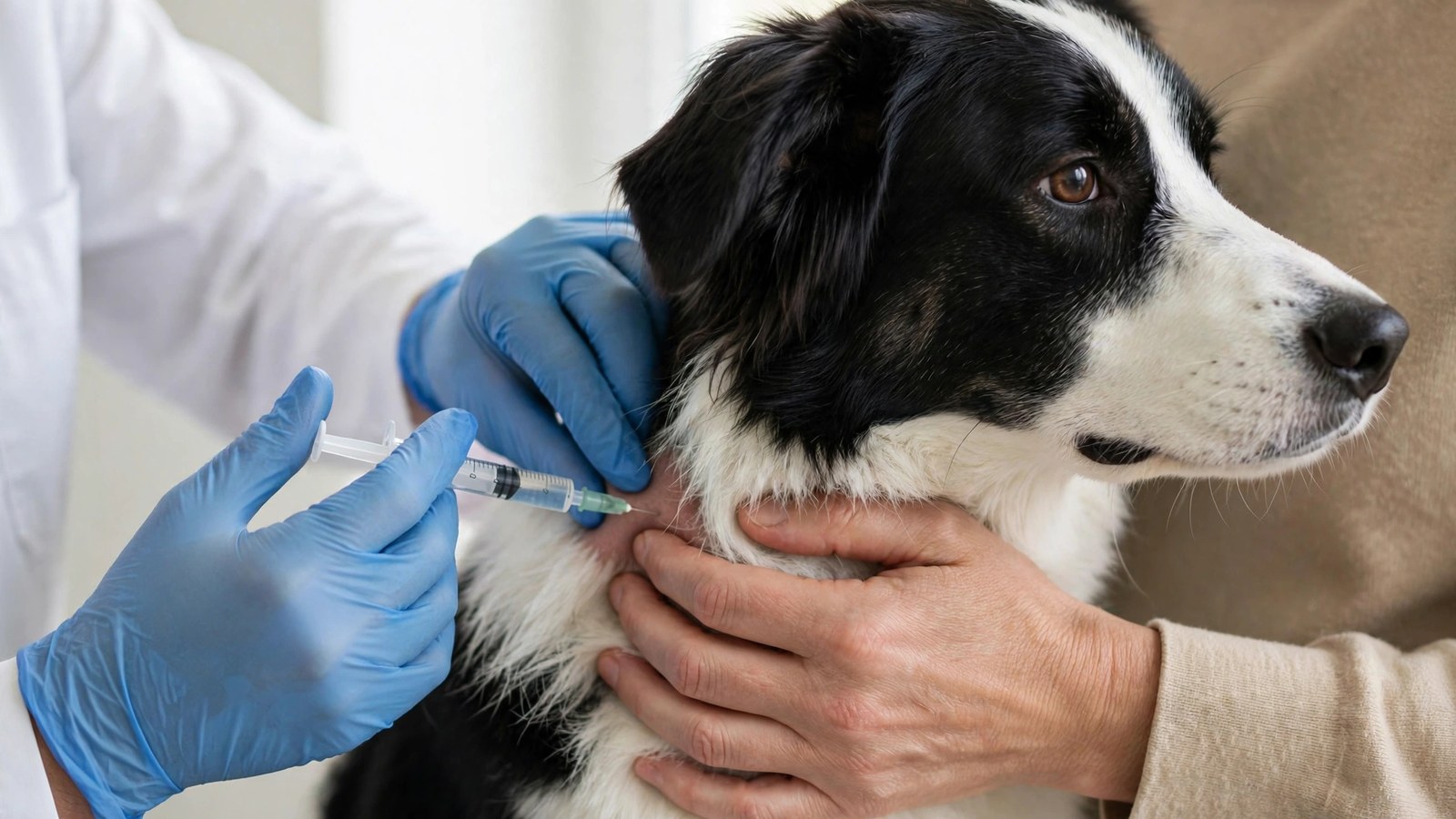
The injectable form is given under the skin. AAHA lists two initial doses, 2 to 4 weeks apart, for the parenteral product. That second dose is the key timing difference. The PubMed Central shelter trial notes that 10 to 14 days are usually required for partial immunity to develop after subcutaneous administration and that a second dose is required 2 to 4 weeks later. Dr. Crawford’s summary adds that injectable vaccines will not provide protective immunity until at least 5 days after the second injection. The injectable route also does not stimulate local immunity in the upper airway in the same targeted way as the mucosal routes. For a dog with no previous Bordetella vaccination, that means the injectable path to protection takes weeks, not days, and boarding plans need to allow for the full series.
The practical lesson is simple. A mucosal vaccine given once and an injectable series given twice do not run on the same clock, so never assume that a dose given yesterday satisfies a facility or protects your dog by the weekend. Ask your veterinarian which form your dog received and when protection is expected to begin.
When Puppies Get Their First Bordetella Vaccine
Cornell states that Bordetella vaccination should begin as early as 6 to 8 weeks of age. Puppies are more vulnerable to respiratory infections, and Merck notes that Bordetella may act as a primary pathogen especially in dogs under 6 months old, so early protection matters most for puppies that will attend puppy classes, meet many dogs, or enter a shelter, rescue, or busy household environment.
The exact puppy pattern depends on the route, following the same split described above. Intranasal and oral products generally start with a single dose, while an injectable product requires two initial doses 2 to 4 weeks apart. Some intranasal products are labeled for use in very young puppies in high risk shelter situations, which is one more reason the product label and your veterinarian’s plan govern rather than any general article. Your veterinarian will fit Bordetella into the puppy’s overall vaccine series and set the first booster date.
Which Dogs Are at Higher Risk
Higher risk dogs
Your dog is likely at higher risk if it attends daycare, stays at boarding kennels, visits groomers regularly, goes to training classes or dog shows, spends time at dog parks, lives in a multi dog home, travels often, or mixes with dogs whose vaccine status is unknown. Cornell lists the settings where prevalence rises as boarding, grooming, and daycare facilities, animal shelters, dog shows, training groups, dog parks, and veterinary clinics. Puppies, unvaccinated dogs, dogs with preexisting respiratory disease, and immunocompromised dogs are also at higher risk of infection and of more severe disease. These are the dogs most often placed on a 6 month booster pattern.
Lower risk dogs
Your dog may be at lower risk if it stays mostly at home, rarely interacts with other dogs, and does not attend boarding, daycare, or group activities. Lower risk is not no risk. Vet visits, walks, an occasional grooming appointment, and unexpected boarding can all create exposure, and Cornell’s setting list includes veterinary clinics themselves. Review the risk level at regular veterinary visits, especially if the routine changes, and ask your veterinarian directly whether a lower risk dog needs this vaccine at all. For some stay at home dogs, the honest answer will be that it does not, at least for now.
How Long Before Boarding Should a Dog Get the Bordetella Vaccine
Ask the facility first, because requirements vary and the facility’s rule is the one that decides admission. Some facilities require proof that the vaccine was given within the last 6 months. Some set a minimum interval between vaccination and arrival. Some accept any of the three routes, while others specify a form. None of that is visible from your dog’s vaccine record alone, so a short phone call early in the booking process prevents most problems.
As a general planning rule, schedule the vaccine at least 1 to 2 weeks before boarding or other group exposure. That margin covers the onset times described above, including the slower injectable series for dogs that need both initial doses, and it leaves time to fix a paperwork problem before travel day. Vaccinating the morning of boarding does not give the immune response time to develop, however convenient it feels.
Practical steps for a boarding stay:
- Call the facility early and ask exactly what it requires: which vaccine, how recent the dose must be, which routes it accepts, and what proof it wants to see.
- Call your veterinarian with those requirements and ask whether your dog’s current vaccination satisfies them, and which form makes sense if a new dose is needed.
- Book the vaccine early enough to leave a margin, rather than the day before departure, and allow the full 2 to 4 week interval plus onset time if your dog needs a two dose injectable series.
- Keep the vaccine record somewhere you can find it, since facilities ask for proof at check in.
If your dog’s record is out of date, if a facility requires a more recent dose, or if kennel cough is circulating locally, your veterinarian may advise an earlier booster. The same applies when your dog starts daycare, begins a regular grooming routine at a busy salon, or starts spending much more time around other dogs.
Can a Vaccinated Dog Still Get Kennel Cough
Yes. A vaccinated dog can still develop kennel cough, for two reasons. First, the vaccine targets Bordetella bronchiseptica, while CIRDC can be caused by several other viruses and bacteria that this vaccine does not cover. Second, even against Bordetella itself, the vaccine reduces risk and severity rather than guaranteeing sterile immunity. Cornell notes that vaccinated dogs that do become ill tend to have less severe signs and to shed the bacteria at a reduced rate, and Dr. Crawford adds that vaccination can shorten the duration of infection and reduce progression to pneumonia. A cough in a vaccinated dog is therefore not proof that the vaccine failed. It is still a reason to keep the dog home and, if signs are more than mild, to call your veterinarian.
Side Effects and When to Call the Veterinarian
Bordetella vaccines are generally well tolerated. The American Kennel Club, summarizing Dr. Crawford’s comments, reports that with the intranasal and oral formulations there is very little risk of adverse events, and that the more common reaction is a little coughing or sneezing, especially after the nose drops. Mild tiredness for a day can also occur after vaccination generally. With the injectable form, a small lump or mild soreness at the injection site can occur in rare cases. Reactions overall are uncommon: the same summary cites an extensive study of 9 million doses of Bordetella vaccine in which fewer than 1 percent of dogs experienced any reaction.
Contact your veterinarian promptly if your dog has difficulty breathing, facial swelling, severe or worsening coughing, repeated vomiting, marked weakness, or any signs that last more than a few days or worry you. Serious allergic reactions are rare, but they need quick veterinary attention. One household note from Cornell may also be relevant for a small number of families: Bordetella bronchiseptica has, infrequently, caused illness in people with compromised immunity, and at risk owners may discuss choosing the injectable vaccine over the intranasal or oral forms with their veterinarian. If that situation applies in your household, raise it before the appointment rather than after.
Protecting Your Dog Beyond Vaccination
Vaccination is only one part of reducing respiratory disease risk around other dogs. Habits matter too:
- Keep a coughing dog home. Cornell advises that dogs with Bordetella should avoid contact with other dogs while they remain contagious, which can extend well beyond the visible cough, and Merck similarly advises housing dogs with kennel cough separately from other dogs.
- Keep food and water bowls, toys, and bedding clean, since the bacteria spread through contaminated objects as well as through the air, and wash hands after handling a coughing dog.
- Be cautious during a local outbreak. If your veterinarian or facility reports kennel cough circulating, consider postponing nonessential group activities, and be especially careful with puppies and older dogs.
- Keep routine veterinary checkups current, so vaccine timing and risk level are reviewed at least annually.
- Support general health with appropriate nutrition, exercise, and prompt care for illness. No habit substitutes for vaccination where exposure is high.
Deciding the Schedule With Your Veterinarian
This article is general information only, not a vaccine schedule for your dog. Bordetella timing varies by product, route, facility rules, and region, and the 6 month versus 12 month decision is exactly the kind of judgment AAHA leaves to the veterinarian who knows the individual dog. Bring three things to that conversation: your dog’s vaccine record, a realistic picture of how often your dog mixes with other dogs, and the written requirements of any facility you plan to use. If a booster has lapsed, do not assume protection remains. AAHA’s guidance for overdue vaccines is to consult the specific product manufacturer’s instructions, and its general rule of thumb is that when in doubt, vaccinate.
Frequently Asked Questions
How often should dogs get a Bordetella vaccine?
Most dogs that need it receive it every 6 to 12 months. Annual boosters are the AAHA guideline default for dogs with ongoing risk, while higher risk dogs in boarding, daycare, grooming, or other group settings often receive boosters every 6 months, sometimes because a facility requires it. Your veterinarian sets the schedule for your dog.
How often should a dog get a Bordetella shot?
The same 6 to 12 month pattern applies, although “shot” is only one of the three forms. An injectable product needs two initial doses 2 to 4 weeks apart, while oral and intranasal products generally start with a single initial dose. Boosters after that are annual by default, or every 6 months for higher risk dogs.
Does my dog need Bordetella every year?
If your dog has ongoing exposure to other dogs, annual vaccination is the usual guideline default, and many higher risk dogs need it every 6 months instead. If your dog rarely meets other dogs, your veterinarian may decide it is not needed at all. Ask at a routine visit rather than assuming either way.
How long is a Bordetella vaccine good for?
Boosters are scheduled annually under AAHA guidance, and intranasal and oral vaccines are reported to offer at least 12 months of immunity. In practice the working window is often treated as 6 to 12 months, because a facility may require a dose within the last 6 months even when your dog’s usual schedule is annual. Check facility rules before boarding.
How soon before boarding does a dog need a Bordetella vaccine?
Plan on at least 1 to 2 weeks before boarding as a general rule, and confirm the facility’s exact requirements first. Mucosal vaccines typically begin protecting within 3 to 5 days, but an injectable series needs two doses 2 to 4 weeks apart plus time after the second dose, so a first time injectable vaccination needs a much longer runway. Do not wait until the day before.
How many days does it take for a Bordetella vaccine to work?
It depends on the route. Intranasal and oral vaccines typically provide protection within 3 to 5 days, and studies of single dose intranasal vaccines show protection beginning within 48 to 72 hours. Injectable vaccines take longer, providing protective immunity only from at least 5 days after the second of two initial doses. Facility acceptance windows are separate from biological onset, so confirm both.
Is the Bordetella vaccine safe for puppies?
Puppies can begin Bordetella vaccination as early as 6 to 8 weeks of age, depending on the vaccine form and your veterinarian’s recommendation, and the vaccine is generally well tolerated. Puppies are more vulnerable to respiratory infection and to pneumonia, so early protection matters most for puppies entering group settings.
Can dogs get Bordetella even if vaccinated?
Yes. Vaccinated dogs can still get kennel cough, because other viruses and bacteria also cause CIRDC and because the vaccine reduces rather than eliminates Bordetella risk. Symptoms are often milder, the illness may be shorter, and vaccinated dogs tend to shed the bacteria at a reduced rate.
Can indoor dogs skip the Bordetella vaccine?
Some indoor dogs are at lower risk, and their veterinarian may agree the vaccine is not needed. They are not completely protected from exposure, though, since vet visits, walks, grooming appointments, emergency boarding, and contact with visiting dogs can all create risk. Ask your veterinarian whether your indoor dog needs it, and revisit the answer if the routine changes.
What happens if you skip the Bordetella vaccine?
For a group setting dog, skipping increases the risk of kennel cough, which spreads quickly among dogs and can progress to pneumonia in puppies, older dogs, and debilitated dogs. It may also mean refused admission at boarding, daycare, grooming, or training facilities. If a booster has simply lapsed, contact your veterinarian to get the plan back on track rather than assuming protection remains.
Keep reading: Traveling With Your Dog: Carrier and Travel Requirements
Sources & references
- American Animal Hospital Association (AAHA), 2022 AAHA Canine Vaccination Guidelines, Recommendations for Core and Noncore Canine Vaccines: https://www.aaha.org/resources/2022-aaha-canine-vaccination-guidelines/recommendations-for-core-and-noncore-canine-vaccines/
- Cornell University College of Veterinary Medicine, Riney Canine Health Center, Bordetellosis: https://www.vet.cornell.edu/departments-centers-and-institutes/riney-canine-health-center/canine-health-information/bordetellosis
- Merck Veterinary Manual, Kennel Cough, Respiratory Diseases of Small Animals (professional version): https://www.merckvetmanual.com/respiratory-system/respiratory-diseases-of-small-animals/kennel-cough?ruleredirectid=463
- American Kennel Club, Bordetella Vaccine: What to Know About the Vaccine for Dogs, including comments from Dr. Cynda Crawford, University of Florida College of Veterinary Medicine, and Dr. Ann Hohenhaus, Schwarzman Animal Medical Center: https://www.akc.org/expert-advice/health/bordetella-vaccine-dogs/
- Edinboro, Ward and Glickman, Purdue University School of Veterinary Medicine, A placebo controlled trial of two intranasal vaccines to prevent tracheobronchitis (kennel cough) in dogs entering a humane shelter, published in Preventive Veterinary Medicine and hosted by PubMed Central: https://pmc.ncbi.nlm.nih.gov/articles/PMC7126306/


