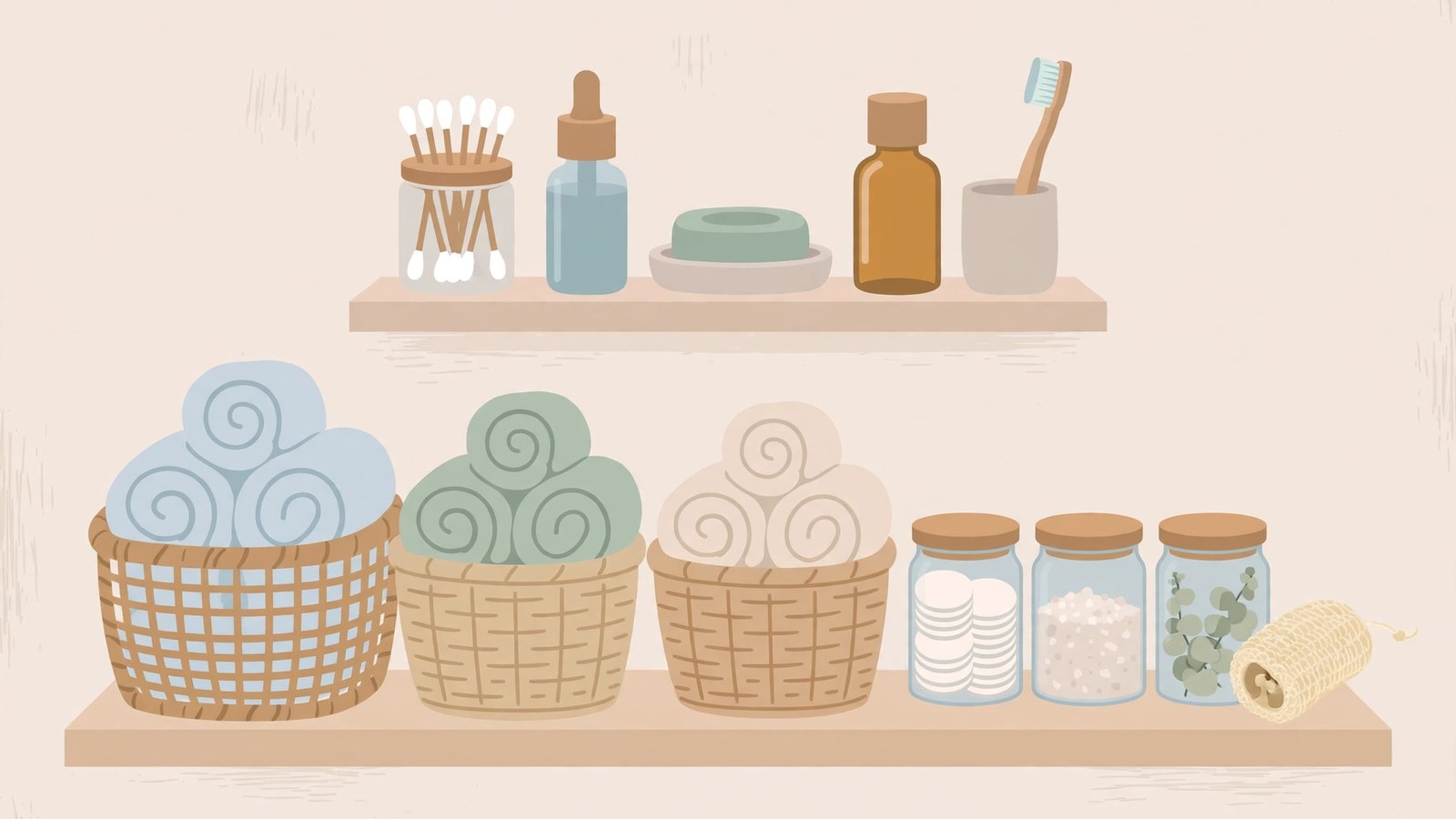
Short answer
- Sort first, buy second. Empty the bathroom, group everything into daily use, weekly use, occasional use, and remove, and keep only daily and weekly items in the room. Then set up four daily zones, one each for the sink, the shower, grooming, and towels, so each part of the routine has one home. Add narrow shelves 6 to 8 inches deep on empty wall space, starting above the toilet, and use one basket per category to group bottles on those shelves. Keep only daily items on the counter, in one small tray. Store medicines in a cool, dry place outside the bathroom, up and away from children, and keep cleaning products in their original containers, separate from personal care items and out of reach of children.
Introduction
A small bathroom feels chaotic for a predictable reason. Everything is stored in the same place and at the same level of access, whether you use it every day or twice a year. The toothbrush, the spare toilet paper, the hair dryer, and the cleaning spray all compete for the same few inches of counter, and the result is a room that is hard to use and harder to clean. Organization in a small bathroom is not mainly about buying more furniture. It is about giving everything a home based on how often you use it, and using walls, doors, and vertical space that are currently empty.
This guide builds that system in three parts: shelves that use vertical space, baskets that group and hide, and daily zones that keep the morning routine fast. It assumes a typical small bathroom with one sink, one shower or tub, and limited counter space, and it works whether you rent or own, with no drill options noted where drilling is not possible. Two safety topics get their own sections, because they change where things should live: medicines and cleaning products do not belong in the same easy reach basket as daily toiletries, and grooming tools need care around water and outlets.
Start by Emptying, Not by Buying
Before buying a single basket, empty the bathroom completely. Take everything out, wipe the surfaces, and sort items into four groups: daily use, weekly use, occasional use, and remove. Daily use means items you reach for every morning and evening. Weekly use means items you use a few times a week, such as a hair mask or a bath soak. Occasional use means spare supplies, backup toilet paper, and seasonal items. Remove means expired products, empty bottles, duplicates you will not use, and items that belong elsewhere.
This step is the one most projects skip, and it is why many of them fail. A small bathroom cannot store bulk supplies, expired products, and a dozen half used bottles and still feel organized, no matter how many baskets you buy. If a product has sat untouched for months, it is not part of your routine and does not need prime space. Keep only daily and weekly items in the bathroom. Store occasional supplies elsewhere, such as a linen closet or hallway cabinet, and bring them in when needed.
Do the expiry check during the sort, not after it. Check dates on medicines, sunscreen, and skincare, set anything expired aside for proper disposal, and check with a pharmacist if you are unsure about a specific product. The sort is also the moment to count what remains. If two people each keep three daily items at the sink, the sink zone must hold 2 multiplied by 3, which equals 6 items, in one tray or organizer. If it cannot, something has to move to weekly storage before you choose any container.
Measure the Room Before You Choose Anything
Measurements decide whether a shelf or cart helps or gets in the way. Measure four things and write them down. First, the width and height of each empty wall stretch, including above the toilet and beside the mirror. Second, the depth you can spare on each wall without the shelf jutting into headroom or into the path of a swinging door. Third, the inside of the under sink cabinet, including where the pipes sit, because pipe position decides whether a two tier organizer fits at all. Fourth, any narrow floor gap beside the vanity or toilet, measured at its narrowest point.
Keep the depth rule consistent as you shop. For toiletries and baskets, shelves 6 to 8 inches deep are usually enough for a rolled towel, a small basket, or a row of bottles. Deeper shelves quickly become cluttered ledges and project further into a room where people turn and dry off. If a listing gives depth in centimeters, 15 centimeters is about 6 inches and 20 centimeters is about 8 inches, so the same range applies. Measure a basket before you pair it with a shelf. A basket that overhangs will catch sleeves and towels every day.
Daily Zones: One Place for Each Part of the Routine
A daily zone is a small, defined area for one part of your routine, so you are not hunting across the room each morning. The most useful zones are the sink zone, the shower zone, the grooming zone, and the towel zone. Each zone should be reachable without moving the items of another zone, and each item should have exactly one home. If you have to shift three things to reach your toothbrush, the zones need adjusting.
The sink zone holds toothbrushes, toothpaste, hand soap, and the skincare you use morning and evening, in a small tray or divided organizer that leaves the counter clear around it. In a shared bathroom, give each person one section of the tray or one small caddy, so the zone grows by person rather than spreading across the counter. Keep the sink zone to products used at the sink. Hair tools, spare bottles, and cleaning products do not belong here.
The shower zone holds shampoo, conditioner, and body wash in a caddy, a corner shelf, or a tension pole shelf, so bottles are not lined up on the tub edge or the shower floor. Keep one set of products in use, not one set per person plus spares, unless people genuinely use different products daily. Bottles on the shower floor get knocked over, trap water underneath, and make cleaning slower, so raising them is a cleaning improvement as well as a storage one.
The grooming zone holds hair tools, brushes, and styling products, ideally near a mirror and an outlet, in a basket or a heat resistant pouch. Let a hot tool cool before it goes back into a basket, and keep cords loosely coiled. This is the one zone where location is limited by safety as well as convenience. The electrical section below explains why it needs a protected outlet and why tools should be unplugged and stored dry.
The towel zone holds one towel per person in use, plus one spare, on hooks or a rail, rather than a stack that never fully dries. Hooks spread towels out so air reaches them and use wall space instead of shelf space, and they suit shared bathrooms because each person can see which towel is theirs. Extra towels live with the occasional supplies outside the bathroom and rotate in as the in use set goes to the wash.
Shelves: Using the Walls You Already Have
Walls are the most underused storage in a small bathroom. The wall above the toilet is prime space: two or three narrow floating shelves there can hold rolled towels, spare toilet paper in a basket, and a small plant, without taking any floor space. The wall beside the mirror can hold a small shelf for everyday toiletries. The wall above the door, which is harder to reach, suits occasional items only. Reserve the hardest to reach shelf for the lightest, least used items, never for heavy bottles you lift down with wet hands.
Choose shelf depth carefully, using the 6 to 8 inch range from the measuring step. Keep the top shelf for display or light items, the middle shelves for daily use, and the lowest shelf for heavier baskets, so the items you lift most often are the easiest to lift safely. Follow the shelf maker instructions for fixing and for any weight limit, and treat that limit as covering the shelf and its contents together. A shelf carrying baskets of bottles belongs on studs or on fixings rated for the job, installed exactly as their maker directs. A shelf that feels loose at installation will not improve under daily use. Take it down and refix it rather than loading it and hoping.
If you rent and cannot drill, freestanding over the toilet units, tension pole shelves, and adhesive shelves are workable alternatives, with one caution. Adhesive shelves suit light items only, should not be loaded with heavy bottles, and should be used only up to the weight limit and on the surfaces their maker states. Check them in the monthly maintenance below, and move anything heavy down if a shelf starts to lift at a corner.
Baskets: Group, Hide, and Calm the Shelves
Baskets are the simplest way to make open shelves look calm. Instead of a dozen individual bottles on display, a basket holds one category, such as hair products or spare toiletries, and the eye reads one basket rather than twelve objects. Use matching or coordinating baskets, and label them if more than one person uses the bathroom, so categories stay separate.
Choose basket material for bathroom humidity. Woven baskets look warm but can suffer in a very damp bathroom. Wire, plastic, or sealed wood baskets cope better with moisture and are easier to wipe clean. In a steamy bathroom with slow drying, put woven baskets on the highest, driest shelf or in hallway linen storage, and use wipeable baskets inside the room. Choose baskets you can lift with one hand when full, because a basket you need two hands to reach is one you will stop putting things back into.
Use small baskets inside drawers too, to stop a drawer becoming a single jumble, and to keep categories separate under the sink. The rule is one basket per category, and no basket so large that it becomes a dumping ground. If a basket is overflowing, the category needs sorting, not a bigger basket. If you cannot see the top items without digging, the basket is holding occasional items that should have stayed outside the room.
Under the Sink, Doors, and Hidden Spaces
Under sink space is prime storage, but it is often wasted by pipes and a single pile of bottles. A two tier organizer, a pull out bin, or a rotating tray can make the vertical space usable, grouping backup supplies by category. Measure around the pipes first, and choose the organizer after you know the clear width and height on each side of the plumbing. Keep daily items out of this space, since reaching under the sink each morning is slow. Reserve it for spares and larger bottles, and keep cleaning products in their own separate container within it, for the safety reasons in the next section.
Doors are another hidden resource. The back of the bathroom door can hold hooks for towels and robes, or an over the door organizer with pockets for hair accessories and brushes. Cabinet doors can hold shallow organizers or hooks, provided the door still closes fully. A slim rolling cart in a narrow gap beside the vanity or toilet can add useful storage without blocking doors or drawers, provided you measured the gap first and the cart rolls freely. The principle throughout is the same: use space that is currently empty, keep daily items at hand height, and keep spares higher or lower.
Medicines and Cleaning Products: Where They Should Not Live
Organization advice fails if it treats every bottle the same. Medicines and cleaning products have storage rules that override the zone system, and both rules move these items away from the convenient basket at the sink.
Store most medicines outside the bathroom. Guidance on storing medicines, published by UF Health from the A.D.A.M. and MedlinePlus tradition and citing United States Food and Drug Administration guidance, states that heat, air, light, and moisture may damage medicine, that medicines should be stored in a cool, dry place such as a dresser drawer or a storage box on a shelf or in a closet, and that heat and moisture from a shower, bath, and sink may damage medicine in a bathroom cabinet, so it can become less potent or go bad before its expiration date. Pills and capsules are described there as easily damaged by heat and moisture. Follow the label and your pharmacist instructions for any specific medicine, and keep medicine in its original container. A hallway closet shelf or bedroom drawer is a better medicine home than any bathroom shelf.
Wherever medicines live, keep them up and away from children. The Centers for Disease Control and Prevention Up and Away and Out of Sight campaign advises putting medicines, vitamins, and supplements away after every use, never leaving them out on a counter or at a bedside, picking a storage place children cannot reach or see, and always relocking the safety cap, while noting that children may still be able to open safety caps. The Food and Drug Administration likewise recommends storing medicines up and away and out of reach and sight of children, and recommends locking medicines up to prevent accidental poisoning. The Centers for Disease Control and Prevention states that about 100 young children are brought to an emergency room each day in the United States after getting into medicines left within reach. Save the Poison Help number, 800-222-1222, in your phone, as both the Centers for Disease Control and Prevention and Ready.gov advise.
Cleaning products get a separate, closed home, not the personal care basket. Ready.gov guidance on household chemical emergencies, from the Federal Emergency Management Agency, states that products containing hazardous materials should be kept in their original containers with labels kept in place, should never be stored in food containers, and should never be mixed with other products, noting that incompatible products such as chlorine bleach and ammonia may react, ignite, or explode. It also states that household chemicals should be stored only in places children cannot get to them. In practice, that means one latched or locked under sink container or a high closed cabinet for cleaning products, separate from personal care items, with bottles returned there after every use and never decanted into a drink bottle or an unlabeled spray bottle. If children live in or visit the home, under sink storage without a latch or lock does not meet that standard, so move cleaning products to a locked or high closed cabinet elsewhere.
Grooming Tools, Outlets, and Water
The grooming zone sits near water, so it needs one electrical check before you settle its location. A ground fault circuit interrupter, often shortened to GFCI, is a device designed to protect people from severe or fatal electric shock. A United States Consumer Product Safety Commission staff report explains that a GFCI monitors the current flowing from hot to neutral, can sense an imbalance as small as 5 milliamps, and can react as quickly as one thirtieth of a second to open the circuit. The same report states that, in homes built to comply with the National Electrical Code, GFCI protection has been required for bathroom receptacle circuits since 1975, and that GFCIs should be installed in areas of greatest exposure, such as the bathroom.
Treat that as a check, not as a wiring project. Look for a receptacle with test and reset buttons, or for GFCI protection provided at the breaker, and test receptacle GFCIs monthly following the maker instructions. The Electrical Safety Foundation International, in guidance reprinted by Safety Online, reminds consumers to test GFCI receptacles every month, states that testing is the only way to ensure they are working properly, and states that a GFCI should be used in any area where water may come in contact with electrical products. If the outlet has no GFCI protection, if a test fails, or if you are unsure, do not do electrical work yourself on the strength of an organization article. Consult a licensed electrician and your local code, because requirements and existing wiring vary. Day to day, use grooming tools with dry hands, keep tools and cords away from a filled sink or tub, unplug tools after use, and store them dry in the grooming basket.
Keeping the Counter Clear
A clear counter is the single change that makes a small bathroom feel larger and easier to clean. Keep only the items you use every single day on the counter, in a small tray, and return everything else to its zone after use. A tray defines the counter zone: if the tray is full, something needs to go back.
Wall mounted soap dispensers and toothbrush holders free counter space without new furniture, and a small hook inside a cabinet door can hold clips or small tools. Clean the counter as part of the evening routine, not as a separate chore. A brief wipe and a return of items to their zones keeps the system working. One exception matters: medicines and cleaning products never join the tray, even for one night, for the safety reasons above.
Maintaining the System Week by Week
An organization system that needs constant effort will fail, so build maintenance into routines you already have. The schedule below uses the same three intervals throughout this article.
| Interval | Task | Time it should take |
|---|---|---|
| Weekly | Return stray items to their zones and check whether any basket is overflowing | About 5 minutes |
| Monthly | Check expiration dates on medicines and skincare stored outside the bathroom, remove empties, test the GFCI receptacle, and check adhesive shelves for lifting | About 10 minutes |
| Each season | Repeat the original sort into daily, weekly, occasional, and remove, and rotate towels and seasonal products | About 20 minutes |
The times are planning targets for a bathroom that is already sorted, not promises. The first seasonal reset after a big clear out will take longer, and that is normal. What matters is that the weekly task stays small enough to actually happen.
If the system stops working, the cause is usually one of three things: too many items for the space, zones that do not match the routine, or a household member who does not know the system. The first needs another sort, the second needs moving a zone closer to where it is used, and the third needs labels and a short conversation, not more containers. In a shared bathroom, revisit the per person counts as well. A system sized for two people will overflow when a third person adds a full set of daily products, and the fix is to recount and resize the zones. A small bathroom organized by zones, shelves, and baskets does not need to be perfect. It needs to be easy enough that putting things back is faster than leaving them out.
Frequently Asked Questions
How do I organize a small bathroom?
Empty it completely and sort items into daily, weekly, occasional, and remove groups. Keep only daily and weekly items in the bathroom, store occasional supplies elsewhere, and remove expired or unused products before buying any storage. Then set up sink, shower, grooming, and towel zones, add narrow shelves on empty walls, and use one basket per category.
Are open shelves or closed cabinets better in a small bathroom?
Both have a place. Open shelves with baskets suit daily items you need to see and reach quickly, while closed cabinets suit spares and items you prefer hidden. Cleaning products and anything that must stay out of reach of children belong in closed, latched or locked storage, not on an open shelf. In a very small bathroom, a mix usually works best: open shelves above the toilet, closed storage under the sink.
How deep should small bathroom shelves be?
For toiletries, baskets, and rolled towels, 6 to 8 inches deep is a practical range. It holds a basket or a row of bottles without creating a deep ledge that collects clutter or projects far into the room. Keep heavier baskets on the lowest shelf, daily items on the middle shelves, and light or display items on top. Follow the shelf maker instructions for fixing and weight limits.
Where should I store medicines if not in the bathroom?
Store most medicines in a cool, dry place outside the bathroom, such as a dresser drawer or a storage box on a closet shelf, following the label and your pharmacist instructions for any specific product. Keep them in their original containers, up and away and out of sight and reach of children, with safety caps relocked after every use. Heat and moisture from a shower, bath, and sink can damage medicine in a bathroom cabinet and make it less potent.
Can I store cleaning products under the sink?
Yes, only in a separate container, in their original labeled containers, and only if children cannot get to them. If children live in or visit the home, under sink cleaning storage needs a latch or lock, or the products should move to a high or locked cabinet elsewhere. Never store cleaning products in food or drink containers, never remove their labels, and never mix products, since some combinations, such as chlorine bleach and ammonia, may react dangerously.
How do I keep a small bathroom organized long term?
Build maintenance into existing routines: a weekly return of stray items to their zones, a monthly expiration and safety check, and a seasonal re-sort using the same four groups from the first sort. If a zone stops working, adjust the zone or reduce the items in it rather than buying more containers. If the counter tray overflows, the system needs a sort, not a larger tray.
Keep reading: Kitchen Pantry Organization by Zone: A System You Can Actually Keep Up
Keep reading: Small Entryway Organization: Hooks, Bench, and Shoe Storage
Keep reading: Compact Living: Small-Space Ideas for Every Room
Sources & references
- Centers for Disease Control and Prevention, About the PROTECT Initiative and Up and Away and Out of Sight campaign pages. Used for putting medicines, vitamins, and supplements away after every use, never leaving them out on a counter or at a bedside, picking a storage place children cannot reach or see, always relocking safety caps while noting children may still open them, asking guests to keep bags containing medicines up and away, and the Poison Help number 800-222-1222.
- Centers for Disease Control and Prevention, Up and Away Campaign Resources. Used for about 100 young children being brought to an emergency room each day in the United States after getting into medicines left within reach, and for the medicine storage safety tips repeated there, including keeping medicines in a location too high for young children to reach or see and calling Poison Help at 800-222-1222.
- United States Food and Drug Administration, Benadryl Drug Safety Communication, 24 September 2020. Used for the recommendation to store medicines up and away and out of reach and sight of children, and for the recommendation to lock up medicines to prevent accidental poisoning.
- UF Health, Storing Your Medicines, a patient education page in the A.D.A.M. and MedlinePlus tradition, citing Food and Drug Administration and Centers for Disease Control and Prevention references. Used for heat, air, light, and moisture damaging medicine, storing medicines in a cool, dry place such as a dresser drawer or a storage box on a shelf or in a closet, heat and moisture from a shower, bath, and sink damaging medicine in a bathroom cabinet so it may become less potent or go bad before its expiration date, pills and capsules being easily damaged by heat and moisture, keeping medicine in its original container, asking a pharmacist about specific storage instructions, and storing medicine out of reach and out of sight of children in a cabinet with a child latch or lock.
- United States Consumer Product Safety Commission, Considerations for Installation of Smoke Alarms on Residential Branch Circuits, CPSC-ES-0504, October 2005, section 3.2 on ground fault circuit interrupters. Used for a GFCI being designed to protect people from severe or fatal electric shock, a GFCI monitoring current from hot to neutral and sensing an imbalance as small as 5 milliamps and reacting as quickly as one thirtieth of a second, the three common GFCI types, GFCI protection being required for bathroom receptacle circuits since 1975 in homes built to comply with the National Electrical Code, and GFCIs being installed in areas of greatest exposure such as the bathroom.
- Electrical Safety Foundation International, GFCIs Protect From Shock This Holiday Season, as reprinted by Safety Online. Used for testing GFCI receptacles every month, testing being the only way to ensure they are working properly, GFCIs being designed to minimize shock and electrocution especially when electrical appliances come in contact with water, a GFCI sensing current leakage and automatically disconnecting power, and a GFCI being used in any area where water may come in contact with electrical products.
- Ready.gov, Household Chemical Emergencies, a Federal Emergency Management Agency guidance page, as archived. Used for keeping products containing hazardous materials in their original containers and never removing labels unless the container is corroding, never storing hazardous products in food containers, never mixing household hazardous chemicals or waste with other products, incompatibles such as chlorine bleach and ammonia possibly reacting, igniting, or exploding, following manufacturer instructions, storing household chemicals in places children cannot access, and the national poison control number 800-222-1222.


