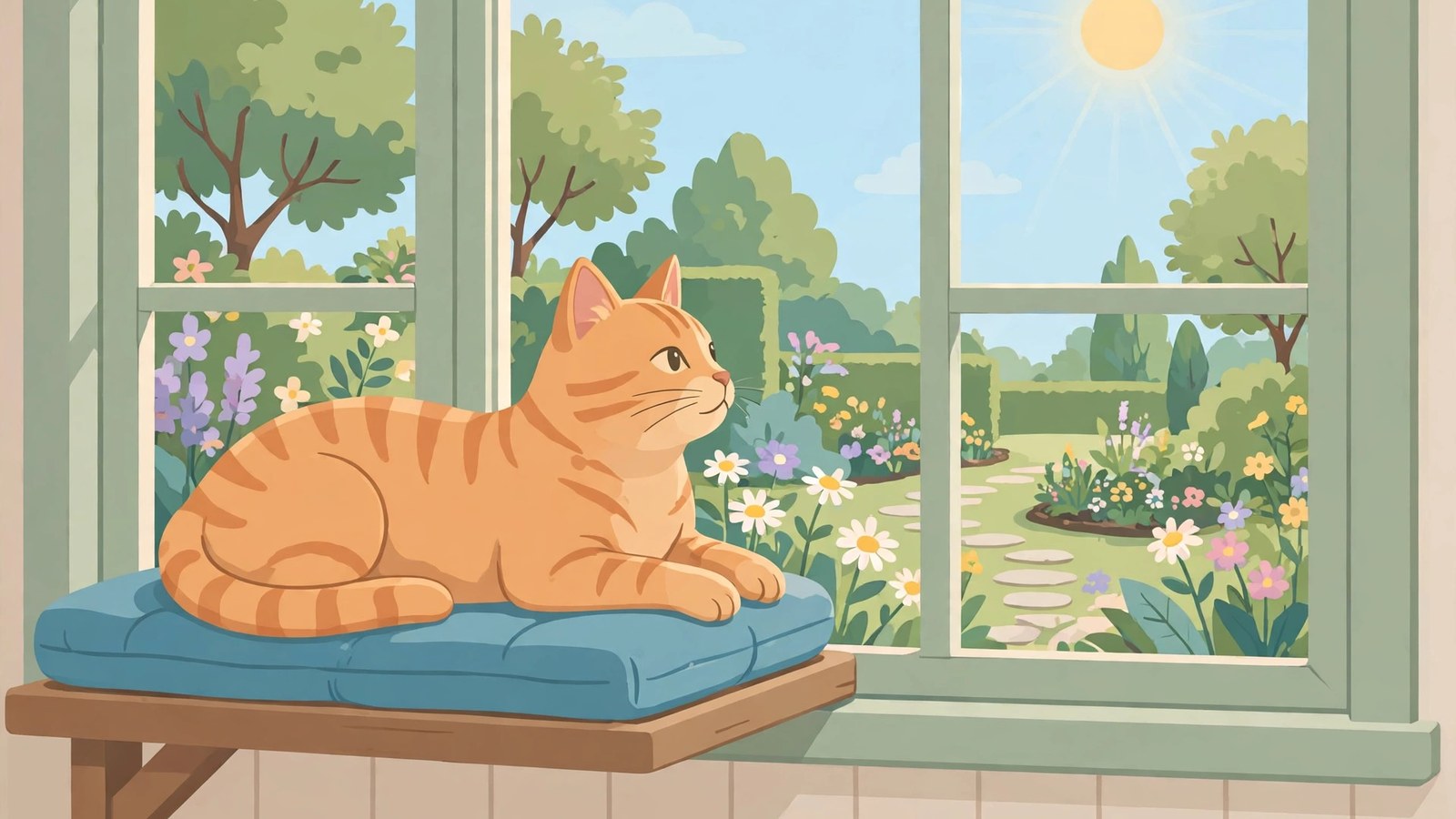
Short answer
- Choose the window first and the perch second. Pick a window with an interesting but calm view, sun the cat can move out of, a lock that still works, and a screen that is snug, sturdy, and undamaged. Then pick the perch type that suits your cat and home: a freestanding tree or sturdy furniture by the window is the most forgiving option, a bracket or sill perch is usually more secure than suction alone, and a suction perch needs the most testing and the most frequent checks. Weigh your cat, choose a perch rated by its maker for more than that weight, install it exactly as instructed, and test it without the cat for at least a day before first use. Give the cat an easy route up and down, a soft landing below, and at least one other resting place elsewhere. If a cat falls, seems overheated, or suddenly stops using a perch it once liked, contact a veterinarian promptly.
Introduction
A window perch gives an indoor cat a raised, sunny place to watch the world, rest, and keep track of the room. It can also fail in ways that matter. A suction cup can let go, a loose screen can give way at an open window, a hot pane can turn a favorite nap spot into a health risk, and a view that looks peaceful to you can leave some cats frustrated or on edge. Cat window perch setup safety is therefore two jobs at once: build a spot a cat genuinely wants to use, and remove the fall, heat, and stress risks before the cat ever climbs up.
This guide covers choosing a window, checking the window itself, comparing suction, sill, bracket, and freestanding perches, reading a weight rating honestly, installing and testing step by step, and knowing when a change in how a cat uses a perch is a reason to call a veterinarian. The behavior and environment guidance follows the AAFP and ISFM Feline Environmental Needs Guidelines and the Ohio State University Indoor Pet Initiative, the fall guidance follows the ASPCA, the heat guidance follows the Cornell Feline Health Center, and the window guidance follows the National Safety Council Window Safety Task Force, all checked on 30 October 2026. It is general household guidance, not veterinary advice, and each perch should be installed and used according to its own manufacturer instructions, which govern over any general advice here.
Why a Window Perch Helps, and What It Cannot Do
The AAFP and ISFM Feline Environmental Needs Guidelines, published in the Journal of Feline Medicine and Surgery in 2013, hold that a cat’s comfort with its environment is closely linked to its physical health, emotional wellbeing, and behavior, and that meeting environmental needs is essential, not optional. Their five pillars are a safe place; multiple and separated key resources such as food, water, toileting, scratching, play, and resting areas; opportunity for play and predatory behavior; positive and predictable human and cat interaction; and respect for the cat’s sense of smell.
A good perch serves the first two pillars. The guidelines describe a safe place as a private and secure area, often in a raised location, and note that an elevated area increases a cat vertical space, lets the cat monitor its environment, and that indoor resting areas should include a view outdoors. The Ohio State University Indoor Pet Initiative says the same on its Perches page: cats need to see what is happening outside, and a perch gives them a safe and private place to watch from above.
A perch is still only one resource. The guidelines advise separate locations for each resource and a choice for the cat, giving a minimum of two resting areas as an example. Keep a second resting place away from the window, and remember that a perch does not replace play, scratching options, or time with people. If a cat avoids a new perch, treat that as information about the location, the stability, or the type, not as a problem with the cat.
Choose the Window Before You Choose the Perch
Judge each candidate window on the view, the sun, the window itself, and the route to it. For the view, a garden, a quiet street, trees, or a bird feeder gives changing, low stakes watching, and the Indoor Pet Initiative suggests a bird feeder or flowers that attract bees and butterflies to enrich it. A window facing a dog run at close range, or one where unfamiliar outdoor cats regularly stare in, is different: the guidelines note that cats do not welcome unfamiliar cats, that indoor spraying by neutered cats can result from environmental stress, and that early tension shows in facial posturing, especially the ears, eyes, and whiskers. A cat that regularly flattens its ears, lashes its tail, growls, or sprays at one window is stressed, not enriched. Move the perch, cover the lower pane, or limit access at busy times.
For sun, prefer morning or filtered light, use a light colored cover, and always leave an easy exit to a cooler spot, because a perch in full afternoon sun can become too hot to rest on. Never confine a cat in a sunny window area. For the window itself, the perch must not block the lock, the opening mechanism, or an emergency escape route, and a window with a torn or loose screen is not a candidate until the screen is repaired or the window stays closed and locked. For the route, you need reach for cleaning and checks, and the cat needs a safe way up and down, such as a nearby chair or cat tree. A long jump from a slippery floor invites a missed landing, especially for kittens and older cats.
The Window Safety Check That Comes First
Falls from windows are common enough that veterinarians call the injury pattern high rise syndrome. The ASPCA reports that during the warmer months its Animal Hospital veterinarians see on average three to five cases per week, and more than 100 cases in one recent year, with the most common injuries being shattered jaws, bruised or punctured lungs, and broken limbs and pelvises. ASPCA Pet Health Insurance, in its guide published on 11 September 2023, adds that cats can fall after pushing on a loose screen, lunging after a bird, being startled, or shifting in deep sleep, and that a fall from only one or two flights can cause more extensive injuries than some higher falls, because the cat has less time to adjust its posture. A low window is not a safe window by default.
Before a perch goes near any openable window, check five things. First, screens must be snug, sturdy, and intact: the ASPCA advises snug and sturdy screens in all windows, and its insurance guide warns that a cat leaning against a loose screen can fall through it, so repair tears and loose frames, and keep unscreened windows closed. Second, never treat a screen as a safety device: the National Safety Council Window Safety Task Force, founded in 1997, states that insect screens are designed to keep bugs out, not to keep children in, and that screens are not safety devices. Third, childproof guards are not cat proof, because the ASPCA warns that cats can slip through them; where limiters or guards are used, the Task Force advises code compliant devices with quick release for emergency escape, with ASTM F2090 the standard to ask about. Fourth, keep even narrow unscreened openings closed, because a cat can slip through a few inches when distracted. Fifth, keep blind cords tied up or cordless beside a perch, and never place a perch where a slip lands the cat on a radiator or a hot surface.
Compare the Four Perch Types Honestly
| Perch type | How it holds | Best suited to | Main weakness |
|---|---|---|---|
| Suction cup | Cups pressed to the glass | Renters, flat glass, one cat well within the rating | Seal can release as cups age or temperature shifts |
| Windowsill | Rests on or clamps to the sill | A wide, strong sill | A narrow or weak sill can tip or flex |
| Bracket or bolt on | Screws fix it to frame or wall | A fixed hold, with permission to drill | Drilling can damage frames, seals, or wiring |
| Freestanding | Tree or furniture stands by the window | Large or active cats, multi cat homes | Takes floor space and must not wobble |
Suction perches need no drilling, but their hold is the least permanent of the four, so they need the most testing and rechecking. Sill perches feel steadier because they rest on a solid surface, but measure the sill depth first, confirm the sill is solid, and avoid a platform that overhangs enough to tip when a cat lands on its edge. Bracket perches are usually the most secure once correctly fixed, but only if the supplied hardware goes into material that can carry the load, clear of window mechanisms, seals, and wiring; if you do not know the construction, ask a knowledgeable person or a professional, and renters need permission. Freestanding options avoid glass and frame entirely: the Indoor Pet Initiative notes that a couch, chair, or sturdy table in front of a window can serve as a perch, and a stable cat tree is the safest default for a large cat, a kitten learning to land, or cats that pile on together, provided it cannot rock, slide, or topple.
Across all four, check the surface as carefully as the fixing. The guidelines advise that perches be wide enough and long enough for the cat to fully stretch, with a hammock style dip helping the cat feel enclosed, and a washable cover is a practical requirement.
Read the Weight Rating Like a Skeptic
There is no universal safe weight for a window perch, and this guide will not invent one. Each rating is set by that product maker, for that product, under that maker test conditions, and the maker limit for the perch you own is the only number that governs it. Treat a rating as a maximum for a still, evenly spread load. A cat that jumps up or lands from a chair loads the fixings harder and less evenly than the same cat asleep, and two cats wrestling load them harder still. That is reasoning about force, not a tested figure for your perch, which is why headroom matters.
So weigh the cat rather than guessing, and reweigh kittens as they grow. Count every cat that could use the perch at once, using their combined weight as the planned load. Choose a perch rated comfortably above that load, retire one a cat has outgrown, and never transfer a rating to a lookalike model. If a listing gives no clear rating, choose a different perch.
How Suction Actually Holds, and Why It Lets Go
A suction cup is not sticky. As Engineer Fix explains, a cup pressed onto a smooth surface expels the trapped air and creates a partial vacuum inside its dome, and outside atmospheric pressure then holds it in place. The hold depends entirely on an airtight seal, which is why failures are usually slow and invisible before they are sudden. Air seeps back through microscopic channels formed by tiny imperfections between rim and glass. Dust, oil, soap film, and fingerprint oils prevent the close contact a seal needs. And plastic and PVC cups lose flexibility and dome shape over time, hardening and flattening after repeated temperature changes until they cannot conform tightly enough to hold a vacuum. A sunny window adds heat, daily temperature swings, dust, and condensation to the exact surface the seal depends on.
The care routine follows from that. Engineer Fix advises washing the cup in mild dish soap and warm water with attention to the rim, cleaning the glass with glass cleaner or rubbing alcohol, drying it completely, and pressing firmly from the center outward. It describes reviving a hardened cup in very hot or boiling water for about 30 to 60 seconds, then applying it while still slightly warm, and it is clear that a cup which stays flat or rigid or shows cracks should be replaced. Follow your perch maker instructions first where they differ.
Install Step by Step, Then Test Without the Cat
- Measure first. Measure the glass or sill, the perch footprint, and the route up, and confirm the perch will not block the lock or the opening you need.
- Clean properly. Clean the glass or sill, rinse away residue if your maker directs it, and dry fully.
- Prepare fixings as instructed. Some suction makers direct a warm water soak for cups first. Do this only if your maker directs it, at the stated time and temperature.
- Fix exactly as instructed. Do not skip brackets or leave a cup half pressed. Tighten firmly without cracking a frame or distorting a seal.
- Test without the cat. Press down firmly, push and pull sideways gently, and try to rock it. A perch that slides or lifts under your hands will not improve under a cat.
- Leave it and retest. Leave the empty perch for at least a day, ideally through a warm afternoon and a cool night, then repeat the test and inspect every fixing.
- Prepare the landing. Put a rug, cushion, or cat bed below and clear hard or sharp objects away.
- Introduce the cat gradually. Use a familiar blanket and a treat or favorite toy, and let the cat approach on its own, as the Indoor Pet Initiative advises. Do not lift a reluctant cat onto the perch.
If a suction perch falls with no cat on it, do not just press it back up. Clean the glass and cups, inspect for warping or cracks, revive or replace the cups, and retest for a full day. A second fall means changing perch type.
Give the Cat a Route Up, Down, and Away
Height helps only if the cat can reach it and leave it safely. The AAFP and ISFM guidelines advise that for kittens and older cats with limited mobility, boxes, perches, and shelves should sit at a relatively low height, or at levels reached by ramps. Apply that to every cat: a stable intermediate step, such as a solid chair or a cat tree platform, turns one big jump into two small ones. Watch the first descents, because many cats climb confidently and then hesitate or launch off the edge when the down route proves steeper. Lower the perch or add a step if so, and keep the route consistent, since moving the step chair removes the cat staircase.
Comfort, Heat, and Cleaning
Start with a thin, washable cushion or a folded blanket that already smells familiar, because scent matters to cats. The guidelines ideal perch is elevated, with a padded cover and a slight hammock style depression that helps the cat feel held. A self warming pad that reflects body heat without electricity can help in cold months. Use a plug in product only if it is made for pet use on a perch, with the cord fully protected and out of reach, and never use a human heating pad for a cat.
For heat, the Cornell Feline Health Center advises fresh water available at all times, noting a fountain may encourage drinking, keeping cats indoors in air conditioned areas when extreme heat is forecast, and pet safe sunscreen on the ear tips and nose of light colored cats to help prevent skin cancer. Feel the perch at the hottest hour: if it is hot to your palm, shade the pane or move the perch until the sun moves. Cornell lists heat stroke signs, which can become life threatening very quickly, as weakness or collapse, excessive panting, drooling, vomiting, and diarrhea. If you see any, move the cat to a cool area with a draft, gently wet the fur with cool water that is not very cold, and contact your veterinarian immediately.
Vacuum or brush the cushion often, wash covers by their labels, and wipe frame, fixings, and glass or sill at each check, because grit under a cup or bracket is a seal problem, not just untidiness.
Read the Cat at the Window
A settled cat looks loose: a relaxed loaf or side rest, slow blinking, neutral ears, a mostly still tail, and occasional ear turns or soft chirping at birds. A stressed cat shows the facial signals the guidelines emphasize: flattened ears, wide pupils, a tense face, plus tail lashing, growling, or repeated agitation. Window stress usually has an identifiable trigger, such as an outdoor cat at the same hour daily or reflections after dark. Respond by changing the setup, not by scolding: move the perch, cover the lower pane at trigger hours, or shift access times. If watching regularly leads to frustration taken out on people or other pets, urine marking near the window, or appetite and litter changes, involve a veterinarian or a qualified behavior professional, because those patterns can have medical causes too.
Multi Cat Homes: One Perch Is Rarely Enough
One sunny perch in a multi cat home is a contested resource, and the contest is usually quiet: one cat takes the perch, another takes the only step up, and the second cat stops trying, which looks like contentment and is often avoidance. The guidelines advise at least as many safe places, each sized for a single cat, as there are cats in the home, with safe places separated and, where possible, more than one entry so access cannot be blocked. They also note that many cats time share resting places, which works only when no cat is actively excluded. So add a second option at another window, or a shelf or tree platform at a different height with its own route up, and keep food, water, and litter in separate locations rather than clustered under the perch.
Kittens, Older Cats, and Cats With Limited Mobility
Kittens need a lower perch, an easy route, and close supervision until jumping and landing are coordinated, because a misjudged indoor fall onto hard flooring can injure a kitten. Start low and raise the setup only as the kitten proves it.
Older cats need the opposite assumption: the perch loved at five may be quietly abandoned at twelve, and that is information. A widely used Cat Osteoarthritis Pain Checklist, based on the Musculoskeletal Pain Screening Checklist from North Carolina State University, asks owners to watch for hesitating before jumping, not clearing jumps in one leap, using the front legs to pull the body up, making smaller jumps or reaching down instead of leaping, and slowing during play. It notes that cats hide pain, that osteoarthritis pain can affect cats of any age, and that it has been seen in more than 60 percent of cats aged 6 years or older in the study it cites, and it states that it is not a diagnostic tool. Treat new hesitation, a slip, or sudden avoidance as a reason to book a veterinary visit. Lower the perch, add steps or a ramp, choose the most stable perch type, and keep an excellent floor level resting place.
A Monthly Check, and What to Do After a Fall
At least monthly, and after any hard landing or knock, check cups for flattening, cracks, and grip, screws and brackets for looseness, fabric for tears, the cushion attachment so it cannot slide off under the cat, and the screen and lock again. Replace worn parts before they fail, and follow any shorter interval your maker states.
If a cat falls, from the perch or at a window, act as if injury is possible even when the cat walks away. ASPCA Pet Health Insurance advises a veterinarian as soon as possible after a fall from height, even when the extent of injury is unsure, because internal injuries such as fractured ribs or vertebrae cannot be seen from outside. Keep handling gentle, use a carrier, and call ahead. The same prompt visit applies after an awkward indoor landing followed by crying, limping, odd breathing, or disorientation.
Common Mistakes to Avoid
- Trusting suction without testing. A seal ages. Testing and timely cup replacement are part of owning this perch type.
- Choosing by the rating headline alone. A rating without headroom for a jumping cat is a limit waiting to be tested.
- Relying on a screen to hold a cat. Screens keep insects out, not cats in.
- Placing the perch above a hazard. Radiators, stoves, open water, and sharp furniture do not belong below any perch.
- Blocking the lock or the exit. If the window cannot lock, or the cat cannot leave freely, the setup is wrong.
- Making the window the only good spot. A cat with no shaded, floor level alternative has no real choice.
- Forcing introductions. Lifting a reluctant cat onto a perch teaches it that the perch means unwanted handling.
- Ignoring a change in use. Avoidance can signal pain, stress, or a new wobble. Investigate the cause.
Choose a calm window, make the window itself safe first, pick the perch type your home and cat can honestly support, and test it before the cat climbs up. The cat will do the rest.
Frequently Asked Questions
Are suction cup perches safe for cats?
They can suit some cats, but they demand the most of the owner. The vacuum seal weakens as dust and oils break contact, temperature changes work on it, and cups harden and flatten with age. Use one only for a cat well within the maker rating, on smooth flat glass, after a full day of empty testing, with regular rechecks. For a large cat, a forceful jumper, or two cats that pile on together, choose a sill, bracket, or freestanding perch instead. One fall means taking it down and diagnosing it. A second fall means replacing the type, not just the cups.
What weight rating should I choose for a cat window perch?
Choose by your cat’s actual weight, not a universal number, because each maker sets its own rating and test method. Weigh your cat, add any second cat that may share the perch at the same time, and pick a perch rated comfortably above that combined load. Recheck as kittens grow or a cat gains weight, and retire a perch a cat has outgrown. A product with no clear rating is not a window perch candidate.
Can a window screen hold my cat if it leans on it?
Do not rely on it. The Window Safety Task Force states that insect screens are designed to keep bugs out, not to keep anyone in, and are not safety devices. The ASPCA advises snug and sturdy screens to reduce fall risk, and warns that a cat can fall through a loose screen it leans against. Keep the window closed and locked or properly screened, check the fit regularly, and never treat the screen as a backrest or barrier.
Which window is best for a cat perch?
One with an interesting but calm view such as a garden or quiet street, sun for part of the day with an easy move into shade, a lock and screen in good order, and a safe route up and down with a soft landing below. The Indoor Pet Initiative notes that more than one perch lets a cat look outside at different angles, so a second window choice is a bonus. Avoid close, constant dog or stray cat traffic if your cat stresses there, and avoid the hottest afternoon window in summer unless you shade it.
My cat ignores the new perch. What should I do?
Check what the cat experiences: wobble, a stressful view, afternoon heat, or an awkward jump. Fix that first. Then add a familiar blanket, a favorite toy, and a treat on the perch, without lifting or placing the cat. The Indoor Pet Initiative suggests watching where a cat already curls up and sleeps, because the cat shows you where it feels comfortable. If the perch is still ignored, move it or make the chosen spot safe instead. Sudden avoidance by a cat that once loved a perch, especially with hesitation before jumping, warrants a veterinary check.
Is a fall from a low window or a low perch really dangerous?
It can be. The ASPCA reports window fall injuries including shattered jaws, bruised or punctured lungs, and broken limbs and pelvises, and its insurance guide notes that falls from one or two flights can be more extensive than some higher falls because the cat has less time to adjust its posture. A short indoor fall onto hard flooring can also injure a kitten, an older cat, or a cat landing awkwardly from sleep. Keep landings soft and windows screened or closed, and see a veterinarian promptly after any fall from height, or any fall followed by limping, odd breathing, disorientation, or hiding.
Keep reading: Pet-Friendly Living Room: Washable Fabrics and Scratch Solutions That Still Look Good
Sources & references
- ASPCA, ASPCA Urges Pet Owners to Install and Secure Window Screens to Prevent High Rise Syndrome. Used for high rise syndrome as the name for injuries when cats fall from windows, unscreened windows posing a serious danger primarily to cats, falls resulting in serious injury or death, cats distracted by activity outside jumping out or losing balance and falling, ASPCA veterinarians seeing on average three to five cases per week during the warmer months, more than 100 cases seen at the ASPCA Animal Hospital in the prior year, the most common injuries being shattered jaws, bruised or punctured lungs, and broken limbs and pelvises, cats clinging to tree bark more easily than to window ledges, concrete, or brick, fully safeguarding animals by installing snug and sturdy screens in all windows, and cats and small dogs slipping through childproof window guards so those guards do not provide adequate protection.
- ASPCA Pet Health Insurance, High Rise Syndrome in Cats, published 11 September 2023. Used for high rise syndrome covering falls from a second floor landing or balcony, out a window, down a fire escape, or after a missed jump to a ledge or window, cases spiking in warm weather months, cats pushing on a loose screen, lunging after a bird, being startled by a loud noise, or falling while shifting in deep or REM sleep, going to a veterinarian as soon as possible after a fall even when the extent of injury is unsure because internal injuries such as fractured ribs or vertebrae are not visible, common fall injuries including shattered jaw, broken limbs or pelvis, fractured teeth or palate, punctured lungs, spinal fractures, and ruptured bladder, falls from one or two flights causing more extensive injuries than some greater height falls because shorter fall cats stay rigid with less time to adjust posture, checking that screens are properly installed and secure and that a cat leaning against a loose screen can fall through, keeping unscreened windows closed, even a few inches of unscreened opening letting a cat slip out, and not relying on childproof window guards.
- AAFP and ISFM Feline Environmental Needs Guidelines, Ellis and others, Journal of Feline Medicine and Surgery, 2013, volume 15, pages 219 to 230. Used for cat's comfort with its environment being linked to physical health, emotional wellbeing, and behavior, addressing environmental needs being essential and not optional, the five pillars framework covering a safe place, multiple and separated key resources, play and predatory behavior, positive and predictable human and cat interaction, and respect for the cat's sense of smell, a safe place as a private and secure area often in a raised location for withdrawal from threatening or unfamiliar conditions, access to an elevated area increasing vertical space and allowing monitoring of the environment, each key resource in a separate location with choice including a minimum of two resting areas as an example, indoor resting areas including a location with visibility of the outdoors, perches being wide enough and long enough for a cat to fully stretch, a hammock style dip and a padded cover on an ideal elevated perch aiding a sense of enclosure, cats in multi cat households time sharing shared resting places, at least as many safe places sized for a single cat as there are cats with multiple safe places separated and more than one entry in multi cat homes so access cannot be easily blocked, kittens and older cats with limited mobility having boxes, perches, and shelves at relatively low height or at levels reached by ramps, cats not welcoming unfamiliar cats, indoor spraying by neutered cats resulting from increased environmental stress, and facial posturing involving the ears, eyes, and whiskers as an immediate response signal.
- Ohio State University Indoor Pet Initiative, Perches. Used for cats needing to see what is happening outside to know it is safe, a perch providing elevation and a safe and private place to watch from above, a perch described as a must have for cats, perches attaching to a windowsill or custom built, more than one perch allowing views at different angles, placing a couch, sofa, chair, or sturdy table in front of a window as a perch, hanging a bird feeder or planting flowers to attract bees, butterflies, and other insects to keep a cat interested, cats feeling safer sleeping high where no other animal or human could sneak up, watching the cat to learn where it feels comfortable by where it curls up and sleeps, and making a preferred area enticing with treats and kind words while allowing a cat that refuses to stay to approach on its own with a favorite treat or toy on the perch.
- Cornell Feline Health Center, Cornell University College of Veterinary Medicine, Feline Heat Safety. Used for fresh water being available at all times with a running water source such as a fountain possibly encouraging some cats to drink more, keeping cats indoors in air conditioned areas when extreme heat is forecast, pet safe sunscreen on the ear tips and nose of cats with light colored fur to help prevent skin cancer, heat stroke becoming life threatening very quickly, its signs being weakness or collapse, excessive panting, drooling, vomiting, and diarrhea, and the response of immediately placing the cat in a cool area with a draft, gently wetting the fur with cool water that is not very cold, and contacting a veterinarian immediately.
- National Safety Council Window Safety Task Force homeowner tips, as published in Glass.com, Window Safety 101: Preventing Window Falls. Used for the Task Force being founded by the National Safety Council in 1997 to promote window safety year round, keeping windows closed and locked when young children are around and using upper sashes out of reach for ventilation, not relying on insect screens to prevent a window fall because insect screens are designed to keep bugs out and not to keep children in and screens are not safety devices, and installing code compliant devices that limit how far a window will open or window guards with quick release mechanisms for fire escape, with compliance with ASTM F2090 to confirm for opening control devices.
- Engineer Fix, How to Get Suction Cups to Stick Again. Used for a suction cup adhering to non porous surfaces by creating a partial vacuum in its dome as air is expelled on pressing, outside atmospheric pressure holding the cup in place, the hold depending entirely on an airtight seal, seal breakdown through microscopic channels from tiny imperfections and debris or surface irregularities letting air seep in, dust, oil, soap film, and fingerprint oils preventing close contact, plastic and PVC losing flexibility and dome shape and hardening and flattening after temperature fluctuation, washing the cup in mild dish soap and warm water with attention to the rim, cleaning the mounting area with glass cleaner or rubbing alcohol and drying it completely, pressing firmly from the center outward to expel trapped air, reviving a hardened cup in very hot or boiling water for about 30 to 60 seconds and applying it while still slightly warm, and replacing a cup that remains flat or rigid or shows cracks because its degradation is too severe.
- Cat Osteoarthritis Pain Checklist, based on the Musculoskeletal Pain Screening Checklist, North Carolina State University, 2019, referencing Slingerland and others, Veterinary Journal, 2011. Used for cats hiding pain including pain itself, behavior changes as possible signs of osteoarthritis pain for a veterinary team to evaluate, the specific changes of hesitating before jumping up or down, not clearing jumps in one leap, using the front legs to pull the legs up, making smaller jumps or reaching down toward the ground instead of leaping, climbing changes, and slowing or taking breaks during chasing and play, osteoarthritis pain affecting cats of any age and having been seen in more than 60 percent of cats aged 6 years or older in the cited study, and the checklist not being a medical diagnostic tool and not replacing discussion with an animal healthcare professional.


