Short answer
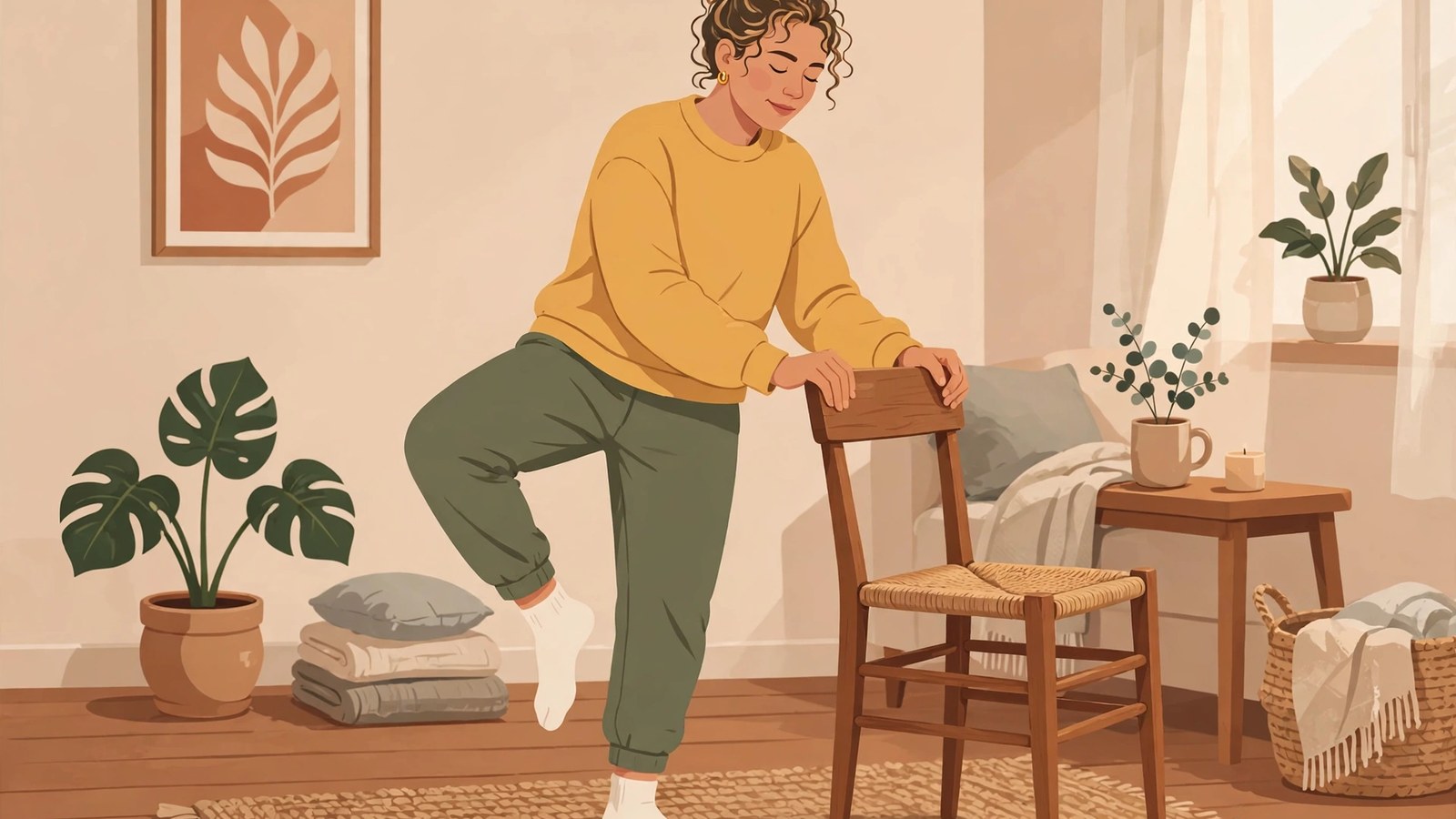
- Beginner balance exercises for stability at home start with support and progress in small steps. Set up beside a sturdy chair or counter on a clear, well lit floor, wearing flat and supportive shoes. Begin with feet together stands, slow weight shifts, heel and toe raises, and sit to stand practice, holding on with both hands. Over the next weeks, reduce support to one hand, then fingertips, and add a supported single leg stand, a heel to toe stand, leg raises, sideways walking, and a heel to toe walk. Only when those feel steady should you try brief free standing holds and unsupported tandem walking, with the chair still within reach. Practice for about 10 to 15 minutes, three times a week, plus short daily micro practices. Stop if you feel dizzy or sharply unsteady, and get professional advice first if you have fallen in the past year.
Introduction
Balance is easy to ignore until it falters. You reach for a high shelf, step off a curb, or turn quickly in the kitchen, and you notice a wobble that was not there a few years ago. The good news is that steadiness responds to practice. This guide is for complete beginners. It builds from holding a chair with both hands to standing and walking with lighter support, one small step at a time, using no equipment beyond a sturdy chair, a counter or wall, and a clear patch of floor. It is general information only and is not medical advice. Practice near support, stop if you feel dizzy, and talk with a doctor or physical therapist before you start if you have fallen before, feel unsteady often, have reduced feeling in your feet, or take medicine that affects your balance.
How Balance Actually Works
Balance is not a single skill. The Royal Berkshire NHS Foundation Trust balance leaflet, checked on 30 October 2026, explains that the brain keeps you upright by combining three inputs: the balance organs in the inner ear, called the vestibular system; the eyes, called the visual system; and the muscles and joints, which provide proprioceptive information about where your body is. The brain integrates those signals and instructs the eyes and muscles so you stay upright while still and while moving. The same leaflet notes that these inputs deteriorate with age: cataracts can impair the visual information, information from the joints and muscles is reduced, and less information comes from the balance organs. That is why a dim hallway feels harder than a bright room. Training cannot fix every cause. Practice gives the working parts more strength and rehearsed responses, so a wobble is more likely to end in a recovery step than in a fall. Daily life needs static balance, staying steady in one position, and dynamic balance, staying steady while moving, so this plan pairs holds with walking patterns.
Why Balance Training Matters
The Centers for Disease Control and Prevention, in its Still Going Strong guidance checked on 30 October 2026, reports that more than 1 in 4 older adults report falling each year, resulting in about 37 million falls. The CDC states that falls can cause serious injuries, such as broken bones or a head or brain injury, and that falls are not a normal part of aging and can be prevented. Those figures describe older adults in the United States as a group, not your personal risk.
The practical reason to train is narrower. The CDC advises older adults to do exercises that make the legs stronger and improve balance, naming tai chi as one example. The National Institute on Aging, part of the National Institutes of Health, adds that keeping muscles strong can help with balance and help prevent falls and fall related injuries, and that you are less likely to fall when your leg and hip muscles are strong. A stumble you recover from is not a fall, and that recovery step is what this progression practices. If your unsteadiness follows a recent injury, surgery, or a diagnosed condition, get individual advice first.
Where Balance Fits in a Weekly Routine
Balance work is one part of a larger activity picture. The CDC guidance for older adults, checked on 30 October 2026, states that adults aged 65 and older need, each week, at least 150 minutes of moderate intensity aerobic activity such as brisk walking, or 75 minutes of vigorous intensity activity, or an equivalent mix; at least 2 days of muscle strengthening; and activities to improve balance, such as standing on one foot. The CDC gives 30 minutes a day on 5 days a week, or about 22 minutes a day, as examples for reaching the 150 minutes. For adults aged 18 to 64, the same guidance lists the 150 minutes and 2 strengthening days, without the added balance line.
The National Institute on Aging frames exercise as four types: endurance, strength, balance, and flexibility. Its guidance, checked on 30 October 2026, states that it is important to get all four types, that doing one kind can improve your ability to do the others, and that variety helps reduce boredom and risk of injury. Its listed balance exercises are tai chi, standing on one foot, the heel to toe walk, the balance walk, and standing from a seated position, and its safety advice is to have a sturdy chair or a person nearby and to talk with your doctor if you are unsure about a particular exercise. For this plan, that means a realistic dose, not a separate hour: about 10 to 15 minutes three times a week. The NHS balance page, checked on 30 October 2026, advises doing its home balance exercises at least twice a week, building up slowly and gradually increasing repetitions. If you have a chronic condition, the CDC advises asking your doctor whether it limits your activity and doing as much as you can rather than staying inactive.
Safety First: Set Up Before You Wobble
Balance training deliberately challenges your stability, so setup matters more here than in most home exercise.
- Use a sturdy chair with no wheels, on a non slip surface, where you can sit with feet flat on the floor. Hold it as much as you need; support is part of the method.
- Stay near a second support. A counter gives you a long surface for a sliding hand, and a wall works for walking patterns. The NHS advises doing the exercises near a wall or a stable chair just in case you lose your balance.
- Clear the floor of rugs that slide, cords, and clutter, and keep the space well lit.
- Wear flat, supportive shoes with non slip soles, and avoid loose slippers. The NHS guide advises loose, comfortable clothing and water kept handy.
- Practice with someone nearby if you are unsteady or nervous, especially for any new exercise.
- Warm up gently: march in place holding the counter for about a minute, roll your ankles slowly while supported, and take a few easy sit to stands.
- Know the stop rules. Stop and sit down if you feel dizzy, nauseated, or unusually unsteady, if you have chest pain or shortness of breath, or if a movement causes sharp pain. Seek prompt advice if symptoms persist, return often, or follow a fall.
A mild wobble is normal; it is your balance system working. A feeling that you are about to fall is a signal to increase support and sit down, not to push through.
Know Your Starting Point, Without Testing Alone
Do not grade yourself with a risky test on day one. Start with three questions the CDC uses in its fall prevention work. Its Still Going Strong guidance tells older adults to tell a doctor if they have fallen, feel unsteady when standing or walking, or are afraid they might fall. The CDC STEADI approach, which stands for Stopping Elderly Accidents, Deaths and Injuries, screens for fall risk using those same concerns.
Use the questions as a routing tool, not as a diagnosis. If you answer yes to any of them, talk with a doctor or ask about a physical therapy referral before the free standing parts of this plan, and stay fully supported until you have that advice. If you answer no to all three, begin at Level 1 anyway. Track simple markers in a notebook: hold time, support used, and steadiness. Longer holds with lighter support over several weeks are real progress.
Level 1: Supported Standing, Weeks 1 to 2
Practice three times a week, holding the chair with both hands. Each exercise should feel mildly challenging but safe. Rest between exercises.
Feet together stand. Stand behind the chair, holding it with both hands, feet together. Hold for 20 to 30 seconds, breathing normally and looking at a fixed point ahead. If that feels easy across two sessions, progress to fingertips only.
Weight shifts. With both hands on the chair, shift your weight slowly onto your right foot, hold for about 5 seconds, return to center, then shift left. Repeat 5 times per side, keeping your hips level and both feet on the floor. This teaches the deliberate weight transfer that every walking step requires.
Heel and toe raises. Holding the chair, rise slowly onto your toes, hold for about 2 seconds, and lower with control. Then rock back onto your heels while lifting your toes, hold briefly, and return. Repeat up to 10 times. The NHS stay steady guidance uses the same slow heel raise pattern while holding a support. These raises strengthen the calves and ankle muscles, a first line of defense against a stumble.
Sit to stand. Sit toward the front of the chair, feet flat and slightly back. Lean forward slightly and stand up slowly, using your hands if needed, then sit back down with control. Repeat 5 to 10 times. The NHS Tayside guidance uses the same pattern and the same ceiling of up to 10 times. This rebuilds the leg power you use every time you get out of a chair, a car, or bed.
Move to Level 2 only when you can hold the feet together stand for about 30 seconds with fingertips only and complete 10 sit to stands with control. If either marker still feels shaky, stay at Level 1 for another week. Staying is training, not delay.
Level 2: Lighter Support, Weeks 3 to 4
Reduce support in order: one hand, then fingertips, then a hand hovering just above the chair. Never reduce support and add a new exercise in the same session.
Single leg stand. Hold the chair with one hand, lift one foot a few inches, and balance for 10 to 15 seconds. Switch sides, 3 times per side, keeping your standing knee soft and your eyes on a fixed point. The NHS balance page gives a gentler start: face a wall with fingertips touching it, hold for 5 to 10 seconds, 3 on each side. Use that timing if the longer hold feels like a gamble. If you wobble, touch down and reset.
Heel to toe stand. Place one foot directly in front of the other, heel touching toe, as if standing on a line. Hold the chair as needed and hold for 10 to 20 seconds, then switch feet. The NHS Tayside guidance uses a 10 second hold and advises taking your hands off only if possible.
Side leg raises. Holding the chair with one hand, lift one straight leg a few inches out to the side, hold for about 2 seconds, and lower with control. Repeat 8 times per side. This strengthens the hip muscles that steady you when your weight shifts sideways, such as stepping off a curb.
Back leg raises. Holding the chair, lift one straight leg a few inches behind you, hold briefly, and lower. Repeat 8 times per side. Keep your back straight and the movement small; control matters more than height.
Sideways walking. Stand side on to a counter, feet together, knees slightly bent. Step sideways slowly, one foot first, then bring the other to join it. The NHS balance page advises avoiding dropping your hips and performing 10 steps each way.
Heel to toe walk. Alongside a counter or wall, take 10 slow steps, each foot placed directly in front of the other, heel to toe, looking ahead. The NHS balance page sets a lower starting target: at least 5 steps, fingers against a wall if needed, moving away from the wall as you progress.
Level 3: Free Standing and Movement, Week 5 and Beyond
Move here only when Levels 1 and 2 feel steady with light support across several sessions. Keep the chair within arm reach, and return to Level 2 support on any day an exercise feels unsteady.
Single leg stand, no hands. Stand with the chair beside you but not touching it. Lift one foot and balance for up to 30 seconds, then switch sides. Repeat twice per side. If you lose balance, step down and reset. Progress is measured across weeks, not by one perfect hold.
Tandem walk without support. Walk heel to toe across your room, arms slightly out, for about 10 steps. Turn carefully with small steps, then walk back. Keep the path clear and well lit, on a firm, non slip floor only.
Step ups. Use a low step, preferably with a railing or near a wall. The NHS balance page describes the pattern: step up with the right leg, bring the left leg up to join it, step down to the start, keep it slow and controlled, and perform up to 5 steps with each leg.
Gentle turns and reaches. Turn in a small circle with small steps, in each direction, near support. Then shift your weight while reaching slowly toward an imaginary object at about waist height.
Simple grapevine, as an optional challenge. This NHS listed pattern involves walking sideways by crossing one foot over the other: cross the right foot over the left, bring the left foot to join it, and attempt 5 cross steps on each side, fingers against a wall if needed. The NHS notes that the smaller the step, the more you work on your balance. Skip it entirely if crossing your feet feels unstable. It is an option, not a requirement.
Tai chi inspired slow movement. The CDC names tai chi as an example of exercise that strengthens the legs and improves balance, and the National Institute on Aging describes it as a moving meditation involving shifting the body slowly, gently, and precisely while breathing deeply. Borrow its principle at home: shift your weight slowly from foot to foot for about 2 minutes beside your chair. A local beginner class is a natural next step.
Building Balance Into Everyday Life
Formal practice is the foundation, but everyday habits reinforce it. Stand on one foot while holding the counter and waiting for a kettle. Walk heel to toe along a hallway occasionally, with a wall within reach. Take the stairs with a handrail, one step at a time, rather than avoiding stairs entirely. Footwear matters too: supportive, low heeled shoes with non slip soles give your feet clearer information than loose slippers. The CDC Still Going Strong guidance tells older adults to have a doctor check their feet at least once a year and discuss proper footwear. Raise numbness, pain, or a change in how your feet feel at that check rather than simply training harder.
Make the Home Itself Steadier
Training and home setup work together; neither replaces the other. The CDC Check for Safety checklist, checked on 30 October 2026, is a room by room guide to fixing fall hazards. In every room, remove throw rugs or secure them with double sided tape or a non slip backing, keep floors clutter free, and coil or tape cords next to the wall. On stairs, keep objects off the steps, fix loose steps and handrails, and have handrails on both sides, with light at the top and bottom. In the bathroom, put a non slip mat or strips in the tub or shower and have grab bars installed inside the tub and next to the toilet if you need support. In the kitchen, keep items you use often at about waist height, and use a step stool with a bar, never a chair. In the bedroom, place a lamp within reach and a nightlight on the path to the bathroom. Train on your safest floor, not on stairs or in the bathroom.
Vision, Medicines, and Other Quiet Risk Factors
Exercise does not address every reason a person feels unsteady. The CDC Still Going Strong guidance advises older adults to ask a doctor or pharmacist to review their medicines, because some can make a person dizzy or sleepy and increase fall risk; to have an eye doctor check the eyes at least once a year and update eyeglasses as needed; and to ask about conditions such as depression, osteoporosis, and low blood pressure on standing. Bring specific observations: whether unsteadiness is worse on standing quickly, in dim light, or when turning your head. Never stop or change a prescribed medicine on your own; that decision belongs to the prescriber who knows your history.
A Simple Weekly Plan
Use the level that fits you now. The plan below assumes Level 1 or Level 2; Level 3 practitioners can swap in Level 3 exercises on two practice days.
| Day | Practice | Time guide |
|---|---|---|
| Monday | Full level set, in order, with full support as needed | About 10 to 15 minutes |
| Tuesday | Micro practices only, such as a supported stand at the counter | About 2 to 3 minutes total |
| Wednesday | Full level set, changing only one support or repetition detail | About 10 to 15 minutes |
| Thursday | Micro practices only, plus a short easy walk if walking is already part of your routine | About 2 to 3 minutes total |
| Friday | Full level set, ending with a notebook check in | About 10 to 15 minutes |
| Weekend | Rest from formal practice, stay generally active, note what felt easier | No set time |
Move up a level only when the current level feels steady, not merely survivable. If you miss a week because of illness or travel, the CDC advises starting again at a lower level and slowly working back up. Apply the same rule here: return with more support, rebuild for a session or two, then progress again.
Common Beginner Mistakes and How to Correct Them
Holding your breath makes you stiffer, not steadier, so breathe normally and count out loud if it helps. Looking down at your feet removes the visual anchor your balance system uses, so pick a fixed point at eye level. Locking the standing knee blocks adjustment; keep it soft. Rushing repetitions skips the learning, because slow movement gives the brain time to read and correct the signals from the eyes, inner ear, muscles, and joints. The last mistake is progressing by calendar instead of by steadiness. Your holds, not the week number, are the real schedule.
When to Seek Professional Help
Talk with your doctor or ask for a physical therapy referral if you have fallen in the past year, feel unsteady when standing or walking, worry about falling, or have dizziness, numbness, vision changes, or medicines that make you dizzy or sleepy. Those prompts match the CDC advice to speak up about a fall, unsteadiness, and fear of falling, and to have eyes and feet checked regularly. A physical therapist can tailor exercises to your strength, vision, or inner ear situation. Seek prompt advice, on the same day where possible, for sudden dizziness, a fall with injury, a sudden change in balance, fainting, chest pain, or new weakness or numbness. These can have medical causes that exercise alone cannot address. Balance improves quietly: one day you will steady yourself on an uneven sidewalk without drama and realize the wobble you trained for is the wobble you just recovered from. That is the point: not perfect stillness, but a body that knows how to find its footing again.
This article provides general information only and is not medical advice.
Frequently Asked Questions
How long does it take to notice better balance?
There is no honest single timeline, and this article will not invent one. The first signs are usually inside the exercises: a longer feet together hold with fingertips only, fewer touch downs in a single leg stand, or smoother sit to stands across several weeks. Track those markers rather than judging by one good or bad day. If nothing improves after several consistent weeks, or unsteadiness is getting worse, talk with a doctor or physical therapist rather than training harder.
Do I need any equipment for these exercises?
No special equipment is required. You need a sturdy chair with no wheels, a counter or wall, a clear and well lit patch of firm floor, and flat, supportive shoes. The National Institute on Aging gives the same safety advice in spirit: have a sturdy chair or a person nearby if you feel unsteady. Skip balance boards and foam pads as a beginner; they remove the firm ground information your feet are learning to use.
Can I do balance exercises every day?
Short, supported micro practices can be done daily, such as a counter supported stand while a kettle heats. Keep full level sets to about three times a week at first, so muscles recover and progress stays easy to judge. The NHS balance page advises doing its home exercises at least twice a week and building up slowly, which supports the same rhythm. If daily practice leaves you sore or shaky, reduce the dose and rebuild.
What should I do if an exercise makes me dizzy?
Stop, hold your support, and sit down until the dizziness passes fully. Do not move on to the next exercise in that session. Mild wobble is normal, but dizziness is a stop signal in this guide, as are nausea, chest pain, shortness of breath, and sharp pain. If dizziness happens often or suddenly, or comes with hearing changes, fainting, or a fall, seek medical advice promptly. Tell the clinician when it happens and what seems to trigger it, because that detail helps them assess medicine, blood pressure, vision, or inner ear causes.
Is tai chi better than these standing exercises?
They do different jobs and are partners rather than rivals. The CDC and the National Institute on Aging both list tai chi as balance exercise, as the Level 3 section describes. The standing plan lets you control support precisely with a chair and progress one variable at a time. Many people start there and later add a beginner tai chi class. Choose based on safety, enjoyment, and what you will actually repeat.
I have already fallen. Should I still exercise at home?
Get individual advice first. The CDC tells older adults to tell their doctor if they have fallen, and a past fall is one of its screening concerns, alongside feeling unsteady and worrying about falling. That conversation does not automatically rule out home exercise. It means a doctor or physical therapist should help you choose your starting level, support, and any exercises to avoid. Until then, do not attempt the free standing Level 3 exercises in this guide.
Keep reading: Chair Yoga for Beginners: Gentle Flexibility at Home
Keep reading: Beginner Strength Training With Dumbbells: A Full-Body Starter Routine You Can Do at Home
Sources & references
- Centers for Disease Control and Prevention, Older Adults: Adding Activity Recommendations. Used for the weekly activity amounts for adults aged 65 and older (at least 150 minutes of moderate intensity aerobic activity or 75 minutes of vigorous intensity activity or an equivalent mix, muscle strengthening on at least 2 days, and activities to improve balance such as standing on one foot), the examples of 30 minutes a day on 5 days and about 22 minutes a day, the added benefits of reduced risk of falling, more years of independent living, and improved brain health, the advice to restart at a lower level after a break for illness or travel, and the advice for people with chronic conditions to ask a doctor about limits, build a plan matching their abilities, and stay as active as they can.
- Centers for Disease Control and Prevention, What You Can Do to Meet Physical Activity Recommendations. Used for the age group summary drawn from the Physical Activity Guidelines for Americans, 2nd edition, including at least 150 minutes a week and at least 2 days of muscle strengthening for adults aged 18 to 64, and the same amounts plus balance activities for older adults aged 65 and older.
- Centers for Disease Control and Prevention, Information for Older Adults, Still Going Strong. Used for more than 1 in 4 older adults reporting falling each year and about 37 million falls, falls causing serious injuries such as broken bones or a head or brain injury, falls not being a normal part of aging and being preventable, the speak up advice to tell a doctor about a fall, unsteadiness, or fear of falling, the medicine review for dizziness or sleepiness, yearly eye checks and updated eyeglasses, yearly foot checks and discussion of proper footwear, asking about conditions such as depression, osteoporosis, and hypotension, the stay active advice to do exercises that make the legs stronger and improve balance such as tai chi, and the home safety advice to remove trip hazards and keep floors clutter free, brighten the home, install grab bars in bathrooms, and install handrails on both sides of staircases.
- Centers for Disease Control and Prevention, Check for Safety, A Home Fall Prevention Checklist for Older Adults, STEADI. Used for the room by room hazard fixes: removing or securing throw rugs, keeping objects off floors and stairs, coiling or taping cords next to walls, fixing loose or uneven steps and loose handrails, handrails on both sides for the full length of stairs, lighting and switches at the top and bottom of stairs, non slip mats or strips in the tub or shower, grab bars next to and inside the tub and next to the toilet, keeping frequently used kitchen items on lower shelves at about waist height, using a step stool with a bar and never using a chair as a step stool, placing a lamp close to the bed, and using a nightlight on the path from bed to bathroom.
- National Institute on Aging, National Institutes of Health, Four Types of Exercise Can Improve Your Health and Physical Ability. Used for the four exercise types (endurance, strength, balance, and flexibility), the finding that it is important to get all four types, doing one kind improving the ability to do the others and variety reducing boredom and risk of injury, strong muscles helping a person stay independent and making everyday activities such as getting up from a chair and climbing stairs feel easier, keeping muscles strong helping with balance and preventing falls and fall related injuries, lower leg and hip strength and fall likelihood, the balance exercise list (tai chi described as a moving meditation involving shifting the body slowly, gently, and precisely while breathing deeply, standing on one foot, the heel to toe walk, the balance walk, and standing from a seated position), and the balance safety tips to have a sturdy chair or a person nearby and to talk with a doctor if unsure about a particular exercise.
- NHS, Balance Exercises. Used for the home balance set being gentle and easy to follow, wearing loose and comfortable clothing and keeping water handy, building up slowly and gradually increasing repetitions, considering the exercises near a wall or a stable chair, doing the exercises at least twice a week, and the exercise instructions for sideways walking (feet together, knees slightly bent, slow controlled steps, avoiding dropping the hips, 10 steps each way), simple grapevine (walking sideways by crossing one foot over the other, 5 cross steps on each side, fingers against a wall if needed, smaller steps working balance more), heel to toe walk (heel directly in front of toe, looking forward, fingers against a wall if needed, at least 5 steps, moving away from the wall as you progress), one leg stand (facing a wall with fingertips touching, hips level, slight bend in the standing leg, hold for 5 to 10 seconds, 3 on each side), and step up (using a step with a railing or wall support, slow and controlled stepping up and down, up to 5 steps with each leg). Page last reviewed 7 November 2023.
- NHS Tayside, Exercises to Try at Home, via NHS Scotland Right Decisions. Used for the stay steady framing, the super six exercises three or more times a week in addition to a daily walk, falls not being an inevitable part of getting older, using a sturdy and stable chair or a solid worktop for support, the stop guidance for joint or muscle pain and for chest pain, severe shortness of breath, or dizziness, and the instructions for sit to stand (up to 10 times), heel toe stand (10 seconds with each foot in front), heel toe walking (10 steps), and one leg stand details.
- Royal Berkshire NHS Foundation Trust, Balance Exercises for Older Patients, Audiology Balance Clinic, January 2024. Used for the balance system combining three inputs (vestibular balance organs, visual system via the eyes, and proprioceptive information from muscles and joints), the brain integrating the information and sending signals to the eyes and muscles to keep a person upright when still and when moving, and the inputs deteriorating with age including cataracts impairing visual information.


