Short answer
- Plan the bedroom around where your pet actually sleeps. Give that spot a washable home: a pet bed with a removable washable cover on a washable mat, or a washable throw over the part of your bed the pet uses. Choose tightly woven, washable fabrics in mid tones or subtle patterns, keep a spare set of pet bedding so washing never waits, and use a low pile washable rug in the pet main area. Shake the throw outside daily, vacuum the pet area weekly, and wash pet bedding regularly and dry it fully. Treat allergens honestly: pet allergy is a reaction to proteins in dander, saliva, and urine, not to hair itself, and guidance for allergic people is to keep pets out of the bedroom, so sharing is a trade off to manage, not a problem a throw solves. Check every plant by botanical name against the ASPCA lists, keep true lilies out of a cat home, route cords out of reach, and store medication and small items in closed drawers.
Introduction
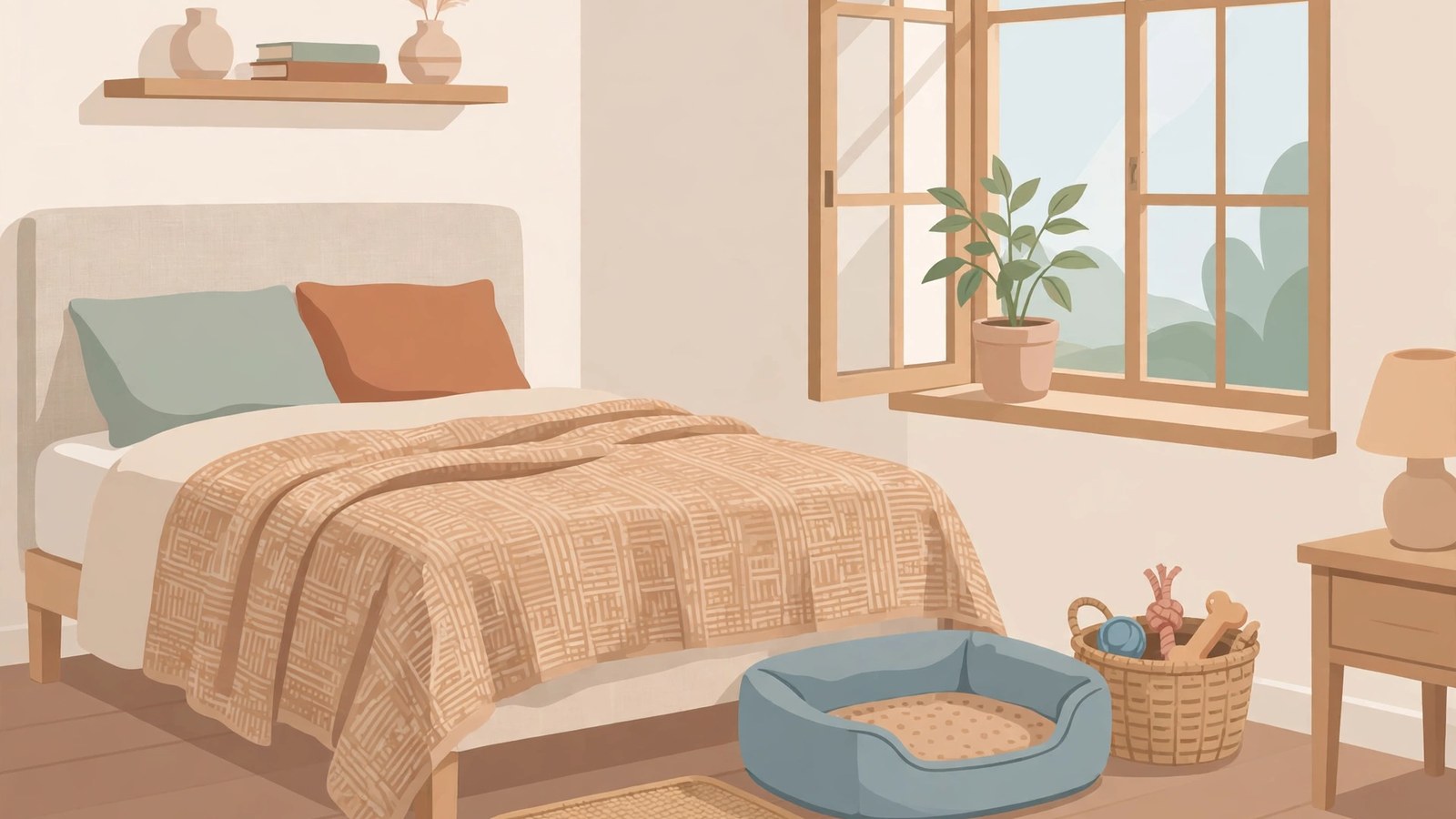
A bedroom shared with a pet can look calm, clean, and intentional. It can also look like a pet store exploded in it. The difference is rarely how much money was spent. It is whether the pet needs were planned into the room from the start, rather than added as an afterthought: a bed that slides under something, a throw that is always half off the bed, a food bowl balanced on a towel. When the pet spot, the cleaning routine, and the materials are chosen together, the room works for both species and still looks like a bedroom.
These pet-friendly bedroom ideas cover the choices that matter most in a sleeping room: where the pet sleeps, which fabrics and floors cope best, how to handle hair, odor, allergens, and night time noise, and how to keep plants, cords, medication, and small items safe. Safety and allergy statements were checked against the ASPCA, the Asthma and Allergy Foundation of America, the US Environmental Protection Agency, the US Food and Drug Administration, the Ohio State University Veterinary Medical Center, and the Cornell Feline Health Center on 30 October 2026. This is general household advice, not veterinary or medical advice. If your pet has health, allergy, or behavior concerns, talk to your veterinarian. If a person in the room has asthma or a pet allergy, talk to their doctor or allergist as well.
Start With Where the Pet Actually Sleeps
Before buying anything, watch where your pet chooses to sleep for a week. Some dogs claim a corner by the door. Some cats claim the foot of the bed, a chair, or a sunny patch that moves with the light. Some pets switch spots by season, seeking a cool floor in summer and a warm blanket in winter. Planning around the real preference saves you from buying a beautiful bed that is ignored.
Once you know the area, give it a defined place. A pet bed with a removable, washable cover on a washable mat is the simplest setup. The mat protects the floor underneath and catches hair, and the removable cover means the whole bed does not need washing every time it gets dusty. If the pet sleeps on your bed, a washable throw over its area protects the bedding and can be shaken outside and laundered regularly, without stripping the whole bed daily.
For cats, height often matters as much as softness. A perch or sturdy shelf can be a favorite spot. Check that it is stable, that the cat can get up and down without jumping onto something fragile, and that nothing breakable sits in the landing path. Older cats may prefer a low bed with a ramp or steps.
Dogs vary by size and age. A large dog needs a bed long enough to stretch out fully. A puppy benefits from a bed and floor that are easy to clean after accidents. An older dog with stiff joints often prefers a thicker, supportive bed at floor level, without a high edge to climb over. Choose the bed for the animal you have now.
Keep the sleeping spot in the same place once the pet accepts it. Moving it to suit tidying usually backfires, because the pet returns to the original corner. Make that corner look deliberate instead: align the mat with the wall and match the bed cover to the room palette.
Choose Bedding and Fabrics That Forgive
Fabric choice is where a pet-friendly bedroom either succeeds or quietly fails. The goal is not indestructible fabric, because no fabric is. The goal is fabric that releases hair easily, washes well, and does not show every paw print.
Tightly woven fabrics tend to resist snagging from claws better than loose weaves or boucle, where a claw can catch a loop and pull it. Smooth, washable covers on cushions and throws are easier to shake out and launder than heavily textured ones. Leather and faux leather can work well for a chair or a bench, because hair wipes off, but they can scratch, and they can feel cold or sticky depending on the season, so test before committing a whole room to them.
Color and pattern are practical tools, not just decoration. A very pale duvet cover in a house with a dark coated dog will show hair immediately. A mid tone color, or a subtle pattern, hides hair between washes without hiding dirt so well that you forget to clean. That balance matters: you want the room to look good on an ordinary day, not only on laundry day.
Keep at least two sets of the pet bedding and any throws they use. When one set is in the wash, the other is on the bed, so the pet spot never disappears and you are not tempted to skip washing because you have nothing to replace it with. Wash pet bedding on a regular cycle, following the label, and check that covers are fully dry before putting them back. The US Environmental Protection Agency notes that damp or wet surfaces serve as a breeding ground for molds, mildews, bacteria, and insects, and that house dust mites grow in damp, warm environments, so a cover put back damp works against the clean room you just washed it for.
Apply the same test to your own bedding. A washable duvet cover you can launder at home will get washed. A decorative cover that needs special care will be washed late. Put the easiest care layer where the pet actually lies.
Floors and Rugs in a Sleeping Room
Most floors can be made pet friendly with the right routine. Hard floors, such as wood, laminate, or tile, are easiest for hair and accidents, but can be slippery for older dogs and for cats landing from a jump. A low pile rug with a non-slip pad in the pet main area gives grip without trapping as much hair as deep pile. Avoid rugs with long loops that claws can catch.
Carpeted bedrooms need frequent vacuuming, prompt cleaning of accidents, and a washable mat under the pet bed. A small washable rug over the most used area can be laundered more easily than the whole carpet. That aligns with allergy guidance too: the Asthma and Allergy Foundation of America advises selecting low pile carpet and cleaning it often if you keep carpet, and using washable throw rugs washed weekly in hot water where you can.
Keep nails in mind as well. Cornell advises regularly trimming a cat nails to minimize scratching damage, and the same habit, done carefully or by a groomer or veterinarian if you are unsure, reduces snagging and scratch marks for dogs. Never cut so short that nails bleed, and ask a professional to show you first if you are new to trimming.
Allergens: The Honest Part of Sharing a Bedroom
Hair is what you see, but it is not what causes a pet allergy. The Asthma and Allergy Foundation of America explains that you are not allergic to pet hair, fur, or feathers. You are allergic to the protein found in pet dander, which is dead skin cells, and in saliva and urine. Hair collects that dander, and can also carry dust mites, mold, and pollen. The foundation adds that cat allergens are especially sticky, that allergens cling to walls, fabric furniture, clothing, carpets, and pillows, and that they may remain at high levels for several months.
The bedroom deserves special honesty because of the time spent there. The foundation notes that people spend about one third to one half of their time where they sleep, and its bedroom guidance notes that the bedroom tends to have the highest amount of allergens. Its direct advice for people with a pet allergy is to keep the pet and its bedding out of bedrooms, keep pets off fabric furniture, and keep the bedroom door closed. The US Environmental Protection Agency similarly lists draperies, bedding, and carpet as places where dust and biological contaminants, including animal dander, accumulate.
If someone in the household has asthma or a diagnosed pet allergy, follow that medical guidance first. Keeping the pet out is the lower exposure choice, and no routine here changes that ranking. If, after medical advice, a household still shares the room, these steps reduce exposure. They do not eliminate it. Use a washable throw over the pet area of the bed, washed weekly in hot water, as the foundation advises for slipcovers and blankets on fabric furniture. Keep the pet in its own bed rather than on pillows, which hold allergens close to your face. Wash sheets once a week in 130 F water, vacuum floors and mattresses weekly, and use allergen barrier bedding and allergen proof mattress encasements, as both the foundation bedroom guidance and the agency advise. Dust hard surfaces often with a damp or microfiber cloth, which the foundation says helps keep dander from going back into the air, and vacuum fabric furniture and carpets weekly with a HEPA filter vacuum. The agency cautions that vacuuming can increase airborne mite allergens, so allergic individuals should leave while vacuuming is done. Keep relative humidity at the 30 to 50 percent the agency generally recommends, because maintaining 30 to 60 percent helps control mold, dust mites, and cockroaches. A HEPA air cleaner, especially where people sleep, supports washing and vacuuming. It does not replace them.
Hair, Odor, and Night Time Noise
Hair is the most visible sign of a pet in a bedroom, and routine matters more than any single product. A quick daily pass with a lint roller, rubber brush, or damp cloth on the throw takes a minute and prevents buildup. A weekly vacuum of the pet area, including under the bed if the pet goes there, keeps hair from migrating into corners.
Odor is usually about bedding and air, not the pet itself. Wash pet bedding regularly, air the room daily when weather allows, and avoid heavy fresheners that mask odor without addressing it. The Asthma and Allergy Foundation of America bedroom guidance notes that scents and chemicals can affect air quality, and that even pleasant scents, such as candles, plug ins, essential oils, and potpourri, can cause asthma symptoms. If odor persists after washing and airing, check for a damp spot or a soiled item under furniture, and consult a veterinarian if the pet odor has changed suddenly.
Night time noise is a common problem. A dog that barks at hallway sounds, a cat that plays at 3 a.m., or a pet that scratches at a door can all disrupt sleep. A consistent bedtime routine helps: a last toilet trip for dogs, a play session for cats earlier in the evening, and a sleeping spot the pet actually wants to use. Keep water where it will not be knocked over in the dark, and avoid a large meal immediately before bed if it leads to restlessness. If night waking is new, frequent, or arrives with changes in behavior, appetite, or toileting, seek veterinary advice rather than assuming it is just a habit.
Safety in the Bedroom: Plants
A bedroom can hold hazards that are easy to overlook, and plants come first because they sit quietly on windowsills and shelves. The ASPCA advises checking plants by name before assuming they are safe, because pets often explore new plants by sniffing, chewing, licking, and eating them, and it warns that any plant can cause mild stomach upset when ingested, while the toxic plants on its lists can cause significant, potentially life threatening consequences.
True lilies need the clearest warning. The ASPCA states that lilies from the Lilium or Hemerocallis species can be lethal to cats, that even small exposures to pollen can cause kidney failure or death in cats, and that bouquets should be checked carefully for lilies hiding in the assortment. Its named examples include Easter lily, tiger lily, daylilies, and stargazer lily. The practical rule for a cat bedroom is simple: do not bring true lilies into the home at all, in a vase or in a pot.
Other common plants appear on the ASPCA toxic lists. In the ASPCA dog plant list checked for this article, golden pothos, Swiss cheese plant or monstera, snake plant, and peace lily all appear as toxic entries. The ASPCA explainer lists sago palm as carrying very serious consequences for dogs and cats with even small exposures, including severe stomach upset and liver damage, with seeds the most concentrated part. Cornell adds caladium, dumb cane, English ivy, philodendron, poinsettia, and mistletoe for cats, while noting its list is neither complete nor the most common list.
Safer choices exist on the ASPCA non-toxic lists, including roses, sunflowers, orchids, Boston fern, spider plant, African violet, and petunia. Non-toxic does not mean edible: the ASPCA list advises that any plant material may cause vomiting and gastrointestinal upset, and that non-toxic plants are not expected to be life threatening. Check every new plant by its botanical name before it enters the room. If you suspect ingestion, contact your veterinarian or ASPCA Poison Control at (888) 426-4435 promptly. Cornell makes the matching point: the only way to guarantee protection for both plants and cat is to block access to the plants.
Safety in the Bedroom: Cords, Medication, and Small Things
Cords are a bedroom hazard because bedrooms concentrate chargers, lamps, and fans in a small space. Ohio State lists electrical cords and wires, including holiday lights, among common household hazards for pets. Cornell adds that cats that chew fabric may also chew electrical cords, twist ties, or pins and needles, and that swallowed fabric can cause life threatening gastrointestinal obstructions. Route cables behind furniture or through cord covers, and keep chargers unplugged and put away when not in use, especially with puppies and kittens.
Small items such as hair ties, earrings, and buttons should live in closed containers or drawers, not on a bedside table where a pet can bat them onto the floor and swallow them.
Medication needs the strictest rule, because bedside tables are where people keep it. Ohio State advises never giving a pet prescription or over the counter medication unless explicitly instructed by a veterinarian, always following prescription label instructions, and keeping cleaning products stored away from pet access. Its hazard list includes acetaminophen, nonsteroidal anti-inflammatory pain medications, antidepressants, and hormone replacement products. Keep human medication in a closed cabinet or drawer, completely out of reach.
Windows, heat, and flame need a final check. A window left open without a secure screen can be an escape route for a cat or a fall risk, especially from upper floors, so check screens regularly for tears and keep balcony doors closed or supervised when a pet is in the room. Ohio State also lists lighted candles among household hazards. If your bedroom has a fireplace, a space heater, or candles, keep them away from bedding, pet beds, and tails, and never leave a lit candle or an unattended heater in a room with a free roaming pet.
Storage That Keeps Pet Things Tidy
Pet supplies multiply quickly: food, treats, leads, toys, grooming tools, medication, and spare bedding. Without a home for each category, they spread across the bedroom. A single basket or a small lidded box near the door can hold leads and everyday items. A drawer or a shelf in a wardrobe can hold grooming tools and spare bedding. Toys can live in one basket, with a simple rule that toys not in the basket at bedtime are put away, which also keeps the floor clear for night time trips to the bathroom.
Food storage deserves its own note, and the US Food and Drug Administration gives the specifics. Store dry pet food in a cool, dry place below 80 F, because excess heat or moisture can break down nutrients. Keep it in its original bag with the top tightly folded down, in a secure location that prevents a pet eating a whole supply at once. Promptly refrigerate or throw out leftover canned or pouched food, keep refrigerated food tightly covered, and set the refrigerator to 40 F or below. Keeping the original bag inside a sealed container preserves batch information on the bag. Store pet medication separately from human medication, in a closed drawer or cabinet the pet cannot open, so the two are never confused in the dark.
Keeping It Looking Good, Day to Day
A bedroom that still looks good is mostly small, repeatable habits.
- Daily: Shake the throw outside, do a one minute lint or damp cloth pass over the pet area of the bed, and return toys to the basket at night.
- Weekly: Vacuum the pet area, including under the bed if the pet goes there, wash pet bedding and the throw, and wash your sheets. If anyone in the room has an allergy, use the hot water and barrier bedding steps above.
- Monthly: Wash or clean rugs following their labels, check screens, cord covers, and the pet bed cover for wear, and check that medication and small items are still in closed storage.
Choose a palette and textiles you genuinely like, rather than defaulting to everything brown or everything washable looking. A favorite cushion in a washable cover, art placed where a wagging tail cannot reach it, and a lamp with a stable base all keep the room feeling like yours.
Finally, accept a little imperfection. Hair will land on a dark cushion, a toy will end up under the bed, and a throw will be rearranged by a kneading cat. That is not failure. Plan the pet place, choose forgiving fabrics, keep the routine short and regular, and the room will look good not in spite of the pet, but because the pet was part of the plan.
Frequently Asked Questions
What fabrics work best in a pet-friendly bedroom?
Tightly woven, smooth, washable fabrics work best for most homes, because they resist claw snagging better than loose weaves, release hair more easily, and can be laundered at home. Use them for the throw, duvet cover, and pet bed cover where the pet actually lies, keep a spare set so washing never waits, and choose a mid tone or subtle pattern close to your pet coat color so hair shows less between washes. No fabric is pet proof, and the care label for the item you own governs how it should be washed.
Should my pet sleep on my bed or in its own bed?
Either can work if it is planned. A pet on your bed needs a washable throw over its usual area, washed weekly, so your bedding is protected without a daily strip. A pet in its own bed needs that bed placed where the pet already chooses to sleep, with a removable washable cover on a washable mat. The exception is health: allergy guidance from the Asthma and Allergy Foundation of America is to keep pets out of bedrooms and off beds for people with a pet allergy, so follow medical advice for the people in the room first.
How often should I wash pet bedding in the bedroom?
Wash pet bedding weekly as a working routine, and sooner if it smells, looks dirty, or the pet has been ill or has had an accident. Follow the care label, and dry covers fully before putting them back, because damp bedding can smell and damp surfaces support mold and dust mites. Keeping two sets makes a weekly wash realistic, because the pet spot can be remade immediately with the clean set while the other set is in the wash.
Which bedroom plants are unsafe for cats and dogs?
Check every plant by botanical name against the ASPCA lists before it enters the room. True lilies can be lethal to cats, with even small pollen exposures able to cause kidney failure. Golden pothos, monstera, snake plant, and peace lily appear on the ASPCA toxic list for dogs, sago palm carries very serious consequences for dogs and cats, and Cornell also names caladium, dumb cane, English ivy, philodendron, and poinsettia for cats. Spider plant, Boston fern, orchids, African violet, and roses are ASPCA non-toxic examples, but non-toxic does not mean edible, because any plant material may cause vomiting or stomach upset.
I have a pet allergy but still want my pet in the bedroom. What helps most?
Start with medical advice, because the lowest exposure choice in Asthma and Allergy Foundation of America guidance is keeping the pet out of the bedroom and off the bed. If you share the room after that advice, use a washable throw barrier washed weekly, keep the pet in its own bed rather than on pillows, wash sheets once a week in 130 F water, use allergen barrier bedding, vacuum weekly with a HEPA filter vacuum, dust with a damp cloth, and keep humidity in the 30 to 50 percent range the Environmental Protection Agency generally recommends. These steps reduce allergens. They do not eliminate them.
How do I reduce night time waking by my pet?
Use a predictable last hour: a toilet trip for a dog, play for a cat earlier in the evening, water where it will not be knocked over, and no large meal immediately before bed if it leads to restlessness. Keep the sleeping spot in its fixed, preferred place so the pet settles. If night waking is new, frequent, or arrives with changes in appetite, toileting, or behavior, book a veterinary check rather than treating it as a decorating problem.
Sources & references
- ASPCA, Do You Know Which Flowers and Plants Are Toxic to Pets? Used for pets exploring plants by sniffing, chewing, licking, and eating them, any plant being able to cause mild stomach upset while listed toxic plants can cause significant and potentially life threatening consequences, true lilies from the Lilium or Hemerocallis species being lethal to cats with even small pollen exposures able to cause kidney failure or death, the named lily examples, sago palm carrying very serious consequences for dogs and cats with even small exposures including severe stomach upset and liver damage with seeds most concentrated, tulips, oleander, and autumn crocus as additional toxic examples, the non-toxic examples including roses, sunflowers, orchids, Boston fern, spider plant, African violet, and petunia, and the advice to contact a veterinarian or the ASPCA Poison Control 24 hour hotline at (888) 426-4435 if ingestion is suspected.
- ASPCA, Toxic and Non-Toxic Plants list and Toxic and Non-Toxic Plant List, Dogs. Used for checking a plant by its name to determine toxicity, the list not being all inclusive, consumption of any plant material being able to cause vomiting and gastrointestinal upset for dogs and cats, plants listed as non-toxic not being expected to be life threatening, and the toxic to dogs entries for golden pothos (Epipremnum aureum), Swiss cheese plant or monstera (Monstera deliciosa), snake plant (Sansevieria trifasciata), and peace lily (Spathiphyllum).
- Asthma and Allergy Foundation of America, Allergic to Your Pet? Learn About Dog and Cat Allergies. Used for pet allergy being a reaction to protein in dander, saliva, and urine rather than to hair itself, hair collecting dander and carrying dust mites, mold, and pollen, allergies to cats and dogs affecting 10 to 20 percent of the world population, cat allergens being especially sticky, allergens collecting on furniture and clinging to walls, fabric furniture, clothing, carpets, and pillows and remaining at high levels for several months, people spending about one third to one half of their time where they sleep, the advice to keep pets and their bedding out of bedrooms and off fabric furniture and to keep the bedroom door closed, damp cloth dusting, slipcovers or blankets washed weekly in hot water, weekly vacuuming with a HEPA filter vacuum, low pile carpet cleaned often or washable throw rugs washed weekly in hot water, hard surface flooring as an option, and air cleaners with HEPA filters.
- Asthma and Allergy Foundation of America, Breathe Easier: Improving Indoor Air Quality in Your Bedroom. Used for spending one third of our lives in bedrooms, the bedroom tending to have the highest amount of allergens, allergen barrier bedding, washing sheets once a week in 130 F water, keeping pets out of the bedroom and off the bed, vacuuming floors and mattresses weekly, and scents and chemicals including candles, plug ins, essential oils, and potpourri being able to cause asthma symptoms.
- US Environmental Protection Agency, Biological Pollutants Impact on Indoor Air Quality. Used for biological contaminants including animal dander and cat saliva, household pets as sources of saliva and animal dander, draperies, bedding, carpet, and other dust collecting areas accumulating biological contaminants, damp and wet surfaces as breeding grounds for molds, mildews, bacteria, and insects, house dust mites growing in damp and warm environments, a generally recommended relative humidity of 30 to 50 percent and maintaining 30 to 60 percent to help control mold, dust mites, and cockroaches, regular cleaning reducing although not eliminating dust mites, pollens, and animal dander, allergen proof mattress encasements and washing bedding in hot 130 F water for allergic people, and vacuuming being able to increase airborne levels of mite allergens so allergic individuals should leave while vacuuming is done.
- Ohio State University Veterinary Medical Center, Protect Your Pet from Household Hazards. Used for never giving a pet prescription or over the counter medication unless explicitly instructed by a veterinarian, always following prescription label instructions, keeping household cleaning products safely stored away from pet access, seeking emergency care and contacting ASPCA Animal Poison Control if a toxin is ingested, and the hazard list including acetaminophen, nonsteroidal anti-inflammatory pain medications, antidepressants, hormone replacement products, household cleaning products, electrical cords and wires including holiday lights, and lighted candles.
- Cornell Feline Health Center, Cornell University College of Veterinary Medicine, Feline Behavior Problems: Destructive Behavior, updated March 2018. Used for scratching as innate marking behavior, regularly trimming cat nails to minimize scratching damage, plastic nail caps replaced every 6 to 12 weeks for cats that allow paw handling, fabric chewing being able to cause life threatening gastrointestinal obstructions and cats that chew fabric also chewing electrical cords, twist ties, and pins and needles, the houseplant chewing list including caladium, dumb cane, English ivy, lilies, mistletoe, oleander, philodendron, and poinsettia with the list being neither complete nor the most common list, and blocking access as the only way to guarantee protection for both houseplants and the cat.
- US Food and Drug Administration, Tips for Safe Handling of Pet Food and Treats. Used for storing dry pet food in a cool and dry place below 80 F because excess heat or moisture can break down nutrients, storing dry pet food in its original bag with the top tightly folded down, keeping pet food in a secure location to prevent a pet eating an entire supply at once, and promptly refrigerating or throwing out unused or leftover canned and pouched pet food with refrigerated food tightly covered and the refrigerator set to 40 F or below.


