Short answer
- Beans grow from seeds. A bean seed contains a young plant, called an embryo, plus stored food. When the seed takes in water in warm, moist soil, growth restarts. A root grows downward first, then a shoot grows upward and breaks through the soil surface. The seedling makes leaves, uses sunlight to make its own food, and grows into a bushy plant or a climbing vine, depending on the type. Flowers then form, and after flowering, pods develop. Inside each pod, new bean seeds grow and mature. Snap beans are usually picked while pods are young and tender. Dry beans are left until pods dry. Timing varies by variety and region, because warmth, light, water, and soil shape every stage.
What a Bean Is
In everyday language, the word bean covers several plants and foods. Most common garden beans belong to the legume family, Fabaceae. The common garden bean is Phaseolus vulgaris, which includes most snap beans and many dry beans. Other garden beans, such as lima beans, fava beans, cowpeas, and soybeans, belong to related groups, and their details differ.
A bean that you eat is a seed, and a pod is the fruit that holds seeds. Snap beans are an exception in use, not in growth: the whole young pod, with small immature seeds inside, is eaten. Dry beans are used after seeds mature and pods dry. Shell beans sit between those uses: the pod is opened and seeds inside are eaten fresh or after drying.
Beans are annual plants in most gardens, completing their life cycle in one growing season, from seed to seed. They are warm season plants that do not tolerate frost well, and cold soil slows or stops germination.
Inside a Bean Seed
A bean seed looks simple from the outside, but it already contains the parts of the future plant in miniature. The outer seed coat protects the inside from damage and drying. Inside the coat, the embryo has a root tip, a shoot tip, and two seed leaves, called cotyledons. Common beans are dicots, which means they have two cotyledons. Those cotyledons are thick and fleshy because they store food for the young plant.
The main parts are:
- Seed coat: the protective outer layer. It softens as it takes in water.
- Cotyledons: the two seed leaves. They store food and, in common beans, rise above the soil and help feed the seedling until true leaves take over.
- Radicle: the embryonic root. It is the first part to emerge, and it grows downward.
- Hypocotyl: the stem section below the cotyledons. In common beans, it lengthens and lifts the cotyledons above the soil.
- Plumule: the embryonic shoot. It carries the first true leaves upward after emergence.
Not every bean follows the same pattern. In fava beans, cotyledons stay below the soil while the shoot grows up, called hypogeal germination. In common beans, cotyledons rise above the soil, called epigeal germination. Both patterns still begin with water uptake, root growth, and shoot growth.
Stored food matters because a seedling cannot make its own food until it has leaves in light. As the seedling grows, stored food is used up, cotyledons shrink and fall away, and true leaves take over through photosynthesis.
Germination: How a Bean Seed Wakes Up
Germination is the restart of growth inside a seed. It needs water, suitable warmth, and air at the same time. Without water, the seed stays dormant. Without warmth, growth is slow, and in cold, wet soil, seeds may rot before they emerge. Without air in the soil, root growth stalls.
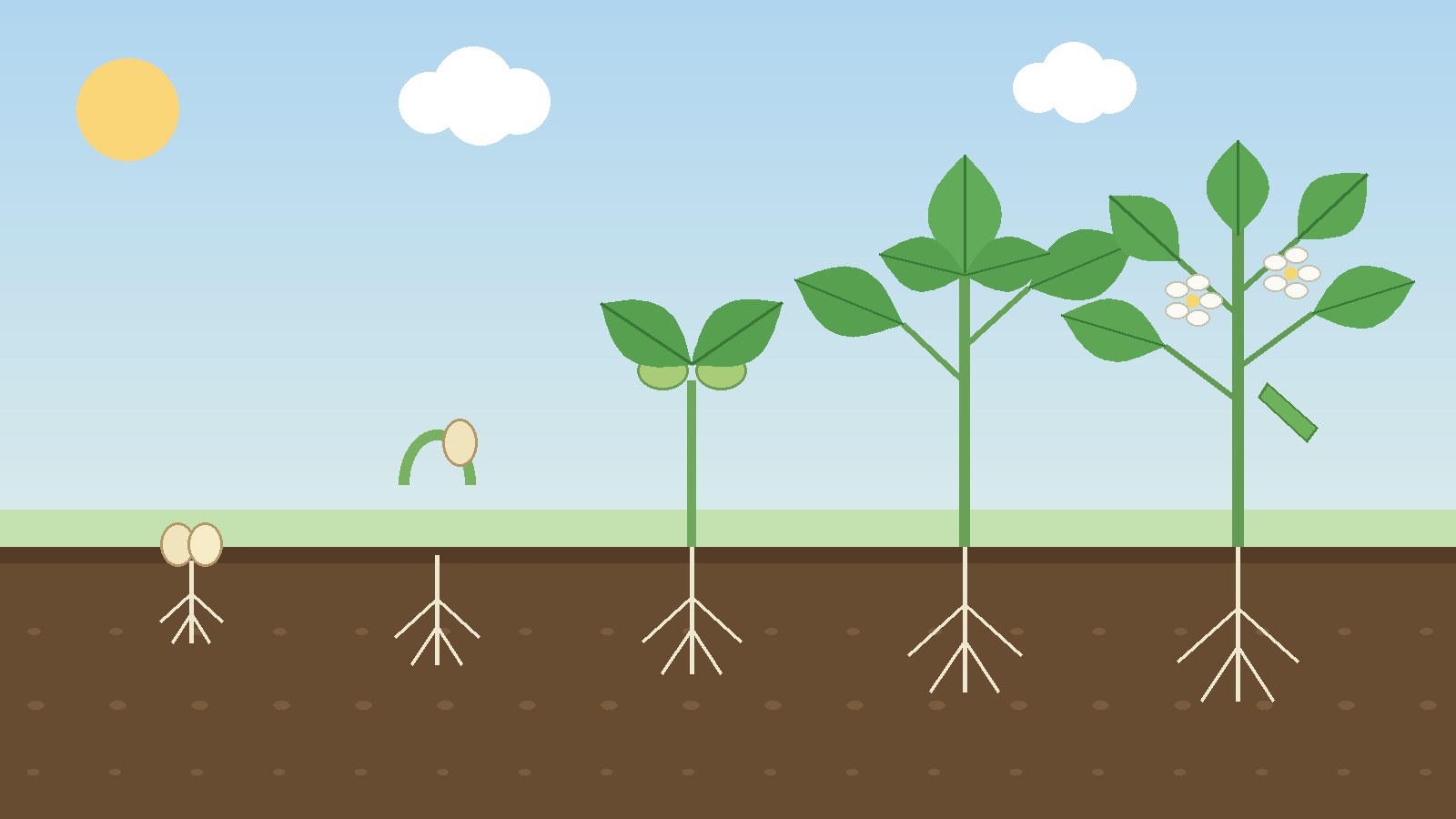
Germination follows a sequence that is similar across common bean types, although timing varies with temperature, variety, seed age, and soil conditions:
- Water uptake, called imbibition. The dry seed absorbs water through the seed coat. It swells, the coat softens, and internal activity restarts. Stored food begins to break down into forms the embryo can use.
- Radicle emergence. The embryonic root breaks through the seed coat and grows downward. This is the first visible sign of growth. The root anchors the seedling and begins to take in water.
- Hypocotyl elongation. In common beans, the stem section below the cotyledons lengthens and forms a loop, or hook, that pushes upward through the soil. The loop protects the delicate shoot tip as it moves through soil.
- Emergence. The loop straightens at the surface, lifting the cotyledons above the soil. The cotyledons open and turn green in light.
- True leaf growth. The shoot above the cotyledons grows, and the first true leaves unfold. Germination gives way to seedling growth, and the plant begins to rely more on photosynthesis than on stored seed food.
Utah State University Extension reports that seedlings emerge in 7 to 10 days when soil has warmed to 65 to 85 degrees Fahrenheit. That range is a guide, not a promise for every garden. In cooler soil, emergence takes longer, and below about 60 degrees Fahrenheit, germination is greatly reduced, according to the same source. Clemson Cooperative Extension gives a similar lower guide, advising not to plant before soil temperature reaches at least 60 degrees Fahrenheit at a depth of 4 inches. Iowa State University Extension notes that most beans need soil temperatures of at least 65 degrees Fahrenheit, with fava beans as an exception. These sources agree on the direction, even though exact thresholds differ by region and bean type: beans need warm soil to germinate well.
A soil crust can block a seedling, a shallow seed may dry out, and a deep seed must use more stored food to reach light. Consistent moisture, without waterlogging, matters in the first days after sowing. A seed that fails to emerge usually met cold, wet, or crusted soil, or was old, poorly stored, or rotted in cold, wet conditions.
From Seedling to Established Plant
After emergence, growth changes character. The seedling is no longer living mainly on stored food. Its true leaves capture light, and its roots take in water and nutrients. Leaves grow larger, stems lengthen, and side branches form. The plant builds the leaf area it will need to support flowering and pod filling later.
In the early seedling stage, the plant is fragile, with a soft stem, small leaves, and a shallow root system. Even moisture helps, because drying out can check growth, while standing water can encourage root rot. Shallow cultivation is preferred for weed control near young plants, because deep digging can damage shallow roots.
As the plant grows, its growth habit becomes clear. Bush beans stay compact, pole beans send out long vines that seek support and climb, and half-runner beans fall between the two habits. Growth habit is set by variety, although support, spacing, and light affect how fully it expresses itself.
Leaf growth also sets up later pod production, because pods draw on food made by leaves. A plant that loses many leaves to pests, disease, or stress will usually produce fewer or smaller pods.
Flowering and Pod Formation
After the plant has built leaves and stems, it shifts toward flowering, and then pods form. This section keeps that shift at the growth cycle level; detailed reproduction biology belongs in a separate article.
In beans, flowers form after vegetative growth is well under way. Bush types tend to flower over a shorter, more concentrated period, which is why much of their crop ripens together. Pole types keep growing and flowering over a longer period, which is why they keep producing pods as long as conditions stay favorable and pods are picked regularly.
After a flower is fertilized, the ovary begins to grow into a pod, and seeds begin to form inside it. At first, pods are small and tender, and seeds inside are tiny. As pods fill, seeds enlarge. For snap beans, the useful stage is reached while pods are full size but seeds are still small and pod flesh is still tender. Utah State University Extension states that pods are ready for harvest about 7 to 14 days after flowering, and that bush varieties flower and mature pods for about 2 to 3 weeks, while pole types do so for about 5 to 6 weeks. Picking regularly matters for snap beans because leaving mature pods on the plant can slow further pod production.
For shell beans and dry beans, the timeline is longer. Shell beans are picked when seeds are full size but pods are still green. Dry beans are left until pods turn yellow and dry, and seeds inside harden. Virginia Cooperative Extension gives 50 to 60 days for snap beans, 65 to 75 days for bush limas, 85 to 110 days for pole limas, and 60 to 110 days for pole beans. Iowa State University Extension gives 50 to 60 days for bush snap beans, 60 to 90 days for pole snap beans, and 70 to 110 days for dry beans.
Bush Beans, Pole Beans, and Half-Runners
Growth habit is one of the most visible differences in how beans grow, and it affects space, support, and harvest pattern.
Bush beans grow as compact, upright plants that usually reach about 2 to 3 feet tall, according to Iowa State University Extension. They do not need support. They tend to produce earlier than pole beans, and most of their crop ripens over a short period, often about two weeks for snap types. That concentrated pattern suits gardeners who want a large picking at once, and it explains why successive sowings are often used to extend the bush bean season.
Pole beans grow as vines that climb. Iowa State University Extension notes that pole beans often exceed 5 to 6 feet tall, and need sturdy supports at least 6 feet tall. Clemson Cooperative Extension recommends trellises at least 6 to 8 feet tall, strong enough to withstand wind and rain. Pole vines keep growing and producing over a longer period than bush beans, as long as pods are picked and weather stays favorable. They produce more per square foot of ground in many gardens because growth goes upward, but they need support in place early, before vines need it.
Half-runner beans sit between the two habits. They produce runners about 3 feet long, according to Clemson Cooperative Extension, and are generally grown like bush beans, although a shorter trellis of about 3 to 4 feet may increase yield. Their harvest pattern is also intermediate: less concentrated than a bush bean, less extended than a pole bean.
Determinate types, such as most bush beans, flower and fruit in a concentrated flush. Indeterminate types, such as most pole beans, keep growing and flowering while conditions allow. Snap, shell, and dry beans are uses, not habits, so each use can be bush or pole.
What Beans Need: Soil, Water, Light, and Temperature
Beans are not demanding plants, but they do have clear preferences, and growth reflects those preferences through the season.
Soil. Extension sources agree that beans grow best in fertile, well drained soil with organic matter. Utah State University Extension states that beans grow in all soil types provided they are rich in organic matter, well drained, and fertile. Virginia Cooperative Extension lists well drained, deep sandy loam, medium rich fertility, and a pH of 5.8 to 7.0 as environmental preferences. Clemson Cooperative Extension recommends maintaining soil pH between 5.8 and 6.5 for snap beans, based on a soil test. The exact pH range differs slightly by source and region, which is why a local soil test is more useful than a single national number. In general terms, beans prefer soil that is not strongly acidic or strongly alkaline, drains well, and holds moisture without staying soggy. Loose soil lets roots grow and seedlings emerge, while heavy clay that crusts can block emergence. Beans have a low to moderate fertilizer requirement, and excess nitrogen can cause leafy growth with fewer pods.
Water. Beans need consistent moisture, especially during flowering and pod development. Iowa State University Extension states that beans require about 1 inch of water per week, from rain or irrigation, especially during blossoming and pod development. Utah State University Extension states that water needs are most critical during flowering and pod sizing, and that drought stress during and after flowering decreases yield through flower abortion, smaller pods, and increased stringiness. Clemson Cooperative Extension notes that the critical period for moisture is during pod set and pod development, and advises watering deeply enough to moisten soil to about 6 inches, rather than light sprinkles that encourage shallow roots. Watering the soil, rather than wetting foliage, reduces leaf disease risk. Overwatering also causes problems, because wet soils promote root rot and slow growth.
Light. Beans need full sun for good growth and yield. Utah State University Extension, Clemson Cooperative Extension, and Iowa State University Extension all describe full sun as the requirement. In practical terms, full sun usually means at least 6 hours of direct sun per day. Light shade may be tolerated by some snap beans, but yield usually falls.
Temperature. Beans are warm season plants, and temperature shapes every stage. For germination, soil warmth matters most, as described above. For growth, Virginia Cooperative Extension lists warm temperatures of 65 to 80 degrees Fahrenheit as preferred, except fava beans, which prefer cooler conditions of 60 to 65 degrees Fahrenheit. Clemson Cooperative Extension describes snap beans as growing best at average temperatures between 60 and 75 degrees Fahrenheit. Utah State University Extension states that hot weather above 95 degrees Fahrenheit, combined with dry conditions, causes flowers to drop, and Clemson notes blossom drop above 90 degrees Fahrenheit, with pod set usually resuming when temperatures cool. These ranges differ because they describe different measures and regions, but they point the same way: beans grow best in warm, but not extremely hot, weather, and they are killed by light frost. Local extension planting dates reflect regional variation better than any single national calendar.
Common Problems and What Causes Them
Most bean problems show up as poor emergence, poor flowering, leaf damage, or pod problems, and each pattern points to a different cause.
Poor emergence. Cold soil, wet soil, crusted soil, and old seed are the most common causes. Seed rot in cold, moist soil is listed by Virginia Cooperative Extension among common diseases, with the advice not to plant in cold, moist soils. Waiting for warm soil, using fresh seed, and avoiding waterlogged beds reduce this risk.
Blossom drop and poor pod set. Heat and dryness during flowering are the leading cultural causes, as noted above. Excess nitrogen, which promotes leafy growth at the expense of flowers and pods, is another cultural cause listed by Virginia Cooperative Extension. If flowers drop during a heat wave but plants are otherwise healthy, pod set often resumes when temperatures cool, according to Clemson guidance.
Leaf damage and pests. Clemson Cooperative Extension lists Mexican bean beetles, thrips, aphids, corn earworms, and stink bugs among insect problems for snap beans. Utah State University Extension describes Mexican bean beetles and leaf beetles, leafhoppers, cutworms, and army worms, with leaf feeding, curling, and drying as symptoms. Damage is usually worst when plants are small, and larger flowering plants can often withstand some feeding with minimal loss in production. Correct identification matters, because control differs by pest.
Diseases. Common diseases include root rot, rust, gray mold, anthracnose, bacterial blight, and mosaic virus. Damp conditions favor bacterial blight, and cool, wet spring conditions are linked to root rot and damping off, where seedlings darken, wilt, and die. Rotating bean locations helps control many diseases, and choosing varieties resistant to bean common mosaic virus and anthracnose is advised by Clemson Cooperative Extension. Avoid handling plants when foliage is wet, because that can spread some diseases.
Stringy or tough pods. Heat or water stress during pod development can make snap bean pods fibrous and stringy, according to Utah State University Extension. Some heirloom varieties are naturally more stringy than modern stringless types. Picking snap beans on time, while pods are tender, also matters: pods left too long become tougher as seeds enlarge.
Harvesting and Saving Seed
Harvest timing depends on how the bean will be used, because the same plant produces pods at different stages for different uses.
Snap beans are picked while pods are full size, tender, and crisp, before seeds bulge visibly through the pod. Clemson Cooperative Extension advises harvesting before the enlarging seed can be seen through the pod, while pods still break easily with a snap. Utah State University Extension advises picking when pods are full but seeds are not yet formed, and picking regularly. Regular picking keeps plants producing, especially for pole types.
Shell beans are picked when seeds are full size and pods are still green, then shelled. The pod itself is usually fibrous at that stage and is not eaten. Lima beans follow this pattern: seeds are shelled when pods begin to bulge but are still green, according to Iowa State University Extension.
Dry beans are picked when pods are fully mature and dry. Iowa State University Extension describes dry bean pods that rattle slightly when shaken, with mature seeds inside. Utah State University Extension advises leaving dry beans until pods yellow and dry, then pulling plants and laying them in a row for several days, shelling seeds, and drying seeds further before storing in sealed containers in a cool, dry place. For home storage, dry, mature seed kept cool and dry stores best, and seed saved for planting should come from healthy plants and fully mature pods.
Saving seed is, in growth terms, simply letting the cycle complete: allow some pods to mature and dry on the plant, harvest the dry seeds, dry them further, and store them. Seed from hybrid varieties may not grow true to the parent, so seed saving is most reliable with open pollinated varieties. Saved seed should be labeled with variety and year, because germination declines with age and poor storage. After harvest, bean roots with nodules can be left to break down in the soil, while diseased top growth should not go into a cool home compost pile.
How Beans Fix Nitrogen
Beans belong to the legume family, and their roots form small swellings, called nodules, that house bacteria known as rhizobia. Those bacteria convert nitrogen gas from the air into a form plants can use, a process called nitrogen fixation. The plant supplies bacteria with organic compounds, and bacteria supply the plant with usable nitrogen. West Virginia University Extension describes this symbiosis: bacteria enter roots, multiply, fix atmospheric nitrogen gas, convert it to ammonia, and make it available to the plant.
Nodules are not present on every bean root automatically. The right strain of rhizobia must be present in soil near the seed, or on the seed coat at planting. West Virginia University Extension stresses that live rhizobia specific to the crop must be planted with the seed. In soils where beans have grown before, bacteria may already be present; in new beds, inoculant containing live rhizobia can supply them. Oregon State University Extension notes that where snap beans have grown before, inoculation is unnecessary, but snap beans are inefficient fixers, and nodulation cannot entirely support nitrogen demand, so some fertilizer is still needed.
That point corrects a common oversimplification. Beans do fix nitrogen, but they do not necessarily add a large surplus while growing, and they do not eliminate the need for fertile soil. Much fixed nitrogen leaves with harvested seeds. The net benefit to a following crop comes mainly from roots, stems, and leaves left in the soil after harvest. Virginia Cooperative Extension adds that beans fix nitrogen once a good root system is established, but excess nitrogen delays flowering.
Gardeners can check nodulation after harvest by digging up a plant carefully, washing roots, and looking for nodules. West Virginia University Extension notes that active nodules, when squeezed, should show a reddish color inside. Pale or white nodules, or no nodules, suggest fixation is not working well.
Frequently Asked Questions
How long do beans take to grow?
It depends on type and variety. Bush snap beans often mature in about 50 to 60 days, pole snap beans in about 60 to 90 days, and dry beans in about 70 to 110 days. Soil warmth, water, and weather shift those ranges.
Do beans need full sun?
Yes, for best growth and yield. Extension sources consistently describe full sun, fertile, well drained soil as the basic requirement. At least 6 hours of direct sun per day is a useful minimum, with more sun generally better, provided water is adequate.
Why did my bean seeds not come up?
The most common causes are soil that was too cold, soil that stayed too wet, a crusted soil surface, or old or poorly stored seed. Utah State University Extension lists cold soil below 60 degrees Fahrenheit, heavy clay crusting, and old seed among causes of poor emergence. Check soil warmth and moisture first, and use fresh seed.
How do beans grow so fast?
Beans are warm season plants with rapid early growth once soil is warm and moisture is steady. Clemson Cooperative Extension describes snap beans as rapid growers. Fast growth still depends on warmth, light, water, and healthy leaves. Stress during flowering or pod filling slows growth and reduces yield, even in a fast variety.
What is the difference between bush and pole beans?
Bush beans are compact plants, usually about 2 to 3 feet tall, that do not need support and produce most of their crop over a short period. Pole beans are climbing vines, often over 5 to 6 feet tall, that need a sturdy trellis and produce over a longer period. Half-runner beans fall between the two habits.
Do beans really add nitrogen to soil?
Beans fix nitrogen through rhizobia bacteria in root nodules, which converts atmospheric nitrogen into a form plants can use. That does not mean beans need no fertilizer, or that they leave a large surplus while growing. Snap beans in particular are inefficient fixers, according to Oregon State University Extension, and much fixed nitrogen leaves with harvested seeds. Residues left in the soil after harvest provide the main benefit to following crops.
Why are my bean flowers falling off?
Heat and dryness during flowering are the most common cultural causes. Utah State University Extension links flower shedding to temperatures above 95 degrees Fahrenheit with dry conditions, and Clemson notes blossom drop above 90 degrees Fahrenheit. Pod set often resumes when temperatures cool and moisture is restored. Excess nitrogen can also reduce flowering.
When should snap beans be picked?
Pick snap beans when pods are full size, tender, and crisp, before seeds bulge through the pod. Pick regularly, because regular picking encourages continued production, especially in pole types. Pods left too long become tougher and seedier.
Can beans grow in containers?
Bush beans can grow in large containers with full sun, well drained soil mix, and consistent water. Pole beans need a tall, stable support and dry out faster in pots.
How do I save bean seeds for next year?
Let some pods mature and dry fully on the plant, harvest the dry seeds, dry them further, and store them in a sealed container, labeled with variety and year. Seed from hybrid varieties may not grow true to the parent, and germination declines with age.
Keep reading: How to Start a Community Garden in Your Neighborhood
Keep reading: How Do Plants Reproduce
Sources & references
- Utah State University Extension. How to Grow Beans in Your Garden. https://extension.usu.edu/yardandgarden/research/beans-in-the-garden
- Clemson Cooperative Extension. Bush and Pole-Type Snap Beans. https://hgic.clemson.edu/factsheet/bush-pole-type-snap-beans/
- Iowa State University Extension, Yard and Garden. All About Beans. https://yardandgarden.extension.iastate.edu/how-to/all-about-beans
- Virginia Cooperative Extension, Virginia Tech. Beans. https://www.pubs.ext.vt.edu/content/pubs_ext_vt_edu/en/426/426-402/426-402.html
- West Virginia University Extension. Legumes and Nitrogen Fixation. https://extension.wvu.edu/lawn-gardening-pests/news/2021/11/01/legumes-nitrogen-fixation
- Oregon State University Extension. Snap Bean, Western Oregon Nutrient Management Guide EM 9154. https://extension.oregonstate.edu/sites/extd8/files/documents/em9154.pdf


