Short answer
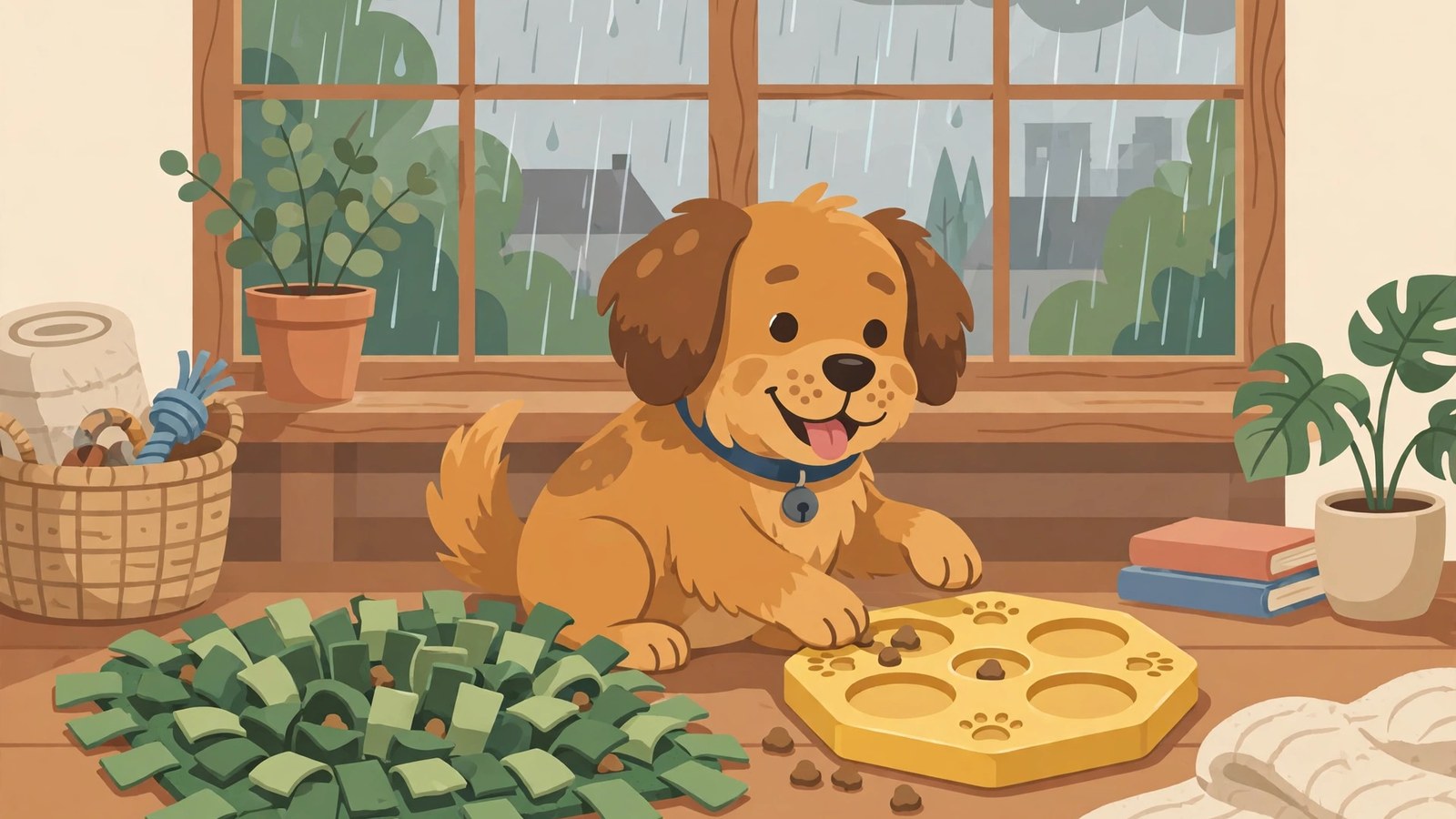
- On a rainy day, replace the missing walk with several short blocks of mental work rather than one long burst of indoor exercise. Serve part of the normal meal in a food puzzle, a snuffle mat, or a scatter search instead of a bowl. Add a scent game such as find it or a box search, one or two training bursts of about five minutes, and a calm activity such as a lick mat or a supervised chew to finish. Use only foods your dog already tolerates, count every enrichment treat inside the daily food total, and check any peanut butter label for xylitol before it goes into a toy. Supervise new toys and homemade puzzles closely, remove anything that breaks or starts to be eaten, and make each game easier if your dog looks frustrated. That mix tires the mind, protects joints and furniture, and leaves most dogs ready to settle.
Introduction
Dog enrichment activities indoors are the practical answer when rain cuts a walk short and a dog who is used to sniffing, exploring, and playing outside starts pacing, barking, chewing, or following people from room to room. The fix is not always more physical exercise inside the house. In a small home, indoor running can be impractical and can end in slips, collisions, and broken objects. Mental work is usually easier to provide in a living room or kitchen: problems to solve, scents to investigate, food to search for, and choices to make.
The ASPCA makes the same point in its at home enrichment guidance: a key to a happy and healthy pet is regular enrichment that lets a dog engage in innate behaviors such as sniffing and chewing, and boredom can lead to destructive and undesirable behavior patterns for some pets. This guide organizes indoor ideas by type, covering food puzzles, scent games, training games, and calm settling activities, with a safety rule and a food check attached to each one. Every dog is different, so start easy, supervise anything new, and adjust for your dog’s size, age, chewing style, and health. This article is general information, not veterinary or professional training advice for a specific dog.
What Enrichment Means, and Why It Tires a Dog
Enrichment is a broad term for activities that let an animal use its natural behaviors: sniffing, foraging, chewing, digging, playing, and learning. The ASPCA describes the key to a happy and healthy dog as regular enrichment that allows innate behaviors such as playing, chasing, smelling, chewing, and scavenging, and it adds that dogs who do not receive stimulation tend to find ways to enrich themselves, resulting in unwanted behaviors. In plain terms, a dog with no job will invent one, and the invented job is rarely one the household would choose.
A pet dog gets food in a bowl in seconds and may then spend hours waiting for the next outing. Enrichment fills that gap by stretching ordinary parts of the day. The ASPCA notes that every meal is an opportunity for enrichment, and that food puzzles can slow down a dog’s eating and provide mental stimulation at the same time. RSPCA Victoria makes a similar case for toys and puzzles, saying that providing adequate exercise and enrichment is vital for keeping a dog entertained and preventing unwanted behaviors such as barking, digging, and chewing, and that mental stimulation is just as powerful as physical exercise.
Enrichment does not need to be elaborate or expensive. A ten minute scent game, a stuffed food toy, or a short training session can take the edge off a rainy afternoon, especially when combined with a brief outdoor toilet break. The goal is a dog who is pleasantly tired and settled, not exhausted, wound up, or frustrated. Keep three principles: variety, choice, and safety.
Safety First: Rules for Every Activity
Supervise new activities. The ASPCA asks owners to closely and actively supervise dogs while homemade enrichment items are accessible to them, and to remove an item from a dog’s mouth immediately if the dog attempts to ingest it. Watch how your dog interacts with any new toy, puzzle, or household item for the first few sessions, and remove it if it breaks, splinters, or produces small pieces.
Match the toy to the dog. Choose toys and chews sized for your dog’s breed, mouth, and chewing strength. A toy that is safe for a gentle small dog may be destroyed in minutes by a powerful chewer, and any ball or cover used in a puzzle must be too large to swallow.
Remove handles, strings, and small parts. If you use a paper bag, remove the handles first, a step the ASPCA’s shelter enrichment guidance also specifies. Avoid string, ribbon, tape, staples, and small detachable parts, and discard a cardboard puzzle once it is torn rather than letting the dog eat the cardboard.
Start easier than you think you need to. The ASPCA’s find it instructions build the game slowly: toss a treat close, praise the dog for getting it, and only then make the hiding harder. A puzzle a dog cannot solve at all is not enrichment. It is a frustration exercise, and a frustrated dog is more likely to chew the puzzle itself or guard it.
Know when to stop. If a dog becomes frustrated, starts guarding a toy or a food item, pants heavily, or shows signs of stress, end the activity calmly and try an easier version later. In a home with more than one dog, run food games separately. That removes competition over hidden food and makes it easier to see which dog is struggling.
Ask your veterinarian about health limits. Dogs with dental problems, digestive conditions, weight issues, or mobility problems may need modified activities, and puppies and older dogs need gentler versions. A dog recovering from an injury or surgery should only do reduced exercise enrichment with veterinary approval. When in doubt, ask before introducing chews or new foods.
Food Safety: What Goes Into a Puzzle Matters
A rainy day can quietly turn into an all day snack if every game is loaded with extra treats. Two checks keep food enrichment safe: what the food is, and how much of it there is in total.
Keep the treat budget inside the day’s food. UC Davis School of Veterinary Medicine advises that treats and additional food items should not exceed 10 percent of a dog’s daily caloric intake, and that 90 percent or more of the calories should come from a complete and balanced food. Its worked example is simple: if a dog eats 100 calories per day, no more than 10 of those calories should come from treats. The arithmetic scales directly. A dog on 600 calories a day has a treat ceiling of 60 calories, because 600 multiplied by 0.10 equals 60. The easiest way to stay inside that ceiling is to take puzzle food out of the measured meal ration instead of adding food on top of it, and to discuss specific treats with your veterinarian, as UC Davis also advises.
Check peanut butter every single time. Peanut butter is a common stuffing for food toys, and the ASPCA suggests it as a puzzle toy filling. It is only suitable if the jar contains no xylitol. The United States Food and Drug Administration warns that xylitol, a sugar substitute that may also be listed as birch sugar or wood sugar, is found in some peanut and nut butters, that it can cause a rapid and profound drop in a dog’s blood sugar within 10 to 60 minutes of eating, and that a dog who may have eaten a product containing xylitol needs a veterinarian, an emergency clinic, or an animal poison control center right away. Read the ingredient list on every new jar, including a brand you have bought before.
Never build a game around these foods. The ASPCA list of people foods to avoid feeding pets includes chocolate, coffee, and caffeine, which contain methylxanthines that can cause vomiting, diarrhea, abnormal heart rhythm, tremors, seizures, and even death, with darker chocolate carrying greater risk. Grapes and raisins can lead to kidney damage in dogs. Onion, garlic, and chives can cause gastrointestinal irritation and red blood cell damage, which can lead to anemia. Macadamia nuts can cause weakness, incoordination, depression, vomiting, tremors, and a raised temperature in dogs. Xylitol can cause low blood sugar and potentially liver damage. Alcohol and raw yeast dough are also on the list, and bones can injure or obstruct the gastrointestinal tract, which is why this guide recommends purpose made chew toys rather than bones for chew time. If you suspect your dog has eaten any of these, note the amount and contact your veterinarian or ASPCA Animal Poison Control promptly.
Use tolerated foods, in small amounts. Do not introduce a new protein, a rich treat, or a dairy product for the first time inside a rainy day game. That caution has a specific reason for dairy: the ASPCA notes that pets do not possess significant amounts of lactase, the enzyme that breaks down lactose in milk, so milk and other dairy based products can cause diarrhea or other digestive upset. Plain yogurt in a thin layer suits some dogs and upsets others, so offer a small amount first and skip it if it does not agree with your dog. Mashed banana is a common stuffing, and UC Davis lists it among its treat examples at about 25 calories in 28 grams, roughly one eighth of a cup, which is why it still counts toward the ceiling above.
Food Puzzles and Work to Eat Games
Food puzzles are the easiest place to start, because they turn a meal the dog was going to eat anyway into an activity.
Scatter feeding. Scatter part of the daily kibble ration across a clean floor, a snuffle mat, or a towel with folds, so the dog must sniff and search for each piece. Start on a hard floor with the kibble spread widely, then make it harder by scattering on a rug or among safe household objects. This mimics foraging and slows down fast eaters.
Muffin tin puzzle. Place kibble or small treats in some of the cups of a muffin tin and cover each filled cup with a tennis ball or a similar object the dog can nose aside. Both the ASPCA and RSPCA Victoria describe this game. Supervise closely, use balls too large to swallow, and remove the tin once the food is found.
Rolled towel or box puzzle. Spread kibble on a towel, roll the towel up loosely, and let the dog unroll it with nose and paws. RSPCA Victoria suggests the same idea with a rolled towel or yoga mat sprinkled with dry food or treats. Or place kibble inside a cardboard box with crumpled plain paper, so the dog must nose through the paper. The ASPCA’s box puzzle nests three boxes inside each other with a treat in the smallest, which is a good harder version once the single box is easy. Remove tape, staples, and glossy coatings first.
Stuffed food toys. Fill a rubber food toy with part of the dog’s meal, perhaps mixed with a small amount of wet food or mashed banana if your dog tolerates it. The ASPCA notes that once a dog gets good at using a puzzle toy, freezing the stuffed toy makes getting the food out take even more time. Start unfrozen and easy, then freeze for short periods as the dog learns. Choose a toy size rated for your dog, inspect it for wear, and replace it if pieces break off.
Snuffle mat. A snuffle mat is a fabric mat with folds and strips that hide kibble. The ASPCA version uses a high pile bathroom mat, or fleece strips tied to a rubber mat, with kibble hidden throughout. Wash the mat regularly, because food residue builds up, and put it away if your dog chews strips free instead of sniffing.
Rotate food puzzles rather than using the same one every day. Novelty keeps the dog interested, and rotation stops the dog from learning a single solution so well that it becomes automatic and no longer mentally tiring.
Scent Games
A dog’s sense of smell is its primary way of exploring the world, and scent games are among the most tiring indoor activities for the effort involved. They need little space and no special equipment. The ASPCA stresses that sniffing can be stimulating and calming, and that it allows a dog to gather information about its environment.
The find it game. Let the dog watch you place a treat on the floor, say find it, and let them get it. Repeat, then start hiding treats in easy spots: behind a chair leg, under a cup, or on a low shelf the dog can reach safely. Gradually increase the difficulty, but keep the dog succeeding most of the time. Success builds confidence; repeated failure builds frustration.
The three cup game. RSPCA Victoria describes lining up three plastic cups, placing a treat under one while the dog watches, and letting the dog show which cup is correct and eat the treat. Once the dog understands, mix the cups up after placing the treat to make the search harder. Use cups too large to swallow and remove them if your dog starts chewing the plastic.
Box search. Place several open cardboard boxes on the floor, hide treats in one or two, and let the dog search. The ASPCA’s scavenger hunt version hides treats around a room in partial view, or in boxes, empty paper rolls, cereal boxes, or egg cartons. Add crumpled paper to some boxes to make sniffing harder, and remove staples and tape first.
Scent trails. Drag a treat or a food scented cloth along the floor to create a short trail ending in a reward. Start with a straight, short trail in one room, then add turns. Keep trails away from stairs, hot stoves, and open doors.
New smells, safely. Offer safe novel scents to investigate, such as a cloth that has been outdoors or a new toy with a different texture. Introduce one new scent at a time and watch the reaction. Do not build a scent game around essential oils or strong fragrances. The ASPCA notes that citrus stems, leaves, peels, fruit, and seeds contain citric acid and essential oils that can cause irritation if ingested in significant quantities, and food and outdoor smells work just as well with no such risk.
Scent games are especially useful for older dogs, dogs who cannot run indoors, and dogs on reduced exercise with veterinary approval. They tire the mind without stressing joints.
Training Games and Play
Short training sessions are enrichment too. Learning a new behavior, practicing a known one in a new room, or playing a structured game all require focus and decision making. The ASPCA suggests short, empowering training exercises such as targeting your hand or a particular object, or learning sit, down, and come, and moving on to tricks such as spin or roll over once the basics are known.
Five minute training bursts. Teach or refresh one simple behavior: touch a hand target, go to a mat, wait at a doorway, or find a named toy. Keep sessions to about five minutes, use small rewards taken from the daily ration, and end while the dog is still engaged. Several short sessions across a rainy day beat one long, frustrating session.
The name game. Teach the dog the names of two or three toys. Place one toy out, reward the dog for touching or fetching it by name, then add a second toy. Keep it playful and do not worry if the dog is slow to learn; the process is the enrichment.
Indoor fetch, with rules. If you have a hallway or a clear room, a gentle game of fetch with a soft toy can burn energy. Throw short distances, place a rug or mat at the throwing end to reduce slipping, and stop before the dog becomes overexcited. Never throw toys up stairs or toward furniture, glass, or hard obstacles.
Tug, with manners. RSPCA Victoria calls tug of war a good way for dogs to get meaningful play and exercise, and gives two clear rules: make sure your dog has a good drop it or leave it command before you start, and stop the game if the dog gets extra rowdy or starts mouthing you. Use a sturdy tug toy, keep the game low and controlled, and stop at once if teeth contact skin. Tug is not suitable for every dog. If your dog guards toys or becomes very aroused, choose a calmer activity and seek trainer guidance.
An obstacle course from household items. Arrange cushions to step over, a blanket tunnel to walk through, and a mat to go to, in a safe, clear space. The ASPCA includes an indoor agility course among its environmental enrichment projects. Guide the dog through with treats, rewarding each step. Keep obstacles low and stable, avoid anything that could tip or slide, and never ask a dog to jump from heights or onto slippery surfaces.
Calm Settling Activities
Not all enrichment should wind a dog up. Rainy days also need calm activities, especially in the evening or before a rest period.
Lick mats. Spread a thin layer of wet food, or a small amount of plain yogurt or mashed banana if your dog tolerates them, on a lick mat and let the dog lick it off. RSPCA Victoria describes lick mats as helping to calm and soothe pets as they enjoy a treat, and as useful for reducing boredom. Use a mat fixed to a hard floor for easy cleanup, supervise so the mat itself is not chewed, and wash it after use.
Chew time. Offer an appropriate chew matched to your dog’s chewing style and dental health, in a safe spot such as the dog’s bed. Supervise chewing, especially with a new chew, and remove it once it becomes small enough to swallow or starts to break apart. Ask your veterinarian if you are unsure which chews suit your dog. Do not substitute a bone from a meal: as noted above, the ASPCA warns that bones can injure or obstruct the gastrointestinal tract.
Watching the world. If your dog enjoys watching out of a window, provide a safe perch or bed near a window where they can watch rain, people, and other animals. This is passive enrichment, but it can be absorbing for observant dogs. If it causes barking or frustration, limit access or redirect the dog to a calmer activity.
Massage and grooming. Gentle brushing or massage, if your dog enjoys it, can be calming and is also a chance to check coat, skin, ears, and paws after a wet toilet break. Keep sessions short and stop if the dog moves away. Some dogs dislike handling, so follow the dog’s lead.
Building a Rainy Day Routine
A rainy day works best with a loose routine rather than a single long activity. An example pattern might be:
- Morning: a brief outdoor toilet break, breakfast served partly as scatter feeding or in a food toy, and a five minute training session.
- Midday: a scent game or box search, followed by a calm chew or lick mat, then a rest period.
- Afternoon: a second food puzzle or a short indoor play session, then a settling activity.
- Evening: a gentle walk if the rain eases, or a window watching and grooming session, followed by the evening meal served with a puzzle element.
Keep a small box of enrichment items, including food toys, a snuffle mat, a few clean boxes, and safe household props, so you can set up a game quickly without searching the house each time. Clean and inspect items regularly, and retire anything worn or damaged.
Watch your dog’s response, because it is the best measure of whether the routine is right. A dog who settles, sleeps soundly, and greets the next activity with interest is getting about the right amount. A dog who is still pacing or destructive may need a different mix, such as more scent work or a longer lasting puzzle, while a frustrated dog needs easier puzzles and more frequent successes. If restlessness, chewing, or barking is new, sudden, or getting worse, treat it as a reason for a veterinary or trainer check rather than a reason to add more games: RSPCA Victoria notes that boredom can contribute to more serious problems such as separation anxiety and obsessive, compulsive behaviors, and those need proper assessment.
Rainy days do not have to be wasted days for a dog. With a few food puzzles, scent games, short training bursts, and calm settling activities, you can give a dog a full and interesting day indoors, and a quieter evening for everyone else in the house. Start simple, supervise, rotate, and let the dog’s enjoyment guide what you repeat.
Frequently Asked Questions
How long should an indoor enrichment session last?
Short is usually right. A training burst of about five minutes, a scent game of ten minutes or so, or one stuffed food toy is a complete session for most dogs. The ASPCA builds its games in small steps, from tossing one treat close in find it to hiding treats only once the dog understands. Spread several short sessions across the day, with rest between them, and end each one while the dog is still succeeding and interested.
Can enrichment really replace a walk on a rainy day?
It can replace most of the mental part of a walk for a day, but not all of the physical part, and it does not replace toilet breaks. RSPCA Victoria states that mental stimulation is just as powerful as physical exercise, and the ASPCA notes that sniffing is stimulating and calming, which is why scent heavy indoor work settles many dogs so well. A healthy dog who misses one full walk for a day of puzzles, scent games, and training will usually cope well. Young, high energy dogs will still need a proper walk when the weather allows, and a dog on restricted exercise should follow its veterinarian’s plan.
What foods should never go into a food puzzle?
Never use chocolate, grapes, raisins, onion, garlic, chives, macadamia nuts, alcohol, raw yeast dough, or anything sweetened with xylitol, which the ASPCA lists among people foods to avoid and which can cause low blood sugar and liver damage. Check peanut butter for xylitol, including under the names birch sugar and wood sugar, before using it as a stuffing, because the FDA warns that some peanut and nut butters contain it. When in doubt, use the dog’s own kibble or wet food. It is safe by definition, it is already measured, and it does not expand the treat budget.
How do I stop enrichment treats from making my dog gain weight?
Take the enrichment food out of the meal, not on top of it, and keep all treats and extra foods within 10 percent of daily calories, the ceiling UC Davis School of Veterinary Medicine advises. Scatter feeding and snuffle mats are ideal for this because they work with ordinary kibble from the measured ration. Measure the day’s food in the morning, set aside the portion for games, and feed the rest as meals. If your dog has a weight issue or a medical diet, ask your veterinarian which enrichment foods fit that plan.
My dog finishes every puzzle in seconds or gives up at once. What is wrong?
Usually the difficulty is wrong, in one direction or the other. A dog who finishes instantly has learned that puzzle, so rotate to a different type, freeze a stuffed toy, or nest boxes inside each other to add a step. A dog who gives up needs the game made easier: leave food partly visible, use a stronger smelling reward, and let the dog watch you set it up, as the ASPCA’s find it steps do. If a dog starts chewing the puzzle itself or guarding it, stop, remove the item, and return later with a simpler version.
Keep reading: Pet-Friendly Living Room: Washable Fabrics and Scratch Solutions That Still Look Good
Keep reading: Walking Plan for Beginners: Building to 30 Minutes Daily, One Step at a Time
Sources & references
- ASPCA, At-Home Tips for Keeping Your Pets Busy and Engaged. Used for regular enrichment as a key to a happy and healthy pet, innate behaviors such as sniffing and chewing in dogs, boredom leading to destructive and undesirable behavior patterns for some pets, snuffle mats for treats or dry food, stuffing a puzzle toy with plain yogurt, peanut butter, or the dog's meal, freezing a stuffed toy once a dog is good at using it so getting the food out takes more time, cardboard boxes, paper towel rolls, and other household items as puzzle materials, scavenger hunts and hiding treats around a room or in boxes, rolls, cereal boxes, or egg cartons, tossing kibble for a dog to search for, short training exercises including hand or object targeting and sit, down, and come, and trick training such as spin and roll over.
- ASPCA, Canine DIY Enrichment. Used for enrichment allowing innate behaviors such as playing, chasing, smelling, chewing, and scavenging, dogs without stimulation finding ways to enrich themselves and producing unwanted behaviors, closely and actively supervising dogs while homemade items are accessible and removing an item from the mouth immediately if a dog attempts to ingest it, every meal being an opportunity for enrichment, food puzzles slowing eating and providing mental stimulation, the muffin tin, nested box, paper roll, and snuffle mat projects including fleece strips tied to a rubber mat, the indoor agility course, sniffing being stimulating and calming and allowing a dog to gather information about the environment, and the find it steps of tossing a treat close, praising the dog, and only then making the game harder.
- ASPCA Professional, Enrichment Ideas Using Re-purposed and Donated Items. Used for food puzzles made from household items, including placing dry food inside a folded paper bag or a cardboard container for a dog to open, removing paper bag handles, frozen treats and frozen broth or kibble cubes, and supervising items that can break or be swallowed. This is the source recorded in the package research file for this article.
- ASPCA, People Foods to Avoid Feeding Your Pets, ASPCA Animal Poison Control. Used for noting the amount ingested and contacting a veterinarian or ASPCA Animal Poison Control at (888) 426-4435 if a pet is suspected of eating a listed food, alcohol and yeast dough effects including gas accumulation and stomach bloat from rising dough, chocolate, coffee, and caffeine containing methylxanthines that can cause vomiting and diarrhea, panting, excessive thirst and urination, hyperactivity, abnormal heart rhythm, tremors, seizures, and death, with darker chocolate carrying greater risk, grapes and raisins and tartaric acid being speculated to be the toxic component that can lead to kidney damage, onion, garlic, and chives causing gastrointestinal irritation and red blood cell damage that can lead to anemia, pets not possessing significant amounts of lactase so milk and dairy based products can cause diarrhea or other digestive upset, macadamia nuts causing weakness, incoordination, depression, vomiting, tremors, and hyperthermia in dogs with signs usually appearing within 12 hours, nuts containing high amounts of oils and fats that can cause vomiting and diarrhea and potentially pancreatitis, citrus stems, leaves, peels, fruit, and seeds containing citric acid and essential oils that can cause irritation if ingested in significant quantities, raw meat and raw eggs carrying Salmonella and E. coli risk, bones injuring or obstructing the gastrointestinal tract, xylitol causing low blood sugar and potentially liver damage with initial signs including vomiting, lethargy, and loss of coordination, and excessive salt producing increased thirst and urination and, in toxicity, vomiting, diarrhea, depression, tremors, seizures, and death.
- United States Food and Drug Administration, Paws Off Xylitol; It's Dangerous for Dogs. Used for xylitol being a sugar substitute that can be poisonous to dogs and also being known as birch sugar or wood sugar, xylitol being present in some peanut and nut butters along with gum, candy, mints, baked goods, cough syrup, chewable vitamins, mouthwash, toothpaste, medicines, supplements, and sugar free desserts, calling a veterinarian, emergency clinic, or animal poison control center right away if a dog may have eaten a product containing xylitol, a rapid release of insulin in dogs producing a rapid and profound decrease in blood sugar within 10 to 60 minutes of eating xylitol, symptoms including vomiting followed by decreased activity, weakness, staggering, incoordination, collapse, and seizures, serious effects sometimes not occurring for up to 12 to 24 hours so a dog may need hospital monitoring, and checking labels for xylitol especially in products advertised as sugar free or low sugar and checking nut butter labels before giving nut butter as a treat.
- RSPCA Victoria, Enrichment Ideas For Your Dog. Used for puzzle feeders and toys slowing down fast eaters and stimulating minds, feeding a normal meal in a slow feeder bowl or puzzle, the muffin tin game with treats or food under tennis balls, the rolled towel or yoga mat game with dry food or treats sprinkled and rolled up, freezing food or toys, the washing basket game, the three cup game including mixing the cups up once the dog understands, tug of war requiring a good drop it or leave it command first and stopping if the dog gets extra rowdy or starts mouthing, lick mats helping to calm and soothe pets and reducing boredom, providing adequate exercise and enrichment being vital for preventing unwanted behaviors such as barking, digging, and chewing, mental stimulation being just as powerful as physical exercise, toys helping dogs relax, learn new skills, and counteract the effects of stress, boredom leading to behavioral problems such as excessive barking, digging, and destructive behavior, and boredom contributing to more serious problems such as separation anxiety and obsessive, compulsive behaviors.
- UC Davis School of Veterinary Medicine, Treat Guidelines for Dogs. Used for treats and additional food items not exceeding 10 percent of daily caloric intake, 90 percent or more of calories coming from a complete and balanced food, the worked example that a dog eating 100 calories per day should get no more than 10 calories from treats or other foods, discussing with a veterinarian whether specific treats are appropriate for an individual pet, avoiding foods known to be harmful to dogs including chocolate, macadamia nuts, garlic, onions, grapes, and raisins, and mashed banana as a listed treat example with about 25 calories in 28 grams, or roughly one eighth of a cup.


