Short answer
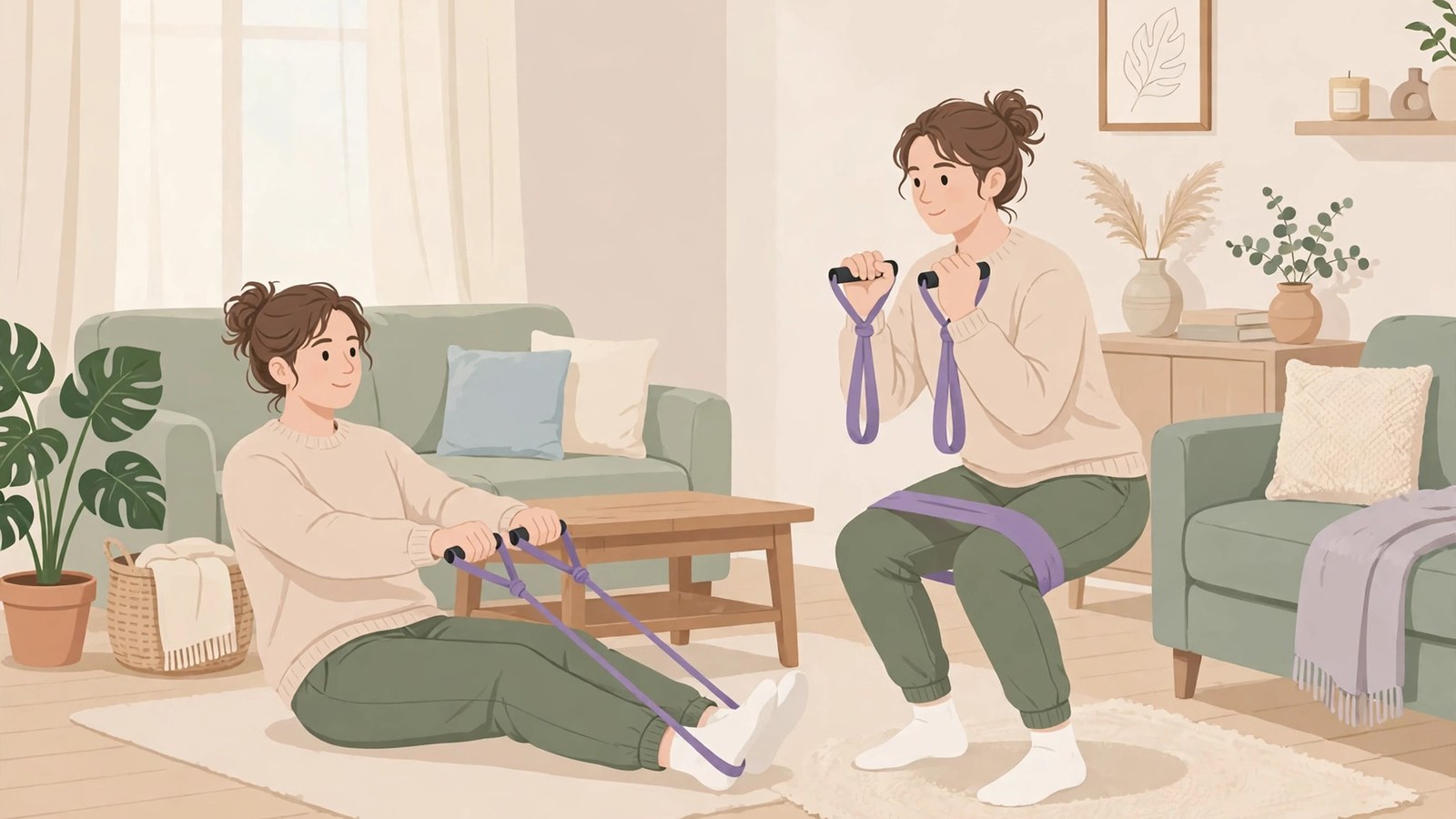
- Start with a light band, two or three bands at most, and a twice a week routine of eight basic movements: a band squat to a chair, a band row, a chest press, an overhead press, a lateral raise, a glute bridge with a loop band, standing hip abduction, and a band pull apart. Do 10 to 12 slow repetitions of each, rest 30 to 60 seconds between exercises, and begin with one set before building to two sets over three to four weeks. Choose a band that lets you finish the repetitions with good form while the last two or three feel challenging. That fits the general adult guidance summarized by the CDC: muscle strengthening activity on at least 2 days a week, working the major muscle groups, alongside at least 150 minutes a week of moderate intensity aerobic activity. Inspect every band before use, anchor it securely, keep it away from your face, control the return, and stop for sharp pain.
Introduction
Beginner strength training with resistance bands is a practical way to start getting stronger at home without heavy weights, crowded gyms, or complicated machines. Bands are light, store in a drawer, travel well, and can be used for pressing, pulling, squatting, and hip work in a living room. For a beginner, their main value is not that they are easy. Used well, they are challenging. Their value is that the challenge can be started low, adjusted in small steps, and learned one movement at a time.
This article provides general information only. It is not medical advice, and it does not diagnose, treat, or prevent any condition or injury. It does not promise a specific strength, weight, or health outcome. Talk to a qualified health professional before starting if you have a medical condition, a recent injury, joint problems, a disability, or any concern about exercise, and stop any exercise that causes sharp pain. Guideline statements were checked against Centers for Disease Control and Prevention (CDC), United States Department of Health and Human Services (HHS), National Health Service (NHS), and American College of Sports Medicine (ACSM) sources on 30 October 2026.
The guide below covers how band training fits general activity guidance, how to choose resistance bands, the safety checks that matter because a stretched band stores energy, eight resistance band exercises for beginners, and a simple resistance band workout plan built around two sessions a week. It also explains what progress actually looks like, because for most beginners it shows up first in everyday tasks, not in a mirror.
How Band Training Fits General Activity Guidance
The CDC, summarizing the Physical Activity Guidelines for Americans, states that adults need at least 150 minutes of moderate intensity activity, or 75 minutes of vigorous intensity activity, or an equivalent combination, each week, plus muscle strengthening on at least 2 days a week. HHS gives the moderate range more fully as 150 to 300 minutes. The CDC example of 30 minutes a day on 5 days a week shows the total does not have to happen at once.
Working with resistance bands is listed by the CDC as an example of muscle strengthening activity, alongside lifting weights and body weight exercise, and the NHS lists it too, defining a strength exercise as any activity that makes your muscles work harder than usual. A band routine is therefore not a lesser substitute. When the effort is real, it counts under both sources.
Both sources define enough effort, which helps a beginner choose a band. The CDC states that strengthening should be done to the point where another repetition is hard without help, that a repetition is one complete movement, and that 8 to 12 repetitions count as one set. It advises at least one set, and two or three for more benefits. The NHS uses the same range and point of difficulty, but advises at least 2 sets. The sources agree on effort and differ slightly on starting sets. A sensible beginner reading is to start with one set while form is new, then build to two, which is what the plan below does.
Coverage matters too. The CDC and NHS both list the major muscle groups as legs, hips, back, chest, abdomen, shoulders, and arms, and advise working all of them across the week. That list is the checklist used later in this article, including one honest gap for the abdomen.
ACSM adds a further reason to take bands seriously. Its 2026 position stand, an overview of 137 systematic reviews covering more than 30,000 participants, defines resistance training as contracting muscles against external resistance such as free weights, machines, resistance bands, water, or body weight, and reports that elastic band training improved strength, muscle size, and some components of physical function compared with no exercise. It also reports that equipment type and training to momentary fatigue did not consistently change outcomes. Two practical conclusions follow: the band is a legitimate tool, and you do not need to push every set until you cannot move. The same stand describes progressive resistance training, meaning the load rises gradually as ability improves.
Expectations should stay honest. The CDC states that some physical activity is better than none, and HHS states that any amount has some health benefits and that the first key guideline for adults is to move more and sit less. One short session this week is a start, not a failure.
Why Bands Suit Beginners, and Their Limits
A band provides resistance as it stretches, so resistance rises through the movement rather than staying constant as a dumbbell does. The later part of a press or row, where the band is most stretched, usually feels hardest, and the start feels lighter, which can make the first repetitions easier to set up with good form. The same long band anchored under your feet can serve a row, a press, and a raise, which is why band exercises at home need so little equipment.
Difficulty is adjustable without a rack of weights: use a lighter or heavier band, stand further from an anchor, shorten your grip to make a band harder to stretch, or step further onto a long band. Small steps suit a learner, because a jump that is too large usually shows up first as poor form.
Bands have limits. Resistance is not labeled in pounds, and it changes with how far the band is stretched, so you record the band, your grip or foot position, repetitions, and how it felt instead of an exact load. Resistance also falls to near zero at the start of some movements, so a band does not load every part of a movement evenly. And bands wear out and can snap, which is why the safety section is not optional. None of this prevents progress. It means a band log is descriptive rather than precise, and inspection is part of the routine.
The everyday case is the benefit beginners notice first. The NHS notes that muscle strengthening activities help maintain the ability to perform everyday tasks. In daily terms that means standing from a low chair, carrying groceries, lifting a case, and holding posture through a long day. This article does not promise those changes to an individual reader. It presents them as the function this training is meant to support, and a more useful way to judge a first month than appearance.
Choosing Your First Bands
You do not need a large collection. Two or three bands cover most beginner exercises, and buying more adds clutter, not strength.
Loop bands, often called mini bands, are short, flat loops that fit around the thighs, ankles, or wrists. They suit hip and leg work such as the bridge and hip abduction below. A light and a medium loop are a good starting pair. Long loop bands are larger loops anchored under your feet or around a sturdy post, for rows, presses, and pull aparts. A light long loop is the most versatile single band. Tube bands with handles, sometimes sold with a door anchor, feel closer to dumbbells for pressing and rowing. If you choose tubes, check that handles feel secure and clips close properly.
Resistance levels are labeled light, medium, and heavy, or shown by color, but colors are not standardized across brands, so how to choose resistance bands comes down to a feel test rather than a chart. A suitable band lets you complete 10 to 12 repetitions with good form while the last two or three feel challenging. If you cannot complete 8 with good form, the band is too strong for that exercise. If 12 feel easy, that exercise is ready for the next band, a shorter grip, or more repetitions. Apply the test exercise by exercise: legs usually manage a stronger band than shoulders.
Check material before you buy. Many bands are made from natural latex. If you have a latex allergy or sensitive skin, look for a latex free alternative or keep clothing between the band and your skin, and stop using a band that irritates your skin. Avoid any band with visible nicks, cracks, thinning, or sticky patches, because damage is where a snap starts. You will also want a sturdy chair, a mat or rug for floor work, and clear space to extend your arms fully. The NHS standard for chair based exercise is a good one: a solid, stable chair that does not have wheels and will not slip.
Safety Basics and Setting Up
Bands store energy when stretched, so a few precautions matter more with bands than with weights.
Inspect bands before every session for tears, nicks, cuts, and worn spots, especially near handles, clips, and anchors. Replace a damaged band. Do not repair it or use it one last time. Never stretch a band toward your face or eyes. Anchor securely. If you anchor to a door, use a proper door anchor, follow its placement instructions, and make sure the door is closed and, if possible, locked so nobody opens it mid repetition. Never anchor to an unstable object, a towel rail, a door handle alone, or furniture that could tip or slide.
Control the return. Resist the band as it draws you back rather than letting it snap you back. That controlled return is part of the work, and losing it is a sign the band is too strong. Keep joints soft, with a slight bend in knees and elbows rather than locking them hard. Breathe normally: exhale during the effort, inhale as you return. Holding your breath and straining is a sign to use a lighter band or rest.
Warm up for about five minutes with gentle movement: marching in place, arm circles, leg swings within a comfortable range, and shoulder rolls. Cool down with slow movement and gentle stretching that feels like a mild pull, never pain. Do not force a stretch, and do not stretch an injured joint.
Stop for sharp pain. Muscle effort, a burning feeling in the working muscle, and mild fatigue are expected. Sharp pain, especially in a joint, is a signal to stop that exercise, reduce the range, switch to a lighter band, or replace the movement, and to seek professional advice if pain persists or worries you. Before starting, follow the CDC advice on checking with a doctor: moderate effort activity is safe for most people, but people with a chronic condition such as heart disease, arthritis, or diabetes should talk with a doctor about the types and amounts right for them, and you should also talk to a doctor before vigorous activity if you have been inactive, have a disability, or have overweight.
The Eight Beginner Exercises
Perform each exercise slowly and with control, for 10 to 12 repetitions, resting 30 to 60 seconds between exercises, and one set of each in your first weeks. Focus on form before resistance: a lighter band done well builds more strength than a heavier band done badly.
1. Band squat to a chair
Stand with a loop band just above your knees, feet about hip width apart, a sturdy chair behind you. Sit your hips back toward the chair, chest lifted, knees tracking in line with your toes and pressing gently outward against the band, then press through your feet to stand. Touch the chair lightly rather than collapsing onto it. This works the legs and hips and rehearses sitting, standing, and climbing stairs. Make it easier by sitting fully, using arm support, or reducing the depth. Stop for knee or hip pain.
2. Band row, seated or standing
Sit tall on a sturdy chair or stand with a long band looped around your feet, one end in each hand, arms extended. Pull your elbows back, squeeze your shoulder blades together, then return slowly. Keep your back comfortable and your shoulders down, away from your ears. Shrugging upward is the most common fault here. This strengthens the back and the backs of the shoulders and arms, and it is the main pulling exercise in the routine. If the band slips, wear shoes that grip it or anchor it securely at low height.
3. Chest press with a band
Stand with a long band behind your upper back, ends at chest height, elbows bent, or anchor the band around a sturdy post at chest height. Press forward until your arms are extended but not locked, then return slowly, wrists in line with your forearms. This works the chest, front shoulders, and arms. The anchored version is steadier if the band slips. Reduce the range if the front of your shoulder feels pinched, and skip the movement if that persists.
4. Overhead press, seated
Sit tall in a sturdy chair, a long band under your feet, ends at shoulder height. Press upward until your arms are extended overhead without locking the elbows, then lower slowly. Avoid arching your lower back to finish, which usually means the band is too strong. This works the shoulders and arms. Overhead pressing does not suit every shoulder. If it bothers yours, press only to forehead height, or skip it and do the lateral raise instead. That substitution is a normal adjustment, not a failure.
5. Lateral raise
Stand on a long band, feet about hip width apart, ends at your sides. Raise your arms slowly out to the side, to shoulder height at most, then lower with control, elbows slightly bent. This targets the shoulders, which fatigue quickly, so use your lightest band and expect fewer clean repetitions at first. Form matters more here than resistance. Stop below shoulder height if a higher raise feels uncomfortable.
6. Glute bridge with a loop band
Lie on your back, knees bent, feet flat, a loop band just above your knees. Press your knees gently outward, lift your hips until your body forms a straight line from shoulders to knees, hold for about two seconds, and lower slowly without arching your lower back. This strengthens the hips and the back of the legs. The abdomen and back work in a supporting role, holding your trunk steady. Get up slowly: roll to one side, sit, then stand with support nearby.
7. Standing hip abduction with a loop band
Stand behind a sturdy chair, holding it for balance, a loop band around your ankles. Torso tall, hips facing forward, move one leg slowly out to the side a few inches, hold briefly, and lower. Count repetitions per side. Avoid leaning away from the moving leg, which turns the exercise into a sway. This targets the outer hip muscles that help stabilize you when walking. Reduce the distance if you cannot keep your hips level.
8. Band pull apart
Hold a light long band in front of you at chest height, arms extended, hands about shoulder width apart. Pull your hands apart, squeezing your shoulder blades together, until the band approaches your chest, then return slowly, elbows soft and shoulders down. This works the back and rear shoulders and makes a good finisher after desk work. Use a lighter band than feels necessary on the first repetition. The last repetitions are the test, and a band that is too strong turns this into a shrug.
How the Eight Exercises Cover the Major Muscle Groups
Against the CDC and NHS list, coverage is broad: squats and abduction for the legs; squats, bridges, and abduction for the hips; rows and pull aparts for the back; chest press for the chest; overhead press and lateral raise for the shoulders; rows, presses, and pull aparts for the arms. The gap is the abdomen. No exercise here is a dedicated abdominal movement. It works in a supporting role in the bridge and in holding your trunk steady, but that is not a main movement. A beginner who wants dedicated abdominal work should ask a qualified exercise professional which movements suit them, especially with a back condition.
Balance needs the same note for older readers. CDC guidance for adults 65 and older adds balance activities. Hip abduction with chair support gives a small, controlled balance challenge, but it does not replace dedicated balance practice, and a reader with a history of falls should discuss balance and fall risk with a health professional before training alone.
The Twice a Week Plan
Schedule band sessions on non consecutive days, for example Tuesday and Friday, or Monday and Thursday, so muscles rest between sessions. That rhythm is the core of this resistance band workout plan, and it matches the guideline floor of at least 2 strengthening days a week.
In weeks 1 and 2, learn the movements: one set of each exercise, twice a week, with a light band, focusing on slow movement, a comfortable range, and the safety checks. Expect mild soreness a day or two after the first sessions. In weeks 3 and 4, add a second set, resting 60 to 90 seconds between sets. That meets the NHS suggestion of at least 2 sets, with the CDC starting point of one set as the on ramp. If a second set is too much for one exercise, keep that one at a single set for another week. Exercises need not progress together.
In weeks 5 to 8, progress gradually. When two sets of 12 with good form no longer feel challenging at the end, progress that one exercise: move to the next band, shorten your grip, or add two repetitions. Progress one exercise at a time.
A sample session takes about 30 minutes. Allow five minutes to warm up, then do the squat to a chair for 2 sets of 10, the row for 2 sets of 12, the chest press for 2 sets of 10, the glute bridge for 2 sets of 12, the overhead press or lateral raise for 2 sets of 10, hip abduction for 2 sets of 10 per side, and the pull apart for 2 sets of 12. In the first two weeks use one set and expect a shorter session. Finish with about five minutes of slow movement and gentle stretching. On other days, aim for aerobic activity you enjoy. Strength and aerobic activity complement each other, and, as the NHS states directly, strength time does not count toward the 150 minute aerobic target.
How to Know You Are Progressing
Progress in the first weeks is rarely visible, so judge it by performance and daily life. The same band feels easier: repetitions that felt hard at number eight feel manageable at number twelve. Everyday tasks feel lighter. Your form improves: you control the return and keep your shoulders down without thinking about each cue. Recovery is quicker: soreness fades within a day or so instead of lingering.
Keep a simple log: date, exercises, band and grip or foot position, sets, repetitions, and a short note on how it felt. Because band resistance is not a fixed number, those details are your record of load, and they stop you progressing by guesswork.
Plateaus are normal. If progress stalls for a few weeks, check the basics first: Are you training twice a week? Resting a day between sessions? Sleeping and eating regularly? Progressing one variable at a time? Small adjustments usually restart progress. Dramatic overhauls and extra daily sessions rarely do, and they are a common way to turn a sustainable routine into a short one.
Common Beginner Mistakes
Going too heavy too soon. A strong band with poor form builds bad habits and raises the chance of a strain or a snap back. Start light and earn the heavier band by finishing 12 clean repetitions.
Rushing repetitions. Fast, bouncy repetitions use momentum instead of muscle. A useful pace is about two seconds to pull or press and two to three seconds to return. If you cannot control the return, the band is too heavy.
Skipping the pulling exercises. Beginners often favor pressing and neglect rows and pull aparts. Balanced training, pulling as well as pushing, supports comfortable posture and keeps the back covered in the muscle group checklist.
Training the same muscles every day. Muscles need rest between strengthening sessions. Daily training of the same exercises leads to fatigue, not faster gains. Alternate strength days with walking, stretching, or aerobic activity.
Ignoring pain signals. Mild muscle burn and mild soreness are common. Sharp pain, joint pain, numbness, swelling, or pain that worsens over days is not something to train through. Stop, rest, and seek professional advice if it persists.
Forgetting to replace worn bands. This is a safety mistake, not a training one. Inspect bands before each session and replace any with nicks, cracks, or thinning.
Storing and Caring for Bands
Keep bands away from sunlight, heat, and sharp objects, which degrade the material. Store them loosely coiled, not stretched around a hook, because a band stored under tension ages faster and is a hazard to whoever unhooks it. Wipe them with a damp cloth if sweaty and let them dry before storing. Label them light, medium, or strong if the colors confuse you, and keep the lightest easiest to reach: it is the one you will use for a new exercise or a return after a break. Sound, ready equipment lowers the barrier to the next session.
Frequently Asked Questions
Are resistance bands enough for strength training for beginners?
Yes, for a beginner they can be. Bands are listed by both the CDC and the NHS as muscle strengthening activity, and the ACSM 2026 position stand reports that elastic band training improved strength and muscle size compared with no exercise, with equipment type not consistently changing outcomes. What matters is effort and progression: the last repetitions must feel challenging, and that challenge must rise gradually. A band that stays easy will stop producing progress.
How many days a week should I do a band workout?
Start with 2 days a week on non consecutive days. That meets the CDC and NHS floor and leaves recovery time. Add a third day only after two days feel comfortable and your form is reliable, and not in the same week that you add sets or a stronger band.
How do I know which band to start with?
Use the feel test. Pick the lightest band that lets you complete 10 to 12 repetitions with good form while the last two or three feel challenging. If you cannot reach 8 clean repetitions, it is too strong for that exercise. If 12 feel easy, move up. Judge each exercise separately, and ignore color, which is not standardized between brands.
Do band workouts count toward my 150 minutes of aerobic activity?
No. Strength and aerobic time are separate. The CDC gives at least 150 minutes a week of moderate intensity aerobic activity plus strengthening on at least 2 days, and the NHS states directly that strength time does not count toward moderate aerobic activity. A brisk walk where you breathe harder and can talk but not sing is the CDC description of moderate intensity, and it is the natural partner to two band sessions.
Is it normal to feel sore after a band session?
Mild soreness a day or two after a new activity is common. Rest and an easier next session are the usual response, but this article cannot judge your symptoms. Severe pain, swelling, joint pain, numbness, soreness that worsens, or any worrying symptom should be checked by a health professional before you exercise again.
What should I do if an exercise hurts my shoulder or knee?
Stop that exercise. On a later day, try a lighter band, a smaller range, or the alternative in the exercise description, such as a lateral raise instead of an overhead press. If pain returns, is sharp, or persists between sessions, do not keep testing it. Ask a physician, physical therapist, or qualified exercise professional for an assessment and alternatives. This guide does not offer treatment for an injury or a joint condition.
Keep reading: A Stretching Routine for Desk Workers: Loosen Your Neck, Shoulders, Hips, and Hands
Keep reading: A Low-Impact, Joint-Friendly Workout Plan: Move More Without Pounding Your Joints
Keep reading: Beginner 20-Minute Bodyweight Workout at Home: A Gentle Starting Point
Keep reading: Walking Plan for Beginners: Building to 30 Minutes Daily, One Step at a Time
Sources & references
- Centers for Disease Control and Prevention, What Counts as Physical Activity for Adults. Used for adults aiming for 150 minutes of moderate intensity activity, or 75 minutes of vigorous intensity activity, or an equivalent combination each week, spread out and breakable into smaller chunks, the talk test descriptions of moderate intensity (can talk but not sing) and vigorous intensity (cannot say more than a few words without pausing for breath), the rule of thumb that 1 minute of vigorous activity is about the same as 2 minutes of moderate activity, intensity depending on fitness, comfort, and health condition, muscle strengthening on at least 2 days a week, doing strengthening activities to the point where another repetition is hard without help, 8 to 12 repetitions counting as one set with at least one set and two or three sets for more benefits, the major muscle groups list (legs, hips, back, chest, abdomen, shoulders, and arms), and working with resistance bands listed as an example of muscle strengthening activity.
- Centers for Disease Control and Prevention, What You Can Do to Meet Physical Activity Recommendations. Used for the age group summary from the Physical Activity Guidelines for Americans, second edition: adults ages 18 to 64 at least 150 minutes a week of moderate intensity activity and at least 2 days a week of muscle strengthening activity, older adults with the same figures plus activities to improve balance, adults with chronic conditions and disabilities at least 150 minutes of moderate intensity aerobic activity and at least 2 days of muscle strengthening including all major muscle groups, pregnant and postpartum women at least 150 minutes of moderate intensity aerobic activity, some activity being better than none, and being as active as you can if you cannot meet the recommendations.
- Centers for Disease Control and Prevention, Adding Physical Activity as an Adult. Used for adults needing 150 minutes of moderate intensity physical activity and 2 days of muscle strengthening activity each week, the example of 30 minutes a day on 5 days a week, some physical activity being better than none, choosing activities you enjoy and that match your abilities, and when to check with your doctor: talking with a doctor about types and amounts if you have a chronic condition such as heart disease, arthritis, or diabetes, and talking to a doctor before vigorous intensity activity if you have been inactive, have a disability, or have overweight.
- United States Department of Health and Human Services, Office of Disease Prevention and Health Promotion, Top 10 Things to Know About the Second Edition of the Physical Activity Guidelines for Americans. Used for the adult range of 150 to 300 minutes of moderate intensity aerobic activity each week plus muscle strengthening activity at least 2 days each week, the first key guideline to move more and sit less, any amount of physical activity having some health benefits, and the removal of the former requirement that only bouts of at least 10 minutes counted.
- National Health Service, How to Improve Your Strength and Flexibility. Used for a strength exercise being any activity that makes muscles work harder than usual, using body weight or working against a resistance, muscle strengthening on at least 2 days a week with working with resistance bands listed as an example, exercises performed to the point at which it would be difficult to do another repetition without help, 8 to 12 repetitions for each activity counting as 1 set with at least 2 sets and 3 sets for even more benefits, the major muscle groups list, muscle strengthening activities helping to maintain the ability to perform everyday tasks, starting gradually and building up over a period of weeks, at least 150 minutes of moderate intensity aerobic activity a week, and time spent doing strength exercises not counting toward moderate aerobic activities.
- National Health Service, Strength Exercises. Used for home strength exercises being gentle and easy to follow, building up slowly and gradually increasing repetitions over time, trying to do the exercises at least twice a week, and for chair based exercises choosing a solid, stable chair that does not have wheels and will not slip, sitting with feet flat on the floor and knees bent at right angles, and wearing loose, comfortable clothing with water handy.
- American College of Sports Medicine, Position Stand: Resistance Training Prescription for Muscle Function, Hypertrophy, and Physical Performance in Healthy Adults, an overview of reviews published in Medicine and Science in Sports and Exercise in 2026. Used for resistance training defined as muscles contracting against external resistance such as free weights, machines, resistance bands, water, or body weight, the synthesis of 137 systematic reviews covering more than 30,000 participants, elastic band resistance training improving strength, hypertrophy, and multicomponent physical function compared with no exercise, training to momentary fatigue and equipment type not consistently affecting outcomes, and healthy adults performing progressive resistance training. Heavy load prescriptions from this source were deliberately not used, because they are not a beginner band prescription.


